
Circle of Transmission: The Living Loom
A Little Bernard Gorceix Sampler – Part 6: ‘The ‘Fama Fraternitatis’ and the ‘Confessio Fraternitatis’, an introduction & commentary‘.

Professor Bernard Gorceix.
Picture by Vincent B. Gorceix,
via Wikimedia Commons.
*
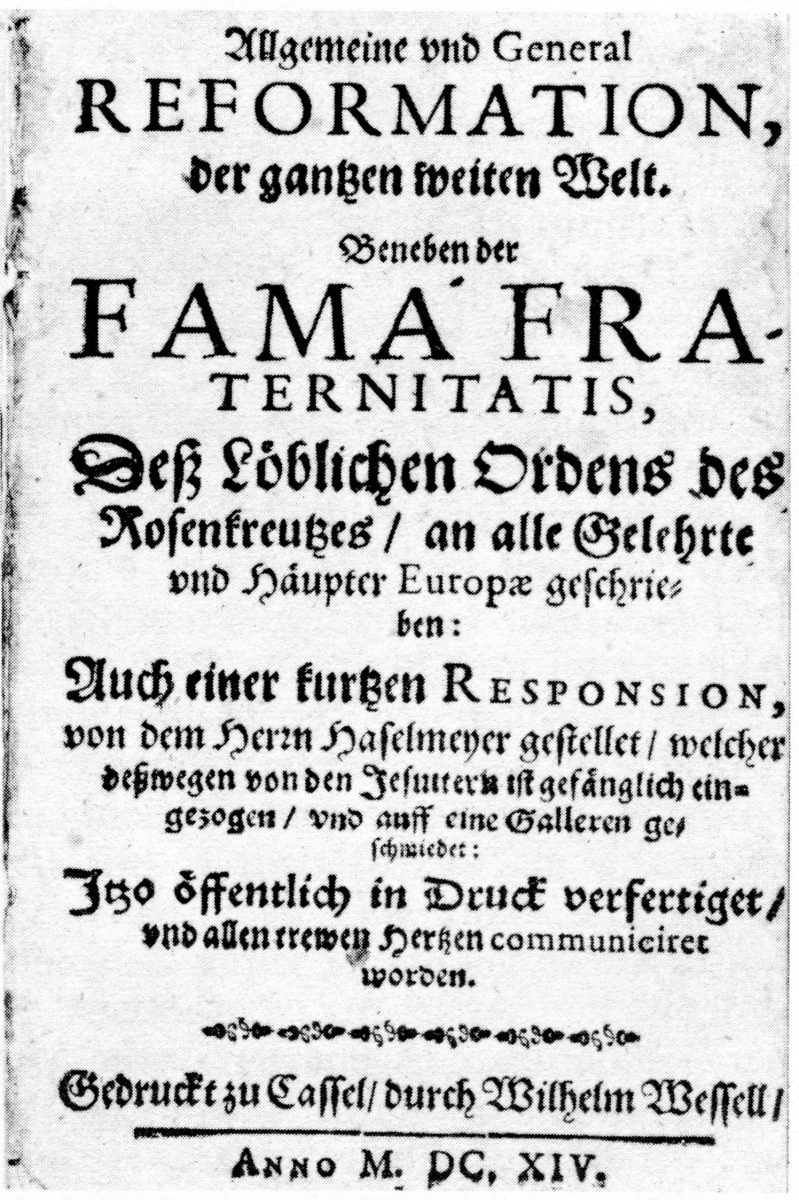
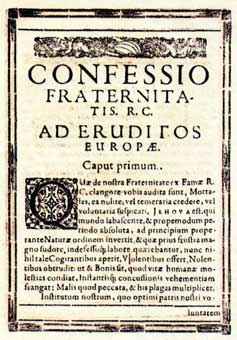
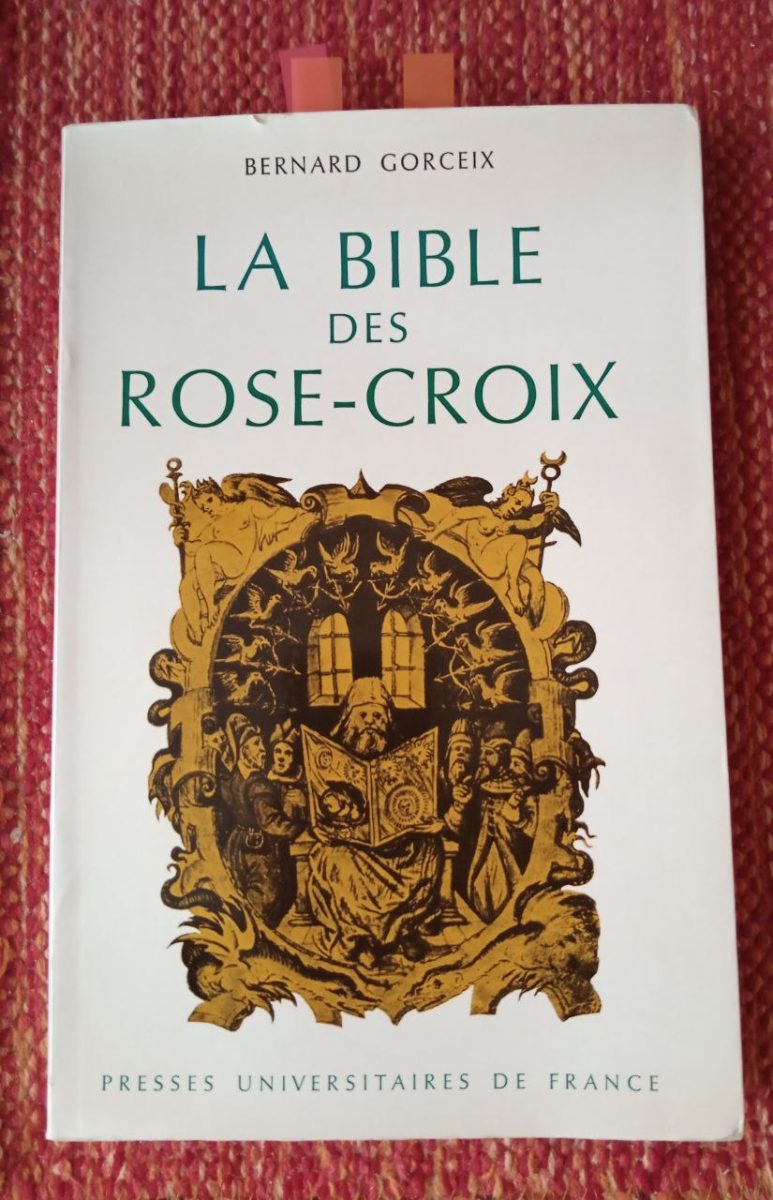
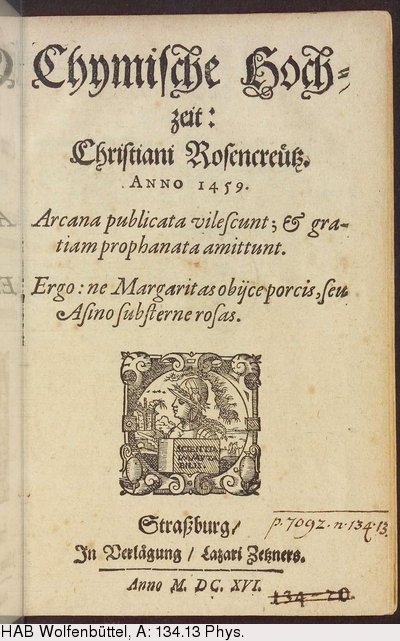
Today’s offering from the Blue House of Via-HYGEIA is Part 6 of our sampler dedicated to the memory of Professor Bernard Gorceix. It is excerpted from ‘La Bible des Rose-Croix‘, published by Presses Universitaires de France in 1970 — his French edition, translation, and commentary of the three foundational Rosicrucian texts: the ‘Fama Fraternitatis‘ (1614), the ‘Confessio Fraternitatis‘ (1615), and the ‘Chymische Hochzeit Christiani Rosencreutz‘ (1616). The excerpt focuses upon the ‘Fama’ & the ‘Confessio‘. Sampler part 7 will focus on the ‘Chymische Hochzeit‘, with its own substantial introduction and commentary.
**
A Contextual Introduction
By Professor Antoine Faivre
‘We are presented with a truly remarkable work by Bernard Gorceix. A Germanist and specialist in the mysticism and esotericism of the 16th and 17th centuries — and translator of Paracelsus’s medical writings — Gorceix successfully defended (January 1971, Sorbonne) his State doctoral thesis on Valentin Weigel, which we may hope will soon be published.
‘La Bible des Rose-Croix’ (1970) contains, as indicated by the subtitle, a translation and commentary on the ‘Fama’ (1614), the ‘Confessio’ (1615), and the ‘Chymical Wedding of Christian Rosenkreutz’ (1616), all preceded by a 53-page Introduction.
Written in a style whose elegance and concision compel admiration, this Introduction also likely represents the most comprehensive study ever written on the connections between the three manifestos and the spiritual, intellectual, and artistic (Mannerist, Baroque) milieu of Germany at the time. Gorceix does not fully share P. Arnold’s view on authorship; he leans toward attributing all three texts to Johann Valentin Andreae, and does not credit Besold as their author. Yet his conclusions broadly align with Arnold’s: ‘Andreae‘, writes Gorceix, ‘certainly invents a fable — that of Christian Rosenkreutz — but in doing so, he aims to synthesize pre-Baroque occultism. What he seeks is to bring together the themes provided to him by the spirituality of his time‘ (p. lvii).
One might regret that Gorceix occasionally uses the term ‘occultism’ — a term coined only a century ago and somewhat anachronistic for the period — rather than ‘theosophy‘ or ‘esotericism‘. Yet, as he notes in one of the Introduction’s many felicitous phrases, Andreae ‘is, to our knowledge, the first German author to deliver to German literature — in this case, Baroque literature — the inexhaustible treasure of alchemical images‘ (p. lx). Regarding philosophy, it is ‘particularly remarkable that it emerges, with Jacob Boehme and René Descartes, precisely at the moment when pre-Baroque alchemy celebrates a veritable renewal‘, shortly after the Paracelsian Gerhard Dorn clearly recognized the value of alchemy ‘for the elaboration of what he already called a speculative philosophy‘ (p. lxiii). One would wish to quote this fine Introduction in its entirety.
We only regret the absence of an index of names at the end of the book. The translation reconciles elegance and accuracy, respecting the sinuosities of pre-Baroque language as well as the art of litotes, without getting lost in the meanderings of complex punctuation and Latin-German bilingualism. The numerous footnotes offer not only historical clarifications and exegetical developments but also linguistic interpretations whenever several hypotheses seem possible’.
Source: Faivre, Antoine. “Rose-Croix et Rose-Croix d’Or en Allemagne de 1600 à 1786.” In Revue de l’histoire des religions, vol. 181, no. 1, 1972, pp. 57–69.
Bernard Gorceix
From the introduction of ‘The Rosicrucian Bible’
II. — On the ‘Fama Fraternitatis’ & the ‘Confessio Fraternitatis’
Among the three treatises that compose the ‘Rosicrucian Bible‘ — the ‘Fama Fraternitatis’, the ‘Confessio Fraternitatis’, and the ‘Chymische Hochzeit’ — the author employs two distinct genres. In this respect, the ‘Fama’ and the ‘Chymische Hochzeit’ stand in contrast to the ‘Confessio’. The former two belong to the traditional genre of the fable; the ‘Confessio’, by contrast, is a manifesto.
The ‘Fama’ recounts the entire life of the fictional hero, Christian Rosenkreutz, followed by the discovery of his tomb. The ‘Chymische Hochzeit’ evokes a single episode: participation in the alchemical wedding. In the Confessio, however, it is the members of the fraternity who speak, outlining their program in fourteen brief chapters.
Yet the opposition is not as sharp as it first appears. Throughout the description of Christian’s life, the ‘Fama’ frequently interrupts the narrative with theoretical exposition — growing increasingly substantial as the work progresses. From this angle, the ‘Confessio’ directly extends the ‘Fama’. In contrast, all didacticism is absent from the ‘Chymische Hochzeit’; or rather, it merges seamlessly with the fiction, blending into the play of allegories and symbols that unfold during Christian Rosenkreutz’s stay in the castle and then in the Tower of Olympus. Thus, regarding genre, it is appropriate to link the ‘Fama’ with the ‘Chymische Hochzeit’, opposing them to the ‘Confessio’; but regarding narrative invention, the ‘Fama Fraternitatis’ and the ‘Confessio Fraternitatis’ are clearly distinguished from the ‘Chymische Hochzeit’, unquestionably the most accomplished work.
I. Abstract Themes in the ‘Fama Fraternitatis’
If we attempt to inventory the abstract themes addressed in the ‘Fama Fraternitatis’ — throughout the description of Christian Rosenkreutz’s life (his studious childhood, journey to the Orient, stays in Arabia, Egypt, Fez, Spain, return to Germany, and the discovery of his tomb) — we can distinguish three groups.
1. The State of the World
This is twofold: on one hand, humanity is experiencing permanent progress — marked by the exploration of unknown regions, scientific discoveries, and the increasing number of scholars. Contemporaries are right to be proud of their time. On the other hand, the situation is catastrophic — not due to the proliferation of the wicked or the devil’s intervention, but because of the flare-up of fanaticisms, the abusive respect for authority, the lack of understanding among scholars, their refusal to communicate discoveries or collaborate, and the decomposition of the Catholic Church.
This state invites two reflections:
-
The urgency of a universal reformation — which the author also calls a general, divine, and human reformation. This urgency had been invoked for years by great minds, notably Theophrastus von Hohenheim, called Paracelsus.
-
The certain approach of the end of times — the world is gravid with a great upheaval, it feels the pains of childbirth, the edifice is dilapidated, but a door is about to open, and restoration is approaching. The expectation is both hopeful — ‘is Europe not about to give birth to a sturdy offspring?‘ — and anxious, since the ‘triangle of fire, whose flame’s brilliance ceaselessly increases, and which will undoubtedly kindle the final conflagration that will set the world ablaze‘ appears. The imminent revolution is betrayed by a number of signs that must be interpreted.
2. The New Society — The Brotherhood of the Rosy Cross
Founded by Christian Rosenkreutz upon his return from the Orient and originally composed of only four members, the Brotherhood has traditional traits of a secret society:
-
Members are subject to the absolute authority of a leader — successor to the legendary founder, who reached the considerable age of 106, and whose imperishable body rests under a sacred dome.
-
They live in clandestinity, scattered across the world; their true names remain unknown — the author designates them only by their initials.
-
They do not draw attention through any particular uniform — they adapt, like the Jesuits, to the customs of the country and the century.
-
Their burials remain secret — it falls to the disciples to discover them.
-
Recruitment is limited: each brother designates his successor.
-
They have their own meeting place — unknown to the rest of mortals — which the author calls the ‘dwelling of the Holy Spirit’. It consists of the former, renovated dwelling that Christian Rosenkreutz built for himself upon his return to Germany. The main room is a large vaulted hall, accessed by a hidden door, whose walls are covered with inscriptions, and whose center is occupied by a circular altar, beneath which lies the tomb of Christian Rosenkreutz.
-
They have their original seal — composed of the letters R. and C.
-
They have their own language — which Andreae calls ‘the magical script and vocabulary‘.
-
A special catalog provides them with the names of the works they must read.
-
Above all, they possess a limited number of genuine sacred texts — designated only by the initials of the title — gathered in a philosophical library. Featured prominently are the works attributed to Paracelsus, particularly his Vocabulaire, his Itinerarium, his Vita.
-
Finally, the society has its history: it remains secret for the one hundred and twenty years following the death of its founder. At that date — translated, in 1604 — the sepulcher is opened, and the existence of the brotherhood is revealed to the world.
3. The Objectives of the Brotherhood
The author first wishes to reassure us: the Rosicrucians do not aspire to overthrow the political, social, or religious order; the brotherhood professes, without ulterior motive, the Lutheran religion. It recognizes the laws and order imposed by the Roman Empire — meaning the Holy Roman Empire — which Andreae also calls: the Fourth Monarchy. Consequently, its two principal enemies remain: the enthusiasts and heretics, whom orthodoxy persecutes, and the gold-makers, whom civil authority punishes.
The exposition of their program is subdivided into two parts:
-
Politico-social objectives — on which the author is very discreet. The most important seems to be the establishment of a veritable monetary fund — initially supplied by the treasure amassed by the founder in the Orient — which would advance money to princes and would harbor more gold than both Spains. Next comes the pedagogical task — primarily the education of princes. The whole is imbued with a certain chauvinism: the brotherhood must ‘necessarily and gloriously serve… the common fatherland, the German nation‘.
-
Intellectual objectives — which by far compose the essence of the universal, divine, and human reformation.
Thus, the difference with the future aspirations of Freemasonry is clearly affirmed here. Ultimately, the brotherhood nurtures only one grand project: that of establishing a ‘philosophy‘. The latter is new, but only in its form — for it ‘is nothing new; it conforms to that which Adam possessed after the fall, and which Moses and Solomon practiced‘. It can be summarized in one proposition: an ordered, harmonic synthesis of all sciences and all beliefs — what was called, in Andreae’s time, pansophy; it is a matter of realizing the unity of knowledge, reconciling the totality of learning with the totality of faith. What strikes the observer of the century is the dispersion of culture, the diaspora of lights — the light of nature and the light of grace, as they said then; one must reverse course to restore the lost unity.
This primordial requirement is expressed in the beautiful language of the era, permeated with allegories and metaphors. One term stands out: that of axiomata, which forms the title of one of the principal works of the Rosicrucian library. One must draw from the entirety of faculties, sciences, arts, from the whole of nature, ‘a precise and infallible axiomatic‘, meaning a defined number of indisputable propositions that can serve as the basis for a system and ‘absolutely resolve all problems‘. The author sketches this system using the image of the circle and the sphere: it must, he says, ‘orient itself, like a sphere, according to its unique center‘; it must ‘correspond, describe a sphere, a globe, all parts of which are at an equal distance from the center‘. All members of the system must be in agreement, because ‘what is certain is always in harmony with itself,” because “truth is unique, succinct, always identical to itself’.
Thus, initially, the new philosophy realizes the synthesis of traditional philosophy and theology, of ancient science and testamentary revolution, of Arab science and that of the Christian West, reconciling Plato, Aristotle, and Pythagoras, Moses, Solomon, and Abraham, and Jesus, who is himself the cornerstone of the new knowledge. It establishes the agreement of the two principal lights: physics and mathematics on the one hand, and the light of the Gospel on the other. The altar covering the tomb of Christian Rosenkreutz contains inscriptions pertaining to these two knowledges: ‘In my lifetime, I made this summary of the universe my tomb‘, ‘…The void does not exist‘, on one side; on the other: ‘Jesus is my all’, ‘…The yoke of the law,… The liberty of the Gospel,… Intact is the glory of God’.
Secondly, it implies knowledge of the Rotae mundi, the wheels of the world — meaning the ‘cycles‘, the different cyclical periods of world history.
Finally, it brings together the science of the microcosm and that of the macrocosm. Indeed, man, the human, is in musical, harmonic accord with Heaven, with Earth, with God: ‘Just as every seed contains the entire tree or fruit, and well-come, the microcosm contains the entire world‘. Man and the world are not of a different essence; quite the contrary: they correspond in their parts and in their modes of existence. Man, God’s last creation during the genesis epic, is the summary of the other creatures. Thus, the domed hall in the shape of a heptagon where the founder’s sepulcher lies, illuminated by an artificial sun, represents the world in its different parts, symbolizing its harmony through its external form and through the geometric figures reproduced on the ceiling, walls, and floor — circles, squares, and triangles. Similarly, the human architect Christian Rosenkreutz wished to imitate the divine architect by fabricating a ‘little world… which, in all its movements, corresponds to the great world’.
This demand for totality, unity, harmony — expressed in the accord of science and faith, in the knowledge of world history, in the correspondence of macrocosm and microcosm — is also expressed in the very titles of the books composing the philosophical library: the first members of the brotherhood must ‘compose a complete exposition of revealed and secret philosophy‘, their successors ‘a volume in which all the wishes, desires, and hopes that man is ever likely to harbor should be recorded‘.
In the book T. (Thesaurus? Testamentum? Totum?), which is, after the Bible, the most precious book of the Rosicrucians, and which is held by the mortal remains of the founder, we read that the latter ‘completed the summary of all things past, present, and future’. One work bears the title: Summary (Concentratum), another: Christian Collection, a third, Book M. (doubtless Book of the World; the founder brought it from the Orient, and it was originally written in Arabic), a fourth, the stranger title of Proteus — a likely allusion to the sea god Proteus, who predicted the future and changed form at will: the totality of human knowledge was to be recorded there, in its multiplicity and its changing diversity. The work called Rotae mundi, the cycles of the world, which is, according to Andreae, the most learned, confirms the importance of the circle theme, which we have already noted in the general definition of the system and in the form of the dwelling of the Holy Spirit.
Three particular sciences play a predominant role in elaborating the new philosophy:
-
Metallic transmutation — i.e., alchemy — which is certainly not the sole aim of the brotherhood but is assiduously practiced by its Grand Master.
-
The Kabbalah — which was celebrating its revival in Germany since Reuchlin, and which inspired Jakob Böhme.
-
Medicine — which is the first instruction received by the disciples, who are indeed forbidden ‘to exercise any profession other than the healing of the sick, on a voluntary basis‘.
The source from which Christian Rosenkreutz draws this knowledge is the legendary Orient — Arabia and Fez — where he makes contact with the origins of European science, whose representatives are precisely ‘the elementary inhabitants‘.
*
II. The ‘Confessio Fraternitatis’ — A Complement to the ‘Fama’
The three groups of motifs we have enumerated concerning the ‘Fama Fraternitatis’ are also found in the ‘Confessio’: the description of the state of the world; that of the brotherhood; the urgency of political and, especially, intellectual reform. The ‘Confessio’ — the author says so from the first paragraphs — only wants to complement the exposition of the ‘Fama’, ‘to formulate in better terms the passages that are somewhat too unfathomable and obscure‘, or again ‘to fill the gaps’.
If we can consider the ‘Confessio’ as a complement to the ‘Fama’, we must not deny the difference in emphasis. Certainly, the themes composing the first group reappear, barely modified, in the new text: the felicity of a century witnessing divine intervention is opposed to an almost total obscuration, caused by the infiltration of servility, falsehood, lies, and darkness into all arts, all works, all human empires. There is no doubt that the end of the world is approaching. Witness the multiplicity of new stars that have appeared in the heavens, which are so many ‘signs of God’s great design‘. A period, a cycle, of world history is ending, and Jehovah, according to the ‘Confessio’, ‘reverses the course of nature‘.
However, the anxiety that pierced through the ‘Fama’ at the expectation of the Last Judgment gives way, in the ‘Confessio’, to a veritable hymn of hope. The world, in fact, is hastening not so much towards its end, towards the torments of the Apocalypse, as towards what the author, from the second paragraph, calls: ‘the state of its rest… a new morning‘.
It is not so much the new deluge, the conflagration announced by the triangle of fire from the ‘Fama’, as the renovation of the century. Evil, and the ancient philosophy, live their last moments, for the triumph of good and the new philosophy. The old edifice collapses, and behold, a new fortress of truth is being erected. Men have lived until now as blind men, and behold, the wonders of the ‘sixth time‘ are revealed. And the sixth time is a time of light, the light projected by the sixth candlestick. Time of glory, where the clear, strong, and high tone of the trumpet resounds. Time of the lion, the lion that appears twice during the exposition and invites political interpretation: its voice and its roar will cover the death knell of the ass’s blessings, while chasing away the few feathers of the eagle that might constitute an obstacle. God has decided to grant the world one last time a happiness similar to that which Adam squandered in Paradise. The breath of messianism is undeniable. It finds its most remarkable expression in the following sentence: ‘Now that time grows short…, when the world, having slept off the drunkenness drunk from the chalice of poison and somnolence, will go forth to meet the new rising sun, with gaping heart, uncovered head, bare feet, in jubilation and joy‘.
The emphasis that fills the eschatological proclamations of the ‘Confessio’ finds a counterpart and an explanation in the second group of motifs, concerning the brotherhood proper. In this part as well, the tone is very different from the ‘Fama’. The latter first described the birth, organization, and statutes of the secret society. What must now be celebrated is the grandeur of the finally revealed brotherhood: for, if the world is approaching supreme felicity, the disclosure of the secrets of which the beloved Father Christian Rosenkreutz was the depositary is its driving force. Indeed, the knowledge of the founder of the order “surpasses everything that, from the first days of the world, the intelligence of man has invented, imagined, produced, amended, propagated, and perpetuated.”
With a dexterity and brilliance that reveal a profound knowledge of his public’s passions, the esoteric author plays on the paradox of secrecy and revelation, of appeal and threat, divulging to conceal, causing anxiety to liberate. The artifice operates not without a vulgarization of themes. The fourth chapter, a grandiloquent panegyric, is an example: knowledge of the Rosicrucian mysteries leads to the satiation of all humanity’s desires: hunger, illness, old age are finally banished; man knows the history of the world from its creation to its end; he is the new Orpheus whose song attracts precious stones and pearls and mobilizes princes. The society assures its members the possession of ‘all goods at once‘. The simple reading of a book reveals to him all the science of the whole universe and of all time, while he savors the delights of ubiquity.
At the same time, the ambiguities the author is keen to raise, the fears he likes to arouse, further stoke the fire of hopes: the Rosicrucians publish their secrets without hesitation and offer their treasures to all winds, without the slightest distinction. But they know that vulgar natures will never be their heirs, that the unworthy will never understand their revelations and illuminations: ‘Unless one possesses the eyes of the eagle, no one can see us nor recognize us‘. Likewise: the brotherhood calls all men, it wants all to partake of the great treasures it graciously offers, and it makes no distinction of origin or knowledge. But it issues the worst threats against the proud, the greedy: their impious machinations will turn against their authors, the chatterers will perish in deserts. Indeed, the brotherhood has the strongest of shields: God. Between Him and the Rosicrucians persists the most direct link. He made the revelation of the arcana possible. The coming reformation is entrusted to the brotherhood, and it is He who is the inspirer of the present design. Nothing other than His all-powerful decree explains the increase in the members of the brotherhood. The testamentary image summarizes Rosicrucian predestination: the cloud of God has taken the brotherhood under its shadow. The last sentence of the ‘Fama’ said in Latin: sub umbra alarum tuarum, Iehova.
The vulgarization and hymnal style noticeable in the exposition of the first two groups of motifs also spill over onto the third and important group dealing with the content of the envisaged reform. We will therefore not be surprised if the first point of the program, political and social reform, takes on greater importance in the ‘Confessio’ than in the ‘Fama’, and if the political character of the program is more clearly affirmed. Nevertheless, the traditional precautions are taken: the Rosicrucians do not aim at subversion; they submit to the authority of the supreme head of the Roman Empire. It is therefore false to suspect them of heresy, of plots against authority. Their enemies are the enemies of order and power, in particular those false alchemists whose books proliferate and upon whom, three times, the author’s thunderbolts fall: one must practice alchemy only after long practice of philosophy; the gold-makers abuse the holy trinity and they strip the simple of their silver; they are blinded by the glitter of gold.
That said, the political program of the ‘Confessio’ is clearly more radical than that of the ‘Fama’. It is explained in plain terms that the Rosicrucians desire to take power ‘once that which must previously happen is realized and accomplished‘: a savory ambiguity. We are even given details: just as, in happy Arabia, in Damcar, the king entrusted the sages with legislative power, the brotherhood will be charged with ‘organizing the government‘ in Europe. Its first task will be destructive: it will be necessary to definitively overthrow the already shaken Pope. The anti-papist theme runs throughout the treatise: Muhammad and the Pope have made themselves guilty of sacrilege against Our Lord Jesus Christ; it is to the present century that the definitive ruin of Roman tyranny is reserved; the lion will sound the death knell of the ass. The hatred culminates in the last pages of the treatise: for the time will come when the viper will cease to hiss and the triple crown will be abolished.
The reformist and Protestant option that casts into shadow the financial and pedagogical aspirations of the first text must not, however, mask what remains most important in the ‘Confessio’, as in the ‘Fama’: the intellectual program. The main lines are always the same: it is a matter of renewing a philosophy living its last moments to found a new philosophy that has two primordial objectives.
The first is the synthesis of knowledge and faith, of the light of nature and the light of grace. It is not at all because the Rosicrucians preach the study of the microcosm that the Bible, the Holy Bible, says the author, must therefore be neglected. Quite the contrary: there has not existed, since the origins of the world, a ‘superior book, a better book, a book as marvelous, a book as salutary‘. It alone brings man close to God. The second objective, we also know: it is the science of the correspondences between man and the universe, the microcosm and the macrocosm. A remarkable formula summarizes the project: ‘Philosophy that tirelessly explores heaven and earth, in short, philosophy that elucidates and copies to satiety man, man alone‘.
If the knowledge of the cycles of the world, advocated by the ‘Fama’, is not explicitly recommended in the ‘Confessio’, a new theme completes and illuminates the reform project. It originates from an observation the author draws from his study of nature; the author says: ‘from the great book of the world‘. God is present in the world. In the language of the time, this presence manifests itself through a certain number of ‘great letters and characters‘, which He ‘engraves on the edifice of the century and the earth‘. To translate these signs hidden from vulgar eyes, which evolve as the world evolves, is to read the book of nature. Pursuing the metaphor: to regroup these signs into a new language, thereby restoring to language the place due to it, that is the meaning of the new philosophy. A grandiose reduction of world history and philosophy is carried out based on meditation on the organs of the senses. There are epochs that have heard, others that have seen, others that have smelled, others that have tasted. The modern epoch is the epoch of speech, that of the tongue. We know hardly any more beautiful consecration of language.
*
III. Assessment of the Two Writings
The brief analysis of the two works — the ‘Fama Fraternitatis’ and the ‘Confessio Fraternitatis’ — that we have just outlined demonstrates their complementarity. On the same three groups of motifs — reflection on the century, the organization of the secret society, the social, political, and intellectual program — the second manifesto contents itself with complementing, while placing slightly different emphases, the themes of the first.
What assessment can we make of the two writings, before we turn to the third — the longest, the richest — the ‘Chymische Hochzeit’?
The first reflection that imposes itself is the following: in a language that may surprise today’s reader but is the language of the time — metaphorical, allegorical, the language of Johannes Arndt, of Jakob Boehme, of Valentin Weigel — Johann Valentin Andreae expresses ideas that are generally widespread in his time and, all in all, traditional. The apparent difficulty of expression must not give the illusion of excessive depth. Indeed, there is no need to refer to the publications of little-known authors, such as Julius Sperber or Ægidius Gutmann, to confirm these echoes of the century. Let us refer to the most general reactions of the public spirit of the time, and to the greatest names, who were being republished or published between 1600 and 1618: Paracelsus, Jakob Boehme, whose ‘Aurora appears’ in 1612, Johannes Arndt, whose books on ‘True Christianity‘ date from 1606, Valentin Weigel, most of whose manuscripts are published between 1609 and 1621.
The Rosicrucian manifestos are clearly placed under the sign of the physician Paracelsus — unquestionably, in Germany, before Boehme, the great master of these complex currents, which flourish particularly in the period that concerns us, the early 17th century, and which contemporaries, before today’s critics, grouped under the beautiful term: pansophy. The only works from the library of Christian Rosenkreutz’s tomb, whose names and author are fully cited, are the works of Paracelsus. One of the books has for title the initials M; if the meaning of the first letter is uncertain (Miscellanea? Memoria? Memoranda?), in all likelihood designates Hohenheim, the first name of the Swiss Theophrastus von Hohenheim, called Paracelsus. Finally, the science most praised by the manifestos is medicine, which the 16th-century author had renewed, by imbuing it with philosophy.
The first group of motifs we isolated concerns one of the great anxieties of the public spirit of the time. After dominating the Middle Ages, it had permeated the Renaissance: speculation on the end of times. In the Rosicrucian treatises, it takes on the contradictory double form, whose origin is a very ancient testamentary gloss; from it were born the anticipated and anguished commentaries on the final cataclysm and, in opposition, the delirious hopes of the chiliasts who glimpsed, before the Last Judgment, the coming of a golden age, the millennial Kingdom of Christ. In Valentin Weigel’s ‘Postille’, published in 1617, the two expressions are clearly juxtaposed.
In Johann Valentin Andreae, the latter theme finds unexpected confirmation in the then-modern belief in the progress of the sciences and techniques, in the perfectibility of humankind — the great contribution of the Renaissance to the history of the spirit: this new optimism is curiously grafted onto the ancient expectation of the millennium. Similarly, the response to the Babelian confusion, which had attracted Paracelsian anger — the creation of a new brotherhood grouping men of good will and science — is far from being the product of the Swabian pastor’s imagination: Will-Erich Peuckert takes it up in the same years in Julius Sperber. It is merely a reprise of the famous speculations of an author read and glossed throughout the ages, Joachim of Fiore (1130?–1202): ‘then‘,’ said the Cistercian who became abbot of Fiore, ‘a religious order will be born whose monks, since the days of Saint Benedict, are only the precursors‘. It will have the most beautiful mission, which can only be expressed in Latin: studere… contemplationi et pacis. As for the unreasonable promises announced by the Confessio, not to mention that they translate the oldest wishes of humanity — wealth, youth, and ubiquity — they had their specialist in our author’s time: Ægidius Gutmann.
Thus, the expressions that seem rare to the uninitiated reader are the most common at the beginning of the 17th century: astronomical and astrological references, already evoked, of the triangle of fire, of Ophiuchus and the swan; allusions to the Apocalypse — the only great book of the Bible, its key and its treasure, according to Paul Lautensack and Valentin Weigel (the sixth candlestick, the lion, the viper, the triple crown); classical division since Daniel and Nebuchadnezzar of world history into four monarchies (Andreae only speaks of the fourth) — the Babylonian, the Persian, the Greek, and the ‘Roman Empire, under which Christ will come‘. We are even surprised not to see appear the prophet Elijah, nor the final comet, nor the handsome young horseman awaited in Görlitz in Lusatia by the metaphysical cobbler.
In parallel, all the meditation on the urgency of a general reform, human as well as divine, and on the establishment of the new philosophy, however complex it may seem, is merely the faithful transcription of Paracelsian, Weigelian, and Boehmean reflections. The Swabian only knows how to summarize them in a few metaphorical phrases of remarkable expressive force. We have distinguished three principal points:
-
The demand for a harmonic synthesis of knowledge and faith, of all sciences and all beliefs.
-
The union of microcosm and macrocosm.
-
The institution of a new language, capable of finally translating the signs with which the universe abounds.
The first point is none other than that expressed through the beautiful term of axiomatic and the classical image of the circle, the sphere where everything closes — the dream of the Renaissance, become, through Rabelaisian commentary, a school dissertation. Paracelsus had commented on it, with gargantuan prolixity, in the preface to his greatest work, the ‘Astronomia magna’. Andreae traditionally fleshes it out with the theme of the journey to the Orient, from which the scholar brings back the profound science of the Arabs — a memory of the ancient contribution of the Arabic tradition to the Christian West, via the stage of Spain (Christian Rosenkreutz passes through Spain, a former bastion of Islamism, before reaching Germany). Valentin Weigel had made the union of the two lights — that of nature and of grace — the pillar of his Christian wisdom. Likewise, the inexhaustible correspondences of microcosm and macrocosm, the web of links uniting the universe and its quintessence, man, that is the Paracelsian theme par excellence, for the Swiss, the very definition of philosophy. More original, also because of its modern resonances, is the institution of a new language. It is clarified, however, if we refer to the craze enjoyed, in Germany in particular since Reuchlin, by the Kabbalah and its geometry — many disciples of the brotherhood are kabbalists — and above all to the Boehmean speculations on language.
The Rosicrucian text is then only the concise and beautiful reprise of two profound themes inspiring the epoch: the theory of signatures, which Paracelsus designates either by the alchemical term “tincture” or by the terms ‘impressions‘ or ‘characters‘ (like Andreae), and which finds its profoundest expression in 1622 in Jakob Boehme’s ‘De Signatura rerum’; and the reflections upon the urgency of a new language, after the follies of the Tower of Babel, which form one of the permanent themes of the Silesian’s work. This language, not only purified but metamorphosed, regenerated — the translation, in the linguistic domain, of the integrality of the necessary reform — Jakob Boehme called it: Natursprache. A new form of the lingua adamica, each term of which was the exact expression, the signature, of beings and things. An aspiration that Valentin Weigel also nourished and which reappears in the coming of the century of the tongue (Zunge), announced by the Rosicrucian ‘Confessio’.
And yet: since it is undeniable that the ‘Fama Fraternitatis’ and the ‘Confessio Fraternitatis’ are a remarkable synthesis, in the form of a manifesto, of the currents of Paracelsian inspiration, which enjoyed great favor in Germany at the beginning of the 17th century and extend into the Weigelian and Boehmean works, how can we explain the oblivion into which apparently similar pansophical works — those of Sperber and Gutmann — have fallen, and the incredible success of the two Rosicrucian treatises? Can conciseness and beauty of expression alone justify the echo and the scandal?
Our answer is twofold.
First: without a doubt, Joachim of Fiore, Julius Sperber, among others, also speak of the appearance of a new order. The first prophesies it, the second calls for it. But Andreae, he realizes it. Indeed: he invents for it a chief and founder, Christian Rosenkreutz, a history — between a journey to the Orient and the opening of a tomb — a statute, a program. That is a lot. Ultimately, in the history of secret cults, particularly the forms they take in medieval and contemporary Europe, between the guilds and Freemasonry, the Rosicrucian mystification, even if it remains on paper — which distinguishes it from the two other types of occult society — is a significant stage. Almost a century before the appearance of Freemasonry in England, then in France, a few years before a war — the Thirty Years’ War — which would, however, consolidate in 1648, for two centuries, the aristocratic order in Germany, it is the first of these ‘bourgeois secret societies‘ that translate the deepest aspirations of new social strata. This is one of the reasons for the success of the Rosicrucian manifestos.
Moreover, addressing his reader, the author proves to be the most skillful of psychologists and mystifiers: not only does he expose to a reader quite ready to hear it, and impatient to know more, the necessity of creating a secret brotherhood, desirous of changing everything, master of the aristocracy — of the kings to whom it lends money, of the princes it instructs — and, with the agreement of the latter, holder of legislative power in the ideal city. He engages the most classic procedure of psychological projection: he explains to us in detail that this marvelous brotherhood already exists, indeed, that it is very ancient (1378, 1484 belong for 17th-century men to the most remote past). He responds to the wishes of his readers by arousing their research. Everything is already ready. Many already know. Seek, and you shall find.
With a certain tinge of chauvinism, already present in the Germany of that time, with the necessary tranquilizer of monarchist sentiment, respect for the emperor and the imperial order — very strong beyond the Rhine — complemented by moderation towards religious authorities and the Bible, and an assumption of ultramontane antipapism, half of Germany — Protestant and bourgeois, disciplined but conscious of the necessity of change, made nervous by the approach of war — could only be seduced. Catholic Germany, which dreamed of a definitive triumph of the Counter-Reformation undertaken since the closing of the Council of Trent in 1563, overflowed with insults.
This first series of observations is complemented by a second. Undoubtedly, the Rosicrucian manifestos address all those who — they were then in the majority — call for a reform likely to delay an inevitable war from 1610 onward: since the beginning of troubles in Prague, the formation of Catholic and Protestant leagues, the discussions concerning Cleves and Jülich interrupted by the assassination of Henry IV of Navarre, the fratricidal struggles in the House of Habsburg, the rise of Ferdinand II of Styria, whose intransigence in Bohemia was going to trigger the catastrophe. But the principal interlocutors of the Rosicrucian manifestos are first of all the men of letters and sciences of the time. That explains the success and rapid extension of the treatises in the Europe of the spirit, then a reality. Beyond the themes directly linked to the mentality of the time, and in the particular language of the German 17th century, the Rosicrucian manifestos express a dream that we find throughout European history: as much in Goethe’s ‘Wilhelm Meister’, as in Saint-Simon’s ‘Réorganisation de la société européenne’, and in Hermann Hesse’s ‘The Glass Bead Game’: that of a government of elites, for the progress of the sciences, for the salvation of the State, for social happiness.
The mythical Orient from which Christian Rosenkreutz brings back his science is only a backdrop to facilitate the critique of a Europe delivered to cultural diaspora. Montesquieu will resort to the same artifices in his ‘Persian Letters’; the adventures of Usbek and Rica, in the France of 1721, have points in common with the account of the visitor to early 17th-century Europe, Christian Rosenkreutz (despite his birth in 1378). The unity of the ‘Fama Fraternitatis’ and the ‘Confessio’ stems from this underlying tone. The criticism that the beloved father ceaselessly repeats to the humanists of Spain and Germany concerns their perpetual disagreement: by creating a system of congresses, of permanent encounters, scholars can palliate the stagnation of knowledge; elites must take power, though it is not said that they want to overthrow princes; when the entire history of the world is known, truth finally unveiled, men will be happy. Two remarks underscore how the manifestos are, all in all, the reverie of a man of the study: the library, the writings always occupy first place in the two manifestos. And the author never doubts that salvation is assured by books, provided the wise possess a catalog of good publications and dangerous works.
 *
*
Source
*
Comin Soon
A Little Bernard Gorceix Sampler – Part 7 :
The ‘Chymische Hochzeit‘,
(‘Chymical Wedding of Christian Rosicross’)-
An introduction & a commentary.
***


Related Articles

Leave a Reply