
Circle of Transmission: The Living Loom
A Little Bernard Gorceix Sampler – Part 2: The Grasping of Parables

Professor Bernard Gorceix.
Picture by Vincent B. Gorceix,
via Wikimedia Commons
*
Today’s sharing from the Blue House of Via-HYGEIA is the second sampler, of a planned few, dedicated to the memory of professor Bernard Gorceix.
We share another excerpt from the very rich introduction of his French translation of Jacob Boehme’s complete ‘Theosophical Epistles‘ (Editions du Rocher, Paris, 1980). From page 84 to 89.
From the same introduction, Sampler Part 3 will follow soon with a surprising: ‘About Man, the End of the World, Resurrection and Judgement Day‘. English translation by Via-Hygeia.
**
To grasp (original French, saisir) parables is the first great undertaking of the spiritual path, Jacob Boehme writes at the end of Epistle 15, of July 3rd 1621:
‘Ask questions if you do not understand according to the parable…What would be reprehensible in the eyes of the prince of heaven is permitted to me, if I act like the earth covered with flowers: do as the bees do, who draw their honey from a multitude of flowers‘.
What we need, it is truly ‘to stay loyal‘ or ‘faithful‘ in regarding to the arcane. This exuberance is reduced down to two allegorical languages. The first one-all commentators have noticed it-is the alchemical language. Let’s be careful, as our writer is no alchemist; as a theosopher above all, he mainly uses a spagyric symbolism. We can glance into the chemistry lessons contemporary to Jacob Boehme’s Oeuvre, let it be the incumbent of the official first chair of chemistry in France, Davidson in 1635, or Etienne de Clave in 1646, or again even way earlier in the century, in the ‘Principles of Physics‘ of Jean-Baptiste van Helmont, translated in Lyon by Le Comte in 1670: the difference is immediately perceptible: our writer is no laboratory man.
Of the two imperatives found in the engraving of his contemporary Henrich Khunrath’s ‘Amphitheater‘, Ora & Labora, it is clearly the first one Jacob Boehme favors, ora, not at all the making of the Opus, opera. He does not use the chemical words in order to report an hypothesis or any science research, but with the freedom of the poet, or of the meta-physicist. Johann Valentin Andreae does not differ in his rosicrucian treatises, published from 1614 to 1616. These symbols, he prefers them to the purely philosophical ones, because the later one are still infused with aristotelism, because they are-according to Alexandre Koyre-‘less used, less intellectual‘.
But, if the Boehmian Oeuvre obviously does not contain any ciphered message about the preparation of the Magnus Opus, we ought not to presume neither his despise for the transmutation, nor a superficial knowledge of the alchemical tradition. It is, in deed, much the opposite: He believes into the reality of the philosophical stone and of the transmutation of the metals. On one hand, he is familiar with the chemists of his era, such as Etienne de Clave among others, and on the other hand, also meets with alchemists. He was notably received by Benedikt Hinckelmann, the physician and apothecary (pharmacist) extraordinaire of the Prince-Elector of Saxony and incumbent director of the Prince’s laboratory. Jacob Boehme understands greatly the arcane of this ‘speculative alchemy‘ of which, from Basile Valentine to Michael Maier, which in the dawn of the seventeenth century-and especially in Prague at Emperor Rudolph the Second’s court-is knowing an astonishing revival.
So, we ought not to express surprise in his frequent reference to the philosophical stone. Let’s review some of its usages: to begin with, in a concrete sense, it designate the aim of the Work. Thanks to it, all of the metals of the earth can ‘access the supreme degree’ (10, 42). To acquire wisdom, it is not only acquiring divine science, but also to be able to prepare the stone, the foundation of the ‘natural intimacy‘. Like many other writers, our letter writer insists upon the modesty of the ‘lapis‘: ‘it is black tainted of grey; it doesn’t look like much‘, but it does contain the supreme tincture (8, 83). For Jacob Boehme, nevertheless, the stone, it is first of all as much the allegory of the Great Mystery (8, 83) than of the crown of wisdom (10, 20). Of this crown, precisely set, Adam ignores everything, because the rough stone ignores the gold, which is nevertheless growing within (11, 30). The stone essentially represents, with more powert, the corporeal and spiritual character of any regeneration. Let’s look at what the twentieth paragraph of Epistle 10 says:
‘It (the stone) contains in fact the noble stone, the philosophical stone, the foundation of all intimacy. The stone is the trim of this crown. It clothes the soul like a garment, like a new body in the kingdom of God (we are here very close to Gnosis !). In this body, it is a child of God, with this body it can cross, harmless, the fire of divine anger, overcome the devil, death & the world, rule upon the stars and upon external life, which otherwise is not possible according to our reason.’
To seize the divine center, equals finding the Stone of the Wise. In the twenty six Epistle, written to his friend Christian Bernhard, the celebration leads into a dithyramb: the stone is, says paragraph 3, ‘more beautiful than the sun and more precious than the sky. Its discoverer is richer that any prince from here-under in the whole world; he embodies the Art and the Intelligence and hides within him all the powers of Heaven & Earth.’
Though, for Jacob Boehme it is not the symbolism of the stone which is the most useful in the unveiling of the Mysteries, but more that of the ‘tincture‘ (dye). The reciprocal actions of the spiritual realities, moreover spiritual and corporeal, is less in fact a gift and a recipience, than an interaction, a mutual penetration. The devil that corrupts the soul & Christ that transforms it, solar energy that allows the plant to green & fructify, and grace that saves us, all act in the manner of a liquid that we would impregnate to color them, a fabric or hair, in the very manner of a tincture, a dye. Surah 2, paragraph 138 of the Qur’an expresses it beautifully using this symbol to express true faith:
‘Allah’s tincture’ (Sibeghat Allahi)!
Who is better than Allah to have us dyed?‘
Sibeghat in Arabic means ‘color’ and the action of using color to dye and is usually ill-translated by ‘religion’ or even ‘baptism’! In the alchemical tradition-which understands both the importance of colors and of the Qur’an-has made it, in the course of the centuries, a central term of its vocabulary: For that, it is enough to look into a lexicon, contemporary to the publishing of Boehme’s ‘Aurora‘, published in 1612, the ‘Lexicon Alchemiae‘ written by Martin Ruland. Nothing astonishing therefore that the spiritual naturalism of our author gives to this symbol a place of choice. A beautiful sentence in Epistle 28, paragraph 12 describes in a concise manner the indelible mark of God’s seal:
‘Any science here is but pointless; what ought to be is the transmission of this tincture‘, meaning the tincture of Christ. The precise origin of this product, Jacob Boehme does explain it to us in 1623, in the thirty-third Epistle by his use of the myth of the snake. The snake, originally, contained both tinctures, the good one & the bad one (paragraph 19). But it refused to contemplate anything else than the inner foundation and for this it was punished, it lost its original wings and had to eat some earth. It still contains deep inside of it, the good tincture. It is not too late to extract it (paragraph 22). The snake, of course, is representing Man and the tincture, Sophia.
With precision, we are being described the action of this tincture: it acts in the manner of a fire that penetrates iron, a solar energy that penetrates the plant and within the plant ‘takes essence & form’. Through his tincture, Christ dwells within the soul, and through him ‘the divine heavens’ engraves itself in the microcosm (28, 3).
This process does not only effectively dye the core of the soul, but also, eased by the quality of the tincture (dye), all of the human forms previously drowned in eternal night. It is so, because as Epistle 42 explains, Christ is an universal tincture (dye) et its action is rigorously parallel to the action of ‘the Artist and of the Philosopher who operate Saturn and Mars’ transmutations into Mercury’. (paragraph 13). The true Christian and Christ Himself are the most accomplished of the dyers (latin: tinctores; those who apply the tincture or dye).
Now, what is happening in Christ, we notice it also during the birth of the divine nature and of the creation of the world. The symbol rises at the level of a universal symbol: when our letter writers relates in Epistle 47 the ‘beginning of the Great Mystery or of eternal nature‘, he precedes each one of the seven forms of the divine revelation (desire, science or the bitter thorn, despair, fire, light, sound, being or essential wisdom) with one of the seven letters of the word TINCTUR : T with desire, I with science or the bitter thorn, N with despair, C with fire, T with light, U with sound and finally R with being or essential wisdom. This characteristic Christian Kabbalah gematria, Jacob Boehme explains it a bit more further on: ‘TINCTUR or the triadic speech designate the balance of all of the powers, their exteriorization through speech, in their capacity of separation and formation.’
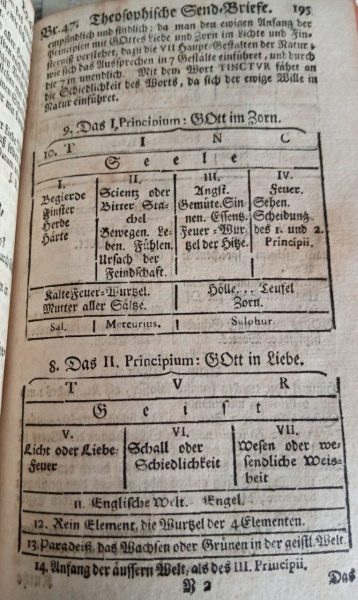
Rarely a symbol has reached in the Boehmian Oeuvre such a pre-eminence: it designate not only from now on the action of faith in Man, but as much also the balance of the creative & destructive energies within divine nature and their manifestation in the Theogony.
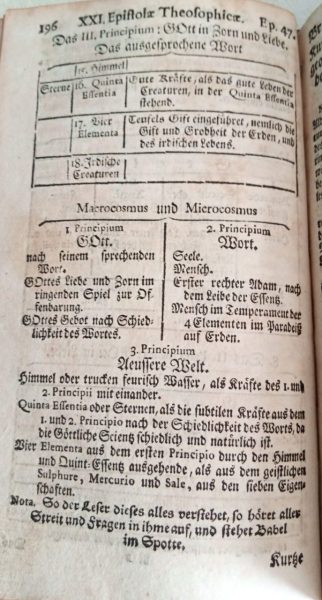
This astonishing use of the alchemical vocabulary goes hand in hand with the rise, itself also very clear, of what we can allow ourselves to call a ‘planetary language‘. The semantic slide is implicit, due to the traditional correspondences still valid at the beginning of the seventeenth century. We can find it in the other figures included in this Epistle 47 and they deal with the birth of the inferior world’s macrocosm:
*
The seven forms of the superior divine nature are met of course in the seven stations or stages of the creation of the external nature, but also of the planets and of the metals. It is meaningful to notice that Man before the Fall and the elemental aerial world corresponds to the Sun (number 4), when the seventh stations or stages designate the double-man, at the same time ‘flesh-of-Christ’ and part of the animal realm; man then possess two qualities like the Moon, good & evil, the clear face & the obscure one, the visible face & the hidden one.
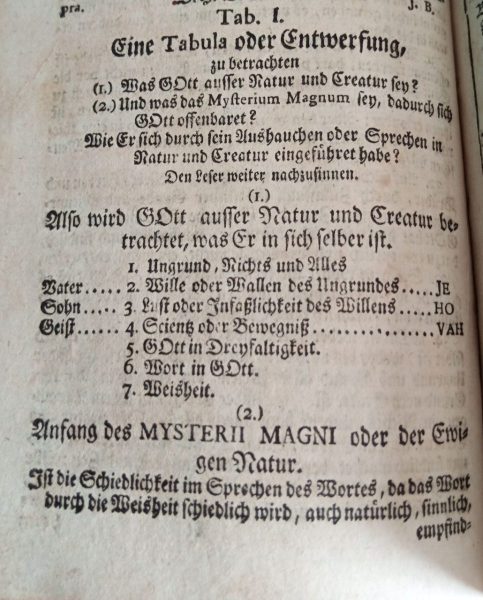
Therefore, this slow regeneration is in fact the slow rising of the Moon towards the Sun, by Venus who is Christ and the tincture (dye) of love (number 5), far from the sulfur of Mars, of the Mercurial curse and the Saturnian prohibitions. But, in the Gnostic tradition we find a rising obstacle to the generalization of this language: the curse hit in fact the world of the stars, which are described as the place of knowledge and error, facing the heavenly world of the Spirit and of the superior waters of Understanding. We can find it with Jacob Boehme and with Paracelsus. Often, the guilty reason is called ‘astral‘ and intelligence to belong to the celestial world. So, to convert, in the proper sense, is to turn away from the astral school and to join the magical, theosophical and celestial school.
In this struggle between the two type of exegesis, the one that rises the language of the star towards the world of God and the one that excludes it from it, we have the beautiful epistle, written on July the third 1621 to the doctor Johann Daniel Koschowitz and it is remarkably meditative. Willing to describe to his correspondent the level he has reached in his spiritual evolution, he redacts a text of an extraordinary density (of which he is conscious at the end of the letter, and he invites the doctor to keep his words secret). (15,20).
Like a poet, he enumerates the seven stations or stages of mystical life, in a permanent reference to the alchemical vocabulary and to the planets. A difficult path, however blessed by the Spirit, by the divine Sun, but constantly threatened by the ‘wheel of the senses‘, a path that lead from the darkness of ignorance to the acquisition of the philosophical body, of the water of fire, of the power of light.
It is, first, a path of knowledge: the soul foresee Saturn, the chaos of the external nature, but also the energies that binds this chaos (Jupiter).
It is then an illuminating path, full of anguish and painful. Slowly the soul engages itself in the mystical hierogamy, which is described as the conjunction of the fiery soul (Mars) and of love (Venus), thanks to the celestial tincture (dye), Mercury. Mars in a first move ends up by raping, defiling Venus, but at the very moment she reaches the deepest bottom of humiliation (the renunciation and the mystical abandon), at this very moment when the artist, the alchemist, the philosopher-but also the Christian-who feels he has lost everything and goes into deep mourning (15, 16, the dark work), suddenly the Moon in her thirst for the Sun ends up by scaring away Mars, and in an ultimate move seizes the Sun and ‘dive deep in him and his love‘. This illumination leads to contemplation:
‘Mars in this love in Jupiter & Saturn, starts to live a life full of bliss. The six qualities abandon their will in Venus and Venus hers in the Sun. This is how life in balance is generated.’
After the painful and bloody balance, here comes the celestial serenity of the recovered union. ‘I know this well’, says our Gnostic (Jacob Boehme), ‘as I have seen it with my own eyes recently. This important evolution does not only provoke in me a wonder, but also a profound JOY.’
*
Source

*

*
Coming soon:
A Little Bernard Gorceix Sampler – Part 3:
‘About Man, the End of the World, Resurrection and Judgement Day’.
***


Related Articles

Leave a Reply