
Circle of Transmission: The Living Loom
A Little Bernard Gorceix Sampler – Part 3: About Man, the End of the World, Resurrection and Judgement Day

Professor Bernard Gorceix.
Picture by Vincent B. Gorceix,
via Wikimedia Commons.
*
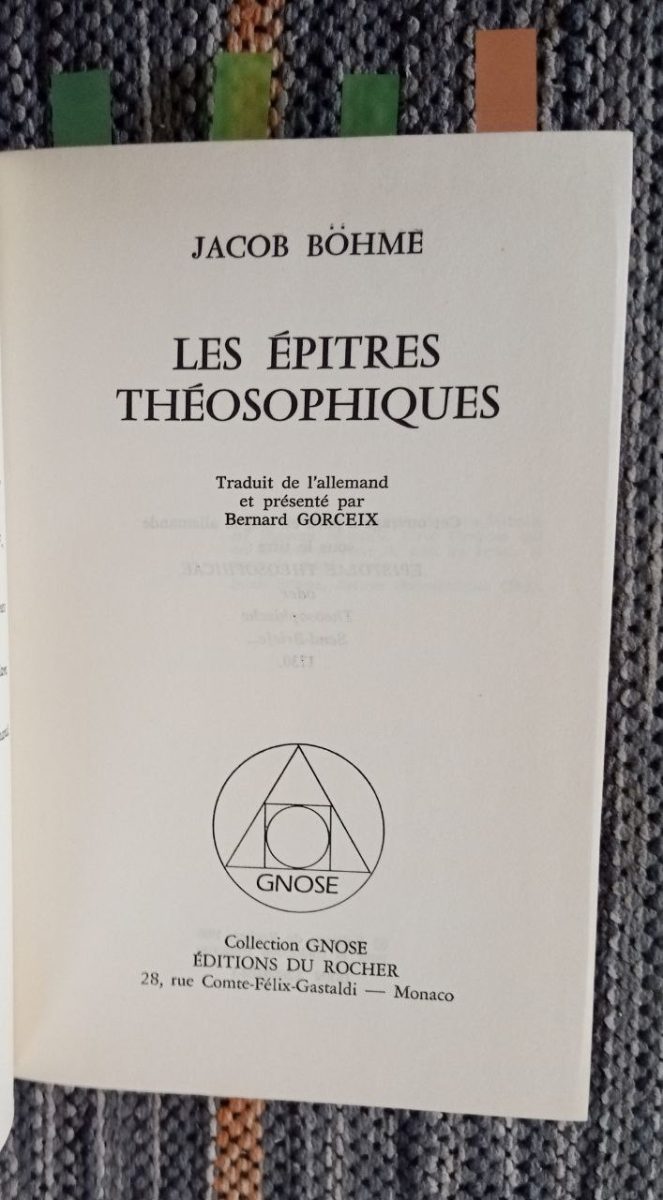
Today’s sharing from the Blue House of Via-HYGEIA is the third sampler dedicated to the memory of professor Bernard Gorceix and our last excerpt from the very rich introduction of his French translation of Jacob Boehme’s complete ‘Theosophical Epistles‘ (Editions du Rocher, Paris, 1980). From page 92 to 99. English translation by Via-Hygeia.
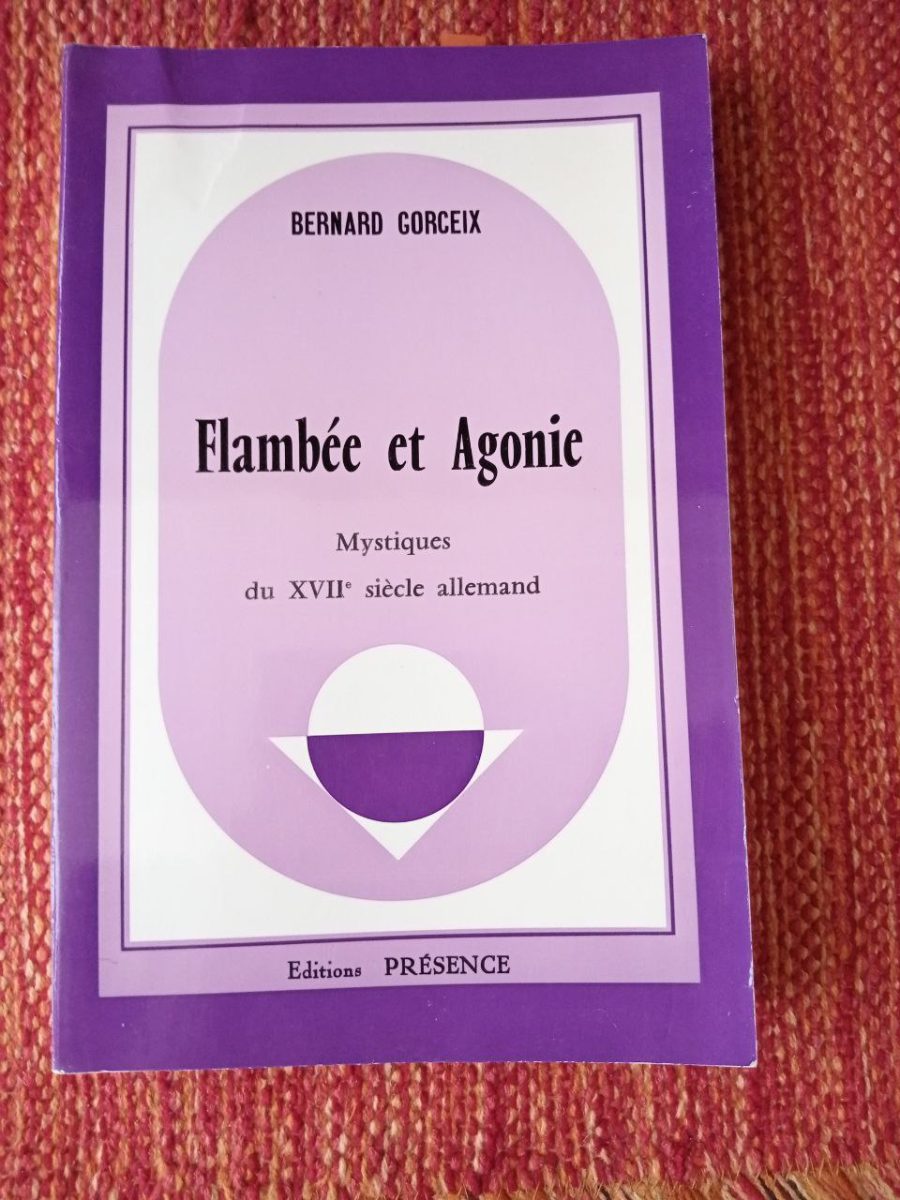
Sampler part 4 will follow soon and will come from his study, ‘Blaze and Agony, German Mystics from the XVIIth century Germany’. Editions Presence, Paris, 1971. Its title: ‘Three Mystical Idiosyncratic Patterns of Johann Georg Gichtel’.
**
Jacob Boehme’s discourse on History does not have the same relative discretion than his dissertations about God or Man. It manifests itself a considerable amount of time, almost one epistle out of two. Moreover, entire texts are devoted to it, especially in the epistles I have spoken of earlier concerning Paul Kaym. The 1730 editors have deemed those so important, that they detached epistle 8 and 11 and published them into a separate treatise called: ‘Informatorum Novissimorum‘, meaning: ‘Information upon the Last Days‘ (even though it is written ‘new‘!) In our edition, we have re-integrated those missing letters from the 1730 edition, consisting of 41 one pages!
If the starting point of the eschatological meditation is the ‘Apocalypse’ and also the great texts of the New Testament, and covers for example the coming of the Son of Man (with Matthew, the eschatological discourse, as the editors of the Bible of Jerusalem call it, fills chapter 24 and 25 in their entirety), or the resurrection of the dead (the whole third part of the first Epistle to the Corinthians, and in its chapter XV), the debate Jacob Boehme is initiating, the poetical evocations of the end of time, the disquiet but also the incredible hope that his writings insufflate, all this make of this meditation upon History in the Christian perspective of a linear time (he ignores the incoherence of this broken line that describe, according to Henry Charles Puech, the Gnostics), one of the great moments of the ‘Theosophical Epistles‘ as much as the whole body of his Oeuvre.
*
Let’s try to correct the non-sense too often formulated by the commentators of the Boehmian discourse about the End of Time, of the Resurrection, and of the Last Judgement. Our author spends more than 40 pages-The whole ‘Informatorum Novissimorum‘, to definitely ruin two dogmas which were made the pillars of his reflection: the dogma of the Millennium (meaning the thousand year terrestrial rule, preceding according to the Chiliasts or to the Millenarists the Judgement Day) and the distinction of multiple resurrections before the unique and only resurrection occurring at Judgement Day. He multiplies chock tactics: to imply the existence of the Millennium is to imply that the world is not totally destroyed yet, meaning that the elements, the rule of the stars, heat & cold, in brief, this valley of tears still endures; so, how to consider ‘the sabbat in the mirror of distress of the divine being‘, where the devil still rules as the prince of the universe ? (epistle 11, paragraph 46). Christ says that, when he will come, the good & the bad will be put together and will oppose each other: what body will the impious have during the thousand years of joy? Will the saints still have to fight them and defeat them? (8, 42).
The New Man will know the most perfect quietude: will he then have to be ‘double’ during this golden age? How would the impious perceive him, if his body is already made of ‘crystal‘? How would a preliminary judgement separate the good and the bad, when John (and Matthew as well) precise that all men are to be submitted to the trial of fire? And Jacob Boehme to add quoting the Apocalypse, ‘anyhow, there will be not enough good people to populate the earth.’ (8, 44). But moreover, to imply the Millennium, is to imply a fragmentation of what is by definition unique, the third movement of the divine Mystery. Parousia cannot be partial; and in the theory of the Millennium and of the two resurrections, it would have to split in a multiplicity of successive events.
Those distinctions are absolutely contrary to the solemnity, to the nobility and to the unicity of the development of these three movement that are Creation, Incarnation and Parousia, based upon the trinitarian model of the Johannite tradition: the movement of the First Principle (the rule of the Father), the movement of the Second Principle (the rule of the Son), and especially before us, close to us maybe, the movement of the Third Principle (the rule of the Spirit), the soul of the third Mystery who inaugurates the restauration of the luminous world, the divine world and the punishment of the impious who will be cast in the world of darkness.
So, in order to summarize: once set in motion, the third movement cannot be stopped and resume later, pause again, so to allow the respite of the golden age. It is without interruption that it must unfold, and develop the gigantic cosmic drama of Parousia, of Judgement, of the Resurrection of the bodies & the end of the world. From the time of its triggering the ‘Figure will be delivered to the center of nature and we mean by that the eternal darkness‘ (8, 33), while the saints will resuscitate with a body invisible to the impious and eternal. To have fun cutting this tragedy of the last Judgment into small skits, is wanting too much to exteriorize events that we ought to contemplate, as much as possible, in their inner meaning. Of course, Jacob Boehme multiplies concrete details, but he mainly seek to describe, as spiritually as possible, the events he writes about. For instance, Sion is less the city ‘Heaven is watering with its dew and the Earth blessing it with its opulence‘, than the ‘invisible community of the New Men‘.
Before the beginning of the Solar year that ought to last a thousand years (8,29)-but we do not know anything about it, and are we certain that the world will last seven thousand years?-the New Jerusalem is building up in the depth of the true believers. The Antichrist himself, whose pain comes preceding the ‘Dies Irae’, is not really for our author the obvious manifested partner of the Babylonian Prostitute. Of course, he carries all the features of the corrupt church of the later days, but, as he explains in epistle 41 written on November the first 1622, the Antichrist is first of all selfishness, the selfishness of sinners. There is no need to levy mercenaries & infantrymen, because it is in our soul that we ought to break him (paragraph 4). By immersing our will in the supreme humility and in God’s mercy, ‘our supreme will, which is the Antichrist, is ceased and killed in Christ’s death‘! (paragraph 8).
*
The concentration of the description of the end of the world into a unique movement and the tendency to spiritually interpret historical events that tradition heralds (his master is is this matter Valentin Weigel), have remarkable consequences. Freed, first of all, from the necessity to fit in a rigid and progressive scheme, the images are able to flow into the discourse with a total spontaneity and naivety. Furthermore, these same images do only have to translate the double and gigantic succession of the two great cosmic periods, the first full of pain & misfortune, the second full of joy & marvels. The first period is the one Jacob Boehme writes about the most, in terrible sketches, but he also describes a multi-characters drama, like in the epistle written on February 20, 1623 to Abraham von Franckenberg.
Jacob Boehme knows and repeats that the period that precedes the end of the world (which may have already started) and of which nobody can evaluate the duration, will be the most rigorous winter of the world’s history. A time of atrocious tribulations, of limitless desolations, a time of war & famine, of anguish & trials, of darkness & blood, all these are references to the New Testament and to the Apocalypse with Babylon, the Prostitute, the Antichrist & the Beast.
But, our author also is eager to free himself from traditional evocations. The text then becomes poetical and of an incantatory nature. visions of ruins & fires, alike the contemporary paintings of Monsu Desiderio or of Jacques Callot: ‘exactly at mid day’-this is what he writes to Freundenhammer on February 27, 1623-a great smoke is rising, ‘which burns the eyes when the evening comes‘(42, 41). The darkness struggle with the lights of the fire it wants to extinguish (50, 9). ‘Babel is crumbling, but also the tree of Life: men mourn a hut which is no more but a hole‘ (41, PS., 4), Visions of storms & hurricanes: ‘Impiety will be so great, and of such an unthinkable cruelty the rain and the hail that will pour down in such a power that the earth will shake and thousands of souls will be drowned‘ (42, 40). The storms will succeed one another from morning to midnight.
In the letter to Abraham von Franckenberg, the image of the wind is vividly present throughout the whole description: ‘the tribulations and the crumbling of Babylon is terribly near, the storm is rising everywhere and it will rage‘ (paragraph 1). ‘The great mourning & distress rise as a spiral‘ (paragraph 3). ‘God’s wind will overthrow the tower of Babylon‘ (paragraph 5). ‘The wind will shake the reed of the sinning soul‘ (paragraph 6). At the end of the text appears a strange character, a postilion waving a sword, ‘helped by the six winds that have ruled long on the earth‘ (paragraph 14). But soon, it is a seventh wind that fills the next paragraph:
‘This seventh wind will reveal a new fire that will free a great light, while the fountain of grace will pour-out its pure water in order to quench the thirst of the indigents. So be it!‘
A vision also of the conjuration of all of the evil forces gathered into what he calls ‘the constellation of Anger‘. ‘The Antichrist is set ablaze before the fall of Babylon. Everywhere Confusion (Turba) is multiplying itself’. ‘We have engrossed far too much the off-spring of the Prostitute‘ and this off-spring is crime itself, envy & tyranny (8, 10). ‘The enemies in this troubled period are cornering us from all sides’ (24, 4), and this ‘while the branches and twigs of our tree are very weak and dry: a sparkle and it is a catastrophe!‘
The Thirty Years War is about to ignites itself and only maintains Jacob Boehme into this worrisome expectative: ‘Violent will be the tribulations that are about to fall upon certain of our provinces‘. The Turk, the Transylvanian, the Cossack are all appearing at the horizon. Further more, everywhere, dreadful, Pharisees are polluting everything with their venom. One would believe peace to be settled back, a religious peace would be established, and again the sectarian spirit would be set ablaze, and this time definitively.
In the sixth paragraph of the epistle to Franckenberg (the post-scriptum), the final struggles are symbolized by the tale of the eagle who had raised in its eyrie lion cubs. The lion cubs once fully grown, forget their gratitude towards their caring father. They tear off its wings so badly that it couldn’t fly anymore and subsequently starved to death:
‘As for the lion cubs, they were fighting for the possession of the eagle’s eyrie; angrily they tore each other apart until that very anger lit a fire that consumed their being.’
Eventually, to this grim portrait of the Churches & the States that have abandoned Christ, the eagle of John- their Lord-comes rushing: ‘like a postillion waving a sword, originating from the kernel of nature, being the only one able to restore the Sun’.
*
This nightmare only lasts but for a while, and what follows is as beautiful & joyful than what preceded was ugly & painful. In the evocation of the end of times, the same poetical freedom affirms itself. We could say that Jacob Boehme allowed himself to exaggerate, that he ‘dechristianized’ willingly his whole description to only retain the extraordinary hope. The future, for him, in fact is less the scheme of the Judgement & Paradise than the formidable arrival, for all of the Christians, of a time of Happiness, limitless, formless, and especially, the end of the waiting for the whole mistreated humanity!
This is particularly visible in his 39th epistle sent to Doctor Krause, in which he evokes the Garden of Eden, its plants & animals. In comparison, the judgments, the cohorts of the Elected and of the Damned, the final Blaze, etc…(in brief, the whole imagery of the long Christian tradition) All this appears suddenly shallow!
For him, only the Magi are able to understand the mobiles and the steps of the eschatological drama, these ‘numbers of the Mystery‘ he speaks of at the end of his epistle to Paul Kaym (8, 25). Revelation is indeed very scarce: It only happened, says the text, twice, during Creation & with Incarnation (8, 27). As for all the prophets, says Jacob Boehme referring to Matthew (13, 10), ‘they have spoken through parables and in a magical manner‘. ‘It is the only language that the person eligible to the Mysteries is able to use‘. The fifth epistle written to Carl von Ender on the Friday preceding the Advent of the year 1619, is the only one of a more optimistic nature. The prophets, among whom our author intends to include himself, are ‘lilies among thorns‘:
‘I will finish the promised writings the printer has selected, adding also the book upon Genesis, in which will be highlighted God’s great marvels. God will grant these gifts to the last world: even though today, Babylon is filling up everything-and despite a great error that is to come-no none should be deterred! Just as God came to the aid of the captive people of Israel with comfort and by sending them prophets; so also, O marvel, lilies will grow amidst thorns!‘ (5, 10)
Therefore, if the course of the last events are uncertain and if we are not able to know the exact conditions of Parousia, of the Resurrection, of Judgement and of the end of the world, what we nevertheless sense are these ‘Might‘ and ‘Marvels‘ that the Holy Spirit is about to reveal. One image translates them in Jacob Boehme’s epistles, with the greatest strength and persistence: It is the Lily.
As early as the fifth epistle, the one we have just quoted from, Jacob Boehme speaks to us of the wonderful ‘greening of the lily‘. (5, 12). Four years later, the flower is still there. ‘But, there is a lily that greens over all the people. Blessed are those who will seize it‘. (42, 44). A question rises: From where does this lily come from? In the 42 cd epistle it rises from ‘midday to midnight‘. But, most of the time, the origin is clear: North. ‘O Northern lands, know this: a lily will flourish for you!‘, rejoices the author in epistle 12, paragraph 6 & 7.
The image of the lily is joined by a harvest of other allegories; the letter to Christian Bernhart, written in June 1621, gives an excellent testimony: the ‘great year of the lily‘ is the golden age, the time of the seventh trumpet, the discovery of the noble pearl, the opening of the doors, the coming of the month of May overloaded with roses. Generated time of the ‘sigil-star that dominates our pole‘. (epistle 24, written on February 12, 1624).
‘Der brothers, the hour is very serious, do not fall into slumber, because here comes passing-by the groom who is inviting the guests to his wedding. He who hears shall go too in order to attend this wedding! He who refuses and who dwells only in lust will repent to have missed, due to his slumber, this moment of grace.’ (58, 5).
The allegories, the testamentary references, only translate the formidable hope that also expresses itself in the literal discourse. The last days, the coming of the end of the world, these are the times of the great Reform, the times that test & pierce good friends, the times of respite for the faithful. The Impatience is understandable: ‘I constantly hope for Babylon to finally end and for Christ to come down to the valley of Josapha, so that all the people may be able to see and celebrate him.’ (38, 16).
The time of the presumptuous is ending; truth replaces quarrel and trial by quietude; the lair of the bandits is finally ruined, the idols overturned, the scribes trampled. Retained too long, compressed by to much misfortune, jubilation explodes to the very thought of the golden age. Marvelous letting off steam in these times of dread & affliction.
Jacob Boehme saw the horrors of war also mirrored by the artistry of Jacques Callot and other contemporary painters. For instance, facing each other we find ‘the players of trick-track‘, the ‘brawl of the musicians‘ and the ‘ace of clubs cheater‘; all expose worlds of wealth & vice, also masterly depicted by Georges de la Tour; we may discover then ‘Saint Sebastian pierced by many arrows and the collected face of Saint Irene & the other woman tending to him‘, opposed with the wonderful happiness of the ‘shepherds’ adoration’, we can see in the Toulouse-Lautrec museum in Albi, France. Same representative alternance, in this century in which Jacob Boehme lived, of violence & peace, of the fire that destroys & of the fire that warms.
Our author only speaks of this alternances as a poet & as a metaphysician. As a poet, through the announcement of this ‘fire of love‘ that will finally follow the ‘fire in the storm‘. As a metaphysician, through an extraordinary short-cutting of the history of the world: Arrived to its term, the linearity of the Christian history of the world gives way to a circle-like approach of time as a great cycle is concluding itself; it is about time going back to its origins, about history closing itself on its eternity, alike a snake biting its tail! Poetry then allows what painting does not: broadening the frame of the painting towards the limits of the whole world:
‘The Lily rises from midday to midnight. The person who will receive it in its properties, will sing the song of divine mercy. And God’s word will green in its own time, alike grass on the earth, while the people will sing in choir Babylon’s song, because the start meets its end‘. (42, 47)
*
Source

*
*
Coming soon:
A Little Bernard Gorceix Sampler – Part 4:
‘Three Mystical Idiosyncratic Patterns
of Johann Georg Gichtel’.
***

Related Articles

Leave a Reply