
Circle of Transmission: The Living Loom
A Little Pierre Deghaye Sampler – Part 2- A Theology of the Image
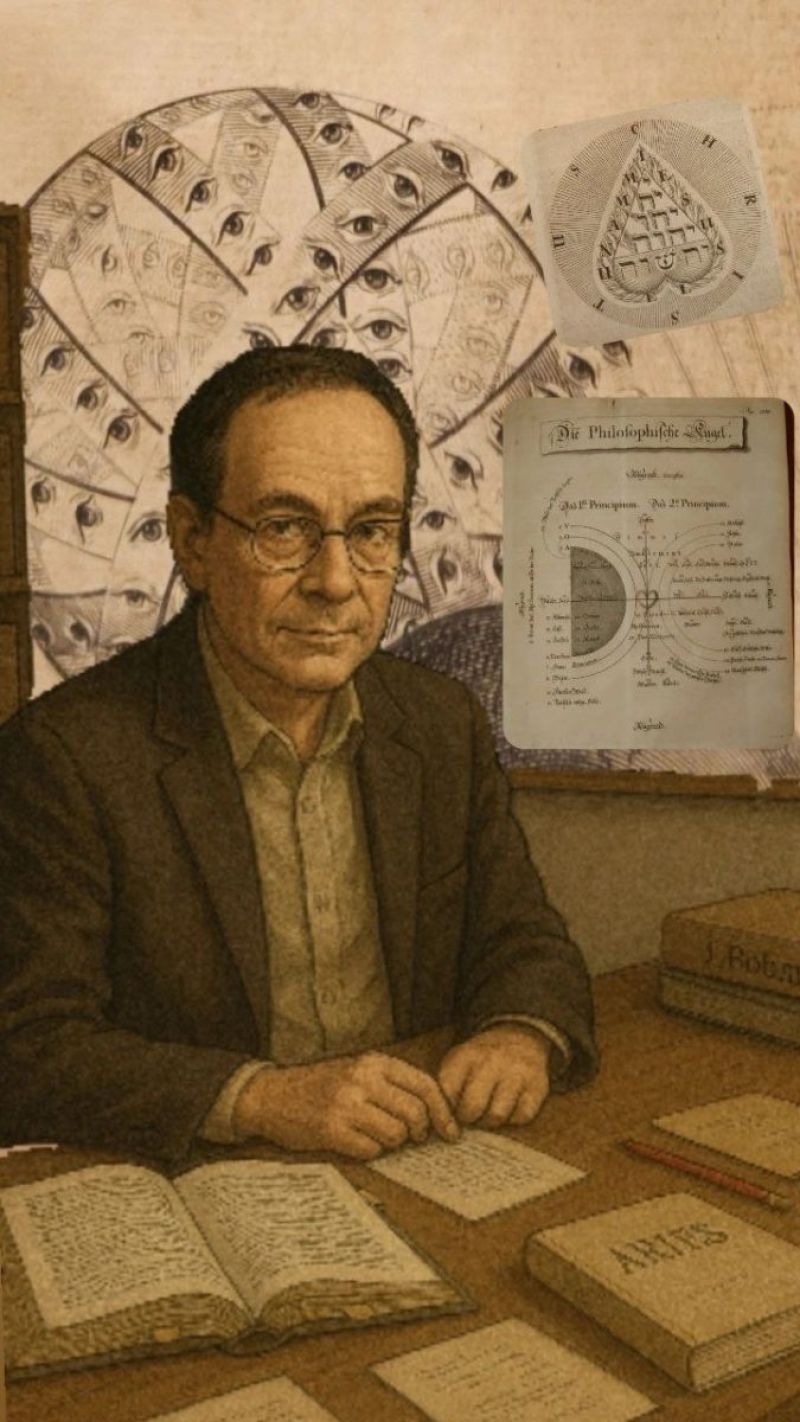
A symbolic portrait of Professor Pierre Deghaye,
in the absence of a real picture.
*
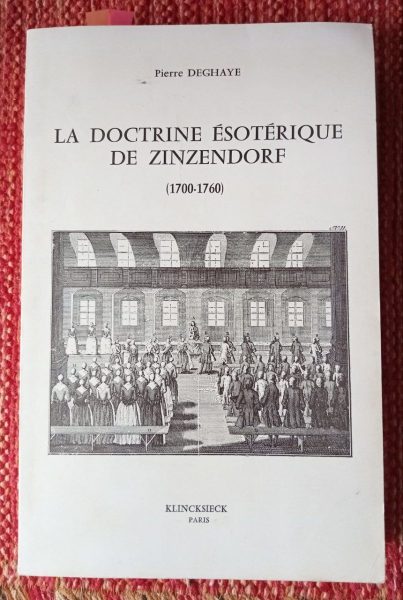
Today’s sharing from the Blue House of VIA-HYGEIA is part 2 of a planned series dedicated to honoring the memory of professor Pierre Deghaye (1924–2005), with this extract from one of his trailblazing publication, ‘La Doctrine Esotérique de Zinzendorf‘ (The Esoteric Doctrine of Zinzendorf), published by Editions Klincksieck in Paris, in 1969. It is part III, chapter 5-section F to J. A Via-HYGEIA English translation from the original French. From page 589 to 603.
**
Section F. Christ-Wisdom,
image of the Divinity
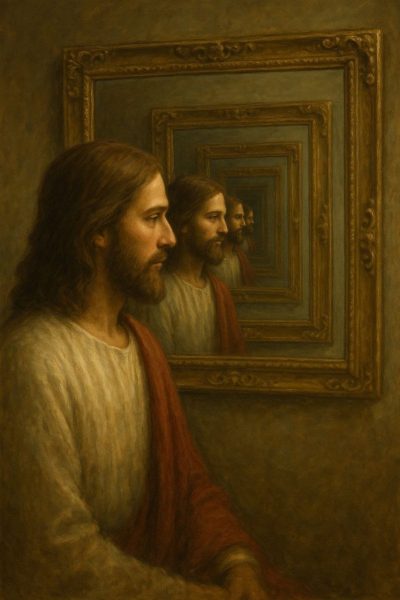
The first epistle to the Colossians (I Col. 1, 15) says that Christ is the image of the invisible God: ‘The Son is the image of the invisible God, the firstborn over all creation‘. Addressing the Hebrews (I, 3), the Apostle was showing that Christ was also the radiance of the Father’s Glory, the effigy of His substance: ‘The Son is the radiance of God’s glory and the exact representation of his being, sustaining all things by his powerful word‘. Biblical Wisdom is described in such terms: ‘She is a reflect of the eternal light, a stainless mirror of God’s activity, and image of His Excellence‘. (Wisdom, VII, 26).
In Zinzendorf, there is a true theology of the image. By referring to Wilhelm Bettermann (‘Theologie und Sprache bei Zinzendorf‘, Gotha, Klotz, 1935), Samuel Eberhard (‘Kreuzes-Theologie. Das reformatorische Aliegen in Zinzendorf Verkündigung’, Munchen, 1937) connects with to what we would call contemporary sensualism. But we ought to remember that for Bettermann, Zinzendorf’s realism is not the ultimate expression of his doctrine: it is only a mean of expression. Contemporary philosophy can only led him anything other than a garment to dress one’s thought. Bettermann would never have admitted, even for a short time, that Zinzendorf’s religiosity could ever be confused with this philosophy.
But then, why not attach this theology of the image first of all to Saint Paul? Zinzendorf repeats tirelessly the verses that we just have quoted. For him, when the apostle affirms that Christ is the image of God, this is not to give more strength to his language. It is to state a fundamental truth.
Without doubt, Zinzendorf was inspired directly by Saint Paul. He could have referred to Origen as well. A book was written that we have referred to earlier and its title is: ‘Theology of the Image of God in the Works of Origen‘ published by Editions Aubier in 1956. It’s author, Father Henry Crouzel demonstrates very well that for Origen, the Son, as image, is the manifestation of the invisible God. Origen himself refers to 1 Col. 1, 15.
A disciple of Jacob Boehme, Friedrich Christoph Oetinger in his ‘Die Lehrtafel der Prinzessin Antonia‘ (1673-74) connects this theology of the image with Jewish Kabbalah (and its Christian avatar). The Angel of the Face, Metraton, who the Christian Kabbalists identify with the Logos, is the image of the divinity. We are then not surprised to find exactly the same identification with Zinzendorf. In his ‘Apological Declaration‘ (Herrnhut, 1756), Zinzendorf answers a question regarding Exodus XXXIII, 14. According to the lesson given by Luther of this verse, God says to Moses: ‘my face will go with you…’ Who is called ‘Face of God? Zinzendorf is asked, is it Christ? To which Zinzendorf answers by quoting Col 1, 15: ‘He is the image of the invisible God‘. The Exodus quote designate the Face of the Holy Trinity hidden in the depth of Divinity.
Metraton is the Angel, the envoy of God. He is the first revelation of the Shekinah. The Kabbalists identify the eternal Angel to the Shekinah, in the same manner how the Christians link Christ to Wisdom. Oetinger follows this tradition faithfully: he unites in the same symbol, the Face of God, the Word and the Shekinah.
Oetinger delineates the identity of the Word and of the Shekinah by referring to a passage of the Zohar in which Psalm II, 7 is commented: ‘You are my son…’ Zinzendorf speaks of ‘the Shekinah image of God’ in a sermon, in which he comments Matthew III, 17: ‘And here a voice from Heaven said: “This is my Son, in Whom I am well-pleased“. The concordance is quite striking.
Thus, we are able to see which traditions Zinzendorf’s theology of the image is connected to. Related to our subject, we haven’t talked yet about Gnosis, when its speculations fill an important space. Why?
For the Gnostics, the value of the image is negative. The Demiurge is at the image of the Father, but here, how inferior to its model is the image! This God image of the Father will produce himself an image of the celestial Son, who is above him. This image will make Christ from above appear, the Psychic Christ. The Demiurge will consequently produce images of the Eons that will become the Archangels and the Angels.
As the images multiply, we are are getting away from the model, in a descending perspective. For the Gnostics, the image is necessarily inferior to the prototype. Hence, the psychic is the image of the pneumatic. The gnostic myth of the primordial Anthropos, as Narcissus’ brother, who fell into the abyss while contemplating his own image, is particularly significant to out topic.
At the opposite of the gnostic mentality, Origen’s theology proclaims the dignity of the image. Father Crouzel, we mentioned above, shows us clearly the difference between Origen’s conception and the Valentinian system, in which the image plays an inferior role. The dignity of the image is rooted in the perfection of Christ, image of the invisible God. Christ can say, in truth, ‘Who saw me, saw my Father.’ (John, XIV, 9).
But Jacob Boehme’s thought goes further, because it suggests the precellence of the image. The visible God, the manifesting God, who reveals Himself, excels over the invisible Deity. The key faculty that rules this manifestation is Imagination.
*
G. Divine Imagination
In Origen’s system, the image is not a fixed portrait. It has all the mobility of Wisdom Itself, mirror of divine activity. Jesus-Christ, God’s Wisdom, reproduces all the actions of His Father. But, mostly, there is a living relationship between the model and its image. God generates His image through His Will, which is His Love. He puts into this generation the very principle of its His activity, which is love. This voluntary conception of the generation of the image is very important in Origen’s thought.
Once conceived, the generation of the image merges with the generation of the Son generated by the Father, the link between them being love. In Boehme’s works, it is so; but for him, it is a specific faculty the presides to this generation: Imagination.
In Boehme’s thought, the first faculty is will. A book that we have already quoted, ‘Die voluntaristische Mystik Jacob Böhmes‘ written by Werner Elert in 1913 and published by Trowitsch und Sohn in Berlin. its title given by the famous Lutheran pastor is quite justified: ‘The voluntary mystic of Jacob Boehme‘.
For Boehme, Christ-Wisdom, before being the image generated by divine will, IS this will itself. Upon this point, Boehme does not differ from Origen, for whom the Word ‘proceeds from the Father, like will from Intelligence.’
Will, Boehme says, is the source of the image. It is its ‘root‘. In fact, this will, from the very moment when it is not the indetermined will of the ‘Ungrund’, from the very moment when it manifests in the Son, only tends towards one aim: to reflect itself in a mirror to apprehend itself. Will can only define itself but through this vision it has given itself as an aim. Will is identified with the spirit, but the spirit itself, according to Alexandre Koyré, is essentially vision. (‘La Philosophie de Jacob Boehme‘, Paris, Joseph Vrin, 1929).
For Boehme, spirit is will, but as soon as this will manifests, it imagines. ‘God imagines within Wisdom‘ and Zinzendorf will use exactly and in the same manner the verb ‘imaginieren‘ (in etwas imaginieren). God projects His Imagination into Wisdom; this is His essential action.
We have with Jacob Boehme a true theology of Imagination. We will find echoes in Zinzendorf’s thought, but in the perspective of the faithful. Zinzendorf’s conception of Imagination implies Boehme’s speculation, but is does not tell it again and does not explain it upon the level of intra-divine life. But, Zinzendorf gives a primordial importance to Imagination in the life of the faithful soul. Under this aspect, substantial faith and imagination are but one. This is here that Zinzendorf appears very close to Jacob Boehme. His vocabulary gives him away.
*
H. The Image of God
in the soul of the Faithful
In generating His image, God brings forth an imaginary universe, which is the model of all the created worlds. In expressing Himself, God incarnates into this universe, which is half-way between spirit & reality, in this meso-cosmos. By revealing the depth of His thought, Boehme’s Divinity already creates, yet in an ideal manner. To Imagine, to reveal oneself and to create is but one thing. Zinzendorf shows us divine imagination at the very heart of Creation. This idea appears in a text in which he remembers the words of the Psalmist praising God to have made him such a marvelous being: ‘O God, I shall thank You for in an awesome, wondrous way I was fashioned; Your works are wondrous, and my soul knows it very well. I shall thank You for in an awesome, wondrous way I was fashioned; Your works are wondrous, and my soul knows it very well. And to me, how dear are Your friends, O Lord! How great is their sum! I shall count them; they are more numerous than sand; I have come to the end, and I am still with You.’ (Psalm 139, 14-17).
We just have just talked about an ideal creation, which is first hidden within the divine thoughts, before it manifests out-side divinity; it reveals itself first to itself; but then, it will generate this ‘ad-extra‘ revelation, in this movement, which in our eyes, makes it go outside of itself. We are at the stage of creation called ‘ex-nihilo‘. It is an improper way to express this. The created world seem to be gushing out of the void. But, in fact, from nothing, nothing can come. This creation that we suddenly see called to existence, pre-existed in the divine schemes. If it would come out of the void, this void is but the divinity itself in its kernel, the invisible trinity.
Upon the level of concrete creation, the Logos will only ‘actualize’ this world, in giving it a sordid reality, as it was beforehand presented to the Father in the ideal mirror of His Person. Our created world is simply the concretization of the spirit that came out of the divine mouth and which has been reflected in this mirror.
Creation was modeled according to this first image, fixed within the person of the Son. It is a primeval state, it carries within a distinct image, which is in the likeliness of the primordial image. It is a second degree image, an image of an image, but this does not, in any way, diminish its perfection.
This second image is incarnated by Wisdom immanent into the creature. The Kabbalists call it ‘the Wisdom from below‘. It is the Shekinah. The inferior Sophia is the last sephira, symbol of the Rule, of the Immanence, while ‘the Wisdom from Above‘, containing the ideal existence of all things, comes in second place within the Pleroma. It is called Hokmah. We have seen that Zinzendorf himself talks about the Shekinah, as image of God within ourselves.
It is this immanent Wisdom, which, according to Jacob Boehme, Adam has lost during his sleep. This event corresponds to the loss of the image evoked by Zinzendorf according to the Scriptures: All have sinned and will be deprived of God’s Glory. Those who will be regenerated will re-possess it again. For Zinzendorf, the loss if the image equals the loss of the spirit.
According to Boehme, Adam has lost the image in the person of his celestial companion, who was separated from him. How will it be restituted in all its perfection: Through Imagination.
God ‘imagines in his wisdom‘. Alike, Man can project his imagination in God, according to the model Christ is offering. Man is able to transform in this model he imitates. We find here the mystical version of the notion of ‘Imitation‘.
The prototype of Imitation is found within the union of Adam with Wisdom before his companion was separated from him. Through Imagination, Adam united with Wisdom, which was his ideal ‘self‘, because She was in him. Likewise, the regenerated Man will unite with an image that is able to incarnate his other himself.
*
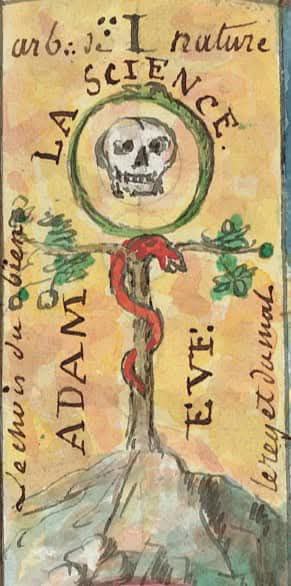
İ. Transforming Contemplation
Boehme did not invent the theory of the transforming contemplation. We find it at the origin of the mystical theology. To unite with God, is to transform within Him. To unite with God, it is about transforming oneself in Him. The principle of this transforming union is love. ‘What we love with love‘, as Saint Gregory of Nyssa says, ‘we become it‘. When God proposes Himself as food, it is for us to assimilate His image. Spiritual manducation (eating) is the transposition of the cannibalistic rite: the primitive eats a brave warrior for him to become similar by the ingestion of his virtues. From his amorous gaze, the faithful eats Christ in order to become similar.
Therefore, the soul transforms itself according to the image towards which its gaze is directed. But its model is not necessarily the benevolent God. It could very well be the image of sin. Man transforms himself according to the image he adores, for the better or for the worse. ‘Human nature‘, Saint Gregory says, ‘takes the shape of what the will constantly desires‘.
The theory of the transforming contemplation occupies an important space in Origen’s thought. His whole ‘Imitation’ concept is grounded upon this theory of the realization of the image in the faithful’s soul.
First of all, to imitate Christ, it is not to act on a purely external way. Imitation, for Origen is an act not only moral, but truly physical. To imitate the Word, it is to be ‘formed’ by it by virtue of a participation in nature. The Logos is at the same time model and the agent of this transformation.
There is a beautiful symbol in Origen’s thought: to the Greek polytheists, he affirms that Christian statues are not hand-made by artists or craftsmen, but sculpted by the Word and formed in us.
Those who have the Lord ceaselessly in the gaze of their spirit, according to Origen’s formula, further transform towards a closer likeliness. Origen comments in a number of his works the words of the Apostle: ‘But we all behold as in a mirror the glory of the Lord with open face, and are changed into the same image, from glory to glory, as by the Spirit of the Lord‘. (2 Corinthians 3:18).
This theory occupies such a space in Origen’s thought that participation to the image merges with sanctifying grace. For Origen, to imitate God is to adore Him and Christ, who is also altogether the object & the source of this love, and makes those who contemplate Him with love christs.
The life of the soul is always regulated by an image, either the Celestial one, or the terrestrial one that inhabit the fallen Man. We can imitate, either the true God or an idol. Speaking of idols, the Psalmist says: ‘Like them will be those who make them, all who trust in them…’ (Psalm 135, 18).
Origen remembers of this truth. The Scriptures designate the false gods under the word ‘vanity‘, and this is how the Lord shouts through the voice of Jeremiah: ‘So says the Lord: What wrong did your forefathers find in Me, that they distanced themselves from Me, and they went after vanity and themselves became vanity?‘ (Jeremiah 2,5).
Satan monkeys God. In fact, he is the god of this world. The devil as a counter-factor pretends engender sons and mark them to his image. Yet, Satan does not engender per se, but it holds only about the quality of the image, which does not have any substantial reality. Satan’s follower will transform purely and simply according to an image of non-being, but the mechanisms of imitation follow the same laws as if the soul would be changing according to the likeliness of the true Being.
Jacob Boehme has used this theme of the transforming contemplation, but he did specify the subjective principle. Faith that makes us participate to the image is duly identified with imagination.
Boehme did not invent also this conception of the imagination, which-we gather that- is not fantasy at all, the house crackpot. We can find it already in Paracelsus’ treatises in which imagination is conceived by the alchemists as an active meditation. Carl Jung sees it as an idea that gives us the key of the whole universe of the alchemists, half-way between spirit & reality.
For the alchemists, imagination is the quintessence of all the vital forces, moral and physical, of the human being. This quintessence is materialized in a subtle body called ‘astrum’, according to Paracelsian terminology. In ‘Psychology und Alchemie‘, Jung defines it as such: ‘astrum in homine coeleste sive supracoeleste corpus’, ‘There is a ‘star’ in the human body, like a celestial and even supra-celestial body‘. Jung goes on explaining this quote from Paracelsus: a divine spark in the deepest layers of the soul, a subtle body, a spiritual, immortal vehicle that transcends the physical and mortal body. It is heavenly as it belongs to a higher, divine realm and supra-celestial because it originate even beyond the heavens. This suggests that the human soul doesn’t just come from the stars but has its origin in the absolute Godhead. (Jung, C. G. 1968. ‘Psychology and Alchemy’, Collected Works of C. G. Jung. Princeton, NJ: Princeton University Press. Page 380).
We ought not to forget that Boehme hypostatizes faith. Essential faith is Christ Himself. Faith or Imagination are together the principle of transformation that operates in us and the subtle body in which they materialize.
After Boehme, Pierre Poiret in his ‘Oeconomie Divine‘, chapter II, page 588, praises the excellence of the imaginative faculty. For him, it is through imagination that God has created, by making things cross from being possible towards being real through the sole Might of his thought.
Though, the human imagination is not sovereign like God’s is. Man does not make things exist through the strength of his own imaginative faculty. But, Poiret shows us the soul ‘imagining in God‘. Imagination concentrates in a vision in which all of God’s virtues are gathered in one body. furthermore, Poiret describes the action exerted in return upon the imagining subject through the strength unfolded in this concentration. Any imagined body impresses the soul. Those views are inspired by Boehme himself, or rather by the tradition to which his thought is connected in this subject.
As for Zinzendorf, we already know that he manifests views very similar to those of Boehme, for whom faith is ‘a strong imagination‘. Boehme says that we ‘imagine in Christ‘. Zinzendorf varies this description at will. One projects his imagination in the body of the Crucified. One projects in the vision of the Savior all of one’s faith, all of one’s love. Zinzendorg crafts some idiosyncratic formulas, such as ‘in den Leichnam imaginieren, sich in den Heiland hineinglauben, hineinlieben’. (Imagine the corpse, believe in the Savior, love him.’
In a beautiful text by the Pseudo-Dionysius the Areopagite, he shows how the painter, due to contemplating his model, finally starts to look alike. This is true in the world of material realities, he says in substance, but how much more when the painter is a spiritual person who is prone to constant contemplation if this sweet and mysterious archetype. Spiritual painters achieve resembling God, with an admirable exactitude.
Zinzendorf also says, that the Elects are the living images of God, and he shows us how, according to the Evangelical wisdom, we ought to be artists focused on the same work like the spiritual painters mentioned above when we quoted Pseudo-Dionysus. Zinzendorf’s spirituals are artists that manipulate the chisel of the mind to carve upon the tables of a regenerated heart the portrait of the beloved Savior.
The symbol of the painter ought not to be misinterpreted. The painter who gaze upon his model in order to impregnate himself of its likeliness, is not the mundane scribbler who multiplies images according to his ever changing phantasy-this we have said it-but Zinzendorf could very well use this quote, because it defines ‘philosophical imagination‘: ‘Et hoc imaginare per veram imaginationem et non phantasticam.’ (‘and to imagine this through true imagination and not phantasy.’) (Jung, ‘Psychologie und Alchemie‘, pages 353-354).
The Decalogue forbids sculpted images. In the new economy (A Via-Hygeia note: from ‘oikonomia’, from the Greek ‘oikos’, meaning household, and ‘nomos’, meaning management in the meaning of management or rules of life, Literally ‘household management or law’) this ban is not justified anymore. On the opposite, this negative ban has been changed into a duty: the faithful ought to make for himself an image of his Lord. But, the first article of the Law remains: ‘You will not worship any other god than Me.’ If we think about this commandment, the interdiction to sculpt images is not entirely and simply abolished. If these images are those of idols, we will then remember the Decalogue: ‘You will not bow before these images, nor will you serve them; you will worship no other god than Me.’ This means that Jesus is the unique model proposed to the spiritual painter. True imagination is fixed upon a unique object; it is not at all free as it would be with the secular painter.
The faithful make himself conform to the proposed model, so that he may paint of the canvas of his spirit. But, for this to be possible, the model ought to be in conformity with his nature. As long as Christ did not reveal Himself according to our likeliness, He could not produce an image. The only image that we are able to sculpt, is a kindred one, the Son of Man. From the very moment when Jesus was born from Mary, our imagination could feed from him, day and night.
In the absence of this revelation, the Decalogue’s ban had a meaning. It does not have it anymore from the very moment Jesus has revealed his image that we can imitate, because it is in conformity with our species. Yet, the image of the Son of Man must be duly fixed in our minds.
Let’s admit that God, in the ancient economy, would have been worshiped according to the image of a man; Satan, then, would have taken this opportunity to have a whole mythology blossom, in which he would have made of man an idol, at the expense of the unique God. We would have forgotten Him.
In reality, this situation is not only historical. It is the making of non-regenerated beings, able to restitute the image of man only according to vile flesh. And, true imagination is only conceived in the spirit.
True imagination resides in the gaze of the interior Man. It palpates the Lord no less than Thomas, the unbelieving apostle, when he puts his finger in the side-wound. It brings him presence in a concrete manner, but only for the eyes of the soul. It gives to this presence a reality far more superior to the reality of dreams and visions, produced by common phantasy. This definition of spiritual imagination is delineated in a sermon dedicated to Psalm 37, verse 28: ‘For the Lord loves justice, and He shall not forsake His pious ones‘. Zinzendorf combines this verse with Matthew 28,20: ‘And surely I am with you always, to the very end of the world‘. This God, who remains with his faithful until the end of time, is Christ. He left them in order for them to worship him in spirit and in truth. This is the image in us, in the Holy Spirit, it is the Shekinah incarnating it in our spirit.
The faithful sees Jesus in his bodily presence, but AS He appeared to the Apostles after having left them. The average psychic sees only the non-transfigured man. One can see in Man only this coarse reality and imagine God according to it. But we can also ignore the human dimension, purely and simply, when one pretend scrutinize the depths of the Divinity. This is exactly what happens with philosopher theologians. And this is even more dreadful.
The twelfth series of the ‘Gesangbuch‘ (book of hymns and common prayers) comprise an hymn called ‘Imaginationslied‘; in this hymn, a verse says: ‘I want to believe His Divinity, and see Humanity‘. In fact, believing and seeing are the same thing for the spiritual person. Through faith, we see, we touch. Faith authenticates our visions. Yet, the verse we have quoted just now reminds, to some that they ought to believe into the Divinity, and to others that they ought to see His humanity. The former are those whose vision is too materialistic of what is divine, and the later are the theologians who are too prompt to avoid incarnation.
God can only appear in a body similar to ours, as an archetype of our species. Otherwise, we would only see a chimera or the devil himself. We know what happened to the Sophia of the Gnostics, who projects its imagination in forbidden depths. Her desire incarnates a stale imagination. It is an imagination that wanders, and who makes of the imagining subject a wandering star, according to the expression used by Jude in his Epistle against problematic spiritual teachers: ‘raging waves of the sea, foaming out their own shame; wandering stars to whom is reserved the blackness of darkness for ever‘. (1 Jude, 13). Zinzendorf also speaks of Lucifer after his fall with the same words. This imagination catches only phantasms. It lead the soul to its perdition, when the real one reveals to us the deepest realities.
We ought to notice, in passing, that for the Gnostics, imagination is presented to us in a negative manner only, the creation that flows from it too through successive degradation of the divine principle, from the spiritual to the psychic. and from the psychic to the hylic.
Zinzendorf in his thought gives a great importance to imagination, when, alike Jacob Boehme, he identifies it to faith. Besides that, he is rather distrusting it, as he had a more abstract mind, not very imaginative. He dreamt a lot, but of truths less transcendent, he confesses. We know how distrustful he is when it comes to metaphysical dream, as he remembers Jude’s epistle that speaks of problematic spiritual teachers. Those heretics are delirious dreamers, hypnotized by the ghosts forming in their minds.
Bad imagination manifests in dreams and IS a manifestation of impurity. On the other hand faithful imagination has this divine clarity, to which it identifies. It holds its rectitude from the divine principle who has taken over our individuality. We ought to notice that the alchemist who projects his imagination into matter, the imaginatio vera, is to be sanctified before making the divine Spirit descend. He ought to be healthy, so that the quint-essence of its vital forces, symbolized by imagination, is able to serve the completion of the Alchemical Opus.
In this perspective, imagination, the true one, identifies itself to the divine principle in us, materialized in a subtle body.
*
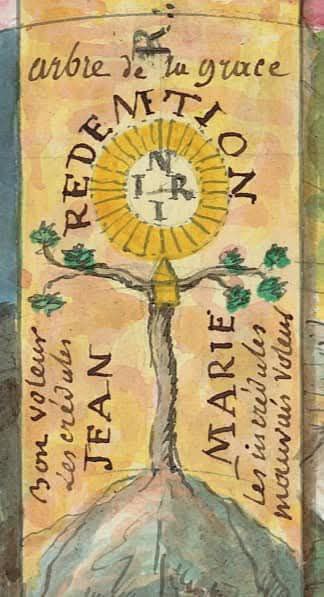
J. The perfection of the image
in the person
It is God Himself who is imagining in the regenerated heart. This God who puts His own image and who completes it. Yet, God appears to each one of us as Himself. In each soul, His image individualizes, It is in the faithful soul that God becomes truly a person. We have seen the person as symbol of plenitude. It is now consecrated through the principle of individuation.
Upon this point, Zinzendorf’s doctrine is close in essence with Jacob Boehme’s thought. For Boehme, each human being represents an individual theophany. Each, according to Alexandre Koyré, presents a specific letter in the great divine poem. Even better, its essential function is to become more and more personal, more and more distinct from the other persons.
Each soul has its God that it incarnates. For Oetinger, a disciple of Jacob Boehme, among those who had the privilege to see God manifest in His Glory, in the Shekinah, nobody has the same vision. Each person had received, from this manifestation, a perception that God in his wisdom has made compliant to his own individuality. It is in his great kabbalistic commentary we presented earlier that Oetinger expresses this opinion. Truly, Jewish tradition is upon this specific point in concordance with Jacob Boehme’s thought. A master of Kabbalah, Isaac Luria, said that ‘there are as many faces of the Torah than there are souls in Israel‘.
For Zinzendorf, the image of God takes on a completely different beauty depending on whether it appears to us in the mirror of this or that soul. Here we can quote Lutheran Pastor Johann Lorenz von Mosheim, who in his own collected sermons (‘Mosheims sämmtliche Heilige Reden‘, III, page 1201.) treads upon similar views, summarizing, engaging with, and critically re-framing a Zinzendorfian concept :
‘It is among the wonderful works of the Holy Spirit that a servant or maid of the Savior is, in a sound sense, a self-subsisting, isolated being, both in terms of grace and gifts; certainly not without Him; but yet without comparison to others… Just as a brother never becomes entirely equal to another, or a child to its parents—even if one thinks, ‘this one is the very father, or the very mother’—so it is also with the gifts and graces, with the impression that a soul receives from the Savior, with the representation of His image in its eyes: His form gazes out from every soul with a different beauty, each time certainly one that is well distinguished from their pure humanity and nature, but yet a different one than that of this or that other of His grace‘. February 12, 1757.
Under this relationship, a person is absolutely distinct from another. We have seen how Zinzendorf was re-using the definition of the ‘person‘ given by the ‘Augsburg Confession‘: ‘by this word, we ought to understand that which subsist by itself.’ We have commented this definition in relationship to the Zinzendorfian doctrine of plenitude ( ‘La Doctrine Esotérique de Zinzendorf ‘, page 476). In its fulness, the person is self-sufficient. Zinzendorf re-uses Mosheim’s quote by adding this: Every faithful is a self-sufficient being which ought to be considered as isolated from its species: ‘ein für sich bestehendes isolirtes Wesen.’
The theory of the image is closely associated to the notion of person, under the double aspect of totality & individuation. (A Via Hygeia note: We remember here Francis Warrain in his opening comments upon the system of the Sephiroth: ‘The absolute incarnates, somehow, into the relative, dons it and penetrates it by bringing life into it.’ from our post: ‘The System of the Scale-Part 1-Fundamental Relationships‘)
Essentially, the person is light and this beaming light shines upon the face of the Elects. For Origen, it is on the face that the superior part of the soul, the ‘principale cordis‘, what later mystics would call: ‘the tip of the soul‘. For Zinzendorf, the symbolism of the spiritual face is closely associated to the symbolism of the person.
This image of the father reflects upon the face of Jesus. This reflection is the prototype of all the images that are offered to the imagination of the faithful. Origen about this quotes the following verse from Psalm 4, 7: ‘Many say, “Who will show us goodness?” Raise up over us the light of Your countenance, O Lord‘. Jesus is the face of the Father. As we said earlier, he is the Angel of the Face, the one from Exodus 33, 14: ‘My Face will go with you‘. Zinzendorf associates this verse to Hebrew I, 3 in which the Apostle speaks of the Son as: ‘Splendor of the Glory of the Father, effigy of His Substance‘. It is this Face that we contemplate in the reflect lit in the kernel of the heart. ‘In fact, the God who says: “From the bosom of darkness may the light shine” is the God that has radiated in our hearts in order to shine the knowledge of the Glory of God, Who is upon the Face of Christ.’ (Mosheim,page 1018).
In the sermon from February 18 1758, we have just quoted above, Zinzendorf says exactly this about the Angel of the Face, the Angel from Exodus 33,14:’ We do not deny that there is in the Old Testament clues of the mystery of the Holy Trinity, the legacy of the New Testament. For instance, it is spoken of the Face of God, of the person. We can see, in fact, what is seen from God is called ‘the face’, the character, the effigy of His substance.’ Zinzendorf puts upon the same level the vision of the face with the notion of person.
In a sermon given in London, Zinzendorf comments II Corinthians: ‘For God, who said, “Let light shine out of darkness,” made his light shine in our hearts to give us the light of the knowledge of God’s glory displayed in the face of Christ‘. A gloss explains to us that we designate the person and the face in the same way.
Zinzendorf identifies the Face of God to the person of Christ. He did the same regarding to our human persons. Zinzendorf attaches great importance to the physiognomy of the Moravian Brethren, because it reveals their hearts. Considering Zinzendorf, this is not just a simple way to express himself, because he dreams to re-discover the arcane of a forgotten science, a sacred physiognomy, for very precise reasons. This science would serve the discernment of spirits.
It is upon the face of the witnesses that the divine light will shine. But what is the meaning of such a testimony? We can conceive this testimony upon a simple moral level. This is what Zinzendorf does in a sermon in which he comments Exodus 34, 43: ‘There I will arrange meetings with the children of Israel, and it will be sanctified by My glory‘. It is about the consecration of the altar. God states his design to be recognized and sanctified in the person of the children of Israel. ‘Daselbst will ich an den Kindern Israel erkant und geheiligt werden’.
In the perspective recalled here God is justified by his own people in the eyes of the others. The sainthood of his children is used to defend Himself against those who would raise accusations against Him. We recognize here an important motive that we have seen earlier: God is holy, just, loyal, but his holiness, his justice, his sincerity demands the testimony of the faithful, who justify God, according to the Scriptures: ‘The one who comes from above is above all; the one who is from the earth belongs to the earth, and speaks as one from the earth. The one who comes from heaven is above all. 32 He testifies to what he has seen and heard, but no one accepts his testimony. 33 Whoever has accepted it has certified that God is truthful’. John 3, 31-33.
Zinzendorf conceives the testimony in spirit of a justification, of a theodicy, but this point of view is rather a negative one, as he does not believe in theodicies in general: God does not need to be defended. If he envisions here its principle, not in a reasoning gymnastics, but as a concrete testimony towards the non-regenerated. It would have no meaning in the Moravian Family!
There is a higher level of testimony. The witness shines the divine Glory from clarity to clarity, nurturing a light more and more perfect: he grows God’s body.
The witnesses multiply the divine light, because in each of their persons, this very light shines with a distinct brightness. We could say that each witness re-expresses the archetype. Each person re-expresses Creation within the prism of his unique personality.
The primordial image will fructify infinitely. There will be as many images than there are people, and all of these images, through the passing of the centuries, will be but one; far from diminishing the plenitude, the individuation of the image will enrich it with an infinite diversity. And finally, this infinite diversity of individual images will re-unite, it will be ‘recapitulated‘ in the unique person of Christ. In this plenitude of light, each clarity will always represent the person it figured once on earth. It is in this meaning that Zinzendorf interprets the words of Jesus to his disciples: ‘You are the light of the world‘.
The God-person, macro-anthropos, will englobe in his finale plenitude the multitude of the individual perfections. He will realize the absolute person. In this final Pleroma, the dark divinity reaches total light, at the end of its manifestation. The history of this manifestation is the revelation of the divinity. It closes in the human person. In this revelation, it is God who knows Himself, alike a person who reaches the luminous consciousness of one’s self.
*
Source
***


Related Articles

Leave a Reply