
Circle of Transmission: The Living Loom
A Little Pierre Deghaye Sampler – Part 3: The Mysticism Of Incarnation, or of the Incarnate Man
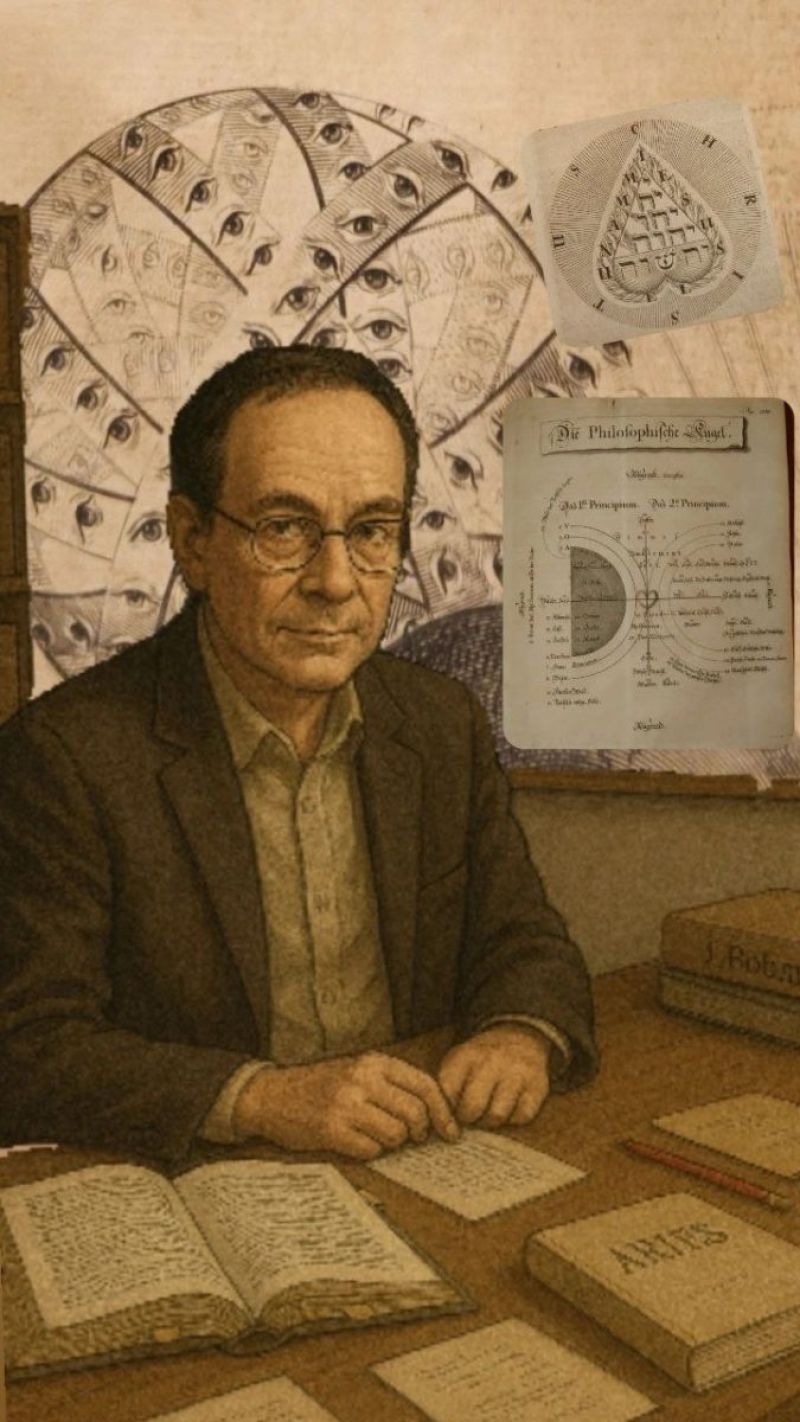
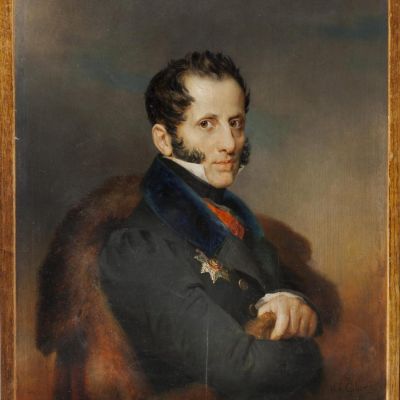
A symbolic portrait of Professor Pierre Deghaye,
in the absence of a real picture.
*
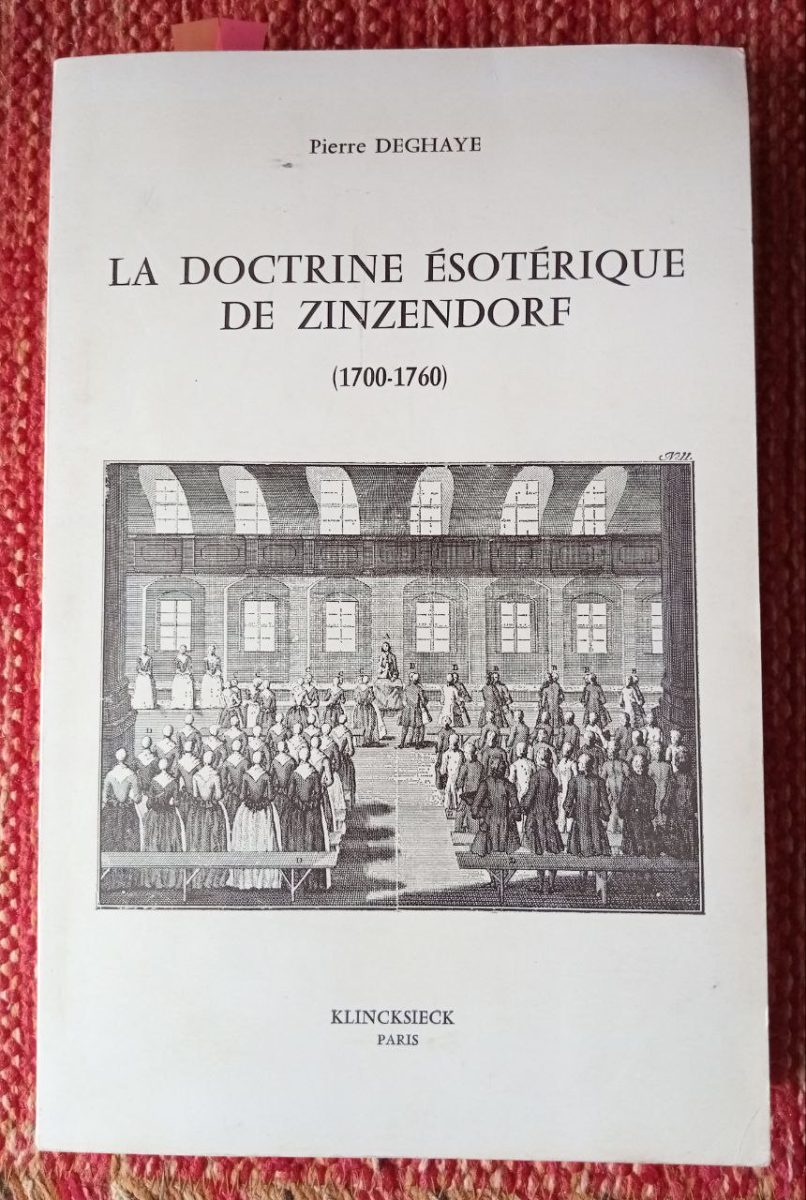
Today’s sharing from the Blue House of VIA-HYGEIA is part 3 of our sampler series dedicated to honoring the memory of professor Pierre Deghaye (1924–2005), with this extract, ‘The Mysticism Of Incarnation, or of the Incarnate Man‘, from one of his trailblazing publication, ‘La Doctrine Esotérique de Zinzendorf‘ (The Esoteric Doctrine of Zinzendorf), published by Editions Klincksieck in Paris, in 1969. It is part III, chapter 4-section d. A Via-HYGEIA English translation from the original French. From page 541 to 557. Coming next as A Little Pierre Deghaye Sampler –Part 4: ‘The ‘Mustard Seed Order (Senfkorn Orden), A Christian Secret Society’.
**
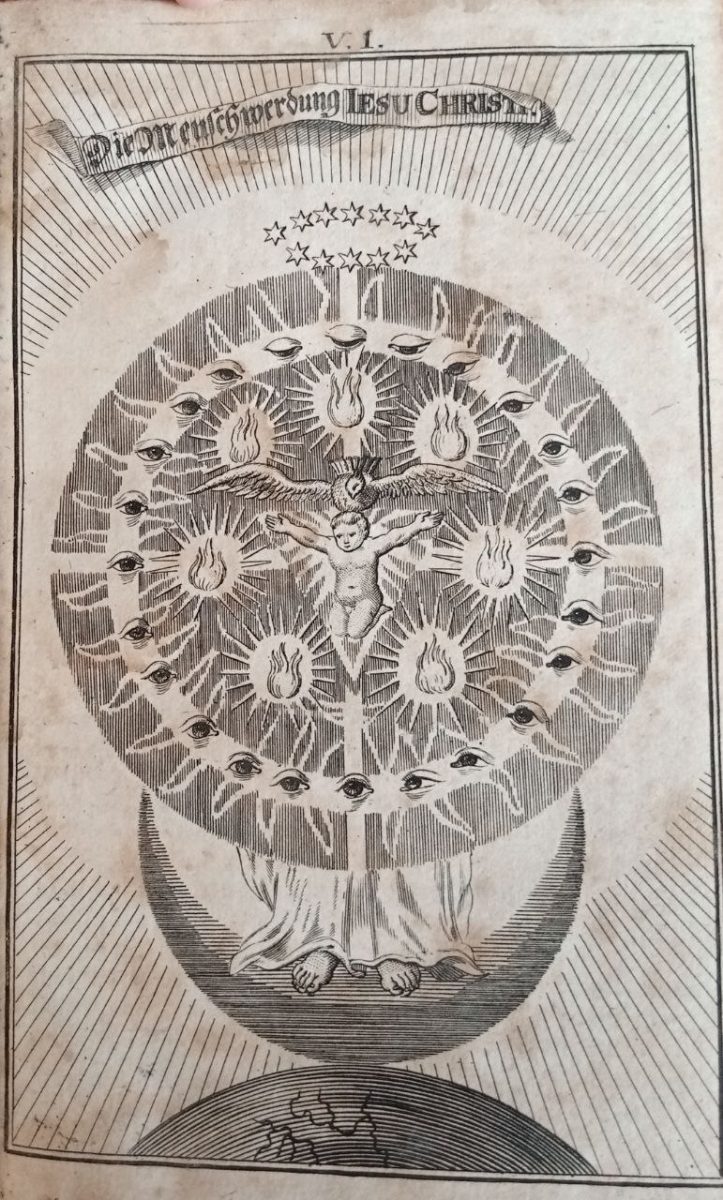
d) The Mysticism of Incarnation,
or of the Incarnate Man
Kabbalah, Gnosis, and the doctrine of Boehme are all three mysticisms of Man. But in these mysticisms, the notion of Man covers diverse realities. We have glimpsed this diversity.
For C. G. Jung, alchemy and Gnosis are related because they share the same fundamental theme: the Anthropos. This is true, but it is also a paradox. This connection appears paradoxical to us if we only glimpse the abyss that separates the Gnostic mentality from the philosophy of nature, the science of phusis.
We speak of the Gnostic mentality as it appears to us fixed in the forms we have mentioned. Both the author of the Pseudo-Clementine Homilies and the Valentinians are resolutely dualistic: they oppose matter to spirit, body to soul. How could they inspire a philosophy of nature whose goal is the assumption of matter? These Gnostics represent the extreme form of idealism combated by Oetinger from the perspective of his spiritual alchemy.
Nevertheless, alchemists were able to take up the theme of the primordial Anthropos in a completely different spirit. This theme was not invented by the Gnosticism of the first centuries after Jesus Christ. One could say it is as old as the world. Bousset showed its very distant origins, at the sources of the Orient, and its quasi-universal diffusion (482). If one reduces Gnosis to these origins, if one has it encompass all doctrines that proceed from them, one risks losing sight of what constitutes the very nature of Gnosticism in the historical phenomenon known by that name.
Alchemists could have borrowed from the Gnostics themselves a theme of which they were not the authors, and treat it in a spirit different from theirs. In the Hellenistic world, this spirit could have been that of Stoic philosophy. For the Stoics, God was a subtle body spread throughout the entirety of matter (483). This conception, in which the duality of God and matter is resolved, agreed with the theory of the macro-anthropos, body of the Divinity.
Note: (482)Wilhelm Bousset, ‘Hauptprobleme der Gnosis‘, entire chapter IV (pp. 160-222). (483) Cf. Joseph Moreau, op. cit., p. 163.
*
Let us add that the Neo-Platonists themselves opposed the Gnostic sectarians. Plotinus fought them. An entire book of the second Ennead is intended to refute their errors (484). For Plotinus, creation is not an evil, quite the contrary. The First Soul did not fall when it created the cosmos (485). Generation is the sign of the perfection attained by the being that begets.
We find in Plotinus the Neo-Platonic version of the bonum diffusum sui. The First Soul begets according to the law of all perfection, which governs all beings in the scale of the Good. As soon as a being reaches the degree of perfection conforming to its nature, says Plotinus, it begets (486).
We have seen a serious contradiction in the Pseudo-Clementine Homilies (487). The author develops a metaphysics of the Divine that spreads into creation. But on the other hand, as soon as he turns toward the real world, he feels only disgust. On the metaphysical plane, the author of the Pseudo-Clementine Homilies approaches the Neo-Platonic spirit. On the plane of lived experience, he is Gnostic. These texts betray an internal opposition between two totally different spirits. The author is doubtless divided between a received metaphysics and his personal reaction, which brings him closer to the Gnostics.
Gnosticism is first for us the symbol of an idealism that considers matter as evil and the sublunary world, our own, as hell. It is connected to Manichaeism, while differing from it. For the Manichaeans, from the beginning of the worlds we witness the struggle between Light and Darkness. From the upper limit of his Kingdom, the Prince of Darkness sees the splendor of the Light. From then on, he has only one thought, to conquer it, not to transform himself into it, to equal it in brilliance, but on the contrary to engulf it (488).
To counter this threat, the King of Light dispatches a hero to fight the Prince of Darkness. This hero is an emanation of himself, like his own self. He is called the Primordial Man (489).
Clothed in an armor, which is his soul composed of the five elements, this hero descends to confront the Master of Darkness. However, he is vanquished and engulfed by the demons (490).
Notes: (484) This is book IX, cf. Plotinus, ‘Enneads‘ II, text established and translated by E. Bréhier, Paris, Les Belles Lettres, 1956, IX (Against the Gnostics), pp. 111-138. (485) Ibid., chap. IV, p. 115. (486) ‘Enneads‘ V, ed. Bréhier, Paris, Les Belles Lettres, 1956, book I, chap. VI, p. 22. See E. Bréhier, ‘La philosophie de Plotin’, Paris, 1928, pp. 41-42. (487) Above, pp. 530-532. (488) Cf. Henri-Charles Puech, ‘Le manichésime’, Paris, 1949, p. 76. (489) Ibid., pp. 76-77. (490) Ibid., p. 77.
*
It will be necessary to save this Primordial Man. This is the first operation of salvation. The King of Light will emanate a hypostasis that will be the Savior. He will penetrate inside the Darkness and seize the hand of the captive to hoist him out of the abyss, a gesture that became ritual in the Manichaean church (491). The Primordial Man is saved, but he leaves his armor, that is, his soul, in the Darkness. This will be the luminous substance buried in the matter of our earthly world, and which an immense machine equipped with wheels to draw up souls, a cosmic noria, will withdraw from the mud (492). The luminous substance held captive in matter is a symbol of pain incarnated in the person of Jesus Patibilis. Jesus on the cross is the celestial Christ crucified on Matter. The entire world appears as a cross of pain, even the trees serve as gibbets for Christ (493). Thus the world is a Gehenna, and Jesus is crucified in hell. If, on the other hand, from the perspective of the divine promise, the world appears as a place of salvation (494), in itself it will always be a dark abode, unless it ceases to exist. It could not be transformed into a kingdom of light.
Let us return to the origins we have mentioned. The primordial Anthropos is engulfed by the darkness after a combat that ended in defeat for him. However, we have another version of this myth, that of voluntary sacrifice. According to this interpretation, the Primordial Man himself conceived the project of sacrificing himself to the Darkness. It will engulf him and seek to hold him captive. But a principle, however luminous it may be, is a poison for an essence contrary to its own. Thus, light is a poison for darkness. The luminous substance of the Primordial Man will therefore be a toxin within the Darkness (495). Consequently, this substance will undermine the enemy world and destroy it from within. In this perspective, the preliminary combat hardly has any meaning. If there is a struggle, it will unfold only inside the abyss.
In the parallel myth of the descent into hell, it is no longer because the monster is avid for light that it engulfs the Anthropos. On the contrary, if the abyss recognized Life, it would not let it penetrate. Hell engulfs only what conforms to its nature, that is, death. It will therefore be necessary to deceive the monster’s vigilance so that it opens its jaws. This is what Christ does according to a doctrine attributed to disciples of Marcion. To go to hell, Christ must die, in order to make himself similar to the power that symbolizes the dark abode: Death (496).
In a text attributed to Bardesanes, a heresiarch of the 2nd century, the Hymn of the Pearl, the envoy of God, the Son of the King, goes into the Darkness, symbolized by Egypt, to bring back a pearl that has a magical virtue and thanks to which the infernal powers exercise their empire. As soon as they lose it, this empire will end (497). Now, to enter Egypt, the Son of the King is obliged to dress as an Egyptian, so as not to attract the monster’s attention (498).
Notes: (491)Ibid., p. 78.(492) Ibid., p. 83(493) Ibid., pp. 82-83. (494) Ibid., p. 83. ((496) Cf. Bousset, Hauptprobleme, pp. 258-259. (497) Ibid., pp. 250-251. (498) Ibid., pp. 252-253.
*
Thus the envoy of God makes himself similar to the matter he wishes to penetrate. It is interesting to find this theme in a text whose author claims the Great Art. It is a short treatise ‘On the Letter Omega’, which dates from the 2nd century and has been attributed to Zosimus of Panopolis, a Greek alchemist (499). In his work entitled ‘Psychologie und Alchemie’, C. G. Jung gives extracts from it in quotation (500).
In the opuscule attributed to Zosimus, the Son of God is the Savior who snatches souls from the world of Fate, of Εἱμαρμένη (heimarméné), to restore them to the spiritual world. This soter can transform himself at will. He penetrates each body to illuminate the soul it encloses.
It is significant to see this motif emphasized in a context dealing with alchemy. This Savior resembles the universal matter of the philosophers, mercury, which takes on all forms without losing itself (501). We have seen the notion of ens penetrable, highlighted by Boehme and Oetinger (502). We glimpse its distant origins.
The universal matter of the alchemists is a poison. To penetrate bodies and rid them of what is impure, a toxic agent is needed. This toxic agent is the philosophers’ mercury. One must dissolve, kill, to reach the pure and immaculate nature. This is the function of the poison, or of fire, of the cautery. Mercury is a poison. It is also a fire, an igneous remedy, that burns, corrupts, and exhausts bodies (503).
This classical conception of the philosophers’ mercury agrees with the Manichaean version of the Son of God who penetrates by ruse into the world of Darkness to destroy it from within. We have seen how for the Manichaeans Life itself could be a principle of death. So too, Death is a principle of survival for the dark beings that haunt its kingdom. Everything is a question of primordial nature. Put a demon in Paradise, for him it will be hell. Everything that does not conform to our essence is hell. Life and Death are therefore reversible depending on the perspective.
At the risk of shocking orthodoxy, Zinzendorf kept repeating that the crucified body of the Lord was a principle of death. He saw in the subtle emanations of this body a precipitating powder (504) or a remedy that made him think of the arcana of the alchemical physicians (505).
Notes: (499) J. Doresse speaks of Pseudo-Zosimus, cf. ‘Les livres secrets’, p. 105. (500) ‘Psychologie und Alchemie’, Zürich, 1944, pp. 492-502. (501) Doresse, op. cit., p. 106 (the Son becoming all things); Jung, op. cit., pp. 505-506; Marcelin Berthelot, ‘Les origines de l’Alchimie’, Paris, G. Steinheil, 1885, p. 272 (on mercury which takes all forms and subsists itself). (502) Above, pp. 486-488. (503) Cf. Berthelot, op. cit., p. 276. (504) DAC, p. 189: ‘das praecipithende Pulver‘. (505) Mos I, p. 50.
*
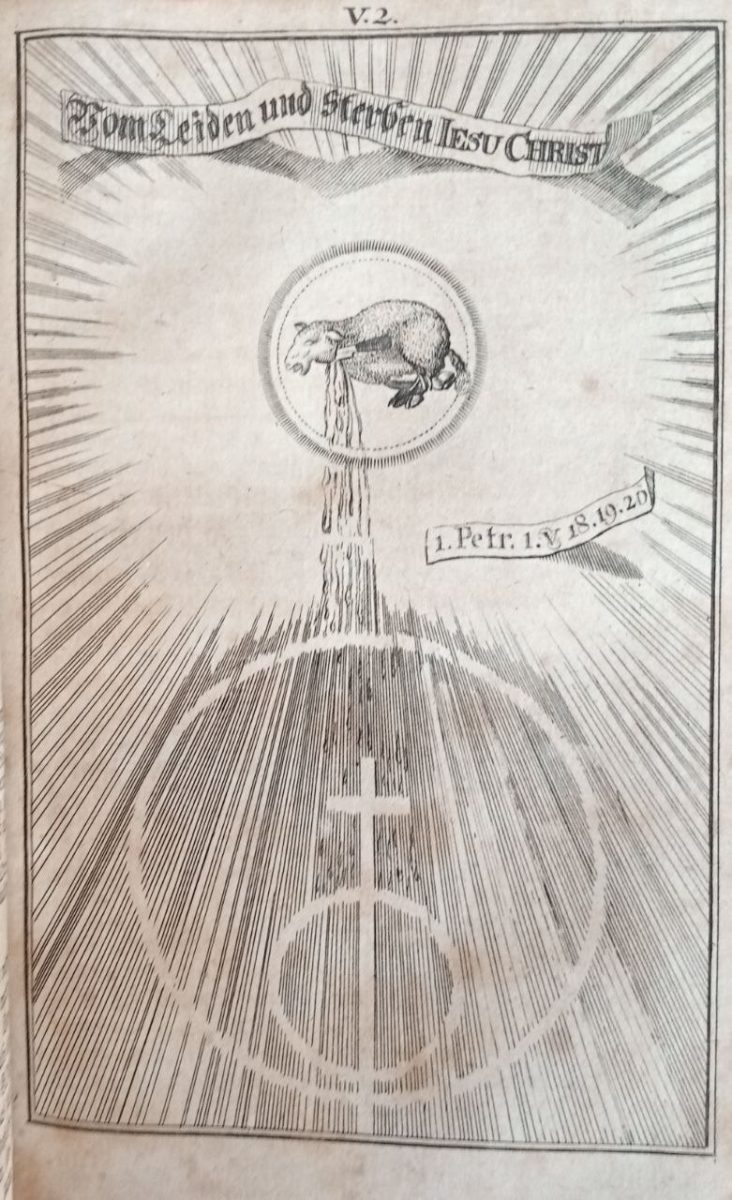
In the sense of his spiritual alchemy, Zinzendorf takes literally Romans 7:4: Christians are put to death by the body of Christ (506). It is the body of death spoken of by Saint Paul, which is to be destroyed. Now, Zinzendorf re-transposes this entire chapter VII of the Epistle to the Romans in the spirit of the sacred art. All that is bad in matter, that is, in our flesh, must be burned, so that our body is reduced to its incorruptible part. The body of Christ on the cross is the chemical agent of this cauterization (507).
To speak of the flesh of Jesus is also to speak of his blood. Flesh and blood are inseparable in the crucified body (508). In the chemistry of the bloody grace (blutige Gnade), the blood of Christ is first an igneous remedy similar to the philosophers’ mercury. It is thanks to it that the great washing (509) will be accomplished, by which we will be rid of our evil flesh and humors. The blood of Christ is the refiner’s fire (510). Zinzendorf borrows this expression from the prophecy of Malachi. The prophet could suggest to him the image of a chemist God from the perspective of the Judgment: ‘But who can endure the day of his coming? And who can stand when he appears? For he is like a refiner’s fire and like fullers’ soap; he will sit as a refiner and purifier of silver, and he will purify the sons of Levi and refine them like gold and silver…’ (511).
Conceived as universal matter, the body of Christ, under the species of his flesh or his blood, is a chemical agent that penetrates and dissolves. This conception can agree with the Manichaean myth. But let us see what is particular about the text cited by Jung under the name of Zosimus, even in relation to this myth.
In this Gnostic text, the Son of God has the faculty of penetrating all bodies. In this he resembles both the Primordial Man of the Manichaeans, who introduces himself into the very heart of the world of Darkness, and the universal matter of the philosophers. But unlike the Anthropos of the Manichaeans, we do not see him at any moment a prisoner of this world in which he moves. He is not at all that Jesus crucified on matter, whose painful face the Manichaeans show us. For a Gnostic of the 2nd century, the Passion of the Savior is a simulacrum. In the extracts cited by Jung, the essential argument of Docetism is quite apparent. The Son of God has the faculty to transform himself at will. Sometimes he is God or an angel, sometimes he is a man capable of suffering like a creature (512). To men he appeared with his mask of a tortured man (513). Now, the author hastens to emphasize that the Son of God did not truly suffer (514). Docetism distances us greatly from the central figure of the Manichaean myth: Jesus Patibilis.
Notes: (506) Ibid., p. 189. (507) Ibid. (508) Mos I, p. 50. (509) DAC, p. 190. (510) Mos I, p. 50. (511) Malachi 3:2-3. (512) Jung, op. cit., p. 500. (513) Ibid. (514) Ibid., p. 500.
*
This Savior, who is the Gnostic incarnation of the Son of God, does not engage in combat with the powers of Darkness. He triumphs over Death by ruse, by stealing the men of light from her without her even noticing (515), and that is all.
In the Manichaean myth, the primordial Anthropos truly comes into contact with matter. Either it is open struggle with the Dragon, or it is a slow, secret process, which we can compare to a chemical action: the luminous substance is mortal for a contrary nature and it will gradually undermine it.
In the Gnostic extracts cited and analyzed by Jung, the Son of God has no real contact with bodies. He passes through them like a shadow to converse with the soul that inhabits their enclosure. But he does not commit himself in the least to confront matter. It is not he who will kill; it is a negating spirit, called Antimimos.
(A Via-Hygeia Note: ἀντί (antí): means “against,” “opposite,” “in place of.”μῖμος (mîmos): means “imitator,” “actor,” “mimic.”Thus, Antimimos fundamentally means “the opposing imitator,” “the counterfeit,” or “the adversarial mimic.” It is a spirit whose nature is to deceptively oppose and copy, with the intent to distort or destroy the original).
Jung is doubtless a bit too impatient to see in this antagonistic spirit the brother of the Son of God. It was tempting for him to pair these two personages to make a hermaphrodite symbolizing the androgynous nature of mercury (516). However, the unprejudiced reader sees them as separate. Apparently, nothing in this text allows us to conclude to the union of opposites, to that famous coincidentia oppositorum that Jung saw illustrated in the philosophers’ prima materia.
Antimimos is a destructive principle. Conforming to his nature, it is the spirit he should destroy. That is indeed what he intends to do. However, he will fall victim to a subterfuge. Instructed by the Son of God, the men of light will deceive him. He will believe he is attacking their luminous substance, but he will be duped. On the advice of their divine master, these elect will preserve their being of light and give as fodder only the old man (517). Through a play of substitution, the Adversary will engulf his own principle.
Antimimos accomplishes the task normally allotted to the Son of God. One can guess all the repugnance the author could feel at the thought that the Spirit might expose itself by confronting matter. The Spirit would be soiled by contact with its victim. On this point, the author of the treatise On the Letter Omega distances himself from the Manichaean myth, but also, and above all, he betrays a mentality that is very different from the spirit of the “philosophers,” despite the chemical turn of his text. He is an idealistic Gnostic, for whom chemical reality was doubtless reduced to an allegory.
We know two personages from this text, the Son of God and his antagonist, Antimimos. We see a third. It is the cosmic Adam, whose body symbolizes the four elements (518). This Adam presents to us sometimes the image of the spirit, sometimes that of the soul, sometimes it is that of the flesh that he shows us (519). He thus appears to us as a symbol of totality that could only seduce Jung. But here again, the author of Psychologie und Alchemie doubtless forces reality by purely and simply identifying this cosmic Adam, primordial Anthropos, with the Son of God (520).
Notes: (515) Ibid., p. 506. (516) Ibid., p. 506. (517) Ibid., p. 506. (518) Ibid., p. 496. (519) Ibid., p. 498. (520) Ibid., pp. 502-503.
*
The God of the Gnostics has difficulty embracing cosmic totality. When the Divinity clothes itself with the cosmos as with a mantle, it is, at best, for a simulacrum. If it is to truly wed the earth, it is fornication. The Son of God can only identify with the spiritual man who is hidden in the cosmic Adam. He is called light, but the memory of his true name has been lost (521). As for the name of Thoth, that of the Egyptian deity given to the Primordial Man symbolized by this Adam, it designates the being of flesh in his visible body (522). We have here distinctions that it is difficult not to take into account.
Thus, the Manichaean myth agrees with one aspect of the chemical work: one can compare the Primordial Man of this myth to the universal substance of the philosophers that insinuates itself into gross matter to attack it from within. But Hellenistic Gnosis gives us an idealized form of the old dualism between spirit and matter. It is repugnant to see the spiritual element attack bodies directly.
In chemical philosophy, the spirit must itself become matter to exercise its action inside bodies. The universal substance is both spirit and matter. Now, in the eyes of a Gnostic sectarian, this coincidence of opposites risks strongly resembling fornication.
Let us now see the other aspect of the chemical work. It is not only a matter of reducing; the ultimate objective is the promotion of matter. This is a goal that is difficult to reconcile with the properly Gnostic spirit, hostile to the world of bodies. It does not agree with Manichaean doctrine.
Mercury is a poison. But the universal substance is also an elixir of life. It brings matter to its perfection. Base lead changes into gold. The man of bronze becomes a man of silver, then a man of gold (523).
One cannot imagine the light of the Manichaeans making Darkness shine, any more than some Gnostic Anthropos regenerating the flesh issued from the Feminine from on high. Its action can at most aim to destroy it, if indeed it does not shrink from committing itself against it.
After citing and analyzing the text he attributes to Zosimus of Panopolis, Jung gives an extract from a text from the 14th century. The author of this text is an alchemist from Ferrara, Pietro Antonio Boni, also known as Petrus Bonus & Peter the Physician. Here, says Jung, we have the oldest document where the correspondence between Christ and the philosopher’s stone is explicit in a detailed manner (524).
Notes: 521)Ibid., p. 496522) Ibid.( (
*
According to a tradition reported by the author, the union of heaven and earth must be accomplished at the end. This is the word of the philosophers, of the sages (525). The fruit of this union is the resurrection of the body of flesh into a glorious body. We are at the antipodes of Gnostic thought.
The term of the chemical work is symbolized by the Day of the Lord (526). On this Day of Yahweh, the resurrected will appear with their body of glory (527). It is in this glorious body of the resurrected that the mystery of the philosopher’s stone is revealed.
This subtle body is not a gift from heaven with which the earth would not be associated at all. It is formed by the conjunction of the soul and the body of flesh in which it had taken up residence before the death of the earthly man. The soul does not flee the body to unite with a distant logos. On the contrary, it finds it again to glorify it.
It is therefore the body of flesh that is promoted to the rank of spiritual body. It has become incorruptible and has the agility of the materia prima: it penetrates everything. Its nature is both spiritual and material (528). This chemical philosophy makes the union of the two natures, one of divine essence, the other human, the goal of the opus.
The model for this union is the one accomplished in the womb of Mary, where God united himself to man. Only man could unite with God, Peter the Physician emphasizes, for other creatures are separated from the Divinity by dissimilarity (529). We see how this alchemy is a mysticism of man. Even in other alchemical texts, whose inspiration is less elevated, we see metals identified with man. Chemistry proper transforms into a veritable biology of metals, and through this channel one always rediscovers the human phenomenon.
The philosophy of Peter the Physician is a mysticism of incarnation, of the incarnate man. The paradigm of the opus is the conception of Jesus in the womb of Mary. Zinzendorf himself would evoke this conception using a symbolism he may have borrowed from the adepts of the sacred art, either directly or through an intermediary.
We have already spoken of a symbolism of the cosmic egg, rather disconcerting for the reader uninitiated in Zinzendorf’s homilies (530). He speaks of an egg hatched by the Holy Spirit. It is from this egg that the creature emerged. This symbolism is attached to that of Genesis 1:2. The brooding Spirit is the one who hovered over the waters, spiritus creator. The waters represent the entirety of the creature that slumbers and that will be called into existence by the life-giving breath. Now, this cosmic totality is also identified with a primordial egg, from which the world will emerge (531).
Notes: (525) Ibid., p. 509. (526) Ibid., p. 510. (527) Ibid. See above, p. 545, a text from the book of Malachi situated in the perspective of the Day of the Lord. (528) Jung, op. cit., p. 510. (529) Ibid., pp. 510-511. (530) Above, p. 76. (531) Cf. the commentary on Genesis 1:2 in JHD, 3 January 1755: ‘Ich vermuthe, der Sinn ist ; der Geist GOttes ist über die ganze Creatur hergefahren, hat sie ausgebrütet, hervorkommen machen aus dem Ei, und hat ihr eigentlich das Leben, das geistliche Wesen gegeben‘.
*
On the other hand, Zinzendorf identifies the womb of the Virgin with this cosmogonic egg that was hatched by the Spirit hovering over the waters. This Spirit is the universal Mother. It is this Mother who over-shadowed the womb of Mary. She literally hatched the Savior, like a hen, Zinzendorf does not hesitate to say (532).
This symbol of the cosmogonic egg is of oriental origin (533). Did Zinzendorf receive it from the Orient? It is very unlikely. On the other hand, he may have found it in texts inspired by the philosophical tradition. The philosophers’ egg of the alchemists, the vessel containing the matter of the Work placed in the furnace, evokes the memory of the primordial egg of Egypt and Chaldea. It is both, says Berthelot in the context of these oriental origins, the sign of the sacred work and of the creation of the universe (534).
What now is the profound meaning of this egg symbolism, both among the adepts of the sacred art and in Zinzendorf? The egg represents the primordial waters from which the creature will emerge. It is the symbol of the birth of the world. But the crowning of cosmogony is the birth of Jesus, of the God-Man in the womb of Mary. In turn, this birth will serve as the archetype for all those that will take place in our flesh, and whose consummation is marked by the Day of the Lord, symbol of completion.
The transmutation of matter is in fact that of man, of our flesh. Now, this does not at all mean that what is represented under the appearance of metals is only an allegory intended to explain a purely moral promotion. Our human flesh will become the quintessence of all matter, including that of which metals were believed to be made. In our flesh, it is all matter that is redeemed, that becomes gold. This is why, according a word of Saint Paul dear to Zinzendorf, the whole of nature, which groans, awaits the manifestation of the children of God (535).
Peter the Physician cites an adage of an ancient wisdom: ‘At the end of time, the marriage of heaven and earth must be accomplished‘. This adage summarizes the profound meaning of a philosophy of nature with which Zinzendorf’s Christosophy perfectly agrees.
The union of heaven and earth is also the aim of the Kabbalist (536).
Note: (532) AS, p. 578. Cf. PR, I, p. 47. (533) Cf. above, p. 76, note 16. (534) Berthelot, op. cit., p. 51. Cf. Jung, ‘Paracelsica’, Zürich, 1942, p. 118 (the egg containing the four elements). On the symbolism of the egg that encloses the world soul, cf. Jung, ‘Psychologie und Alchemie’, p. 278. (535) Romans 8:19: ‘For the creation waits with eager longing for the revealing of the children of God‘. Cf. above, p. 298. For the parallelism between metals and man, cf. Berthelot, op. cit., p. 60. (536) See above, pp. 521-522.
*
Gershom Scholem evokes this theme concerning practical Kabbalah, conceived as a magical art of creation. The product of this art is a homunculus, which its adepts call a golem.
The prototype of the golem is Adam, born in the likeness of the Primordial Man. Now, Adam is issued from the marriage between Elohim, the God of Genesis, and Edem, that is, Israel or the Earth (537). The adepts attempt to imitate this hierogamy to conceive their golem, whose birth repeats that of Adam (538).
Certainly, in practice, the creative art of the Kabbalists has its limits. The demiurgic adept is capable of giving his golem a body of clay, which grows, but he does not manage to give it speech (539). He is incapable of communicating to it the breath of life thanks to which it could speak. Why? Because in itself this breath of life is altered by contact with impurity (540). If he were without sin, man could create a world. Now, the Kabbalist is always conscious of being a sinner. On the other hand, this practice is dangerous, for it sets in motion forces that can annihilate its author (541). The Kabbalist attributes to man in himself an extra-ordinary power: the Just One is the foundation of the world. But at the same time the Jewish mentality distrusts the real man, whoever he may be. It knows him to be a sinner. The just man would be the equal of God, but men must always be reminded of the word of Scripture: ‘But your iniquities have made a separation between you and your God‘.(542).
Thus, in the context of Jewish mysticism, the creative art quickly appears as a dubious, even guilty, theurgy. We must therefore not attribute excessive importance to it. But it is interesting to note that the ideas claimed by this practice are found exactly in the alchemical tradition. The aim of the spagyric art is indeed the union of heaven and earth. This hierogamy is accomplished in the image of sexual union. The fruit of this union is concretized in a birth. Finally, the principle on which the sacred art is founded is the law of correspondence between the worlds. What is accomplished on the plane of the Divinity is repeated in our world. What happens in heaven is reproduced exactly in the sublunary world (543). It is by virtue of this principle that the adept imitates God, on the plane proper to him. This is why, on this plane, the physicist of antiquity says the same thing as the philosopher who treats divine things (544). He takes up the ideas of Plato, notably those of the ‘Timaeus’ (545). Kabbalah itself pushed to its ultimate consequences the principle of analogy that governs the entire scale of beings in ancient thought. On the other hand, the properly Gnostic spirit is fundamentally contrary to this principle. For it, there could be no analogy between Heaven & Earth, between Light & Darkness.
(537) Cf. Scholem, ‘La Kabbale et sa symbolique’, p. 184. Two words have been confused, ‘adama (Earth) and ‘Eden (written Eden in the Septuagint version). (538) Ibid., p. 196. (539) Ibid., p. 186. (540) Ibid., p. 206. (541) Ibid., p. 205. (542) Isaiah 59:2; Scholem, op. cit., p. 186. (543) Cf. Jung, ‘Paracelsica’, p. 94. (544) Cf. Berthelot, op. cit., p. 250. (545) Ibid., p. 264.
*
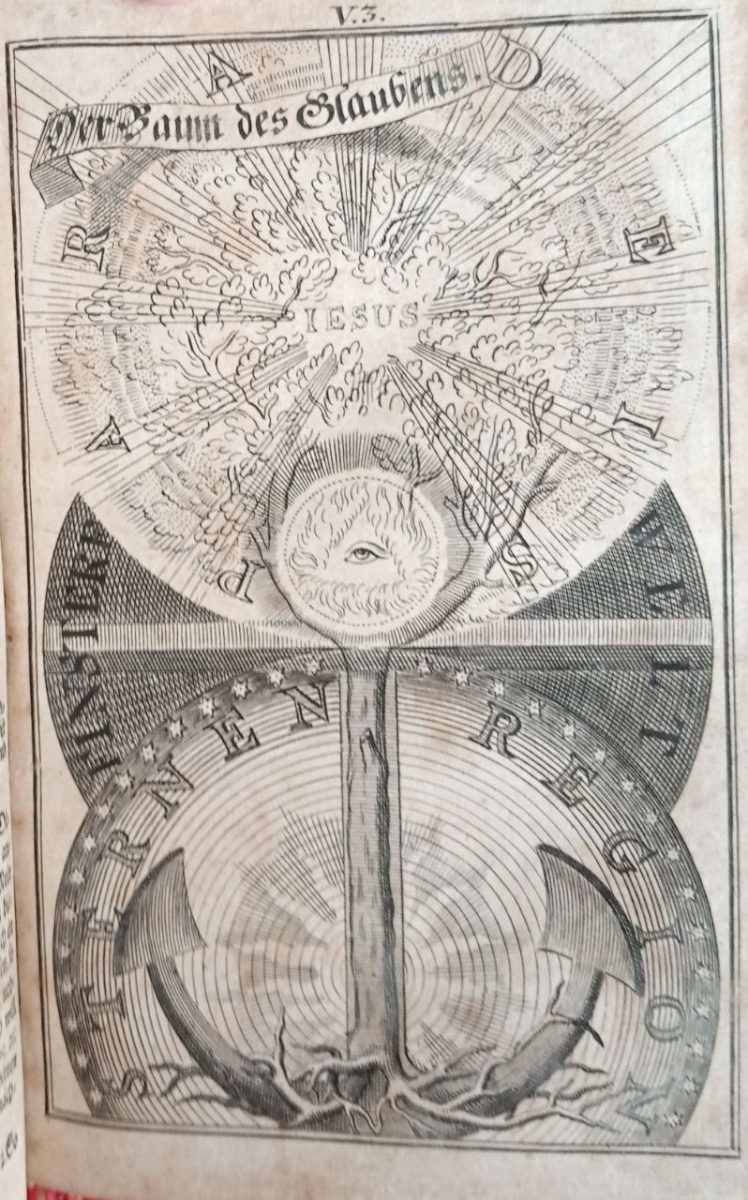
The fundamental theme of alchemy, the conjunction of heaven and earth, is generally traced back to the Gnostic syzygy. Berthelot himself emphasizes the importance of this motif. He takes the example of Zosimus of Panopolis. According to this philosopher, a Greek alchemist born in Egypt, the work is accomplished by the union between the male element, assimilated to the east, and the female element, compared to the west (546). The union of the sun and the moon will be a constant theme of alchemy. For Berthelot, it is of Gnostic inspiration. For Jung, likewise, the hermaphrodite, the rebis of the alchemists, originates in Gnosis.
The alchemists of the origins identify their science with the art of ancient Egypt, as Berthelot himself says (547). It is doubtless difficult to verify the authenticity of these ancient origins. Now, in the Egypt where the Greek Zosimus was born, he found traditions that cannot be limited to what Gnosticism of the 3rd century represents for us.
The name Gnosis is given to diverse traditions without specifying the differences between this Gnosis and Gnosticism proper. As soon as there is mention of a bisexual anthropos, one speaks of Gnosis. Now, in his work devoted to the cosmic God in Hermetic philosophy, Father Festugière cites sources that are not Gnostic, notably Asclepius, a Greek physician of the 2nd century, for whom the Divinity is androgynous (548). The Corpus Hermeticum itself represents an entire tradition that offered alchemists its conception of the macro-anthropos (549).
In this Hellenistic world, Father Festugière clearly shows the existence of two currents, one Gnostic, the other cosmic (550). According to the eminent commentator of The Revelation of Hermes Trismegistus, the famous myth of the Poimandres, often cited to illustrate the conception of the primordial Anthropos of Gnosis, arises from diverse tendencies and even reconciles them very poorly. It is an ambiguous source (551).
In the Middle Ages, philosophers rediscovered the principles of ancient alchemy, but amalgamated them with Christian theology. Now, they interpreted this theology in a sense that radically opposed it to Gnosis. Peter the Physician maintains that the sacred art stands above nature (552). Now, if the practice of the philosophers transcends nature, or at least aspires to this end, it is to glorify the created world, and not to forget it like a Gnostic nightmare. It is to restore to it its original beauty, like an old man reborn in a young body, like a father who changes into his son (553).
(546) Ibid., p. 64. (547) Ibid., p. 27. (548) Cf. André-Jean Festugière, ‘La Révélation d’Hermès Trismégiste’, II, ‘Le Dieu cosmique’, Paris, Gabalda, 1949, p. 69. (549) Ibid., II, p. 82. (550) Ibid., III, ‘Les doctrines de l’âme’, Paris, 1952, p. 35. (551) Ibid., III, pp. 87 and 95. (552) Jung, ‘Psychologie und Alchemie’, p. 510. (553) Ibid., p. 511.
*
Alchemy makes its purpose a fundamental theme of Christian theology: the resurrection of the bodies (554). It transposes the eschatological perspective to bring the beyond into a universe which is not necessarily that of gross materiality, but which is for the adepts a present world. Eschatological reality becomes a present and concrete reality: the Day of the Lord is the term of the work.
Certainly, all that the adept perceives is symbol. But what for the philosopher is symbol, is not a simple reflection, a weakened image. For Paracelsus, for example, that curious incarnation of the philosophical spirit, everything is symbol. But Paracelsus is not an idealist for all that. The physician-philosopher does not at all despise our world. Certainly, he does not take it as we see it superficially. But he is attached to it. Within sensible matter itself, the physicist discovers a dimension that will give a new reality to the real (555).
For Paracelsus, says Koyré, there is no body without a soul. But one cannot imagine a soul without a body any more: every essence must have a body (556).
Thus the symbols of alchemical books are not simple signs, or allegories. They are valorized by the reality they make sensible: the philosopher’s stone truly has a meaning because it is Christ. But conversely, the symbol valorizes a truth which, without this analogy we perceive, would remain a dead letter: the truth contained in Christ becomes effective in the philosopher’s stone. On the one hand, alchemy has imitated theology. But on the other hand, through the sacred art one rediscovers the truths of faith.
In alchemical symbolism, Christ truly participates in both worlds, as Koyré says in a striking formula: ‘The philosopher’s stone is the Christ of nature, and Christ is the philosopher’s stone of the spirit‘. (557).
Christ thus incarnates that totality which the androgynous mercury unites. But before representing it completed, he is its principle. The philosopher’s stone is not only the product of the work, it is first its agent. Before figuring the syzygy of the two worlds, the heterogamy celebrated between heaven and earth, the conjunction of the sun and the moon, it is the artisan of this union. Mercury is par excellence the mediator between the sun and the moon (558).
Among alchemists, the idea of mediation derives from an axiom imitated from Platonic metaphysics: it is impossible to unite two bodies without a third (559). Mercury is par excellence this intermediate body. Now, Christ is the spiritual mercury of the universe. He is the great mediator. Before being the symbol of the totality achieved in the conjunction of opposites, Christ is the principle thanks to which this conjunction is realized.
Notes: (554) Cf. C. G. Jung, ‘Die Erlösungsvorstellungen in der Alchemie’, Eranos-Jahrbuch, 1936, p. 99: ‘What alchemy ultimately wanted: it wanted to produce a corpus subtile, the glorified resurrection body’.
(555) See A. Koyré, ‘Mystiques, spirituels, alchimistes du xvie siècle allemand’, Paris 1955, p. 54. (556) Ibid., p. 55. (557) Ibid., p. 70. (558) Ibid. (559) Berthelot, op. cit., p. 275.
*
The philosopher’s stone identified with Christ thus symbolizes both the principle of the work and its product. But the principle of the work is not only a means, it is also the artist who puts this means into operation. The man who works at his furnace only imitates the artistic genius who, in an invisible form, works within matter. It is this genius that the philosophers of nature designate by the name of archeus (archeus). The archeus is first the genius of the earth, the fire that animates nature (560). It is thanks to him that the growth of metals operates. Now, what is accomplished in the metals is in the image of what occurs in man, and vice-versa. The archeus acts both in our human body and in the depths of the earth. The archeus is first of all that subtle alchemist who operates in our belly. It is he who presides over our nutritive functions. He realizes in our food a sort of quintessence; he divides the matter and extracts from it what is necessary for our nutrition (561). But the archeus is more than this alimentary genius. It is he who specifies the nature of each being according to its species (562), it is a veritable principle of life.
The Christ of Zinzendorf is this mystical alchemist who operates inside our bodies. The active substance with which he identifies is his Spirit. It is the Spirit of life that is in all things. It is in the sap of trees, in the seed that germinates in the earth, as well as in man (563). It communicates itself to each body according to a mode conforming to its species, to its variety (564), just like that principle to which alchemists give the name of Mars or Ares and which specifies the individual on the biological plane. Ares is a name of the archeus (565). All the chemical attributes of the incarnate Word will be summed up in Zinzendorf in the blood of Jesus. The doctrine of the blood of Christ, universal tincture, we know, was not invented by Zinzendorf. It is already in Boehme (566). But Boehme himself is by no means the first to see in blood the primordial matter. We find among alchemists a symbolism of blood that it is not useless to recall in our context. The menstruum of the philosophers is none other than mercury.
The alcahest of Van Helmont is this universal menstruum. It is the most perfect of salts (567). In late alchemy, the philosophers’ mercury has a competitor. It is salt. If one knows salt and its preparation, one possesses the secret hidden from the ancient sages (568). The philosophers could refer to the Gospel. ‘Salt is good‘, says Jesus in a verse already cited (569). This saying must have interested the sages all the more as the following consideration on salt that loses its savor ends in an atmosphere of mystery: ‘He who has ears to hear, let him hear!‘ (570).
Notes: (560) Jung, ‘Paracelsica‘, pp. 96-97.(561) Koyreˊ, ‘Mystiques, spirituels, alchimistes‘ … p. 70, note 1. (562) Jung, ‘Paracelsica‘, note 2 on page 95. (563) Cf. the continuation of the passage from JHD (3 January 1755) cited above, p. 549, note 63: ‘… und halt ihr eigentlich das Leben, das geistliche Wesen gegeben (sein lebendiger Geist ist in allem), einem jeglichen den Geist, der zu seiner Art geho¨rt. Dahin geho¨rt der Saft der Baüme und der Saam der Gewa¨chse, kurz, das Leben, von was Art es ist’. (564) Jung (‘Paracelsica‘, pp. 9697) defines it as follows: ‘der individuelle Gestalter‘, ‘principium individualiensis sensu strictiori’ (565) Ibid. (566) See above, p. 487. (567) Cf. Louis Figuier, ‘L’alchimie et les alchimistes‘, Paris, 1854, p. 62. (568) Ibid., p. 57. See Jung, ‘Psychologie und Alchemie‘, p. 353. (569) Mark 9:50; Figuier, op. cit., p. 57. (570) Mark 9:50 (cont.)
*
Like mercury, salt is an igneous remedy. Van Helmont finds in it fire under the two aspects we have already mentioned: fire softened by water and the fire of Gehenna (571). Jesus also says: ‘For everyone will be salted with fire‘. We know through Oetinger this symbolism of igneous salt, imitated by Zinzendorf (572). We see its origins.
The physicists see this salt also in metals (573). However, it is in the human body that alchemists of a later era will preferably seek the quintessence. They will believe they find their projection powder in the milk of virgins, but also in menstrual blood (574).
To our knowledge, Zinzendorf does not explicitly identify the blood of Jesus with menstrual flow. But however shocking it may be, this identification would not be surprising coming from him. In Zinzendorf’s preaching, the androgynous side of Jesus is abundantly described as a maternal womb. Jesus is this God who carries his children in his bosom, according to the very particular version that Zinzendorf gives of the prophecy of Isaiah: ‘Listen to me, O house of Jacob, all the remnant of the house of Israel, who have been borne by me from your birth, carried from the womb‘. (575). Zinzendorf transposes this text by making Jesus himself the mother of each of his children. The womb from which they are born is the side of Jesus, the divine matrix, and from this womb flow rivers of living water (576). This living water is the blood of Jesus, universal tincture. The vision of this generation conceived in the image of a river of blood flowing from the maternal womb is quite disturbing.
Notes: (571) Figuier, op. cit., p. 62. Cf. above, pp. 504-505. (572) See above, pp. 503-504. (573) Cf. Jung, ‘Psychologie und Alchemie’, p. 465. (574) Figuier, op. cit., p. 59. (575) Isaiah 46:3. (576) Mos II, p. 801. Here is the version given by Zinzendorf of Isaiah 46:3: ‘Die ihr von Mir im Leibe getragen werdet und Mir in der Mutter lieget‘. Zinzendorf continues by citing Isaiah 66:9. Here is this verse in the reading of the Jerusalem Bible, which corresponds to that of Luther’s Bible: ‘Shall I bring to the birth and not cause to bring forth? says the Lord; shall I, who cause to bring forth, shut the womb? says your God‘. Zinzendorf translates: ‘Solte Ich andere lassen geboren und selbst nicht auch geboren? Solte Ich andere lassen geboren und selbst verschlossen seyn?‘ Finally, this maternity of Christ is rendered by John 7:38: ‘Out of his heart shall flow rivers of living water‘. This saying echoes that of Exodus 17:6, whose text is the commentary of this homily of 18 July 1756: ‘Behold, I will stand before you there on the rock at Horeb; and you shall strike the rock, and water shall come out of it, that the people may drink‘. The rock is Christ, according to 1 Corinthians 10:4 (Cf. Mos II, p. 800). The hollow of the rock, through which water gushes, is the side of the Lord opened on the Cross (ibid., p. 801). The symbolism of this hollow of the rock (Steinzeit) merges with that of the Song of Songs, cf. 2:14; ‘My dove, in the clefts of the rock…‘ The true children of God hide in the cleft of the spiritual rock which is Christ. Thus they are in the womb of their mother. See 34 H, pp. 316-317.
*
Certainly, this blood is the Spirit. Zinzendorf does not forget what John adds after having spoken of the living water that would spring from the bosom of Jesus: ‘Now this he said about the Spirit…‘ (577). But for the alchemists, blood is also the Spirit, or the soul. The anonymous author of a treatise on Sulphur speaks of the soul which in us represents God. Now, the place of this soul is in the spirit of life, in the pure blood (578).
This blood is pure, but it is not an abstraction. It conceals a superior reality, but this reality is truly in it. It is immaterial, even intangible, but it is impossible not to conceive it as a matter. Now, this conception is not a makeshift, for blood is at once material and immaterial.
Among the Gnostics, blood is figured by the unclean flux of the woman with an issue of blood, a feminine symbol of permanent legal impurity. This blood only sullies the masculine seed, symbol of the Spirit (579). It has nothing in common with it. On the contrary, for the philosophers, it is in the blood itself that the seed is found. Certainly, it is a matter of purified blood, but in all the reality of its essence.
In this perspective, one can no longer be Docetist. One cannot imagine a Christ delegating his shadow on earth, where it will walk a bit like a thief careful not to be caught. One cannot conceive this shadow of Christ accomplishing a simulacrum on the cross!
In this tradition, the incarnate Man becomes a reality. The Passion, Oetinger will say, is accomplished by virtue of a physical necessity: physica necessitate (580). We could just as well say a chemical necessity.
Zinzendorf reasons in similar terms. Let us recall that in this spirit, the true death of Christ only occurs at the moment when his side is pierced by the lance thrust (581). This death only has meaning through the blood that springs from the wound in the side. It is this springing forth that was necessary.
Can one speak of a necessity in God? No, says Zinzendorf, no one can constrain God. Christ was absolutely free to live or to die. But from the side of the creature, this death was a necessity (582).
It is our misery that made the death of Christ necessary. Seeing our distress and knowing that his sacrifice would put an end to it, could God have chosen not to die? His mercy constrained him to it (583).
From God’s point of view, Zinzendorf gives this moral explanation of the death of Christ. In this perspective, one can conceive of a necessity only as purely moral. But on the plane of the creature, the death of Christ is a remedy alone capable of saving a sick body.
Notes: (577) John 7:39. Cf. Mos I, p. 53. (578) Jung, ‘Psychologie und Alchemie’, p. 383. (579) Cf. above, p. 532. (580) Cf. Auberlen, op. cit., p. 255. (581) AS, p. 486. (582) R 3 A Nr 4 — 1 (Marienborn 1740) (manuscript from the Herrnhut Archives), p. 71: ‘Auf Gottes Seiten hat ihn niemand dazu gezwungen. Er hatte Macht sein Leben zu lassen und auch nicht. Auf unserer Seite aber wars eine Nothwendigkeit‘. (583) Ibid.: ‘Unser Elend brauchte es und seine Barmherzigkeit zwang ihn dazu, denn sonst wäre uns nicht geholfen worden‘.
*
The effects of this remedy are not purely moral. It is not enough to say that God imputes to us the merits of Christ, emphasizes Zinzendorf. One must see in the action exercised by the blood a mechanism, a reality: the blood of Christ is a true tincture for the world, which symbolizes the sick flesh, it is a veritable elixir (584). Zinzendorf insists as much as he can: the blood of Jesus is not only a moral symbol, it is a physical reality. (585).
This realism is entirely in the spirit of Boehme. While defending himself from being an alchemist (586), that is to say, doubtless, from engaging in a true practice of the art of fire, Boehme realized in some way the quintessence of the philosophical chemistry. His disciple Oetinger rationalized this quintessence, as a subtle theologian.
By rediscovering the profound spirit that could have inspired the adepts to very diverse degrees, Boehme gave to the incarnation and the death of God a powerful reality. It is this reality that most marks his doctrine.
For the Docetist Gnostics, the Passion is only a simulacrum. For the Manichaeans, the suffering of Jesus is real: a prisoner of the world, Christ is hung on every tree (587). The pathetic face of the Manichaean Jesus is a reality. Now this pain is above all negative. It is positive in a certain sense, for it is assumed in the perspective of salvation. But in the final analysis, it is negative, for it is not it that is truly the cause of our salvation. It is at most its means. For the Manichaeans, it is not the blood of the Savior that regenerates the world. Moreover, there is no question of regenerating it; it will simply be cut off.
For Boehme, the Passion is a certain reality. His entire doctrine can be considered as a philosophy of pain and death. Now this death is for the Theosopher a symbol of resurrection. Death is at the center of all life (588), but this also means that life is born from death.
Christ gave us the model of death & resurrection. We must imitate this model. But in the spirit of Boehme, imitation supposes a permanent creation of the subject by the object. Man imitates Christ. In return, Christ fashions him from degree to degree to his likeness. Christ begets the man who imitates him. The image begets. Imitation could not be conceived without this constant generation. Likewise, the alchemist starts from a model which he wants to realize in imitation. This model is a perfect body given in an archetype, the philosopher’s stone. This archetype, in return, begets the metal one wants to create in its image. It is he who is the agent of the work, the true artifex, much more so than the man we see standing near the furnace.
Notes: (584) Ibid.: ‘Es liegt in dem Bluth e Jesu nicht nur eine imputation von Gottes Seiten, sondern auch ein Mechanismus, eine realitaet, daß das Bluth Christi wirklich die Welt tingirt und gesahlt hat‘. (585) Ibid.: ‘Es ist nicht nur moralisch, sondern so zu sagen physical sch‘. (586) Cf. Koyré, ‘La philosophie de Jacob Boehme‘, pp. 84-85. (587) See above, p. 543. (588) Cf. Koyré, op. cit., p. 202.
*
The generation by Christ of the man who imitates him rests implicitly on an old axiom of the philosophers: only like begets like. One cites this adage attributed to Zosimus: ‘He who sows wheat produces wheat and harvests it; he who sows gold and silver, produces gold and silver‘. (589). Or again, one summarizes in the following formula this rule of the generation of like by like: ‘If you want to make a metal, take a metal, for a dog is never engendered except by a dog‘. (590).
One can find in this axiom the realistic explanation of that natural necessity to which Christ obeyed, according to Zinzendorf, by incarnating himself in our vile flesh and dying on the cross. To beget us, Christ had to become our like. He was like Adam, however our humanity is no longer that of the first man. It is therefore this humanity that he must now put on. He must be born in our flesh of a son of Adam, and not in that of Adam son of God.
Now, the whole truth of this flesh is in our mortal condition. To become fully our like, it was therefore necessary for Christ to espouse totally our mortal condition. It was necessary for him to die. And to complete the resemblance, it was necessary for him to assume our suffering in all its bitterness.
Then, as soon as this similitude is fully realized, the body of Christ gives that philosopher’s stone which, by perfectly symbolizing our condition, can beget us anew.
It seems that all the mysticism of Jesus professed by Zinzendorf, with its aspects so disconcerting to the modern theologian, can be explained by these forgotten data.
Notes: (589) Cf. Berthelot, Les origines de l’alchimie, p. 186. (590) Figuier, op. cit. page 55.
*
Source
Coming Soon
A Little Pierre Deghaye Sampler –Part 4:
‘The ‘Mustard Seed Order (Senfkornorden),
A Christian Secret Society‘.
***
Related Articles

Leave a Reply