
Circle of Transmission: The Living Loom
A Little Pierre Deghaye Sampler – Part 4: The Mustard Seed Order, A (Secret) Christian Society
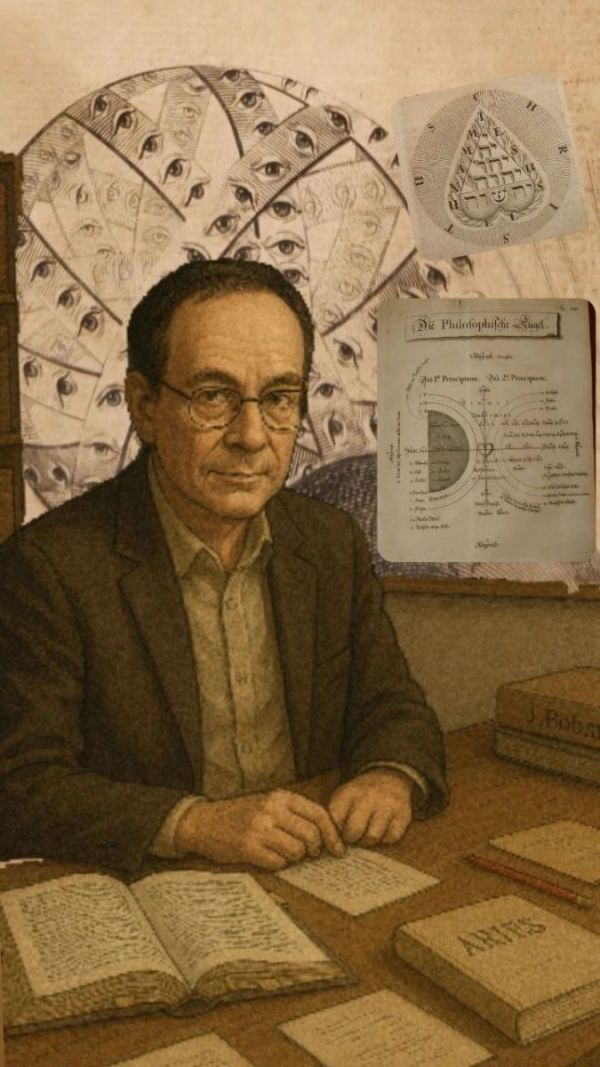
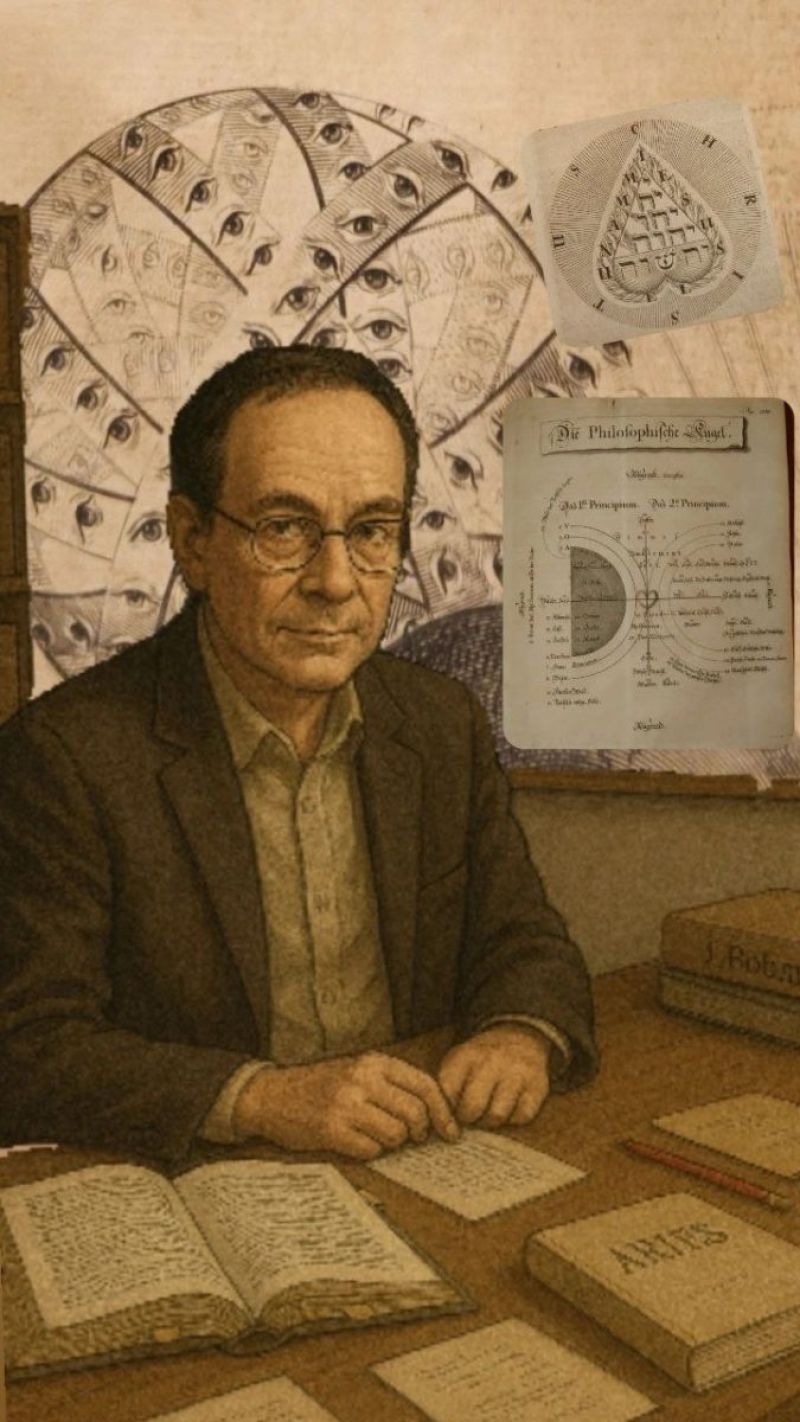
A symbolic portrait of Professor Pierre Deghaye,
in the absence of a real picture.
*
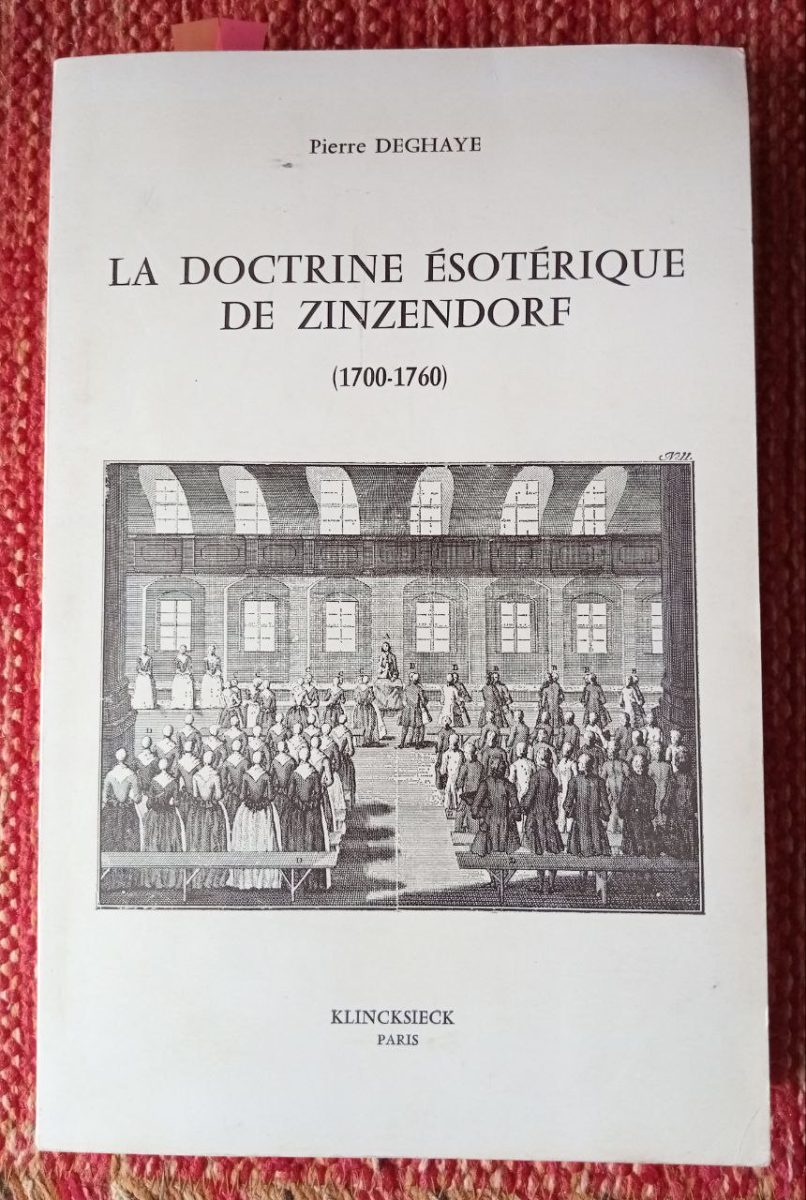
Today’s sharing from the Blue House of VIA-HYGEIA is part 4 of our sampler series dedicated to honoring the memory of professor Pierre Deghaye (1924–2005), with this extract, ‘The Mustard Seed Order (Senfkornorden): A (Secret) Christian Society’, from one of his trailblazing publications, ‘La Doctrine Esotérique de Zinzendorf’ (The Esoteric Doctrine of Zinzendorf), published by Editions Klincksieck in Paris, in 1969. It is part I, chapter XV (pages 90–99).
In this pivotal chapter, Deghaye unveils one of the most enigmatic episodes in early Moravian history: the Senfkornorden, a secret society founded in childhood by Count Zinzendorf and four companions. Far more than a youthful pledge, this Order evolved into a sophisticated network uniting high-ranking political and religious figures across confessional lines.
Deghaye meticulously dissects its statutes, rituals, and paradoxical nature—simultaneously Christian and esoteric, exclusive yet universal—revealing how it served as a unique laboratory for Zinzendorf’s vision of a ‘visible invisible church‘. This text offers a rare glimpse into the pragmatic, even political, dimensions of Zinzendorf’s spirituality, where the mustard seed symbolizes a faith meant to grow hidden among the elites before manifesting its fruit to the world.
Coming up next will be part 5: A Little Triptych: ‘1. The Body of Glory in Terrestrial Life, 2. The Incarnation of the Spiritual Life & 3. The Inner Man Hidden in the Heart’.
**
PREAMBLE
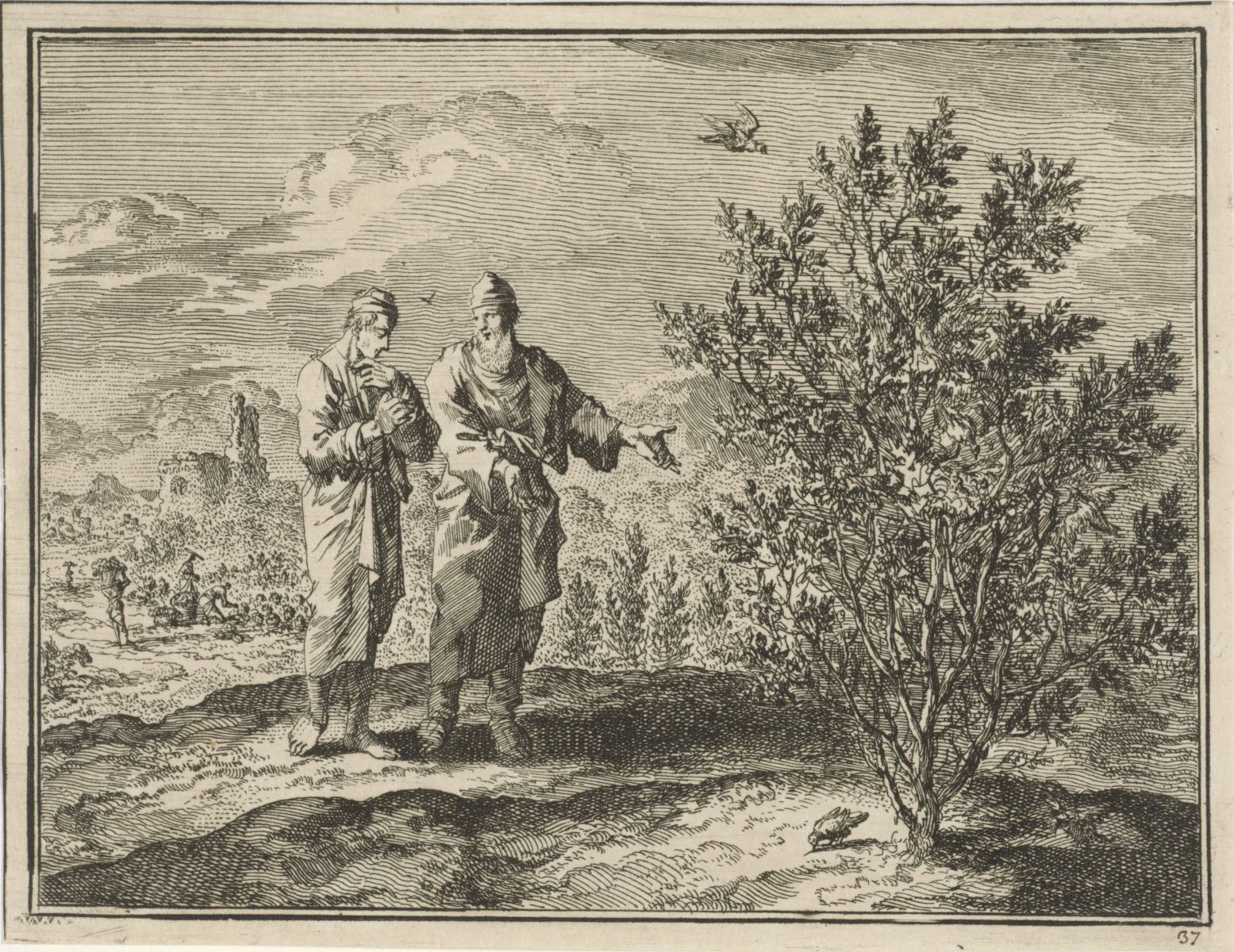
‘The Parable of the Mustard Seed’
The image of the mustard seed serves as the foundational metaphor for the Senfkornorden (Mustard Seed Order). In the Synoptic Gospels, Jesus employs this agrarian simile to illustrate the paradoxical nature of the Kingdom of God: it begins from the most insignificant, hidden origins yet expands into a vast, sheltering presence. For Zinzendorf and his companions, this was not merely a lesson in humility, but a strategic blueprint for a society that intended to operate secretly (‘germinating hidden‘) before influencing the broader structures of Christendom and the world.
The Three Accounts
Matthew 13:31–32: ‘He put another parable before them, saying, ‘The kingdom of heaven is like a grain of mustard seed that a man took and sowed in his field. It is the smallest of all seeds, but when it has grown it is larger than all the garden plants and becomes a tree, so that the birds of the air come and make nests in its branches‘.’
Mark 4:30–32: ‘And he said, ‘With what can we compare the kingdom of God, or what parable shall we use for it? It is like a grain of mustard seed, which, when sown on the ground, is the smallest of all the seeds on earth, yet when it is sown it grows up and becomes larger than all the garden plants and puts out large branches, so that the birds of the air can make nests in its shade under its shadow‘.’
Luke 13:18–19: ‘He said therefore, ‘What is the kingdom of God like? And to what shall I compare it? It is like a grain of mustard seed that a man took and sowed in his garden, and it grew and became a tree, and the birds of the air made nests in its branches‘.’
*
A Comparative
Exegesis:
Part I. Nuances of the Seed
While the core message remains consistent across the three Gospels, subtle variations in wording and setting offer distinct theological emphases that likely resonated differently with the esoteric imagination of the 18th century.
1.The Setting: Field vs. Garden
Matthew and Mark describe the seed being sown in a field (agros), suggesting an open, perhaps wild or agricultural expanse. This implies a Kingdom that grows publicly and broadly within the world at large.
Luke, however, specifies a garden (kepos). This nuance suggests a more cultivated, contained, or intentional space. For a secret society like the Senfkornorden, the Lukan “garden” is particularly evocative: it implies a protected enclosure where the seed is deliberately planted by an initiate (“a man took and sowed”), distinct from the open field of the public church.
2. The Growth: Herb vs. Tree
Biologically, the mustard plant (Brassica nigra) is a large herb, not a tree. However, all three evangelists use the word tree (dendron) to describe its final state.
Mark provides the most vivid botanical detail, noting it puts out ‘large branches’ (klados megalous), emphasizing the structural capacity to offer shelter.
This hyperbole serves a specific apocalyptic function: it recalls the Old Testament imagery (e.g., Ezekiel 17, Daniel 4) where a great tree represents a universal empire. The transformation from “smallest seed” to “cosmic tree” underscores the miraculous, divine agency behind the growth, rather than natural progression.
3. The Shelter: Branches vs. Shade
Matthew and Luke focus on the branches where birds nest.
Mark adds a crucial sensory detail: the birds nest in its shade (skia). In the harsh climate of Palestine, shade is a symbol of protection, relief, and life. Mark’s version emphasizes the comfort and refuge the Kingdom provides, not just its structural magnitude.
*
Part II. The Mustard Seed as
the Blueprint of the Senfkornorden
For Zinzendorf and his young allies at the Paedagogium of Halle, the Parable of the Mustard Seed was not merely a moral lesson in humility; it was a structural and strategic mandate for their secret society. The specific variations found in the Synoptic Gospels map almost perfectly onto the unique identity, function, and ambition of the Senfkornorden as described by Pierre Deghaye.
*
1. The ‘Garden’ of Luke:
A Cultivated Elite
Luke’s specification that the seed was sown in a garden (kepos) rather than an open field resonates profoundly with the exclusive nature of the Order.
Selective Membership: Unlike the public church (the ‘field‘) which is open to all, the Senfkornorden was a cultivated enclosure. Its members were not ‘common people‘ but a specific social elite: princes, generals, bishops, and dignitaries. As Deghaye notes, the statutes explicitly restricted membership to those of ‘high consideration‘.
Intentional Cultivation: A garden implies a gardener who selects, plants, and tends. This mirrors the role of Zinzendorf and his grandmother, Baroness von Gersdorf, who consciously ‘planted‘ this society with specific individuals to foster a particular kind of spiritual growth that could not survive in the wild, contentious soil of public confessional politics.
Secrecy as Protection: A garden is often walled or bounded, offering privacy. This aligns with the Order’s foundational requirement for secrecy. Just as a garden protects delicate plants from the elements, the secret statutes and rituals of the Senfkornorden protected its members from the scrutiny and hostility of the established churches and the public eye.
*
2. The ‘Tree’ of Prophecy:
A Supra-Confessional Structure
The transformation of the tiny seed into a tree (dendron)—a botanical hyperbole—provided the theological justification for the Order’s ambitious, supra-confessional goal.
Transcending Boundaries: In the 18th century, European Christianity was fractured into rigid confessional ‘fields‘ (Lutheran, Reformed, Catholic). The mustard tree, however, is a singular, massive entity that transcends these boundaries. The Senfkornorden aimed to be this tree: a structure where members of different confessions could unite “outside the visible temple” without abandoning their respective churches.
The ‘Garden Plant’ vs. The ‘Tree’: The text highlights that the mustard plant becomes ‘larger than all garden plants‘. This suggests that the Order was not meant to be just another religious society among many (a ‘garden plant‘), but a unique, overarching framework (a ‘tree‘) that could house and connect them all. This reflects Deghaye’s analysis that the Order was a ‘derogation from the principle of the tropes‘, creating a unity that the visible churches could not officially sanction.
*
3. The ‘Shade’ of Mark:
Refuge for the Powerful
Mark’s emphasis on the birds finding rest in the shade (skia) of the tree offers a poignant metaphor for the spiritual function the Order served for its high-ranking members.
Spiritual Refuge: These were men and women burdened with the weight of political and ecclesiastical authority (‘Obrigkeit’). The public sphere was one of conflict, protocol, and confessional strife. The Senfkornorden offered them ‘shade‘—a cool, hidden place of rest where they could relate to one another simply as ‘honest people‘ (rechtsschaffene Leute) united by a core faith, stripped of their titles and dogmatic disputes.
Protection from the ‘Heat‘: The ‘heat‘ of the day can symbolize the persecution, controversy, and theological rigidity of the era. The secret society provided a protective canopy under which ideas of tolerance, universal love, and mystical unity could survive. As Deghaye points out, the Order allowed for an “interconfessional meeting ground” that was impossible in the public square.
*
4. The ‘Hidden’ Germination:
The Necessity of Secrecy
The biological reality of the mustard seed—that it must be buried and remain hidden to germinate—was the central operative principle of the Order.
‘To Remain Secret & Germinate Hidden’: The statutes literally cited this nature of the seed as the reason for their secrecy. The Order believed that its universal mission could not succeed if launched prematurely into the public eye. It needed a period of invisible growth, networking, and spiritual consolidation among the elites before it could influence the world.
The Paradox of Power: The seed is the ‘smallest of all seeds’, representing the humble, hidden beginnings of the group (five young boys). Yet, its destiny is universal dominion (the tree sheltering the birds of the air, i.e., ‘the whole of humankind‘). This paradox justified the existence of a secret elite: they were the hidden root system necessary to support the future visible unity of the Church.
In essence, the Senfkornorden attempted to enact the parable in history. They created a ‘garden‘ for the elite, planted the ‘seed‘ of a secret universalism, and waited for it to grow into a ‘tree‘ that would eventually offer ‘shade‘ to the entire world.
The tragedy, as professor Pierre Deghaye suggests, is that the ‘tree‘ remained largely a hidden root system, flourishing only briefly before receding back into the archives, a ‘what if’ of ecclesiastical history.
*
Pierre Deghaye, from ‘The Esoteric Doctrine of Zinzendorf’:
Chapter XV — THE MUSTARD SEED ORDER
(SENFKORNORDEN)
1. A (Secret) Christian Society
The Community could not remain hidden. But outside of it, there was a phenomenon that we must still study within the framework of Zinzendorfian esotericis m. This is the Senfkornorden. In French it was called la noble société de la Senevé.1 This order goes back to a simple association of young students from the Paedagogium in Halle, who had united out of Christian spirit. One of them was Zinzendorf; he was the instigator. These young people were of different communions, but they set aside what separated them to focus on what was essential.2 It must be said that this philadelphian spirit was precocious, for at the beginning, we are in 1713: Zinzendorf was thirteen years old. There were five of them, who recalled the words of Matthew XVIII, 20, by which Christ defines His Church: ‘For where two or three are gathered together in my name, there am I in the midst of them‘.3 These young people were filled with missionary zeal. In 1715, two of them united specially to promote the evangelization of pagans—of those, Zinzendorf specifies, whom no one else would look after.4 Moreover, these young nobles had no need to fear the perils of such an enterprise, for they could not envisage pursuing it through direct action: they were destined by their families for worldly careers and were obedient sons.5 They thought that God, already so good to them, would provide them with vocations.6
This evangelizing zeal and the form in which it is expressed are nothing surprising. In 1706, the first German Protestant missionaries, under the auspices of the King of Denmark, arrived in the East Indies. They came from Halle.7 This mission had a great impact, and the news that reached them must have nourished the imagination of the Paedagogium students. To support the missionaries, Halle had to make contact with English societies founded at the end of the previous century, such as the Society for Promoting Christian Knowledge, whose president was the Archbishop of Canterbury. This society would appoint Francke as a corresponding member. In the perspective of this mission, we thus see the establishment of ecumenical links, although Halle did not rally to the projects for union between Protestant churches dear to Leibniz.8
The idea of Christian societies on an ecumenical level was sufficiently widespread at the time to stimulate the imagination of our young boys. In 1748, Zinzendorf would claim a Societas Evangelica whose vocation was to instill in Evangelical Christendom, but also and especially among savage peoples, the fundamental truths contained in the Augsburg Confession. He traces the project back to Ernest I the Pious, Duke of Saxe-Gotha (1601-1675).9 Gerhard Reichel does not take this Evangelical Society seriously. He thinks it existed only in Zinzendorf’s mind and attributes this fiction to his penchant for genealogies.10 Nothing allows us to contradict Reichel’s skepticism, but what matters here is that we have an idea dear to Zinzendorf.
In themselves, these Christian societies do not have an esoteric character. But let us see how this brotherhood evolves, which, before becoming the Senfkornorden, bore different names. Its members first called themselves the Slaves of Virtue. Then it was the Society of the Confessors of Jesus Christ. Finally, they named themselves after the mustard seed of the Gospel.11 The bonds uniting Zinzendorf and his young friends in the same ideal grew tighter. They would constitute themselves as a true association. What was originally a simple brotherhood of very young people would be erected into an order, with statutes. This is not at all a more or less passing exaltation. An oath is sworn before God, not without mature reflection, as emphasized by Zinzendorf’s faithful biographer, Spangenberg.12 From this stage onward, we must consider this society otherwise than as a mere sentimental testimony.
But when exactly was this association, constituted as an order with its statutes, born? This remains a mystery, and for good reason. All we know is that the Society was very flourishing between 1724 and 1741, to the point that, according to Zinzendorf, it included people of high standing, men and women, ministers, generals, prelates, even primates having jurisdiction over empires.13 But this account does not tell us whether 1724 was the year of foundation or merely the date marking the beginning of its prosperity. It is even impossible to specify the exact moment of this expansion. This is because from the very beginning, this association was organized as a secret society. This was on the good advice of Zinzendorf’s grandmother, Baroness Henriette Katharina von Gersdorf, whom we will see enamored of esotericism. On this point as well, we refer to the testimony of the faithful Spangenberg.14
In fact, the existence of the Senfkornorden only became known to the public following a malicious indiscretion. Until 1736, the statutes had never been printed. Each member copied them by hand. However, to avoid this copying, it was decided to entrust them to a London printing house. In 1738, a member of the Senfkornorden died, a high-ranking personage from Amsterdam, Baron Abraham von Rumswinckel. Before his death, he had entrusted his son-in-law with the task of returning the insignia and printed statutes to the Order. It was then that a copy of these statutes fell into the hands of one of Zinzendorf’s worst adversaries, Professor Voget of Utrecht.15 These statutes define the Senfkornorden as a secret society: ‘Indeed, it is in keeping with the nature of the mustard seed, which is to remain secret and to germinate hidden‘. We have translated literally the end of Title VIII.16
*
2. The Specific Plan of
the Mustard Seed Order
This secret society thus numbered among its members very high-ranking personages. Regarding the prelates or primates, it has been thought that this might refer to Cardinal de Noailles.17 One will be very skeptical on this subject, especially since the list of members contained in the Herrnhut Archives file18 does not mention the name of the Archbishop of Paris anywhere. On the other hand, we find there the name of the Archbishop of Canterbury. Let us also cite Daniel Ernst Jablonsky, preacher at the court of Berlin. His father, Petrus Figulus, had married the daughter of Comenius.19 Petrus Figulus was to succeed his father-in-law in the episcopal ministry, but he died before him. Thus it was his own son, Daniel Ernst, who entered into the apostolic tradition and presided over the destinies of the branch of the ancient Unitas Fratrum established in Poland.20 It was this latter who, by virtue of this apostolic tradition, consecrated the bishops of the new Unity, David Nitschmann, and then Zinzendorf himself.21
In addition to these personalities from the religious world, we find in the correspondence of the Senfkornorden the names of the Governor of Georgia, General Oglethorpe, the director of the East India Company, a Scottish Secretary of State, etc. We see how far we are from that brotherhood born among the young disciples of Halle. The Senfkornorden encompasses the political world. But what is its exact nature? Zinzendorf’s adversaries and that of the Brethren, notably Voget, identified the Senfkornorden with the Community. The account published in the Bündigische Sammlung, which was at the very least inspired by Zinzendorf, resolutely rejects this imputation. In fact, it does not seem that the Order is placed on the same level as the Assembly of the Brethren. Title I of the statutes defines the Senfkornorden as a society intended to gather within it members of different confessions, but there is no question of transcending religions in the perspective of a superior spirituality. Each remains within the limits of his confession.
Regarding religions, we have seen that Zinzendorf had not rallied to the projects for union of the Churches. Spener himself had rejected certain of them, notably that of a society which was to be called Fruchtbringende Jesus-Gesellschaft and whose promoter was Ahasverus Fritsch.22 Spener intended to gather the children of God only within the limits of a given confession and under the control of ministers.23 At the level of religions, Zinzendorf did not wish any more to undermine the authority of the Churches; we have seen in what spirit he conceived it. However, he admits an exception; we have proof of this here. Now, this exception is granted under certain conditions. First, it is covered by secrecy, meaning it cannot create a precedent. Second, the members of the Senfkornorden are not common people. They are either personalities from the political world, high-ranking military officers, or dignitaries of the various Churches.24
Title I of the statutes clearly situates the society at the level of religions. What is its argument? It is not possible, it says, to bring honest people of different communions together under one roof if one places oneself within the framework of public religions. This means that the Order offers these honest people an interconfessional meeting ground, outside the visible temple. However, we are not thereby at a level that transcends religions.
Within the framework of public religions, it is therefore not possible for faithful of different communions to meet within the same walls. This is in the nature of things, it says, if we consider the present state of the Churches: bei gegenwärtiger Kirchenverfassung.25 What does this expression mean? The present eon is opposed to the future eon, that is to say, the temple of religions to the Church of Christ. The Assembly of the end of time can merge with that of the present, but only for the spiritual. True children of God, by virtue of this merging, can find themselves in the same enclosure regardless of their confessional origins, and their meetings need not be kept secret, for they are in the nature of things.
The secrecy of the Senfkornorden is only conceivable from the perspective of religions. If it is strictly required, it is because one departs from the rule of the visible temple. This perspective is confirmed on the other hand, for it is said that all members of the Order unite to confess the unique fundamental truth upon which all religions must agree.26 We have here the same consensus that unites the different tropes within the Church of the Brethren.
The Senfkornorden is a secret society, but one that is not situated on the properly mystical plane. This latter term mystical indeed means secret, however it implies for each person a spiritual realization which is not in question here. The members of the Order are not as such the regenerate. They are honest people with regard to public religions: rechtsschaffene Leute in Ansehung der öffentlichen Religion.27
We must therefore distinguish between the public institution of the tropes, the secret order of the Senfkorn-orden, and the mystical Kingdom of the Gemeine, of the Assembly of the Brethren stricto sensu.
The Senfkornorden constitutes a derogation from the principle of the tropes. Its members are faithful of the visible temples, but they associate within an institutional unity normally forbidden to confessions, since the latter are defined by their plurality and each must preserve its own function, its personality. On the other hand, this institutional unity is situated, at least in theory, outside the Brüderkirche. It is defined uniquely on the level of religious truths, while escaping the control of authority. But this is a derogation that cannot be extended, which is why here the rule of secrecy is strictly applied. This exception is only possible for a social elite, which embodies to some extent that authority, that Obrigkeit, to which religions are subordinate. Authority does not need for itself the police power it exercises over the people within religions.
*
3. In the Service of Humankind
At this social level, we will attain an ecumenicity which will certainly not be absolute like that of the Spirit on the properly spiritual plane, that of the Gemeine, of the Assembly of the Brethren,28 but which will nevertheless be a true universality at the level of human realities. We are no longer limited to the three Protestant confessions of the Agreement of Sandomierz. We are no longer even within the framework of Christian religions alone, for the purpose of the members of the Senfkornorden aims at the whole of humankind.
Title II of the statutes begins with these words: ‘Let each one, in the post entrusted to him from on high, love humankind and work for its good‘.29 Persons holding high office are asked to love humankind for its own sake, and no longer in terms of this or that confession. In this Christian society, no one will exercise proselytism by seeking to bring to his own communion a pagan already won to the obedience of the Cross, but by a minister of another confession.30 Moreover, care is taken to recall that it is not sufficient to pour water on pagans or to make them kneel at the foot of the Cross to truly convert them.31
On the level of relations between religions, the statutes of the Senfkornorden attest to a spirit of tolerance that is quite significant for the era. Let us recall, however, that we are not at the highest level on the scale of spiritual values. On the scale of true ecumenicity, which is that of the Spirit, the absolute is the guarantee of universality.
*
4. The Senfkornorden &
Freemasonry
The tolerance defined in the statutes of the Senfkornorden claims to be universal. Moreover, these statutes testify to a love of humankind that we will find again in the perspective of mystical theology.32 At the level where we place ourselves here, these two aspects make us think of the Masonic ideal. In a French History of Freemasonry, published in the middle of the last century,33 it is noted that in Germany, in 1738, the birth of an establishment of religious Masons who took the name of the Order of the Mustard Seed and whose goal was the propagation of the Gospel and the practice of Christian virtues, in particular charity. 1738 is the year when the Senfkornorden began to become publicly known, and this year could have been mistaken for that of its birth. But on the other hand, the years 1737-1738 are also those when English and French Freemasonry reached Germany. One may wonder whether the year 1736 marks a renewal in the history of the Order.
Zinzendorf tells us that the Senfkornorden was flourishing between 1724 and 1741. This is quite vague. Now, one might suppose that if it was deemed good to have the statutes printed in 1736, it was because the members had multiplied at that time. Would this be the year when the Order lost its intimate character? We are reduced to conjectures, however Spangenberg’s account confirms that the Senfkornorden then received new memberships, particularly from people of high standing, for example Abraham von Rumswinkel. The Order thus experienced a certain renewal, and one may wonder whether this renewal does not correspond to the favor that Freemasonry was beginning to enjoy in Germany.
Was Zinzendorf in contact with English Freemasonry? It is thought that Comenius, the last bishop of the Czech Unity, had encountered this Freemasonry in 1641, during his stay in England, at a time when it had long since lost its corporate character. His sympathies for the Masons are evident.34 But regarding Zinzendorf, we know nothing on this subject.
*
5. The Senfkornorden &
Johann Valentin Andreae’s Project
At the very least, the Order attests to the taste of Zinzendorf and his friends for secret societies. Certainly, this taste was not new. In the previous century, Johann Valentin Andreae had launched the idea of the famous Rosicrucian fraternity.35 It was only a fiction, but precisely, if we are to believe G. Reichel,36 Zinzendorf also invented, from whole cloth, that Evangelical Society whose project he traces back to Ernest the Pious. These fictions undoubtedly stem from the same myth, which appears in different traditions as a veritable archetype. However, it is to the project conceived by Andreae of a societas christiana that the Senfkornorden most calls to mind. Andreae had envisaged for this society an organization that made it a true brotherhood of the Masonic type.37 Comenius, who was linked with Andreae, had followed this project closely.38
Andreae is one of the few names that Zinzendorf cites.39 This should capture our attention. It is true that there is a difference between their conceptions. Both speak of the only true religion, but from perspectives that are not the same. For Zinzendorf, the only true religion has existed in all ages and has manifested itself in visible forms. The Assembly of the Brethren, the Gemeine, bears witness to this. In his mind, the celestial fraternity is not a fiction. Andreae, on the contrary, had launched his famous Fama fraternitatis manifesto by deliberately placing himself in the perspective of legend, and indeed, it is said, it was only a jeu d’esprit.40
On the other hand, he conceives the ‘only true religion‘ in a more concrete mode than that of the Gemeine, although his project appears utopian. It is no longer a matter of a celestial fraternity that would have existed from all eternity, but of the ideal religion that remains to be realized in the perspective of the union of the Churches.41 The ‘only true religion‘, in Andreae, appears as the exoteric counterpart of the celestial fraternity, whereas in Zinzendorf it embodies the invisible Church itself.
Andreae’s utopia conceives of Christian society in a spirit of general reform.42 It does not seem that religious utopia inspired the Senfkornorden. As we know, Zinzendorf did not militate for the union of the Churches. He leaves confessions as they are and when he speaks of the ‘only true religion‘, it is on the mystical plane of the Gemeine, which for him is not at all a fiction.
The Senfkornorden is a reduction of Christian society for the benefit of a social elite that presides over the destinies of the visible Churches. It is secret because it cannot be extended to this entire society. Its statutes reflect the concern for the government of men, certainly conceived in a Christian spirit, much more than the concern to preserve the purity of faith. Let us not hesitate to say it: the spirit that presided over the constitution of the Senfkornorden in its definitive form seems to us essentially political and realistic.
*
6. The Senfkornorden &
Its Ritual
Despite all that the conception of the Senfkornorden may have that is particular, this association reflects the taste of an era for secret societies and their rites. We know nothing of the ritual according to which the admission of a new member took place exactly, but the statutes inform us about the insignia of the Order and the costume worn by its members.
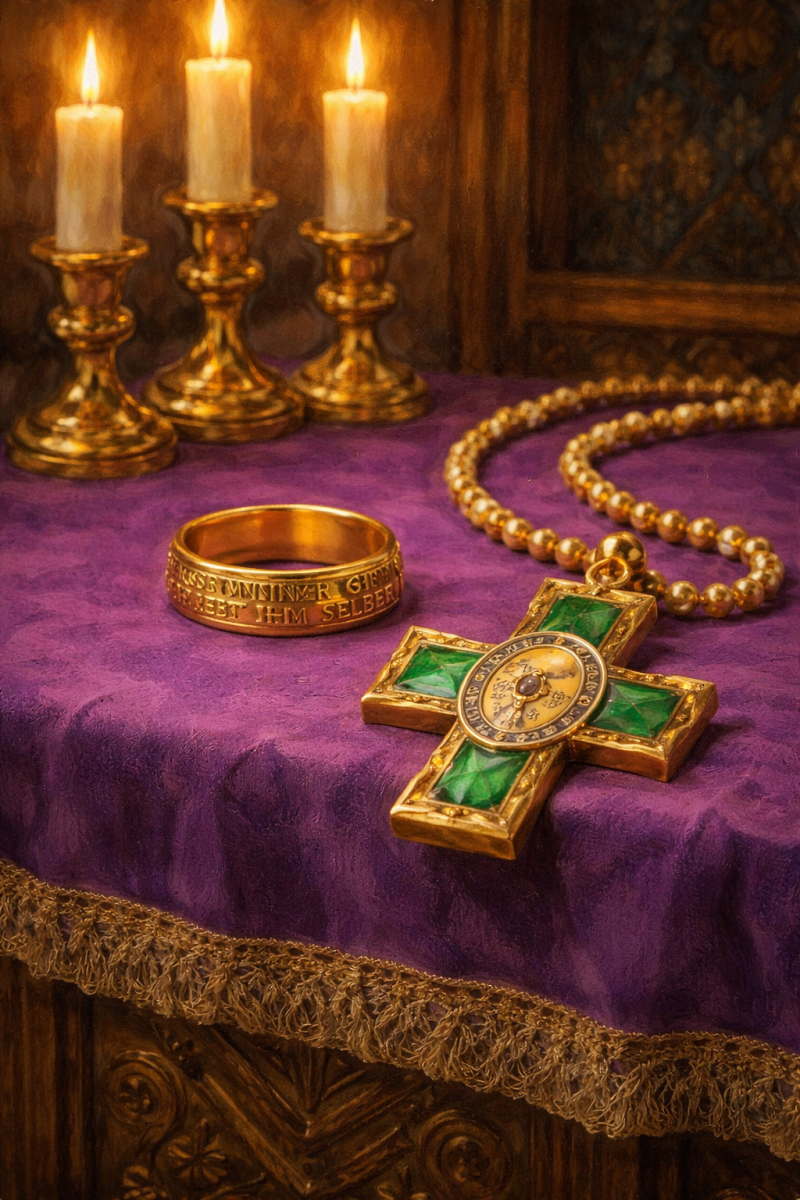
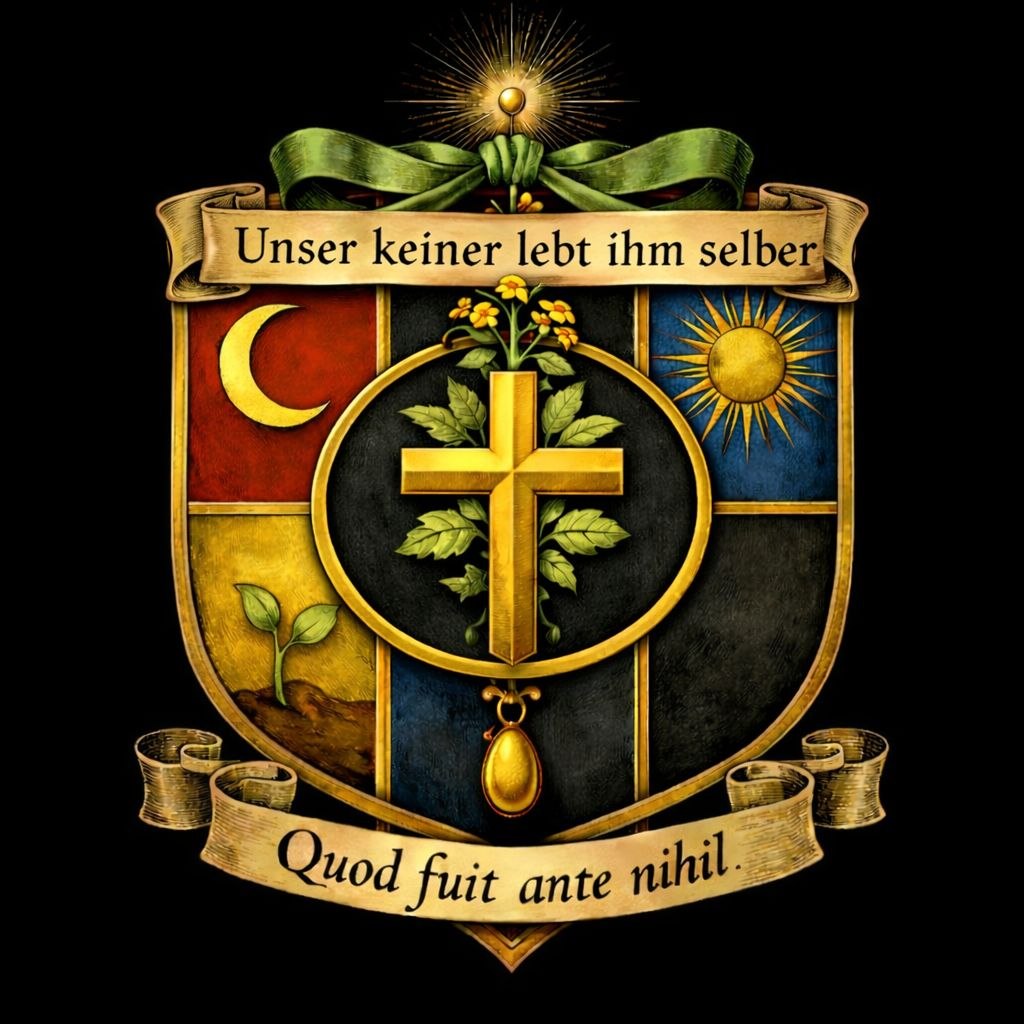
Each new member was given a gold ring with this inscription: ‘None of us lives for himself‘.43 He wore as another insignia a cross also made of gold, with angles in green enamel. In the center, in an oval, one saw a mustard seed, with these words: quod fuit ante nihil. This cross was suspended either from a chain composed of mustard seeds alternately open and closed, or from a silk ribbon that laymen wore sea-green, and ecclesiastics white with only the border in sea-green.44
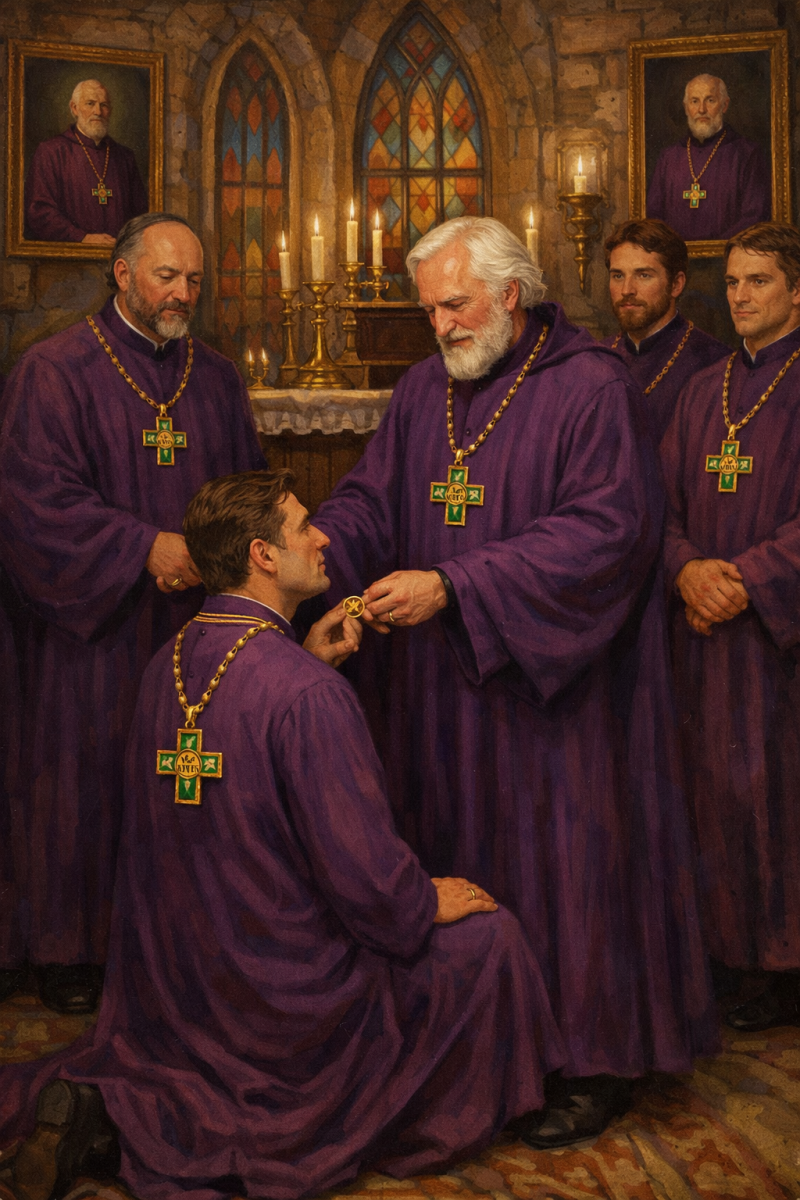
Title XII of the statutes envisages the possibility of a general assembly to be held in the chapel of Gnadenstadt. This town name, it is noted, is not found in any atlas. In this brief evocation, we are told how the companions will be dressed. They will wear a long purple caftan. We think of the mantle that envelops the Word in the vision of Rev. XIX and which appears dipped in blood. On the right, the caftan will be adorned with a silver-embroidered cross. On this cross one will see a single mustard seed and will read these words: ‘He extends His branches infinitely in Jesus Christ‘. Inside the chapel, portraits of the companions in this attire will be placed on the walls. On a painting preserved in the Herrnhut Archives, we see Zinzendorf clad in the purple caftan, however without the cross.
*
7. Another Secret Society:
-The Order of the Confessors of the Passion of Jesus-
Nature of the Two Orders
It seems that the Senfkornorden did not survive beyond the year 1753. In any case, that is where the Herrnhut Archives file ends. On March 30, 1753, the secretary, a Dutchman named Isaac Lelong, writes to Zinzendorf to resign from his functions due to his advanced age. He will return to Zinzendorf the rings and documents he still holds.45 If we refer to what Zinzendorf himself said,46 the prosperity of the Order declined from 1741 onward. From that moment, the Senfkornorden must have more or less vegetated. But on September 19, 1742, another secret society was born. It was called ‘Orden vom Bekenntnis des Leidens JEsu’ and its founder was Johann Nitschmann the elder. The statutes of this society are reproduced in a previously cited journal, Der Brüderbote.47
What is important is that this time, the Order was founded within the Community itself. What part did Zinzendorf take in it? We do not know, however this new society could not have been born without his approval. The Order of the Confessors of the Passion of Jesus no longer had the political character of the Senfkornorden. It was a corporate society grouping theologians.48
It is remarkable to see a Moravian Brother, Nitschmann, take up an idea dear to Comenius. The last bishop of the Czech Unity dreamed of a college of scholars, from which he expected a universal reform.49 But what was the exact importance of this society founded within the Community itself? Nothing allows us to estimate it. Nor do we know whether this new order had a long existence. Be that as it may, regarding the essence of Zinzendorf’s doctrine and assuming that the latter was an active member of it, we attribute to it, until further information, only episodic importance.
The Senfkornorden itself only interests us because it illustrates a form of esotericism to which Zinzendorf paid his tribute. But the core of his doctrine lies elsewhere. It is on the properly spiritual plane that it must be sought. At this level, esotericism ceases to be a deliberate mode and becomes identified with the very nature of all mystical knowledge.
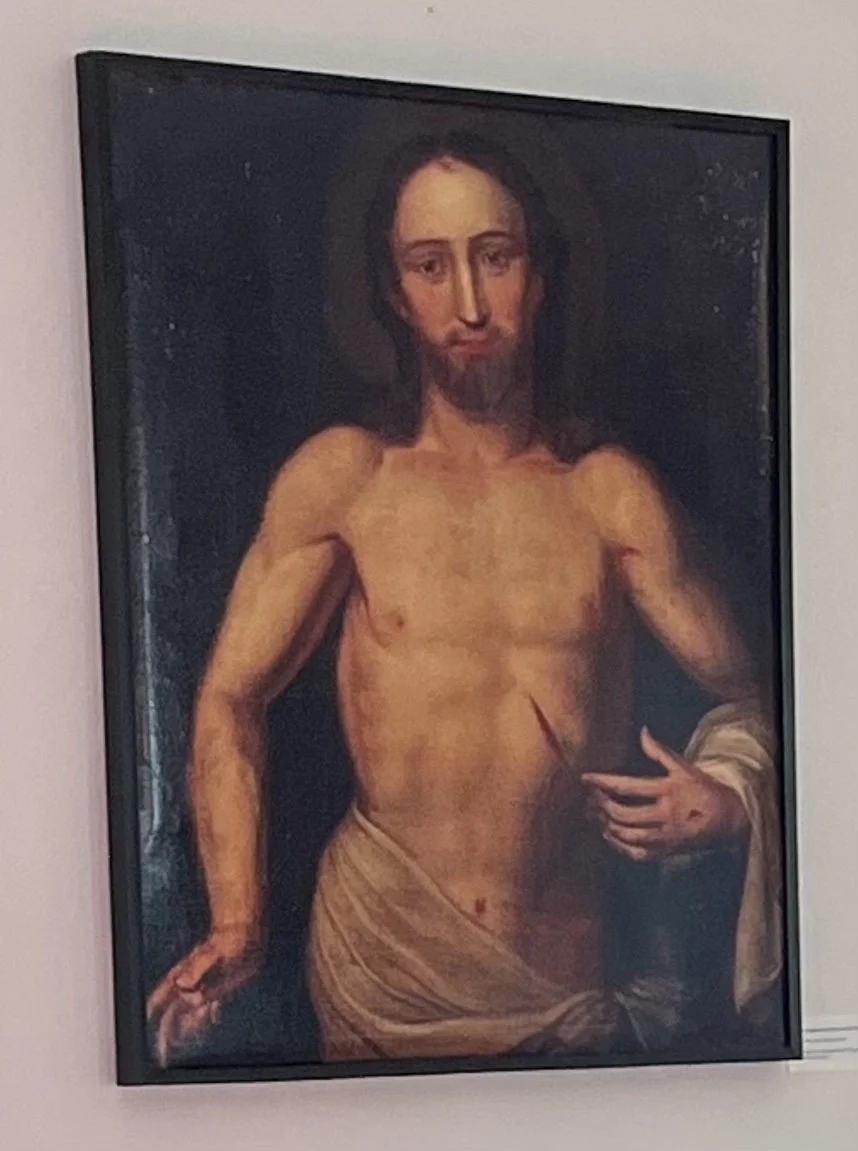
Zinzendorf’s esotericism cannot be defined solely in terms of social or corporate realities. These realities can only be considered in themselves on the lower plane of religion. On the superior level, they are at the very least transposed. Certainly, when from this summit the gaze descends upon the world, we find a no less clear divide, and one could affirm that the very principle of this divide still betrays Zinzendorf’s origins. But spiritual aristocracy laughs at human, social, or corporate contingencies. The weak confounds the strong and the fool confounds the wise. This aristocracy will only be more absolute, for the election it claims is prior to the foundation of the world. The Brethren are a chosen race and they cannot judge the common people by taking themselves as models. It was an Englishman who told them so, but Zinzendorf reports this compliment not without pleasure.50 The Senfkornorden certainly counted among its members high personalities, but the statutes were there to remind them that they did not thereby have the privilege of the second birth.
*
ENDNOTES
-
Cf. the letter of 8 July 1744 in file R 20 A no 9 b of the Herrnhut Archives (Nachrichten und Briefe des Senfkorn-Ordens und die Glieder desselben betreffend 1737-1744-1753).
-
Spangenberg, Leben, I, p. 46.
-
NR, Beylagen, p. 6.
-
Ibid., p. 7.
-
Ibid., pp. 7-8.
-
Ibid., p. 8. The Baron von Canstein, cited in this text, was the brother-in-law of Zinzendorf’s grandmother, the Baroness Henriette Katharina von Gersdorf (cf. Beyreuther, Der junge Z., p. 58). He had been Francke’s patron for the construction of the Paedagogium in Halle (cf. Beyreuther, A. H. Francke, p. 162).
-
Beyreuther, A. H. Francke, p. 201.
-
Ibid., p. 200.
-
Cf. Zuverlässige Nachricht.
-
G. Reichel, Der “Senfkornorden” Zinzendorfs, 1. Teil: Bis zu Zinzendorfs Austritt aus dem Pädagogium in Halle 1716, Leipzig, 1914, pp. 196-197.
-
Spangenberg, Leben I, p. 48.
-
Ibid.
-
Cf. NR, Beylagen, p. 6.
-
Spangenberg, Leben I, p. 48.
-
We relate these facts according to BS II, pp. 677-682: Historischer Bericht vom Senff-Korn-Orden. Professor Voget distinguished himself by his writing entitled in German: Unterscheid der wahren und falschen Gottesgelaßtheit bey Gelegenheit der unter Anführung Herrn Nicol. Lud. Grafen von Zinzendorf und Pottendorf erfolgten Herrnhutischen Bewegungen, Durch Herrn Albertus Voget, Lehrer der Gottesgelaßtheit in Utrecht verfasst …, Zurich, 1741.
-
Cf. Der Brüder-Bote, 9th issue, Herrnhut, 1882, p. 221.
-
Ibid., p. 215.
-
R 20 A no 9 b, letter of 24 October 1737.
-
Cf. Cranz, op. cit., p. 82.
-
Ibid., p. 90.
-
Ibid., pp. 254 and 281.
-
Cf. A. Ritschl, op. cit., II, p. 141; G. Reichel, op. cit., pp. 194-195; P. Grünberg, Philipp Jakob Spener, Göttingen, 1893-1906, I, p. 172; ibid., II, pp. 111-112.
-
Cf. A. Ritschl, op. cit., II, p. 141.
-
See the wording of Title IV, Brüder-Bote, 9th issue 1882, p. 218. One shows oneself disposed to admit into the Society all persons who have at heart to militate for the cause of Christ, but enjoying a certain consideration, as evidenced by this phrase: “although we now admit without hesitation into our Society those esteemed persons for whom the Kingdom of Christ is important…”
-
Ibid., p. 217: “The nature of the matter does not allow, under the present church constitution, to bring all honest people with regard to public religion under one roof.”
-
Ibid., p. 218: “… but on one point knowledge is required of each of us, namely that Jesus Emmanuel, the God of God, born of the Virgin Mary, is the sole cause of our salvation.”
-
Ibid., p. 217.
-
Cf. the definition of the Gemeine given by Zinzendorf: “The Congregation of God (Gemeine Gottes) in the Spirit is a work of God, which consists of the communion of souls with the Lamb, and of hearts with one another, which one cannot see, nor demonstrate to anyone by reason; it is the spiritual body of Jesus Christ, the most secret society on earth.” (From the Berliner Reden, 1738, quoted in BS II, p. 674.)
-
Brüderbote, 9th issue 1882, p. 218.
-
Ibid., Title VII.
-
Ibid., Title VIII.
-
Cf. Part II, Chapter III.
-
Histoire de la Franc-Maçonnerie depuis son origine, by Emmanuel, in Encyclopédie théologique edited by Abbé Migne, Paris, 1850, vol. 33, col. 276. In this very mediocre book, the author also reports that this order was condemned by the Pope. We have not found confirmation of this claim. However, we do know that the Inquisition kept watch over Zinzendorf. On the other hand, Benedict XIV is said to have expressed great sympathy for him.
-
Cf. Griegern, op. cit., pp. 385-386.
-
For the history of this “legendary fraternity,” see Paul Arnold’s book, Histoire des Rose-Croix et les origines de la Franc-Maçonnerie, Paris, Mercure de France, 1955.
-
Cf. above, p. 91.
-
Cf. Griegern, op. cit., p. 363.
-
Cf. ibid. and Arnold, op. cit., p. 144.
-
Cf. Mos II, p. 679.
-
Cf. Arnold, op. cit., pp. 144-145.
-
Cf. Griegern, op. cit., p. 330.
-
Cf. Arnold, op. cit., p. 202.
-
See Brüderbote, 9th issue 1882, Title X of the statutes: “They are presented with a gold ring with the inscription: ‘None of us lives for himself.'”
-
Ibid., Title XI.
-
According to his letter of March 30, 1753 sent from Amsterdam (file R 20 A no 9 b).
-
Zinzendorf says exactly that the Society was very flourishing between 1724 and 1741.
-
Brüderbote, 4th issue, 1883.
-
Ibid., p. 96.
-
Cf. Griegern, op. cit., pp. 362-363.
-
Cf. BS I, p. 40.
*
Source
*
Coming soon
A Little Pierre Deghaye Sampler – Part 5:
-A Little Tryptic: ‘1.The body of Glory in terrestrial life,
2. The incarnation of the spiritual life &
3. The inner Man hidden in the heart’.
***

Related Articles

Leave a Reply