IV. – Assessment
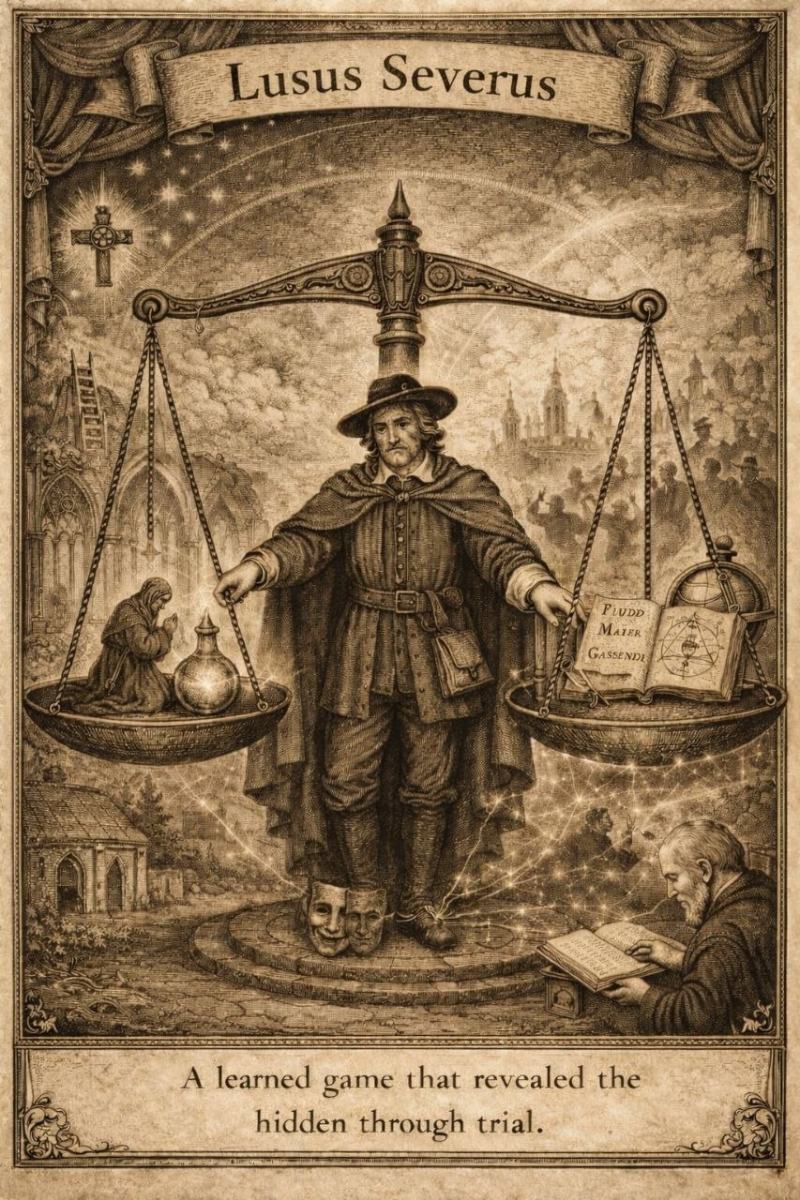
‘Lusus Severus: The Rosicrucian Manifestos were an unmistakable milestone
in the history leading from the mystical Middle Ages to modern philosophy’.
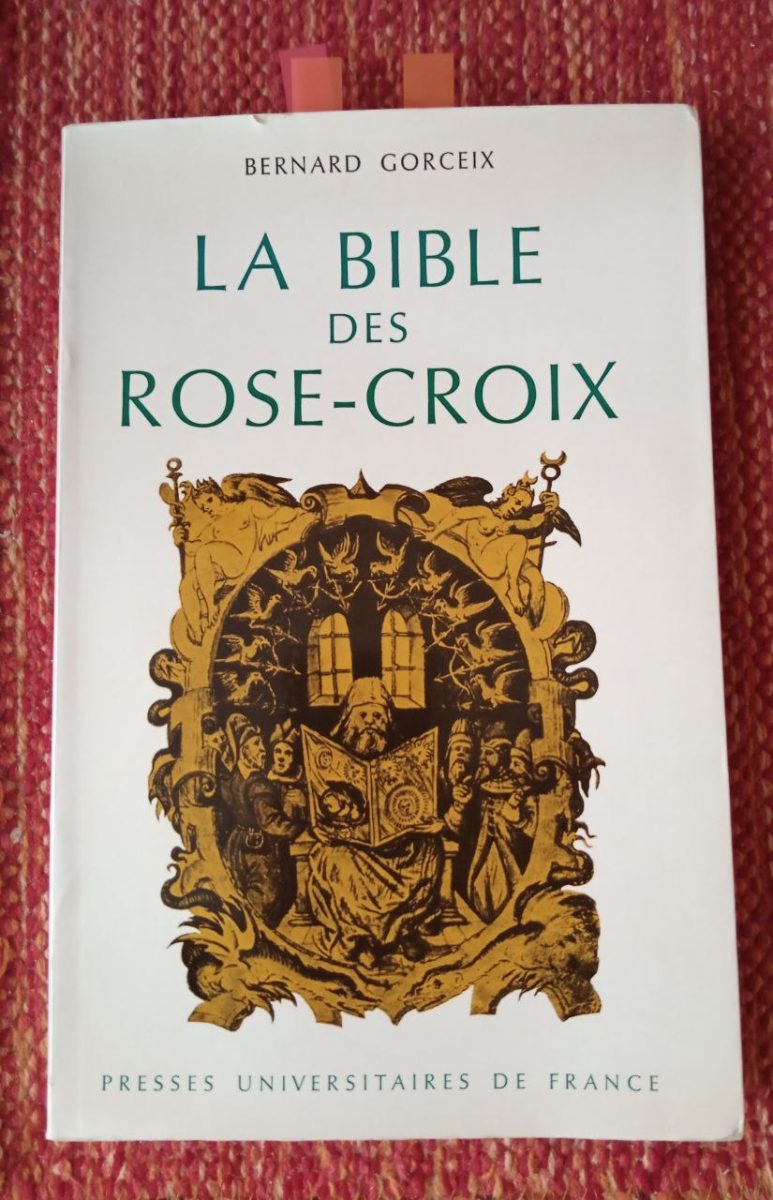
A rapid analysis of the three brief writings that comprise the Rosicrucian Bible—the Echoes of the Fraternity, the Confession, and the Chymical Wedding—allows us to draw up an assessment in five points.
The study of these treatises allows us to refute the thesis that it would be possible to maintain, based on the acerbic criticism that the author, from 1619 onwards (as we have already noted), launches against the dreams of alchemists and the makers of mystery: namely, that the Rosicrucian mystification is merely a caricature of occultism and a product of nascent rationalism; that the three writings are a clever fable by means of which the author first seeks to attract his reader, offering him apparently profound enigmas, only to repulse him later and bring him back to the religion of reason and Christian morality.
As seductive as it may be, this hypothesis does not seem to correspond to the goal Johann Valentin Andreae had in view, and it is incapable of accounting for the multiplicity of structures that our analysis has revealed. While the political and social intentions are undeniably present, they do not in any way exhaust the work; nor is the latter the distant ancestor of the Enlightenment.
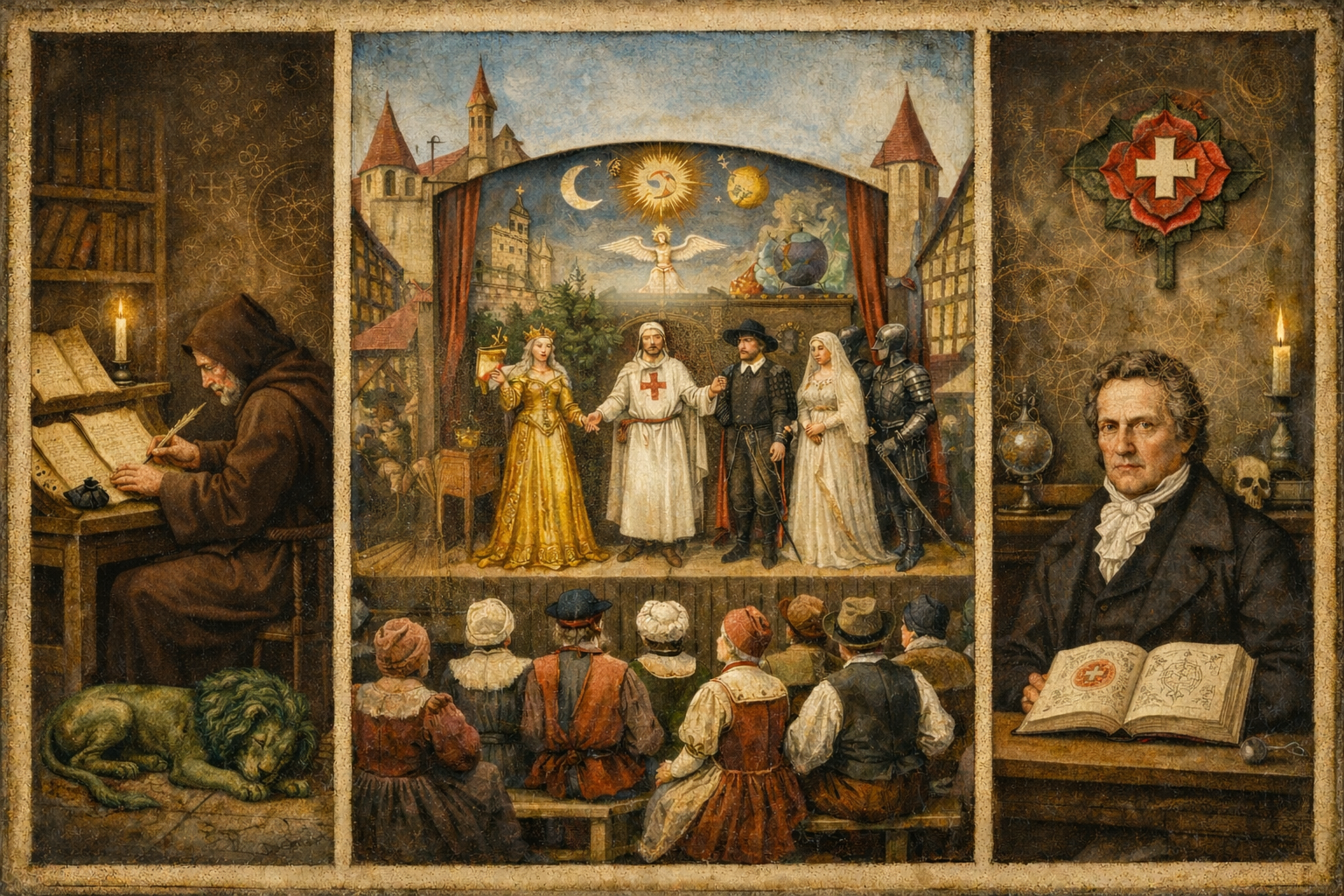
There is no doubt that the three treatises are, first and foremost, the work of a young mind keenly interested in the mystical, alchemical, and spiritual currents agitating his time. He certainly invents a fable, that of Christian Rosenkreuz, but he does so in order to create a synthesis of pre-Baroque occultism.
What he wants is to group together the themes delivered to him by the spirituality of his time, around a character imagined from scratch, even more mythical than Faust, a historical figure from the end of the 15th century. That he later renounced the passions of his youth can be explained as much by his conversion to a more orthodox, more dogmatic, and more edifying Christianity, as by the fear that drove him to avoid compromising his career through scandal. The three treatises are indeed a game, but a game through which a young Swabian from the dawn of the Baroque century gives expression to the profound understanding of his time.
Moreover, this delicate mixture of play and seriousness, of mystification and gravity, of humour and profundity, should not surprise us in the least. Socratic irony winds its sure way through the Middle Ages, down to Erasmus and Melanchthon. One need only read the Rabelaisian prologue of Gargantua to know how ‘fooleries‘ and ‘joyful lies‘ are a thousand leagues from scepticism or libertinage: “For within it (in the substance of the marrowy kernel) you will find a far other taste and a doctrine more abstruse, which will reveal to you very lofty sacraments and horrific mysteries, both concerning our religion and also the political state and economic life.” In his Preface to the Fifth Book, recently reissued, Michel Butor showed the subtle game the author demanded of his reader in deciphering allegories.
(A Via-hygeia note: In his Preface to the Fifth Book, recently reissued, Michel Butor [1926–2016: a major French novelist of the Nouveau Roman movement, celebrated for his essays on literature and his analysis of how readers decipher complex allegories in texts like Rabelais] showed the subtle game the author demanded of his reader in deciphering allegories).
Andreae’s humour is only the humanist, and how much less profound, form of that laughter which bursts forth and finds an echo in the Frenchman, and which is perhaps the only possible attitude in the face of life and death. The modern era bludgeons the most troubling truths with the best of consciences; the 16th century had not yet, under the influence of science, unlearned how to probe imponderable mysteries; it inherited from the Middle Ages that prudence, that art of nuance. Thus the art of jest triumphs in a supremely cultivated century, which knows how to be profound without rigour, whose smile is only the perpetual questioning that wishes to go further into the heart of things, and which knows that the mysteries of existence and faith cannot be put into formulas; that it is better to exclaim, Trink, or to write a fantastic tale, than to play the Anabaptist or practice philosophical proselytism, or political action.
It is, moreover, remarkable that the most zealous propagandists of the Rosicrucian fable were themselves supremely conscious of the intellectual profundity of this serious play, and of this seriousness that plays: Lusus severus (Solemn Play) and Locus severus (Solemn Place/Jest) compose the titles of the two works published by Michael Maier in 1616 and 1617, in which the Emperor’s familiar writes an amused panegyric of the science particularly dear to his heart: alchemy. In the first treatise, a tribunal composed of men and beasts crowns Mercury, king of the inhabitants of this world; in the second, the phoenix, that Rosicrucian bird, favours the election to the title of queen of birds of the owl, the bird of Pallas Athena, which is one of the classic symbols of chemistry.
Finally, this particular relationship uniting the writer and his work finds, two centuries after Johann Valentin Andreae, its most brilliant confirmation in the work of Goethe. An affinity emerges, regarding novelistic views and art, between two writers, the second of whom borrows much from the first, if only in the attested parallels of the letter of June 28, 1786, to Charlotte von Stein, where Goethe borrows from the song of love from the fifth day of the Wedding, in the poem Die Geheimnisse, where he celebrates the rose and the cross, and in Faust, Part Two, where he draws inspiration from Andreae’s novel. Goethe’s attitude towards alchemical symbols is no different from that of a Swabian at the beginning of the 17th century: admiration for their beauty and poetry is present, along with a certain humour, which is not a condemnation, but an attempt to discern, through them, an intellectual content beyond that rationalism to which the 18th and 19th-century author seems, however, ultimately to wish to confine himself.
A second point of assessment concerns the unity of the three treatises that comprise the Rosicrucian Bible. Internal criticism of the Echoes of the Fraternity, the Confession, and the Chymical Wedding highlights the differences between the three works, without, however, denying their complementarity. It confirms the hypothesis of the Wedding’s earlier composition. Whereas, upon first reading, the two manifestos are very different from the wondrous tale of the Wedding, their unity emerges as soon as the analysis becomes more precise.
Not only do the ancillary structures of the tale, notably its social critique, foreshadow the fraternity’s political reflections. On the central point, spiritual reform, the treatises complement each other: indeed, the Wedding celebrates alchemy, which best illustrates the mysteries of faith, and which is already the central science dreamed of by the Echoes and the Confession—the new philosophy that must reconcile knowledge and faith, reason and spirit. The manifestos do not reject classical alchemy: they only fulminate against false spagyria, which pursues earthly gold and seduces princes; Christian does not refuse to practice metallic transmutation. Based on the intuitions of the Wedding, Andreae elaborates the theme of the urgency for a total science.
In this endeavour, the authors of his time, particularly Boehme, and the great masters of the past, especially Paracelsus, help him to define veritable points of doctrine: the foundation of a new axiomatic; the union of macrocosm and microcosm; the institution of a new language. It goes without saying that the transition from the philosophical tale to the manifesto does not occur without a certain popularisation, an amplification of formulas, especially since the writer skillfully uses the deepest reactions of the public spirit of his time to better conquer it. Thus, he completes and reinforces the purely doctrinal exposition with two new themes: the millenarian theme, which allows him to emphasise the urgency of reform; the political theme, which impassions his readers, in the troubled situation of an Empire on the brink of war. Furthermore, he concretises this bundle of aspirations by giving as support for his programme a secret confraternity, already ancient, which is on the point of seizing power, to carry out a fundamental reform.
At the same time as it reveals to us the consummate art of a historical Baroque author, his sense of mystification and fiction, the richness of his novelistic invention, his skill in practicing the most diverse genres, combined with a perfect knowledge of his public, the publication of the Rosicrucian Bible is a date that deserves to be noted in literary history. On the one hand, the Chymical Wedding provides us with the model of a Mannerist prose text, in the early years of the Baroque 17th century. On the other hand, and above all, Johann Valentin Andreae is, to our knowledge, the first German author to deliver to German Baroque literature the inexhaustible treasure of alchemical images.
His attempt goes beyond the narrow framework of scientific poetry, of which Albert-Marie Schmidt was the most astute analyst for 16th-century France, and for which we unfortunately have no counterpart in the perhaps richer domain of German-speaking countries, although certain critics, Ernst Benz among others, had sensed the interest that a detailed study of the relationships between high science and German Baroque poetry would present. With the publication of the Wedding, alchemy acquires its literary letters patent. Quirinus Kuhlmann and Angelus Silesius, the mystical Baroque poets, and much later Goethe and the German Romantic authors, will follow the trail boldly drawn by the Swabian of the early 17th century.
If the literary assessment rests in part on the interpretation of the Chymical Wedding, the historical assessment, just as important, draws more particularly on the two manifestos. Indeed, the Rosicrucian Bible is an excellent document that allows us to penetrate the public spirit of an important period of German history, that preceding the outbreak of the first truly European conflict. Without a detailed analysis of German public opinion on the eve of the Thirty Years’ War (1618-1648), we cannot understand the horrors and miseries of a time for which the French painter and engraver Jacques Callot (1592-1635) was the Goya. The Echoes of the Fraternity and the Confession bear witness to the tensions, anxieties, and hopes that paralysed Germany in the 1610s.
The prodigious promises launched by the Confession reveal the irritation, in the literal sense, of a public opinion ready to believe anything to avoid sinking into despair. This millenarianism is, moreover, expressed in a relatively ancient form, in those eternal speculations that had raged since the Middle Ages, on the end of time, on the Last Judgement, but also on the Parousia and the Reign of Christ; in the 16th century, the Anabaptists had been its most faithful propagators. Moreover, the manifestos confirm the ardour of religious oppositions, particularly in Protestant lands, an anti-papism always as virulent, but, in parallel, the depth of a faith that still very ardently proclaims its attachment to the sacred text.
In the more strictly political domain, the Rosicrucian writings reflect the thirst for political reform that animates the entire social body, consecrating the defeat of the Lutheran and Calvinist reform movements, which, far from opening up a sclerotic society, had resulted in the most dogmatic orthodoxy, and maintained the traditional social order. They simultaneously bear witness to the vigour of monarchical sentiment in Germany, one of the constants of the era, despite the political incapacity of a disunited imperial family, especially after the death of Rudolf II, torn apart by fratricidal struggles. Finally, they show the virulence of German national sentiment, which would be exacerbated over thirty years of war by the exactions of the Swedes, the Spanish, the Swiss, and the French.
From the particular angle of the history of secret societies and sects in Western Europe, the Rosicrucian Bible provides remarkable testimony to the permanence of those centrifugal currents which, in the Germany of the 16th, 17th, 18th centuries, and forever, tend towards the constitution of those closed ecclesiolae (little churches), whose programme is far from exclusively theological. It is true that this attempt, in the case of the Rosicrucian fraternity, remained in a state of project. But the success of the mystification, whose echo has not yet died out, testifies to the ardour of the hopes that the public spirit places in the constitution of such associations.
Moreover, the Rosicrucian mystification provides us, for the first time in contemporary Germany, before the constitution, in the second half of the 17th century, of Freemasonry, with the model, imaginary certainly, of one of those politico-religious groupings, which aspire as much to the reform of society and government as to the reform of morals, religion, and philosophy.
(A Via-Hygeia note: From ‘ecclesiolae’ to the ‘inner Church‘. When Bernard Gorceix describes the Rosicrucian groups as ecclesiolae (‘little churches‘), he identifies a specific historical phenomenon: small, closed communities forming in opposition to the rigid state churches of the 17th century. Yet, this concept plants the seed for a profound spiritual idea that would flower a century later.
Gorceix’s ‘ecclesiolae’ are the direct ancestors of what the German mystic Karl von Eckartshausen (1752–1803) would later term the ‘inner Church‘ (Die innere Kirche). While the Rosicrucian ecclesiolae were often secret societies seeking political or religious reform, Eckartshausen’s ‘inner Church‘ evolved into a purely spiritual concept: an invisible community of enlightened souls (‘knowers‘) scattered across the world, united not by geography or dogma, but by a shared inner light and direct knowledge of the divine.
By linking these two ideas, we see the continuity of the esoteric tradition Gorceix describes: the ‘little churches’ of the Baroque era were not merely historical curiosities, but the structural vessels that preserved the flame of inner wisdom, eventually leading to the universal spirituality of the modern age).
Between the confraternities of the late Middle Ages, very poorly known, the principal of which are the guilds and the compagnonnages (journeymen’s brotherhoods), both variants of traditional corporatism, and Freemasonry, the Fraternity of the Rosy Cross is, at the beginning of the 17th century, the most remarkable example of those ‘secret cults‘ which are one of the forms of opposition of the nascent bourgeoisie to the princely, more than imperial, aristocracy, from the 16th to the 19th century. In this sense, the year 1614, when the Echoes of the Fraternity first appeared, marks a pivotal moment in the history of secret societies and sects in Europe.
This significant literary and historical assessment is eclipsed by the interest the Rosicrucian Bible holds for the history of German thought. We know little of the detail of those complex currents that animated European spirituality between the 16th and 19th centuries, and that contributed to the birth of ‘those great events in the history of modern thought that we call German metaphysics, German Idealism, and German Romanticism‘. Access to it is difficult. The terms are poorly defined, often turned from their meaning by a modern and superficial occultism. The analysis of currents and methods of thought, such as alchemy, Kabbalah, theosophy, seems to many scientifically impossible to carry out.
The more precise our knowledge of European thought between the Middle Ages and modern times becomes, the more important, however, the part taken by these ‘pseudo-sciences‘ in the formation of modern thought appears. The work of Alexandre Koyré, Eugène Susini, in France, and Ernest Benz, in Germany, has laid out the broad lines of the evolution of German theosophy, from Jakob Boehme to Franz von Baader, via the pastor Friedrich Christoph Oetinger (1702-1782).
We have shown that the meeting, in the Saxon mystic Valentin Weigel (1533-1588), of the Eckhartian and Taulerian tradition, on the one hand, and the ‘natural wisdom‘ of the Swiss physician Paracelsus, on the other, is the birth certificate of this German-language theosophy. We are also beginning to better understand the important role played in this gestation by the theosophical Kabbalah that G. G. Scholem analysed in detail from the Zohar, the Book of Splendour, which appeared in the last years of the 13th century, in the heart of Castile.
It is very likely that Boehmenist metaphysics draws inspiration from a mystical doctrine whose richness the German humanist Johann Reuchlin (1455-1522) had already signalled, in his Treatise on the Kabbalah: Boehmenist Kabbalah and metaphysics both indeed propose to know and describe the mysterious operations of the divinity, particularly the passage from the abyss of the Godhead to the triune and creating God.
Throughout the 17th and 18th centuries, the tradition was kept alive by the translations of Knorr von Rosenroth (1636-1689), and by the commentaries of the Pietist Oetinger. We tend to treat as syncretism a philosophical effort that rejects traditional orthodoxy, and that does not insert itself directly into the line of the most famous representatives of philosophy, in the Baroque century and the century of Enlightenment.
Yet these researches, these errors, these passions best represent the spiritual anxieties of a transitional time, placed between the mystical Middle Ages and modern philosophy. Starting from the bankruptcy of medieval philosophy, it would take more than three centuries for questions to be defined in a new way, and for the language of modern philosophy to be elaborated. It is absurd to claim that the theosophy tainted with Kabbalism, which flourished in those intermediate years, is confused: it could only be so, because philosophy was still at that embryonic stage, which alchemists call the chaos of the prima materia. It is up to us to untangle the skein, and to detect in this mass the lines of force, of which the authors themselves are only barely conscious.
During this long history, the role that falls to alchemy is still very poorly known. It seems very important to us. Indeed, we have already said that alchemy was simultaneously science and religion, at the meeting point of chemical experience and mystical experience. It establishes a parallelism which, over the years, asserts itself more and more clearly, between metallic transmutation and the mysteries of faith.
This parallelism goes further than a simple analogy, such as the traditional Middle Ages understood it: the Science par excellence describes what it calls a transmutation, an evolution of matter towards spirit. Thus, it liberates reflection on matter beyond mere atomistic contemplation, to discover in it the mark of the divine, to enunciate the laws, rules, and stages of its sublimation. Externally, it proclaims the independence of its speculative effort from any orthodoxy, especially religious.
These simple theoretical considerations illustrate the particularly rich relationships that unite alchemy and philosophy: alchemy favours the bringing together of theological analysis and cosmological analysis. It shows God in the world, God in matter, God in history. Because it formulates defined phases in the preparation of the Great Work, in the creation of the spiritual body, it leads to an ordered reflection on God, on man, on the world.
Without being philosophy, it already poses the central questions of all philosophy: theogony, theodicy, the relationships between spirit and matter. Because it applies itself to the description of a transmutation, a sublimation, an evolution, it invites a philosophy of becoming and history. Because it proclaims the freedom of its meditation, it encourages philosophy to affirm its independence: indeed, it lends man an eminent role, that of completing the work of nature, of accelerating the historical evolution of matter towards spirit.
It goes without saying that we know extremely little about the historical points of contact between alchemy and philosophy. It is, however, particularly remarkable that the latter was born, with Jakob Boehme and René Descartes, at the very moment when pre-Baroque alchemy was celebrating a veritable renewal. We have earlier cited the name of the Paracelsian Gerhard Dorn. It seems that he had a very clear consciousness of the interest that alchemy could represent for the elaboration of what he already called a speculative philosophy.
It is very important that the author of the Rosicrucian Bible, which appeared in the 1610s, the century of Descartes, Leibniz, and Spinoza, searching for a new philosophy, a synthesis of knowledge and faith, a revolution of the cycles of world history, a union of microcosm and macrocosm, a new language and a philosophy of language, centers his reflection upon an alchemy steeped in mysticism.
It is important that he clearly recognises its polyvalence. He confirms for us, indeed, by his work, the place that alchemy occupies in the transformation of traditional mysticism, at the very moment when the Zschopau mystic (of Görlitz), Jakob Boehme, raises his theosophy to its apogee, by referring precisely to this same alchemy and to the Kabbalistic tradition.
Without the patient clarity of the pastor Valentin Weigel, without the genius of the Lusatian Jakob Boehme—though a work of genuine literary beauty—the Rosicrucian Bible is, above all, a weighty stage in the long and fascinating history that remains to be written: one that leads from the mystical Middle Ages to modern philosophy, by means of the great reflection on the world and on matter, perpetuated over the centuries by alchemy, already rendered into language by Paracelsus.




Leave a Reply