
Circle of Transmission: The Living Loom
A Little Bernard Gorceix Sampler – Part 5: The Sweetness of Divine Union, The New Body, and the New Priesthood

Professor Bernard Gorceix.
Picture by Vincent B. Gorceix,
via Wikimedia Commons.
*
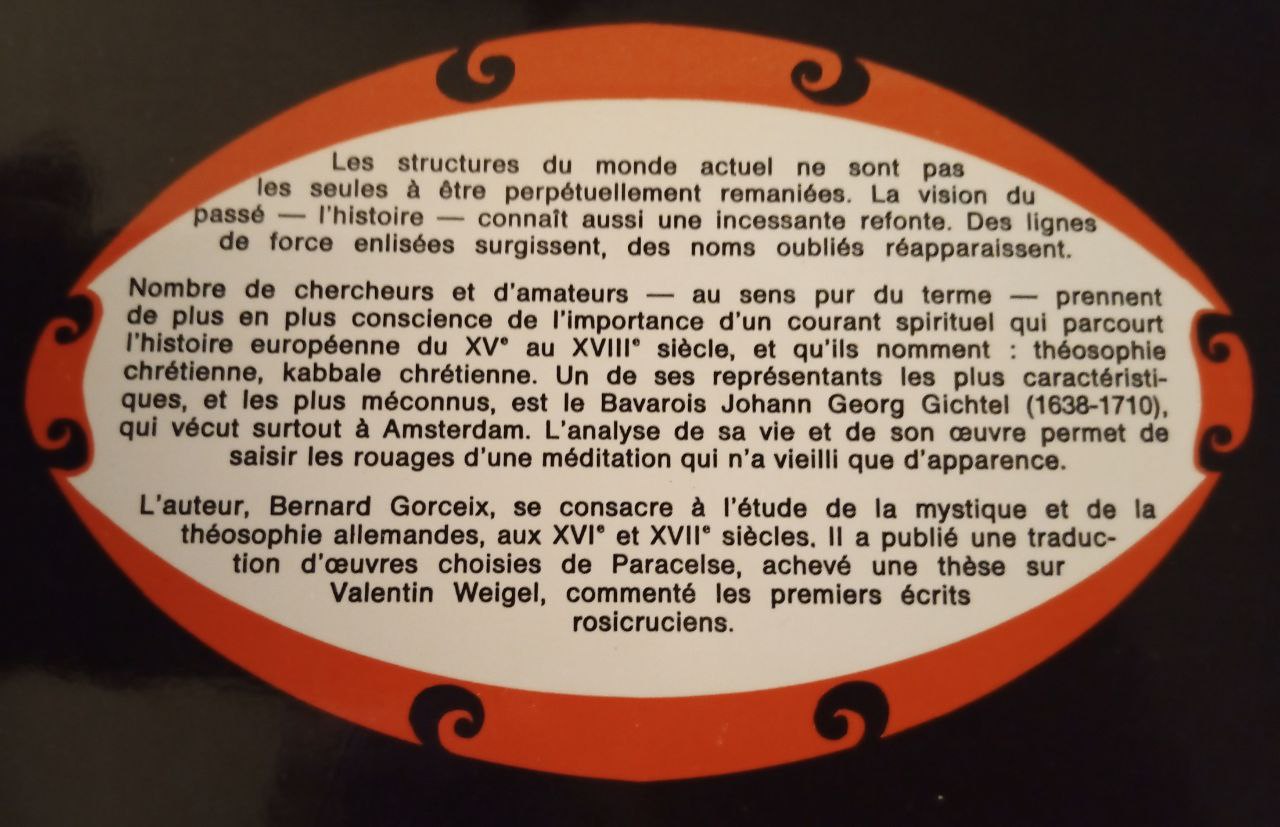
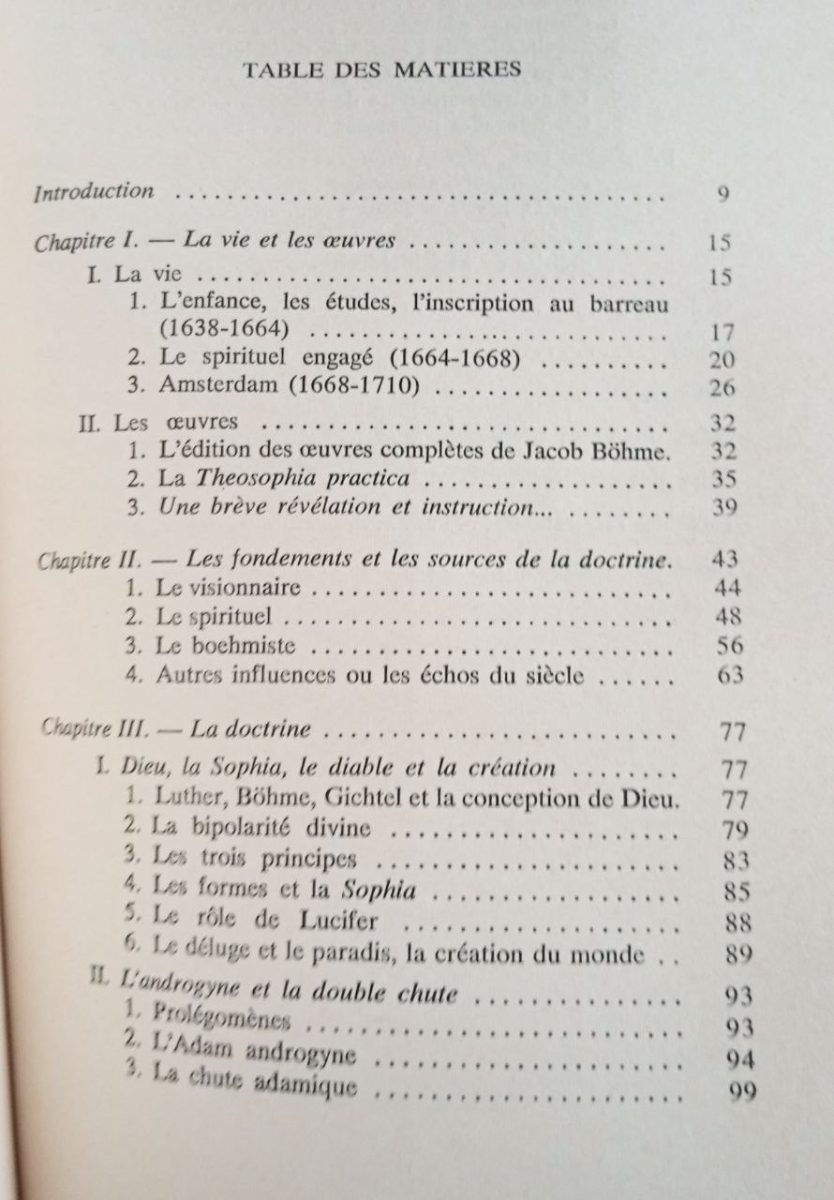
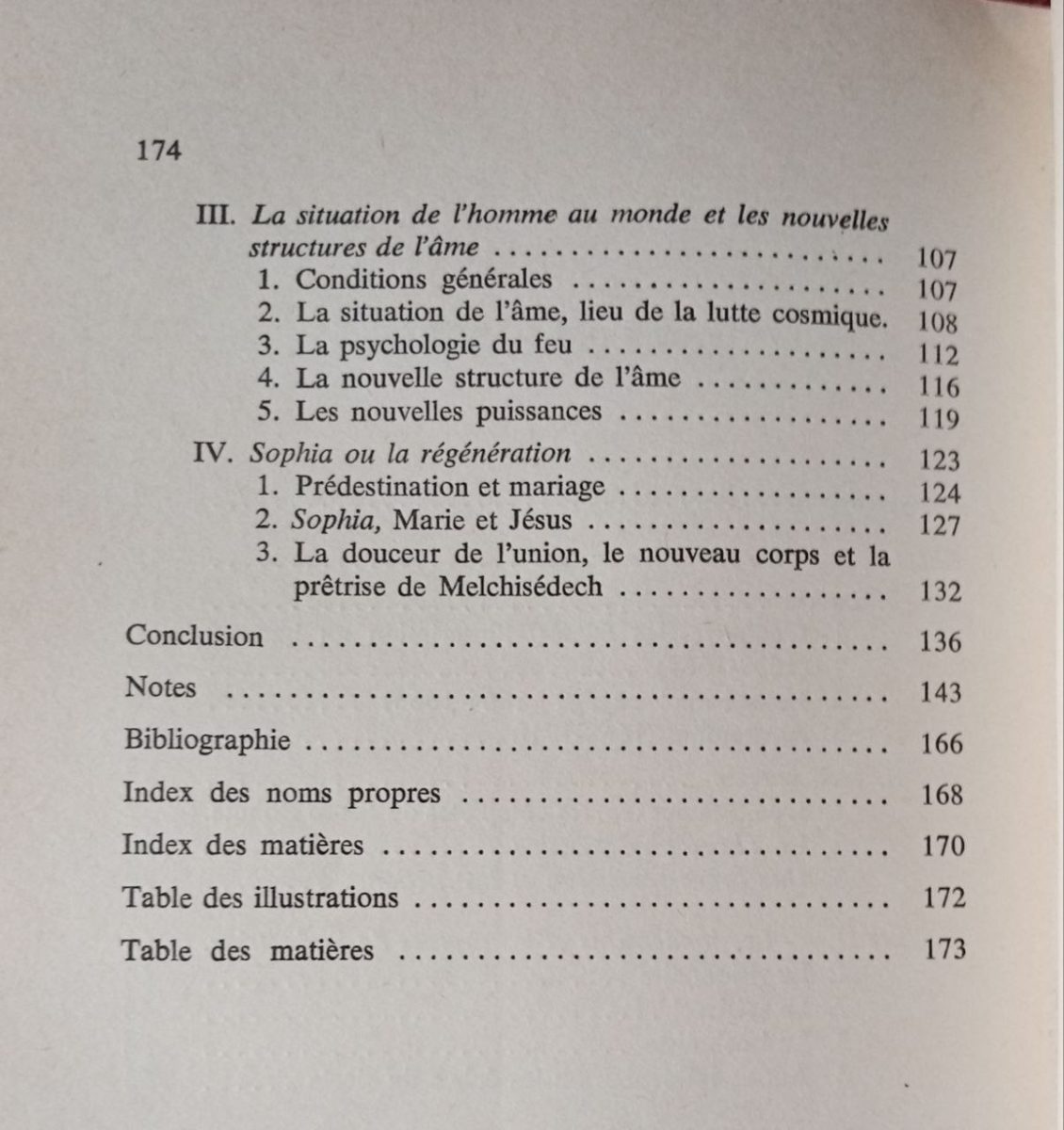
Today’s sharing from the Blue House of Via-HYGEIA is part 5 of the sampler dedicated to the memory of professor Bernard Gorceix, an extract of his ‘Johann Georg Gichtel, théosophe d’Amsterdam‘ published by Editions l’Age d’Homme in 1975, and titled: ‘La douceur de l’union, le nouveau corps et la nouvelle prêtrise’. From page 132 to page 135. A Via-HYGEIA English translation from the original French.
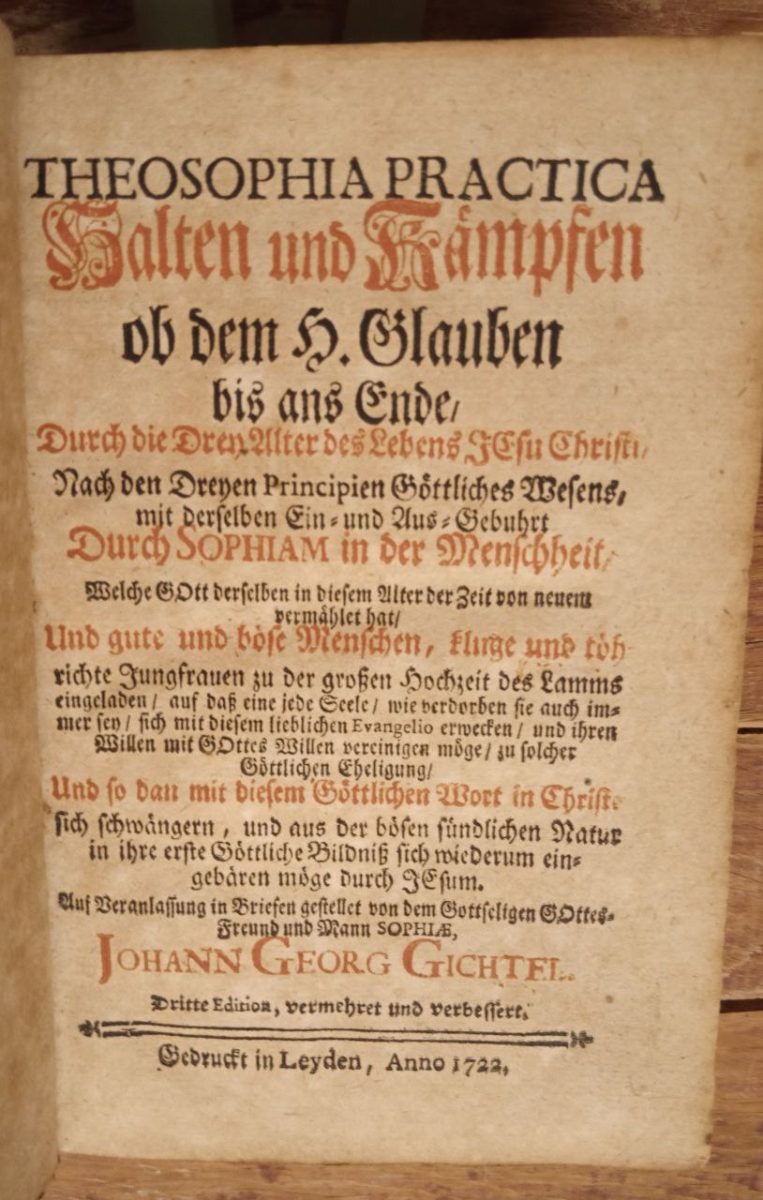
At the end, the appendix offers two translated excerpts from the ‘Theosophia Practica‘, Gichtel’s collected letters, exemplifying and highlighting exactly what is discussed in the small chapter below. They are ‘letter 93‘ from volume 1 and Paragraph 22 from letter 72 in volume 2. Impressive.
Forthcoming sampler part 6 and sampler part 7 will be part II and III of his introduction to ‘La Bible des Rose-Croix‘, published by Presses Universitaires de France in 1970, being his French translation of the three founding texts of Rosicrucianism, the ‘Fama Fraternitatis‘, the ‘Confessio Fraternitatis‘ & the ‘Chymische Hochzeit Christiani Rosencreutz‘ and its title will be: ‘The Fama and the Confessio, an introduction & commentary‘. Part 7 will be dedicated to the ‘Chymische Hochzeit‘, with also an introduction & a commentary.
**
3-The Sweetness of Union, the New Body, and the New Priesthood
Johann Georg Gichtel very often evokes the delightful and overwhelming newness of the new union. In this final paragraph, we revisit the principal themes of this description. While they add nothing to the speculative framework, they bear witness to the spiritual richness of our author’s theosophy.
When he attempts to grasp the mystical union in its entirety, it is, like all spiritual authors, with the terms mystery, ineffable, that he settles. ‘It is a truly profound mystery‘, he writes on January 15, 1701, ‘and may God grant that you be worthy of it, to be a pure and humble receptacle that remains submissive to its creator and author’. A little further on, he evokes ‘the new birth and its mystery‘. This contemplation of God, this gazing into the imagination of God, this nuptial community with Sophia, this new similitude of God and man, this marriage of the Lamb, cannot be described with words alone, such is its sweetness! ‘The sensation and the taste that form in the spirit, in the senses, and in the heart at the moment of the spiritual marriage are comparable to nothing, and thus they are ineffable‘. The soul perceives many syllables, but these cannot be pronounced by an earthly mouth.
Through certain chosen terms, through certain rare metaphors, however, the letter writer makes his correspondent understand, first of all, the general meaning of this dynamism which leads the soul from the second to the third heaven, through which it accesses the Trinity—a total change of spirit. We have seen how images of fire and light already represented either the life of the soul, in its relations with the principles, with Sophia, Mary and Jesus, or the complex relations of the principles and the qualities. The theosopher is also very fond of the term: breakthrough (Durchbruch), used alongside that of lightning flash, through which he can account for this upward revolution, this rupture, this penetration felt by the man who drowns in the higher waters. It is necessary, he concludes, ‘that you break through towards God in the heaven of the sacred trinity‘. It is ‘thanks to the power of the Spirit of God that the breakthrough occurs‘. The term is often correlated with the image of the dawning day: ‘The day is born when the light breaks through anew from within and swallows up the darkness‘. A very beautiful letter from May 16, 1699, compares the itinerary of the Fall and the second birth to the life of the atmosphere: ‘When vapors are born from the sea, they awaken clouds, which cover the sun, which deprive the earth of its brilliance and its rays; and although it is in the sky, it cannot however exercise its forces unless it breaks through the clouds anew. It is in the same manner that Sophia is born from the fire of our soul‘. It is prayer that allows this liberation, provided we pour it, like a seed, into the field of the Sophianic matrix.
The theosopher also willingly describes the content of feelings and impressions that spring from spiritual birth and the reanimation of the Trinitarian life within us. All the senses, all the faculties experience an acme, which he calls ‘magical‘, to distinguish the celestial sensibility from the common, earthly sensibility. ‘The God-man, man-God will‘, he writes, ‘is introduced into Paradise, which shows itself inwardly, in taste, touch, smell, sight, and hearing‘. For each sense, it is a summit of its activity, which is of course impossible to describe. ‘And I must acknowledge that no human tongue can express the sweetness of the taste of love which one enjoys inwardly in the conjunction of these two divine ideas or qualities‘. When the arrow has pierced the black center of the target, we are endowed with magical eyes and ears. The prayer we formulate at the heart of this contemplation is more a ‘spiritual meal‘ than an intellectual act. We literally eat God’s word of love, we taste the sweetness and honey of the light. We are refreshed like the thirsty deer. Likewise, the new language we speak resembles no earthly tongue, yet it has sounds, words, it is animated by the ‘tonal-force and the echo‘ of the Word of the Father made flesh. Our sight, meanwhile, is multiplied in its acuity and density. ‘The will‘, says the theosopher, glossing Revelation, ‘is once again covered with wings speckled with eyes‘.
It is within this renewal of a veritable supranatural nature that one must grasp the care with which the theosopher describes the believer’s new body. Innumerable are the passages where Johann Georg Gichtel affirms the urgency of a new birth that is also corporeal, enumerates the qualities of the body of the second Adam, describes this pleroma, this fullness announced in the ‘Epistle to the Philippians’. The fault of the Lutherans, he says bluntly, is not to concern themselves with the body, and to send the soul straight to heaven or hell. The earthly body is fragile, it must feed on the elements, it undergoes astral influences, it must finally become dust. This is because it is created from ‘the essence of mineral dust‘. The first energy-body—and he adds pointedly: ‘of which Paul speaks‘—will already be transparent, like crystal. It will not be destructible; the fire of anguish will not be able to damage it. We will pass painlessly through the fiery trials, with the same serenity as the three Hebrews in the furnace. The tincture of the new body will penetrate the old one, as fire penetrates iron, to render it incandescent. As for the paradisiacal body we will put on after the Last Judgment, it will be even more extraordinary. It will be made of a purer earth, of the most subtle of quintessences. It will have the fineness of the body of the resurrected Jesus, visible to the saints, invisible to atheists. We will shine like stars. And the disciple returns to Boehme, advising the reading of the ‘Informatorium novissimorum’, which the Lusatian addresses to the customs officer Paul Kaym.
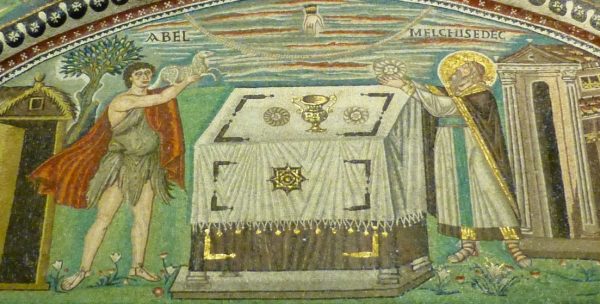
On earth, we are certainly still far from this total transformation made possible only by death, then the Last Judgment. We have here below only a foretaste, ‘a small sample‘ says the theosopher. Wisdom can always withdraw. The function of the believer is, however, not negligible. A mission is entrusted to him: the priesthood of Melchizedek. Melchizedek is that ‘king of Salem, priest of the Most High God‘ (Gen. 14:18), who brings bread and wine, and whom Psalm 110 presents as a figure of the Messiah, also a Priest, King, instituting the Eucharist. Although Gichtel claimed the contrary, Jacob Boehme also knew Abraham’s priest, whom he likewise made a symbol of Christ. In Johann Georg Gichtel, the theme assumes considerable importance. It ends up summarizing the entire mission that God entrusts to the mystic, all the gifts He communicates to him in a new priesthood, revealed in the vision of 1664. ‘This priesthood is eternal, no one can understand it, because it has its foundation in the light, in the sacred Ternary, and because it is the fire of love, not that of wrath, as with Aaron’s, that kindles it‘. It alone can replace the mass of the Papists. But false Christians have stifled it, buried it. God reinstates it in the person of Johann Georg Gichtel. What God said to Moses in the Old Covenant is indeed renewed in the New, through the communication of this supreme ministry. What does it consist of? Doubtless ‘to work ceaselessly in the Lord’s vineyards‘, through prayer, but above all to become anathema, in the ancient sense of the term. To be anathema is to accept to sacrifice oneself for one’s brothers, to become a religious offering (this is the meaning of the Greek word), to heal those possessed by the devil, by accepting to suffer in their place, to snatch sinners from hell through one’s prayer, to chase the enemies from one’s country, such as the French from Holland. A new Christ, the new believer accepts Calvary (Golgotha) for the salvation of mankind. This is what Johann Georg Gichtel wants to express when he renews this ancient figure of the mysterious Melchizedek.
*
Source

*
*
*
*
Appendix
Excerpt 1
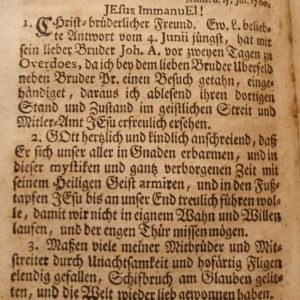
Amsterdam, the 15th of July, 1700.
JESUS Immanuel!
1. Christ-like brotherly Friend, Honoured Sir,
Your beloved reply of June 4th recently, was handed to me two days ago in Overtoom (West Amsterdam) by our dear brother Johann A., when I was visiting dear Brother Uberfeld and Brother Pr., from which I gratifyingly discerned their position and state there in the spiritual warfare and knightship of Jesus.
2. For this I thank God in a childlike and filial manner, that He desires to build us all up in grace, and in this mystical and wholly hidden time to work with His Holy Spirit, and faithfully lead us in the footsteps of Faith right to our end, so that we may not run in our own delusion and will, and thereby miss the narrow path.
3. Especially since many of my fellow brothers and fellow combatants have wretchedly fallen through inattention and false loves, have suffered shipwreck in faith, and have won the world for themselves again.
4. And as Your Honour rightly observes from yourself, the New Birth makes us into small, unknowing children, who in their own power know neither Good nor Evil, and finally causes us in the prayer of the Spirit to grow continually from one degree and age, until we attain to a full, perfect age in Christ, and through all kinds of tribulations obtain exercised senses, through which we can also let our light shine before others.
5. For I too, by God’s grace, have been led in such a manner and way, and have received my knowledge, from which this my unworthy answer and humble request is composed: that you would vigilantly and in humility before God walk in your inner ground, and diligently make a prayer of it, so that you may no longer be seduced by the lustful serpent in the external creature.
6. For because so much is now preached and prophesied about the coming of Christ to His thousand-year kingdom, and because the devil, through those faithful warriors of God, suffers great resistance and diminishment, he therefore stands in great wrath, and rages fiercely among the children of disobedience and wickedness.
7. And misuses them, to persecute the righteous with slanders, lies, calumnies, and to blaspheme their good and holy conduct, so that their soul may be saved and won for God, as he has likewise practiced here against us with his slanderers; but to the Highest belongs endless thanks, who has until now joyfully upheld us, and has not let us fall into the hands of our enemies.
8. If we were followers of Christ and hearers of the Word, we would outwardly need no teacher nor leader; the πνεῦμα (pneuma, Spirit) would indeed lead us into all truth, and drive us to prayer. But blessed is a Christian community which has an enlightened teacher and preacher, who is a true follower of Christ, and confirms his teaching with his life.
9. The laughter, however, which befalls them against their will, is only an effect of the Spiritus Mundi in the sensual, or, according to Paul’s word, the animal man, indeed of unbelief, and is therefore to be well distinguished from the operation of the Holy Spirit, whose joy in the spirit of the mind is immeasurable to the outer, bestial man, yes often quite imperceptible; especially to those who, weaned from the breast of quiet love, enjoy stronger meat.
10. And as can be joyfully seen from Your Honour’s letter, his soul hungers only for the powers of the πνεῦμα (pneuma, Spirit), and is not content with Academic idleness, and therefore will be able to distinguish or test well within himself whether such laughter abides in faith and brings forth strength?
11. Also, the visions and ecstasies are commended to us to test; but in turn to distinguish them from those in the spirit of the mind, which fill the heart with God’s Word, indeed with fullness, and strengthen in the πνεῦμα (pneuma, Spirit), also not through such raptures of the elemental man, but are to be judged with understanding, of which Paul reports to the Corinthians.
12. The art of divination, however, reaches only into the sun, and can ferret out another man’s thoughts, but it can go no further; and because we have in us as much darkness as light, and are surrounded with the sensual man, it is nothing strange.
13. The spirit of our souls can enter into all three realms, and behold things, for our standing is in heaven; and it is therefore quite possible to enter into hell in the spirit, and to help one’s brother overcome with one’s treasure, if one is drawn thereto. This is the true Melchizedekian priestly office, of which Paul reports in his ‘Epistle to the Hebrews‘; it is also the only true service of God, of which Joh. 1. Ch. 3-16 writes, and has been shown to me by Θεοδιδακτοί (Theodidaktoi, Taught of God), Joh. 15. 13-14. Although it is mocked and perverted by the inexperienced, I am yet assured that we shall with Christ as kings and priests hold the judgement: for His office is also to stand against the wrath in His anointed ones, as we see in Abraham, Moses, David, Paul Rom. 9, who wanted to be accursed from Christ for their brethren, and resisted the wrath.
15. And it were to be wished that all who bear the name of Christ were kings and priests of the Spirit realiter (in reality), who bore their brothers’ burden, and with their prayers held back and turned away God’s wrath; it would go better in the world.
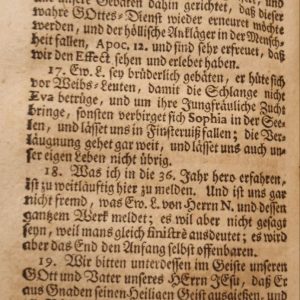
16. We have enough zeal for God, and directed all our prayers thereto, that this true service of God might be renewed, and the great adversary in humanity might fall, Apoc. 12, and are very rejoiced that we have seen and experienced the effect.
17. Your Honour is fraternally admonished to pray for wise discernment, so that the serpent does not deceive Eve, and rob her of her virginal chastity, otherwise Sophia hides herself in the soul, and leaves us in the five senses; the renunciation goes very far, and leaves us also not a carefree life.
18. What I have experienced in these 36 years is impossible to report here. And what Your Honour reports about Mr. N. and his whole work is not at all strange to us; but it should not be spoken, because one immediately misinterprets it; but the end will reveal the beginning itself.
19. We beseech meanwhile in the spirit our God and Father of our Lord Jesus Christ, that He out of grace would pour out His Holy Spirit, and convert or lead all peoples to Himself! For we are temples of the Holy Spirit; so that at last one of the sheep of Christ might become a shepherd and teacher! Amen.
20. What I can otherwise serve your dear relatives I do heartily and gladly, and have in the short time of our acquaintance with dear J. A. transacted so much good instruction, that I do not doubt a good effect, I also love him heartily, because he is childlike and simple, and have included him in my prayer, as also Your Honour and other dear relatives, and kept him here in our fellowship.
21. There is no lack of good teachings; and as we must bear the name of a Life of Faith against our opposite, so we wish such most holy Faith, living in certain hope, to every human heart, that He will not let it be unfruitful.
22. Meanwhile we commend ourselves all to God’s mercy, and remain with friendly greeting to Your Honour and all those who love Jesus, in in Christ Jesus.
Your Honour’s
wholly devoted
J. G. G.
Original German




*
Excerpt 2
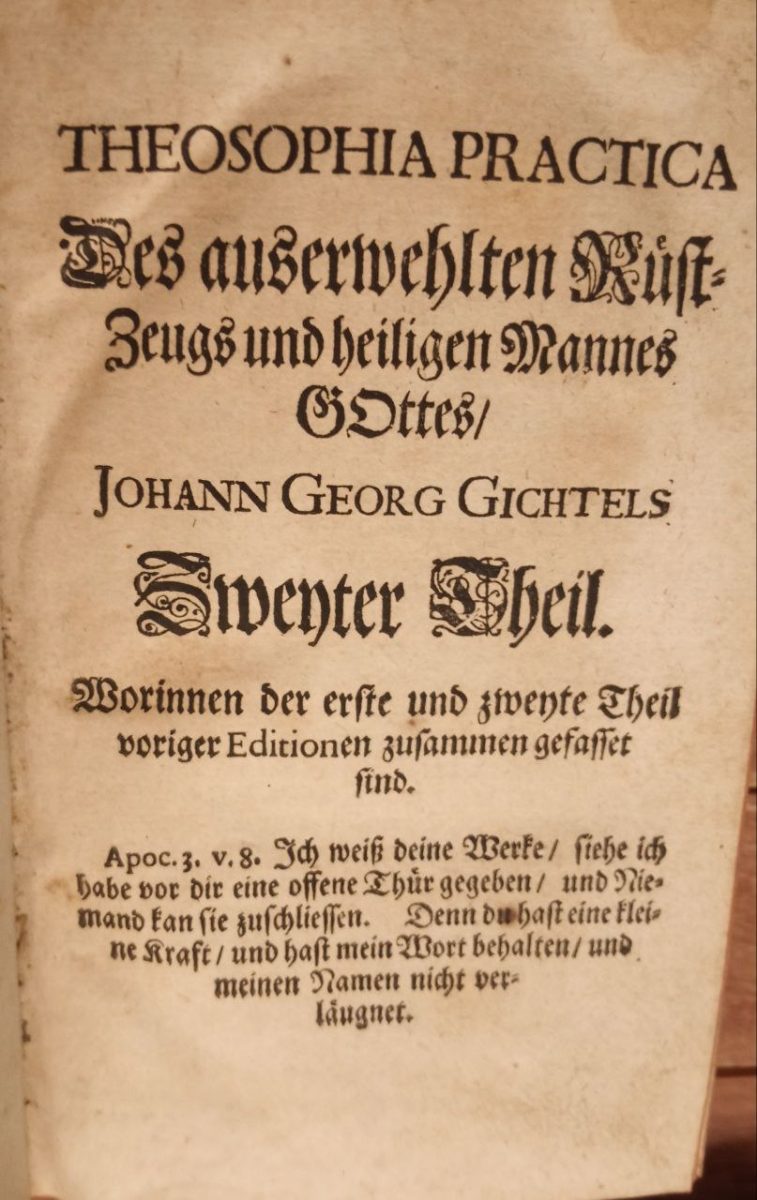
Paragraph 22 from letter 72 in Volume 2.
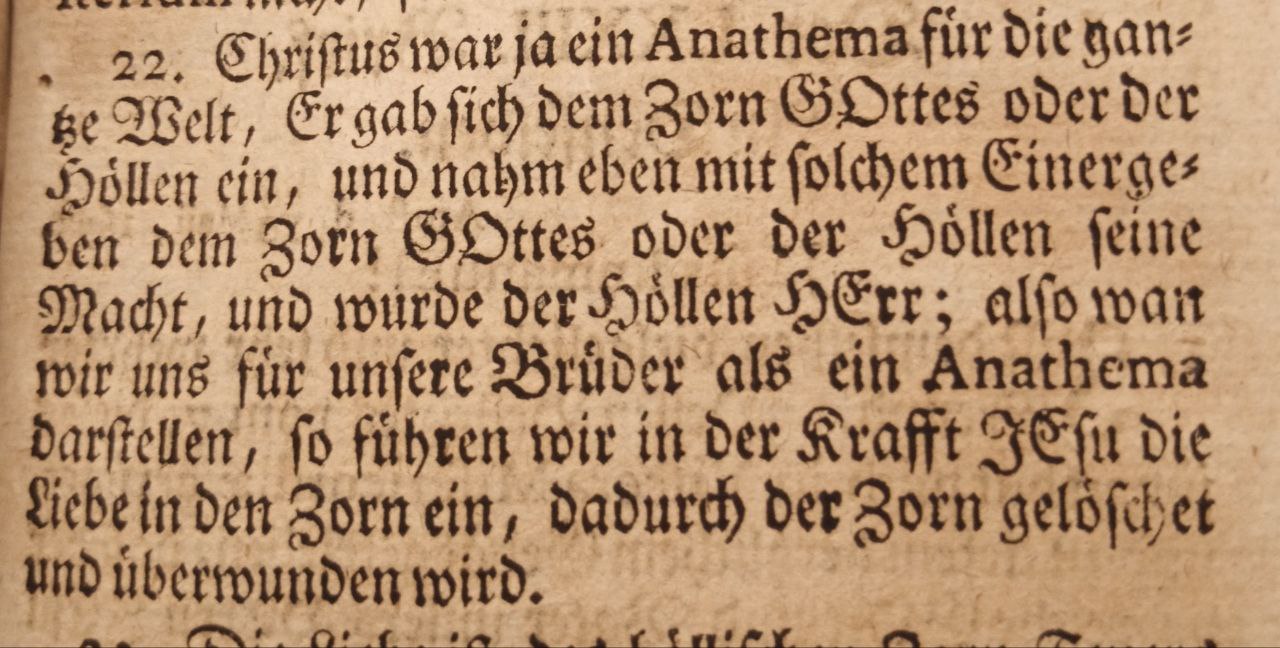
22. For Christ was an Anathema for the whole world, surrendered Himself to the wrath of God or of Hell, and with precisely such a surrender to the wrath of God or of Hell took His power, and became the Conqueror of Hell; thus, if we present ourselves for our brethren as an Anathema, we then lead in the power of Christ love into the wrath, whereby the wrath is dissolved and overcome.
Original German
*
Coming soon
A Little Bernard Gorceix Sampler – Part 6:
‘The Fama Fraternitatis and the Confessio Fraternitatis,
an introduction & commentary‘.

***

Related Articles

Leave a Reply