
Circle of Transmission: The Living Loom
A Little Bernard Gorceix Sampler – Part 7 : ‘The Chymical Wedding of Christian Rosenkreutz’- An introduction & a commentary.

Professor Bernard Gorceix.
Picture by Vincent B. Gorceix,
via Wikimedia Commons.
*
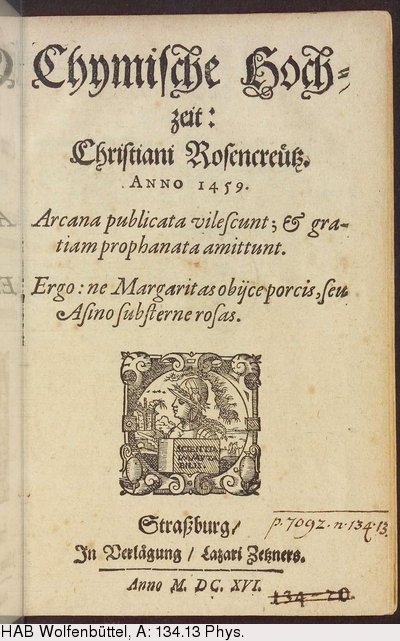
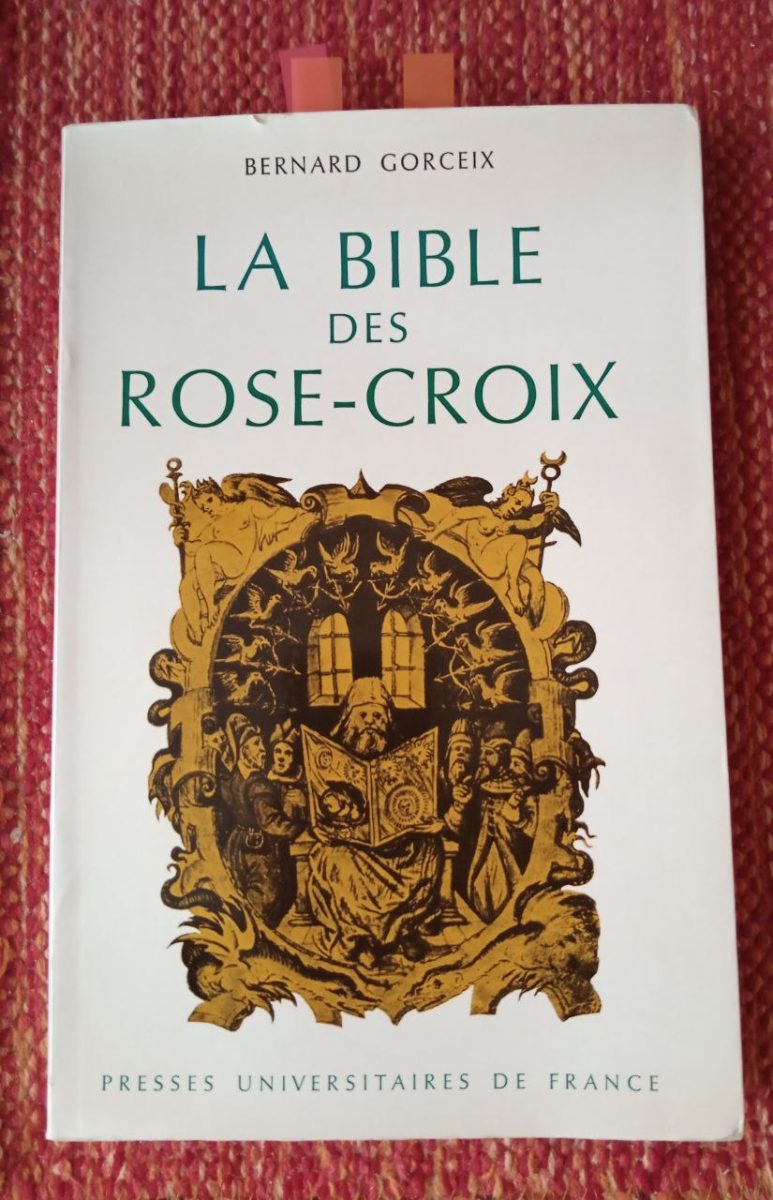
Today’s offering from the Blue House of Via-HYGEIA is Part 7 of our sampler dedicated to the memory of Professor Bernard Gorceix. It is excerpted from ‘La Bible des Rose-Croix’, published by Presses Universitaires de France in 1970—his French edition, translation, and commentary of the three foundational Rosicrucian texts: I. the ‘Fama Fraternitatis’ (1614), II. the ‘Confessio Fraternitatis’ (1615), and III. the ‘Chymische Hochzeit Christiani Rosencreutz’ (1616). Today, this excerpt focuses upon text III: ‘The Chymical Wedding of Christian Rosenkreutz’.
In this introduction, Gorceix advances his central thesis: that Andreae’s work is neither a purely alchemical treatise nor a simple mystical allegory, but a deliberate superposition of both structures—spagyrical and theological—woven so intimately that they cannot be separated without distortion. Drawing upon the full symbolic vocabulary of Baroque spagyria (the phoenix, the homunculi, the philosophical egg, the chromatic sequence of nigredo to rubedo), Andreae renders visible the Christian mysteries of death and resurrection, the soul’s ascent toward unio sacra, and the opposition between eros and agape. All of this unfolds within a historical moment when alchemy itself was transforming from a practical art into what Albert-Marie Schmidt called ‘a parallel religion’.
Coming next: A Little Bernard Gorceix Sampler — Part 8: from ‘La Bible des Rose-Croix’-‘Lusus Severus: An unmissable milestone in the history leading from the mystical Middle Ages to modern philosophy’.
**
*
Bernard Gorceix
From the introduction of ‘The Rosicrucian Bible’
III. — The Chymical Wedding
Despite the multiplicity of themes developed in the ‘Fama Fraternitatis’ and the ‘Confessio’, the Rosicrucian Bible, reduced to these two manifestos, occupies only a secondary place. It gains in depth and literary value thanks to the tale narrated in the third treatise: ‘The Chymical Wedding’. The narrative, 146 pages in the original 1616 edition, is presented in the first person and spans seven days. It deals with the journey of the hermit Christian Rosenkreutz, his participation in the royal wedding, and his return after numerous and wondrous adventures.
The story is interrupted in its final moments: while Christian Rosenkreutz, guilty of a serious infraction, must remain in the castle in the role of gatekeeper with no hope of rapid release, the editor informs us that two pages of the narrative have not reached him. However, he knows that the hermit eventually returned home. Each day is occupied by a particular adventure, and the schedule is punctuated by meals—plentiful at the beginning, frugal during the most important day, the sixth.
- First Day (11 pages in the 1616 edition): The departure. On Easter Saturday, a winged messenger visits the hermit Christian Rosenkreutz bearing an invitation to the royal wedding; first dream; departure of the hermit.
- Second Day (20 pages): The journey and the first evening at the castle. Hesitation among the four access paths; crossing the three enclosures; preparation for dinner, and dinner; second dream.
- Third Day (37 pages): The day of judgment. The judgment of the unworthy and the awarding of the Golden Fleece; the execution of the judgment in the garden; the visit to the castle; the weighing; third dream.
- Fourth Day (24 pages): The preparation for the wedding. The scene in the garden; the presentation to the royal persons; the theatrical performance; the death of the royal persons; the nocturnal embarkation of the coffins.
- Fifth Day (13 pages): The sea voyage. Second garden scene, and the transgression: visit to the underground dwelling of Venus; the simulated burial of the royal persons; the sea voyage, and the ceremony of the sea goddesses; arrival at the Tower of Olympus; the nocturnal scene.
- Sixth Day (23 pages): The resurrection of the King and Queen. The seven stages of resurrection in the seven storeys of the tower; the embarkation of the royal couple; conversations with the old man, guardian of the tower.
- Seventh Day (13 pages): The return. The awarding of the Order of the Golden Stone; the return voyage; the avowal of the fault and the punishment; the unforeseen denouement.
This simple summary of the action of ‘The Chymical Wedding’ shows us the richness of the novelistic technique compared to that of the ‘Fama’ and the ‘Confessio’. Certainly, the general outline of the narrative is traditional: the visit to a mysterious castle where fabulous events unfold. We need only mention the German romances of the Round Table, particularly Wolfram von Eschenbach’s ‘Parzival’, dating from the very first years of the thirteenth century. Paul Arnold, in his study, rightly cited Canto X of Edmund Spenser’s ‘The Faerie Queene’, a poem published in 1590 and 1596 which describes the legend of the ‘Knight of the Red Cross‘.
The points of comparison between the English and German works are numerous: the beautiful veiled lady, the princess Una who guides the knight, and the mysterious virgin of the Wedding; the House of Holiness, its enclosures and porters, and the German castle; the hermitage of the holy old man, the Tower of Olympus guarded by the old man; the second birth of the knight and his betrothal, the rebirth of the king in the Wedding. However, upon this classic theme of the castle—which in mystical language, particularly in Andreae’s time, as with Teresa of Avila in ‘The Interior Castle’, is one of the key allegories of union—the Baroque chronicler grafts an infinite luxury of detail, fruits of an exuberant fantastic imagination.
Even if the ‘Fama Fraternitatis’ also tells of a wondrous journey, that of Christian Rosenkreutz to Arabia, Egypt, Morocco, and Spain, the setting indeed plays only a secondary role in the manifesto, except in the second half of the treatise regarding the account of the discovery of the tomb and its description. In ‘The Chymical Wedding’, on the contrary, the setting is present everywhere. To strike the reader’s imagination, the author of the Fama has only the evocative power of proper names at his disposal: Damcar, Fez, the elemental inhabitants.
In ‘The Chymical Wedding’, the permanent change of location where the action unfolds is accompanied, often several times during the same day, by a total renewal of the scenic arrangement: the chronicle takes on the allure of an opera, where even the musical accompaniment is never lacking. Multiple outdoor scenes unfold: the four access paths to the castle, the enclosures, the gates, the tree-lined avenues of the fortress; the garden, successively a museum, a place of capital execution, the site of a fountain with enigmatic inscriptions, an open-air theatre with a four-tiered stage hung with multicolored fabrics, and a stage representing the Temple of the Sun, finally, a place for a simulated illumination. Then there are all the sea scenes: nocturnal shores with moonlight, storm, cloud effects; ocean covered with vessels; rounds of sirens and sea goddesses; the island with enormous ramparts, with the marvellous architecture of the Tower of Olympus, a group of seven towers encased within one another. To this exterior setting, the dreams that conclude the first three days compose an imaginary backdrop: the closed pit at the bottom of which chained prisoners stir; the human puppets hung from the sky by a thread that an unknown artist brutally severs; the door in a wall that refuses to yield.
In the interior scenes, the fantastic unfolds with even more verve: staircases and trapdoors, carbuncles and pyrite lamps, library and planetarium, set tables, vaults and canopied beds, orchestras, trabants and virgins, golds, pearls, knightly orders, sumptuous gifts, an uncountable crowd of curious objects, naked or veiled figures, domestic and exotic animals, moving tableaux and musical instruments, colors and sounds.
Thus, the tomb of Venus, described at the beginning of the fifth day, consists of two rooms communicating via a trapdoor, one occupied by a triangular mausoleum, the other by the fairy-like bed of Venus. The action is concentrated mainly in three large halls: in the first take place the meal, the judgment of the unworthy, the procession of the first queen, the dances of the virgins; access to the second hall is via a staircase of 365 steps: it has its painted vault, its dais on which the king and queen sit enthroned, behind a curtain, in a light of unbearable brilliance; in the third hall, the adepts see the six royal persons, the choir of old men, Cupid, an altar covered with symbolic objects, before a hooded executioner hastily decapitates the entire court. Finally, the center and end of the whole narrative, the strangest operations take place in the seven superimposed halls of the Tower of Olympus, forming a veritable anthology piece of the fantastic.
Add to these outdoor and indoor scenes the multiplication of enigmas of all kinds: coded writings, rebuses, geometric figures, numerical games worthy of a mathematician, culminating in the equation with eight unknowns already solved by Leibniz—as noted by Kienast and cited in Arnold—by which the beautiful companion of the hermit reveals her true identity: Alchimia. The lover of the marvellous cannot fail to be seduced.
In the formal domain, the multiplicity of settings has its counterpart in the variety of styles and genres. Certainly, the ‘Fama’ and the ‘Wedding’ are, like one another, chronicles, in the sense that they both present an apparently impartial account of a set of historical facts, reported in the order of their succession. Very skillfully, however, the use in the ‘Wedding’ of the first-person narrative in the indicative brings closer to us events made distant by their marvellous nature. The alternation of prose and poetry helps to distinguish the everyday from the extraordinary.
Two genres independent of the chronicle occupy an important place in the picaresque novel. Almost ten pages of the narrative are devoted to theatre: seven acts with interludes, placed at the heart of the novel, prefigure the death, then the resurrection of the betrothed. Moreover, the seriousness of the episodes described is always counterbalanced by a humor that is sometimes pleasant, sometimes dark, in which Andreae excelled: the purification session, for example, during the second day, is a veritable scene of burlesque comedy; invisible barbers brutally seize the old hermit to tonsure him upon his arrival at the castle.
The punishment of the unworthy, during the third day, a piece of social criticism during which tyranny and corruption are virulently denounced, does not lack comical scenes: an emperor, in particular, to weigh more on the scale, hides a book under his robe; the folio escapes him. Similarly, the cruelty of the scenes on the fourth day, during which the kings are executed, is tempered while being enhanced by the mischievous attitude of Cupid who teases the virgins.
The diversity of fantastic themes and genres does not compromise the unity of the work. This rests on a dual foundation.
The first is illuminated by reference to recent works devoted to the analysis of a movement that is one of the constants of European art and spirit, from the Middle Ages to the present day, but which flourished particularly in these decades that André Chastel groups under the name: ‘The Crisis of the Renaissance’ (1520–1600). In the sixteenth century, indeed, after the classical moment of the Renaissance, under the primacy of Italy, a spiritual crisis erupted throughout Europe—in Germany around 1590–1600, as the Reformation and Counter-Reformation delayed the deadline—affecting all genres. In the domain of literary and artistic creation, this took a form that it is customary to call Mannerism.
As Chastel defines it, this involved ‘work on an already created form, on a style already acquired‘, a ‘sentiment of an irreducible complexity, ultimately more precious than order, balance, and reason‘. The works of André Chastel and Jacques Bousquet are precious because they identify a defined number of key themes that define this culmination, this renewal of forms and subjects, particularly noticeable in the second half of the century. It goes without saying that these still little-known definitions concern not only painting and sculpture, but just as much literature, as Gustav René Hocke has demonstrated in his studies on mannerism in European art and literature.
The canon applies in particular detail to the treatise of Johann Valentin Andreae, composed in the very first years of the Baroque century. The ‘primacy of the detail‘ that André Chastel analyzes in the spirit of the decoration of ornamental engravings and the master of Augsburg (second half of the sixteenth century), in the love of rhetoric and preciosity, we have just set forth in ‘The Chymical Wedding’. ‘Festival, Court Art, and the Marvellous‘, the title of the fourth chapter of ‘The Crisis of the Renaissance’, would also apply to the Rosicrucian work: ‘entries and masquerades‘, triumphal arches, temporary decorations, taste for luxury, parade pieces, monstra, dragons and litters—this recalls the nautilus cups of Jamnitzer, the creations of the goldsmiths of Munich and Augsburg, the entire fauna of the Kunstkammern, the cabinets of curiosities, one of the most famous being that of our author’s contemporary, Rudolf of Habsburg.
Antoine Caron of Beauvais’s ‘Tomb of Love’ at the Louvre would be an excellent illustration of the treatise we are translating: vaults and galleries, temple in a grove, moonlight, the sea in the wings, a procession with its banners, its cupids and old men, veiled virgins, tender colors, love borne to the tomb. We know the attraction to the bizarre, the taste for the strangeness of the living, expressed as much by Giuseppe Arcimboldo as by Hendrick Goltzius, the mania for the horrible of which one of the most striking witnesses is that ‘Medusa’ by Victor Wolfvoet in the Dresden Museum, the knowledge of ruins and fantastic and infernal architectures: the reader of ‘The Chymical Wedding’ will not be disoriented.
The elegant femininity of the nymphs of the School of Fontainebleau, of the Dianas and Venuses, of the Cupids and Psyches by Jacopo Zucchi, underscored by the luxury of clothing, jewels, pearls, we find them again in the Alchimia of the ‘Wedding’, in the choir of virgins, in the sea goddesses. The pursuit of attitude, the preference for gesture, a certain grandiose immobility assert themselves in the static tableaux of Andreae’s novel: assembly of royal persons, chevrons of virgins, parades and processions, rounds and groups—they abound in the ‘Wedding’. Even that particular trait that André Chastel calls the Eros of cold beauty characterizes the sleeping Venus that Christian Rosenkreutz surprises on her couch, ‘so superb, so beautiful that I was frozen‘, immobile as a statue, and the royal couple born from the ashes and blood of the phoenix.
The text of Johann Valentin Andreae is not chaste: the diffuse eroticism takes on a color of perversity, of cruelty that appears, for example, in the bloody scenes of the execution of the royal persons. On this count as well, the work of the Swabian is undoubtedly one of the best testimonies of literary Mannerism, between the humanist and edifying literature of the early years of the sixteenth century and the great flowering of Baroque literature, around 1620.
The second point that creates the unity of the narrative is no less important. It is indeed through the analysis of the work’s symbolism that we can begin the interpretation of the treatise. Yet, in this domain, rare critics have taken pleasure in obscuring the question. The most frequent judgment passed on Rosicrucian philosophy states the syncretic character of the treatise: Serge Hulin, in ‘Les Sociétés secrètes’, calls it ‘a composite synthesis which gathered the vestiges of all the more or less secret traditions that had traveled underground throughout the Middle Ages and the Renaissance’. Nesta Webster speaks of a ‘compound of ancient esoteric doctrines, of Arabian and Syrian magic, of Jewish Kabbalism, partly inherited from the Templars‘. The lover of clarity risks being disappointed, even if advised not to confront these doctrines which are said to be ‘by essence‘ confused.
The only critic who attempted a detailed deciphering of the symbols of the ‘Wedding’, R. Kienast, did not simplify the task: very ingenious explanations of some allegories and metaphors rub shoulders with the most hazardous commentaries. The allusion to the three temples crowning the mountain, for example, in the letter the messenger addresses on the first day to Christian Rosenkreutz, would be Babylonian and Assyrian; the virgin who extinguishes the lanterns, between the second and the third gate of the castle, would be Perso-Gnostic. Venus, whom Christian surprises on her couch, would not be the Latin goddess, but a Semitic figure. The Tower of Olympus would be analogous to those famous ‘ziggurats’, to the astronomical observatories of the ancient city of Nebuchadnezzar. Caution is recommended in the face of such vague parallels.
Deciphering the multiple symbols contained in the treatise is difficult, first and foremost because the twentieth-century critic knows the culture of the seventeenth-century man very poorly. He constantly runs the risk of attributing to the originality of a Baroque author an image that was actually commonplace in his time, just as positivism for a very long time operated, regarding the sixteenth and seventeenth centuries, a distinction between astrology and astronomy that made no sense at the time, for Johannes Kepler, for example, ‘one of the founders of scientific astronomy’.
The danger is particularly threatening concerning the Baroque century, which is eminently the century of allegory, fable, and metaphor. The literary culture of the seventeenth-century author, as we can appreciate it, for example, in Jakob Boehme, Leibniz, Quirinus Kuhlmann, Angelus Silesius, is as vast, as diverse as it is heavy with the past, full of allusions and images unfathomable today. In this respect, Johann Valentin Andreae does not have, as far as we can judge, a more exuberant novelistic imagination than Martin Opitz or Christoph von Grimmelshausen.
This ultimately negative judgment, however, does not concern the entire symbolism of the work, but only the first two types that R. Kienast analyzed in detail: ancient symbolism, and testamentary symbolism. In both, indeed, Andreae shows himself classical: allusions to Homer (the Symplegades of the ‘Odyssey’ among others), to Virgil (for example, the verse from the ‘Aeneid’ engraved on the portal), reference to the ‘Corpus Hermeticum’, which, in the sixteenth and seventeenth centuries, was not necessarily tainted with occultism, to the Christian Latin poets (Prudentius, probably, for example, in the evocation of virtues and vices), and above all: the host of images borrowed from the Bible, more particularly from the Apocalypse.
These two symbolisms, however, which the notes of our translation frequently recall, supplemented by traditional allusions to famous authors of the Middle Ages (Boccaccio notably, in the meal with riddles) absolutely cannot account for all the images used in ‘The Chymical Wedding’. Indeed, for the most part, these belong to the alchemical language, and are particularly frequent in the spagyrical treatises contemporary with our author. Their multiplicity, their frequency, their recurrences throughout the work cannot be the effect of chance: the student of Tübingen, the contemporary of Maier, Khunrath, Böhme, has an in-depth knowledge of traditional alchemical literature.
The manner in which the images follow and link together allows us to find in the novel the detailed description of a traditional alchemical process. In this respect, one of the best connoisseurs of alchemical literature, Carl Gustav Jung, is entirely right to take Andreae’s work as one of the important sources on which he bases his psychoanalytical thesis. ‘The Chymical Wedding’ is the first spagyrical work he cites in his ‘Mysterium Coniunctionis’. The idea for this book, as its author states in the preface, was born from an article by Karl Kerenyi on the Classical Walpurgis Night of Goethe’s Faust II, a scene itself inspired by ‘The Chymical Wedding of Christian Rosenkreutz’. There are also numerous references to the ‘Wedding’ in Jung’s ‘Psychology and Alchemy’, as well as in the commentary by M. L. von Franz on the treatise attributed to Thomas Aquinas, the ‘Aurora Consurgens’, discovered and published by Jung in the third volume of the ‘Mysterium Coniunctionis’.
The thesis is based first on two external elements: the title, and the riddle of the beautiful lady’s name, which we have already cited. Even if the title of a work may give a false impression of its content, it is nonetheless never negligible. Yet, it is difficult to deny that the title of the Rosicrucian writing is that of an alchemical work—they said then, chemical. R. Kienast tried to do so, without success. Andreae’s title, ‘Chymical Wedding’, expresses the center and the end of the operation of the great work, the philosophical marriage of sulfur and mercury, ordinarily represented by a king and a queen: the spouses are enclosed in the philosophical egg, which also bears the name of nuptial chamber. It is the famous γάμος (gámos)
of the often incestuous couple that we see embracing in the fourth emblem of the ‘Atalanta fugiens’ of 1618, coupling in the ‘Rosarium Philosophorum’ of 1550, often transforming into a hermaphrodite. An anonymous author, likely from the thirteenth century, titled his alchemical treatise ‘Consilium Coniugii’, a treatise on prenuptial education, as cited by C. G. Jung.
On the other hand, it is remarkable that the old hermit attains knowledge through the advice of a beautiful lady who guides him from beginning to end, and whose name is: Alchemy. She is, after Christian, the central character. This role cannot be without profound meaning. Without alchemy, Rosenkreutz would never have reached the castle, he would never have visited the Tower of Olympus. The old man-young woman couple is frequent in spagyrical treatises: it represents the alchemist and mercury, sulfur and mercury, the prima materia close to death, and its new youth in the Work. Their presence in Andreae’s treatise evokes emblem XLII of the same ‘Atalanta fugiens’, published the same year as the ‘Wedding’: an elegant virgin whom Michael Maier calls Natura and whose veil floats in the wind precedes and guides through the night an old man with a heavy step, carrying a staff and a dark lantern. The engraving well illustrates the scene from the second day of the ‘Wedding’, during which a lady dressed in blue guides on the path leading from the second to the third gate of the castle, in the night, our hoary and lame Christian.
These first two observations are illuminated in light of a third: the scenes of the first three days could, strictly speaking, not impose references to alchemical works. Even the garden scene of the fourth day, where the Bibite fratres of the hermetic inscription recalls the Rabelaisian Trink, and the meal in the first hall, where king and queen sit enthroned behind a curtain, can be considered only as traditional motifs of the tale. But it seems impossible to us to explain, other than alchemically, the sequence of tableaux and events of the three principal episodes of the ‘Wedding’: the theatrical performance at the end of the fourth day, which prefigures the fifth and sixth days, during which take place the execution, the burial, and the resurrection of the royal couple. These scenes reproduce the different operations that occur during the most frequent process of the wet way, particularly the classic phase of putrefaction, then of resurrection and rubification. The objects, the characters, the colors are borrowings from alchemical literature, even if, through them, Johann Valentin Andreae wishes to express something else, or more than simple metallic transmutation.
The scene of the execution of the kings presents clear parallels with the episodes recounted in the play: in the latter, the old king adopts a little orphaned princess, found in a casket floating on the waters; promised to the king’s son, she is abducted by a Moor, then condemned to death; she survives because she agrees to become her master’s concubine; the young king kills the Moor, and the betrothed celebrate their wedding. In the former, the royal persons—two young people, an old king assisted by a young woman, a black king assisted by a little veiled old woman—are executed by a ‘tall man, black as jet‘. The executioner is then himself decapitated, and his head wrapped with his axe in taffeta. Lady Alchimia comments on the scene in these terms: ‘If you follow me, this death will be the source of life‘.
In both cases, therefore, persons of royal blood are tortured by the same character, the Moor. These events precede their resurrection, which takes place at the end of the following day: for the betrothed to achieve common life, they must die beforehand. Now, this is a process that can be interpreted without difficulty in an alchemical manner; in the first stage of the great work, contrasts unite by destroying each other. This is the phase of mortification, calcination, putrefaction, the nigredo, symbolized by the head of the black raven (caput corvi). Corresponding to it is the black color which is traditionally evoked not only by the decomposing corpse, but also by the Ethiopian, a variant of the Moor: we see this, for example, in the ‘Splendor Solis’ by Salomon Trismosin, a manuscript dating from 1582.
The death of the king is also one of the most banal themes: in the ‘Viridarium Chymicum’ by Stolcius de Stolcenberg from 1624, as illustrated in Jung’s ‘Psychology and Alchemy’, armed men with pikes pierce the prostrate king. In emblem XXIII of the ‘Atalanta fugiens’, a warrior bearing an axe has just split the skull of an old man, from which springs a virgin with long hair. Likewise, armor, the sword, the arrow are frequent allegories in alchemical language: similarly, in the ‘Wedding’, seven armed captains supervise the judgment of the unworthy; on the same day, a lion breaks a sword it holds in its claws; the old man of the Tower of Olympus is surrounded by trabants (laboratory assistants). It is also remarkable that the number of persons executed is seven, if we count the Moor—three of the female sex, four of the male sex—just as there are seven metals and seven planets, three traditionally feminine, four masculine.
The hypothesis we are advancing here is only truly confirmed in light of the events in the Tower of Olympus. The latter is indeed there to prepare powders and liquors. On the first floor, the royal corpses ferment in a kind of furnace-fountain, from which ultimately gushes a red liquor collected in a golden globe. On the second floor, this globe is brought to a very high temperature using a system of a reverberating solar furnace, before being split with a diamond point and revealing a completely white egg. On the third floor, this egg gives birth to a phoenix which is fed with blood and which alternately passes through black, then white, then iridescent colors. On the next floor, the bird, placed in a pot-bath, becomes hairless, then blue. On the fifth floor, it is decapitated, its blood collected and its body reduced to ashes. On the last floor, these ashes are moistened until they form a paste which, placed in two molds, is used to cook two homunculi, one female, the other male. These, fed on the bird’s blood, and animated by means of tubes communicating with the outside air, finally attain human form, and the spirits of the dead kings enter their inert bodies; the operation concludes with the presentation of the royal couple, of ineffable beauty.
The interpretation seems to us beyond doubt. Indeed, in this narrative which is the center of ‘The Chymical Wedding’, the instruments described are the two principal utensils of the alchemist: the athanor, erected in the center of the laboratory, composed most of the time, as in Andreae, of three floors—in the ‘Mutus liber’ for example, which dates from 1702, as reproduced in modern editions—called by Annibal Barlet in 1653 in his ‘Vray cours de Physique’, as cited by Grillot de Givry, the cosmic furnace; on the other hand, the philosophical egg, or matras, in which the enclosed matter dies, then is reborn, sublimating itself (becoming, as they said, volatile, swan or phoenix).
Moreover, the stages described by Andreae correspond to known phases of traditional alchemy: dissolution (first floor), calcination (second floor), fermentation and sublimation (third floor), coction in the bath, which precedes incineration (fifth floor), and transmutation or final projection (last floor). These phases are expressed by numerous and diverse colors which, for C. G. Jung, succeed each other in an immutable order, which we find in the ‘Wedding’: black (melanosis), white (leukosis), yellow (xanthosis), red (iosis). Yellow does not appear in Andreae, which would be frequent in contemporary treatises: in the fifteenth and sixteenth centuries, indeed, as Jung notes, yellow appears only very rarely. A new color is added by the Swabian: blue, the color of the virgin, used notably by the author of the ‘Tractatus Aureus Hermetis’, reproduced in the ‘Bibliotheca chemica’ of 1702, as cited in the ‘Mysterium Coniunctionis’. Finally, if green is absent (the taffeta in which the head of the decapitated Moor is wrapped is green, however), the great color of Henricus Khunrath—“O blessed viridity, which makes all things germinate!”—iridescence plays an important role in the operations on the third floor: it is the famous cauda pavonis, the peacock spreading its tail, which we see prominently featured in the ‘Ars symbolica’ of the alchemical Jesuit Jacobus Boschius, in his Symbol LXXXIV.
What holds for the utensils, for the phases of the operation, and for the colors also holds for the final operations: the phoenix, and the homunculi. The phoenix is one of the great birds of the alchemical valley, and the modifications in the shades of its plumage very often translate the different colorations that matter takes before the final rubification. In the index rerum of the ‘Mysterium Coniunctionis’, numerous alchemical allusions to the mythological bird are recorded, which, once burned, is reborn from its ashes, and which is often compared to Christ. Moreover, C. G. Jung does not fail to refer to Andreae’s treatise, judiciously comparing the bird of the ‘Wedding’ to the phoenix described by Michael Maier. Let us not forget either that the alchemists of the Baroque century have a veritable adoration for the bird, which Martin Ruland in his 1612 dictionary, in the article ‘Phœnix’, confuses with the philosopher’s stone, and which is magnificently engraved on the title page of the ‘Songe de Poliphile’, edited in 1600 in Paris by Béroalde de Verville—this being the work of the Italian Dominican Francesco Colonna, the ‘Hypnerotomachia Poliphili’, first edited in 1499.
What holds for the phoenix also holds for the homunculus, famous since Faust—specifically in ‘Faust II’, verses 8174 and following in the Trunz edition. Indeed, the operations described in the ‘Wedding’ do not culminate in obtaining the philosopher’s stone: the only stone Andreae speaks of is a blue stone, born from the bathwater of the phoenix, and with which the bird is then rubbed. It is not that solid powder of brilliant red that Paracelsus calls ruby, and which, by projection, transforms the vilest metals into gold. However, it would be erroneous to see in this deviation from classical tradition the intrusion of a non-alchemical motif.
On the contrary: the homunculus, popularized by the ‘De natura rerum’ attributed to Paracelsus, translates into terms of life the hidden treasure that alchemists dream of, and which has too often been mistakenly confused with a hard, dead matter, enclosed by the Swiss physician in the pommel of his sword. The philosopher’s stone indeed aims to be a veritable living creature, often compared to mercury, whose polyvalent properties it possesses, notably the liquid and solid state. As C. G. Jung describes it in his work on redemption ideas in alchemy, it is an ‘essentially mythical being, composed of a body, a soul, and a spirit, represented with wings or as a hermaphrodite‘.
This latter characteristic is particularly noticeable in the ‘Wedding’ thanks to the allegory of the royal couple: not only the two elements, masculine and feminine, but also the two natures, body and spirit, unite at the end of the process; the body is born from the ashes of the phoenix, the spirit enters the tower through the tubes of the trumpets; the two molds contain a creature of the male sex, another of the female sex, whose wedding is to be celebrated. Moreover, the theme of the homunculus is frequent in the seventeenth century: we have already seen it emerge from the old man’s skull in emblem XXIII of the ‘Atalanta fugiens’. We see it, with the English alchemist Edward Kelley [in a 1676 posthumous publication], as illustrated in Jung’s ‘Psychology and Alchemy’, spring from the hermetic vessel, before being carried by the philosopher who regards it as his son. It is enclosed in the child of the ‘Mutus liber’, in the form of a chubby Mercury, one foot touching the Sun, the other the Moon. However, we have not been able to discover precise references where two homunculi, fed on the blood of a phoenix, attain, as in Johann Valentin Andreae, thanks to the insufflation of the spirit, the enviable stature of the bridegroom and bride of the chymical wedding.
Starting from this alchemical symbolism of the fifth and sixth days, it becomes possible to account for most of the images that Andreae uses in the preceding pages. We will point them out in the notes to our translation. Let us cite the most striking: the allegories of the raven and the dove, the lion and the unicorn are usual for expressing the two antagonistic principles, from which the new body must be born, traditionally called sulfur and mercury. The lion and the unicorn already surrounded the Lady with the Unicorn at the Musée de Cluny, a fifteenth-century tapestry. The paths between which Christian hesitates may express what Philalethes called the regimens, meaning the different processes of the great work: one of them manifestly evokes that royal path strewn with dangers, reserved for a very small number of elect.
The knightly orders, into which the adepts of the ‘Wedding’ are admitted, are the Order of the Golden Fleece and of the Winged Lion, and the Order of the Golden Stone. The meaning of the second is beyond doubt. For the first, it is well not to forget that one of the alchemists’ preferred comparisons links metallic transmutation with the expedition of the Argonauts to Colchis, gone to conquer the Golden Fleece, the ‘aureum vellus’: we see the latter held by three warriors in emblem XLIX of the ‘Atalanta fugiens’. The hermetic fountain, the altar and its six objects (a clock, a sphere, a death’s head, a white serpent, a fountain, a perpetual lamp), the monument of Venus composed of a basin and a tree embraced by an angel—so many imaginary architectures that recall Henri Bosco’s ‘Antiquaire’, and which are constructed from traditional alchemical symbols.
In a more general way, the characters themselves of the ‘Wedding’, as much as the adventures they undergo, seem drawn from the most famous spagyrical works: mercury is often symbolized by a lady similar to Andreae’s Alchimia. The virgins that swarm in the fabulous castle resemble the female creatures that assail Poliphilo in the ‘Songe’. The old man who guards the Tower of Olympus, and his double, the king’s spokesman, Atlas, evoke Saturn which designates the prima materia, or the mercurius senex; the kings are the metals. Similarly, the alchemist likes to compare the pursuit of the Work to a perilous journey towards a city surrounded by high walls or towards an impregnable citadel: this is the subject of Michael Maier’s ‘Viatorium’, which appeared in Andreae’s time—specifically the Rouen edition of 1651 (a posthumous edition).
During this peregrination, the sea crossing is an indispensable stage: on page 183 of the same ‘Viatorium’, we admire a noble caravel with sails swollen by the wind, manned by an armed man, and by an armillary sphere, sailing on a rough sea, while a crowned king grows impatient on an island and two eagles fly in opposite directions. The sea monsters of the ‘Wedding’, we discover them even in the remarkable engraving of the ‘Mutus liber’, which represents three concentric circles: the outer circle encloses a sea traversed by a siren, while the inner circle shows us a boat occupied by fishermen, a strange winged Neptune, and a concert of hippocamps and dolphins.
It is also surprising that the enigmas proposed to us during the meal that ends the third day all offer the same ternary structure: it concerns the same character, most often female, coveted by two suitors: would it be stretching the text too much to see in this the struggle of the two principles, sulfur and salt, for the conquest of the indispensable mercurial spouse, whose chemical symbol accompanies the verse invitation brought on the first day to Christian Rosenkreutz? Finally, the symbolism of the rose and the cross, which is already signaled in the ‘Divine Comedy’, can easily be interpreted spagirically: for Basil Valentine, the rose designates the beloved stone; for Benedictus Figulus, red or white, it is the image of the albedo and the rubedo; for Robert Fludd, with its seven petals, it is the allegory of the seven planets, and of the seven phases of the great work. The cross completes the first symbolism by representing the four elements, and the Calvary that the prima materia must ascend, before resurrecting with an incorruptible body.
Faced with this marvelous metaphorical play, which translates the inexhaustible richness of a symbolism too poorly known, especially in its relations with Baroque poetry, the critic wonders which source Johann Valentin Andreae referred to more particularly. The answer is difficult because, at the time when the Swabian was writing, the greatest alchemical anthologies were already published or were in the process of being published: the ‘Ars chemica’, appearing in two volumes in Strasbourg in 1566; the two volumes of the ‘Artis Auriferae, quam chemiam vocant’, in Basel in 1593; finally, the first three volumes of the most complete collection, the great ‘Theatrum chemicum’, in Strasbourg in 1602. Our author therefore had at his disposal, in very recent editions, some eighty-eight alchemical treatises, if we count only the texts assembled in the three anthologies cited.
Two particular influences, however, seem possible to point out, with all the caution that must be maintained in this delicate area: without a doubt, first, the influence of Paracelsus who, in his ‘Paragranum’, had given alchemy, before virtue, but after philosophy and astronomy, an enviable place, and from whose De natura rerum Andreae seems to draw the theme of the homunculus which, all things considered, before the sixteenth century, is not a frequent representative of the alchemical population. Next, but less evident, that of the personal physician of Emperor Rudolf II of Habsburg, the Holsteinian Michael Maier, who died in Magdeburg in 1622. Certainly, the parallel rests only on an affinity that never ceases to captivate us, when we compare the Wedding and the great works of the imperial alchemist, particularly the ‘Atalanta fugiens’ and the ‘Viatorium’, but also the ‘Lusus serius’ and the ‘Jocus severus’. One would like to illustrate the Rosicrucian work with the magnificent engravings from Maier’s writings: the same mythological and royal characters, the same rustic setting of mountains, seas and lakes, the same bestiary, the same costumes, the same mixture of eroticism and cruelty. Could Andreae have read, or even known, the one who first systematically linked alchemical philosophy with Egyptian, Greek, and Latin mythology? We only know that the reverse is true: Michael Maier was passionate about the Rosicrucian mystification which, alongside Radtichs Brotoffer and his English friend Robert Fludd, he defended and understood as an alchemist, particularly in his ‘Silentium Post Clamores’ of 1617, in ‘Themis Aurea’ of 1618, and ‘Verum inventum’ of 1619.
The arguments we have just enumerated lead to a conclusion: ‘The Chymical Wedding’ of Johann Valentin Andreae, arguably the oldest of the three writings that compose the Rosicrucian Bible, is an alchemical treatise, in the same category, for example, as the ‘Atalanta fugiens’, or the ‘Chrysopoeia’ by Augurelli. And yet:
If we compare a traditional spagyrical treatise with the work we are studying, we are struck, in the latter, by the absence of what we might call practical alchemy. We do not read the account of the experiments of a conscientious laboratory chemist trying to wrest its mystery from matter. Christian rarely gets his hands dirty; he has nothing of the laborant (laboratory assistant) about him. In the ‘Mutus liber’, liquids are dosed and filtered meticulously, the decantings follow one another in a rigorous order, the position of the vessels above the fire of the athanor, the length of the charred part of the wick, the cooking times are taken into consideration. Before being a ‘philosopher by fire‘, the alchemist is an apprentice stoker. Similarly, the patient narration of George Ripley’s ‘Book of the Twelve Gates’ in no way resembles the grandiose evocation of the ‘Wedding’. The author does not concern himself with describing to us, step by step, with the modest precision of the scientist, the preparation of the great work. Christian is not ‘the operator burned by the acids of research‘ evoked in Marguerite Yourcenar’s ‘The Abyss’.
And then, it is clear that Andreae is strongly seduced by the shimmering of allegories and colors, by their expressive force, by the beauty of metaphors. What the structuralists would call literality predominates in his narrative. Reading the novel, we are often tempted to say that the writer resorts to alchemy only to create a literary work. Is he more moved by the mine of images that spagyria delivers to him than by the meaning they hide, by the precise chemical methods they describe? Is he more aesthete than philosopher, poet than alchemist? Is he the precursor of the Goethe of the second ‘Faust’, who describes for us the birth of Homunculus in Wagner’s laboratory, and composes the Aegean festival, itself likely inspired by the ‘Wedding’? The answer tends often to be affirmative: it is the attitude of the Mannerist and Baroque poet, who knows what alchemy can bring to his art of image and metaphor; it could also be the philosopher, who only uses the settings and symbols that alchemical tradition delivers to him to express a particular conception, not necessarily alchemical, or quite simply, to mock hermeticism, and to show its inanity.
We have said, indeed, that most of the images and scenes can be interpreted alchemically. But we could not say: all the images and all the scenes. It is particularly important not to forget that the action takes place at a specific moment in the liturgical year, during Holy Week and Easter Week, and that this choice cannot be indifferent. The narrative begins on the evening of Maundy Thursday and ends on the Wednesday after Easter. Now, during these seven days, Christ died on the cross, under the weight of the world’s sins; he rose again on the third day, after being placed in the sepulcher; the apostle said, ‘it was necessary for the Son of God to die, in order that through death He might destroy him who holds the power of death, that is, the devil’. Similarly, during the seven days of the ‘Wedding’, the king succumbs to the blows dealt by the diabolical Moor (black with committed sins), and he rises again, after being carried to the tomb.
Easter time tears us away from our daily framework, just as Christian leaves his cell to go out into nature, and just as Faust, later, distracted by the Easter bells, escapes from his laboratory and mingles with the strollers. At the end, Christian returns to the mountain where his little house is carved out, just as, the feast over and the cycle completed, we return to our daily cares. Easter time is a time outside the ordinary, symbolized by the unleavened bread that Christian (the Christian) prepares on the day before Easter, to ‘sustain the gracious little Easter lamb‘, and which a whole patristic tradition also evokes through the cross, and through the rose, the color of the red rose symbolizing the blood of Christ who died on the cross.
The parallel between Easter time and the wedding that Andreae calls on the fourth day a ‘blood-wedding‘ is confirmed several times during the narrative; we are struck by the importance taken, on the third day, by the judgment of the unworthy. The action of the ‘Wedding’ no longer concerns the particular destiny of an individual; it expands to the limits of the world, through the banal theme of the weighing of souls. Indeed, this session on the third day is a last judgment in miniature, with that tone of social criticism that often tinges the eschatology of the sixteenth century. Traditionally, it ends with the separation of the good and the wicked, and with the description of the various torments to which the latter are condemned.
Now, the good are not so much the pure, the blameless, as the humble, who, the day before, became aware of their imperfections and accepted to sleep chained on the bare floor. The wicked are those who do not counterbalance the seven weights, which seem to symbolize the virtues, and of which we only know that the fourth designates humility. Thus, the theological and catechetical content is here clearly underlying the narrative. It appears even more clearly in the great scene that concludes the third day, and which follows the meal of riddles, during which Alchimia reveals her identity: a noble procession at the head of which walk two torchbearers, followed by six virgins, and a lady, who is ‘the queen of the entire wedding ceremony‘, who ‘contemplates heaven more than earth‘, who recommends the adepts to raise their gaze towards the creator, and invites them to fervent prayer, warning them against the dangers of the world. This is followed by a collective prayer for the Church, for the authorities, for the people, and for the adepts themselves. That day is the ‘silent day‘, in remembrance of the holy Saturday of the Passion. After this ceremony, the seven veils that the lady wore fall, and ‘the Queen of Heaven‘ is finally revealed. The reference to the Virgin is clear, and appears again a little further on, when a ‘Heavenly Queen‘ will enter the theatrical stage. The following day, after the decapitation of the kings, she reappears, coming from heaven, surrounded by glory, and her body becomes so brilliant ‘that no one could look at her‘.
The very fault for which Christian is condemned, on the fifth and sixth days, reveals its meaning in the light of Christian dogma: because he caught a glimpse of Venus on her couch, Christian is punished by Cupid, who pricks his palm with the point of an incandescent arrow, then judged and condemned to be only the gatekeeper of one of the castle gates: he confesses his fault, he repents; he knows he cannot remain alongside the royal couple, so he only desires to return home; in short, he renounces: he abandons the pursuit of the absolute to return to pray, unknown, in his little house nestled in the mountain.
But this love which condemns Christian to failure is quite different from the love sung the same day by the nymphs on the open sea, and which the author calls: ‘The fair and noble love that can make us like unto God’. This one is the source of life, it is the source of grace; it explains, we are told in verse, the patience of parents, and the affinity of spirits; it allows us to master ourselves and to subsist. It is this love above all that separates the royal couple, only to reunite them later; it is this love that causes ‘pain‘, so that ‘deep joy‘ may be born. Far from any chemical commentary, Andreae in this beautiful diptych sketches the traditional opposition between carnal love and divine love, between eros and agape, between love whose only end is the satisfaction of the senses, and that which is the love of God for his son, of Christ for the Church, of the soul for its creator.
Original sin is a sin of curiosity, the curiosity of Eve who wants to satisfy her desire, who loves herself, instead of loving God. Christian is likewise punished for his curiosity; he wants to catch a glimpse of Venus. It is also significant that the basin of Venus’s mausoleum contains a fruit tree (the paradisiacal tree of good and evil), embraced by an angel (the angel of evil?). True love nevertheless subsists nonetheless: through love, indeed, God sacrifices his son, and, through love, he gives him back his life. If Andreae leads not only the king to death, but a royal couple, it is because he desires not only to recount the epic of Christ, but a broader and more current story: the Bridegroom and the Bride represent, as in the Christian tradition, Christ and his mystical body, the Church, at the same time as Jesus and the soul, perhaps even Jesus and his mother, the Virgin Mary.
Reflection on the time of the ‘Wedding’, the interpretation of scenes as important as the weighing and the judgment of the unworthy, and the procession of the queen on the third day, the play on the fourth day, the fault and its punishment on the fifth and sixth days, and the celebration of true love during the marine festival on the fifth day invite us to conclude that ‘The Chymical Wedding’ is just as much a religious treatise, which speaks of edification, eschatology, and mysticism. ‘The Chymical Wedding’ is just as much the ‘Mystical Wedding’. An edifying work, since it celebrates the theological and cardinal virtues, particularly humility and temperance. An eschatological work, since it compares the destinies of the Church to the Passion of Christ, to base both on the alternative of death and resurrection, pain and joy.
Even more, a treatise of mysticism, which describes the ascent of the soul towards God, of the fiancée and the spouse towards the fiancé and the bridegroom. The allegory of the castle regains its Teresian and anagogical meaning: it is the interior castle of the soul, at the depths of which the beloved finds the beloved for union. In seven days is described, step by step, the preparation for celestial nuptiality, the slow ascent towards the citadel of the soul, the celebration of the mystery of interiorization that the German language conflates with memory (er-innern).
The images then take on their full meaning: the messenger with the robe strewn with eyes, like the wings of the Living Beings in the Apocalypse (4:8), symbolizes as much the cognitio vespertina as the revelation granted to the soul in prayer, meditating on the Paschal mystery. The dove and the raven, at the beginning of the via mystica, embody the difficulty of the journey, the struggle to be faced between good and evil, disinterested love and selfish love. The crossing of the gates, on the second day, represents the stages of purification, the practice of poverty in spirit (at each gate, Christian abandons one of his goods, bread, water, then salt), of virtues, of patience above all: the soul always makes the mistake of believing it has reached its goal; it despairs; this is a trial that God has in store for it.
The riddles of the meal on the third day show how far the soul still is from the source of true faith, symbolized by the pure fountain of the garden (the unicorn is an allegory of the Virgin, the lion of the strength to which the Christian submits, and the hermetic inscription of the fourth day recalls that the true medicine is Christ, the fountain of life from which the Christian must drink and wash, communicate and amend, without defiling it). However, the soul only approaches God in the last days of the narrative, when it practices the imitation of Christ: when it sacrifices itself, when it crucifies itself, when it accepts to bear the blackness of the world, to descend into hell, when all its faculties (symbolized by the seven royal persons) consent to mortification, the indispensable condition of resurrection through blood (like Jesus), and through fire (like the three Hebrews in the furnace, and that phoenix which burns itself on its pyre).
This sacrifice that leads to union has a single principle: love, not the love of the senses, but the true love in which God creates the world, and his son. The imitation of Christ, finally, has as its goal, as in the ‘Song of Songs’, the mystical wedding, the union of the bride, the rose of Sharon and the lily of the valleys, and the Beloved. However, the seventh day teaches us how this union here below is only temporary, because man is always tainted by the sin of desire: after having tasted illumination, Christian returns to his earthly dwelling.
This interpretation explains the constant ternary images, which run through the work and are so many allegories of the Trinity: the three temples on the mountain, the three cedars, the three gates of the castle, the three characters in the riddles, the three animals of Venus’s mausoleum. Let us not forget either that the traditional chemical character of Mercury, under whose sign Andreae places his work—it is depicted in the original edition in the margin of the invitation letter to the ‘Wedding’—is also a Trinitarian symbol: the central circle designates God, the cross the Word, the horizontal bar the Holy Spirit, clearly represented by the wings of the caduceus. R. Kienast, who could not accept that ‘The Chymical Wedding’ was alchemical, pronounced without ambiguity: ‘The Chymical Wedding, in a garment sewn from the most diverse pieces, borrowed from Greek and Semitic religions, in particular, describes the ascent of the human soul towards the unio sacra with God‘.
These two apparently contradictory interpretations place us before the following dilemma: are the ‘Wedding’, in the final analysis, a treatise on alchemy, or on mysticism? Eliminating one of the two interpretations in favor of the other, as Kienast attempted, who, taking sides for the latter, was manifestly bewildered by the undeniably alchemical scenes of the sixth day, is impossible. We are therefore compelled, if we wish to account for all the scenes and all the images of the ‘Wedding’, to distinguish a superposition of closely interwoven structures: two dominant structures, the alchemical and the mystical; but also two secondary structures, the social criticism which appears on the third day in the clear condemnation of civil authority and false propagandists, and the theme of the synthesis of sciences, which also heralds the ‘Fama’ and the ‘Confessio’, and which appears during the visit to the library and the planetarium, on the third day.
The apparent structural contradiction of the ‘Wedding’ is however illuminated by a reflection on the definition and history of alchemy.
We are poorly informed about alchemy. The anathema cast upon it by the Church, the difficulty of access to sources, the problem of deciphering manuscripts and interpreting engravings have resulted in a negative assessment. Positivist scientism, still alive, has cast it into the hell of syncretism and the occult. However, in the twentieth century, the works of C. G. Jung, whose erudition in this matter is considerable, the conclusions of Mircea Eliade, Alexandre Koyré, and Albert-Marie Schmidt have revealed the extraordinary modernity of its study, and the considerable place it occupies in the history of thought, in the Middle Ages and during the contemporary period.
It is now beyond doubt that it is only by chance the ancestor of chemistry: indeed, whereas the latter is a science, in the modern sense of the term, the former is, in the words of Albert-Marie Schmidt, which we could place as an epigraph to our work, ‘a parallel religion‘. Mircea Eliade confirms this in ‘The Forge and the Crucible’: ‘From the alchemist’s point of view, chemistry was a fall, by the very fact that it was the secularization of a sacred science‘; in fact, ‘it was born from the decomposition of alchemical ideology’. Its history is therefore an integral part of the history of religions: the soteriological function is inherent to it. Orthodox Christianity was aware of its religious content: hence it banished and cast into the mire an enemy and foreign theology that denounced its insufficiency: in stercoribus vivit enim alchimia [for alchemy lives in excrement].
The ‘philosopher by fire‘ is certainly a laborant, he frequents the laboratory, he discovers antimony, but above all he devotes himself to the death, marriage, and resurrection of substances, he discovers in matter the true meaning of redemption. Thus, in his thesis on Jakob Boehme, Alexandre Koyré speaks of two conceptions of God throughout history: that of a purely spiritual God, which is the God of Eckhart and Bonaventure; and that of a corporeal God, a God provided with a body, which Jakob Boehme accepts, to avoid any pantheism. Alchemy seems to us to be the crucible where the ancient conception of the body of God survives the blows of orthodox spiritualism. This religious content accounts, in ‘The Chymical Wedding’, for the close interweaving of the spagyrical and theological or mystical structure, which is surprising only to those who see in alchemy the misshapen ancestor of modern chemistry.
On the other hand, if we poorly understand the structure of the ‘alchemical sacred’, we are even more ignorant of its ‘morphology’, the evolution of its forms over the course of history, particularly in the Middle Ages and at the beginning of modern times. The material is so vast that it is still impossible to master. The histories of alchemy date back to the nineteenth century: apart from the publications of M. Berthelot on the origins of alchemy and on the chemistry of the Ancients—his Collection des anciens alchimistes grecs in three volumes, ‘Les origines de l’alchimie’, ‘Introduction à l’étude de la chimie des Ancients et du Moyen Âge’, and ‘La chimie au Moyen Âge’ in three volumes—the works of H. Kopp, his ‘Geschichte der Chemie’ in four volumes and ‘Die Alchemie’ in two volumes, of Lippmann, his ‘Entstehung und Ausbreitung der Alchemie’ in three volumes, even of Ganzennmüller, his ‘Die Alchemie im Mittelalter’ and his article on transformations in the historical consideration of alchemy, deliver to us only a barely critical heap of names, dates, texts, without any attempt at classification, synthesis, or exegesis.
Moreover, they deal above all with Greek and Arabic alchemy, leaving aside the period after 1300. Finally, we must not forget that the majority of alchemical texts to which we most often refer are, in their edition, relatively recent, since they are extracted from the great anthologies of the sixteenth and seventeenth centuries. Certainly, they were often written several centuries earlier, but their selection and publication are the work of contemporaries of the Renaissance and the Baroque, who undoubtedly did not fail to mark them with their imprint, at a time when publishing was never critical. Our study of Western alchemy is singularly complicated by this. Compared, for example, to the mass of alchemical treatises published in the sixteenth and seventeenth centuries, the earlier texts referred to by C. G. Jung in ‘Psychology and Alchemy’ scarcely exceed twenty, and most do not go back beyond the fifteenth century.
However, we can support the following thesis: from the fifteenth century onwards, alchemy began to lose its practical character to become what it already was for Zosimos of Panopolis, in the third century AD, a philosophy of alchemy. Its internal decomposition, which led to its extinction in the eighteenth century, under the blows of the lights of modern chemistry, began from the moment when many alchemists ‘left their furnace and their crucible to devote themselves exclusively to hermetic philosophy‘. This transformation of alchemy, which appears clearly in the metaphysician Jakob Boehme, is already perceptible in Paracelsus. It is marked by the progressive absorption by the alchemists of the Renaissance and the Baroque of parallel traditions, the most important of which is the Kabbalah.
Simultaneously, spagyria becomes saturated with themes and symbols of traditional Christianity. It leads to a religious syncretism, to a veritable alchemical gnosis, which flourishes in Michael Maier as well as in Henricus Khunrath, which moves further and further away from the patient laboratory work, at the very moment when the encounter of traditional mysticism and Paracelsian hylozoism, in Valentin Weigel, engenders German-language theosophy. The transition is clearly perceptible in the systematic parallel that alchemists establish, during this period, between the philosopher’s stone and Christ. C. G. Jung devoted a long chapter of ‘Psychology and Alchemy’ to what he calls the Lapis-Christus-Parallele, spanning pages 469 to 578.
Certainly, this correlation is not an absolute novelty: after Zosimos, the ‘Codicillus’ attributed to Raymond Lull, for example, clearly attests to it. Scientific experience was never, in the Middle Ages, separated from spiritual experience. But the theme formulated by Petrus Bonus of Ferrara as early as 1330–1339, developed in an important manuscript text from the early fifteenth century, ‘Das Buch der heiligen Dreifaltigkeit’ (The Book of the Holy Trinity), preserved in Nuremberg, continually strengthened over the years, culminating in Jakob Boehme’s ‘De Signatura Rerum’, published in 1622.
In this transformation of alchemy into Hermeticism, a Paracelsian, unfortunately very poorly known, seems to have played a leading role: the lexicographer Gerhard Dorn, who lived during the second half of the sixteenth century. The treatises published under his name in the first volume of the ‘Theatrum chemicum’ of 1602, covering pages 206 to 644, particularly his ‘Speculativa philosophia’ on pages 245 to 298, reflect the effort of synthesis that the author undertakes between medical Paracelsism, alchemy, and mysticism, as also noted in the ‘Mysterium Coniunctionis’.
It is also remarkable that authors of the same century, as far removed from Hermeticism as Luther could be, formulate in terms of surprising clarity the interest that meditation on the art of alchemy holds for the Christian, in a text from the Table Talk, translated by Louis Sauzin, which is a veritable prefiguration of the treatise we are translating:
‘The true art of alchemy is in truth the much-vaunted philosophy of the ancient sages. Alchemy pleases me greatly; not only for the utility derived from it, for it teaches us to melt, separate, refine, and treat metals; to distil and sublimate plants, roots, and so many other bodies; but also for these hidden allegories and symbols, which are very beautiful, in particular that figuration of the Last Judgment and the resurrection of the dead…’
These considerations on alchemy and its evolution find their most striking illustration in the Rosicrucian Bible. The three writings of Johann Valentin Andreae are, in this respect, an important date in the history of spiritual and philosophical concerns during the centuries of the Renaissance and the Baroque. The aspiration to total knowledge, to the new philosophy, expressed by the ‘Fama’ and the ‘Confessio’, is only the vulgarized and still confused expression of these encounters whose fruit we suspect, without yet being able to identify it clearly: mysticism, alchemy, Paracelsism, theosophy.
At the dawn of a century which, like that of Eckhart, Tauler, and Suso, is a great mystical century, in the German lands and in France, the future Swabian pastor is passionate about the mystical union of the soul and God, of Christ and the Church. On the other hand, he is well acquainted with the alchemical literature of his time, particularly vigorous in Michael Maier and Henricus Khunrath. He is aware that Lutheran orthodoxy, of which he will however become an official representative, is not sufficient to account for the concerns that agitate the era, and which he feels most particularly: the relationships of union between the soul and God, Christ and the Church, God and the world.
But he knows that alchemy, saturated with Christology, has been able to establish the parallel between the deliverance of matter through the birth of the spiritual body of the philosopher’s stone, and the mystery of union, redemption, and resurrection. He observes that the scenes and images contained in spagyrical treatises allow the best representation of the fundamental alternative of death and resurrection, the old body and the new body, pain and joy. ‘The chymical wedding‘ helps him understand the mystical wedding. Metallic transmutation interests him less than the possibility of translating, through it, the mystery of faith, the union of spirit and matter, the creation of the world, the history of the Church. He composes his treatise: ‘The Chymical Wedding’. Alchemy mingles intimately with the mystical tradition: it transforms itself into Hermeticism, in the same years when it receives its metaphysical letters of nobility in the work of the Lusatian cobbler, Jakob Boehme.
*
Source
*
Coming next
A Little Bernard Gorceix Sampler – Part 8:
‘Lusus Severus: An unmistakable milestone in the history
leading from the mystical Middle Ages to modern philosophy’.
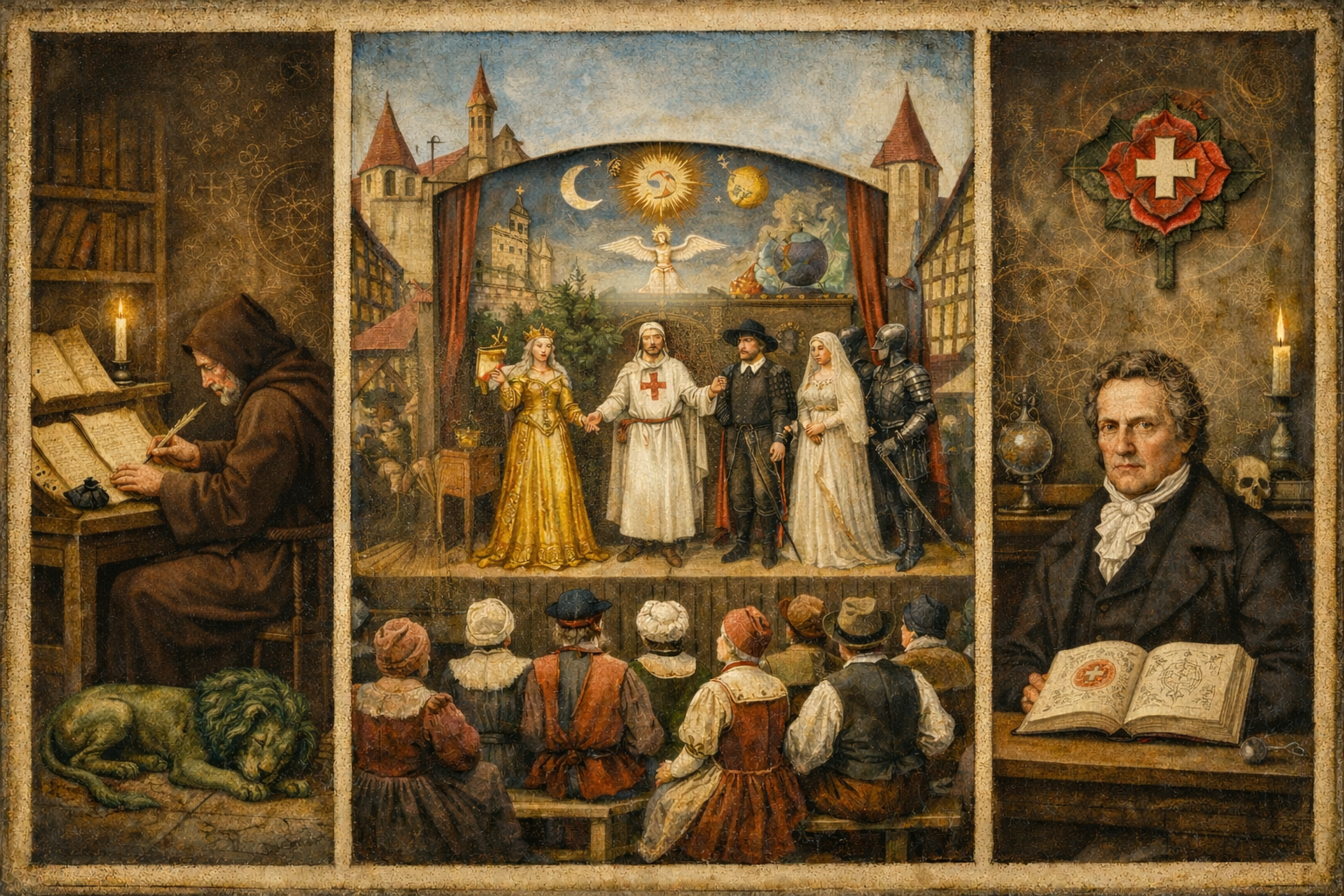
Triptych: The Rosicrucian ‘Lusus Severus’ — From Medieval Scriptoria to German Idealism
This triptych illustrates the transmission and transformation of symbolic knowledge from the medieval monastic world to the speculative philosophy of modern Germany.
Left panel — The Scriptorium
A monk copies manuscripts in the quiet discipline of a medieval scriptorium. Around him lie the instruments of learned transmission: parchment, compass, and the geometrical traces of sacred science. At his feet rests the Green Lion, a classical emblem of alchemy, here depicted in repose. The image evokes the hidden preservation of hermetic and theological wisdom within monastic culture, where symbolic knowledge was guarded, copied, and silently transmitted through the centuries.
Central panel — The Rosicrucian Stage
In a German town of the seventeenth century, a street theatre presents an allegorical episode inspired by the Chymical Wedding of Christian Rosenkreutz. The audience of townspeople watches the ritual drama unfold. At the center stands a white-robed figure marked discreetly with the rose-cross, signifying the Rosicrucian initiate. Celestial symbols above the stage recall the cosmological language of alchemy and astrology. The scene evokes what Bernard Gorceix described as the ‘Lusus Severus’—the serious play through which esoteric truths were communicated in the form of allegory and spectacle.
Right panel — Philosophical Transmutation
In a study illuminated by candlelight sits Friedrich Wilhelm Joseph Schelling, one of the central figures of German Idealism. Before him lies an open book displaying the rose-cross emblem. Around him faint diagrams of cosmic order and alchemical geometry appear upon the walls. The image suggests the moment when symbolic traditions inherited from mysticism and hermetic philosophy enter the domain of speculative thought, becoming part of the philosophical exploration of nature and spirit.
The Triptych as a Whole
From monastic preservation, through Rosicrucian allegory, to philosophical reflection, the three panels depict the long metamorphosis of Western esoteric symbolism. What begins as guarded knowledge in the cloister becomes public allegory in the Rosicrucian imagination and finally re-emerges as speculative insight within modern philosophy.
***

Related Articles

Leave a Reply