
Circle of Transmission: The Living Loom
The Structural Skeleton: Francis Warrain and the Rehabilitation of Absolute Science
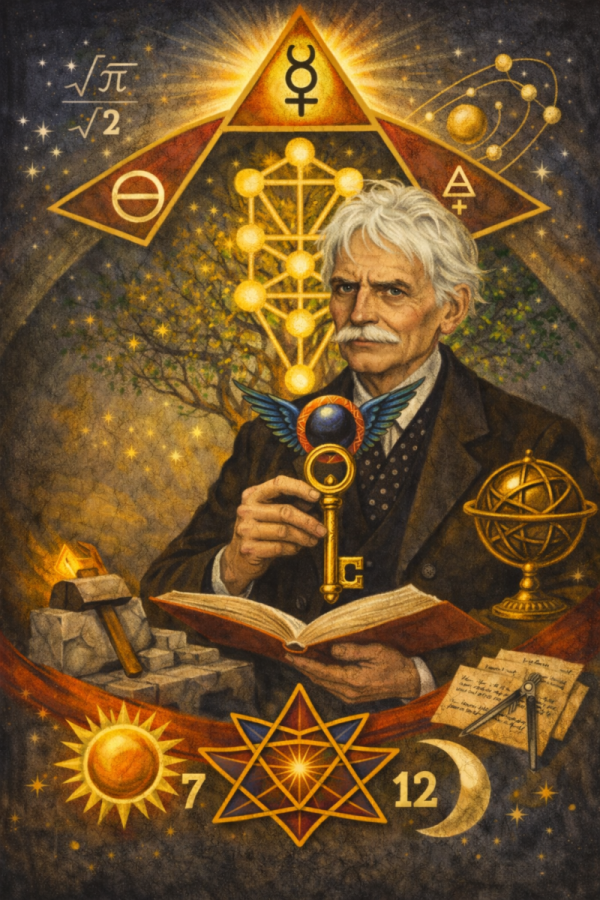
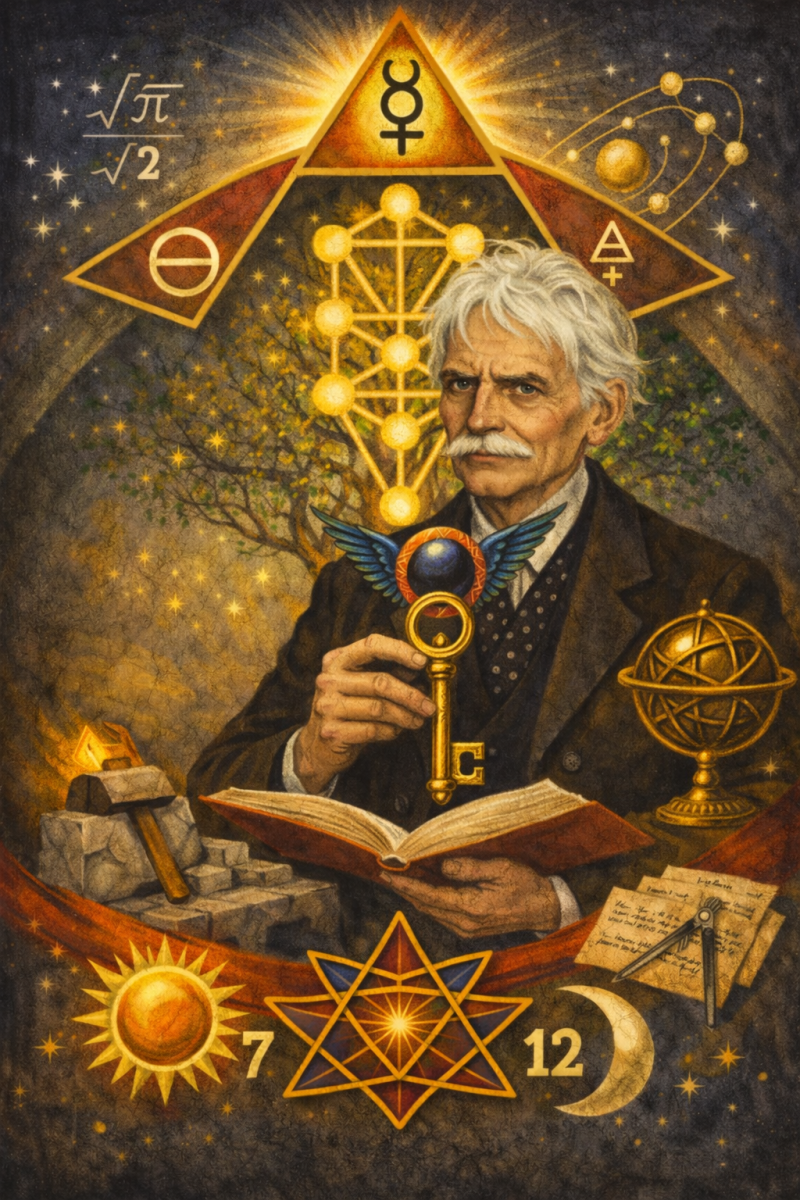
A symbolic portrait of Francis Warrain
*
We present another sharing for the day from the blue House of Via-HYGEIA marking a pivotal moment in our bibliotherapeutic mission: the presentation of a comprehensive study dedicated to Francis Warrain (1867–1940)—mathematician, Kabbalist, sculptor, and the structural skeleton of the legendary ‘Petrus Talemarianus’ collective.
This article ventures beyond mere biography to accomplish a work of metaphysical justice: the vindication and rehabilitation of Absolute Science. We reveal Warrain not as a peripheral figure in the history of French esotericism, but as its master architect—the guarantor of the ‘master standard of timeless esotericism’ that the Petrus collective established through ‘De l’Architecture Naturelle’ (1949).
Our research, drawing upon newly examined appendices and the full scope of Warrain’s authorship, demonstrates that his System of the Scale—the mathematical-Kabbalistic framework uniting Wronski’s Law of Creation with Keplerian harmonics and Sephirotic emanation—provided the immutable criterion against which all authentic sacred traditions might be measured.
We offer this work to the academic circle with the fervent wish that it may catalyze:
Critical scholarly editions of Warrain’s major works: ‘La Théodicée de la Kabbale’, ‘La Pensée de Charles Henry‘ (1930, Les Cahiers de l’Étoile), ‘L’Œuvre Psychobiophysique de Charles Henry‘ (1932, Éditions de la Nouvelle Revue Française), Conference proceedings: ‘La Pensée de Charles Henry‘,’ presented at the Collège de France (February 3, 1930) and published in the Bulletin de l’Institut Général de Psychologie.the three-volume ‘L’Œuvre Philosophique de Hoëne Wronski’, and ‘Essai sur l’Harmonices Mundi’.
Systematic studies of the ‘Petrus Talemarianus’ and its appendices, now definitively attributed to Warrain’s hand, besides his participation to the content of the whole project-book.
Interdisciplinary recognition of Warrain’s place in the lineage of mathematical Platonism—between Pythagoras, Kepler, and the contemporary Traditionalist school.
May this forgotten luminary, who gave his life to the Rehabilitation of Absolute Science, at last receive the duly published, scholarly accessible tribute that his work demands. The golden key still turns in the lock.
**
*
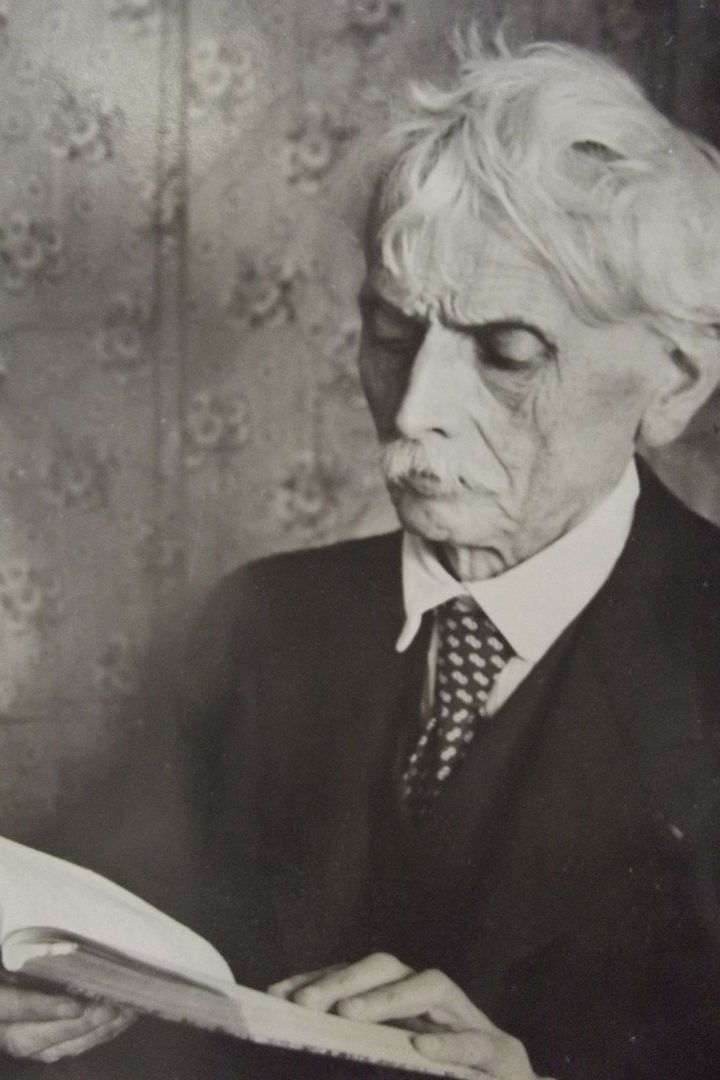
Francis Warrain
(October 10, 1867 – February 29, 1940)
Francis Warrain stands as one of the most fascinating yet underappreciated figures in the landscape of French esoteric philosophy. A polymath who traversed the territories of mathematics, sculpture, philosophy, and Kabbalistic exegesis, Warrain dedicated his life to uncovering the hidden architectures of reality—those mathematical and metaphysical structures that he believed underpinned all manifestation. His work represents a unique synthesis of rigorous scientific inquiry and mystical speculation, positioning him as a crucial bridge between 19th-century occultism and 20th-century metaphysical thought.
*
The Wronskian Odyssey: From Mathematics to Absolute Philosophy
Warrain’s intellectual journey crystallized around an unlikely figure: Józef Maria Hoëne-Wroński (1776–1853), the Polish polymath whose grandiose claims to have discovered a ‘Law of Creation‘ had rendered him a pariah in mainstream scientific circles. Where others saw madness, Warrain perceived a misunderstood genius whose mathematical formulations concealed profound metaphysical truths.
In 1925, Warrain published ‘L’Armature Métaphysique établie d’après la Loi de Création de Hoëne Wronski’ (The Metaphysical Framework Established According to Hoëne Wronski’s Law of Creation), a work that would define his scholarly trajectory. This was followed by a monumental three-volume opus, ‘L’Œuvre Philosophique de Hoëne Wronski: Textes, Commentaires et Critique’ (1933–1938), published by Éditions Véga—the same house that would later publish his posthumous masterpiece.
Warrain’s engagement with Wronski was not merely academic rehabilitation. He recognized in Wronski’s ‘Law of Creation’—the claim that every system of reality could be generated through a universal mathematical function—an echo of ancient Kabbalistic cosmogony. Wronski had famously claimed to have discovered the absolute foundation of mathematics, a ‘supreme law‘ that could generate any series expansion. Warrain interpreted this not as mathematical hubris but as a modern restatement of the Sefirotic emanation: the Kabbalistic model whereby the Infinite (Ein Sof) generates the finite through a series of graduated manifestations.
As noted in the Via-HYGEIA translations, Warrain understood Wronski’s work as revolving around ‘his Law of Creation of every system of reality‘—a formulation that parallels the Kabbalistic Tzimtzum (divine contraction) and the Neoplatonic Henosis. For Warrain, Wronski’s mathematical determinants (later formalized as the Wronskian in linear algebra) were not merely technical tools but ontological signatures—the fingerprints of Absolute Intelligence upon the fabric of manifestation.
*
Charles Henry and the Psychobiophysics of Harmony
Warrain’s metaphysical system was not constructed in isolation from contemporary science. A crucial dimension of his thought emerged through his sustained engagement with Charles Henry (1859–1926), the mathematician, philosopher, and pioneer of psychophysics—the quantitative study of the relationship between physical stimuli and conscious experience.
Henry had developed a revolutionary approach to mathematical aesthetics, proposing that aesthetic experience could be precisely measured through the “aesthetic proposition”—a mathematical law governing the relationship between sensory input and psychic response. His work bridged the gap between experimental psychology and idealist philosophy, seeking to establish objective laws of sensation that would ground artistic and architectural harmony in physiological reality.
Warrain became the primary expositor and continuator of Henry’s system. Between 1930 and 1932, he published three major works on Henry’s thought:
- ‘La Pensée de Charles Henry’ (1930, Les Cahiers de l’Étoile)
- ‘L’Œuvre Psychobiophysique de Charles Henry’ (1932, Éditions de la Nouvelle Revue Française)
- Conference proceedings: ‘La Pensée de Charles Henry’,’ presented at the Collège de France (February 3, 1930) and published in the Bulletin de l’Institut Général de Psychologie.
These texts reveal Warrain’s conviction that Henry’s psychophysics provided the missing link between abstract mathematics and lived experience. Henry had demonstrated that geometric proportions, musical intervals, and color relationships produce predictable psychophysiological effects—that the golden ratio, for instance, generates a specific “aesthetic emotion” measurable through experimental methods.
For Warrain, this was the experimental verification of the Kabbalistic System of the Scale. If Henry could demonstrate that mathematical harmony directly affects consciousness, then Warrain’s architectural metaphysics was not merely speculative—it was scientifically grounded. The System of the Scale was not just a symbolic structure but a psychobiophysical reality: the proportions of the Tree of Life, when embodied in architecture, would necessarily produce specific states of consciousness in the inhabitants.
This insight became foundational for the Petrus collective’s work in ‘De l’Architecture Naturelle’. The ‘master standard of timeless esotericism‘ was not merely a traditional authority but a psychophysiological law: architecture that adhered to the septenary-duodenary relationships would automatically harmonize the consciousness of its occupants with cosmic rhythms. The Golden Rule of building was thus a therapeutic prescription—a means of healing modern alienation from natural harmony through mathematical proportion.
Warrain’s synthesis of Henry’s psychophysics with Wronski’s metaphysics and Kabbalistic emanation created a threefold cord of absolute science:
- Wronski: The ontological structure of reality (the Law of Creation).
- Kabbalah: The symbolic architecture of manifestation (the System of the Scale).
- Henry: The phenomenological verification through consciousness (psychobiophysics).
This integration positioned Warrain uniquely among 20th-century esotericists: he could claim experimental scientific grounding for his metaphysical assertions, not merely traditional authority or mathematical elegance.
*
‘La Théodicée de la Kabbale’: The Unfinished Symphony
Warrain’s magnum opus, ‘La Théodicée de la Kabbale’ (The Theodicy of the Kabbalah), published posthumously by Éditions Véga in 1949, represents the culmination of his life’s work. The title itself signals his ambitious project: a ‘theodicy’ traditionally justifies the goodness of God despite the existence of evil, but Warrain transposed this theological framework onto the Kabbalistic Tree of Life (Etz Chaim).
The work is structured around the System of the Scale—a complex metaphysical architecture that Warrain derived from his studies of:
- The Sephiroth: The ten divine emanations of Kabbalistic cosmology.
- Jacob Boehme’s ‘Eternal Nature’: The German mystic’s alchemical theology.
- Musical harmonics: The Pythagorean tradition of cosmic music.
- Mathematical proportion: The golden ratio, Fibonacci sequences, and geometric progression.
- Psychobiophysics: The Charles Henry tradition of measurable aesthetic response.
The Via-HYGEIA excerpts reveal Warrain’s method: he treats the Kabbalistic system not as historical theology but as a universal metaphysical grammar with experimentally verifiable psychological effects. His “System of the Scale” operates through:
- Fundamental Relationships (Part 1): The binary oppositions that generate reality.
- Bilateral Balance (Part 2): The principle of equilibrium between opposing forces.
- Hierarchy (Part 3): The graduated emanation from simple to complex.
- Genders and Persons (Parts 4–5): The anthropomorphic completion of the cosmic structure.
Warrain’s approach to metaphysical anthropomorphism—the attribution of human characteristics to the Absolute—was particularly sophisticated. He argued that anthropomorphism was not a primitive projection but a mathematical necessity: the human form, properly understood, embodies the proportional harmonies that govern cosmic manifestation. This positioned him in dialogue with both Renaissance hermeticism (Ficino, Pico della Mirandola) and contemporary phenomenology, enriched by Henry’s psychophysical data.
*
The Synthesis of Quantity: Warrain’s Mathematical Mysticism
Central to Warrain’s philosophy was the conviction that quantity is never merely quantitative. In his analysis of Wronski’s work on the “synthesis of quantity,” Warrain developed a metaphysics where mathematical operations—addition, multiplication, the generation of series—were simultaneously ontological events.
According to the Via-HYGEIA texts, Warrain identified two fundamental forces generated by the ‘separation created by Space between Appetition and Union‘: Condensation and Expansion. These are not merely physical forces but metaphysical principles that operate across all scales of reality—from the generation of mathematical series to the formation of galaxies, from the contraction of the divine will (Tzimtzum) to the expansion of human consciousness.
This binary dynamic manifests in Warrain’s System of the Scale as:
- The Septenary (7): The planetary spheres, the days of creation, the lower Sephiroth.
- The Duodenary (12): The zodiacal signs, the tribes of Israel, the upper Sephiroth combined with the lower.
The relationship between these number systems—7 and 12, prime and composite, circular and linear—provided Warrain with a mathematical key to the Kabbalah. He demonstrated that the traditional 22 paths of the Tree of Life, when properly geometricized, generate proportions that correspond to both musical harmonics and planetary orbits.
*
Kepler and the Music of the Spheres
Warrain’s 1942 work, ‘Essai sur l’Harmonices Mundi ou Musique du Monde de Johann Kepler’ (Essay on Kepler’s Harmonies of the World), reveals another dimension of his thought: the Pythagorean-Keplerian tradition of cosmic harmony. In two volumes—’Fondements mathématiques de l’harmonie and L’harmonie planétaire d’après Kepler adaptée à nos connaissances actuelles’—Warrain updated Kepler’s 1619 masterpiece for the modern astronomical era.
Kepler had discovered that the extreme velocities of planets correspond to musical intervals—the octave, the fifth, the third. Warrain extended this analysis, showing that the solar system itself is a musical instrument tuned according to mathematical proportions that mirror the Kabbalistic Tree. This was not mere analogy: for Warrain, the same divine architecture that structured the Sephiroth also structured the planetary orbits.
This work positions Warrain within a lineage of mathematical Platonists—from Pythagoras through Kepler to Wronski—who believed that number is the language of creation. But Warrain added a crucial Kabbalistic dimension: the recognition that this mathematical cosmos is not static but dynamic, generated through the interplay of opposing forces (Condensation/Expansion, Chesed/Gevurah) that find their resolution in the central column of the Tree of Life (Tiferet).
*
‘De l’Architecture Naturelle’ (1949): Warrain as the Structural Skeleton
The most significant testament to Francis Warrain’s authority as a synthesizer of sacred science came with his central role in ‘De l’Architecture Naturelle’ (Natural Architecture), the monumental 1949 work published under the pseudonym ‘Petrus Talemarianus‘. This was not the work of a single author but a collective egregore—a collaborative vessel for a circle of French esotericists united by the vision of Natural Architecture as operative metaphysics.
The Petrus Collective: A Circle of Absolute Science The pseudonym ‘Petrus Talemarianus‘ concealed a circle of scholars and practitioners active in the early-to-mid 20th century:
- Francis Warrain (1867–1940): The mathematician and probable author of the Kabbalistic-mathematical appendices—the structural skeleton of the entire work.
- Alexandre Rouhier: The hermeticist and nominal ‘Editor‘, who provided the alchemical and esoteric sources and illustrations from his impressive library and his deep hermetic experience.
- Pierre Bordeaux-Montrieux: Contributor to the esoteric synthesis.
- Jacques Bacot: The Tibetologist who brought comparative mystical perspectives.
- Marcel Nicaud: The illustrator who gave visual form to the archetypes.
Their collaboration emerged from the occult revival of the Belle Époque—specifically the Rosicrucian and Kabbalistic circles influenced by Stanislas de Guaita and Joséphin Péladan—yet it transcended sectarian affiliation to pursue what they termed ‘Natural Architecture’: not a style, but a science of manifesting universal laws in material form.
Warrain was the Architectonic Principle within this collective; he was the structure. His contributions provided the immutable mathematical framework upon which all other specializations depended:
- The Septenary-Duodenary Relationships: The numerical harmonics governing cosmic manifestation.
- The System of the Scale: The graduated emanation from simple to complex.
- The Wronskian Law of Creation: The generative function underlying all systems of reality.
- The Psychobiophysics of Charles Henry: The experimental verification that mathematical proportion produces specific conscious states.
The Editor’s Note to the Appendices reveals the depth of Warrain’s authorship:
‘We thought it best to insert, in these Appendices, an unpublished study by Francis WARRAIN (to whom we had submitted the manuscript of this work), because it appeared to us to perfect a theory to which ‘PETRUS Talemarianus’ had not given so complete a development‘.
This statement, read superficially, suggests Warrain contributed only Appendix VII. But the full reality is more profound: all the appendices are Warrain’s work, as most of the mathematical calculations & demonstrations and the kabbalistic insights throughout the whole text of the ‘Petrus‘. The Via-HYGEIA publications have established this through textual analysis:
- Appendix VII: On √π, 1/√2, and the ratio between the septenary and the duodenary—the mathematical foundation.
- Appendix XI: A Kabbalistic Exegesis and Meditation upon the Book of Numbers, the Book of the Ecclesiastes—biblical numerology.
- Appendix XII: The Divine Architectural Archetype and its Paths—architectural morphology.
These texts bear the unmistakable signature of Warrain’s mathematical Kabbalah: the rigorous correlation between numerical proportions, geometric forms, and metaphysical principles. The ‘Petrus Talemarianus‘ persona allowed Warrain to speak collectively, to subsume his individual authority into the greater Work—just as the Infinite contracts (Tzimtzum) to allow manifestation.
The collective’s stated aim was to establish a ‘master standard of timeless esotericism‘—a living reference point against which all claims to sacred knowledge could be measured. Warrain’s mathematics provided the objective criterion for this standard: if a tradition could be mapped onto the System of the Scale, it was authentic; if not, it was deviation or degeneration.
This was Absolute Science rehabilitated: not the reductionist science of the modern academy, but the perennial philosophy of Pythagoras, Kepler, and Wronski—restored to its rightful place as the queen of knowledge, now fortified by Charles Henry’s psychophysical experimentalism.
The work presents eighteen models of houses for habitation, each designed so that ‘the ratios of two successive coefficients were 4/3, 3/2, 4/3, 5/4, 3/2, ratios measuring the musical intervals of the major third, the fourth, and the fifth, which form the perfect major chord’. The ratio of the greatest to smallest façade in this ensemble is 13, the seventh number of the Fibonacci series—a direct application of Warrain’s mathematical Kabbalah.
The Vega Connection: A Network of Absolute Knowledge – The publication history reveals the esoteric network that Warrain anchored. Éditions Véga was founded in 1929–30 through René Guénon’s initiative, with funding from the American heiress Mary Wallace Shillito. Although Guénon soon departed for Egypt, the publishing house—under the direction of Shillito’s second husband, Ernest Britt (a lifelong admirer of Wronski)—became the primary vehicle for Wronskian and Kabbalistic scholarship.
Between 1931 and 1949, Véga published:
- Warrain’s ‘La Théodicée de la Kabbale’ (1931).
- Warrain’s three-volume ‘L’Œuvre Philosophique de Hoëne Wronski’ (1933–1938).
- ‘De l’Architecture Naturelle’ (1949), with Warrain’s appendices as the structural core, beyond his participation throughout the whole project-book.
This sequence demonstrates that ‘De l’Architecture Naturelle’ was conceived not as an isolated architectural treatise but as the practical application of the Wronskian-Kabbalistic-Henryan system that Warrain had spent his life elaborating. The work’s intention to serve as a ‘master standard of timeless esotericism’ depended entirely on Warrain’s mathematical and psychophysical authority.
*
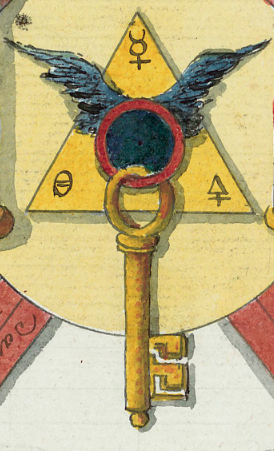
The Symbol from François-Nicolas Noël: A Visual Commentary
The symbol included in this article—a detail from François-Nicolas Noël’s much neglected ‘L’Alchymie du Maçon’ (1813)—provides a remarkable visual parallel to Warrain’s philosophical system. Noël’s manuscript, housed in the Bibliothèque Nationale de France, represents a synthesis of Freemasonic, alchemical, and Rosicrucian symbolism created exactly midway between Wronski’s lifetime and Warrain’s birth. Let us decode this image as a commentary on Warrain’s legacy:
The Winged Circle: Mercury as Metaphysical Mediator At the center of the composition sits a dark circle rimmed in red, flanked by blue wings. This is the symbol of Mercury (☿)—not merely the planetary deity or chemical element, but the principle of mediation itself. In Warrain’s system, Mercury corresponds to the Binah-Sephira on the Tree of Life: the divine understanding that mediates between the infinite and the finite. The wings suggest volatility—the capacity to transcend fixed categories. For Warrain, this is the mathematical function itself: the operator that transforms one quantity into another, the ‘Appetition‘ that seeks Union across the separation of Space. Mercury is the hermaphroditic principle that contains both Condensation and Expansion, the alchemical Azoth that dissolves and coagulates.
The Golden Key: Access to the Absolute Suspended from the Mercury-symbol is a golden key—the Clavis Philosophorum (Key of the Philosophers). In Freemasonic symbolism, the key represents initiatic knowledge, the ability to unlock the secrets of nature. For Warrain, this key is Wronski’s Law of Creation itself—the mathematical formula that generates all systems of reality. The key’s bit is shaped in a geometric pattern reminiscent of the Hebrew letter Shin (ש) or the triple flame—both symbols of divine manifestation. This echoes Warrain’s Kabbalistic exegesis, where the ‘System of the Scale‘ provides the ‘key‘ to understanding the relationship between the Sephiroth.
The Triangular Frame: The Three Principles Behind the central symbols sits a yellow triangle containing three alchemical/astrological glyphs:
- Top: Mercury (☿) — the volatile spirit.
- Left: Salt (🜔) — the fixed body.
- Right: Fire (🜂) or Sulfur — the active principle.
This triad corresponds to the three alchemical principles: Mercury, Sulfur, and Salt—or in Warrain’s metaphysical translation, the three columns of the Tree of Life: the Pillar of Severity (Condensation), the Pillar of Mercy (Expansion), and the Pillar of Equilibrium (the Middle Path).
The triangle itself is the geometric generator of reality: the simplest polygon that encloses space, the symbol of the Trinity, the architectural principle of stability. For Warrain, the triangle represents the fundamental relationship (Part 1 of his System of the Scale) from which all complex structures derive.
The Red and White Base: The Alchemical Wedding The lower portion of the image shows red and white geometric forms—the colors of the alchemical opus: albedo (whitening) and rubedo (reddening). This is the Great Work itself: the transformation of base matter into spiritual gold, the progression from multiplicity to unity that Warrain mapped onto the Sephirotic emanations. In Warrain’s terms, this represents the bilateral balance (Part 2 of his System) between opposing forces, resolved in the hierarchical ascent (Part 3) toward the divine.
*
Convergence: Why This Symbol Embodies Warrain’s Legacy
The Noël symbol functions as a visual précis of Warrain’s entire philosophical project:
- The Mathematical-Metaphysical-Psychophysical Synthesis: Just as Noël combines geometric forms (triangle, circle, key) with alchemical symbolism, Warrain combined Wronskian mathematics, Kabbalistic metaphysics, and Henryan psychophysics.
- The Principle of Mediation: The winged Mercury embodies Warrain’s concept of the mediating function—whether mathematical (the Wronskian determinant), metaphysical (the Sephirotic pathways), or psychological (Henry’s aesthetic propositions).
- The Architecture of Emanation: The triangular structure mirrors Warrain’s System of the Scale, where reality emerges through graduated stages from simple to complex.
- The Initiatic Key: The golden key represents Warrain’s conviction that knowledge is transformative—that understanding the mathematical structure of reality is simultaneously an alchemical transmutation of consciousness and a psychophysiological harmonization.
- The Historical Continuity: Noël’s neglected 1813 manuscript represents the Freemasonic-esoteric tradition that Warrain inherited and transformed. Both men stood at the intersection of craft symbolism (masonry, alchemy) and speculative philosophy (mathematics, metaphysics).
- The Collective Egregore: Just as Noël’s symbol would have served as a visual guarantee of esoteric authenticity for Freemasons in 1813, Warrain’s mathematical-psychophysical authority served as the structural guarantee for the Petrus collective in 1949—allowing individual personalities to dissolve into the greater Work.
*
Warrain’s Place in the Esoteric Tradition
Francis Warrain occupies a unique position in the history of Western esotericism. He was:
- The systematizer of Wronski: Rescuing a ‘failed‘ mathematician from obscurity by revealing the metaphysical architecture underlying his technical work.
- The mathematical Kabbalist: Demonstrating that the Sephiroth are not merely theological concepts but geometric-musical realities accessible to rational inquiry.
- The psychobiophysical harmonist: Extending Charles Henry’s experimental aesthetics to demonstrate that mathematical proportion produces measurable conscious states.
- The harmonic philosopher: Extending the Pythagorean-Keplerian tradition into the 20th century, showing that cosmic order is fundamentally musical-mathematical-psychological.
- The metaphysical artist: As a sculptor, Warrain understood that form is meaning—that the proportions of a statue embody the same laws that govern the solar system and structure human consciousness.
- The structural skeleton of the Petrus collective: Through his role in ‘De l’Architecture Naturelle’, he provided the mathematical-Kabbalistic-psychophysical spine that allowed a circle of French esotericists to manifest their vision of Natural Architecture—a master standard of timeless esotericism against which all authentic expressions of sacred tradition might be measured.
His influence can be traced through the Traditionalist circles of René Guénon (who shared Warrain’s critique of modernity and appreciation for Kabbalah), the mathematical esotericism of Charles Henry (whose psychophysical system Warrain preserved and extended), and the architectural mysticism of the ‘Petrus‘ collective (where Warrain’s participation to the core text and to the appendices provide the structural core of the ‘Golden Rule‘ for building).
*
Conclusion: The Key Turns in the Lock
Francis Warrain died on February 29, 1940—appropriately, on a leap day, that temporal anomaly that keeps our calendar in harmony with cosmic cycles. His legacy, like the golden key in Noël’s symbol, awaits those who can recognize its shape.
The symbol shared above—a winged Mercury suspended above a golden key, framed by the triangular architecture of the three principles—is not merely an illustration of Warrain’s ideas. It is their visual equivalent: a demonstration that the same patterns structure matter, consciousness, and the divine. Warrain’s life’s work was to show that mathematics is the language of the Absolute, that the Wronskian determinant, the Kabbalistic Tree, and Henry’s aesthetic propositions are three notations for the same cosmic music.
His role as structural skeleton of the Petrus collective ensured that this vision would not remain abstract speculation but would become operative wisdom—a master standard against which the authenticity of sacred traditions might be measured. The ‘Petrus Talemarianus‘ persona, that collective egregore born from the Belle Époque occult revival, was the vessel; Warrain’s mathematics was the wine.
Together, they accomplished what neither could achieve alone: the rehabilitation of Absolute Science in an age of materialism.
In an era of increasing specialization, Warrain reminds us that true knowledge is synthetic—that the separation between science and mysticism, between quantity and quality, between the individual and the collective, between the psyche and the cosmos, between the key and the door it opens, is itself an illusion to be transcended.
The winged circle still hovers, the key still turns, and the music of the spheres continues to play for those with ears to hear, minds to calculate its harmonies, hearts to feel its psychophysical resonance, and hands to build its proportions into the world.
*
Sources and Further Reading (Chronological)
1813. Noël, François-Nicolas. ‘L’Alchymie du Maçon’. Manuscript, Bibliothèque Nationale de France.
1925. Warrain, Francis. ‘L’Armature Métaphysique établie d’après la Loi de Création de Hoëne Wronski’. Paris: Félix Alcan.
1930. Warrain, Francis. ‘La Pensée de Charles Henry’. Paris: Les Cahiers de l’Étoile. Warrain, Francis. “La Pensée de Charles Henry.” Bulletin de l’Institut Général de Psychologie (Conference at Collège de France, February 3).
1932. Warrain, Francis. ‘L’Œuvre Psychobiophysique de Charles Henry’. Paris: Éditions de la Nouvelle Revue Française.
1933–1938. Warrain, Francis. ‘L’Œuvre Philosophique de Hoëne Wronski: Textes, Commentaires et Critique’. 3 vols. Paris: Éditions Véga.
- Tome I (1933)
- Tome II: ‘Architectonique de l’Univers’ (1936)
- Tome III: ‘Encyclopédie développée d’après la Loi de Création’ (1938)
1942. Warrain, Francis. ‘Essai sur l’Harmonices Mundi ou Musique du Monde de Johann Kepler’. 2 vols. Paris: Hermann.
- Tome I: ‘Fondement mathématique de l’Harmonie’.
- Tome II: ‘L’Harmonie planétaire’.
1949. Warrain, Francis. ‘La Théodicée de la Kabbale’. Paris: Éditions Véga. Talemarianus, Petrus [Pseud. Collective including Francis Warrain, Alexandre Rouhier, Pierre Bordeaux-Montrieux, Jacques Bacot, Marcel Nicaud]. ‘De l’Architecture Naturelle’. Paris: Éditions Véga. [Contains Warrain’s appendices: VII, XI, and XII]
2007. Godwin, Joscelyn. ‘Foreword to the English Translation’. In ‘Natural Architecture’, by Petrus Talemarianus. Sacred Science Translation Society.
From 2023 to now. Via-HYGEIA Bibliotherapy. Francis Warrain: From ‘La Théodicée de la Kabbale’ and ‘A Little Petrus Talemarianus Sampler‘ series of translations & commentaries.
This chronological arrangement reveals the arch of Warrain’s career: from the foundational Wronskian metaphysics (1925), through the Henryan psychophysical period (1930–1932), to the monumental scholarly edition of Wronski’s complete works (1933–1938), the Keplerian harmonies (1942), and finally the posthumous flowering of Kabbalistic synthesis (1949)—including his structural contributions to ‘De l’Architecture Naturelle’.
***


Related Articles

Leave a Reply