
Circle of Transmission: The Living Loom
(心為君主)-The Heart-Mind as Monarch: An Annotated Reading of the Xiuzhen Baochuan (修真寶傳)
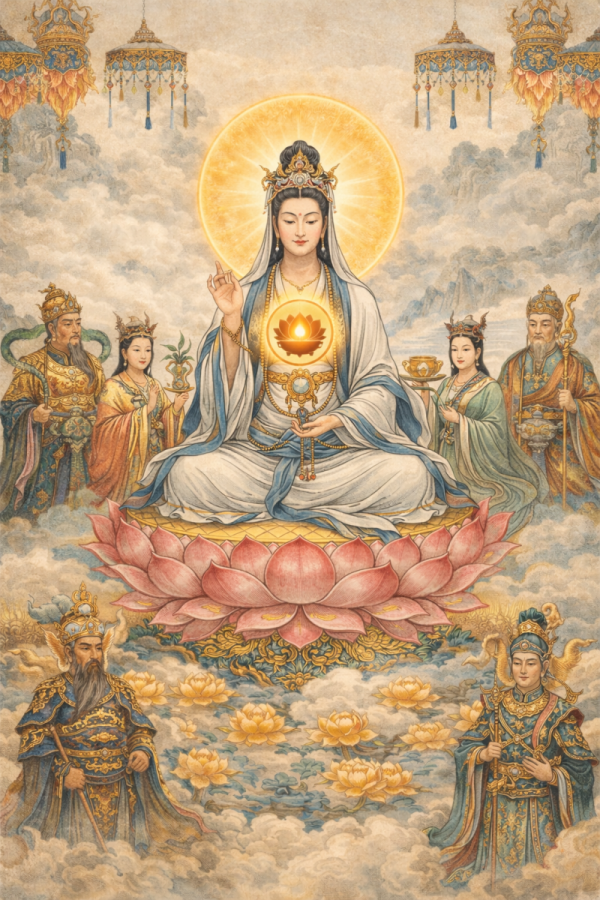
A symbolic visualization of the Xiuzhen Baochuan’s opening scene: Guanyin upon the Nine-Petaled Lotus Platform, surrounded by attendant spirits and cosmic phenomena. The golden lotus at the heart-center visualizes the ‘sacred infant’ (shengying) of internal alchemy, while the solar mandorla represents the ‘returning light’ (huiguang) of the awakened heart-mind.
*
Today’s sharing from the Blue House of Via-HYGEIA presents more excerpts from the ‘Xiuzhen Baochuan’ (Precious Transmission of Cultivating Reality), a late imperial Chinese spiritual text of the neidan (internal alchemy) tradition.
Our focus is the theme of ‘The Heart-Mind as the Monarch’, naturally extending our previous publications while opening new avenues for investigating the text’s synthesis of Buddhist and Daoist technologies of the self.
**
Introduction
The ‘Xiuzhen Baochuan’ (修真寶傳, Precious Transmission on Cultivating Perfection), dated to the Qianlong era (乾隆庚申, 1740), presents a sophisticated synthesis of Daoist internal alchemy (neidan 內丹), Buddhist Guanyin devotion, and millenarian eschatology. Emerging during a period of intense imperial scrutiny of sectarian groups—the Qianlong era witnessed both the compilation of the Siku Quanshu (四庫全書) and the suppression of ‘heterodox‘ teachings, creating a discursive environment where sectarian texts increasingly adopted the vocabulary of ‘harmonization of the three teachings‘ to evade censorship while preserving initiatory transmission—the text encodes its soteriology in a language that is simultaneously orthodox and subversive.
Following our previous investigations into the body as alchemical vessel and stillness as the root of return, this essay examines the heart-mind (xin 心) as the governing principle that orchestrates the entire cultivation process. In the internal alchemical tradition, the heart-mind occupies the position of “monarch” (jun 君) within the somatic polity—a ruler whose clarity or delusion determines the welfare of the entire realm.
The ‘Xiuzhen Baochuan’ develops this theme through a dialogic structure in which Guanyin Bodhisattva (觀音菩薩) instructs disciples on the path to salvation, revealing how the heart-mind’s transformation serves as the pivot between worldly bondage and transcendent liberation. The text’s syncretic framework—combining the neidan triad of essence (jing 精), breath (qi 氣), and spirit (shen 神) with Buddhist concepts of original nature (benxing 本性) and karmic retribution—positions the heart-mind as the site where these traditions converge.
The Six Selections
Selection I: The Monarch’s Mandate
Chinese Original: 古佛聖壽無疆爾時,觀音古佛升座九蓮臺上,現大神通,演說大乘無為妙法。只見天垂寶蓋,地湧金蓮,觀音菩薩蓮臺證,金童玉女兩邊分,龍天八部來站定,文武眾聖顯威靈。
Pinyin: Gǔfó shèngshòu wújiāng ěrshí, Guānyīn gǔfó shēngzuò jiǔliántái shàng, xiàn dà shéntōng, yǎnshuō dàchéng wúwéi miàofǎ. Zhǐjiàn tiān chuí bǎogài, dì yǒng jīnlián, Guānyīn púsà liántái zhèng, jīntóng yùnǚ liǎngbiān fēn, lóngtiān bābù lái zhàndìng, wénwǔ zhòngshèng xiǎn wēilíng.
Translation: At that time, when the Ancient Buddha of Sacred Longevity was without boundary, the Ancient Buddha Guanyin ascended to the seat upon the Nine-Petaled Lotus Platform, manifesting great spiritual powers and expounding the wondrous Dharma of the Great Vehicle and Non-Action. One observed heaven hanging down the jeweled canopy, earth welling up with golden lotuses; Guanyin Bodhisattva certified the lotus platform, golden lads and jade maidens arranged on both sides, the dragon kings and eight divisions of beings came to stand in attendance, and the civil and military sages manifested numinous power.
Location: Page 6, right half, lines 1–5 (opening of main text following ‘西江月’ prelude)
Commentary: This opening scene establishes the heart-mind’s sovereign authority through ritual and spatial symbolism. The ‘Nine-Petaled Lotus Platform’ (九蓮臺) represents the heart as the center of spiritual transformation. While the lotus is the traditional seat of Buddhist enlightenment, the specific enumeration of ‘nine petals‘ reflects the sectarian syncretism of the Qing era: it overlays the Pure Land Buddhist concept of the ‘Nine Grades of Birth‘ onto the Daoist body. Rather than strictly corresponding to the nine physical orifices, the fully bloomed lotus signifies the completion of the alchemical process—the perfected spirit that then governs the somatic realm.
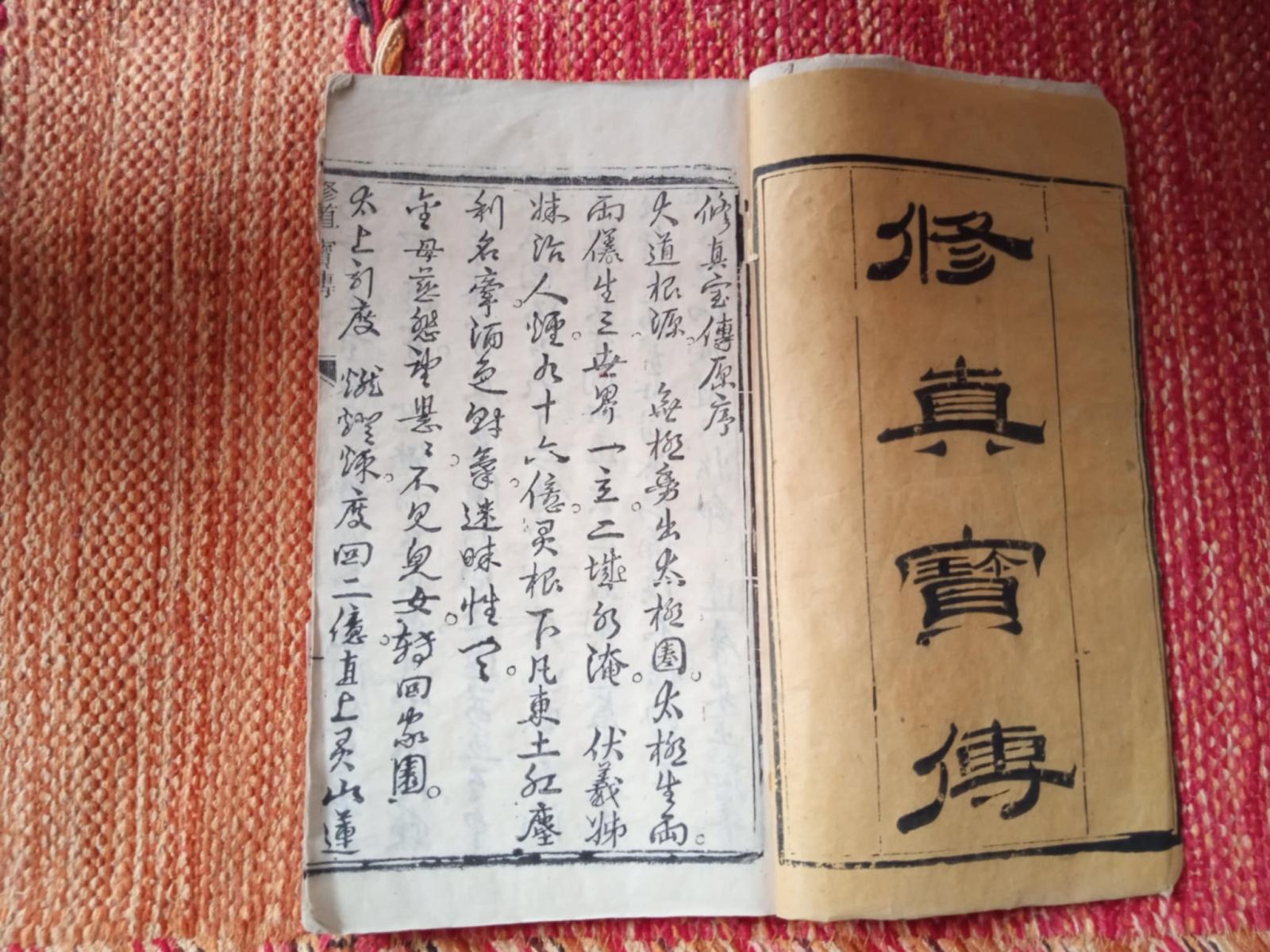
The Xiuzhen Baochuan‘s woodblock print (Page 2 of the manuscript) visually reinforces this mandalic structure: the title characters 修真寶傳 occupy the center like the monarch’s throne, surrounded by the 西江月 prelude and 原序 materials as attendant officials.
The text’s description of Guanyin’s ascent mirrors the neidan process of ‘raising the spirit‘ (tiju shen 提舉神) to the upper dantian, yet frames this somatic movement within Buddhist soteriology. The ‘golden lads and jade maidens‘ (金童玉女) personify the alchemical ingredients of true lead (zhenqian 真鉛) and true mercury (zhēngǒng 真汞)—the generative forces of kidney-water and heart-fire that must be harmonized under the heart-mind’s supervision. Their symmetrical arrangement ‘on both sides‘ (liangbian fen 兩邊分) evokes the Yijing hexagram Tai 泰 (Peace), where heaven and earth achieve productive intercourse through the mediation of the human heart.
The phrase ‘manifesting great spiritual powers‘ (xian da shentong 現大神通) carries dual resonance: in Buddhist contexts, shentong 神通 denotes the superknowledges attained through meditation; in neidan discourse, it describes the spontaneous functioning of the perfected spirit (shen). The Xiuzhen Baochuan collapses this distinction, suggesting that the heart-mind’s purification naturally manifests both Buddhist liberation and Daoist immortality. This syncretic move reflects the broader Qing-period phenomenon of ‘three teachings harmonized‘ (sanjiao heyi 三教合一), wherein the heart-mind serves as the common ground for Confucian moral self-cultivation, Buddhist mind-only (weixin 唯心) philosophy, and Daoist internal alchemy.
The ‘jeweled canopy‘ (baogai 寶蓋) descending from heaven and ‘golden lotuses‘ (jinlian 金蓮) rising from earth visualize the neidan principle of “extracting from kan ☵ and filling li ☲” (chou kan tian li 抽坎填離). This hexagrammatic operation, central to the Zhouyi cantong qi tradition, occurs within the heart-mind’s field of awareness: the monarch’s throne becomes the crucible where cosmic forces are transmuted.
*
Selection II: The Deluded Subject
Chinese Original: 觀音菩薩開言問:「命爾下凡度眾生,素真蓮前來跪定,只因劫運來得緊,伏乞慈悲發護心。」
Pinyin: Guānyīn púsà kāiyán wèn: “Mìng ěr xiàfán dù zhòngshēng, Sùzhēn lián qián lái guìdìng, zhǐ yīn jiéyùn lái de jǐn, fúqǐ cíbēi fā hùxīn.”
Translation: Guanyin Bodhisattva opened her mouth and asked: “I commanded you to descend to the mortal world to save sentient beings. Suzhen knelt before the lotus throne in stabilized devotion, solely because the kalpic catastrophe draws near, humbly begging for the issuance of a compassionate, protective heart.”
Location: Page 7, right half, lines 6–9 (dialogue opening)
Commentary: The introduction of Liu Suzhen (劉素真)—the feminine exemplar whose name combines the surname Liu (associated with the Han dynasty imperial house and, by extension, legitimate rule) with the sobriquet ‘Plain Truth‘(素真)—signals the heart-mind’s capacity for both delusion and awakening. Her posture of kneeling (gui 跪) before the lotus platform embodies the recognition of the heart-mind’s sovereignty: the subject prostrates before the monarch, acknowledging the hierarchical relationship between the true heart (zhenxin 真心) and the conditioned mind (wangxin 妄心). The phrase ‘Suzhen lian qian‘ likely denotes ‘Suzhen before the lotus‘, reinforcing the spatial hierarchy of the celestial court within the practitioner’s psyche. The phrase ‘kneel in stabilization‘ (gui ding 跪定) combines the physical posture of kneeling with the technical term ‘定’ (samadhi, stabilization), suggesting that Liu Suzhen’s prostration is itself a meditative attainment.
The prominence of a female interlocutor in a Qianlong-era text is notable: while official Daoist lineages remained patriarchal, sectarian baojuan often accorded women authoritative roles as spirit-mediums and teachers. Liu Suzhen’s name—’Plain Truth‘—may signal this unadorned, direct transmission outside institutional hierarchies.
The phrase ‘kalpic catastrophe has drawn near‘ (jieyun lai de jin 劫運來得緊) invokes the three-stage eschatology (sanqi 三期) central to late imperial Chinese sectarian religion. The Xiuzhen Baochuan belongs to the ‘Precious Scroll‘ (baojuan 寶卷) genre, which typically divides history into the Green Yang (青陽), Red Yang (紅陽), and White Yang (白陽) periods. The ‘tightening‘ (jin 緊) of the kalpa indicates the urgency of heart-mind cultivation: as the present age degenerates, only the rapid activation of the heart’s innate clarity can prevent dissolution into chaos.
Liu Suzhen’s plea for a ‘compassionate, protective heart‘ (cibei fa huxin 慈悲發護心) reveals the interdependence of absolute and relative dimensions of mind. The ‘compassion‘ (cibei 慈悲) refers to the universal responsiveness of the awakened heart-mind, while the ‘protective heart‘ (huxin 護心) denotes the specific technique of guarding the mind’s center against dispersion. In neidan terminology, this corresponds to ‘guarding the one‘ (shouyi 守一) or ‘maintaining the center‘ (shouzhong 守中)—practices that stabilize the heart-mind so it may serve as the vessel for transmutation.
The use of the verb ‘issue‘ or ‘emit‘ (fa 發) is technically precise: it describes the heart-mind’s function as the origin of both cognition and transformation. Just as the monarch issues edicts that reorganize the state, the purified heart emits spiritual light (shenguang 神光) that reconfigures the practitioner’s psychophysical landscape. This ‘emission‘ is not a depletion but a radiation—the heart-mind’s natural expression when unobstructed by delusion.
*
Selection III: The Monarch’s Admonition
Chinese Original: 菩薩演說已畢,眾皆頂禮恭敬,信受奉行。五四妙諦,信者堅心,昧者早醒。有緣有分,得上天京;無緣無分,掃入幽冥。
Pinyin: Púsà yǎnshuō yǐbì, zhòng jiē dǐnglǐ gōngjìng, xìnshòu fèngxíng. Wǔsì miàodì, xìnzhě jiānxīn, mèizhě zǎoxǐng. Yǒuyuán yǒufèn, dé shàng tiānjīng; wúyuán wúfèn, sǎo rù yōumíng.
Translation: When the Bodhisattva had finished expounding, the assembly all bowed their heads in worship, receiving [the teaching] with faith and practicing it with diligence. The wondrous truth of the Five-Four [stages]: for those with faith, the heart becomes firm; for the deluded, early awakening. Those with karmic connection and allotted share ascend to the Heavenly Capital; those without connection or share are swept into the darkness.
Location: Page 7, right half, lines 13–16 (conclusion of teaching section)
Commentary: This passage articulates the soteriological function of the heart-mind’s resolution (jianxin 堅心). The ‘Five-Four‘ (wusi 五四) likely encodes a numerological schema—possibly the multiplication of Five Phases by Four Directions yielding the twenty stages of alchemical refinement, or perhaps referencing the Twenty Paramitas of the Bodhisattva path. The text’s esoteric numerology resists definitive decoding, suggesting deliberate multivalence. The pairing of ‘faith‘ (xin 信) with ‘firm heart‘ (jianxin 堅心) suggests that religious commitment is not merely intellectual assent but a structural stabilization of the heart-mind’s energy.
The Xiuzhen Baochuan here employs the technical vocabulary of karmic resonance (yuanfen 緣分)—a concept that bridges Buddhist retribution theory and Daoist “matching resonances” (ganying 感應). The heart-mind’s capacity to ‘receive‘ (shou 受) the teaching depends upon prior cultivation, just as the monarch’s edicts can only be implemented by officials capable of understanding them. The binary outcome—ascension to the ‘Heavenly Capital‘ (tianjing 天京) or descent into ‘darkness‘ (youming 幽冥)—represents the heart-mind’s definitive orientation: toward the light of awareness or the obscurity of delusion.
The verb ‘swept‘ (sao 掃) carries connotations of exclusion from the alchemical process. In neidan discourse, the heart-mind that fails to achieve sovereignty becomes subject to the ‘ghosts and spirits‘ (guishen 鬼神) of visceral deities, which manifest as emotional disturbances and physical diseases. The Huangting jing (黃庭經) tradition, influential on the Xiuzhen Baochuan, describes these somatic spirits as subordinate officials who rebel when the central monarch grows weak. The text’s warning thus has concrete physiological implications: without heart-mind cultivation, the practitioner remains trapped in the cycle of generation and corruption.
*
Selection IV: The Inversion of Perception
Chinese Original: 回光返照,產出聖嬰。得者成聖,聞之超生。善言不聽,惡聲造深。不修片善,害死殺生。
Pinyin: Huíguāng fǎnzhào, chǎnchū shèngyīng. Dézhě chéngshèng, wén zhī chāoshēng. Shànyán bùtīng, èshēng zào shēn. Bùxiū piànshàn, hàisǐ shāshēng.
Translation: Returning the light to shine within, the sacred infant is produced. Those who obtain it become sages; those who hear of it transcend birth. Not listening to good words creates deep evil sounds. Not cultivating even fragmentary goodness harms life and kills living beings.
Location: Page 6, left half, lines 9–12 (central doctrinal passage)
Commentary: This passage presents the heart-mind’s quintessential technique: “returning the light” (huiguang 回光, huiguang fanzhao 回光返照). A term borrowed from Buddhist meditation manuals and adapted by neidan authors such as Liu Yiming (劉一明, 1734–1821), huiguang denotes the reversal of sensory attention from external objects to the internal source of awareness. The Xiuzhen Baochuan positions this technique as the monarch’s primary method of governance: by withdrawing the light of consciousness from the “eyes and ears” (ermu 耳目)—the outer officials—the heart-mind consolidates its power at the center.
The ‘sacred infant‘ (shengying 聖嬰) corresponds to the immortal embryo (xiantai 仙胎) of neidan theory, produced through the union of spirit and breath (shenqi 神氣) in the lower dantian. However, the text’s emphasis on ‘hearing‘ (wen 聞) introduces a distinctive auditory dimension to heart-mind cultivation. Guanyin, the ‘Observer of Sounds‘ (觀音), embodies the heart-mind’s capacity to discriminate beneficial from harmful influences. The text’s focus on ‘listening‘ (wén) and ‘sounds‘ (shēng) is not merely metaphorical but etymologically tied to the instructor, Guanyin (‘The One Who Perceives the Sounds of the World’). The heart-mind, therefore, cultivates sovereignty by becoming a perfect ‘Guanyin‘ within the microcosm—perceiving not merely external sounds but the ‘internal resonance‘ (neiyin 內音) of spirit and qi moving through the body’s cavities.
The phrase ‘deep evil sounds‘ (e sheng zao shen 惡聲造深) suggests that the ungoverned heart-mind generates karmic resonances that reverberate through multiple lifetimes—a sonic ontology of moral consequence.
The parallel structure of ‘not listening‘ (bu ting 不聽) and ‘not cultivating‘ (bu xiu 不修) establishes attention as the fundamental ethical act. In the heart-mind’s court, the monarch’s receptivity to ‘good words‘ (shanyan 善言) determines the welfare of the entire somatic realm. The Xiuzhen Baochuan thus extends the neidan practice of ‘guarding the orifices‘ (shouqiao 守竅) into a comprehensive moral pedagogy: the heart-mind’s sensory discipline becomes the foundation for both personal transformation and cosmic harmony.
*
Selection V: The Eschatological Heart
Chinese Original: 十惡不善,亂紛紛。殺氣騰騰透天心,東土眾生惡狠狠。慧眼遙觀大劫運,看看三災將要近,八難不遠面前存。
Pinyin: Shí’è bùshàn, luàn fēnfēn. Shāqì téngténg tòu tiānxīn, Dōngtǔ zhòngshēng èhěnhěn. Huìyǎn yáoguān dà jiéyùn, kànkan sānzāi jiāngyào jìn, bā nàn bùyuǎn miànqián cún.
Translation: The ten evils and lack of goodness, chaotic and confused. Murderous qi steams upward, penetrating the heart of heaven; the sentient beings of the Eastern Land are vicious and cruel. The wisdom-eye observes from afar the great kalpic catastrophe—see how the three disasters draw near, the eight difficulties exist not far before one’s face.
Location: Page 7, left half, lines 1–5 (eschatological warning section)
Commentary: This passage reveals the heart-mind’s cosmological sensitivity. The ‘heart of heaven‘ (tianxin 天心) refers both to the celestial pole (the Big Dipper’s handle, doubing 斗柄, around which the heavens revolve) and to the human heart as microcosmic correspondent. When ‘murderous qi‘ (shaqi 殺氣)—associated with the Metal phase and the lungs’ grief and anger—rises to penetrate this center, it signals the breakdown of the hierarchical order that should obtain between heaven and humanity.
The ‘wisdom-eye‘ (huiyan 慧眼, prajna-caksus) represents the heart-mind’s capacity for non-discriminative awareness—a Buddhist concept adapted to neidan epistemology. Unlike ordinary perception, which grasps at phenomena (xiang 相), the wisdom-eye perceives the ‘kalpic catastrophe‘ (jieyun 劫運) as the natural consequence of collective heart-mind delusion. The text’s urgent tone (“draw near,” jiangyao jin 將要近; “not far,” buyuan 不遠) reflects the eschatological pressure that accelerates the cultivation process: the heart-mind must achieve sovereignty before the temporal order dissolves.
The ‘three disasters‘ (san zai 三災) and ‘eight difficulties‘ (ba nan 八難) combine Buddhist and Daoist calamity typologies. In Buddhist cosmology, these refer to the conflagrations, floods, and winds that destroy worlds at kalpa’s end. In neidan interpretation, they denote internal obstructions: the three disasters as disorders of essence, breath, and spirit; the eight difficulties as the heart-mind’s susceptibility to the ‘seven emotions‘ (qiqing 七情) and ‘six desires‘ (liuyu 六欲). This ‘simultaneity‘ is not metaphorical but experiential: the neidan practitioner learns to recognize the ‘three disasters‘ as they arise in meditation—when essence dissipates through sexual arousal, breath scatters through emotional disturbance, or spirit withdraws through drowsiness—and to transform them through the heart-mind’s immediate, non-dual awareness.
The Xiuzhen Baochuan maintains both readings simultaneously, suggesting that the macrocosmic crisis and the microcosmic emergency are identical in nature and simultaneous in occurrence.
*
Selection VI: The Return to Sovereignty
Chinese Original: 素真領旨,百度化千仙。因此抄成修真傳,善男信女,仔細玩觀,醒覺回頭,學佛仙,速登彼岸,早戀慈船。
Pinyin: Sùzhēn lǐngzhǐ, bǎidù huà qiānxiān. Yīncǐ chāo chéng xiūzhēn zhuàn, shànnán xìnnǚ, zǐxì wán guān, xǐngjué huítóu, xué Fó xiān, sù dēng bǐ’àn, zǎo liàn cíchuán.
Translation: Liu Suzhen received the edict, transforming a hundred [kalpas/degrees] into a thousand immortals. Therefore copying out and completing this Transmission on Cultivating Perfection, [for] good men and faithful women to carefully examine and observe, to awaken and turn their heads, to study Buddha and immortality, to quickly ascend to the other shore, to board the ship of compassion early.
Location: Page 8, left half, lines 10–13 (textual self-reference and conclusion)
Commentary: The conclusion returns to the heart-mind’s executive function: the ‘receipt of edicts‘ (lingzhi 領旨) that characterizes the ideal subject’s relationship to the sovereign. Liu Suzhen’s transformation of ‘hundred into thousand‘ (bai du hua qian 百度化千) describes the multiplicative power of the heart-mind’s awakening—a single realization propagates through the entire psychophysical system, converting temporal duration (du 度, ‘degrees‘, ‘kalpas‘, or ‘crossings-over‘) into spatial transcendence (xian 仙, ‘immortality‘ as elevation). The phrase ‘百度’ is ambiguous: du may indicate kalpic durations (百度 = one hundred crossings), degrees of merit, or simply ‘multitudes’. The multivalence is productive: Liu Suzhen’s awakening converts temporal suffering into spatial transcendence regardless of specific quantification.
The text’s self-reflexive reference to its own production (‘copying out and completing‘, chao cheng 抄成) positions the Xiuzhen Baochuan as a material extension of the heart-mind’s function. Just as the monarch’s edicts circulate through the empire as written documents, the awakened heart produces texts that awaken others. The ‘ship of compassion‘ (cichuan 慈船, karuna-nauka)—a common metaphor in baojuan literature—represents the heart-mind’s soteriological vehicle: it transports beings across the ocean of suffering to the ‘other shore‘ (bi’an 彼岸, paramita).
The ‘ship‘ (chuan 船) is a feminine noun in Chinese, grammatically echoing the maternal aspect of Guanyin’s compassion. The practitioner boards not a warship of conquest but a vessel of ‘early attachment‘ (zao lian 早戀)—the urgent, tender longing for liberation that characterizes the heart-mind’s devotional dimension. The imperative ‘turn your heads‘ (huitou 回頭) echoes the neidan technique of ‘returning the light‘ while adding the bodily dimension of repentance. In Chinese religious culture, turning the head signifies the rejection of worldly pursuits and the reorientation toward ultimate values. The Xiuzhen Baochuan demands this physical-gestural complement to internal cultivation: the heart-mind’s sovereignty must be enacted through the body’s submission, just as the subject prostrates before the monarch.
*
Conclusion: The Monarch’s Empty Throne
The ‘Xiuzhen Baochuan’ presents the heart-mind as simultaneously sovereign and empty—the monarch whose authority depends upon the recognition that no essential self occupies the throne. This paradox, central to both Chan Buddhist ‘no-mind’ (wuxin 無心) and neidan ‘non-action‘ (wuwei 無為), finds expression in the text’s repeated emphasis on ‘emptiness‘(kong 空) and ‘non-being‘ (wu 無). The text resolves the tension between the active monarch (who issues edicts and guards the center) and the empty monarch (who practices non-action) by positing Compassion (cibei) as the active function of Emptiness. The Monarch is empty of self-interest but full of responsiveness. The heart-mind governs not through the imposition of will but through the clear reflecting of conditions—the ‘wisdom-eye‘ that perceives without grasping, the ‘compassionate heart‘ that responds without clinging.
In the Qing-period religious landscape, where sectarian movements competed for authority and imperial patronage, the ‘Xiuzhen Baochuan’ offered a somatic technology of sovereignty available to all practitioners regardless of social status. The heart-mind’s cultivation required no external validation—no ordination, no monastic affiliation, no ritual expertise—only the persistent reversal of attention that the text calls ‘stillness’ (shou 守) and ‘return‘ (hui 回). This democratization of the monarch’s function, paradoxically, reinforced the hierarchical structure of the text’s imaginary: every practitioner could become the heart-mind’s subject, but the heart-mind itself remained the supreme authority.
Our annotated reading has traced this theme through six selections, moving from the celestial establishment of sovereignty to its eschatological urgency, from the techniques of perception to the vehicles of salvation. The heart-mind as monarch emerges not as a static metaphor but as a dynamic process—the continuous activity of governing that is itself the transformation it governs.
The ‘Xiuzhen Baochuan’ thus participates in what Barend ter Haar identifies as the ‘scriptural turn‘ in Chinese sectarianism: the transformation of oral revelation into written authority. The heart-mind’s sovereignty is validated not by imperial decree but by the text’s own circular logic—the ‘edict‘ (zhi 旨) that Liu Suzhen receives is the text we now read, the ‘copying out and completing‘ (chao cheng 抄成) that generates further transmission. The monarch’s empty throne is, finally, the reader’s own heart-mind, activated in the moment of reading.
In this, the ‘Xiuzhen Baochuan’ remains faithful to the neidan axiom that the means and end of cultivation are identical: the heart-mind’s awakening is the awakening to the heart-mind’s nature, the monarch’s rule is the recognition that there is no monarch to rule.
*
Source
Xiuzhen Baochuan (修真寶傳)
*
Bibliography
Baldrian-Hussein, Farzeen. ‘Inner Alchemy: Notes on the Origin and Use of the Term Neidan‘. Cahiers d’Extrême-Asie 5 (1989–1990): 163–190.
Clart, Philip. ‘The Ritual Context of Morality Books: A Case-Study of a Taiwanese Spirit-Writing Cult.” Ph.D. dissertation, University of British Columbia, 1996. 549 pp. Then published by Ottawa: National Library of Canada/Bibliothèque nationale du Canada in 1997.
Despeux, Catherine. ‘Taoïsme et corps humain: Le Xiuzhen tu’. Paris: Guy Trédaniel, 1994.
Kohn, Livia, ed. Daoist Handbook. Leiden: Brill, 2000.
Liu Xun. ‘Daoist Modern: Innovation, Lay Practice, and the Community of Inner Alchemy in Republican Shanghai’. Cambridge, MA: Harvard University Press, 2009.
Overmyer, Daniel L. ‘Folk Buddhist Religion: Dissenting Sects in Late Traditional China’. Cambridge, MA: Harvard University Press, 1976.
Overmyer, Daniel L. ‘Precious Volumes: An Introduction to Chinese Sectarian Scriptures from the Sixteenth and Seventeenth Centuries’. Cambridge, MA: Harvard University Press, 1999.
Pregadio, Fabrizio. ‘Foundations of Internal Alchemy: The Taoist Practice of Neidan’. Mountain View, CA: Golden Elixir Press, 2011.
Pregadio, Fabrizio, ed. ‘The Routledge Encyclopedia of Taoism’. London: Routledge, 2008.
Robinet, Isabelle. ‘Taoist Meditation: The Mao-shan Tradition of Great Purity’. Translated by Julian F. Pas and Norman J. Girardot. Albany: SUNY Press, 1993.
Schipper, Kristofer. ‘The Taoist Body’. Translated by Karen C. Duval. Berkeley: University of California Press, 1993.
Seiwert, Hubert Michael. ‘Popular Religious Movements and Heterodox Sects in Chinese History’. Leiden: Brill, 2003.
ter Haar, Barend. ‘The Gathering of Brothers and Sisters: Locality, Person, and the Creation of Sectarian Identity in Baojuan Scripture Recitation‘. In ‘Text and Context in the Modern History of Chinese Religions: Redemptive Societies and Their Sacred Texts’, edited by Philip Clart, David Ownby, and Wang Chien-ch’üan, 19–46. Leiden: Brill, 2020.
Valussi, Elena. ‘Female Alchemy: An Introduction‘. In Internal Alchemy: Self, Society, and the Quest for Immortality, edited by Livia Kohn and Robin R. Wang, 165–186. Magdalena, NM: Three Pines Press, 2009.
Wang Chien-ch’üan. ‘Spirit Writing and the Redemptive Society. In Text and Context in the Modern History of Chinese Religions: Redemptive Societies and Their Sacred Texts’, edited by Philip Clart, David Ownby, and Wang Chien-ch’üan, 47–68. Leiden: Brill, 2020.
***

Related Articles


Leave a Reply