
Circle of Transmission: The Living Loom
Essence (精 Jing) as the Medicinal Herb: An Annotated Reading of the Xiuzhen Baochuan (修真寶傳)
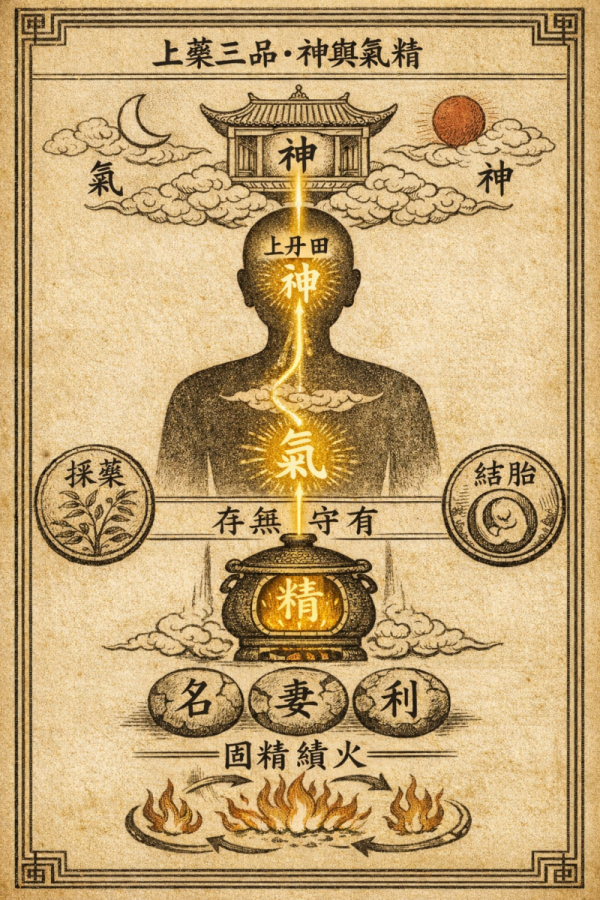
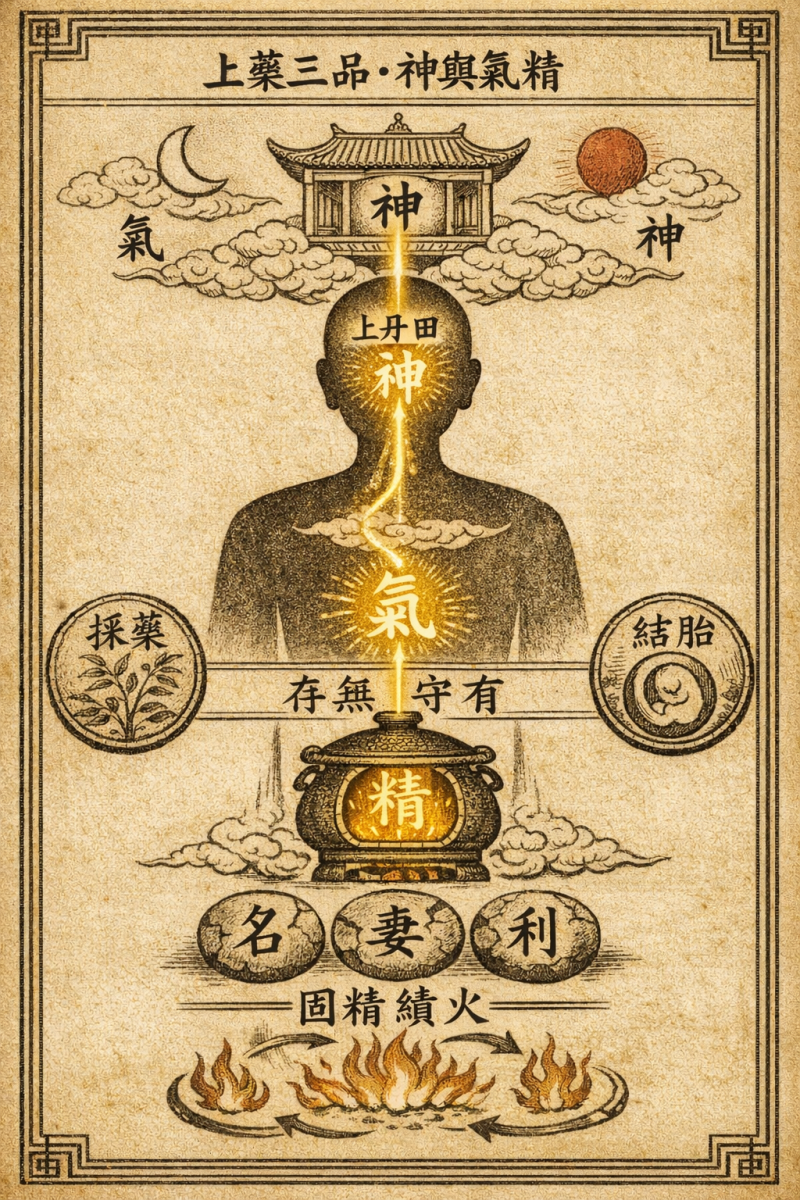
Illustration legend: This neidan (內丹 nèidān) diagram depicts the human body as a microcosm of internal alchemy. The Lower Dantian (下丹田 xià dāntián) appears as a sealed furnace containing Jing (Essence 精 jīng), the medicinal herb. Above, the Middle Dantian (中丹田 zhōng dāntián) contains Qi (氣 qì), the transformative agent, while the Upper Dantian (上丹田 shàng dāntián) within the cranial palace contains Shen (Spirit 神 shén), the governing monarch. Key inscriptions—存無守有 (cún wú shǒu yǒu, “Preserve Non-Being, Guard Being”) and 上藥三品 神與氣精 (shàng yào sān pǐn, shén yǔ qì jīng, “Superior Medicine: Spirit, Qi, Essence”)—encode the central principles and the Three Medicines. Flanking seals indicate the harvesting of the herb (採藥 cǎi yào) and the gestation of the Holy Infant (結胎 jié tāi / 聖嬰 shèng yīng). The lower foundation bears the inscription 固精續火 (gù jīng xù huǒ, “Secure Essence, Continue Fire”), while the cracked outer circles warn of potential loss through the Three Thieves (三賊 sān zéi) of Fame (名 míng), Wives/Sexual Attachment (妻 qī), and Profit (利 lì). The diagram emphasizes the ascending transformation of essence into energy and spirit, regulated circulation (火候 huǒhòu), and the alchemical process of refining Jing into Qi (煉精化氣 liàn jīng huà qì), offering a technically precise and visually faithful representation of late-Ming internal alchemy.
*
Today’s sharing from the Blue House of Via-HYGEIA presents more excerpts from the Xiuzhen Baochuan (Precious Transmission of Cultivating Reality), a late imperial Chinese spiritual text of the neidan (internal alchemy) tradition. Our focus is the theme of ‘Essence (Jing 精 ) as the Medicinal Herb’, naturally extending our previous publications while opening new avenues for investigating the text’s synthesis of Buddhist and Daoist technologies of the self. In our next issue, we will kindle ‘Qi as the Fire‘ (qi wei huo 氣為火), exploring the huohou (火候)—the “fire-timing”—that cooks the medicinal jing (精) into qi (氣) , and qi eventually into shen 神 (Spirit).
**
Editorial Introduction: The Alchemical Sequence
Our exploration of the Xiuzhen Baochuan (修真寶傳) has thus far established the foundational architecture of the internal elixir (neidan 内丹). We began with Stillness (jing 靜)—not as mere quietude, but as the primordial substrate, the ‘uncarved block‘ (pu 樸) that precedes all transformation. From this ground of silence, we erected the Body as Furnace (shen wei luding 身為爐鼎), recognizing the somatic vessel—the Lower Cinnabar Field (xiadan tian) and its cauldrons—as the necessary container in which any work might transpire. We then installed the Head-Mind as Monarch (xin wei jun zhu 心為君主), acknowledging that without the directive intelligence of the Heart-Mind (xin 心 )—the ‘ruler‘ who maintains the seal and governs the fire—furnace and stillness remain inert, mere potential without operative wisdom.
With these three pillars established—the field, the vessel, and the governor—we turn now to the substance itself. This issue examines Essence (Jing 精 ) as the Medicinal Herb (yao 藥), the raw material that fills the furnace and awaits the monarch’s command. In the pharmacology of internal alchemy, jing is simultaneously the most corporeal and the most precious: the ‘original seed‘ (yuanjing 元精) that descends from pre-heaven, yet manifests in the body’s vital fluids, sexual potency, and foundational vitality.
The selections herein trace the lifecycle of this medicine: its identification as the ‘Superior Medicine’ (shangyao 上藥) distinct from ordinary matter; the delicate operation of ‘harvesting’ (caiyao 採藥) during the ‘living midnight’ (huo zi shi 活子時)—the internal moment of spontaneous vitality—when it stirs; and the ever-present danger of the ‘three thieves’ (san zei 三賊)—fame, desire, and profit—that would deplete the essence (hao jing 耗精) before it has time to form the Holy Infant (shengying 聖嬰).
Yet medicine, however potent, remains inert without its activating principle. In our next issue, we will kindle ‘Qi as the Fire‘ (qi wei huo 氣為火), exploring the huohou (火候)—the ‘fire-timing‘—that cooks the medicinal jing into qi, and qi eventually into shen (Spirit). How does one regulate a fire that cooks without consuming? The furnace has been built, the monarch enthroned, and the herb identified; now we must learn to burn.
*
The Three Selections
Selection I: The Prescription
Source: Page 6, right column, upper section
Chinese Text: 上藥三品 神與氣精 恍恍惚惚 杳杳冥冥 存無守有 頃刻而成
Pinyin: Shàng yào sān pǐn, shén yǔ qì jīng Huǎng huǎng hū hū, yǎo yǎo míng míng Cún wú shǒu yǒu, qǐng kè ér chéng
Translation: ‘The Superior Medicine has three grades: Spirit, Qi, and Essence. Indistinct and vague, dark and obscure. Preserve the Non-Being, guard the Being; in a moment it is complete‘.
Commentary: This passage explicitly names the Three Medicines (三品藥) of internal alchemy. While the text lists Spirit (Shen), Qi, and Essence (Jing) collectively as the ‘Superior Medicine‘, our current operation isolates Jing as the primary substrate to be gathered. In this specific alchemical phase, Jing constitutes the tangible ‘substance‘ or ‘herb‘ (cao), while Qi acts as the ‘fire‘ (huo) and Shen as the ‘ruler‘ (jun) who administers the prescription.
Note the paradoxical instruction to cun wu shou you (存無守有): one must ‘preserve emptiness‘ (the pre-cosmic void from which Jing emerges) while ‘guarding existence‘ (the manifested essence in the body). This captures the unique ontological status of Jing in Neidan—it is simultaneously the most material (seminal, bodily) and the most primordial (pre-heaven) substance.
*
Selection II: The Harvest
Source: Page 6, left column, continuation
Chinese Text: 回光返照 產出聖嬰 三年九載 一紀飛昇 得者成聖 聞之超生
Pinyin: Huí guāng fǎn zhào, chǎn chū shèng yīng Sān nián jiǔ zǎi, yī jì fēi shēng Dé zhě chéng shèng, wén zhī chāo shēng
Translation: ‘Turning the light around to reflect within, one gives birth to the Holy Infant. Three years and nine years, in one ji-period ascending to flight. Those who obtain it become sages; those who hear of it transcend birth‘.
Commentary: Here the text describes the maturation of the medicine. The ‘Holy Infant‘ (Shengying 聖嬰) is the elixir-body crystallized from the refined Jing. The timeframe—three years for the initial congelation, nine years for completion—refers to the ‘cooking‘ of the herb within the bodily furnace.
Crucially, the text distinguishes between de (得, obtaining) and wen (聞, hearing). The ‘medicine‘ is not merely a theoretical concept; it must be physically gathered (caiyao) during the ‘living midnight‘ (huo zi shi 活子時). This term does not refer to a fixed clock time, but to the internal moment when vital energy spontaneously stirs within the practitioner. To ‘hear‘ the teaching without capturing this essence is to remain a philosopher; to ‘obtain‘ the medicine is to become an immortal (聖 shèng, here implying the perfected person). This underscores the text’s practical, somatic emphasis: Jing must be seized as a material reality before it dissipates into ordinary desire.
*
Selection III: The Theft of the Medicine
Source: Page 8, left column, lower section
Chinese Text: 有一等爲着名不思睡覺 有一等爲妻思上了圈套 有一等爲着利受盡煎熬 千魔百難不退心
Pinyin: Yǒu yī děng wèi zhe míng bù sī shuì jiào Yǒu yī děng wèi qī sī shàng le quān tào Yǒu yī děng wèi zhe lì shòu jìn jiān áo Qiān mó bǎi nán bù tuì xīn
Translation: ‘There is a class [of people] who, attached to fame, forget to sleep; There is a class who, thinking of wives, enter into snares; There is a class who, attached to profit, suffer complete torment. [But the true practitioner, facing] a thousand demons and hundred difficulties, does not retreat from the heart‘.
Commentary: This passage provides the pharmacological warning label. In the syncretic moral universe of the Xiuzhen Baochuan, the ‘medicinal herb‘ of Jing is constantly threatened by ‘thieves‘ (賊 zéi). The text identifies three primary thieves that steal the essence: Fame (名 míng), Sexual Desire (妻思 qī sī), and Profit (利 lì).
The metaphor is precise: just as a precious herb must be protected from mold, insects, and improper climate, the Jing must be guarded from ‘snares‘ (圈套 quān tào) that drain the Lower Cinnabar Field. The reference to ‘wives‘ serves as a synecdoche for unchecked sexual desire or attachment to sensual pleasure, which causes the leakage of Essence, rather than a condemnation of family life per se (as many neidan practitioners were laypeople with families). The reference to ‘not sleeping‘ (不思睡覺 bù sī shuì jiào) alludes to the practice of ‘guarding the furnace‘ (守爐 shǒu lú)- maintaining vigilant awareness even in dormancy to prevent the nocturnal emission of the medicine (夢遺 mèng yí). The ‘thousand demons’ (千魔 qiān mó) are not external entities but the internal manifestations of unrefined Jing seeking outward discharge. To ‘not retreat from the heart‘ is to maintain the seal on the furnace, ensuring the medicinal herb does not escape into the world.
*
Note on Pronunciation:
着 (zhe): In selections I and III, this particle indicates the action of attachment (‘为着名’= for the sake of/attached to fame).
紀 (jì): In selection II, a classical measure of twelve years, representing the complete alchemical cycle.
了 (le): In selection III, a completed action marker (‘上了圈套’ = entered into/fell into the snare).
*
Source
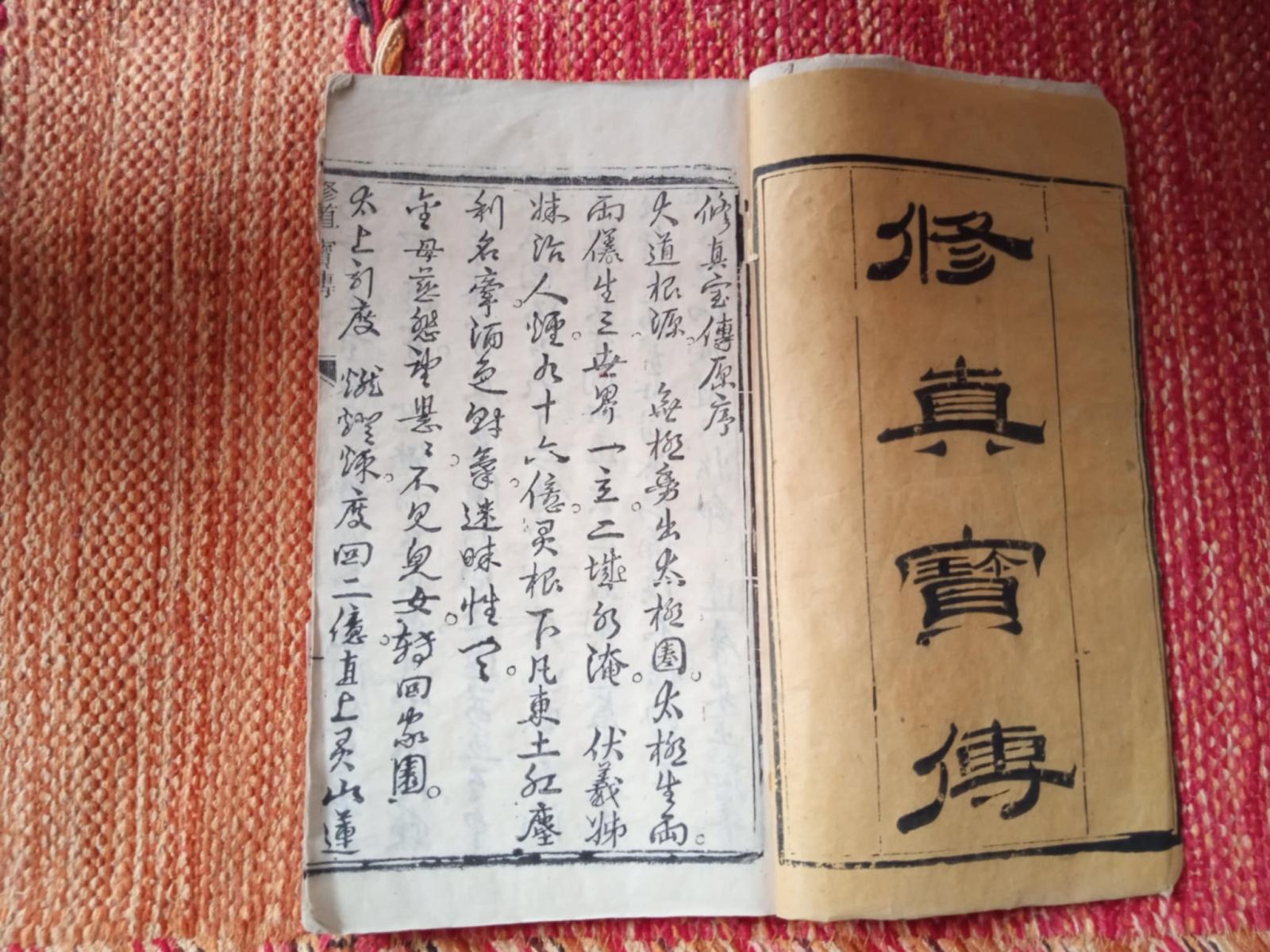
Xiuzhen Baochuan (修真寶傳)
*
Bibliography
For readers wishing to deepen their understanding of the Xiuzhen Baochuan and the technical vocabulary of Internal Alchemy, we recommend the following:
Pregadio, Fabrizio. Taoist Internal Alchemy: An Anthology of Neidan Texts. Routledge, 2019. An indispensable scholarly collection that situates the concept of jing (Essence) as the ‘medicinal herb‘ (yao) within the broader taxonomy of the Three Treasures (sanbao). Pregadio’s introductions elucidate the precise relationship between the ‘harvesting‘ (caiyao) metaphor and physiological practices in Ming-Qing lineages.
Overmyer, Daniel L. Precious Volumes: An Introduction to Chinese Sectarian Scriptures from the Sixteenth and Seventeenth Centuries. Harvard University Asia Center, 1999. Provides essential context for the baojuan (precious scroll) genre to which the Xiuzhen Baochuan belongs. Overmyer analyzes how these syncretic texts blended Buddhist salvationist rhetoric with Daoist alchemical terminology for lay audiences—a synthesis evident in our current selections.
Despeux, Catherine. ‘Jing’ and ‘Neidan’. In ‘The Encyclopedia of Taoism’, edited by Fabrizio Pregadio. Routledge, 2008. Two concise, authoritative entries by the foremost French scholar of Daoist body cultivation. Despeux clarifies the distinction between post-natal (houtian) and pre-natal (xiantian) essence, a distinction crucial for understanding the ‘double nature‘ of the medicinal herb described in Selection I.
Liu, Xun. Daoist Modern: Innovation, Lay Practice, and the Community of Inner Alchemy in Republican Shanghai. Harvard University Asia Center, 2009. While focused on a slightly later period, Liu’s study illuminates the social context of ‘inner alchemy for the people‘ (minjian neidan) that texts like the ‘Xiuzhen Baochuan’ helped establish during the late imperial era. Particularly useful for understanding how the conservation of jing became a moral and communal imperative for lay practitioners.
***
Related Articles


Leave a Reply