
Circle of Transmission: The Living Loom
The Echo of the Sierra – The Opening Prayer from ‘El-Müntekâ Min Kelâmi Ehli’t-Tûka’: Preserving the Legacy of Ibn Masarra

Legend of the ‘Yā Karīm’ Illustration
At the heart of the composition, the invocation يا كريم (Yā Karīm – ‘O Generous One‘) unfolds in a Maghrebi-Kufic hand—its measured geometry carrying both sobriety and quiet expansion. The gold of the script does not merely ornament: it radiates, suggesting a generosity that precedes and exceeds all petition.
Behind it, the muted silhouette of the Sierra rises in layered stillness. These mountains, evoked rather than described, stand as the interior landscape of reception—where the soul, like the horizon, becomes واسع (wāsi‘ – vast) enough to receive what cannot be earned.
The deep blue field recalls both الليل (al-layl – the night) of contemplation and the hidden treasury of the unseen, while the surrounding geometric frame, inspired by Andalusian ornament, orders space without enclosing it. It is a discipline of form that gestures toward the infinite.
This image does not illustrate a doctrine. It enacts a call: not toward merit, but toward recognition—that generosity is أصل (aṣl – origin/root), not response.
‘O Generous One‘—not because we are worthy, but because He is!
*
Another sharing for the day from the Blue House of Via-HYGEIA, being a profound prayer, translated into English from the Turkish edition of ‘El-Müntekâ Min Kelâmi Ehli’t-Tûka’ (İnsan Yayınları, 1999, edited by professor Mehmet Necmettin Bardakçı.
This text is drawn from the only known manuscript in the world, preserved in Turkey, and originally published as part of the prestigious ‘Irfan‘ (Gnosis) Series.
While compiled by the Andalusian master Ibn Hamis to preserve a fading legacy, these pages breathe the authentic spirit of Ibn Masarra (883–931)—the first philosopher-mystic of Cordoba. A rare glimpse into the batini (inner) tradition of Al-Andalus, offered for your contemplation and healing!
**
A contextual Introduction
A Legacy Preserved, Not Written
For centuries, this profound collection of prayers was attributed to Ibn Masarra (883–931), the first philosopher-mystic of Islamic Spain (Al-Andalus). Recent scholarship, however, has corrected the historical record: the anthology ‘El-Müntekâ Min Kelâmi Ehli’t-Tûka’ (‘The Selection from the Words of the People of Certainty‘) was actually compiled by the Andalusian Sufi Muhammad Ibn Hamis (d. 1109), two hundred years after Ibn Masarra’s death.
Why does this matter? It tells a deeper story. Ibn Masarra’s own writings were systematically burned and banned by the religious authorities of Cordoba, who feared his esoteric teachings. His voice was silenced, but his spirit could not be extinguished. Ibn Hamis, a later master walking the same path, compiled these prayers to keep the flame of Ibn Masarra’s insight alive.
The text you are about to read is drawn from the only known manuscript of this work in the world, housed in the Kütahya Vahit Paşa Library in Turkey. Its publication in 1999 by professor Mehmet Necmettin Bardakçı (as part of the distinguished ‘Irfan‘ or ‘Gnosis‘ Series) rescued this unique artifact from obscurity, introducing Ibn Masarra’s theory of knowledge and spiritual psychology to the modern world. When you read this text, you are hearing the voice of a tradition—a chorus of Andalusian mystics resonating with the original frequency of Ibn Masarra’s batini (inner) wisdom, preserved in a singular, fragile thread of history.
The Two Paths: I‘tibār and Ḥurūf Although Ibn Hamis compiled the prayers, the structure of the spirituality within them is undeniably Ibn Masarra’s. Scholars identify two authentic works by Ibn Masarra that form the backbone of this tradition:
1. The Path of Reason
(Risālat al-I‘tibār)
This treatise teaches that the universe is a book to be read. By observing nature—from the smallest insect to the stars—one can reason their way up to the Creator. This is the “upward” journey of the intellect.
In the Prayer: Notice the lines: ‘You have opened the paths that lead to You… You have multiplied the proofs that point to You’. This is the language of I‘tibār—using the world as a mirror for the Divine.
*
2. The Path of Letters
(Risālat al-Ḥurūf)
This work explores the metaphysical secrets of the Arabic alphabet, viewing letters as the building blocks of creation. It suggests that divine knowledge flows “downward” from God through these symbolic structures.
In the Prayer: The text’s rhythmic, almost incantatory quality, and its focus on the “names” and “attributes” of God, reflect this science of letters. It is not just asking; it is aligning the soul with the cosmic syntax.
*
Conclusion:
Navigating the Batin
(The Inner Dimension)
Ibn Masarra was a master of the Batin—the hidden, inner meaning of scripture. He taught that while the outer law (Zahir) governs society, the inner truth (Batin) liberates the soul. This prayer is a manual for accessing that inner dimension.
The Secret (Sirr): The prayer speaks of the ‘cleanliness of my secret‘. In Ibn Masarra’s school, the Sirr is the holy of holies within the human heart, where the divine light touches the soul directly, beyond words or thoughts.
Certainty (Yaqīn): This is not blind faith. It is the ‘taste‘ of truth arrived at through both reason (I‘tibār) and spiritual unveiling. The prayer’s plea for ‘the sweetness of knowing You’ is a request for this experiential certainty.
The Generous One (Al-Karīm): A central theme in Ibn Masarra’s thought (and this prayer) is God’s overwhelming generosity. The logic is mystical: ‘I do not ask because I am worthy; I ask because You are Generous’. It is a surrender of the ego’s accounting in favor of divine grace.
*
Why This Text for Bibliotherapy?
In the context of Via-HYGEIA, this text is a tool for re-integration. It acknowledges the shadow (defects, weakness, forgetfulness) without shame. It activates the intellect (inviting reflection on the signs of the universe). It soothes the heart (through the rhythm of supplication and the promise of mercy).
Though Ibn Masarra’s own books were burned, his prayer survived in the heart of his follower, Ibn Hamis, and in a single, fragile manuscript. As you read, know that you are participating in an act of spiritual resistance—a reclaiming of the inner light that no fire can destroy!
*
And now the text:
The Opening Prayer
from ‘El-Müntekâ’
O my God! You are hidden from ears and eyes, so ears cannot perceive You with their hearing, nor hands with their touch. You are concealed within might and majesty, behind the veils of the beauty of Your power. You are One within the sanctuary of Your grandeur. Yet, You are manifest in minds, in thoughts, and in souls. Your support illuminates them, and Your granting of success makes them radiant. Evidence is brought to You through Your creations, through the signs of Your act: everything that speaks and is silent, moves and is still, is manifest or hidden. Each of them, until a time You have determined, a goal You have limited, an end You have decreed, proceeds towards You in perfect submission and obedience.
How exalted is Your glory! You are wise in Your judgment, just in Your decree. You have opened the paths that lead to You, You have made beautiful the ways to know You (ma‘rifa), and You have multiplied the proofs that point to You. You have no need of our remembrance, our gratitude, our praise, or our goodness. Do not leave us to ourselves in our striving for Your certainty (yaqīn), in clinging to the proofs of Your teaching, or in our sincerity (ikhlāṣ) towards You. Do not make us dependent on the means of acquisition. Enrich us by establishing Your proof and manifesting Your evidence. Gladden us with Your inspiration, and open for us, from the strength of our nature, a door to the pool of affirmation, a path to acknowledgment through verification (taḥqīq).
O my God! Unite speech, deed, and intention with the sincerity of Your oneness (tawḥīd). Make the tongue an interpreter of what is hidden in the heart, a bridge to what You have placed in the gardens, an expounder of what the heart conceals of the proof of Your Lordship (rubūbiyya), a clarifier of Your Oneness (waḥdāniyya). For You have brought together diverse desires and passions, and You have reconciled and made affectionate opposing and repelling things.
O my God! If I fall short in the stations of certainty (yaqīn), if I lessen my vigilance for the aims of sincerity (ikhlāṣ) and its secret in order to reach its innermost depth, if, due to my being human, I cannot attain its realities, and if my deficiency as a created being prevents me from grasping its ultimate goal, then reward me with the reward of the people of sincerity and the possessors of certainty. Even if I am lower and farther than them, more deficient than all of them, forgive me, do not scrutinize my state with minute accounting, and pardon me.
O my God! Make what You have given me—my supplication to You, Your decree upon me from Your affair—a degree for the purification of my intention, an aid to the cleanliness of my secret, a ladder to the sincerity of my conscience, a door to the uprightness of my belief. Do not make the understanding You have given me a thing that renders my deed futile, nor the knowledge (ma‘rifa) a thing that spoils my effort. I seek refuge in You from a knowledge that breeds ignorance of You. Save us from a heedlessness that whispers doubt, and from a trial (fitna) that distances from You.
When my soul leads me astray towards a kind of knowledge, when it humiliates and abases me through a kind of understanding, do not withhold Your help from me. Woe to the afflictions I have fallen into if I have turned away from Your signs, stripped myself of Your clear proofs, and if my eye is blind to Your light! Woe to the sorrows that befall me if the foolishness of Your servants who led me astray in sincerity, and the dullness of those who preceded me in tawḥīd, is the cause.
O my God! Make me a leader among those whose hearts are open for You in the worlds, among those who strive for You; a guide for those who know You with certainty (yaqīn); one of those whom You have elevated by degrees, for whom You have opened the veils that prevent reaching You; place me among those whom You have honored with Your special gifts and made imams.
O my God! Bestow upon me, as the greatest of blessings and the supreme gift, a nearness with which You provide me, a knowledge that You guarantee, and a wealth from which You grant me benefit. Grant me a discernment (baṣīra) that removes doubt, and the signs of faith that unveil the realities of certainty.
O my God! Do not make my breast a hunting ground for Satan, nor my heart a field for him. Do not make me one who distresses someone with his voice, who harbors evil thoughts about him, who seizes his share, who partners his wealth and child, who causes confusion in his spirit and body.
Be for me a refuge against his temptations, a way out from his snares, a means of distancing from his misguidance. Cover me against him with the covering of Your nearness, protect me with the tent of Your preservation (‘iṣma), and place between me and him a barrier of knowledge (ma‘rifa), so that he finds no path to humiliate me, no passage to lead me astray. Support me against him with Your protective soldiers and guardians.
O my God! Satan may whisper into the heart, casting things the tongue cannot utter, the soul cannot spread. These things distance the exaltedness of Your might and the loftiness of Your honor from him. O my Master! If the majesty of Your sovereignty and the greatness of Your grandeur remove him, then erase and cleanse the sins recorded, through Your unending mercy and compassion. Draw the sword of Your enemies against him with gentleness, driving him away from me, and burn him with the fire of Your vengeance. Make my salvation a sorrow for him, and increase his ruin.
O my God! Do not discipline me with Your punishment; forgive and pardon my faults with Your good pleasure; accept my prayer and my repentance. O He whose mercy is vast and whose beneficence is great, deal with me according to Your mercy.
O my God! I repent to You from every sin my body committed, strengthened by the health and well-being You gave; from every sin my hands reached for, despite the abundance of Your favors; from every sin they stretched towards, despite the plenty of Your provision; from every sin committed while concealed by Your covering, relying on Your forbearance; from every sin done depending on Your pardon and forgiveness. I seek Your forgiveness for all of it.
O my God! I ask Your forgiveness for everything my soul promised You and then did not fulfill. O my God! I seek Your forgiveness for Your blessings with which You favored me, and with which I multiplied my sins. O my God! I seek refuge in You from speaking a word that is true, but thereby seeking the pleasure of someone other than You. I seek refuge in You from adorning myself for people with something that, in Your sight, is a disgrace and fault in me.
I seek refuge in You from being adorned for people with what You have taught me. I seek refuge in You from being a lesson for one of Your creatures. I seek refuge in You from one of Your creatures being happier with something You taught me than I am, and from falling into a sin that harms me.
O my God! Enrich me with knowledge, beautify me with obedience (ṭā‘a). Adorn me with contentment (qanā‘a) and elevate me with piety (taqwā). O my God! Do not leave me to my own soul, for then I would be helpless. Do not leave me to people, for they would waste me. O my God! Make me one who gives thanks, who remembers, who is patient, who is content, who hopes and fears, who obeys, who is humble (khushū‘), who supplicates much, and who repents often to You.
O my God! Guide my heart, expand my breast, make my task easy, erase my sin, delight my eye in Your worship. Grant me success in Your obedience, and provide me with the fear of Hell and the hope of Paradise.
O my God! Truly, I come to You with no righteous deed to offer, and no intercessor whose intercession I hope for. But I come to You acknowledging my sins, confessing my evil deeds. I have no argument to gain Your forgiveness, except Your mercy with which You forgive those who err. Beautify them with Your forgiveness, and protect them from forbidden things.
O my God! I desire a pure faith with which to discipline my soul; a sincere certainty (yaqīn) that teaches me that only what You have decreed will befall me, and that cleanses my heart; and contentment with what You have decreed for me. O my God! Rectify my religion, which You have made the guardian of my affairs; set right my world, in which I live; correct my afterlife, my final destination. Make my life an increase in all good, and my death a rest from all evil.
O my God! Make the end of my life good. Make the best of my deeds their last, and make the day I meet You the best of days. O my God! I ask for Your mercy against my major sins, and Your forgiveness for the virtues I failed to attain. I ask for the gain of all Your goodness, safety from every kind of sin, the attainment of Paradise, and deliverance from Hellfire.
O my God! Make Your love the dearest thing to me, and Your fear the most frightful thing. Sever my attachment to this world through the desire to meet You. When the people of the world find delight in the world, delight my eye with the worship I perform for You.
O my God! Provide me with the fear (khashya) that acts as a barrier between me and sins committed against You; with obedience (ṭā‘a) that leads me to Your mercy; and with certainty (yaqīn) through which the afflictions of this world appear insignificant and light to me.
Provide me with a certainty (yaqīn) that makes everything other than You insignificant, through the exaltation of Your remembrance.
O my God! Spread Your mercy over me, so that the path to nearness to You is made easy thereby, and the excellence of my station with You increases. Cover me with Your beautiful grace. Do not alter my senses, my organs, or the light of my heart from the blessings You have given me. Rectify my soul, strengthen me with a spirit from You. Protect me from laziness and weariness, from falling behind and from confusion in Your command; guard me from inclining towards immediate ease and from transient passion. O my God! Truly, You know what is beneficial for me. Bestow Your favor upon me, spare me, and have mercy on me.
O my God! Whatever is more beneficial for me among habituation to a task, attaining ease from anxiety, striving and working in a matter, and making it a habit; whichever is the most beautiful path, closest to the right way, and most beneficial—make me love it. Do not make me need base things, until subtle and gentle counsels lead me to lofty stations, through a facility and well-being from You. Protect me from corrupt and evil character, and make me one of those who obey You in humility.
O my God! Be my guide in the darkness of confusion and the filth of doubts. Do not leave my soul to act as my agent in any of my affairs. Purify me, heal me, and be pleased with me. Take me as a friend, as You have taken as friends Your righteous servants and those with piety ‘for whom there is no fear nor grief‘, among those whom You have befriended. O my God! Help me in guarding my tongue, my eye, and my other organs against the forbidden. Do not withhold Your help against my soul, against what opposes reason, and against every obstacle that stands between me and what benefits me.
O my God! Preserve the piety (taqwā) in my heart, which is my place of goodness and light. Bless the remaining part of my life for the righteous deeds I must do for You. Provide me with constant remembrance of the heart. Place sorrow and fear within me, so that I may be among those who delight in Your command and those who are cautious and firm in Your affair. Make me among those who fulfill Your trust, who are faithful to their pledge to You, who carry out Your orders, who are without equal, who are faithful to the exaltedness of Your obedience, who ascend high from their sacred stations. Make me among the patient who attain salvation and who help You.
O my God! I stretch my hand to You, as do those who long for You and supplicate to You, those who withdraw in poverty and need, those who are in need only of what is with You, those who open their hands crying out, asking for Your mercy. If I am deprived of Your forgiveness, no one besides You can forgive me. Believing this, I seek refuge in You as a fugitive seeks protection, asking for Your protection and, in submission, asking for Your pardon. If You do not reward me, I will find no one to reward me besides You.
How exalted is Your glory! There is no god but You. There is none besides You who can forgive sins and remove evils. You alone give goodness and blessings.
O my Master! If You reject me, whom would I appoint as my guardian? O my God! If You turn away from me, to whom would I entrust myself? O my Friend! If You cut off my means, to whom would I present them? O my God! Pity me in this state of mine in Your hands. Forgive me because of my humility before Your forgiveness, because of the greatness of my hope in Your pardon. Connect the means by which I approach You, through Your grace, to a sheer mercy, successive, encompassing all, blessed, whose shadow and security are unending, to the Great Mercy.
O my God! I complain only to You of the weakness of my body, the hardness of my heart, the dominance of my passion, the feebleness of my resolve, the length of my hope, the approach of my term, the multitude of my sins, my evil thoughts (sū’ al-ẓann), and my view of my own soul. O my Master, You are the best of those to whom complaints are made.
O my God! My sins have multiplied and increased. Forgiving them is easy for You. Here I am, humble and fearful, confessing the faults of my soul and my sins. O You who forgive the one who confesses his sin to You! O You who are generous to the one who shows humility to You in abasement! Just as You showed me the ugliness of my confessed deed, so too does bestowing favor belong to You. You showed me goodness until I humbled myself before the loftiness of Your sovereignty and the completeness of Your blessings.
O You to Whom I confess my sin because of Your generosity, before Whom I show utmost humility for the sake of Your sovereignty! You are my Creator. By Your might, my goodness does not adorn Your sovereignty, nor does my sin defile Your dominion. Your treasuries are not increased by what You have forbidden me, nor are they decreased by what You have given me. If You forgive, You are worthy of that; if You punish, I deserve it.
O my God! Do not disappoint me of Your mercy. How evil my state would be if I were to return deprived by You! No call can raise me to You, nor can it deliver me to a request near You. You have made my voice an obstacle to You? Have You turned Your generous Self away from me? Have You closed Your door to me, Your humble and worthless servant? O my Master, I seek refuge in You from this.
O my God! Do not tear out from my heart the love with which You have enriched me. Continue the sorrow with which You have charged me. Grant me success to do what You have commanded me. Protect me by keeping me away from what You have forbidden. Convey to me, through Your mercy, what You have promised me. Protect me, in Your forgiveness, from what You have warned me against. Beautify me with Islam, so that I may meet You through it.
O my God! I cannot bring what I hope for to You, nor can I postpone what I fear. I am held as a pledge by my deeds. There is none poorer than me; grant me relief. Provide me with piety (taqwā) as long as You give me life, and with Your generosity when You cause me to die. Grant me the ability to give thanks for the things You have favored me with in the past of my life and will favor me with in the future. Forgive my sin, and protect me from the greed of my soul.
O my God! Truly, You have given me Your blessings abundantly. In return, my gratitude has been little. No one besides You can count the blessings You have given me. How beautiful are the trials You have given me, how good are Your deeds! My Master, I have only increased my poverty, while You have only increased the riches You gave me. I have only increased my sins, while Your forgiveness has only increased in breadth.
O my Master! Your servant implores You. Hopeless, poor, praying, beseeching, free from pride and sedition, submitting to Your command, content with Your judgment, without despair of Your mercy, without feeling secure from Your scheming, fearing Your punishment with his knowledge, and hoping for Your mercy—he implores You. No one can distance me from You, nor is there any one besides You to lead me astray. I have made my sinful soul dignified through Your grace. I have been unable to render thanks for many of the blessings You have given me. I have many sins which You know and count, that I am ashamed to mention. If You do not forgive me, I fear Your punishment for them.
O my God! The fear of those who fear is for You. The sincerity (ikhlāṣ) of those who supplicate in humility is to You. Awe is from You, hope is in Your forgiveness. O God of all creatures, O Lord of the worlds, O Most Merciful of the merciful, accept the prayer of those who seek help. Forgive the sins of the sinful and those who transgress in evil. O Most Generous of the generous, increase Your bounty for the righteous on the Day of Resurrection.
O my God! I am Your servant, I cannot account to You. If I cannot merit Your mercy, how can I endure Your punishment? With Your abundant forgiveness and Your mercy…
…You improve the state of sinners. O God, when my sin frightens me, I hope for forgiveness from You, based on my good opinion of You. You are so Generous that the hope of those who hope, the aspiration of those who yearn, is not wasted with You. Only forgiveness befits You. If You punish, there is none more just than You in judgment.
O God, You continue to gladden me throughout my life, and after my death, do not cut off Your goodness and forgiveness from me. O God, if my sin frightens me, my love for You makes me secure. Take charge of my affair, for You are worthy of it. Only Your forgiveness befits a servant whose ignorance makes him sinful. O God, if I am not worthy of Your goodness, You are worthy of bestowing virtues upon me, for You are Generous (Karīm). The Generous does not give all good things only to those who pray and ask for their needs to be fulfilled.
O God, in the world, You concealed my sins. I am more in need of their concealment in the afterlife. If You do not expose them, how well You act! Complete Your beneficence by forgiving them. O God, though my deed of obedience to You is small, my hope and expectation of You is greater.
O God, I have not despaired of my good opinion of You. Do not render the truth of my hope false.
O God, I have committed many crimes and sins for which You have declared war, and my sin by which I disobeyed You is great. But when I recall the greatness of my crime and the immensity of Your forgiveness, I see that between the two lies Your pardon, with which You are pleased.
O God, when errors alienate me and drive me away from the beauties of Your grace, make me feel, through certainty (yaqīn), the goodness of Your compassion. O God, if heedlessness prevents me from preparing for the day I will meet You, let knowledge (ma‘rifa) convey me to Your abundant blessings.
O God, though my faults are many, I implore Your help by beseeching You. O God, I stand at one of the doors of Your forgiveness, asking, turning away from other than You, deeming it shameful to ask them, in a state of necessity, sighing, awaiting Your mercy. Turning away a madman, a beggar, cannot be among Your beautiful favors.
O God, if You do not guide me with Islam, I cannot find the right way. If You do not provide me with faith (īmān), I cannot believe. If You do not free my tongue to pray to You, I cannot pray to You. If You do not acquaint me with the sweetness of knowing You (ma‘rifa), I cannot know. These means, which You have graciously given me and with which I obey You, are evidence of my good opinion of You point to something veiled. O God, how could You abase and humiliate my soul, which You have exalted with the strength of Your faith, among the layers of fire?
O God, when the worshippers heard of the abundance of Your reward, they feared and submitted. When the ascetics heard of the greatness of Your recompense, they showed humility. When the sinners heard of the breadth of Your mercy, they immediately returned. At Your door, many crowded groups of Your sinful servants await in throngs. In all Your lands, noises mixed with prayer arise.
O God, when I err against my soul while contemplating what holds its salvation, I seek refuge and ask help from You, hoping for its dignity. O God, if I sever my connection to You by the fewness of what I must do for You, I reach You with the capital I have prepared—sighing, weeping, and shedding tears. O God, I pray to You as one who has no hope other than You prays. I hope in You as one whose hope is in none other than You hopes.
O God, if You only accept the prayer of those who strive and labor, to whom will those who fall short and remain behind flee? If You only bestow favors on those who do good, what will the evildoers do? If only the sincere (mukhlisūn) are saved on the Day of Gathering, from whom will the foolish and corrupt seek help? O God, if You forgive, it is from Your bounty; if You punish, it is by Your justice.
O God, You created a body for me, containing limbs with which I obey and disobey You. Then You gave my soul a nature and disposition that inclines to passions and loves pleasures. You placed me in an abode full of trials. Then You said to me, ‘Hold fast, protect yourself‘. How can I hold fast? How can I protect myself? O God, if You do not hold and protect me, how can I protect myself? O God, I am holding fast, clinging; protect me. O God, I am imploring; grant me refuge. I ask for Your protection in what benefits me. Protect me. I ask You to grant me success in what entails obedience to You. Grant me success. I seek refuge in You from what You turn away from; protect me from it.
O my God, I have sinned, as You know. You are the Accepter of repentance. Accept my repentance. Write me, for the remainder of my life, as an obedient servant to whom You have shown favor; and for the time passed, write me as a disobedient servant on whom You have had mercy.
O God, just as my soul was the dearest thing to me in the world, the most beneficial thing returning to me in my grave is my soul, which You have forgiven through Your guidance and adorned with Your obedience. You are its Master. Forgive my soul. Do this for me. O God, when my trace and mark are gone from the world, and my name is forgotten among creatures, have mercy on me. O God, when my form changes and my body stinks, when my joints separate and break apart, have mercy on me.
O God, You are the Healer of weakness and strength. I bear witness to Your Oneness and Your power. I acknowledge that Lordship (rubūbiyya) and Grandeur belong to You. O my Master, You created me with blessings, to the gratitude for which I can only attain strength with Your help; You protected me against the increase of deviation with the covering of health and well-being; You continued to look upon me with the gaze of grace with which You look upon Your servants in times of my heedlessness; You encompassed me with compassion and mercy even though I did not deserve it.
The blessings, gifts, and favors You have given me are more beautiful and greater than can be counted. Therefore, let not my ignorance of You and my audacity towards You prevent Your forgiveness. If You deal with me gently in my sin, if You grant me respite at the moment I commit it, if You cover me when I am alone with evil deeds, then do not disgrace me by later exposing my fault. O my Master, if You show people the opposite of what You know about me, it would be as if You are pleased with my deed. O my Master, pleasure (riḍā) is from Your generosity and forbearance.
O my God! Truly, You are the One upon whom favor is bestowed without being seen, and the One who is obeyed without being disobeyed. Then, if You direct me towards what brings me near to You, if You make me desire what is with You, and if You provide for me from what is with You, there is no one who can prevent this for You.
O my Master! When I pray to You, You are the Accepter; when I ask, You are the Giver; when I obey You, You exalt me; when I disobey You, You grant me respite and conceal those acts. Thus You have completed Your blessings upon me and loved me with Your beneficence. You have made what I give to You in submission a loan and a substitute for me. If You were to take it from me by force, You would erase my sins with it and make it capital for me with You.
My Master, for the sake of Your Majesty, Your Generosity, Your Might, Your Sovereignty, do not turn away Your generous Face from the one who seeks Your pleasure and the gifts of Your grace. Your generosity and bounty towards Your creatures are vast. My Master, You are my hope and my refuge. My trust (tawakkul) is in You, my love is in Your mercy.
You placed love for perishable things in me. I turn to You, seeking Your generosity. I open the door of Your grace with my prayer. I hope to be Your guest. My standing is under the shade of Your forgiveness. I turn my eye to You. My Master, if my desire for You is lost, where is there to flee? If I lose Your beneficence in my moment of need, how will salvation occur?
O my God! Occupy me with Your command. Make me one who despairs of Your creatures, who declares war on Your enemy, who shows reverence for Your right, who is sincere in his worship, content with Your judgment, patient in Your afflictions, grateful for Your blessings, who finds delight in Your remembrance, who constantly implores You night and day, prepared for death, yearning to meet You, eager to ask for the good, health, favor, and generosity that are with You.
O You who complete blessings until souls are satisfied with Your abundant favor, who bring forth lessons until the silent speak, who bring forth those who glorify You with praise, who make good and firm goodness and favor until the friends (awliyā’) confess their faults regarding Your right, who manifest Your signs until everything that prostrates to Your Essence among Your creatures—in the heavens, the earth, and all creation between them—emerges, proclaiming Your Oneness and indicating Your Lordship!
O Revealer, Expositor, Interpreter, Bestower of gifts, Favor-giver, Bestower of health and well-being, Announcer of good news, Sufficer. O Knower of hidden things, Reviver of the dead, Hearer of voices, Ruler of earth and heavens, Acceptor of prayers, Fulfiller of needs. How exalted is Your glory! There is no god but You.
O He whom eyes do not see, whom conjectures do not touch, whom describers cannot depict, whom thinkers cannot fully comprehend in all His aspects. How exalted is Your glory! There is no god but You. O First without beginning, O Last without end, who raises the one who draws near with His power, who abases the proud with His grandeur. How exalted is Your glory! There is no god but You.
O He whose dominion does not perish, whose might is not abased, whose strength does not weaken, whose sovereignty does not end, who has no termination, for whom guarding all creatures is not difficult or tiresome. How exalted is Your glory! There is no god but You. O He who has no helper in what He creates, no partner in His dominion, who is as He was before and will be as He is after. How exalted is Your glory! There is no god but You.
O Mighty, Majestic, High in station and honor, Transcendent above what the disbelievers disbelieve, above the attributes altered by the ignorant. There is no god but You. How exalted is Your glory! How sublime are You! All Your names are holy. There is no god, no deity but You. All affairs are for You. All creatures are Yours. All good is in Your hand. All favors and excellences are Yours. All praise and commendation are for You. All blessings and goodness, the first and the last, are from You. The origin is You, and the return is to You.
Praise is for You, for the vast mercy You have spread. Commendations are for You, for all the blessings You have bestowed. Praise is for You, for every distress and sorrow You have removed. Praise is for You, for every harm and affliction You have warded off, for everything You have protected against. O my God, by Your Generous Name, Your great dominion, Your abundant favor, I ask for success in performing the deeds You love, for a good opinion of You, and for true trust (tawakkul). Grant me to taste the sweetness of Your forgiveness and of knowing You (ma‘rifa).
O my God, I ask for an unchanging faith (īmān) and certainty (yaqīn), an inexhaustible joy, an unceasing delight of the eye, and in the abode of immortality, companionship with the Prophet Muhammad (peace be upon him), his Family, and his Companions. O Lord, bestow upon me the love of them and the love of those who love them. Protect me and them on the day of the greatest fear. Grant Your favor to me, to them, and to those who memorize this beautiful supplication and the great remembrance it contains.
May the blessings and peace of Allah
be upon Muhammad, his Family,
and all his Companions!
*
Glossary of Key Terms from the Opening Prayer
This glossary defines the essential Arabic terms that form the spiritual backbone of Ibn Masarra’s supplication. Understanding these concepts provides a deeper insight into the prayer’s meaning and the inner state of the one praying.
Dua’ (دعاء) – Prayer / Supplication
The act of calling upon God, asking for His favor, help, or forgiveness. It is the central action of the entire text, representing the creature’s humble and direct communication with the Creator.
Ilāhī (إلهي) – O my God
A personal and intimate vocative form of address, meaning “My God.” It establishes a direct and personal relationship between the supplicant and the Divine.
Tawḥīd (توحيد) – Oneness / Unification
The fundamental principle of Islam: the absolute Oneness and Uniqueness of God. In the context of the prayer, it refers to the sincere belief and inner realization that God is One, with no partners.
Rubūbiyya (ربوبية) – Lordship
The quality of being the Lord, the Sovereign, the Nurturer, and the Sustainer of all creation. Acknowledging God’s rubūbiyya means recognizing His absolute authority and care over everything.
Rabb (رب) – Lord
The Sustainer and Cherisher. Implies a relationship of ownership, care, and constant attention from God to His creation.
Raḥma (رحمة) – Mercy / Compassion
One of God’s most central and frequently invoked attributes. It encompasses His loving-kindness, forgiveness, and benevolent care for all beings. The prayer repeatedly appeals to God’s boundless mercy.
‘Afw (عفو) – Pardon / Forgiveness
The act of blotting out or erasing sins. It implies God’s willingness to completely remove the stain of transgression from the sinner’s record. The prayer contrasts God’s immense capacity for ‘afw with the servant’s many faults.
Maghfira (مغفرة) – Forgiveness
Similar to ‘afw, but often implies covering or protecting the sinner from the consequences of their sin. It is the primary thing the supplicant seeks throughout the text.
Tawba (توبة) – Repentance
The act of turning back to God from sin. It involves feeling remorse, ceasing the wrongdoing, and resolving not to return to it. The supplicant asks God to accept his tawba.
‘Iṣma (عصمة) – Preservation / Infallibility
Divine protection from falling into sin or error. The supplicant asks God to protect him with the “tent of Your preservation,” seeking shelter from his own weaknesses and from Satan’s temptations.
Īmān (إيمان) – Faith / Belief
Inner conviction and trust in God, His angels, books, messengers, and the Last Day. It is more than just intellectual assent; it is a state of the heart that leads to action. The supplicant asks for an unchanging faith.
Ya-qīn (يقين) – Certainty
Firm, unwavering knowledge and conviction in the truths of faith, free from any doubt. It is a higher stage of īmān, where spiritual realities are perceived with clarity. The prayer frequently asks to be provided with yaqīn.
Ikh-lāṣ (إخلاص) – Sincerity
Purity of intention in worship and action, doing things solely for God’s sake, free from any desire for show or reward from others. It is the state of being exclusively devoted to God.
Ma‘-rifa (معرفة) – Gnosis / Intimate Knowledge
A deep, direct, and experiential knowledge of God gained through spiritual insight and purification, as opposed to mere intellectual learning. The supplicant yearns for the sweetness of this knowledge.
Taḥ-qīq (تحقيق) – Verification / Realization
The spiritual journey of actualizing the truths of faith in one’s own being. It moves beyond blind belief to a state where divine realities are personally “verified” and experienced.
Qanā-‘a (قناعة) – Contentment
Inner satisfaction and acceptance with what God has decreed and provided. It is a state of the heart that frees one from greed and anxiety about worldly matters.
Tawak-kul (توكل) – Trust / Reliance
Complete and absolute reliance upon God as the sole source of help and provision, while still taking the necessary means. The supplicant declares, “My trust is in You.”
Riḍā (رضا) – Divine Pleasure / Contentment
Both God’s being pleased with His servant, and the servant’s state of being content with God’s will and decree, whatever it may be. It is a high spiritual station.
Khashya (خشية) – Reverential Fear
A profound fear of God born out of love, awe, and awareness of His Majesty. It is a fear that motivates one to avoid displeasing Him, not a fear of a tyrant. It acts as a “barrier between me and sins.”
Khawf (خوف) – Fear
The fear of God’s punishment and displeasure. It is one of the primary motivations for seeking forgiveness and obeying His commands.
Rajā’ (رجاء) – Hope
Hopeful expectation of God’s mercy, forgiveness, and bounty. It balances fear, preventing despair, and motivates the servant to continue striving and supplicating. The text speaks of the supplicant’s “good opinion” (ḥusn al-ẓann) which fuels his hope.
Ḥusn al-Ẓann (حسن الظن) – Good Opinion
Thinking well of God, believing that He will respond with mercy and forgiveness, not with rejection or punishment. This attitude is the foundation of the supplicant’s hope.
Su’ al-Ẓann (سوء الظن) – Evil Opinion / Despair
Thinking ill of God, which leads to hopelessness and despair of His mercy. The supplicant complains to God of this state as something he seeks refuge from.
Fitna (فتنة) – Trial / Temptation / Sedition
A test or trial that can lead one astray from the path of God. It can be external (persecution, wealth) or internal (passions, doubts). The supplicant asks to be saved from it.
‘Ibāda (عبادة) – Worship / Servitude
The purpose of human existence; encompassing all acts of devotion, obedience, and service to God, performed with love and humility.
Ṭā-‘a (طاعة) – Obedience
Compliance with God’s commands. It is the practical expression of faith and servitude.
Nafs (نفس) – Soul / Self / Ego
The human soul, which has various levels. In the prayer, it often refers to the lower self (nafs al-ammāra) that incites to evil, which the supplicant struggles against and seeks God’s help to discipline.
Qalb (قلب) – Heart
The spiritual and intellectual center of a human being. It is the seat of faith, knowledge (ma‘rifa), intention, and understanding. The supplicant asks God to guide and purify his heart.
Sirr (سر) – Secret / Innermost Consciousness
The deepest and most hidden part of the heart, where divine secrets may be disclosed and where sincere intention resides. The supplicant asks for the “cleanliness of my secret.”
Karīm (كريم) – Generous
One of God’s most beautiful names, signifying His boundless and unearned giving. The supplicant repeatedly appeals to God’s essential generosity, arguing that the Karīm does not turn away a beggar.
Walī (ولي) – Friend / Protector
A friend of God, a saint. Also refers to God as the Protector and Guardian of the believer. The supplicant asks to be taken as a friend by God, like His righteous servants.
*
Source
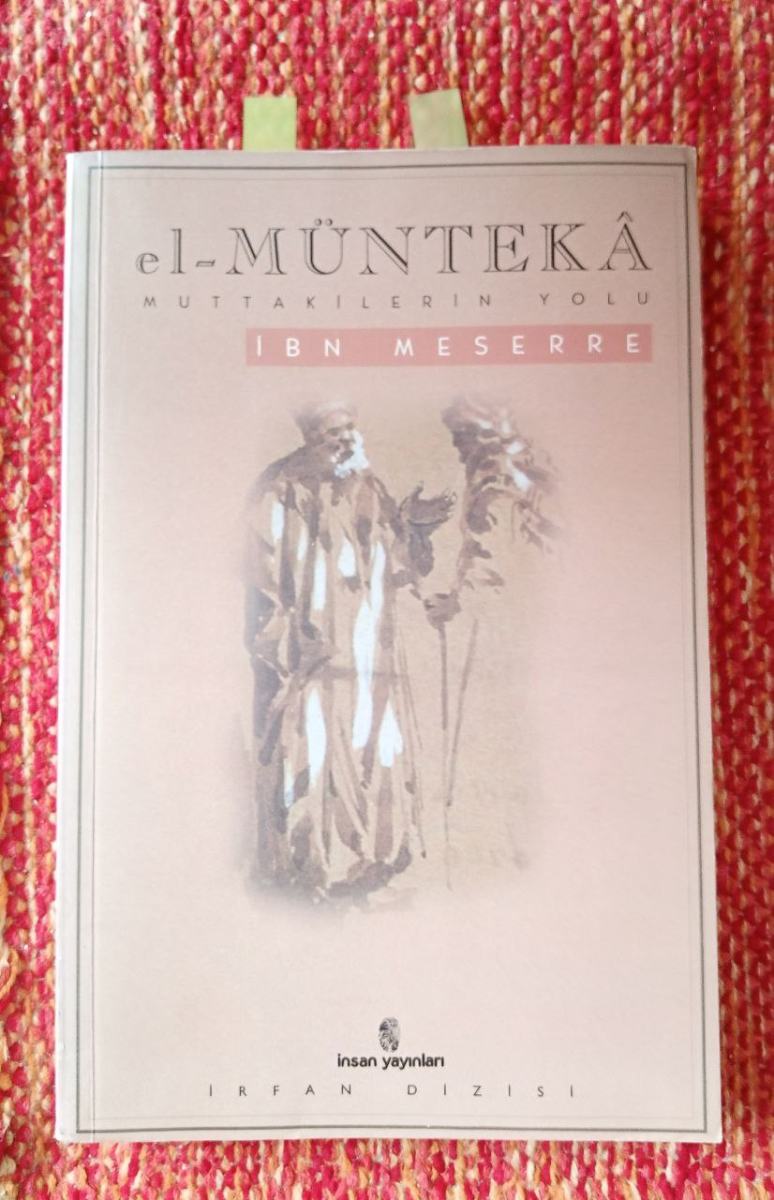
*
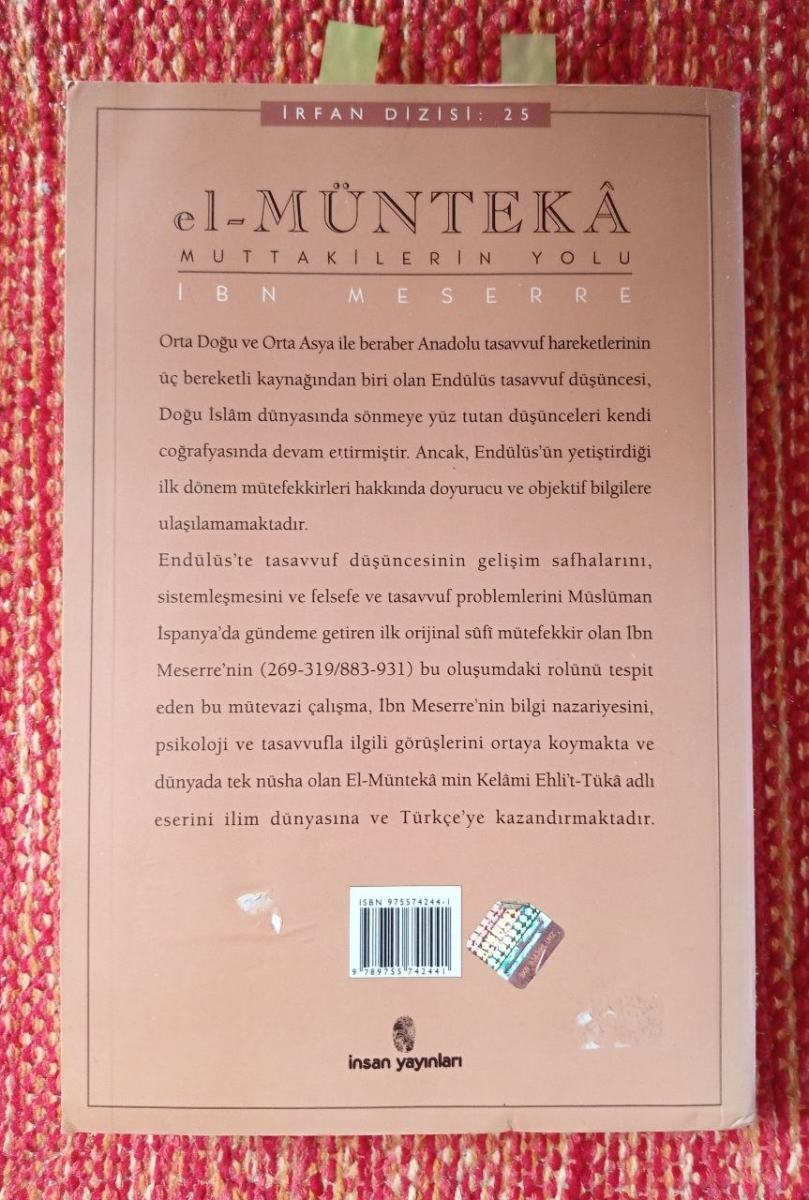
Text from the back cover:
‘el-MÜNTEKÂ THE PATH OF THE RIGHTEOUS (MUTTAQĪN) IBN MESERRE’
Along with the Middle East and Central Asia, the Sufi thought of Al-Andalus is one of the three blessed sources of Anatolian Sufi movements. It continued the thoughts that were on the verge of disappearing in the Eastern Islamic world within its own geography. However, satisfactory and objective information about the first-period thinkers produced by Al-Andalus has not been reached.
This modest work identifies the role of Ibn Meserre (269-319/883-931)—the first original Sufi thinker in Muslim Spain who brought the developmental stages of Sufi thought in Al-Andalus, its systematization, and its philosophical and Sufi problems to the agenda—in this formation. It reveals Ibn Meserre’s theory of knowledge, his views on psychology and Sufism, and introduces to the world of academic scholarship, in Turkish, this work titled ‘El-Müntekâ min Kelâmi Ehli’t-Tūkā’, which is the only copy in the world.
‘İnsan Yayınları’ (Publishing Company).
Further Reading & Bibliography
1. Primary Source & Translation
Ibn Masarra (attrib.), Ibn Hamis (comp.). ‘El-Müntekâ Min Kelâmi Ehli’t-Tûka’ (The Selection from the Words of the People of Certainty). Edited and translated into Turkish by Mehmet Necmettin Bardakçı. Istanbul: İnsan Yayınları, 1999. (Part of the Irfan Dizisi, No. 25). Note: This edition is based on the unique manuscript held in the Kütahya Vahit Paşa Public Library, Türkiye.
*
2. On Authenticity & History (The Ibn Masarra / Ibn Hamis Distinction)
Bozyiğit, Ahmet. ‘İbn Meserre’nin Eserlerinin Otantikliği Üzerine’ [On the Authenticity of Ibn Masarra’s Works]. Siirt Üniversitesi İlahiyat Fakültesi Dergisi, vol. 2, no. 1, 2015, pp. 151–180. Essential reading: This study definitively proves that while the spiritual lineage is Ibn Masarra’s, the compilation of El-Müntekâ was authored by the 12th-century Sufi Ibn Hamis.
Bozyiğit, Ahmet. ‘Endülüslü Bır Fılozof, Ibn Meserre’.(Ibn Meserre, an Andalusian Philosoph). FRC Publishing Company-Ankara. 2017. This is professor Bozyigit’s doctoral thesis published.
Clemente, Pilar Garrido, and Mehmet Necmettin Bardakçı. ‘Kitab al-Garib al-Muntaqa min Kalam ahl al-Tuqa’. Universidad de Extremadura, 2010. A collaborative scholarly work confirming the attribution to Ibn Hamis and analyzing the text’s Sufi terminology.
Stroumsa, Sarah, and Sara Sviri. ‘The Beginnings of Mystical Philosophy in al-Andalus: Ibn Masarra and his Epistle on Contemplation‘. Jerusalem Studies in Arabic and Islam, vol. 36, 2009, pp. 201–253. The definitive academic analysis of Ibn Masarra’s two authentic treatises: The Epistle on Contemplation and The Epistle on Letters.
*
3. On Andalusian Mysticism & The Batini Tradition
Asín Palacios, Miguel. ‘The Mystical Philosophy of Ibn Masarra and His Followers’. Translated by Elmer H. Douglas and Howard W. Yoder. Leiden: E.J. Brill, 1978. The classic work that first introduced Ibn Masarra’s “batini” (inner) philosophy to the Western world.
López-Anguita, Gracia. ‘The Mystics of al-Andalus: Ibn Barrajān and Islamic Thought in the Twelfth Century’. Cambridge University Press, 2016. Provides excellent context on the spiritual environment of Al-Andalus that preserved Ibn Masarra’s legacy after his death.
Addas, Claude. ‘The Red Sulphur: The Life and Times of Ibn ‘Arabī, the Andalusian Sufi Master and Saint‘. Translated by Peter Kingsley. Cambridge: Islamic Texts Society, 1993. Peter Kingsley writes: ‘This is not just a translation of the book which appeared in French in 1989 under the title ‘Ibn ‘Arabī ou La quête du Soufre Rouge’, but effectively a second edition. The author has modified a number of passages; sometimes new material has been added; and what was originally just an index of select Arabic terms has been expanded into a full glossary for the convenience of readers with no knowledge of the language‘. This is the standard biographical work that details his life in Spain, his travels, and his spiritual station.
Ibn Arabi. ‘The Meccan Revelations’ (Al-Futūḥāt al-Makkiyya). (Selected excerpts). Ibn Arabi, the greatest Andalusian mystic, frequently cites Ibn Masarra as a spiritual ancestor. Reading Ibn Arabi helps understand the later development of the ideas planted by Ibn Masarra.
*
4. On Bibliotherapy & Spiritual Healing
Jack, Dana. ‘The Healing Power of the Written Word‘.
Via-HYGEIA Bibliotherapy Archives. For readers interested in how ancient texts like El-Müntekâ function as tools for modern psychological integration.
Nasr, Seyyed Hossein. ‘Islamic Spirituality: Foundations’. World Wisdom, 1987. Offers a broad overview of the concepts of Qalb (Heart), Sirr (Secret), and Yaqīn (Certainty) discussed in the introduction.
***



Related Articles


Leave a Reply