
Circle of Transmission: The Living Loom
The Science of the Outward and of the Inward – ‘Zahir ve Batın İlmi’: From Ibn Masarra’s ‘El-Müntekâ’
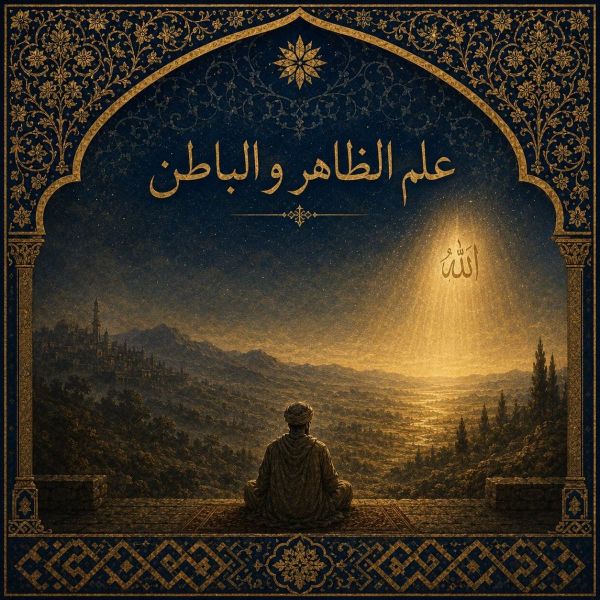
Legend of the Illustration: This illuminated plate evokes the contemplative epistemology associated with Ibn Masarra (d. 931) and the early esoteric traditions of al-Andalus. Beneath an ornamental manuscript arch, a solitary seeker sits suspended between shadow and radiance, contemplating a landscape gradually unveiled by descending light. The distant city, partially dissolved into darkness, symbolizes the world of inherited forms, outward knowledge (ẓāhir), and attachment to visible structures, while the illuminated horizon suggests inward realization (bāṭin), certainty (yaqīn), and contemplative knowledge (maʿrifah).
Unlike allegorical ascents in later mystical imagery, the seeker here does not journey physically toward the divine. Instead, illumination descends upon the world itself, expressing the transformation of perception rather than movement through space. The suspended divine Name — الله — appears within radiance yet remains beyond localization, preserving the transcendence central to Islamic metaphysics.
The blue-and-gold palette, geometric lower frieze, and floral arabesques deliberately recall the visual language of Islamic illuminated manuscripts, while the atmospheric landscape introduces a contemplative stillness appropriate to the polarity announced in the title: ʿIlm al-Ẓāhir wa-l-Bāṭin — “The Knowledge of the Outer and the Inner.”
*
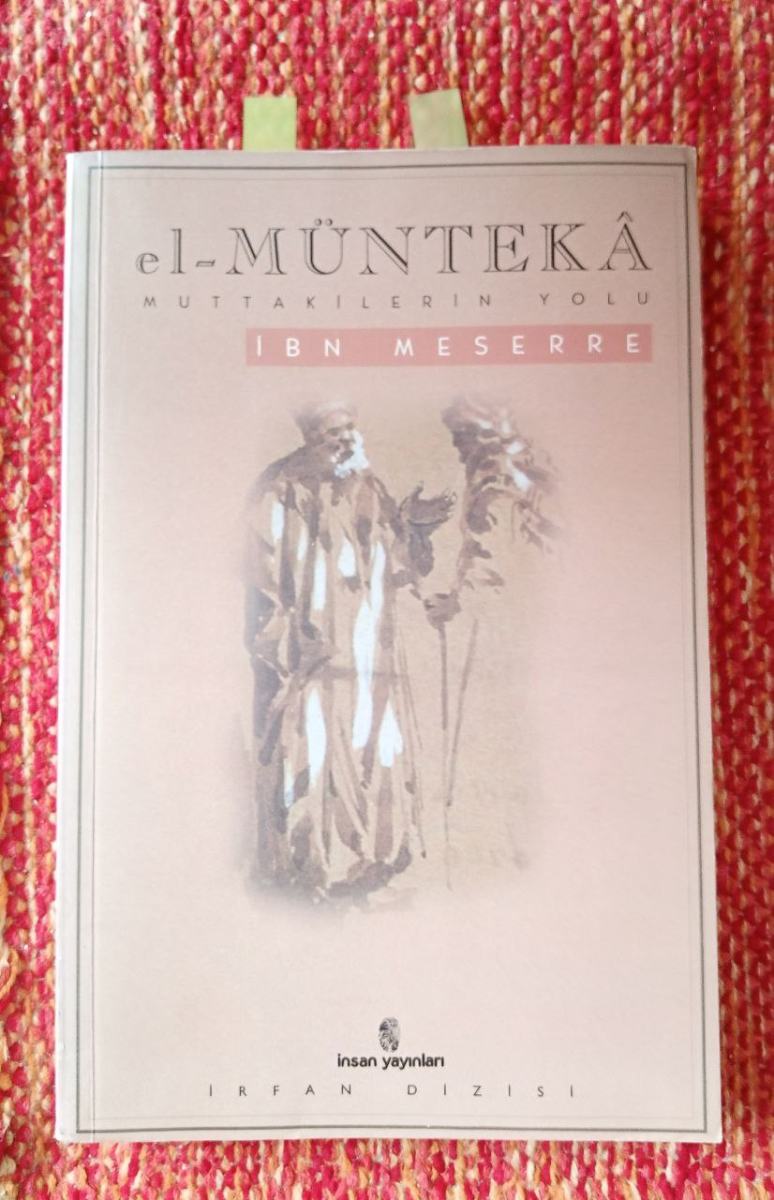
Today’s sharing from the Blue House of Via-HYGEIA presents ‘The Science of the Outward and of the Inward – ‘Zahir ve Batın İlmi’ from Ibn Masarra’s El-Müntekâ Min Kelâmi Ehli’t-Tûka. İnsan Yayınları, 1999, edited by Professor Mehmet Necmettin Bardakçı, pages 275–283.
What distinguishes a mere confession of faith from the living light of certain knowledge? In this chapter from the Andalusian mystic Ibn Masarra (883–931 CE), transmitted by Muḥammad ibn Ḥāmis, we encounter a radical critique of outward religiosity and a detailed map of the heart’s purification.
The text distinguishes between two kinds of knowledge—the tongue’s report, which can veil or adorn, and the heart’s inward gaze, which sees God’s governance directly. Caprice (hawā) is named as the sole barrier between servant and Lord. Purification unfolds in four ascending stations, culminating in the saint’s constant watchfulness (murāqabah).
Finally, the Prophet’s daily repentance is reinterpreted not as sin but as the necessary sign of perpetual ascent through divine stations—a model for the awliyā’. Dense, lapidary, and luminous: a window into early Andalusian Sufi epistemology.
Coming soon, will be the next chapter: ‘The Degrees of Faith’ – Andalusian Wisdom from Ibn Masarra:’The Stations of Believers and the Patience of the Saints‘.
**
A Contextual Introduction
Al-Munteqā min kalām ahl at-tuqā (The Select Sayings of the God‑fearing), preserves the teaching of the Andalusian mystic and philosopher Muḥammad ibn ‘Abdallāh ibn Masarra (883–931 CE).
Compiled by the later transmitter Muḥammad ibn Ḥāmis (d. 1109), the work gathers discourses and doctrinal fragments that circulated among Ibn Masarra’s followers in Muslim Spain.
The present section—titled Zahir ve Batın İlmi (The Science of the Outward and the Inward)—develops a sustained critique of mere verbal faith, distinguishes between two kinds of knowledge, maps the degrees of inner purification, and offers a profound interpretation of the Prophet’s daily repentance.
The Critique of Mere Verbal Faith
Ibn Masarra opens by drawing a sharp line between outward confession and authentic ‘ilm (knowledge). To declare “the Qur’an is true” or to affirm that God sent prophets and books does not, by itself, lift a person from the station of ignorance.
Such profession merely distinguishes a Muslim from an unbeliever and shows respect for the Law (sharī‘ah). True knowledge, Ibn Masarra insists, consists of ma‘rifah (gnosis) and yaqīn (certainty)—a lived, inward insight (baṣīrah) that transforms the heart.
Ignorance is not the absence of information but a doubt or blindness in the heart, a turning away from God’s command.
The Barrier of Caprice (Hawā)
A central theme of this chapter is the psychology of spiritual failure. The only true barrier between the servant and his Lord is caprice (hawā). As long as hawā persists in the body and character, one’s efforts yield no fruit. Satan exploits this caprice, binding a person to custom, family religion, and fanaticism (‘aṣabiyyah).
Ibn Masarra describes how a young person, upon reaching puberty, faces a choice: either sink into the comfort of desire, become a prisoner of habit, and ultimately take one’s caprice as a god, or endure the bewilderment of spiritual awakening with patience and high aspiration (himmah), tearing the veil of darkness with the light of truth.
Two Sciences: The Knowledge of the Tongue and the Knowledge of the Heart
Ibn Masarra famously distinguishes between two kinds of knowledge. The first is the knowledge of the tongue—heard, narrated, written on pages, transmitted from teacher to student.
This knowledge is a wasīlah (means) for ordering religion and worldly affairs, but it remains a description of knowledge, not knowledge itself. It can become a tool for ostentation, superiority, and even denying the truth.
The second is the knowledge of the heart—a light that God casts into the heart of His servant. This is the beneficial knowledge, the science of insight, the knowledge of certainty.
It allows one to see the divine governance over creation, to understand how God is general and specific, outward and inward, separate and united. Only when the knowledge of the tongue is submitted to the heart’s verification does it bear fruit.
The Four Stations of Purification (Ṭahārah)
A key ladder in the text is the fourfold purification of the heart. The first two stations purify both outward and inward from (1) disbelief and doubt, and (2) major sins and innovations.
The third station purifies the heart from hidden vices like hypocrisy (riyā’), vanity (‘ujb), envy, and ill opinion.
The fourth and highest station—reserved for the saints (awliyā’) whom God has singled out—is the purification of the heart from everything, even from the subtle stirrings of the ego and passing thoughts. At this level, the servant worships God as if seeing Him, under constant watchfulness (murāqabah). This is the final purity of the ṣiddīqūn (the utterly truthful ones).
The Prophet’s Repentance: A Model for the Saints
One of the most original sections of the chapter explains why the Prophet (peace be upon him) sought God’s forgiveness daily, saying “a veil covers my heart.”
Ibn Masarra rejects the idea that this was ordinary sin. Instead, he interprets it as the Prophet’s continual ascent through divine stations: whenever the Prophet rose to a new station, he saw the deficiency of his previous state and repented from it—not from disobedience, but from the relative imperfection of a lower nearness.
The “heedlessness”(ghaflah) or “inattention” (sahw) attributed to prophets is a covering of mercy and tranquility (sakīnah) that calms the overwhelming fervor of their spiritual striving.
The text presents several scholarly opinions on this matter, all concluding that such inattention is a sign of the Prophet’s unceasing elevation, not a lapse. This teaching integrates prophetic infallibility with the reality of perpetual growth in gnosis.
Conclusion: Knowledge as Light, Not Text
Throughout this chapter, Ibn Masarra insists that true knowledge is not the accumulation of written reports but a divine light. Writing is necessary but ambiguous; it can be used for truth or falsehood. When the carriers of knowledge depart, people rush toward the corrupt interpretation that pleases their caprice.
The only safeguard is to seek the station of insight through purification, truthfulness, and aspiration. This is the path of the saints—the awliyā’ who, having been purified in the fourth degree, see all things through God’s gaze.
Thus, in Zahir ve Batın İlmi, Ibn Masarra (via Muḥammad ibn Ḥāmis) develops a comprehensive mystical epistemology and spiritual psychology. He distinguishes outward profession from inward realization, identifies caprice as the sole veil between God and the servant, maps the degrees of purification, and reinterprets prophetic repentance as a model of continual ascent.
It is a dense, lapidary text that reflects the convergence of Neoplatonic light metaphysics, Sufi praxis, and Qur’anic hermeneutics in early Andalusian Islam.
*
And now the Text:
The Science of the Outward and of the Inward
May God grant you success and protect you. Your acknowledgement that God the Exalted sent prophets and revealed books, and your statement with your tongue that this Qur’an is the truth and what it brings is correct—this is not knowledge. Every person who is a Muslim does not attain the rank of knowledge by this acknowledgement, nor does he rise from the station of ignorance. By this, he is only distinguished from the community of unbelief, and reverence is shown to the sanctity of the Sacred Law.
The learned one rises from the station of ignorance through the realities of ma’rifah (divine knowledge). This is the knowledge of certainty (yaqin) and insight (basirah), practiced with resolve. That is knowledge. Ignorance is to doubt the soundness of this in the heart, to fail to see what is beyond it, and to be incapable of recognizing it. Hearts only go astray and fall into darkness by turning away from their Lord’s command. He misleads by ignoring the response to the call of God the Exalted, by distancing himself from the path of salvation, just as He has called him to salvation and life, yet he misleads him with his own deviation and increases his malady.
The one who desires the station of knowledge by which the highest zuhd (asceticism) is attained is one who is prepared for it. This is to gradually strip away from his body and his character the superfluous things of this world, distancing himself until he has no concern with any trace of them. From all his turning away, for the special stations, there emerges a state of holiness and an utterly beautiful sincerity. For the superfluousness of the body prevents the heart from seeing all the lights.
The superfluousness of character directs intention away from the Real and the Truth, distancing one from the door of union (wisal). The only barrier between the servant and his Lord is caprice (hawa). As long as caprice persists in a body and in a character, how can this situation—wherein one is not thanked for his effort, nor is the fruit of his deed reaped—come to be?
In this world, there is nothing but pride (kibr) and humility (khushu). Humility is entirely nearness (qurb) and a means (wasilah). Pride is entirely a veil from God, loss, and ruin. Food, clothing, or any worldly comfort—all these pleasures, from whatever direction, are things that exude a scent to the ego, stirring and provoking its pride, covering the heart. It is pride, the opposite of humility. Its opposite is ugliness of appearance, pallor and fading of color, scarcity of wealth, and judging with justice in all affairs.
All of these are humility and submission. So too are the pleasures of character. Pride, anger, wrath, obstinacy, bigotry, excess, belittling a blessing and acting arrogantly, and competing for superiority—all of these are boasting and pride, the opposite of humility. Their opposite is clemency (hilim), forgiveness, patience, obedience, restraining the gaze from the forbidden, and sadness. All of these are humility and modesty.
When a child of Adam reaches the age of puberty, his covenant is first taken from him. When he reaches the age of nocturnal emission, the source of youth—when the blood boils—is with him. The habits of his parents and the things for which he is obligated remain with him. If he sinks into a state that incapacitates the ease and comfort of his caprice, becomes accustomed to tales of strangeness, and consents to his religion being the religion of custom, then he has taken his caprice as his god. Caprice is the opposite of the Truth and of patience.
When Satan sees him inclining toward his caprice, he accustoms him to this state and, with bigotry, casts him back to his origins and the religion of his parents. He presents to him the example of partisanship (asabiyyah) and appeases him with those who are not with the tribe in their deviations.
He distances him from God’s guidance, for which He has made them compete in knowledge, and he abandons what his ego has abandoned. If his understanding matures, he sees the realities, he seeks the light of certainty, the darkness of childhood afflictions is reduced, adherence to customs and imitation of family are abandoned—if bewilderment stirs his ego, he patiently endures through the superiority of aspiration (himmah), tearing the veil of darkness with the light of truth.
He perceives according to the value of his patience and his sincerity in acting through the means appointed for him, from God’s bounty and grace. His first desire is to hear, and to narrate what he hears with his tongue. Yet with all this, he is incapable of expressing what is memorized or written on his page.
“My tooth is God’s proof to the child of Adam. The knowledge of the heart is the beneficial knowledge.” Spoken and heard knowledge is not real until it settles into one of two directions—benefit or harm—and follows one of two inclinations.
If the knowledge of the tongue were to obey desire in learning the directions of the heard and narrated reports, directing its intention toward adorning itself before people and toward boasting superiority over them, then the knowledge of reality would become forbidden because of this, and he would be prevented from seeking light through his heart. He would not know what his heart sees with it. He would believe in that which he denies and rejects.
The knowledge of the tongue is a means (wasilah) for ordering religion and the world. If he does not make it a toy, does not prefer the desire to hear and take pleasure in the outward of the report, or the desire to benefit over the result of the seeking—which is union (wusul)—and does not patiently endure misguided thoughts, then he will have presented to his heart everything he narrates with his tongue.
If he perceives the reality through the knowledge of the tongue, he presents it to his heart; otherwise, he seeks severity and distress for it. He believes it, strongly and purely, by way of the sincerity and tranquility of the heart, and the witnessing of the innate nature (fitrah) without doubt.
As soon as God teaches the light of knowledge to his heart’s eye, he perceives this small thing as much. For he has performed a sound deed for God through patience, not through caprice. His heart has gathered the opposite of the limbs and desires. If he remains in that station of knowledge and does not act, he is in the first stratum I have written about.
But if he holds his striving high, seeking great life in the degrees of understanding, in union (wusul), in the greatest specialness, preferring this over worldly desires and cutting off attachments other than it, then a portion of the knowledge of the heart is completed for him—that by which he will see God’s judgments and the sources of those judgments.
Thus, he reaches the knowledge of divine oneness (tawhid) between Him and His servants, and the wisdom placed for the governance of His dominion. He knows how He arrives at what He wills, without opposing the justice of His judgments and decrees, or His ruling.
He sees the soundness of the outward (zahir) through the inward (batin), and the inward through God the Exalted, and the outward from His judgment. Truthfulness (sidq) appears in him, and his speech becomes wisdom. He understands the glorification of their Lord by the animals that cannot speak. He comprehends the prostration of all creatures to their Creator, and becomes aware, through the light of certainty, of the things of this world and the next that are to be witnessed.
He witnesses all of this through his knowledge. He learns directly from God the reality of the names for which He has made a testament concerning Himself in His Book, by which the Book was revealed and by which He spoke. He consolidates, gathers, and separates what he wills. His inward is gathered upon the inward, and his outward is spread upon the outward.
When he sees their realities with insight through the light of his Lord, he also sees His governance over creation. How He is general (‘amm), how He is specific (khass), how He is outward and inward, how He separates and unites.
He sees the entirety of His governance, the hiddenness of His affair, and the stations of His justice. He witnesses their outward with the whole. He witnesses the necessity of His proof with the obligation of His mercy, and the majesty of His measure with the justice in His judgment. He sees the meaninglessness of having proof amidst the constriction of decrees.
He sees the friendship of the attributes, his affirmation of them, their witnessing of one another for some of them, the twisting and turning of the ends of the wisdom he possesses, and the return of the parts to their origins. It is as if he witnesses the beginning of affairs, the indications of the judgments upon the foundation of the past decree for him.
He neither transgresses the limit nor deviates from its path. There, he does not distort the emergence of justice in the coming into being of existents and the separation of judgments. He sees with his own eye the emergence, for the Day of Separation (the Day of Resurrection) and the separation of the two groups, of that which is still from these things.
It is then that he sees the attribute of Oneness (wahdaniyyah), His majesty, the causes to which the deviant incline, from which those who affect fine speech deviate, and to which the obedient arrive. With them, he sees the necessity of prophethood and their sending, as from the reality of His attributes. He sees how it is necessary to accept what He willed in the first unseen with Him, before creating the preserved tablet. He sees the comprehensiveness of the decree, how it flows, how it is placed in the universe, His censure of it to all creatures, to the point that nothing remains outside this rule.
If a thing were to emerge from His estimation—due to His bringing forth the affair, His majesty, the outward, and the whole—this world would entirely perish in the blink of an eye. He sees both faith and Islam, with which all His servants worship God, their obligation in the beginning, how they are differentiated in His judgments upon people, how they are born from the sublime attributes, and how their places of reward and punishment are in this world and the next.
It is necessary for the person who reaches this attribute not to answer the disputer, to abandon obstinacy, and not to spread wisdom until he sees the station of wisdom. This person likely sees his interlocutor. For wisdom leads its possessor to the people of wisdom, to those who show humility toward it. They know the truth as truth. He sees him as one who is worthy of humility and strives to accept it, who opposes the path of the arrogant who obstinately argue and boast.
I swear that those who seek knowledge have followed the same path as the teachers. For knowledge departs with the departure of those who carry it. In our time, people have not become rich by finding its image on pages. For writing is used in two ways, correct and incorrect, to interpret it.
Writing is necessary to distinguish the forms of interpretation of the silent one from the speaker, and it is an indication to separate the crooked from the straight. If the one who wrote it departs, people turn toward the crooked and the corrupt, and rush toward it, because it opposes the Truth. Whoever opposes the Truth follows caprice (hawa).
The child of Adam follows caprice and rushes to become accustomed to it, because caprice is part of his nature. He was tried with it at the beginning of his creation, and he is commanded to strive against it with patience.
May God have mercy on Hasan al-Basri. Regarding the time that remains, he used to say: “The commentators have gone, the mixers remain. The intelligent and the clever have gone, the wicked and the sinful remain. I hear sensation and movement, but I see no one. I see bodies, but I do not see intellects. There is neither scholar nor student! What do you say about our present day? Which description befits this time of ours? We say to our own selves: ‘We are God’s servants, and to Him we shall return.’”
For every knowledge, there is a book in which it is gathered. That is the description of knowledge, not knowledge itself. For knowledge itself is an insight (basirah) opened by God, a light that He teaches to the hearts of His servants whom He wills.
Knowledge as a description is the knowledge transferred to pages by tongues and ears. The knowledge of insight is the knowledge of certainty (yaqin). It is the knowledge of the effect of the proof (burhan). God the Exalted says regarding this: “No indeed! If you only knew with certain knowledge.” (Q. 102:5) And: “Who is better in judgment than God, for a people who are certain?” (Q. 5:50 – paraphrased)
The verse explains that the best judgment is known only by those of sound understanding. Whoever errs in this interpretation follows their own opinion toward denial, whereas God the Exalted is the best of judges for people of sound understanding.
It is only those who rely on their own minds who stray. The verse of God, “Who is better than God in judgment?” is particularized to the beauty of the outward judgment. It is not so for the inward. God the Exalted has supported His judgment, for both those of sound understanding and others, for the inward and the outward, the first and the last, with the beautiful attribute outside of this description. He is the Exalted, the Great.
The person who thinks himself to be of sound understanding is the one who knows the goodness of God’s judgment. Let such a person look at the afflictions of his ego. If, with his heart, he contemplates the beauty of his Lord’s judgment—the representation of what justice necessitates and where it occurs, the flow of His decree—free from doubt and confusion, then he is among the people of sound understanding.
But if this is not present with him as an example, and he is not content with the place of incapacity and the station of ignorance, and prefers his desire and effort over the sublime aspirations by which one reaches his Lord, then let him know the deficiency of his ego and let him seek the station of the people of sound understanding from its source, through the instrument of seeking it.
The instrument of seeking it is dignity (waqar), truthfulness (sidq), and purification for God. Purification is to avoid being veiled from the station of the elite (khawass) and its benefit. Their source is the Book of God.
He perceives as much of the Truth of Certainty (haqq al-yaqin) as his share of dignity and truthfulness allows. Whoever does not possess dignity but sits in idleness and incapacity, let him only blame his own ego. The illusion of his loss and his ill-gotten gain is heavier than turning toward the station of the seekers and entering the company of those who are purified.
Purification is of four stations. The judgment of two of them applies to the outward and the inward, and the judgment of two applies only to the inward.
The first is purification outwardly and inwardly from disbelief and doubt, concerning which God says: “They are those whom God did not wish to purify their hearts.” (Q. 5:41 – paraphrased)
The second is purification outwardly and inwardly from the disease of sins, their contagion, and turning toward innovations (bid’ah). This is the purification concerning which God says: “Indeed, God loves those who repent and those who purify themselves.” (Q. 2:222) This is for those who repent purely. The third is the purification of the heart from hypocrisy (riya’), vanity (‘ujb), envy (hasad), and ill opinion (su’ al-zann).
There are many proofs for this station in the Qur’an and the Sunnah. The fourth is the station in which God has made His saints (awliya’) unique in purification. That is the purification of the heart from everything—from whisperings (waswas) to the speech of the ego in a state of stillness. If he forgives much, he inclines toward something of this world. If he trusts in or deems permissible anything other than God, then seeing God’s watchfulness (muraqabah) overcomes their hearts, as God indicates in the verse: “He who watches over every soul in what it earns.” (Q. 13:33)
The Messenger of God, may God bless him and grant him peace, said regarding this matter: “Worship God as if you see Him, for though you do not see Him, He sees you.” This is the final purification for the pure and unsullied.
God purifies in the first station whomever He revives in faith through affirmation and action to establish the Sacred Law. God purifies in the second station whomever He gives, after teaching him the varieties of knowledge according to the Sunnah, the light by which he sees the path of salvation, and the obligation to adhere to repentance at every moment.
God purifies in the third station whomever He opens the door to see His gift and bounty, after His grace and ma’rifah. Whomever, along with the knowledge of certainty (‘ilm al-yaqin), sees things through God’s gaze, witnessing poverty (faqr) with acceptance (rida) and submission (taslim), is purified in the fourth station. Only those who desire sainthood (wilayah) attain this.
*
The Reason for the Prophet’s (peace be upon him)
Repentance and Seeking of Forgiveness
If the servant’s certainty (yaqin) is correct, there is no salvation for him but in God. The name of servitude is realized for him. The sign of truthfulness in this matter is his abandonment of what God deems evil. No one will be saved except those whom God wills, aside from those who forget repentance to escape punishment while confessing their sin. Indeed, God the Exalted polishes the people of faith with the repentance of atonement (takfir).
He continues polishing persistently until He purifies them from sins. He honors His saints (awliya’) with the repentance of watchfulness (muraqabah) concerning efforts (hirmen) and thoughts (khawatir). This is the feeling of shame before God the Exalted, by which He increases the guidance of hearts and elevates the realities of divine oneness (tawhid). Do you not see the saying of the Messenger of God? “A veil covers my heart, and I seek God’s forgiveness one hundred times a day.”
The whisperings (waswas) of every servant are according to the degree of his faith (iman). Satan causes the one with weak certainty to fall into disobedience and sins, hypocrisy and vanity. For the one with strong certainty, Satan whispers the composure found in pleasures and the return to hopes and careful measures. This is indeed a favor and a kindness specific to the saints and the truthful ones (siddiqun).
As for the inattention (sahw) and heedlessness (ghaflah) of the prophets’ hearts, it is their witnessing of their own deficiency in knowing God and in being in awe of Him. Because the prophets ascend to new stations of the Truth at every moment, in each station they attain, they repent and seek forgiveness for the station they previously occupied.
Regarding this matter, some scholars say: The covering of the heart by heedlessness is only found in prophets and the great saints. This is known only through the purity of hearts, the radiance of secrets, the continuity of remembrance (dhikr), and the intensity of guarding everything with which the conscience is obligated. The Messenger of God elevated the majesty of his station, the loftiness of his measure, and the purity of his heart by his continuity in remembering Him.
He finds that which comes and goes swiftly to his heart—that by which he imagines the hidden. It is what comes to the heart from brilliant thoughts, images, and subtle objections. His state and the swiftly arriving thoughts (khawatir) and that which comes secretly are not equal in adhering and continuing to his being. Upon that, he seeks refuge in God by seeking forgiveness and takes refuge in Him through poverty (faqr).
Another group says: The ego (nafs) is similar to a mirror that is pure, clear, and polished, in terms of the reflection of its light. When it unites with the ego through its purity and sincerity, there is observed there a trace that covers it at the time. After its radiance, no trace or effect remains. Thus, heedlessness, inattention, and forgetfulness are only known in the heart whose description is such. This is a lofty and exalted state, found only in prophets and those close to them in heart.
Another party says: Inattention and heedlessness are not of this kind. Their description does not enter into this meaning. It is rather like the covering of the heart of the Messenger of God by mercy and the presence of the meaning of tranquility (sakinah), for this is the description of the Prophet, may God’s peace be upon him.
He connects sorrow and grief with reflection. There is no ease for him. He has strength in his striving, the boiling over of his secret, and immersion in the pleasures of his devotions for God. He stood on the tips of his fingers while remembering his Lord, until the verse was revealed: “Ta, Ha. We did not send down the Qur’an to you to cause you distress, but only as a reminder for those who fear God.” (Q. 20:1-3) He did not place his feet on the ground due to his obedience to God. Then, truthfulness and secrecy continue with him. He loves it and knows what he strives with all his might to do. Such was the heart of the Prophet (peace be upon him).
When his fervor intensifies, the tranquility that covers his heart reaches him. Its protection of him is to calm slightly the preoccupation of his state and the strength of his fervor. He would grieve over this and find it hidden in his secret. In this moment of weakness when he finds it, he takes refuge in God. This fervor is a refuge to him, to alleviate his complaint with seeking forgiveness. He takes refuge in Him, refraining from presenting the state of the informer to him with dignity and all his effort. This is a mercy and a love from his Lord. Heedlessness and inattention are the covering of the heart of the Messenger of God by mercy when it is weak and calm.
Another group says: Inattention is the superior of two states. Its meaning is that the degree of the Prophet (peace be upon him) was elevated with each moment that occurred in the times to come. The Prophet sees him as increasing with him, and his state rises and becomes perfected.
God willed to make some of the stations of good superior to others. Every station has a beginning, a middle, and an end. If God places one of His servants into one of the abodes that He has made a means to reach Him,
He shows him what to do at the beginning of this abode. Then He makes him proceed therein with its principles and method until he learns and acts upon what he has learned. He reaches the end of this abode, and if he desires to be transferred to the next in terms of virtue, he ascends to the second abode. A superiority is placed between the two abodes so that he may know the judgment of what passes and what comes between them.
He finds the completion of the first state and the coming of the second through the superiority between them. This is the most beautiful of knowledge and the most superior of abodes. May God’s peace be upon him.
When the Prophet (peace be upon him) passed from one state to another, he knew the virtue between them and that his state was the state of this description, and he took refuge in God by seeking forgiveness. He hastened toward Him, desiring Him.
This is a path along which time flows. When he knew this, he counted it as inattention (sahw). No one can fully reach the ultimate goal of God’s command. The servant’s heart opens according to the degree of his ma’rifah of God, his knowledge of Him, and his fear of Him.
*
Lexicon of Key Concepts and Words
(Note: Transliteration standardized to Arabic for consistency
with Ibn Masarra’s original context)
- Ālim (pl. ulema) – Scholar; one who has risen from the station of ignorance through the realities of ma‘rifah and the knowledge of certainty.
- Ām / Hāṣṣ – General / Specific. Refers to God’s universal and particular governance over creation, which the perfected knower witnesses.
- ʿAṣabiyyah – Partisanship, tribal or group fanaticism. The text mentions it as something Satan uses to bind a person to ancestral religion and deviation.
- Baṣīrah – Insight, inner vision. A light granted by God by which one perceives spiritual truths. Distinguished from outward knowledge transmitted on pages.
- Bāṭin – The inward, hidden dimension of things, especially of religion, scripture, and the self. It is known through the heart and stands in relation to ẓāhir (the outward).
- Burhān – Proof, demonstration. The effect of burhān is the knowledge of insight (baṣīrah).
- Faqr – Spiritual poverty; neediness before God. A state by which the Prophet and saints take refuge in God, indicating complete dependence.
- Fiṭrah – The primordial, innate human nature. Its testimony is free of doubt and supports sincere belief.
- Ghaflah – Heedlessness, forgetfulness of God. It can be a veil over the heart, but in prophets, a special form of ghaflah is spoken of as a covering by mercy.
- Ḥaqq – The Truth (one of God’s names), also reality, right, or the Real. Opposed to hawā (caprice).
- Ḥaqq al-yaqīn – The Truth of Certainty; the highest level of certainty, attained by the saints who see through God’s gaze.
- Ḥasan al-Baṣrī – Early Muslim ascetic and scholar (d. 728 CE). Quoted lamenting the departure of true scholars and the rise of corrupt people.
- Hawā (pl. ahwā’) – Caprice, base desire. The only barrier between the servant and his Lord. Taking one’s caprice as a god is the opposite of following the Truth.
- Khawf – Fear (of God). A motive for action among the righteous.
- Khawāṣṣ – The elite. Those who act with knowledge based on ma‘rifah, as opposed to common believers.
- Ḥilm – Clemency, forbearance. An attribute opposite to pride and anger, part of humility.
- Himmah – Aspiration, spiritual resolve. Through superiority of himmah, one tears the veil of darkness.
- Hirmen – Efforts, strivings (contextual). Saints are honored with the repentance of murāqabah concerning their efforts and thoughts.
- Khushūʿ / Ḥusūʿ – Humility. Entirely nearness (qurb) and a means (wasīlah) to God, opposite of pride.
- Ikhlas – Sincerity, purity of intention. Emerges in special stations after stripping away worldly superfluities.
- ʿIlm – Knowledge. Distinguished into: (1) the knowledge of the tongue (transmitted, outward, a wasīlah for ordering religion and world), and (2) the knowledge of the heart (beneficial, given by God as light, insight, and ma‘rifah).
- ʿIlm al-yaqīn – Knowledge of Certainty. Lower than ʿayn al-yaqīn and ḥaqq al-yaqīn; associated with the third stage of purification.
- Kibr – Pride, arrogance. A veil from God, leading to loss and ruin. Its opposite is khushūʿ and tawāḍuʿ.
- Maʿrifah – Divine knowledge, gnosis. The realities that raise one from ignorance. It is not mere verbal affirmation.
- Murāqabah – Watchfulness, spiritual vigilance. The awareness that God sees one at all times. The Messenger said: “Worship God as if you see Him, for though you do not see Him, He sees you.”
- Nafs – The ego, self. Often the seat of caprice (hawā) and the source of whisperings. It is compared to a mirror that can be pure or rusted.
- Nūr – Light. Knowledge of God is a light taught to the heart. Those far from the realms of Light cannot describe the Truth purely.
- Riḍā – Acceptance, being pleased with God’s decree. A quality of those who race in submission (taslīm).
- Ṣabr – Patience. Three types: patience with one’s portion (enduring complaints), patience with the substitute (calm under affliction), and patience with the decree (overflowing with God’s patience).
- Sahw – Inattention, absence from remembrance. A state attributed to prophets as they ascend stations; not ordinary forgetfulness but a higher covering by mercy.
- Sakīnah – Tranquility, divine presence. Covers the Prophet’s heart to calm its fervor.
- Ṣidq – Truthfulness, sincerity. A sign of true servitude, leading one to abandon what God deems evil.
- Ṣifah – Attribute, description. The knowledge that is written on pages is the description of knowledge, not knowledge itself.
- Taḥqīq – Verification; achieving certainty through personal realization, not mere imitation.
- Taslīm – Submission, surrender to God. The highest form of racing in servitude, accompanied by riḍā.
- Tawḥīd – Divine oneness. The science of tawḥīd is reached when one sees God’s judgments and the sources of those judgments.
- Taʾwīl – Interpretation (especially of scripture). Writing is used for correct or incorrect interpretation. True understanding belongs to people of sound understanding (ulu’l-albāb).
- Tawbah – Repentance. Multiple levels: repentance of atonement (from sins), repentance of watchfulness (from heedless thoughts), and the Prophet’s repentance as he rises to new stations.
- ʿUjb – Self-admiration, vanity. A disease of the heart from which one must be purified.
- Ulū’l-albāb – People of sound understanding. They know the beauty of God’s judgment, both outward and inward.
- Wilāyah – Sainthood, divine friendship. The fourth station of purification (seeing through God’s gaze) is reached only by those who desire wilāyah.
- Walī (pl. awliyā’) – Saint, friend of God. One who attains nearness and for whom God removes veils.
- Wuṣūl – Union, arrival at God. Hindered by the superfluities of character and the veil of caprice.
- Wasīlah – Means, intermediary. The knowledge of the tongue is a wasīlah (means) for ordering religion and the world. Humility is a wasīlah to God.
- Yaqīn – Certainty. When correct, the servant realizes there is no salvation but in God. Strong certainty repels Satan’s whisperings.
- Ẓāhir – The outward, apparent dimension. Its soundness is seen through the bāṭin, and the bāṭin through God.
- Zuhd – Asceticism; renunciation of worldly superfluities. The highest zuhd is attained through a station of knowledge that strips away bodily and moral excess.
Source
*
Coming soon
‘The Degrees of Faith’ – Andalusian Wisdom from Ibn Masarra:
‘The Stations of Believers and the Patience of the Saints‘.
***

Related Articles


Leave a Reply