
Circle of Transmission: The Living Loom
A Little Hendrik Jansen van Barrefelt, a.k.a. Hiël, Sampler-Part 1: Two Early Historical Accounts by Gottfried Arnold & Pierre Poiret
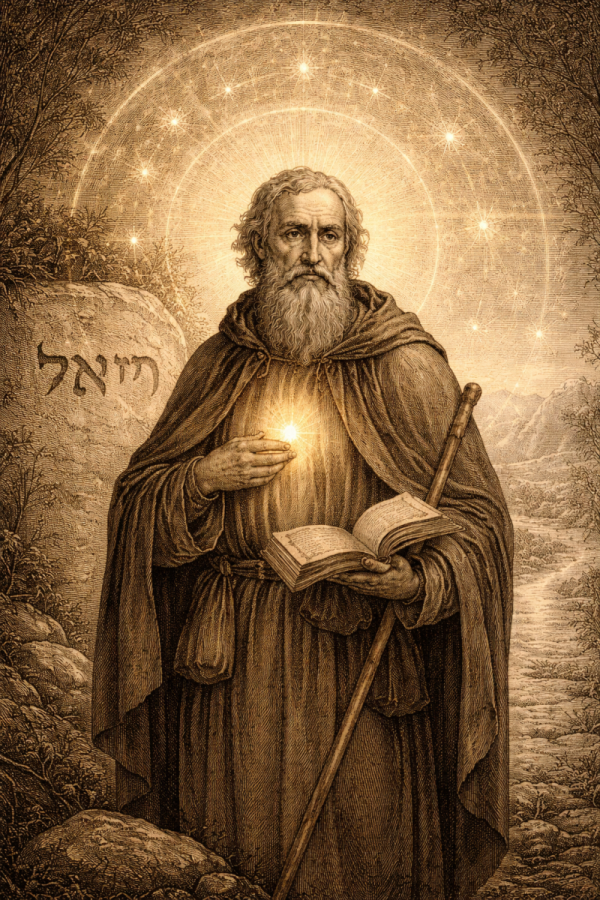
A symbolic portrait of
Hendrik Jansen van Barrefelt, a.k.a. Hiël.
*
Today’s sharing from the Blue House of Via-HYGEIA presents two excerpts devoted to the memory of Hiël, also known as Hendrik Jansen van Barrefelt. The first excerpt is the chapter devoted to him by Gottfried Arnold in his Unparteiische Kirchen- und Ketzerhistorie (Impartial History of the Church and of Heretics, 1699–1700), Volume II, Chapter III. The second excerpt comes from Pierre Poiret’s Lettre Touchant les Autheurs Mystiques, published at the end of his French translation of the Theologia Germanica by Henrich Wetstein in Amsterdam in 1700.
Arnold’s contribution is invaluable for preserving Hiël’s own voice; it features an extensive autobiographical narrative (the Foundation-Piece) in which the mystic details his agonizing transition from ‘heathenish wildness‘ and ‘earthly righteousness‘ to the ‘one-essential life‘. Through Arnold, we access Hiël’s raw, psychological description of the ‘inspeaking Spirit’ confronting the deceptive ‘Reason-Spirit‘, offering a firsthand account of the inner death and rebirth that defines his spirituality.
Poiret’s account, written from the perspective of a systematic mystical theologian, complements Arnold by decoding Hiël’s core methodology. Poiret elucidates the concept of het een-mezig leven (‘the uni-real life‘), explaining how Hiël unified Life, Reality, and Unity to transcend the sectarian divisions of his age. Furthermore, Poiret highlights Hiël’s unique allegorical approach to Scripture—where biblical figures are read as internal maps of the soul—and provides crucial historical context regarding Hiël’s collaboration with the printer Plantin and the Hebraist Arias Montano.
**
Forewords
Hiel and his Time
In the turbulent decades after the Protestant Reformation, a Dutch weaver named Hendrik Jansen van Barrefelt (c. 1520–c. 1594) emerged as one of the most distinctive voices of radical Christian mysticism. Writing under the biblical pseudonym Hiël (Hebrew for ‘Life of God‘), he sought a spirituality of inward, living unity with God that transcended the bitter denominational conflicts of his age.
His path wound through the secretive world of the Family of Love, the workshop of the greatest printer of the age, and the scholarly circle of a Spanish biblical humanist — and his writings would later be rediscovered by historians of mysticism such as Pierre Poiret as a precursory current to Jacob Boehme.
Barrefelt first appears in the early 1540s as a follower of Hendrik Niclaes (c.1502–c.1580), a German merchant‑mystic who had founded the Family of Love (Familia Caritatis). Niclaes, who claimed a divine summons to a messianic ministry after a series of visions, taught that the inner spirit of love placed his community above all external forms — Scripture, creeds, liturgy, and civil law.
His disciples were bound into a strictly hierarchical organisation, yet were encouraged outwardly to conform to whatever established church they lived under — a pragmatic strategy known as Nicodemism in an age of religious persecution.
Barrefelt became one of Niclaes’s most trusted agents. He lived in Niclaes’s household in Emden, managed the secret printing and distribution of his master’s works across the Netherlands, and acted as intermediary with the early Familist printers. By the 1560s, however, doctrinal tensions were growing. Barrefelt grew disillusioned with Niclaes’s claims to exclusive divine authority and the rigid priestly hierarchy laid out in works such as the Ordo Sacerdotis.
In 1573, Barrefelt experienced a decisive mystical vision. From this moment he called himself Hiël (meaning ‘the uniform life of God‘) and broke away from Niclaes, taking a substantial part of the Familist intellectual network with him. His followers became known as Hiëlists — ‘lovers of the truth‘ — and after Niclaes’s death around 1580, this ‘Second House of Love‘ became the principal vehicle of Familist spirituality, distinguished by its emphasis on inward piety, tolerance, the invisible (but not exclusivist) Church, and the rejection of Niclaes’s messianic pretensions.
Crucially, Hiël found an ally and spiritual disciple in Christophe Plantin (c.1520–1589), the great Antwerp printer‑humanist. Plantin, who had already printed Niclaes’s works in secret, broke with Niclaes after the schism and became the central figure around Hiël. The relationship deepened in the late 1570s; the first extant letter from Barrefelt to Plantin is dated 17 November 1580, and thereafter Plantin acted as Hiël’s printer, publisher, and distributor. Indeed, the relationship evolved from one of devoted discipleship into a profound intellectual partnership; by the later years, Plantin’s humanist guidance was so integral to Hiël’s work that some scholars describe the printer as having become a spiritual and intellectual mentor to the prophet.
One of the most intriguing dimensions of Hiël’s circle is his connection with Benito Arias Montano (1527–1598), the Spanish biblical humanist whom Philip II had appointed to supervise the production of the Plantin Polyglot Bible (1568–1573). Montano, a man of deep but unorthodox piety, became an intimate friend of Hiël, despite their very different public confessional allegiances.
The learned Spaniard would interpret for the unlettered weaver the etymologies of Hebrew and Greek biblical names, enabling Hiël to produce his elaborate allegorical commentaries on Scripture. So great was Montano’s esteem that he testified of Hiël: “Christianae veritatis viventis testis, cui nomen ipsa Christi virtus & veritas HIEL indidit” (A witness of the living Christian truth, to whom the virtue and truth of Jesus Christ Himself gave the name HIEL). Whether Montano ever actually met Hiël face‑to‑face remains debated, but their intellectual partnership was real and profound.
Around 1582, Hiël initiated two series of biblical engravings, the Imagines et Figurae Bibliorum, for which the artist Pieter van der Borcht drew 113 scenes and Hiël himself wrote the commentaries. The Latin edition was published under Plantin’s pseudonym Jacobus Vilanus in 1582. After Plantin’s death in 1589, Hiël’s works continued to be printed by Augustijn van Hasselt in Cologne, where Hiël seems to have died around 1594.
Hiël’s Core Teachings: The Uni-Real Life
Hiël’s central concept, as Poiret’s chapter summarizes, is het een-mezig leven — ‘the uni-real life‘ or ‘the life in unity and reality‘ (French: vie uni-réelle). It combines three inseparable dimensions:
- Life: A living, actual spirituality, distinct from dead dogma.
- Reality: A solid substance and essence, not mere shadow or figure.
- Unity: Oneness with God and with His children, transcending sectarian division.
All external religious forms — ceremonies, doctrines, sects, opinions — are at best secondary and elementary means, useful for the weak but not to be mistaken for the goal itself. To treat them as the final end, Hiël taught, is “hypocrisy, pharisaism, self-righteousness, chosen holiness, imagined and carnal holiness.” Scripture itself should be read not as a history of events outside us, but as an inward picture of the spiritual drama unfolding within each soul. Hiël thus became “one of the most inward, most fruitful, and most sublime allegorists who has ever written.”
Hiël’s works fell into relative obscurity after his death, but they were rediscovered in the late seventeenth century by Pierre Poiret (1646–1719), the French Reformed pastor and mystical theologian. Poiret, who had already been profoundly influenced by Hiël, included a long chapter on him in his Lettre sur les Auteurs Mystiques. Through Poiret’s edition, Hiël’s writings reached a new audience among the German‑speaking Pietists and early readers of Jacob Boehme.
Gottfried Arnold (1666–1714), the radical Pietist historian, also treated Hiël with respect in his monumental Unparteyische Kirchen- und Ketzerhistorie (1699–1700), counting him among those spiritual witnesses who had been maligned by the official churches. Indeed, by the eighteenth century, Hiël was increasingly regarded in England and Germany as a precursor of Jacob Boehme (1575–1624). Although Boehme almost certainly never read Arias Montano or Hiël directly, both writers share remarkably similar roots: Rhineland mysticism, the Theologia Germanica, the Imitation of Christ, and the radical spiritualism of Sebastian Franck.
In England, figures such as the Moravian translator Francis Okely presented Hiël as part of the “increasingly popular tradition of Jacob Boehme.” Thus, the weaver from Barneveld who had called himself “the Life of God” took his place among the forerunners of one of the most influential mystical currents in early modern Europe.
*
From Gottfried Arnold’s
Unparteiische Kirchen- und Ketzerhistorie
Hiels Historia
(History of Hiel)
The other author, whose mention is here made, is in the titles of his writings merely designated by the Hebrew name HIEL. But who he was hath neither been disclosed by himself, nor suffered to be discovered by others.
Yet so much information appeareth, that he was a simple, unlearned handicraftsman, who, as he himself confesseth in the postscript of The Treasure hid in the Field, could speak nothing but his mother tongue, and, in case of need, write a little; as the author of the preface to the third part of his Letters mentioneth, p. 2, who otherwise had good intelligence concerning the rest of his condition, yet chose rather to keep all in silence, than to give occasion to the blind or offence-seeking to take offence.
Besides, it is certain that his name was Hendrik Jansen, and that he lived about the year 1550, and indeed in the Netherlands, even before the bloody religious war there, concerning which he, as a messenger and witness of God, had previously announced many things worthy of deep consideration.
In the eighth letter of the third part, p. 69, he writeth of himself to a person of some religious order: That now, according to the creature, he was far advanced in years; and that he had no certain dwelling-place where he might remain constantly, but was sometimes here, sometimes there, with a good friend: That before the world he was lost, but found in the sight of God.
As he likewise writeth in the preface to his Everlasting Testament, p. 3, that the time of his creaturely life was well nigh run out, and his body tending apace toward its dissolution.
In the eighth letter of the III. part, p. 70, he relateth that it was now no less than fifty years since he had first sought to know God, having travelled through many narrow ways with sighs, struggles, and lamentable cries and supplications to God: That he had also, in obedience, submitted himself to the Christian ceremonies and services, in which he had for a season been pacified, and had his maintenance therein, that he might not fall into worldly wickedness.
By which occasion he also acknowledgeth that this, for an earthly man, and for him too, had been a good beginning, in order to come to God in a typical and figurative way.
But in order to come to the clearness of the heavenly essence in God, he had surrendered his inmost soul to the most holy service of the Spirit in Christ, according to Ps. 85. v. 9. Rom. XV. 18.
This his spiritual guidance he relateth further in his own narrative in the Foundation-Piece, chap. XXXVI, number p. 106. Of all the pieces whereof I shall set the most principal here:
“I confess at first before God and all lovers of the truth, my earthly blind course in the worldly heathenish being, wherein in my youthful ignorance I have walked with the unquietness of life.
And in the blind course I heard at first, that the real inspeaking and calling of God in my soul happened at divers times with accusation: which I make known in part to the lovers of the truth: and therewithal, when my soul hath been converted from the blind earthly way to the essential God in the light of life.
And all this for an instruction to the aftercomers, who desire to have their communion with God and his holy essential life, which is granted me by God through his grace. And that they through this description may the better learn to know their blind course, to which they also are subject, in order to convert themselves through God’s calling to the essential light in the one-essential life of Christ. Go and mark well!
So have I then at first (as is mentioned) in my youth, to the worldly being, in a vain, fearful, anxious lightmindedness, in ignorance of God and the devil, in the earthly lusts (as a prisoner in the same lusts) followed with unreason, and for a time so done.
And in this anxious, vain, earthly life: wherein my soul was always unquiet, I became first aware of the inspeaking spirit and the call of God: And that through the law of righteousness, which accused my soul in its vain life: yet not essentially in clearness from heaven. O no: but in darkness, in a figurative way; from afar out of the earthly clouds, which hang between heaven and earth.
Yet nevertheless the same figurative inspeaker drove me out of the clouds, out of the same wild heathenish wasted being, to seek something better: at first however no further than into the human opinionative or supposed righteousness of the flesh, which stood yet almost wholly comprehended in the earthly being: so that as yet I knew nothing of the heavenly essential Spirit of God.
And after I had for a time run and laboured in the earthly opinionative or supposed righteousness, and now supposed that the inspeaking spirit was appeased, and enough done for it: Then came the same inspeaking spirit again into my soul, and accused me in the same earthly righteousness: as he had accused me before in the heathenish wasteness, and spake to my soul: This righteousness doth not yet make thee blessed: For thou remainest after all nothing the less in thy earthly, wicked, self-seeking being.
But this inspeaking spirit was also not yet born out of the essential clearness of the heavenly essence, so as to testify of the essential light of God in me. And this happened because my eyes were yet impure, and could not endure the heavenly sun.
Here, because I saw not the clearness of the righteousness of God, and yet was accused by the inspeaking spirit in my earthly righteousness, so cursed I it according to my figurative, comprehending self-choosing, again in another manner, amongst divers peoples; and thought at first: I will so long seek amongst all peoples, until I find God’s righteousness and the rest of my soul: That I might satisfy the inspeaking spirit in his calling and accusation or attack. And was also diligent in the change. For I have always had such a nature, that in what I took for the dearest, I was diligent to learn the power thereof.
Only, after I had also herein employed my diligence with running and racing, the inspeaking spirit in my soul rose up again, and said to me: Thou must also herein seek yet further alteration, and stand still in thy earthly self-choosing. For I will not leave thee in peace here in thy earthly righteousness. For my free essence is not here; these are all yet earthly self-choosing images, which thou here servest.
When I heard this, and also found that it was true, a great sadness came over my soul. Insomuch that it thought: Where then am I (after all) to seek and find God? and when shall I rest from these uncertain toils and turmoils, pacifying or giving satisfaction to God’s inspeaking spirit; that I may not be thus accused and convicted by the righteousness of God unto the condemnation of my soul?
And when I was in this sadness without comfort, nor knew any more where to seek comfort amongst the children of men; a crafty, masked, or disguised Reason-Spirit accosted me, who in a spiritual way showed himself very cordially in me. And said to my soul: I will bring thee the righteousness, wherein thou mayst find God, and do enough, so as to live at rest. For I come from God (said he) and am born of him.
Which spirit rejoiced my soul at his coming, because it thought it was God, or came from God; especially as I heard many rational mysteries from the same spirit, which in my simple being I had not heard before. Wherefore I resigned myself up to the same spirit in a reasoning way, to receive doctrine and instruction from him. And his doctrines were to me, at his coming, according to reason, very sweet and pleasant, insomuch that I entirely supposed therewith to still the inspeaking spirit and do enough.
For all my former figurative righteousnesses were by this crafty, masked Reason-Spirit excelled, as I fancied: And he made me, according to reason, much more subtle in all earthly things than I had been before. Moreover he had the impudence to aver and attest to me, that all I did under his order and authority was the righteousness of God; whereas what I did not do under his order and authority was not acceptable to God, be it ever so good.
And hereby I learned in time to discern his earthly properties. And yet this supposed righteousness stuck a long while to me in my reason, and held my soul captive under an hypocritical, coloured propriety of the flesh.
Thus also he so deafened my ears with this very propriety of the flesh, that for a long season I was no more able to listen to the true, free, inspeaking spirit of God. Yea, and I took it for granted that matters, in a great measure, stood mighty well with me, in respect of my soul. The reason was, because my soul had reposed all its trust and confidence in this earthly Reason-Spirit, upon the fond conceit of its having come from God out of heaven.
Now when my soul had in part taken up its rest in this ratiocinative subtilty, the inspeaking spirit came in a legal manner to my soul, challenging from it God’s righteousness essentially in the spirit. Which was a great terror in my soul! because the earthly Reason-Spirit had told me, that I had already, in a degree, fulfilled and given satisfaction to God’s righteousness under his order and authority; and that I should give farther satisfaction to it.
And whereas I had not heard the inspeaker within me for a long while, I also supposed and took it for granted, that what the Reason-Spirit had told me was true. But when the inspeaking spirit of God required of and challenged from me God’s righteousness essentially in the spirit; setting it before my eyes, in point of the renunciation of my own propriety; then did my soul fall into a swoon, and was unable to stand upright, or even to speak a word; because God’s righteousness was not essentially, through the denial of itself, with her.
This swoon remained with my soul a long time, because I found that my soul was yet so far from God’s essential righteousness in the spirit: and that I was yet so contrary or adverse to God in his holy essence in my life, and knew not how I should come to God’s essential righteousness in the spirit, and to the rest of my soul.
And I must in the swoon myself comfort my soul with the mourning and tears of my heart, because it saw and felt, that until this hour it had lived in the earthly counter-being of God. Which life ought to be a death to it, according to the requirement of the denial of Christ and the godly life.
And at this point my soul had the damnation of hell. And was wholly in a swoon as to itself, because it found no comfort either from God, or from men, nor yet from its reason, wherewith it had formerly suffered itself to be comforted; and thus it thought with itself: Is there then, in this time of need, no divine comfort left for me, neither in heaven nor on earth? so must I needs be buried in hell (that is, in eternal pain).
And this pain, which I must suffer in my soul for my own earthly righteousness, was to me many thousand times more bitter than the pain was, when I had to part from the heathenish wasteness with the lust of my life. Especially as the heathenish wasteness is much sooner to be left, than the holiness in the flesh.
And when my soul lay down in this great pain of sadness and comfortlessness, the inspeaking spirit came again to me, and addressed my troubled soul in her pain, and said to her: Livest thou, or art thou dead?
Then said my soul: All the joy which I used to have in my reasonish-earthly life, in the wild heathenism, and in my own earthly righteousness, is dead in me: And I now see no joy of life before mine eyes.
Then said the inspeaker to my soul: But hast thou then had a life? Thereupon my soul said: O Lord! I dare not speak; since I know not whether I have lived at all: But death I feel well. Whereof I may now well speak and testify.
Whereupon the inspeaking spirit of God said: What sort of a death is this then, which thou feelest? Is it the death, that thou canst not do enough for thine earthly desires in their own life? Or is it the death, through the denial of thyself, in thine own life? Or is it the death in God’s life?
To this my soul answered: I feel the death of the godly life very well, which is made known to me sufficiently by means of condemnation. And the death in mine own life hath also seized upon me, and tormenteth me sufficiently, so that my soul can have no rest. Furthermore, the death in the divine life is also powerful in my soul.
Thereupon the inspeaking gracious spirit of God, out of which Christ is born, rejoined: It is well for thee, that thou feelest this! For this cometh to thee from the truth, because thou hast never lived as yet.
For, as to the life thou hast lived hitherto, it is one that thou hast taken up for thyself, by thy earthly reason, out of the wild heathenism, and thereafter into a masked holiness in the flesh, out of death, in thine earthly lusts. Wherefore it is always clothed with death. So that death must always follow it.
Then said my soul: Must I then go to hell in death? If so, verily I could wish I had never been born a man.
Then said the inspeaking spirit: That self-choosing earthly life, which is always subjected to death, must always receive its reward, which it hath always received from death, from death.
And that very soul, which hath taken up the earthly life in propriety, must also be tormented by death. And the torment must be as great, and greater, than the earthly life in its lusts hath been. For the godly death must overcome the earthly damnable life, taking it back again to itself in the death, out of which it is taken. Then said my soul: Must I then abide in death?
To this the inspeaking spirit replied: Yea; in proportion to the life thou hast lived in the lusts according to the flesh, in thine own earthly self-choosing righteousness, in the very same must thou suffer death in this death.
Nay, though thou shouldst, in blindness, have taken up and chosen this same death for thyself as a life; yet must it be known and felt before God as a death nevertheless. For whatsoever is a death before God must become a death before thee likewise.
Then spake my soul: O death! is there then no God of life for me, in whom I may hope? then must I needs abide in death.
Thereupon the inspeaking spirit said: There is no God of life for thee, so as to live to thy earthly lusts of propriety. But if thou wouldst fain live in God, then seek this life through that death, which is the denial of all flesh, in the free one-essentiality of God, who is the perfection of life.
And if so be thou desirest to be a partaker of the same, then must thou deny thyself in thy self-choosing life (which thou, out of all connexion with God, hast taken up in thine own propriety, in despite and direct opposition to the free righteousness of God), and seek my life through death in thyself:—Which thou hast never yet done.
For, amidst thy own self-choosing righteousness, together with all thy willing and running, thou hast never yet betaken thyself to the unappropriated God in his essence, so as to live in him, and fulfil his righteousness.
When my soul heard this out of the righteousness of God, it was affrighted and said: O righteous God, I dare not come to thee, because thou art so righteous: and I so unrighteous: therefore I cannot endure thy presence.
And when my soul lay in the terror and fear of death, and felt nothing but death and damnation, then came the Christian gracious inspeaking spirit very comfortingly and lovingly to my soul, and spake: Be not so greatly affrighted!
I come with grace to thee, to make known my goodness unto thee, and not my righteousness, that thou mayst first receive a hope of faith in thy dead, troubled soul: In order to be redeemed from the damnable death through my life.
And if thou receivest the hope in Christian faith, it will become fruitful in thee, and bring forth the divine power in thee, so as to come from death into life: And under the obedient denial of thyself (that is: from the propriety after the flesh, into the freedom of God in the spirit;) and in this freedom of God wilt thou begin to live the life in God, and also feel it.
And when my soul heard and felt this, it first received a desire and love to the goodness of God, so as to deny itself, through the power of hope and faith, in its propriety, and thought: O God, is there yet grace for me, to come from death into life, then do I bring and yield up all the love and lust which I have ever had in my propriety to flesh and blood, into thy holy free essence.
And through the Fruitfulness the same essential Life, out of its one-essential Powers, hath been called, urged, and driven by the Godhead, divinely and humanly, and is a living Testimony of the one-essentiality of GOD, to give before all divided, deadly Senses and Thoughts: and that for the Salvation of Men, and for the Spreading of his holy Essence.
And after my Soul, through the Call and Inspeaking of GOD, willingly, in all Obedience, had surrendered itself under the one-essential Spirit of Christ, so that it desired to live nothing else but the one-essentiality in the Godhead of Christ; then the same one-essential Spirit took my Soul to himself into his holy Essence, out of all earthly dividednesses: so that it saw in GOD nothing but Spirit and Essence.
Which Spirit and Essence comprehended and governed Heaven and Earth. And in Contrast thereto it saw also, how the human Essence, in its blind earthly dividedness, had fallen away from the same Essence of GOD: And knew not (as is mentioned above) that there was an essential GOD, who governed Heaven and Earth through his Essence.
And through this Vision my Soul, under the essential Obedience of Christ, became compassionate over the fallen human Essence. And cried with Weeping of my Heart to the great one-essential GOD, and spake:
O Lord and GOD! make thy one-essential Spirit known (be it through what Means it may) to the blind, divided Men: that they may first see, that they are so divided, fallen into the earthly self-willed Essence against thy one-essential Godhead; that they may receive this through an Abhorrence of themselves, in order to convert themselves from their corrupted Propriety.
When I was now in this Prayer, the one-essential Spirit touched my Heart and Tongue, to give written or oral Testimony of him in the essential Godhead. And that not as mine own rational Word. O no: but as his essential Word. As he saith: The Word of Righteousness cometh out of my Mouth, and therein shall it also remain eternally.
And as I now began to speak to some concerning the essential Word: that one must serve and seek GOD in the Spirit; because he (blessed be he) is an essential Spirit: Then was this such a strange Language to the figurative, divided Men, that they said: Never in all our Lives have we before heard any Thing like this!
So that I was glad to keep Silence for a Time, and to desist from speaking to them of the essential spiritual GOD. As was also formerly the Case, when Men would not hear the Name of Christ spoken.
And yet I spake (as I thought) with those who I supposed might have some feeling Sense of GOD’s Spirit. Like as the Apostles also first addressed the Jews; whom they supposed ought at least to have known Christ. Matth. 9.
And thereby we prove before GOD and all Lovers of the Truth, that we serve the same Testimony through the one-essential Spirit of GOD: and not our own Opinion.
I say with the Truth of my Mind, that we neither think nor mean, that we by our Reason should be able to serve any Service of GOD. O no.
That is beyond our Power. But the one-essential Spirit of Jesus Christ serveth himself, out of his own free, unappropriated Essence, in obedient Souls.
Let every Reader lay this duly to Heart; and let him receive these Writings for Serviceableness, as a Help from GOD, to come to the Essence of GOD: And thank GOD for his Grace.
Moreover, let him leave the gracious Works of GOD unappropriated, that he may not with Reason domineer over them in Propriety. And then shall our Soul find Rest in GOD, and have Peace with Men, because we desire no Propriety. For out of Propriety ariseth all Strife and dividedness.
And though we have no Propriety, yet do we possess and use all Things in the Plenitude of Life, in as large Measure as the Life requireth or is needful to it for its Sustenance. And it is rich beyond all the Desires and Proprieties of the Flesh. And whosoever will abide in his Propriety, will nevermore have enough: And must remain a poor Captive under his own Cravings; even though he had Heaven and Earth for his Propriety.
Therefore now, in this last Portion of Time, shall the glorious Freedom of Christ be praised and magnified above all the Treasures of Property: I may well testify thereof, for I have experienced it in Deed and Truth.
I say: All Lives that stand comprehended in Propriety, live not in the perfect Rest of the free, Christian, unappropriated Life.
For Death is intermixed with the own-Life. Whether it be the Life under the Constraint of the Law, or the Life under the Concupiscence of the Flesh; yet is Death Lord over them both. And because the Life of Christ is so glorious in its Freedom, therefore is it so dear and precious to us in our Hearts; that we have chosen it above all the Treasures of this World.
And through the Love which we have thereto, it hath made an essential Dwelling-place in our Humanity, and hath united itself with our Humanity (the inmost Mind, Spirit or Essence of the Heart. I. Part, cap. 32. v. 2.) unto one Essence and Spirit.
Whereby we, together with the one-essential Life, and the one-essential Life with us, in one Essence, bear a serviceable Testimony before all Lovers of the Truth, and bring forth one-essentially.
Whereby we give all self-willed Men to understand, that they ought to depart from their own divided Opinions or Conceits, or that they will perish therein. And if they will not perceive the true Warning, which the one-essential Spirit now himself giveth, and the Time unregarded pass from his first Condition, which may not be unserviceable for all Manner of Intelligence”.
*
But the Reasons why, as well by the Author himself as by the Publishers, his Name hath been concealed, he hath already himself opened in the Introduction to the Treasure hid in the Field, I. C. §. 5. thus:
“Because GOD hath translated our Soul out of figurative Things into his eternal Essence, and therewith united it to a Christ; and we find in this dangerous Time, that about the choosing of personal Things such Strife and Party-schism ariseth: therefore we have for this Time not set our personal Name in this Testimony; but our essential Name (the one-essential Life) we have clearly declared, and directed the Reader thereto.
And indeed chiefly because the Reader might not suffer himself to be taken captive by the creaturely Name to an earthly, creaturely Mishap or Scandal: and thereby forget the inward Work of GOD in himself, as hath happened for a Time amongst the Children of Men. For it is not unknown what Havock the Essence of Men’s Children hath made with the personal Name unto dividedness.
The Publisher considered at first, when he was praised, exalted, or when he was reviled and bitterly spoken of, as being Flesh and Blood as he also was. When the Author had so powerfully received the essential Gift in his Soul, that Praise and Revilement were alike to him; yet had he, for the Reader’s sake (because he perceived the earthly party-Spirit in unenlightened Men), in this divided Time, need to take Care that he did not inwardly blind himself by the creaturely Name, or outwardly make a Faction of Flesh and Blood to a Tumult:
For the unregenerate Reader, or such as are not yet translated into the Essence of GOD, maketh in his earthly Elevation out of the creaturely Name at one Time a God, and at another Time a Devil, and all this to the Blinding of his inward Essence. Therefore it is good, that one take the Knife out of the Hands of the ununderstanding Children, until they may use it aright with the Time of their Age for their Preservation.
For that we do not testify our creaturely Name with the Pen in this Time, is done for the Reader, out of Love, to the Rest of his Mind. Hoping that he may inwardly so much the better heed the Essentiality of GOD, and give up his Soul into the one-essential Life of the divine Nature. For that is it which remaineth eternally with Men.
But that he would only make himself known under the Hebrew Name HIEL, which signifieth as much as the Life of GOD, the Translator in the Preface to the first Part of the Letters, p. 21, 3, hath thus explained:
It signifieth the Author’s Life, raised again from Death into the divine Nature. Like as Paul testifieth of himself, that he ought to speak nothing, but Christ speaketh in him.
That therefore these Writings flowed not from Reason, and therefore can hardly or not at all be understood, but by those whom the Spirit of GOD hath taught, and who have felt the Truth of the same in themselves; as is again read at the Beginning of the Instruction from an old Manuscript”.
*
In the said Preface §. 1. it is also thereupon noted, that one of the most learned, famous, and also pious Men, who lived at the End of the 16th and Beginning of the 17th Century (who is only indicated by the letters B.A.M., Benito Arias Montano) hath publicly testified of this Author, that he was Christianae veritatis viventis testis (A witness of the living Christian truth), to whom the very Virtue and Truth of Christ gave the Name HIEL.
Concerning the Writings themselves, the same were for the most Part already printed and known in the Netherlands about the Year 1580, and further thence; but especially the Treasure hid in the Field and others, even three Times, as well in Low-Dutch as French, and also issued from the famous Plantin Press at Leyden in 8vo and 4to; whence one may see, that at the same Time such Writings frequently went forth and were used.
The Biblical Figures were also printed in 1582 in the Netherlands Language, like the others. From that Time they mostly lay by again, until after an Hundred Years, in 1687, almost all of them were published anew together at Amsterdam in High-Dutch 8vo; to which afterwards, in 1690, the III. Part of the Letters was likewise printed.
I will now set down the Titles of the Treatises here in Order, for the benevolent Reader’s information:
A short and instructive Instruction by Hiel, wherein he giveth to know, what they yet lack who read his Testimonies and judge them good. Wherein it is powerfully shown, what the one only End of all divine Testimonies is, namely that all the Soul-powers of Man may burn in Love to GOD: how, on the contrary, the earthly Man letteth the Knowledge drawn thence fall into Reason, to a false Freedom of the Flesh: how one should constantly heed the divine Working in his Soul, and earnestly take Heed that it be not destroyed by the Speculating of Reason, and the Reception of the Spirit of GOD hindered by introduced creaturely Figurativeness. Likewise also, how by the Fruits of the spiritual as well as of the letterly or figurative Services, both Services are to be distinguished from one another: what the remaining divine Seed is: what Times are to be expected: also what Sort of Spirits are generated amongst Men (or rather already are generated), how they will show themselves toward one another: and what Misery, Anguish, and Need must come upon the earthly Propriety, before the Figure may pass into Essence. Together with many other instructive Appendices concerning the true Essence.
An eternal Testament: which maketh the Soul to the Surrendering of itself, to have Communion with the Essence of GOD, with the eternal Godhead, in the one-essential Life. To the Lovers of the Truth, testified in their Hearts for a Pattern of Life. All by Hiel, the one-essential Life of GOD.
Spiritual Songs, as well in Sadness as in Joy, to draw Courage in GOD and to sing devoutly. With an appended Admonition, wherein and also at what Time Man shall afflict himself and rejoice: and that he shall betake himself to the Working of GOD after singing. To which are also added instructive Sentences, Counsels or Warnings and Commands, and how one shall pray fruitfully, with interspersed Explanation upon a Question; all by Hiel, the one-essential Life of GOD.
Of the hidden Eternity of Christ: how he always, from the Beginning of the World, in his divine Essence hath been by GOD the Father and by all the holy Ones of GOD, as well in the Law and the Prophets, as in Hope and Faith: and the heavenly Blessedness; In manifold Workings, over the human Essence; he hath served. To the Lovers of the Truth, testified in their Hearts for a Pattern of Life; all by Hiel, the one-essential Life of GOD.
Explanation of the Revelation of John, out of the visionary Sight, into the true Essence of Jesus Christ.
Biblical Questions, or a short and clear Representation of all memorable Histories and Stories of the O. and N. Testament: with added short, secret, and essential Explanations thereof: whereby Man is led, in the simplest Manner, out of the external Images, out and into the Essence in his Soul; and it is also clearly shown him, how he is not to remain hanging upon such Figures, Images, and Letters, but to use them aright to the End-purpose aimed at by GOD, and so to become Partaker of the Essence prefigured by them, for the Renewal of his Soul.
A spiritual Journey of a Youth to the Land of Peace, there inwardly to live essentially in GOD: who in the Journey fell into three Disputations. Together with some Sentences, which the Age (of the Manhood of Christ) giveth to the Youth (in Christ) for Instruction, and showeth him, how he should grow up from Youth to Age. Which Sentences at last change into a spiritual Discourse between the Age and the Youth, [showing] very probably, to those yet begun, a Round-dance, whereon the vain heathenish Lusts with their godless, devastated, unbridled Senses and Thoughts, as well in Devastation as in the Show of Holiness, gather themselves from all Corners of the Earth, and Hand in Hand dance, rub, and spring thereon, even into Hell.
The Foundation-Piece, which fundamentally in the Heart of Humanity explaineth two contrary Essences, namely: The true Christian Doctrine in the Spirit, and the false Doctrine of the earthly Essence: wherein both the inward essential Working of GOD, and also the false Working of the earthly Essence, together with the Drive and Business of Satan, in a Soul that resigneth itself in Obedience to GOD, are clearly revealed and made known. And indeed for the Benefit of poor Man in this horrible Corruption: whether he may thereby be delivered from his Blindness, discern and perceive the Working of GOD in his Soul, and learn to distinguish it from the Working of earthly Reason and of Satan: but on the other Hand attain to the true Worship of GOD in the Spirit, resulting in a Renovation of Life, and be made Partaker of an essential Comfort in his Soul. Together with a circumstantial Narrative and Detail, how the Writer of this little Book, driven out of the devastated Heathenism by the inspeaking Spirit, and called of GOD, was ordained to give Testimony of him.
First Part of the Christian secret Epistles or Letters; which aforetime, by the Outflowing of the Spirit in the one-essential Life, from a God-meet, zealous Heart, in Low-Dutch Language, under the concealed Name of Hiel, have been published to the Lovers of the Truth, for an essential and sure Answer to their Desire: And that for the Furtherance and Service of those, who feel and inwardly perceive within themselves a hearty Desire after the true Essence of GOD in Jesus Christ. Unto which, at the End, are annexed diverse other Letters; wherein, from the Writer’s own living Experience and essential Discovery of the Matter within himself, it is simply shown, how we must all be planted together with Christ our Saviour in the Likeness of a suffering, dying, and being buried together with him, &c., before we are in a Capacity of being fully raised up again, and of living a heavenly-minded Life together, or in Fellowship with him.
Second Part of the Letters, or the Book of Epistles; containing a great Variety of deeply-founded Secreties or Mysteries, and Doctrines, in respect to the interior State of Souls; made public through the Outflowing from the Spirit of the one-essential Life; both out of a Heart’s Zeal, and also at the Desire of certain Lovers of the Truth, by Way of an authentic, safe, and essential Answer to their Cravings: And which are withal for the Furtherance and Service of such, who have a Desire after the genuine Essence of GOD in Christ Jesus.
Third Part of the Christian secret Epistles or Letters; wherein, from the Writer’s own living Experience, and essential Discovery of the Matter within himself, it is simply shown, how of all Necessity we must be planted together with our Saviour in the Likeness of, or in a suffering, dying together, and a Burial together with him, before we are in a Capacity of being fully raised up again, and of living a heavenly-minded Life together, or in Fellowship with him.
The Book of the Testimonies of the hidden Treasure hid in the Field: in which, as in a bright Mirror, are set forth in full View the hidden, wondrous Deeds of GOD, comprehended within the inmost Ground of Men’s Hearts; whereunto all the Saints of GOD, either with covert Voices, or in dark Similitudes, Figures, and Images, have pointed and directed, until the full Lustre of the essential Light broke in. Particularly therein is revealed and explained:
1. What the mystical and spiritual Creation of the various Operations of GOD in Man, from Darkness to Light, and to the perfect Essence, is.
2. How the earthly Spirits set themselves in Opposition to, and counteract the enlightened Essence of Jesus Christ in Man; working Destruction in Soul and Body. How Lies, both in their Wickedness and in the pretended Holiness of the Flesh, bring the Conscience to Insensibility, so that it can recognize no Guilt; and what Difference there is between the Speaking and the essential Word.
3. What the true Spirit is, in its self-chosen own-Righteousness, and in Contrast thereto also what the essential Spirit and Doctrine of Christ properly is: and
4. How Man is to turn about and be converted from all earthly Images to that heavenly Image, which uniteth the Soul with GOD in one Essence and Spirit. Whereupon then follows,
5. A solid and fundamental Instruction, how Man, when the Law of GOD’s Righteousness revealeth itself within him in Opposition to Sin, is to lay Hold of Faith: together with a mystical Explanation of the Lord’s Prayer, the Angelic Salutation, and the Song of Thanksgiving of Simeon; transferred from the Images into the true Essence, &c.
The full Contents of these somewhat strange and remarkable Writings we will examine somewhat more closely below, in the V. Part, because it would be too prolix to fall upon them here.
(A Via-Hygeia Note: These texts will be incorporated
in forthcoming parts of this sampler devoted to Hiël’ and his writings).
*
From Pierre Poiret’s
‘Lettre Touchant les autheurs Mystiques’
(Letter Regarding the Mystical Authors)
XI. HIEL
The Flemish author who concealed himself under this name is also quite unique in his character, which is to treat all things according to the divine Principle that Jesus Christ Himself recommended as being both pleasing to His Father and conformed to His divine nature, namely, the Spirit or LIFE and REALITY or truth, according to the words: “God is Spirit, and He must be worshiped in Spirit and in Truth” — that is, in a living and real manner. This author calls this in Flemish het een-mezig leven, which is to say, ‘the uni-real life‘, or ‘life in unity and reality‘. He derives everything from this; he explains everything by it; he relates everything to it. And here is the way by which he seems to have been led, and the maxims he held.
He lived at a time when there were nothing but troubles, divisions, and partisanship in Christendom concerning religion and the worship of God. This worship, over which people so fiercely debated, consisted partly of ceremonies and external things of Christianity, and partly of opinions and mental speculations. The author no doubt had his own share in this, and believed himself very advanced in his Christianity for having united himself with the party that seemed best to him, for having used ceremonies and sacraments according to what he thought was the most complete and pure institution, and for having received in his mind (in his belief) speculations and opinions that seemed more true and salutary than those of other parties.
But God’s goodness having given him the feeling that despite all this he was still in a state of perdition, he took this important truth seriously. Then divine light showed him more particularly both the mistakes of his state and the solid truths opposed to his false assumptions. It made him understand that to be a true Christian, to truly serve God, to be in a state of salvation, one needs not divisions and partisanship, but UNITY; not ceremonies, shadows, figures, and external things, but REALITY; not speculations and vain theories and opinions, but LIFE.
These are precisely the three things he unites in the word Een-mezig leven, or ‘uni-real life‘, i.e., (1) a living and actual life or spirituality, (2) real and solid, and (3) united as one with God and with His children — which is precisely what Jesus Christ asks of His Father for the consummation of all things (John 17:21, 23).
To better understand the solidity of this spiritual and sublime author, it is necessary to establish and consider the following positions or principles:
I. First, that spiritual and inward things are the source, reality, force, and virtue of all things. For indeed, all things, especially corporeal things, have been nothing; and according to Scripture itself (Hebrews 11:3), they came into being only through the power of spiritual and invisible things, of which they are like outgrowths or shoots, so to speak.
II. Therefore, as inward things are disposed, so likewise will outward and material things be disposed, since they proceed from them, and as the cause is, so is the effect.
III. If, then, a spiritual thing, a soul, and all its inward acts are well disposed, its outward and bodily side will also consequently be found in good disposition.
IV. Therefore, if all spirits or all souls, each one of them with all their acts, were well disposed, then all outward, corporeal, and material things would also be universally well disposed. And that being so, this would be the universal and glorious restoration of the entire universe, resulting, as said, from the inward state of each spirit. And so everything returns to the good disposition of each individual soul, and everything depends on it.
V. Now it is clear that there can be no better immediate means to this, nor better disposition for each soul, than a principle and living, real, solid acts in unity with God and with His children — which is precisely what this author calls the ‘uni-real life‘, and which may also be called, in the same sense, ‘true life in divine unity and simplicity‘.
VI. Now ceremonies, figures, shadows, outward worship are not reality. Partisanship, sects, divisions, dissensions, debates are not unity. And opinions, persuasions, theories, speculations, ideas, discourses are not life and spirit. Therefore, not being the uni-real life, or the grave life in unity and divine simplicity, they are not immediate and living means to restore either each individual person or the universe in general.
Therefore, to stop at them as if they were immediate and living means is hypocrisy, pharisaism, self-righteousness, self-chosen holiness, imagined and carnal holiness — as the author expresses in several places, and for which he strongly criticizes the Christianity of recent times.
To stop at them as if they were the end or goal to be aimed at is to make gods and idols of them; it is idolatry before God, according to the same author, who shows that present-day Christianity is only too contaminated by this little-considered idolatry.
But to use them as accessory, coarse, or elementary means to advance toward the real life in divine unity is their just and true use. This use is directly and properly for the weak, and it is useful to them; but the more advanced can and should also use them, both to avoid being a stumbling block to the weak, and to encourage them to practice things that profit them as long as they effectively serve to advance them, and also to stir themselves up or to recollect themselves in God when the spirit happens to be distracted and wandering, or downcast and sluggish in them — as indeed sometimes happens even to the most advanced.
VII. It follows from this that since Scripture is given by God as an external means to advance men toward salvation and toward the true inward worship of God, or to lead them to the real life in unity and divine simplicity, or to a spiritual, living, and solidly united state with God, the best use one can make of it for this purpose is to consider all the things it contains and represents to us as pictures and models of what happens or should happen within ourselves, in our spirits, in our souls, in our faculties, and in our inward acts. And thus all of Scripture is truly found within, and must be spiritually fulfilled in each individual soul. It is from this principle that this author has explained it throughout, from Genesis to the Apocalypse, and he is one of the most inward, most fruitful, and most sublime allegorists who has ever written.
He wants us to read Scripture not simply as a history of things that happened long ago and outside us, but to regard it as a picture showing us in various ways the evils that sin has produced and still produces in us, and how God, through the inward operations of His good Spirit, wants to mortify and exterminate them from our hearts, and put in their place a Principle, a life, and salutary and divine fruits that can eternally subsist before Him and in unity with Him.
*
This author lived about 150 years ago. He was a layman and unlettered, knowing no language other than Flemish, his mother tongue, as he says in his books. One should not doubt this, seeing that in his allegorical explanations of Scripture, he always renders the proper names of the Bible, both Hebrew and Greek, by an interpretation exactly corresponding to their etymology.
This is because he was an intimate friend of the famous and learned Arias Montanus, who interpreted them all for him, and who had such esteem for him that he publicly gave this testimony: “Christianæ veritatis viventis testis, cui nomen ipsa Christi virtus & veritas HIEL indidit” (A witness of the living Christian truth, to whom the virtue and truth of Jesus Christ Himself gave the name HIEL).
This name Hiel means ‘the life of God‘. He was also a great friend of Christophe Plantin, who printed all his books in Flemish and French with all the skill, neatness, and beauty of which that able printer was capable.
But Plantin did not put his name on them, nor the date or place, propter metum Judæorum, ‘for fear of the Jews‘ no doubt, and to avoid trouble. (See note below).The original Flemish is much preferable to the old and faulty French translation; but both are now very rare.
In 1692, his explanations of biblical figures were reprinted in Flemish in Amsterdam, and three or four years earlier, all his works were translated into German and published at the same place. They can be reduced to 7 or 8 volumes in octavo, of which his Hidden Treasure is the main piece; his Fundamental Points is the most concise and substantial; his Letters in 3 parts, with some dialogues, is the clearest and most familiar; and his Explanation of Biblical Figures, with that of the Apocalypse (the first and eighth parts of the Hidden Treasure), is the most allegorical.
Allegorical or symbolic theologians, insofar as their explanations return to the pure inward state, approach his character in this respect:
Origen in several places; St. Augustine in the last book of his Confessions; Arnobius the Younger (author of the 5th century, though others say 3rd) in most of his Latin commentaries on the Psalms, published in Basel in 1560; Hesychius (author of the 7th century, others say the 5th), whose 7 books on Leviticus were published in Basel in 1527.
Also, part of the Mysterium Magnum of Jacob Boehme also approaches this. Without mentioning some others, not very many, since most of those that Maximilian Sandaeus lists in his Symbolic Theology are quite different from interpreters of the inward sense.
But Dr. John Pordage, whose treatise entitled Sophia was recently published in German at Amsterdam in 1699, excels in this character quite singularly; as does the English lady Jane Lead in several of her treatises mentioned above.
*
Historical Note:
The Meaning of ‘Propter Metum Judæorum‘
in Poiret’s Account
In his 1700 Lettre Touchant les Autheurs Mystiques, Pierre Poiret remarks that the great printer Christophe Plantin omitted Hiël’s name and publication details from the original editions propter metum Judæorum (‘for fear of the Jews‘).
To the modern reader, this phrase may suggest a fear of physical retaliation from the Jewish community. However, within the historical and theological context of the late 16th century, the meaning is far more nuanced and relates to theological persecution rather than communal violence.
1. The Danger of ‘Judaizing’. Accusations Hiël’s writings were deeply rooted in Hebrew etymology and Old Testament typology, a method developed through his close intellectual partnership with the Spanish humanist Benito Arias Montano. In the confessional turbulence of the Reformation, any Christian mystic who prioritized Hebrew texts, Jewish commentary, or the ‘inner law‘ over established Church tradition risked the severe charge of ‘Judaizing‘.
This accusation implied that the author was undermining Christianity or secretly adhering to Jewish beliefs. For Plantin, printing such works openly could have invited immediate condemnation from Christian authorities who were hyper-vigilant against perceived Jewish influence.
2. The Shadow of the Inquisition. Plantin operated primarily in Antwerp (then under Spanish control), where the Inquisition was active. The Inquisition frequently targeted spiritualist groups (like the Family of Love) and scrutinized their connections to Judaism. Arias Montano himself later faced Inquisitorial suspicion due to his deep engagement with Jewish scholars and texts.
By publishing Hiël’s works anonymously and without dates or places, Plantin was likely employing a defensive strategy to avoid triggering an Inquisitorial investigation based on the ‘Jewish‘ nature of the content. The ‘fear‘ was not of the Jews themselves, but of the lethal consequences of being accused of being too close to them.
3. Poiret’s Perspective (1700). By the time Poiret wrote this in 1700, Amsterdam had become a safe haven for both mystics and Jews. Poiret may have been repeating an older tradition or shorthand explanation found in earlier prefaces. The phrase propter metum Judæorum likely evolved as a condensed way of saying: “These books were hidden to avoid the scandal and persecution that arises when Christian mysticism is perceived as being influenced by Jewish thought.”
So, in conclusion, the phrase propter metum Judæorum should be understood as a fear of the accusation of Judaizing in an era when such a label could lead to censorship, imprisonment, or execution.
It highlights the precarious position of Hiël and Plantin: they sought to recover the ‘Hebrew truth‘ of Scripture as a path to inner Christian unity, yet had to conceal their methods to survive the dogmatic intolerance of their time.
*
TO CONCLUDE
Together, these accounts reveal Hiël not merely as a historical footnote of the Family of Love, but as a pivotal figure who challenged the formalism of his age by pointing relentlessly toward an inward, essential union with the Divine.
His distinction between the ‘Reason-Spirit‘ and the ‘inspeaking Spirit‘, and his insistence on the ‘uni-real life‘ over external propriety, provided a crucial bridge between the radical spiritualism of the Reformation and the later theosophical currents of Boehme and the Pietists.
As Arnold and Poiret demonstrate, Hiël’s message was not one of division, but of a return to the ‘one-essential Life‘ that transcends all creaturely names and sects.
Original German
*
Original French
HIEL in Poiret’s Letter on Mystical Writers
*
Coming soon
A Little Hendrik Jansen van Barrefelt, a.k.a. HIEL, Sampler-Part 2:
‘A first selection of his writings‘.

***

Leave a Reply