
Circle of Transmission: The Living Loom
‘Of God and the Human Being’-Andalusian Wisdom from Ibn Masarra

Legend of the illustration: A solitary seeker sits at the threshold between the fading world and the luminous unseen, embodying the ‘spiritual merchant’ described by Ibn Masarra. Guided by the light of his intellect (ʿaql), he engages in the ultimate transaction. From his heart—the axis (quṭb) of all transformation—a subtle light rises to meet a descending celestial ray, marking the intimate link between servant and Lord. Before him, a delicate balance weighs the perishable against the eternal: on one side, the dissolving traces of caprice (hawā) and worldly attachment; on the other, the quiet radiance of divine return. A still basin reflects not his outward form, but his inward awakening, suggesting the passage from knowledge to witnessing (mushāhadah). Framed in gold and deep blue, the scene is governed by the Qur’anic word inscribed above: “Indeed, God has purchased from the believers their selves”—a visual meditation on the inward transaction through which the heart is purified, aligned, and drawn into the light of the Malakūt.
*
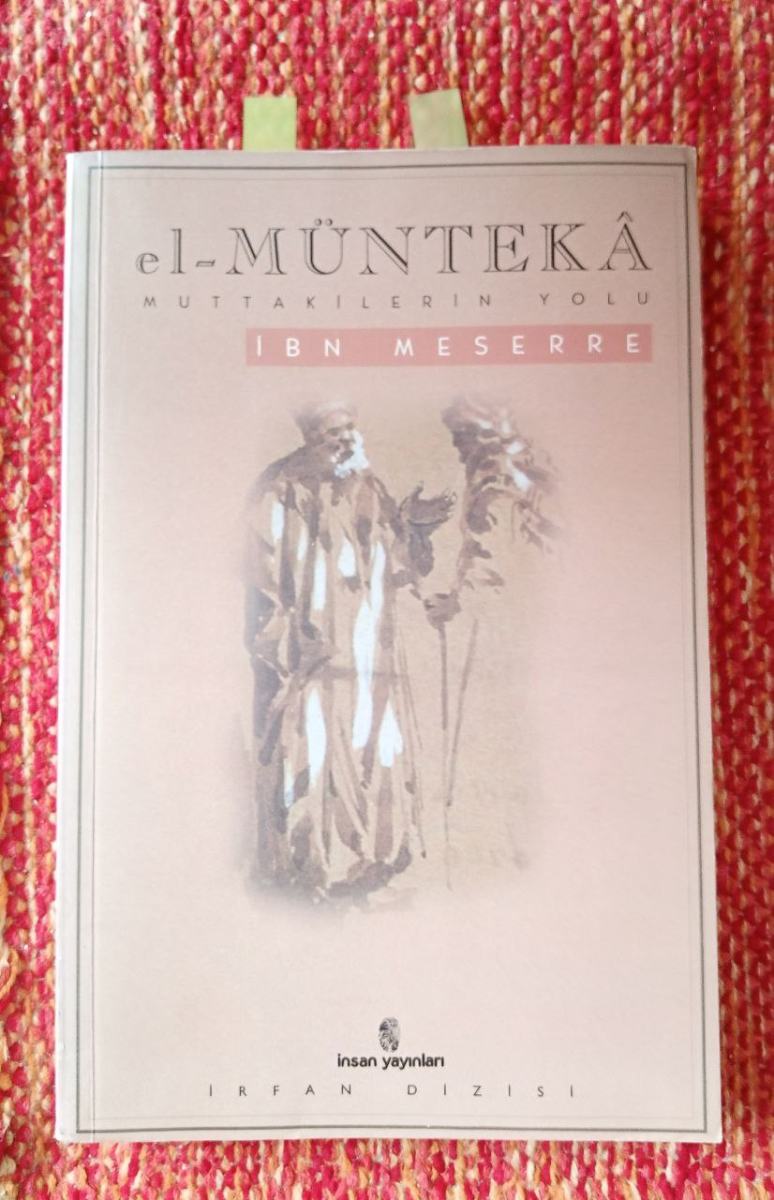
Today’s sharing from the Blue House of Via-HYGEIA presents ‘Of God and the Human Being’ from El-Müntekâ Min Kelâmi Ehli’t-Tûka (İnsan Yayınları, 1999, edited by Professor Mehmet Necmettin Bardakçı), pages 260–275.
Drawn from the only known manuscript in the world, preserved in Turkey, and originally published as part of the prestigious Irfan (Gnosis) Series, this text breathes the authentic spirit of Ibn Masarra (883–931)—the first philosopher-mystic of Cordoba. Compiled by the Andalusian master Ibn Hamis to preserve a fading legacy, these pages offer a rare glimpse into the bāṭinī (inner) tradition of Al-Andalus.
This chapter unfolds an intimate dialogue between the Creator and the human being, calling the ‘son of Adam‘ to recognize the exclusive attributes of Lordship and the true worth of his own soul. It delineates the path of sincere servitude (ʿubūdiyyah): distancing the self from divine pretensions, planting humility, and awakening to God’s ever-present gaze. The heart is declared the axis (quṭb) of all spiritual work—its emptiness meant only for knowledge, its vigilance the key to freedom.
Through trials, renunciation (zuhd), and the ‘profitable transaction‘ of selling one’s self to God, the seeker exchanges the perishable world for the permanence of the Hereafter. The text explores the two kinds of testing, the duties of the heart, the stages of certainty (yaqīn), and the state of those whose hearts roam in the Malakūt (the realm of divine sovereignty).
It culminates in a stark contrast between outward and inward knowledge, affirming that only the purified heart—freed from caprice (hawā) and superfluities—can behold the divine light. A vital testament to early Andalusian Sufi thought, this is a manual for the spiritual merchant who seeks God alone.
**
A Little Contextual Introduction
Compiled by Ibn Hamis to preserve the fading legacy of Ibn Masarra, this chapter offers more than a historical artifact; it presents a living challenge to the modern seeker.
The Rationality of Renunciation
What distinguishes this chapter is its framing of spirituality as a rigorous, intellectual exercise. The text does not ask for blind faith; rather, it addresses the ‘intelligent person‘ (al-ʿāqil), urging the use of intellect (ʿaql) to calculate the infinite return on the investment of self-sacrifice.
It presents a counter-economy: in the worldly market, one accumulates to gain security; in this divine economy, one divests—through renunciation (zuhd) and the abandonment of caprice (hawā)—to gain true freedom. The ‘profitable transaction‘ described is not a metaphor for passive belief, but an active, total liquidation of the ego’s autonomy in exchange for Divine nearness.
A Radical Alternative to Integration
For the modern reader familiar with psychological concepts like ‘shadow work‘, this text offers a striking, counter-intuitive perspective. Where contemporary psychology often seeks to integrate the shadow—accepting and harmonizing repressed defects to achieve a ‘whole‘ personality—Ibn Masarra calls for their liquidation. The text does not invite the seeker to dialogue with their caprice (hawā) or negotiate with their ego; it demands that these be sold and surrendered entirely.
The goal here is not the strengthening of the human ‘I‘ through integration, but its annihilation (fanāʾ) through servitude. In this divine economy, the ‘defects‘ are not lost parts of the self to be recovered, but false idols to be dethroned. The ‘vertical virtue‘ achieved is not psychological balance, but the total alignment of the heart with the Divine Will, where the self ceases to be an owner and becomes purely a mirror.
A Spectrum of Surrender
From Integration to Transaction: This distinction becomes even sharper when compared to other spiritual paths of surrender, such as the Latihan Kejiwaan of Pak Subuh (as interpreted by J.G. Bennett). Like Ibn Masarra, the Latihan demands a unilateral surrender of the ego to a higher power. However, the method differs profoundly.
The Latihan often emphasizes a passive, spontaneous receptivity, where the seeker ‘steps aside‘ to allow an energetic force to purify the self through movement and emotion.
Ibn Masarra, by contrast, proposes an active, rational discipline. His path is not merely ‘letting go‘; it is a conscious contract. The seeker must use their intellect to calculate the trade, will the sale, and enforce the renunciation of caprice through rigorous ethical struggle (mujāhadah). Where the Latihan is an organic flow, Ibn Masarra’s path is a deliberate transaction: a volitional act of selling the self, not just waiting for it to be taken.
The Heart as the Axis of Witnessing
Central to this teaching is the concept of the heart (qalb) as the pole (quṭb) of human existence. The text argues that the physical organs are merely servants to the heart’s direction. Therefore, the primary spiritual work is the purification (tazkiyah) of the heart from moral diseases such as arrogance, envy, and the fear of creatures.
Once purified, the heart transitions from mere belief to witnessing (mushāhadah)—a state where the believer does not just know God is watching, but sees themselves being watched. This shift from hearing to seeing is the pivot point of the entire chapter, transforming duty into love and hardship into a sign of Divine attention.
A Manual for the ‘Spiritual Merchant’
Ultimately, this text serves as a manual for the ‘spiritual merchant‘. However, this title must be understood in its most radical, counter-cultural sense. In an age where spirituality is often commodified—marketed as a product to be acquired for personal comfort or status—Ibn Masarra and Ibn Hamis propose a counter-economy that dismantles the very logic of the market. The ‘merchant‘ here is not a trader seeking to accumulate spiritual capital or negotiate a favorable deal. Rather, this is a merchant of total liquidation.
The text systematically deconstructs the ego’s attachment to the temporal world—described as a ‘sea of Hell without bottom or end‘—and reconstructs human purpose around the concept of servitude (ʿubūdiyyah). The ‘transaction‘ (bayʿah) described is not an exchange of equals, but a unilateral surrender: the seeker sells their only true possession—their self (nafs), their will, and their caprice (hawā)—into the ownership of the Divine. The text warns that following one’s caprice is not merely a moral failing but a theological crisis, akin to taking a rival deity.
Thus, the ‘profit‘ (fawz) of this merchant is paradoxical: it is found only in loss. As the text states, ‘If you sell these things, you will lose in the transaction‘. The seeker loses their autonomy, their illusions of control, and their attachment to the perishable. In return, they do not ‘gain‘ a product, but rather become something new: a free servant, liberated from the tyranny of the self.
For the seeker willing to endure the ‘hour of patience‘, the text promises a reversal of fortunes: humiliation in this world for sovereignty in the next, and the exchange of a perishable self for an immortal presence in the Malakūt. This is not a guide for the spiritual consumer, but for the radical vendor who sells everything to purchase nothing less than freedom.
*
And now the text:
‘Of God and The Human Being’
O son of Adam! Reflect upon what you have been made responsible for and what is asked of you. Understand well and remember what I am about to tell you. For I have gathered for you every kind of speech. Do you know what is asked of you? You are asked to know the attributes of your Lord and to recognise the worth of your own self (nafs). O son of Adam, do you know what else is asked of you? You are asked not to dispute concerning the attributes that your Lord has made exclusive to Himself, apart from His creatures. As a report has come: ‘Grandeur is the cloak (ridā) of Allah the Exalted.’ Whoever disputes with Allah the Exalted concerning His cloak, Allah destroys him and annihilates him. O son of Adam, make your Lord one (tawḥīd), just as His servants make Him one. Do not liken your self to Him in any matter.
O son of Adam, do you know how far your attribute is from His attribute, despite all your effort and striving? Do you wish for this to be explained so that you may understand? As you know, you are a servant (ʿabd), and Allah is the Lord (Rabb). Distance your self from the attributes of Lordship (rubūbiyyah). Plant the attributes of servitude (ʿubūdiyyah) within your self. No, by Allah, you do know them. And knowing them brings you closer to Him. Your Lord’s teaching you is not like another’s teaching you. His making you responsible is not like another’s making you responsible.
O son of Adam, your affair is summed up in the word of goodness and virtue. Be a servant to Allah just as He created you as a servant. Learn the requirements of servitude and accept them as your duty. It is not right for a slave to be arrogant towards his master. It is not fitting for him, while under his master’s watch, to transgress joyfully, to boast, to be ungrateful for blessings, to turn away and forget, to be arrogant and affected. On the contrary, it is necessary for him to elevate his worth, to honour his station, to maintain self-watchfulness (murāqabah), to increase his witnessing (mushāhadah), and to rectify his actions. Freedom from slavery and subjugation, from misery and need for compassion, is only achieved by doing these things.
O son of Adam! Be a servant to Allah in order to possess everything in this world and the next. O son of Adam! If you fulfil servitude properly, Allah will single you out (khaṣṣaṣa) and bring you near to Him. O son of Adam! Do you know what Allah singling you out in this world means? It means He removes the veils from you until you see His light with your heart, He makes you hear the secret (sirr) and the things that come to mind and memory—that which only the righteous among His servants know and are aware of—He makes you see what the heedless do not see, and He makes you comprehend the state of those who act with prudence.
O son of Adam! If you truly fulfil your servitude, He will elevate your worth and honour you. Do you know what His honouring you is? It is that He does not refuse what you ask, He gives you His mercy abundantly, He makes you a means of mercy for others, He shows mercy to the community you are in, and He honours the land you live in because of you. It is that He gives you what you want before you even want it. For He knows better than you what you want.
O son of Adam! Do you know what His choosing you and His honouring you mean? He grants you freedom while you are still in this world. He relieves you of the burden of seeking your worldly sustenance and spares you the situation of the people of this world who are attached to it and strive for it. How sorrowful it is that their hearts are detached and distanced from wanting Him, while you look upon Him with hatred and scorn what He has honoured you with. O son of Adam! Hasten, rush to the profitable transaction before it is lost and passes away. Purchase honour with humility, freedom with servitude, and nobility with lowliness.
O son of Adam, listen! How He calls you to the obligatory duties (farāʾiḍ) with the most beautiful and subtle of prayers and invocations, after the great acts of resolve (ʿazāʾim): “Is there anyone who will lend Allah a good loan, so that He may multiply it for him many times over?” [Quran 2:245]
O son of Adam! Use your intellect and intelligence concerning what He calls you to. Accept the path He shows you. He has made the Hereafter noble and magnificent for you. He calls you towards it and shows you its way. He has made this world seem small and lowly to you, and calls you to renounce it (zuhd). There is nothing more noble than what Allah has made noble and superior, and there is nothing more lowly than what Allah has made lowly and contemptible.
If you do not accept Allah’s call and do not listen to Him, which call will you listen to? Which guide will you accept other than His Book? What word will you believe after His? Make haste.
O my brother! May Allah guide you to the path of salvation. Consider this very hour I am living as my day. Seek help from your Lord for the rectification of your heart. Turn entirely to Him. Do not deviate from the path that leads to Him. Trust in Him and rely (tawakkul) on His guidance. Begin to take your sustenance from permissible foods and protect it from all afflictions. Guard your tongue from disturbing things, except for commanding, forbidding, asking, and answering. Likewise, guard your eye, your ear, your hands, and your feet from what is unnecessary. Watch how you use these organs. Let your heart be the thing you guard most. For the point of motion and the axis is the heart. It is the pole (quṭb), and it is the foundation for guarding all these organs. Be humble and modest (mutawāḍiʿ). If you are humble, you will attain what you wish from these things, and you will have the strength for it. Increase in this until your heart opens up towards Him and becomes filled with light, and until Allah teaches you what you do not know. Absolutely avoid heedlessness (ghaflah), for it is through heedlessness that Satan finds a way to enter you and destroy you.
You are in a sea among the seas of Hell, a sea without bottom or end. Allah, Allah! There is nothing more superior over your self (nafs) than your own self. Allah has given your self the striving to humble caprice (hawā), to strengthen resolve (ʿazm), to seek help, and to sever the causes that hold you back from your path. Beware of your self and guard it most carefully. Distance it from lusts (shahawāt) and pleasures. For it does not leave you alone for even an hour. I have seen nothing more beautiful than being with it, nothing more complete for its salvation than moderation in eating and drinking, nothing more perfect than the acts of worship and duties you must perform, and nothing better than abandoning creatures. Fear Allah. For you are responsible for yourself and for your self’s preoccupation with others.
Allah does not ask of you anything but your heart. When you make your heart for Allah, then go wherever you wish, do whatever you wish. For that will no longer harm you. If you never leave the street, night or day, it would be as if you have fled from your Lord with your heart, devoted your heart to another, and a share for someone else has been allocated there. Even sitting in mosques night and day, and the greatness of the goodness and gifts in your worship of your Lord, will not benefit you. All the firm causes connecting you to yourself will be severed. How purely will you continue in the companionship of your Master? You will be saved from the afflictions of this world. Whoever desires good attains it. It is only an hour of patience. There is no need for you to desire what He does not desire. He is more kind to the obedient than fathers are to their sons.
Allah the Exalted created this world upon perishing (fanāʾ). He spread out everything within it as various trials. No day harder than today has come for the people of this world to escape from it. Those who desire it are described as being ‘from it’. The fearful one is not secure from abandoning what he sees as evil, nor from the calamity that his beloved thing might bring upon him. Nothing in this world can be brighter than its current state, except that it is transferred from one state to another. You are one of the things in it. Leave your state as it has been transferred. Then do not return to the place from which your state was transferred, and do not leave that place. In your perishing days, which have no permanence, take the days of permanence that have no perishing. When the perishing days pass, it is as if they never were. When the permanent days are reached, they never disappear. Rush towards the Hereafter with deeds, prepare for it before desires are cut off.
The Angel of Death is waiting for you without error, determined not to leave you behind, and has gone to no one other than you since the time you were created. It is as if he attributes error to someone other than you, and says his intention is towards you. Take what is most precious from him. Present your poverty for a day whose coming is inevitable, prepare for it, and do not be heedless. If you think according to your self’s desires, no one other than you will prepare it for you. For all people either prepare it and send it away for their own selves or for their bodies.
This world is but a day and a night that help you and oppose you. It is clear that the things you do by night and day, whether for or against you, are transient. Reduce your friendship with them before long separations arrive. Populate your heart with the remembrance (dhikr) of your Lord, enliven His remembrance within it. If you increase in remembering Him, a quality will appear in you that is not found in others. Increase your desire and longing for that to which your Master has called you. Protect it from the persistent opposition of caprice (hawā). Hasten to straighten your intention, rush to purify your organs. Perhaps then your soul will be cleansed of all filth, become pure and untainted. Your heart will be cleansed of all dirt and purified (tazkiyah).
You must practise renunciation (zuhd). For it is the most appropriate thing for Allah and the most beautiful thing that leads to His pleasure. Renunciation purifies the heart of those who strive to magnify the Possessor of Majesty. Thus they see both the grandeur of Allah and the faults of this world. When its evils are revealed and its shameful aspects are exposed, they look upon it with blame and disgust. Their resolve (ʿazm) strengthens. Their organs inevitably submit to what Allah, the Guardian (Walī) and the Praiseworthy (Ḥamīd), calls them to. Their hearts become tranquil, so they drink from the cup of purity, contenting themselves with sufficiency in food and clothing. They expel what is beyond that, along with what has settled in their hearts, mixing it with the sweetness and pleasures of knowledge that reaches their selves. Only those who enter there and drink from its cup know this. When they journey towards this station, their lusts die, their caprices melt away, the provision of their selves betrays them, and their intellects strengthen. Their organs perform worship and servitude. Their hearts are emptied for His remembrance and populated by His remembrance, becoming tranquil by turning to Him, and through Him becoming independent of all else besides Him (mā siwā Allāh).
If a servant (ʿabd) practices renunciation (zuhd) in this world with sincerity and a beautiful will, Allah strengthens him with a spirit (rūḥ) from Himself. The servant finds the sweetness of worship in his heart. Worship becomes light and easy for him. His movement during worship is like stillness in the sight of others. He continues this state until his strength and knowledge (maʿrifah) increase. Then, trials (takālīf) are placed upon him as a place of testing and experience. He begins to find heavy that sweetness and delight which he did not find heavy when he first entered asceticism. If his resolve (ʿazm) strengthens, his caprice becomes disordered, his aspiration (himmah) is exhausted, he remains patient in obedience to his Lord, and strives to seek His pleasure, then his Lord rescues him from distress and afflictions. The difficulty of worship becomes easy, and he is blessed with remembrance (dhikr). The governance (siyāsah) intended for his self becomes a means of planning for him. He accustoms them to their former natures. He bequeaths to them penetrating understanding, intelligence, inspiration (ilhām), and insight (baṣīrah).
These are the servants of Allah who are attached to Allah through their thought and will. They are hidden from all things, yet are not hidden from Him alone. They, through being blessed by Allah, distance themselves and turn away from families, wealth, and children, from being blessed with every kind of intention of this world and the next. They are content with Him and turn towards Him. Their station and rank are very high with their Master. They have cut off their selves’ greed from people through the riches of their Master. He shows them His favours through themselves. He guides them every hour by advising their hearts. To everything other than Him, they turn towards Him, look to Him, rely upon Him (tawakkul), and trust in Him.
O my brother! Do not banish the remembrance of the Hereafter from your heart because of your love for this world. For neither this world nor the Hereafter condemns its companion. If you love this world, you will forget the Hereafter. If you love the Hereafter, you will cut your connection to this world. Emigrate from this world with your heart, like a person who receives a share of this world and gives something in return, leaving this world with nothing but closeness.
The goal of richness with Allah is that you speak with poverty (faqr), thinking well of your Lord concerning yourself and trusting in Him. Moreover, even if you had chests filled with gold and silver, you would trust more, and you would remove the envy in your heart towards kings and the rich.
You are only something through Allah. What you attain through Allah’s pleasure is yours. If you fear Allah’s punishment concerning His creatures, you will attain what you hope for. And He will protect you from the evil of those other than Him. A servant cannot achieve victory over his own self (nafs) nor rectify its crookedness. The self is only rectified by Allah making it moderate. The servant cannot corrupt his self, except that it becomes corrupted by Allah’s leaving it to corruption. No one can reach Allah except through obedience to Him, submission to Him, the beauty of certainty (yaqīn), and considering this world contemptible in one’s eyes. The heart of one whose heart is thrown into doubt and suspicion by the sorrows of this world is veiled from its Lord.
The duties incumbent upon the heart are: abandoning what Allah has forbidden; abandoning arrogance (kibr), transgression (ḥadd), envy (ḥasad), ill-thinking (sūʾ al-ẓann), adornment (for show), bigotry (taʿaṣṣub), belittling blessings and becoming arrogant, deceiving and hoarding from people (iḥtikār), the desire for elevation and permissiveness (ibāḥah), boasting (tafākhur), fraud, grieving over this world, regretting and lamenting what has passed, greed (ḥirṣ), avarice (ṭamaʿ), seeking fame (shuhrah), wrath (ḥiddah), excessive desire (raghbah), self-admiration (ʿujb), ostentation (riyāʾ), procrastination (taswīf), long hopes (ṭūl al-amal), fear of creatures, and working for their sake in word and deed. When the heart abandons these moral traits and is purified of them, it becomes free. It reaches the peak of sincerity (ikhlāṣ) and is cleansed of turbidity. The organs also become upright. If this is not the case, then the faith (īmān) of his heart is deficient, his state is weak, he is deviated, and he is veiled from the lights of the hearts.
Outside the path of salvation, there are only difficulties, which are removed only by strong patience (ṣabr), right conduct, and the removal of distracting preoccupations. The signs of truthfulness (ṣidq) are: removing excesses from the body, killing the self’s lusts, abandoning jesting and idle talk, leaving people alone, adhering to solitude (waḥdah), having little greed for this world, and cutting off excessive attachment to it.
An intelligent person must rectify his intention (niyyah), the pillar of his actions, and gather his heart, mind, and intention for this purpose. He directs the goal of knowing his Lord (maʿrifat Rabbih), the aim of his enemy, and the struggle (mujāhadah) of his self.
He despairs of performing deeds in hope of reward. For even if he were unique and unparalleled in his worship, he could not reach the degree of salvation because of the evils he commits. If this worship is tainted by even a single sin he commits, he becomes deserving of punishment. If this is the case, then what of the state of all sins, along with the scarcity of his turning to Him, concealing his repentance (tawbah) and return to Him? Then what of the state of one who combines obedience to his Lord as much as he can? If the accursed Satan confronts him with something, or his self elevates him to recall some of His favours over others, he sees the evils that Allah has previously shown him as contemptible and vile, and he exposes their faults. At that moment, the accursed Satan, who is contemptible and vile, is driven away from him.
There are servants to whom Allah the Exalted has given intellects (ʿuqūl) so that they may attain faith (īmān) through them. They attain, through faith, the light of certainty (nūr al-yaqīn); through the light of certainty, pure contemplation (khāliṣ al-tafakkur); and through pure contemplation, the uprightness of the heart (istiqāmat al-qalb). Through the uprightness of hearts, they attain correctness in deeds. Insight (baṣīrah) is left in their hearts, wisdom (ḥikmah) appears in their hearts, and springs of wisdom flow upon their tongues. Through the understanding (fahm) of their hearts, they charge into the hidden places of the unseen with their mounts: will (irādah) and sincerity (ikhlāṣ). Through the purity of their hearts and their certainty, they grasp profound understanding (al-fahm al-ʿamīq). Through profound understanding, they grasp the comprehension of hidden knowledge (al-ʿilm al-khafī). They know Allah the Exalted according to His reality, trust in Him with true reliance (tawakkul), and submit entirely to Him. Thus their hearts become mines for the clarity of certainty and the purity of the springs of wisdom. They are prudent people whose hearts roam in the Malakūt (the realm of sovereignty) among creatures. These are those whose Lord has taken charge of their affairs, and they have sought refuge in Him. They have killed the desire of their selves in their hearts, and are content with Allah taking charge of their affairs, choosing Him. Thus grief leaves their hearts, and the doing of beautiful things and success in their states becomes necessary for them. Richness and honour are bequeathed to their hearts, and the doors of need for creatures are closed to them. The Creator’s favours come to them as generosity from whence they do not reckon. He cleanses their hearts from being preoccupied with things they do not need. He protects them from every blemish. He makes them walk securely and tranquilly upon the peaks of the earth. Yet they are more famous in heaven than on earth.
It is reported that Allah the Exalted said to Prophet David (peace be upon him): “Say to those who love Me and are preoccupied with Me: If I know that their preoccupation with Me and their attachment to Me has overcome their hearts, it is fitting for Me to remove the veils between Me and them, and they will look at Me with the eyes of their hearts.”
The intelligent, strong, rightly guided, and clear-sighted person rectifies his self (nafs) in eating and dressing with gentleness and kindness, disciplining it, and refining his heart, until his organs submit to his heart, his resolve (ʿazm) strengthens, and his caprice (hawā) perishes. At that time, the station of the strong one is the station to which Allah has raised him above a certain level. For him, taking and giving become equal. He does not grieve over what is lost, nor rejoice at what comes to him. He increases his love, friendship, gratitude, knowledge (ʿilm), recognition (maʿrifah), and self-watchfulness (murāqabah) towards his Master until his heart becomes refined. In all his affairs, he turns to Allah without being attached to secondary causes. Whether he wears something rough or soft, beautiful or ugly, or eats something good or bad, little or much, it does not change his state of remembering the Lord in his heart and his desire to magnify Him. If he prays, Allah knows best who among those in the grasp of His powerful hands stands, who goes into bowing (rukūʿ) and prostration (sujūd), who recites, and who supplicates.
Whoever wants to enter into Allah’s love should not trust in anything other than Allah. He should not need anything other than Allah. He should not desire anything other than Allah. In all his affairs, he should take Him as his Disposer (Wakīl), be content with His decree, and submit to His choice without possessing anything or choosing for himself. If he does this, Allah will place love (maḥabbah) and yearning (shawq) in his heart, protect him from this world, remove the greed for creatures from his heart, and make him possessor of a sound intellect (ʿaql salīm). He will inspire him with a knowledge from His hidden knowledge, revealing some of the secrets of the unseen. “This is a favour (ihsān) that Allah the Exalted gives to whomever He wills. And Allah is the possessor of great bounty.” [Quran 57:21, paraphrased]
Allah the Exalted says: “Indeed, Allah has purchased from the believers their lives and their properties in exchange for Paradise.” [Quran 9:111] One who imitates Islam with its covenant and promise must fulfil this pledge (bayʿah) so that tomorrow, with Allah the Exalted, He may take it completely as the property and possession of Paradise.
The life and property are entirely for the Lord. He has sold them to his Lord. They are things that Allah entrusted to him, and Allah may do with them as He wills. He does not disapprove of anything that Allah decrees concerning his self (nafs) or his property. For Allah has given these to him in exchange for Paradise, with which He is pleased. If He sends down upon his self a trial or an affliction because of it, he grieves, shows impatience, and becomes sorrowful. He reprimands his self and says: O my self, what is wrong with you that you despair…why do you despair? You belong only to Allah the Exalted. I have sold you to Him with the pledge of fidelity (wafāʾ). Your property is the worst of the things spent in this matter. Through it, I am free from you. I have taken for you the best return and the highest reward. I have given you in this perishing world to profit in the realm of permanence (bakāʾ). I have granted you the world of grief, illness, and afflictions as a gift, to profit in the world of blessings, sovereignty, and abundance. If a calamity befalls your head concerning your property, that is more fitting for contentment. And he says: The property is His. He gave it and blessed with it. Then He called us to spend it for something better than itself. So we answered Him thus. We made it necessary for our selves.
How can a believer disapprove of something that Allah has decreed? Breaking the pledge is distance from Him. We want to receive the immediate value of a thing. Then we demand the right price for what we have given. Surely, Allah does not deceive nor plot. We have rejoiced in this and coveted it. For rejoicing and coveting are our right. As Allah says concerning this: “Then rejoice in the transaction you have made. That is the great attainment.” [Quran 9:111]
You have been left in a place only to be tested and tried, like one who is tested to teach the permissible (jāʾiz) and evidential knowledge that he does not possess. Allah, may He be glorified and exalted, knows all things. How sublime is His glory! This is His command: “We will surely test you until We make evident those who strive (jihād) among you and those who are patient, and We will manifest your news.” [Quran 47:31]
Everything that happens to you morning and evening, which you must endure, is a trial (imtiḥān)—that is, a test. By these, your truthfulness or falsehood is tested concerning the trust (amānah) placed upon you and the fidelity you vowed to your Lord. He accepts only the truth of speech, for He is the manifest truth. The trial brings out your truthfulness. If you are truthful, you will settle among the truthful. If you are a liar, you will join the liars. This is the word of Allah: “Alif, Lām, Mīm. Do people think that they will be left to say, ‘We believe,’ without being tested? We certainly tested those before them. Allah will surely make evident those who are truthful, and He will surely make evident the liars.” [Quran 29:1-3]
Your trial is of two kinds. First: your action that you perform for Allah, by which you distance yourself from your lust (shahwah). Second: your opposition to caprice (hawā), which is the deputy of the intention affected by what you dislike and find ugly. When you do the work correctly, the principle is one. Perfection (tamām) and soundness (ṣiḥḥah) are both a means for those who strive.
Say: O my self (nafs)! This is perfection and soundness. Your Lord is testing you to see how your self-sacrifice (īthār) and your rushing towards Him are. If you are patient, imagine the outcome of the patience He calls you to. Its gain and submission have been given to you. Consider its hardship, its gradual dissolution, and the end of laziness: How did His call go? You have attained no well-being by your own hand.
If a difficult matter befalls your property or your body, know that it is a trial. If you know that it is a cause of consolation, that is the key to your patience and the contentment (riḍā) for your pain. Say: O self! Your Lord has remembered you and wants to bring you near to His sacrifice. Do not fall behind. He gives you hardship greater than that with which He tests others, in order to raise your rank—or He reveals your blameworthiness and denial, and makes permissible for you what you have declared lawful for yourself.
If the affliction is small, do not rejoice in its smallness, but say: I am of little worth with my Lord. For my value with Him is only as much as this hardship and distress. Yet I am content with His companionship, for He knows me better than I know myself. He has been gentle with me because He knows my weakness. I have been burdened according to my weakness. Perhaps if I had been tested with more than this, I would not have been able to endure it. Even though affliction has a great station and value, the first thing pointed to your heart’s eye—when you thought before the trial came, ‘I will be patient’—is that if you are patient, you will gain a great reward; if you are not patient, that is the result of impatience, and the judgment follows.
How do these two states bring you loss and gain? Then the trial seems insignificant to you, and what is taken from you is replaced with something more virtuous. If you free yourself from conjecture and illusion, say: O self! Look with the light of your intellect (ʿaql), not with the darkness of caprice (hawā). You are nothing. You have no worth with your Lord that He would show it. He tests you, not because of your own sovereignty in your affair, but with the test of one who has a share of patience because of His command and His love. Rejoice and draw one step closer to Him. Beware of holding back from Him and fleeing from Him.
That good and evil are not permanent for you is among the attributes of this world you inhabit. If either of them comes and settles with you, it drives away its companion. If you are hungry, it is as if you have never been full. Likewise, when you are full, it is as if you have never been hungry. When you are tired, it is as if you have never been at rest.
And if you are rested, it is as if you have never been tired. When you are ill, it is as if you have never been healthy. And when you are healthy, it is as if you have never been ill. Take this further and reflect: When you die, it is as if you have never lived nor benefited from a single hour of a day in this world. Then, when you are resurrected, it is as if you have never died. Consider what your Lord calls you to, and magnify Him for the blessing He has given you. The proof that He has given you the blessing of non-acceptance and loss is that He calls you to abandon the perishable blessing and to exchange lasting desires, to a lasting delight that is permanent, with no reckoning for its eternity and no punishment required. When He calls you to this kind of easy patience and the promised easy path, if you reflect with your intellect free from caprice (hawā), the matter of gaining the pleasure of your Lord, who has blessed you, becomes light and easy. How can this great share, this great attainment (fawz), this exalted station, and this continuous praise be yours, along with this easy patience He has given you? Truly, it is astonishing! You reach such a degree that if you say to a thing, ‘Be!’ it is. Concerning this, Allah says: “They will have whatever they wish for therein. Thus Allah rewards the righteous (muttaqīn).” [Quran 16:31]
O ‘Uyyūn! Awaken from this stagnant, deep sleep before the attack of the Angel of Death awakens you. Do not fill your share with sleep until He brings you the abode of immortality! Then you will say, ‘If only I could give a gift for my life!’ But then advice will not benefit, words will not be grasped, and regret will not be removed from you. Goodness will not be written for you, nor will evil be erased from you.
Recognise the trust (amānah) you have been given and the covenant (ʿahd) you have agreed upon. Remember the One who rewards you, with whom you have made a transaction, the goods you have sold, the value you have set for them, your profit when you gain, and your loss when you are ruined. How can fidelity become pure and clear for you? Or how does failure occur for you? If you attain knowledge of this with true recognition (maʿrifah), the grandeur of the One with whom you transact will be taught to you. You will magnify the majesty of His Lordship (rubūbiyyah), His power, His Malakūt, the sublimity of His glory, the loftiness of His station, the great value of recompense in reward and punishment, and what passes between you and Him. First learn, then set to work. See, then be patient. Seeing is closest to patience. Whoever does not know is far from right guidance (rushd) and has abandoned doing these things.
Your Lord gave you your self (nafs) at the beginning of this worldly life and invited you to the most profitable trade, the most excellent transaction. He taught you that you are in a perishing world full of distress and illnesses. He placed all the afflictions, fears, destructions, injustices, griefs, sorrows, and hardships as a trial, so that you might answer the call of the One who calls you to the abode of Paradise. He invited you to a transaction in which you exchange the perishable for the permanent, blessing for hardship, sovereignty for servitude, freedom for submission, exaltation for humiliation, rest for illness, security for fear, salvation for reproach, and immortality for transience. Then He informed you about this world you are witnessing. He exposed its faults, revealed its evils, and reminded you of its end. He gave you news of the Hereafter, setting forth what you see in this world as evidence for it. He made it utterly secure and confidence-inspiring for you. He raised it above all goals, to the degree of infinity. He protected it from the perishing and loss imagined by intellects. He made it such that drawing a likeness for it constricts the chest. After you have reflected on the two attributes and placed the likeness of the two abodes (this world and the Hereafter) in your heart, He says to you:
“Make your self for Me in this transient, lowly world, and I will make the Hereafter, that permanent and exalted abode, for you. Be a lowly servant (ʿabd) in this world, so that you may be like a beautiful angel in the Hereafter. Imprison your self here, so that you may be free there. Seize it here, so that you may rejoice there. Obey Us in everything here, so that everything obeys you there. Do what is desired here by submitting, so that you may do as you wish there. Distance your self here from transient caprice (hawā) and lust (shahwah), so that lasting desires and wishes are given to you there. Annihilate your self, so that you may find the perishing thing you seek when you annihilate it. Abandon a little, impermanent thing here, so that you may take a great, permanent thing there. Be patient for a little while here, so that you may be blessed for a long time there.”
(A Via-Hygeia note: This passage is a rhetorical paraphrase of Divine Speech composed by Ibn Masarra (via Ibn Hamis) to summarize the spiritual covenant. While it echoes the meanings of Quran 9:111 (The Divine Purchase) and various Hadith Qudsi regarding divine nearness, it is not a direct revelation but rather a mystical exhortation framing the ‘transaction’ of the self. This distinction preserves the sanctity of the Quran while honoring the profound spiritual insight of the Andalusian master who crafted this powerful summary of the ‘profitable transaction’).
When you sell these things, you will lose in the transaction. This does not remain with you. Then you will be permanently distant from Him. You will fall into a punishment that cannot be removed. If you know the value of this transaction, its profit and loss, its necessity, and you are faithful to your covenant, then you will profit. By Allah, this transaction you are making is profit. After this, there is no question of eternal loss. Do you know what its price, its value, its liability (dhimmah), and its fidelity (wafāʾ) are? Its price, its value, its profit, and its loss are all your self (nafs). By Allah, these stations revolve. When you reflect, reflect well. Beware of deceiving anyone in the transaction. Do you know what deceiving means? If you deceive, you lose Paradise along with your self.
Do you know what loss and deficiency mean? If you act deficiently, you squander Paradise along with your self. Do you know what profit means? If you profit, you gain Paradise along with your self. Truly, this situation is astonishing.
By Allah, if you are truthful, profit and gain will run towards you in this world. You will be given patience in return for contentment, bitterness instead of sweetness, difficulty instead of ease. Take delight in illness for Allah’s sake, just as the affluent take delight in ease. Become accustomed to harshness and severity, just as those granted blessings become accustomed to blessings. Say: I have accepted the transaction and the agreement. Is there more? I will accept it. For your Lord has declared you truthful. Show humility to Him by submitting, so that He may free you. Turn to Him with wretchedness, servitude (ʿubūdiyyah), and humility, so that He may bring you near, give you sovereignty, and elevate you. Fulfil His right just as a sincere and devoted slave fulfils the right of his master.
Are you the place where everything ends and settles? Do you settle with the essence (dhāt) of Allah in all your moments and the management of your states? If you say no, you have denied. If you say yes, why do you not reflect until the vision of the greatest of the seers becomes clear? Why do you not magnify your witnessing (mushāhadah)? Why are you not cautious and vigilant concerning His wishes? If you see and perceive Him, He protects and watches over you with His gaze, and gives you respite with His clemency (ḥilm).
Reprimand your self! Whoever calls his self to account today, his Master will exempt him from the reckoning of the Day of Resurrection tomorrow. Say: “O my self! If there were a watcher over you from among people, you would guard yourself as long as he watched you; his seeing would reproach you to keep you from deviating, and his seeking of your right would frighten you. May Allah have mercy on you! How can it not be so for you, who are watched over between the powerful hands of your Lord? Magnify my looking at Him, venerate and glorify my witnessing of Him. Do you not hear what He commands? ‘Whenever you do any action, We are witnesses over you when you are engaged in it.’” [Quran 10:61, adapted] How can you consider His gaze more insignificant than the gaze of His creatures? This is only because of the littleness of your recognition (maʿrifah) of Him. When you are shy before the Exalted Creator, He gives you the management of blessing in return for your hope at the beginning. He is Seeing, Protecting, Near, and Answerer of prayers. Now compare these! If you are alive and your heart is in motion, take these counsels as an example fixed in your heart and vision.
Allah knows every state of yours and sees you at every moment. He is not heedless of you. It is as if He looks at none other than you.
Nothing preoccupies Allah, whose glory is sublime. When He intends a good aspiration (himmah) for you, say: I am between the hands of my Lord. Strengthen it and adorn it. Be shy before your Lord. If He sees your action as deficient, He also sees that you have worked for something other than Him.
If He grieves you with evil, fear and beware of His gaze, His witnessing, and His being with you. Remember the blessings and favours He has given you. Refrain from striking out against Him with a sin. He gives you His blessings and mercy; if you do the very thing He has forbidden you from, you are heading towards losing Him in this action of yours. Take your self as a dwelling and blame it; continue to constrict the soul (rūḥ). Do not move any of your outer or inner organs according to its caprice (hawā). For that is an attribute of the absolutely free who disposes by himself and has taken his caprice as his god. Do not bring about any event from yourself, whether open or hidden, small or great, except what the Master commands.
If your caprice agrees to this, you have taken your caprice as an ally. If it opposes, you have put patience in its place. Feel this resolve (ʿazm) and determination. Seek help to maintain this intention against the weakness or incapacity you fear. If Allah sees you accustomed to this, He will take you under His protection, spread His mercy over you, grant you help, and make your affair easy for you. He will bring you near, strengthen you, make you perform servitude, and suffice for you.
O my brother, load your self (nafs) with the utmost burden. Blame it. Remove from it the love of wealth and the fit of greed. Turn towards the highest servitude. Place the field of servitude upon your certainty (yaqīn). Then you will attain some things in this world through the action appointed for you. Eat only enough to satisfy your hunger, remove your weakness, and gain strength to keep your body standing. Do not mix it with the lust by which you take pleasure, nor with the honour by which you are blessed. Sleep enough to gather your mind, to remain awake and alert in the early dawn hours (sahar), and to keep away the distress and fits of old age. Do not mix sleep with comfort, lust, and doing things to satiety. Wear clothes enough to cover your nakedness and protect you from the cold. Do not add excess adornment to them. The same for your dwelling and other worldly benefits. If you are like this, and this is your goal, your heart will become pure and clear, and your Lord will be with you. “For Allah is with those who are patient and do beautiful deeds.” [Quran, cf. 2:153, 16:128]
Paradise has degrees. The first degree is salvation from the Fire of Hell by fulfilling the obligatory duties (farāʾiḍ) and obeying Allah in command and prohibition.
Then come the degrees of superiority attained by reducing the superfluities (fuḍūl) of this world. Virtues occur in things by which the virtue of Paradise is attained. Whoever clings to the highest renunciation (zuhd) in this world is granted the highest degrees in the Hereafter. For he only attains the highest renunciation together with knowledge (ʿilm). The highest renunciation is achieved by the erasure of all lusts of bodies and souls. And that can only come through knowledge. Allah does not delay unveiling the light of knowledge to His servant. Indeed, the servant sees the unseen (ghayb) with the eye of the unseen.
The one who turns to his Lord with correct knowledge has little connection to ignorance. But beneficial knowledge is that by which one turns to action and self-sacrifice (īthār). This knowledge commands him to the noblest thing in every matter. For when he sees, he sees with the light of knowledge. The reward Allah has promised him is great; it guards him from punishment. He regards everything besides fear and hope as contemptible. Any knowledge that increases desire for this world and greed to attain it is not beneficial knowledge. For knowledge that is for Allah is to accept His command.
His affair is to practice renunciation (zuhd) in this perishing world and to desire the permanent Hereafter. Whoever opposes His command, does not accept His call, and inclines towards what He has condemned in His Book has not understood Him, nor has he attained beneficial knowledge that would trouble and weary him. Even if another story prevails upon his tongue, he has not absorbed it into his heart. For preoccupation with the superfluities of this world indicates the source of his own knowledge. The superfluity of this world is a veil for the heart from seeing the realities of knowledge. It is an obstacle that covers and shrouds the light of knowledge. Realities are only seen by the lights of hearts.
Caprice (hawā) is the root of ignorance and a part of it. The root of everything appears in its part. For the son of Adam remains alone with caprice until Allah gives him the intellect (ʿaql) by which he struggles against his self. The one who makes the intellect given to him an ally of his caprice to resist its excessive desires in this world—his caprice turns his self away from seeking the knowledge of his Lord, and he remains astray in the station of ignorance. The inclination to caprice through ignorance, preferring the ease of pleasure, and the excessive desire that rushes to the heart in childhood persist for a long time. Until he turns away from the command of his Lord.
Dependence on habits and attachments, and abandoning the demands of his intellect, come to dominate him. Because he turned away from Allah’s command, distance from Him, cultivating his desires, and abandoning the actions of the intellect created for his prosperity and fortune—all of these come upon him in succession. He has sought the satisfaction of his self, lost the pleasure of his Lord, distanced himself from Allah’s mercy and protection. A call is made from a distant place, but he does not hear the reality of the meaning with his heart.
Only a part of the sound reaches the ear of the hearer. He imagines the truth mixed. He cannot describe it pure and clear because he is far from the stations of light and nearness. This likeness is present in the inner eye of his heart, with which he sees Allah’s commands—not in the beautiful outward eyes that even animals have. Disbelief (kufr) and ingratitude are a single station. For when he distances himself from Allah’s command, Allah’s command also distances itself from him. He cannot see it; even if he sees it, he sees it as one sees a distant thing. He cannot recognise its beauty to love it, nor understand its ugliness to avoid it. When he cannot distinguish the truth (Ḥaqq) with his heart, he cannot explain it with his tongue. For the tongue is the interpreter of the heart.
*
Quranic Reference Index
| Reference | Quoted / Paraphrased Text | Page(s) |
|---|---|---|
| Quran 2:153 (cf. 16:128, paraphrased) | “For Allah is with those who are patient and do beautiful deeds.” | 273 |
| Quran 2:245 | “Is there anyone who will lend Allah a good loan, so that He may multiply it for him many times over?” | 261 |
| Quran 9:111 | “Indeed, Allah has purchased from the believers their lives and their properties in exchange for Paradise.” | 267, 268 |
| Quran 10:61 (adapted)* | “Whenever you do any action, We are witnesses over you when you are engaged in it.” | 272 |
| Quran 16:31 | “They will have whatever they wish for therein. Thus Allah rewards the righteous (muttaqīn).” | 270 |
| Quran 16:128 (cf. 2:153, paraphrased) | “For Allah is with those who are patient and do beautiful deeds.” | 273 |
| Quran 29:1-3 | “Alif, Lām, Mīm. Do people think that they will be left to say, ‘We believe,’ without being tested? We certainly tested those before them. Allah will surely make evident those who are truthful, and He will surely make evident the liars.” | 268 |
| Quran 47:31 | “We will surely test you until We make evident those who strive (jihād) among you and those who are patient, and We will manifest your news.” | 268 |
| Quran 57:21 (paraphrased) | “This is a favour (ihsān) that Allah the Exalted gives to whomever He wills. And Allah is the possessor of great bounty.” | 267 |
*
Index of Key Words and Concepts
A
- ʿabd (servant/slave of God) – 260, 261, 264, 267, 271, 272, 275
- ʿahd (covenant) – 267, 270, 271
- akhlāq (moral traits) – 265, 275
- ʿaql (intellect) – 262, 264, 265, 267, 269, 270, 274, 275
- ʿazāʾim (great acts of resolve) – 261
- ʿazm (resolve, determination) – 262, 263, 264, 265, 267, 269, 272, 275
B
- bakāʾ (permanence/immortality) – 263, 268, 270, 271
- baṣīrah (insight) – 264, 266, 275
- bayʿah (pledge of allegiance) – 267
C
- caprice – see hawā
- certainty – see yaqīn
- contentment – see riḍā
- counter-economy (spiritual trade) – 261, 267, 270, 271
D
- dhāt (essence of God) – 272
- dhikr (remembrance of God) – 263, 264, 265
F
- fanāʾ (perishing, annihilation) – 263, 268, 270, 271
- farāʾiḍ (obligatory duties) – 261, 273
- faqr (poverty, spiritual neediness) – 265
- fawz (great attainment, success) – 270
- fuḍūl (superfluities) – 274, 275
G
- ghaflah (heedlessness) – 262
- ghayb (the unseen) – 264, 275
H
- ḥadd (transgression) – 265
- Ḥamīd (the Praiseworthy, name of God) – 264
- hawā (caprice, base desire; rival deity) – 262, 263, 264, 267, 269, 270, 271, 273, 274, 275
- ḥasad (envy) – 265
- ḥiddah (wrath) – 265
- ḥikmah (wisdom) – 266
- ḥilm (clemency, forbearance) – 272
- himmah (aspiration) – 264, 273
- ḥirṣ (greed) – 265
I
- ibāḥah (permissiveness) – 265
- iḥtikār (deception, hoarding) – 265
- ikhlāṣ (sincerity) – 265, 266
- ihsān (favour, spiritual excellence) – 267
- ilhām (inspiration) – 264
- ʿilm (knowledge) – 260, 264, 267, 274, 275
- imtiḥān (trial, test) – 268, 269, 270
- īmān (faith) – 265, 266
- irādah (will) – 264, 266
- istiqāmah (uprightness of heart) – 266
- īthār (self-sacrifice) – 269, 270, 275
J
- jihād (striving) – 268, 269
K
- khaṣṣaṣa (to single out, choose) – 261
- kibr (arrogance) – 265
- kufr (disbelief, ingratitude) – 275
M
- maḥabbah (love of God) – 267
- Malakūt (realm of divine sovereignty) – 266, 270
- maʿrifah (recognition, gnosis) – 264, 265, 266, 267, 270, 272, 275
- mā siwā Allāh (all else besides God) – 264
- murāqabah (self-watchfulness, awareness of God) – 261, 267, 272
- mushāhadah (witnessing, direct perception of God) – 261, 267, 272
- muttaqīn (the righteous, God-fearing) – 270
N
- nafs (self, soul, ego) – 260, 262, 263, 264, 265, 266, 267, 269, 270, 271, 274, 275
- niyyah (intention) – 265
P
- perishing – see fanāʾ
- permanence – see bakāʾ
- poverty – see faqr
Q
- quṭb (pole, axis) – 262
R
- Rabb (Lord) – 260, 264, 265, 267, 272
- raghbah (excessive desire) – 265
- renunciation – see zuhd
- riḍā (contentment, pleasure of God) – 260, 267, 269
- riyāʾ (ostentation) – 265
- rubūbiyyah (Lordship, divine attributes of sovereignty) – 260, 270, 271
- rūḥ (spirit) – 264, 273
S
- ṣabr (patience) – 263, 265, 268, 269, 270, 271
- shahwah (lust, desire) – 262, 268, 269, 271
- shawq (yearning) – 267
- shayṭān (Satan) – 262, 263, 266
- shuhrah (seeking fame) – 265
- ṣidq (truthfulness) – 265
- sirr (secret, innermost consciousness) – 261
- siyāsah (governance of the self) – 264
- sūʾ al-ẓann (ill-thinking, suspicion) – 265
T
- taʿaṣṣub (bigotry, blind partisanship) – 265
- tafākhur (boasting) – 265
- tafakkur (contemplation) – 266
- takālīf (trials, responsibilities) – 264
- tamām (perfection) – 268, 269
- ṭamaʿ (avarice, covetousness) – 265
- tawakkul (reliance on God) – 262, 264, 266
- tawbah (repentance) – 266
- tawḥīd (divine oneness) – 260
- tazkiyah (purification of the self) – 263
- ṭūl al-amal (long hopes) – 265
U
- ʿubūdiyyah (servitude, worshipful devotion) – 260, 261, 271, 272
- ʿujb (self-admiration) – 265
- ʿuqūl (intellects, plural of ʿaql) – 266
W
- wafāʾ (fidelity, loyalty to covenant) – 268, 270, 271
- Wakīl (Disposer, Trustee) – 267
- waḥdah (solitude, being alone with God) – 265
- Walī (Guardian, Friend of God) – 264
- witnessing – see mushāhadah
Y
- yaqīn (certainty) – 265, 266, 271, 272, 273, 275
Z
- ẓāhir wa bāṭin (outward and inward) – 275
- zuhd (renunciation of the world) – 261, 263, 264, 274, 275
Source
***



Related Articles


Leave a Reply