
Circle of Transmission: The Living Loom
From Paradox to Temple: The Consistent Moral Vision of Nicolas François de Neufchâteau
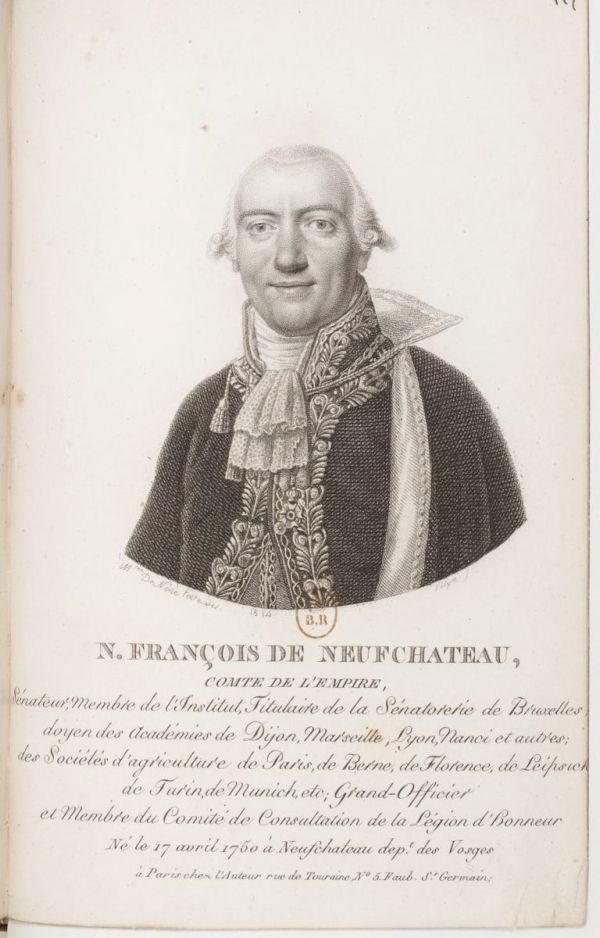
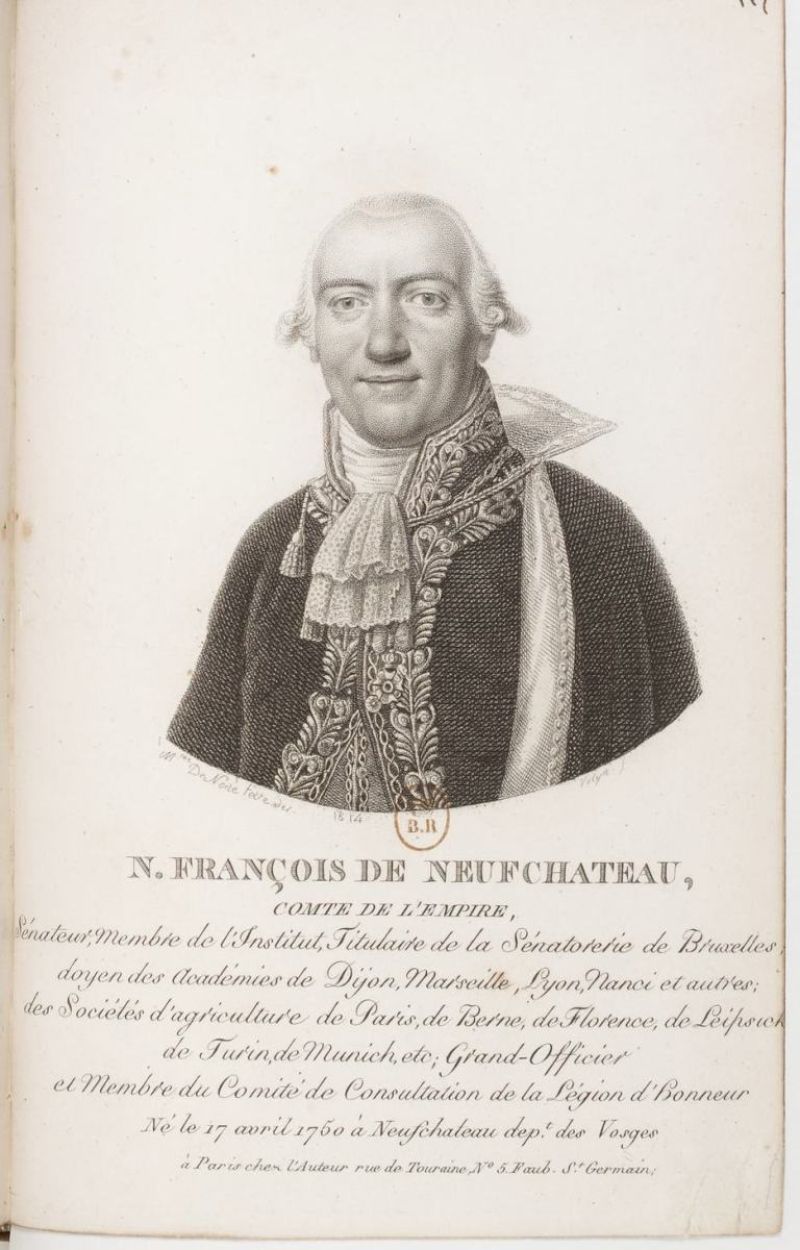
Portrait of Nicolas François de Neufchâteau, Count of the Empire (1814).
Artwork by Marie-Thérèse de Noireterre, engraved by Velyn.
*
Another sharing for the day from the Blue House of Via-Hygeia with two idiosyncratic works by Nicolas François de Neufchâteau: the sharp, satirical ‘Dialogue between a Philosopher and a Man of Virtue‘, a daring defense of intellectual tolerance against Enlightenment dogma, and the revolutionary ‘Hymn to Liberty‘, a poetic invocation where Reason replaces Dogma and Virtue becomes the only true cult. Together, they reveal the unwavering moral compass of a man who navigated the storm of history without losing his soul. We plan to follow soon with a selection from de Neufchateau’s ‘Anthology Morale‘.
**
A contextual Introduction:
The Moral Compass of a Survivor
In the turbulent history of the French Revolution and the Napoleonic Empire, few figures managed to navigate the shifting tides of power with the grace and longevity of Nicolas François de Neufchâteau (1750–1828). While often dismissed by historians as a mere political survivor—a chameleon who adapted his colors to whichever regime held power—a closer examination of his writings reveals a man driven by a remarkably consistent moral vision. Far from an opportunist, Neufchâteau was a steadfast moderate who believed that true liberty rested not on dogma, but on intellectual tolerance, civic virtue, and the practical improvement of human life.
This continuity is best understood through two pivotal texts written nearly two decades apart: the ‘Dialogue between a Philosopher and a Man of Virtue‘(1775) and the ‘Hymn to Liberty‘ (1793).
The first text, published anonymously under the pseudonym ‘M. Z.’ in 1775, emerges from the intellectual ferment of the late Ancien Régime. At a time when the Enlightenment was fracturing into rival sects, the young Neufchâteau stepped into the fray to defend the controversial journalist Nicolas Linguet against the established elite of the Philosophes and Physiocrats. As biographers note, this was not merely a literary squabble; it was a defense of the right to dissent. In the Dialogue, Neufchâteau warns against the arrogance of self-proclaimed ‘Sages‘ who claim a monopoly on truth, arguing instead that virtue lies in moderation, fairness, and the courage to challenge orthodoxy. This early work establishes the core tenet of his philosophy: liberty is impossible without the freedom to be wrong.
Eighteen years later, amidst the radical dechristianization and political terror of the Revolution, Neufchâteau penned the ‘Hymn to Liberty‘ for the inauguration of the Temple of Liberty in Paris (1793). On the surface, this poem appears to be a product of its radical times, celebrating the overthrow of kings and priests. Yet, beneath the revolutionary rhetoric lies the same moral framework established in 1775. When he writes, “Our gospel is Nature, and our cult is Virtue,” he is not calling for a new dogma to replace the old, but rather advocating for a civic religion based on reason and ethical action—the very same ‘virtue‘ he defended in the Dialogue. The ‘fanaticism‘ he condemns in the Hymn is the same intellectual tyranny he critiqued in the Philosopher who throws stones at dissenters.
The significance of these texts is further illuminated by Neufchâteau’s later career as Minister of the Interior (1797–1799), a period extensively documented by historian Charles Simian. Simian highlights how Neufchâteau translated these abstract ideals into concrete policy. As a statesman, he did not seek to impose ideological purity; instead, he focused on practical utility. He organized the first industrial expositions to showcase French innovation, promoted agricultural reforms to ensure food security, and founded prizes for civic contribution.
For Neufchâteau, ‘Virtue‘ was not a theoretical concept to be debated in salons, but a tangible force to be cultivated in the fields and workshops of the nation. His administrative work was the logical extension of his belief that a free society requires citizens who are economically independent and morally grounded.
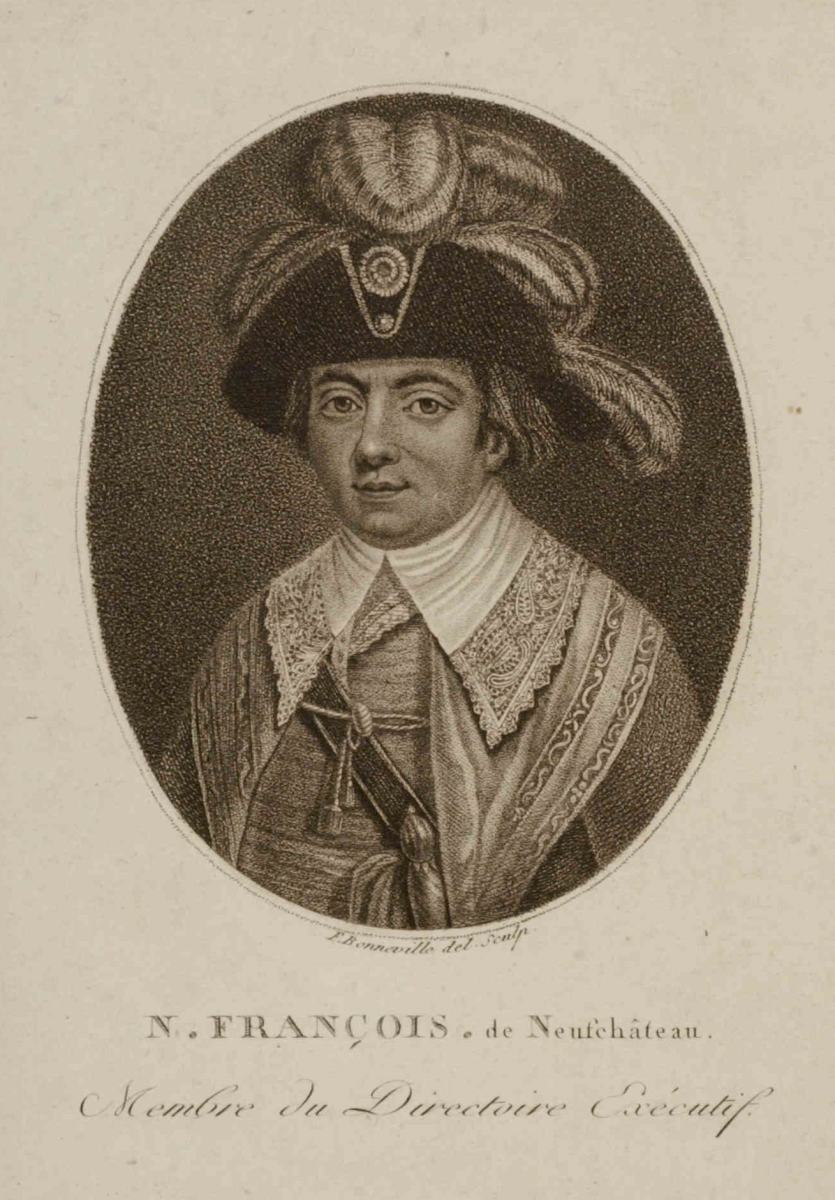
Together, the ‘Dialogue’ and the ‘Hymn’ offer a unique window into the mind of a man who refused to sacrifice his principles at the altar of political expediency. From the literary salons of 1775 to the revolutionary temples of 1793, and finally to the senatorial palace of the Empire (as depicted in his 1814 portrait by Marie-Thérèse de Noireterre), François de Neufchâteau remained the ‘Man of Virtue’. He stands as a testament to the possibility of maintaining intellectual integrity and moral consistency in an age of extremes.
*
Part I
Dialog Between a Philosopher And a Man of Virtue,
on the ‘Theory of Paradox’.
‘AMSTERDAM’-1775
THE PHILOSOPHER: Well now, Sir, well! Have you read the Book? The luminous Book, of which the whole world is drunk, Which makes the Criers in the street lose their voice? Finally, for us too, we shall have our laughers. This happy brochure effaces the vain shadow Of Linguet’s talents, crushed by the numbers. You are confounded. Do you dare deny it?
THE MAN OF VIRTUE: They saved this trait for him for the last moment, Sir; While, repelling infernal leagues, He stood alone against all cabals, Against all his Enemies, all his Detractors, Men of Law, men of the pen, Authors, Compilers, Vile echoes of hatred and of calumny; Dark informers whom genius irritates; Some very circumspect, plotting behind closed doors, Others shamelessly hatched in the broad daylight; All launching against him venomous arrows, (It must be admitted) in these famous jousts, Your new Athlete has chosen his time very well To serve as a recruit for the other Combatants.
THE PHILOSOPHER: Did you have the mania of condemning this Book?
THE MAN OF VIRTUE: Eh! Who could smile at the flat irony, At the awful sarcasms, at the cowardly outrage Of such a Libel, in such a moment?
THE PHILOSOPHER: Eh! What then? To second the universal voice! To deploy the eloquence and zeal of a Sage! To enlighten a Public still poorly established, Is that a crime?
THE MAN OF VIRTUE: Sir, the Author is your friend. He has pierced for you the mysterious shadow With which he veils his injurious pen from our eyes. As a delicate Judge, do you dare to pronounce?
THE PHILOSOPHER: You yourself, like me, must hesitate.
THE MAN OF VIRTUE: No, I do not know the innocent man being slaughtered; Except by the traits that vengeance forges; Except by the horror which, in a well-made heart, Is the infallible effect of persecutions. When Séguier, with a courageous and Roman voice, Spoke like Cicero, to avenge Demosthenes, When he recalled him into the Temple of Laws, I loved to mix my suffrage with the public voice Which made this august sanctuary resound. Paris praised in chorus a triumph so just; And the Triumphator, oppressed, unhappy, Is only more sacred to a generous heart.
THE PHILOSOPHER: But of this public cry, which your mouth attests, The prestige has ceased.
THE MAN OF VIRTUE: But the truth remains.
THE PHILOSOPHER: The truth! How dare you invoke it In favor of an ingrate, eager to attack it; Who thinks to destroy it the moment he implores it; Who strikes it on his knees, crying that he adores it; And who, familiar Orator of Paradox, Would not be known, if he were not singular?
THE MAN OF VIRTUE: Declamations are nothing but outrages.
THE PHILOSOPHER: Have you not then read the Extract of his Works? The Author cites him everywhere.
THE MAN OF VIRTUE: He alters him everywhere. He truncates scraps from one end to the other. From arguments he blames, he removes the proof. This rare method, moreover, is not new. Every Zoilus has known this insidious art Of pruning an Author to make him odious. With infamous centos, they have soiled Virgil. Mutilated texts would corrupt the Gospel.
THE PHILOSOPHER: Can one thus deny the evidence? How! When this unheard-of man openly maintains On the same matter, both the for and the against; When he contradicts himself, when one shows it to you, Do you still insist! Are you not vanquished?
THE MAN OF VIRTUE: If one had shown it to me, I would be convinced. But without contradicting himself, a sure and free hand Can seek the balance of good and evil; And when Reasoners are divided among themselves, Balance their opinions opposed to one another. Every Book is a closed field, where dialectic Must arm criticism with a two-edged sword; He may take a little too much care in sharpening it: ‘Eh! What Author, great God! never goes too far!‘ (Verse by M. de Voltaire in ‘The Cabals’.) Voltaire told you so; Voltaire, your Oracle. An Author without fault would be a true miracle. Every Mortal is kneaded with contradictions; But for being Mortal, must one be disgraced?
And you yourself, between us, you Sages whom we revere, If you were judged on this severe dogma! If from the obscure chaos of your opinions One day they drew out your contradictions; If they retraced for you the clash of your problems, And of those whirlwinds they call systems, Clashing with one another and destroying each other all; Finally, if one dared, without putting you in a rage, To represent truly your modern Apostles, Tolerant only for themselves, and tyrants for others, Crawling flatterers and declared critics, Friends of everyone, extreme Egoists, Preaching liberty with a tyrannical voice.
THE PHILOSOPHER: Sir, do not finish this iniquitous parallel.
THE MAN OF VIRTUE: I am far from imitating an unjust fury. I pardon humans for being born for error.
THE PHILOSOPHER: What use is an outbreak so lively and so hot? Our Sages are known; if they err, it is without fraud. Truth is always the object of their care; They seek it without feigning.
THE MAN OF VIRTUE: They say so, at least. But let us reason a little. These Sages I admire, Did they not claim the liberty to write? Has their voice at all times not proscribed Every bound imposed on the flight of the spirit? Have they not all blamed the insane custom Of enslaving reason, of chaining thought? Sermon, Novel, Physics, Ode, History, Opera, ‘Everyone can write anything, and hiss who will‘ (Another quote from Voltaire’s “Epistle to the King of Denmark.” Neufchâteau adds a sharp irony here: Voltaire praised this specific King for allowing free speech, yet in reality, that sovereign was a despot who severely restricted the liberty to write). Hiss then, if need be; but allow one to dare To use a right acquired in Verse as in Prose. Suffer that following in the steps of your famous Sages, One scribbles, disputes, fences like them. A bold Writer seems heterodox to you; The fear of prejudice leads him to paradox! He is not of the same opinion as you on wheat! Well then, answer him, but without gall, without rage, The true Scholar refutes, and the fool injures.
THE PHILOSOPHER: Oh! This time it passes beyond raillery. How! A madman who wants to be applauded, Will maintain that it is night at the hour of noon, And seriously one must refute These games of a false spirit! One must discuss Evident travesties, singularities Which he will put, by caprice, in the rank of truths! When the Universe proscribes the Disciples of Ignace, Will a fool undertake to pity their disgrace! Of all the Emperors he will make the Fréron! He will blame Titus, excuse Nero! He will destroy the faith one must have in History!
THE MAN OF VIRTUE: “He does not destroy it: he doubts, before believing. Often the altered records of Nations Offer nothing but imposture to enlightened eyes. Could he not, in the night of this ancient chaos, To assure his march, advance as a skeptic? Eh! Besides, is it up to you to condemn in him What one sees you ceaselessly admire in others? Has not Voltaire, with more energy, Written the apology of the Tyrant of Castile? (Here, Neufchâteau refers to Voltaire’s ‘History of the Republic of Rome,’ where the philosopher controversially defended certain actions of Spanish monarchs, challenging the reader to see the inconsistency in praising Voltaire’s boldness while condemning Linguet’s.).
Has not another, using the same rights, Disputed the seven Kings from the records of the Romans? (This refers to M. de Pouilly, whose discourse—published by Palissot—questioned the traditional historical narrative of Rome’s first seven kings, arguing that much of early Roman history was mythical. Neufchâteau uses this to prove that rewriting history was an accepted practice among the ‘Sages’ when they did it, but deemed a crime when done by their critics).
And when Bodin formerly vaunted despotism, Did he see among Reasoners the insane fanaticism Of making a crime of State of his opinion?”
THE PHILOSOPHER: If you can absolve such an attempt, I have nothing more to say, and it is a fine share To flatter tyrants, to exalt slavery!
THE MAN OF VIRTUE: But your Sages, Sir, they themselves have sung it. Of the fate of Paraguay their enchanted spirit Praised the blessed irons and the holy chains That fortunate slaves bear on those shores. How many other tyrants have they not incensed? What Despots, great God! have they not caressed? Be just then, finally, have not two measures; Do not condemn yourselves by your own censures. What is the blindness of an unjust wrath? The traits you launch return against you.
THE PHILOSOPHER: Ah! I am wrong, I admit it. One must go into ecstasies Over the little suppers of the tyrants of Asia. A Sultan can very well give himself the pleasure Of impaling his Bashaws, of strangling his Vizier, Nothing is more agreeable. Blind that we are! We believe slavery a misfortune for men! Pure prejudice! Domesticity No doubt has more horror and more atrocity. A Serf is not to be pitied. He is very happy even.
THE MAN OF VIRTUE: Sir, let us not jest on so great a problem. ‘This important Trial is not yet judged‘ (‘Adhuc sub judice lis est’. Horace, Art of Poetry); And the number of opinions is divided. The Author has said his own. He could do so without scruple; By distorting it, one makes it ridiculous, Odious, suspect to the crowd of fops Who are always imposed upon by words, Who read without hearing, or who judge without reading. O deplorable delirium of the human spirit! Once abused by the cries of hatred, The Public no longer hears the innocent accused. One can provoke him, without him being able to fight. Under the hand of executioners if he dares to struggle, It is a crime more that one makes him expiate, And one even punishes him for justifying himself.
THE PHILOSOPHER: But by what right finally this bizarre Writer, Blaming what France has produced of rarest, Dares he to mock the learned results (The ‘net product’ is the rallying word, the war cry, the Montjoie Saint-Denis of the economic sect). That the ‘net product‘ offers for the good of States? Judge of all the excess of his profound blackness! He takes pleasure in bamboozling these Benefactors of the world, These Sages, these Scholars, these great Calculators, Of the unique science, unique inventors, Illustrious offshoots of the Encyclopedists, And whom he dared to tarnish with the name of Economists!
THE MAN OF VIRTUE: But if they provoked him! If their numerous parties Have plotted against him dark conspiracies!
THE PHILOSOPHER: I wish to suppose it. At least in his defense He puts too much heat and too much violence.
THE MAN OF VIRTUE: Why was he attacked? Every aggressor is wrong: One has the right to crush the serpent that bites us. Eh! What is the man cold, phlegmatic, impassible Whom an unexpected affront does not find sensitive? Retaliation is just and of natural right: He who provokes it is the sole criminal.
THE PHILOSOPHER: Finally everything is matter for his Panegyric. Everything serves for his praise, and your rhetoric Shows itself ingenious to justify him. His Order has however come to sacrifice him. Should he have insulted this respectable Order?
THE MAN OF VIRTUE: No one has praised it more. Deign to be equitable. What did he say, in effect, of this virtuous Body Of Orators whom his impetuous style wounded? What did he see in them? magnanimous Soldiers, All armed by honor to combat crimes: Generous Rivals, who, friends of one another, Attack each other nobly under the eyes of Themis: Who, free by status, by duty intrepid, Rapid dominators of subdued spirits, For the weak oppressed make their voice resound, And cover the orphan with the Aegis of Laws: Who, burning with a holy zeal, imitate that great man, The oracle, and the savior, and the martyr of Rome (Cicero), Or who know how to arm themselves with those victorious thunders, Which Aeschines and his rival launched into the depths of hearts. Should they have punished him for it? Is it then an outrage, To believe in their talents, to vaunt their courage? Finally, this glorious portrait of their virtues, Would it be false enough, to be injurious?
THE PHILOSOPHER: Oh! One knows that his style is brilliant with phosphorescence. He sows with full hands his long metaphors. And loses himself in the mass of his comparisons.
THE MAN OF VIRTUE: There are, to strike him out, powerful reasons!
THE PHILOSOPHER: But if he is innocent, explain to me, I pray, From where comes this relentless persecution he excites on Parnassus, At the Bar, in the world, in the City, at the Court.
THE MAN OF VIRTUE: I know the motives well.
THE PHILOSOPHER: Speak then without circumlocution.
THE MAN OF VIRTUE: No, no, do not hope that here I reveal to you These frightful mysteries.
THE PHILOSOPHER: The reserve is new.
THE MAN OF VIRTUE: It is prudent at least. But see, of all time, What was in the Universe the fate of great talents. Ostracism, irons, exile, ignominy, Hemlock and death await Genius. Such is the common price of celebrity. I could cite you a thousand examples for one; But I see that finally this conversation shocks you. I fall silent.
THE PHILOSOPHER: It is enough. Nothing is less equivocal. You aspire, Sir, to the name of Man of Virtue. I suspect you even a little bit Christian. I will denounce you.
THE MAN OF VIRTUE: You are too honest.
THE PHILOSOPHER: Of your morals, in Paris, one can make an inquiry; And charitably, from house to house, Gather details and facts.
THE MAN OF VIRTUE: …
THE PHILOSOPHER: Since of a Reprobate you are an idolater, We shall know how to contain this obstinate zeal, And you would make for him useless efforts, We are more numerous, we shall be the strongest, At his first writing we shall know how to confound him. We shall have him burned.
THE MAN OF VIRTUE: To burn, yes, that is to respond; And I am, in the end, of your opinion.
THE PHILOSOPHER: I believe, Sir Man of Virtue, that you are laughing at me.
THE MAN OF VIRTUE: Ah! Zounds! at the very least, you will allow one to laugh. All this is, at bottom, only a pleasantry.
THE PHILOSOPHER: What do you call it, Sir? I am not amusing.
THE MAN OF VIRTUE: But your seriousness is quite amusing.
THE PHILOSOPHER: You are a rogue.
THE MAN OF VIRTUE: Marvelous.
THE PHILOSOPHER: A Corsair.
THE MAN OF VIRTUE: Courage.
THE PHILOSOPHER: An imbecile, a pedant, a forger, A bastard of Zoilus, a fool, a rascal.
THE MAN OF VIRTUE: How Philosophy inspires merriment, Of wit and gaiety, of grace and of decency! Of right reason, I feel the power; I cease to defend a jealous Writer. Yes, he who wants to think well, must think like you, Write at your pleasure, take your manner, Swear in your name, follow your banner, Make himself your monkey and cry in every place: Let one adore Psaphon; for Psaphon is a God. This cunning system of charlatanry, Would merit also to have its Theory.
(A Via-Hygeia note: The climax of the ‘Man of Virtue’s’ satire comes with the reference to Psaphon, the ancient Libyan tyrant who trained birds to chant ‘Psaphon is a god’ to manufacture a false divinity. Neufchâteau accuses the Philosophes of doing the same: creating an echo chamber where followers (‘monkeys’) are trained to repeat dogmas (‘Psaphon is a God’) rather than think critically. It is a devastating critique of the Enlightenment’s dark side: the replacement of religious dogma with a secular cult of personality, where truth is decided by the loudest chorus of approval).
THE PHILOSOPHER: (He picks up a stone and throws it at the head of the Man of Virtue.) Will you not finish this impudent discourse? Parry this argument, if you can.
THE MAN OF VIRTUE: (He runs away crying.) Help!
THE PHILOSOPHER: There, I avow to you, an abominable man, One cannot convince him unless one knocks him out. How error, alas! makes its poison glide!
*
Index of Names and Concepts
in the ‘Dialogue’
The Characters
The Philosopher: Represents the dogmatic Enlightenment establishment, specifically the Physiocrats and their allies. He claims a monopoly on truth, is intolerant of dissent, and ultimately resorts to violence (throwing a stone) when logic fails.
The Man of Virtue (L’Homme de Bien): The voice of François de Neufchâteau. He argues for intellectual tolerance, moderation, and the right to doubt. He defends the accused writer (Linguet) not necessarily because he agrees with him, but because he defends the principle of free inquiry.
Historical Figures & Authors
Nicolas Linguet: The controversial lawyer and journalist defended in the dialogue. He was attacked by the Physiocrats for his economic theories and his criticism of their ‘sect‘.” Neufchâteau portrays him as a victim of a ‘cabal‘.
André Morellet: The Abbé and philosopher who wrote the Théorie du paradoxe attacking Linguet. He is the ‘new Athlete‘ mentioned in the text, representing the establishment’s attack dog.
Voltaire: Referred to as the ‘Oracle‘. Neufchâteau cleverly uses Voltaire’s own words against the Philosophes, pointing out their hypocrisy in praising Voltaire’s freedom while denying it to others.
Jean Bodin: A 16th-century political philosopher known for his theory of sovereignty and despotism. Neufchâteau notes that Bodin was allowed to publish his controversial views without being treated as a criminal, unlike Linguet.
M. de Pouilly & M. Palissot: Contemporary writers who questioned the historical existence of Rome’s first seven kings. Cited as examples of skeptics who were tolerated when they challenged ancient history, unlike Linguet.
Psaphon: An ancient Libyan tyrant who trained birds to chant ‘Psaphon is a god‘ to manufacture a false cult. Neufchâteau uses this as a metaphor for the Philosophes, who he accuses of training followers to blindly praise their ‘Sages’.
Séguier & Cicero: Famous orators. Séguier is praised for defending the innocent (like Demosthenes/Cicero did), contrasting with the Philosophes who attack the innocent.
The Gracchi: Roman tribunes mentioned in the Hymn (and alluded to in the spirit of the Dialogue) as martyrs for the people, contrasting true public servants with selfish elites.
Key Concepts & Terms
The ‘Net Product’ (Produit Net): The central dogma of the Physiocrats. They believed only land agriculture produced true wealth. Linguet (and Neufchâteau) mocked this as a rigid, quasi-religious belief.
Cabals: Secret cliques or factions. Neufchâteau accuses the Philosophes of operating as a ‘cabal‘ to silence opponents through gossip and exclusion rather than open debate.
Paradox: In this context, a viewpoint that goes against established opinion. Neufchâteau argues that ‘paradox‘ is often just the first step toward new truth, and punishing it stifles progress.
The Stone: The physical object thrown by the Philosopher at the end. It symbolizes the failure of dogmatic reason and its inevitable descent into violence/censorship when challenged.
Tolerance vs. Tyranny: The central theme. The dialogue argues that true philosophy requires tolerating error, whereas false philosophy (dogma) seeks to destroy it.
*
Original french
Dialogue entre un philosophe et un homme de bien-Nicolas François_de_Neufchateau
*
Part II
‘Hymn to Liberty’
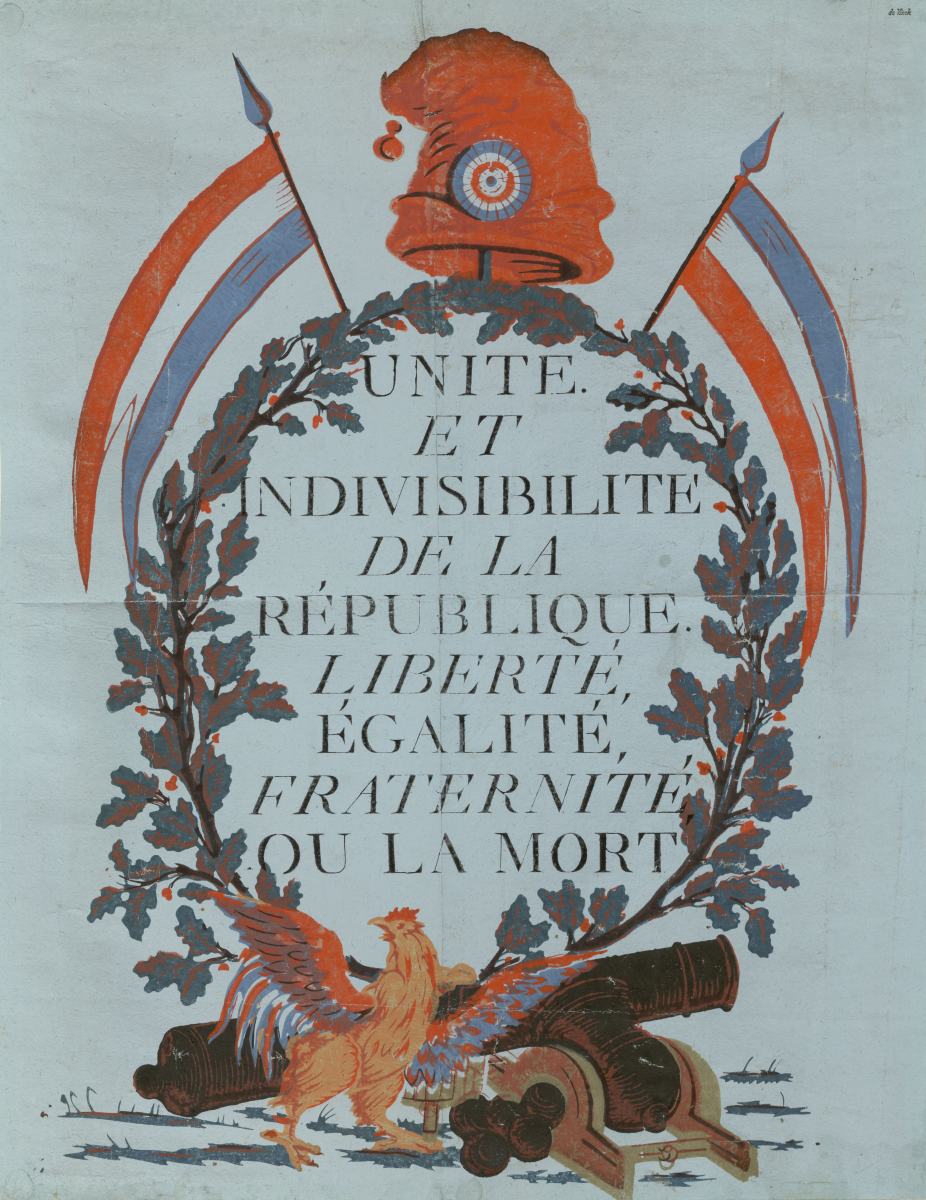
For the inauguration of its temple, in the section of the Observatory, in the former church of Saint-Jacques. Sextidi, 26 Brumaire, Year 2 of the One and Indivisible Republic [1793] By N. François (de Neufchâteau)
I
O Liberty, holy Liberty, Goddess of an enlightened people, Reign today within this enclosure; By you, this temple is purified. (2x)
Liberty! Before you, Reason chases away imposture; Error flees, Fanaticism is overthrown, Our gospel is Nature, And our cult is Virtue. (3x)
II
Your Temple, on the banks of the Tiber, Under the Gracchi, might have flourished. A people unworthy of being free, Let them perish without avenging them. (2x)
Liberty, you were then But the vain idol of Rome; But your triumph Is more assured among us; It is not the wish of a single man, It is the wish, the need of all. (3x)
III
For too long our credulous ancestors Allowed their rights to be usurped; Bound by the stole of priests, Bowed beneath the scepter of kings. (2x)
At the accents of your voice, let scepters and mitres fall. Let the rights of humankind be engraved everywhere! The world had lost its titles; France has found them again. (3x)
*
Contextual Notes
‘Former church of Saint-Jacques’ / ‘Purified’: This refers to the dechristianization campaign during the Reign of Terror. Churches were converted into ‘Temples of Reason‘ or ‘Temples of Liberty‘. Neufchâteau views this not as destruction, but as purification—cleansing the space of religious “superstition” to dedicate it to civic virtue.
‘Our gospel is Nature, And our cult is Virtue’: This is the core theological statement of the Revolution’s civic religion. It replaces divine revelation (the Bible) with natural law (Nature) and replaces religious ritual with moral action (Virtue). This directly echoes the moral philosophy found in his 1775 Dialogue, where the ‘Homme de Bien‘ defends natural reason over dogma.
‘The Gracchi’ / ‘Rome’: The Gracchi brothers were Roman tribunes who tried to help the poor and were killed for it. Neufchâteau argues that the Roman Republic failed because the people were not truly virtuous or vigilant enough to save their defenders. In contrast, he claims the French Republic is stronger because liberty is the ‘need of all‘, not just the wish of a few elites.
‘Stole of priests’ / ‘Scepter of kings’: A classic revolutionary pairing identifying the two sources of oppression: the Church (Altar) and the Monarchy (Throne).
‘France has found them again’: This suggests that human rights are not new inventions of the Revolution, but ancient, natural ‘titles’ that humanity had lost through superstition and tyranny, and which France has now rediscovered.
*
Note upon the two featured text: The Via-HYGEIA English translations of the Dialogue and the Hymn used in this article were rendered specifically for this publication based on the original French editions held by the BnF.
*
Bibliography
I. Primary Sources
(Works by Nicolas François de Neufchâteau)
François de Neufchâteau, Nicolas. (1775). ‘Dialogue entre un philosophe et un homme de bien sur la “Théorie du paradoxe’ [Dialogue between a Philosopher and a Man of Virtue on the “Theory of Paradox”]. Amsterdam: [s.n.]. (Published anonymously under the pseudonym “M. Z.”). Available via: Bibliothèque nationale de France, Gallica.
François de Neufchâteau, Nicolas. (1793). ‘Hymne à la Liberté pour l’inauguration de son temple, dans la section de l’Observatoire’ [Hymn to Liberty for the inauguration of its temple, in the Observatory section]. Paris: Imprimerie de la République. Recited on: Sextidi, 26 Brumaire, Year II of the Republic.
II. Historical Studies & Biographies
Simian, Charles. (1889). François de Neufchâteau et les expositions [François de Neufchâteau and the Expositions]. Paris: Imprimerie Nationale. This seminal study details Neufchâteau’s tenure as Minister of the Interior and his pioneering organization of industrial expositions as a tool for civic and economic improvement.
Conus, Ch. (1874). ‘François de Neufchâteau, ministre de l’Intérieur’ (17 juin 1798–22 juin 1799) [François de Neufchâteau, Minister of the Interior]. Paris: [s.n.].
Margairaz, Dominique. (2008). ‘François de Neufchâteau. Biographie intellectuelle‘ [François de Neufchâteau: An Intellectual Biography]. Annales historiques de la Révolution française, No. 351, 13–34. Provides a modern analysis of his career trajectory and the consistency of his Enlightenment values across different regimes.
Académie française. (n.d.). ‘Nicolas François de Neufchâteau’. In Les Immortels. Retrieved from academie-francaise.fr. Includes details on his moral writings, including the ‘Anthologie morale’.
III. Contextual References
(Enlightenment & Freemasonry)
Amiable, Louis. (1897). Une loge maçonnique d’avant 1789: La loge des Neuf Sœurs [A Masonic Lodge before 1789: The Lodge of the Nine Sisters]. Paris: Delalain Frères. Confirms Neufchâteau’s membership in this influential lodge and his role as President of the Conservative Senate.
Voltaire. (1768). Épître au Roi de Danemark [Epistle to the King of Denmark].
Voltaire. (1772). Les Cabales [The Cabals].
Aelian. (c. 200 AD). Various History (Book II, Chapter 31). (Source of the anecdote of Psaphon).
***

Leave a Reply