The Epistle
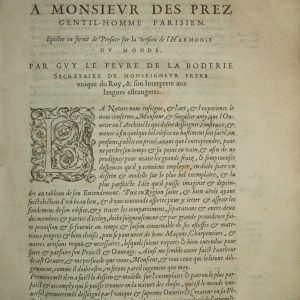
To Monsieur Des Prez, Gentleman of Paris
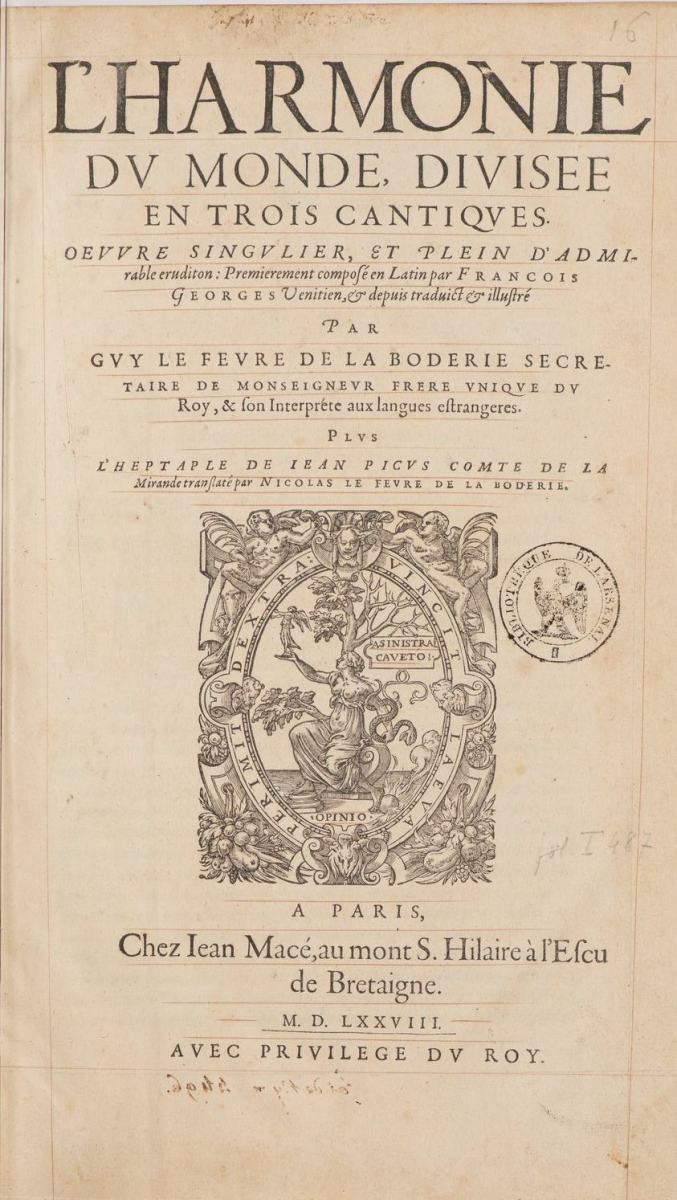
Preface to the Translation of The Harmony of the World by Francesco Giorgi By Guy Lefèvre de la Boderie, Secretary to His Royal Highness the King’s Brother, and Interpreter in Foreign Tongues.
As Nature teaches us, and as art and experience confirm, Monsieur and singular friend, that the Workman or Architect who desires to design, construct, and bring to completion some fair edifice—whether sacred or profane, public or private—ought, before undertaking it (lest he waste his time and labor in vain, and squander the great costs and sumptuous expenses required), to make a design and model based on the most beautiful exemplar and the most perfect Idea that he can imagine and depict upon the tablet of his Understanding.
Then, in a sound and well-aired region, having chosen a fair site and a convenient situation for laying the foundations of his edifice, and for tracing the compartments, separations, and partitions of its members and parts, he ought diligently and with great providence to furnish himself in due season with proper and well-chosen materials. He must also provide himself with good masons, carpenters, and other requisite artisans, who are expert and well-versed enough to perfect his Project and Work.
Thus, it seems to me, has the author of this Work done; and I persuade myself that you, Monsieur, and all those who shall read it diligently (as it ought to be read), will make the same judgment as I.
First, he made his design and model upon the exemplar and pattern most perfect and accomplished that can be found in the nature of things: which is the universal world. This world was first designed by the unique and supreme Workman and Creator in His divine Thought, and then by His co-eternal Word produced and brought to light. It is endowed with the ornament, beauty, and perfection that our predecessors through all past ages have remarked, and that even now we of the present may contemplate—indeed, that the most learned and ingenious who shall come after us may forever admire and recognize, as long as it endures.
I say the World is unique yet triple. By such recognition, the learned and venerable antiquity reports and represents (though from afar and as if by a trace) the Almighty, the All-wise, and the All-good Workman by whom it was created, formed, and made. For our author, imitating the great Moses—or rather Nature herself—was not content to comprehend and embrace within the compass of his understanding only what is contained in the spherical roundness of this great mundane machine, which we may behold with the pupil or crystalline mirror of the physical eye. But moreover, he has dared to penetrate beyond the last enclosure of this great Circus and Theatre, even unto the Archetype, the intelligible world, the supreme tabernacle, the sacred shrine of the universal Temple, the Ark of the Covenant, the celestial Jerusalem, the Angelic dwelling, the seat of the blessed spirits—or by whatever other name one might wish to call it. This is that which Plato spoke of in the Phaedrus, and which none of our poets has yet sufficiently sung nor adorned with praises.
Inasmuch as God the Creator, all-perfect, can neither be considered nor sought except in three manners—first, in the search of the things created by Him; secondly, in the consideration of the things created in God; and thirdly, of God Himself in Himself—the spirit and understanding of our author has been delighted and expanded through all these first two orders, degrees, or steps, leaving the third to the sole divine sapience. To this third order it belongs—not to men nor to Angels—and of it they and we can know nothing, save only as much as the Son, who was in the bosom of the Father, has of His grace deigned to reveal to us.
He who sees and contemplates the works in God considers the disposition and form of the house in relation to the Father of the family, of the kingdom to the king, of the artifice in the artisan, and of the sciences and doctrines to the learned and knowing. And he who knows and remarks the Workman in the Work gathers, as by a trace (as much as his capacity can bear), the Idea and universal notion in the chain and interweaving of things according to their stages and degrees, and in the correspondence of causes to their effects, and of effects to their causes. It is in this manner that St. Paul said that the invisible things of God are contemplated and understood by those things which are made.
It is in this manner that all the Sages and Philosophers who have ever flourished since the Heaven began to turn until now have searched, comprehended, and remarked in the consideration of the things of the universe—some more, others less, according to the felicity and reach of their spirit illuminated by natural light. In sum, it is of this contemplation (as all the Hebrew Sages, together with our Catholic and Christian Doctors, expound it) that God Himself responded to Moses, who required of Him to see His face: “Thou shalt see,” said He, אֲחוֹרַיִם (Achorayim), “My hinder parts, but פָּנִים (Panai), My face thou shalt not see.”
For in truth, the order and interweaving of creatures are the hinder parts of God, by the trace of which man may mount to the knowledge of Divinity. And as Origen well understood, the mystery of the Seraphim with six wings, mentioned in the vision of Isaiah, signifies nothing else. For with two wings, says the Prophet, they covered His face; with two others, His feet; and with the two in the middle, they flew. Because it is impossible to man, so long as he is detained in the prison of this body, to hear and comprehend nakedly what God was before the creation of the world, and what He would be of Himself if the world were reduced to its first nothingness; or to assign a head or face (that is to say, principle and beginning) and feet (that is to say, an end and extremity) to Him who is infinite, Eternal, and incomprehensible.
But the two wings of the middle with which they fly demonstrate and signify the knowledge that we may have of God by the means of creation—a middle consideration between the before and the behind. Or, to speak as the secret Hebrews, between אֵין סוֹף (Ein Sof), where is the Infinity on one part, and תְּהוֹם רַבָּה (Tehom Rabbah), or the abyss without bottom, on the other.
Therefore, our author, imitating as closely as he could the order of the world—or rather the Workman and Architect thereof—has first divided and distributed this Harmony of the World into three Canticles. Each Canticle is divided into 8 Tones or Books, and each Tone into several chapters, so well conjoined and allied, and so subtly distinguished and ordered all together, that the Method and clarity—indeed, the very order of the universal world—is discovered and manifested therein.
And because he wished to avail himself not only of natural reasons (to convince the unbelief and impiety that reigns in many) but also of authorities and testimonies not only of ours (that is to say, of Christian doctors) but also of foreigners—Hebrews, Chaldeans, Egyptians, Persians, Arabs, Greeks, and Latins—so as to leave no affirmation that was not duly proved: To this cause, at the beginning of the first Canticle, he wished to demonstrate a point. That every Christian who wishes to dispute with a Pagan, Barbarian, Philosopher, Mahometan, or Jew, or whatever other sect he may be, ought always to lay as foundation the antiquity, authority, and primacy of Moses and the Hebrew prophets above all other philosophers or authors who ever were. Inasmuch as, as St. Paul says, they have had this credit and pre-eminence: that to them were committed and delivered, as in deposit, the oracles of God. To the end that by this means it may be demonstrated that whoever would worthily speak of God, of the Creation of the World, or of His admirable Providence in the administration and government thereof, ought to have recourse to the authority and testimonies of the holy persons and Prophets inspired by the spirit of God. For where the wings of nature fail, one must take those of Grace; and where natural light is stopped up and obscured, it is then needful to require the infused and divine light.
Yet he has not failed to cite and bring forward the testimonies of other foreign authors, from whom he has plucked the most beautiful feathers. Following the counsel of St. Augustine, he has pillaged and taken by assault, as from unique possessors, their most precious jewels, treasures, and riches to bring them to the ornament and embellishment of the Tabernacle of God and of His Church—even as of old the children of Israel did to the Egyptians, from whom by a holy theft they borrowed jewels, rings, and riches to employ them to better use. And with such great dexterity and industry has he arranged, conjoined, and ordered them that they appear in his work of the Harmony as the pipes of organs or instruments through which the breath and wind of the spirit of God is sounded.
For as St. Ambrose said, and after him St. Thomas: “The truth, by whomsoever it be spoken, is of the Holy Spirit.” And he, like a good organist, touching dexterously and numerously the keys of the clavier, makes them sound now low, now high, then now of a middle tenor, but always in perfect chords and most sweet melody. Briefly, whoever shall well consider this work, it will seem to him to see a beautiful great tableau of marquetry made in the manner of Music, or rather of Mosaic, in which the little pieces of diverse figures and colors are so well joined and related that the whole seems to be of one single piece of several paintings artfully embellished and distinguished.
Now you shall see it following the four first degrees or steps of the Ladder of Nature, as Raymond Sebond says: to wit, being, living, feeling, and understanding. Or as the Hebrews name them: דּוֹמֵם (Domem), צוֹמֵחַ (Tzomeach), חַי (Hai), מְדַבֵּר (Medaber)—the mute, the vegetable, the living, and the speaking. Through these, he discourses upon all the essences and natures contained beneath the concavity of the Sphere of the Moon: metals and minerals, precious and common stones, herbs, trees and plants, Zoophytes or plant-animals participating of two natures (to wit, of the vegetable and living, as oysters and mussels adhering to rocks and shells); then by the innumerable diversity of brute animals, savages, terrestrial, aquatic, and aerial. These the Hebrews distinguish in four words, which are בְּהֵמָה (Behemah), חַיָּה (Hayah), דָּג (Dag), and עוֹף (Of)—to wit: domestic beast, wild beast, fish, and bird. Not to mention another subaltern genus which they comprehend under the word שֶׁרֶץ (Sheretz) or רֶמֶשׂ (Remes), that is to say Reptile or Creeping thing, which the Latins with one word call infestile.
Now again you shall see it raise itself through the spirit through all the interweaving of the ten traversable Heavens, and there mark the good or bad influences, the order, proportion, symmetry, and correspondence of the ones to the others, and of the Spheres to their motive Intelligences. Then, passing beyond all the ten curtains of this Tabernacle or celestial Temple, and their four tapestries or Elements, to penetrate the Tabernacle or Temple super-mundane: following not only the steps of the חֲכָמִים (Hakhamim), or Hebrew Sages, but also of the Apostles and Apostolic men—principally of St. John, St. Paul, St. Denis, and Hierotheus—to recognize beneath the Father of lights: Father, Son, and Holy Spirit (as we speak Christianly); or beneath the All-powerfulness, All-wisdom, and All-goodness; or beneath the Understanding, the Understood, and the Intelligence of Himself; the Unity, the Truth, the Good; or the three supremes, Abraham, Isaac, and Jacob, as the Hebrews speak.
So that one may gather from several places of their commentaries, and namely from that of the Zohar (an ancient book written in the most secret language of Jerusalem), where these proper words are written in column 254, upon the Exodus: בְּסִפְרָא דְאָדָם קַדְמָאָה כְּתִיב, בְּיוֹמָא דְיִתְקַם בֵּית מִשְׁכְּנָא אִתְעָרוּן אַבְהָן (B’sifra d’Adam Kadmaah ketiv, b’yoma d’yitkam Beit Mishkana it’arun Avhan.) That is to say: “In the book of the first man it was written: on the day that shall be planted the house of the tabernacle, the Fathers shall be excited.” Which signifies that at the same time that this saying of the Apocalypse shall be accomplished—”Behold my tabernacle with men”—then the knowledge of the sacred Holy Trinity shall be excited in all, principally in the Elect.
And in Bachya (ben Asher) upon the same Exodus it is written: הַכֹּל נוֹבֵעַ מִמַּעְיָן אֶחָד, וְלֹא מָצִינוּ שְׁלוֹשׁ עֶשְׂרֵה מִדּוֹת, וְלֹא מָצִינוּ שְׁלוֹשׁ עֶשְׂרֵה סְפִירוֹת, סוֹד הוּא מִפְּנֵי שֶׁהַשְּׁלוֹשָׁה מְאוֹרוֹת הָעֶלְיוֹנִים שֶׁהֵם עַל עֶשֶׂר סְפִירוֹת בִּתְחִלָּתָם, שֶׁהֵם שֵׁם וְעֶצֶם לְשֹׁרֶשׁ הַסְּפִירוֹת (Hakol novea mima’ayan echad, v’lo matzinu shlosh esreh middot, v’lo matzinu shlosh esreh sefirot. Sod hu mipnei shehashloshah me’orot ha’elyonim shehem al eser sefirot bit’chilatam, shehem shem v’etzem l’shoresh hasefirot.) That is to say: “All springs from one fountain, and although we find thirteen measures or properties, and that we do not find thirteen Sefirot, the secret of this is because there are three Mirrors or supreme luminaries above the ten Sefirot, which have no beginning, for they are name and substance to the root of roots.”
Item, by the same author expounding according to the sentence of his predecessors this verse of David, “I will lift up mine eyes unto the mountains”: They say, שְׁלוֹשׁ אָבוֹת עֶלְיוֹנוֹת (Shalosh Avot Elyonot), that is to say, “the three supreme Fathers.”
He therefore, beneath these three supreme Luminaries (to speak in their mode), recognizes and remarks the ten Sefirot or Spiritual Spheres, the ten יְרִיעוֹת (Yeri’ot), or Curtains of the super-mundane Tabernacle, of which the exemplar was shown to Moses on the mountain, and upon which he patterned and designed the model of his, as he had been commanded. Which, as in a small and abbreviated figure, represents both this Archetype, and the celestial World, and the Elemental, and together Man—whom the Greeks have properly named Microcosm; the Hebrews עוֹלָם קָטָן (Olam Katan), or עוֹלָם הַפֵּרוּד (Olam HaPerud), that is to say the Little World, or World of Separation, because it is separated from the three others, which yet summarily it contains, though in them it is contained. As elegantly and at length have discoursed Philo and Josephus the Jew (two torrents of Greek eloquence), and almost all the secret Hebrew Interpreters; and among the Moderns, the Count of Mirandola and of Concord, Jean Picus [Pico della Mirandola] in his Heptaplus (of which you have hereafter the version), and after them the Author of the present Work.
I have also sketched some Project in the eighth Circle of my Encyclie, which I can say and testify in truth to have designed, made, and composed before I had read either of the two last-named. Now, that the fashion of the Tabernacle of alliance, or ambulatory Temple, relates in several conformities to the Creation of the world and construction of this great round Temple—besides the passage where God said to Moses, “Make according to the exemplar which has been shown to thee on the mountain”—this can be proved by several other places of Holy Scripture. Of these we shall bring some of the principal, to more and more verify this saying of the Hebrew Sages (for upon this maxim, and that which they say Anaxagoras was the inventor, Hippocrates the confirmer, and several learned approvers, is founded almost all the argument of these two present works): to wit, “all things are in all things”; and הֵיכָל שֶׁל מַטָּה מְכֻוָּן כְּנֶגֶד הֵיכָל שֶׁל מַעְלָה (Heichal shel matah m’kuvan k’neged Heichal shel ma’alah). That is to say: “The temple down here has been arranged and appropriated with regard to the temple up there.”
Of the creation of the World it is written: “He stretcheth out the heavens as a curtain.” And in the Psalmist: “He stretcheth out the heavens round about as a curtain.” And of the Tabernacle it is written: “And thou shalt make curtains of goats’ hair for the tent over the tabernacle.” Of the creation we read: “Let the waters be gathered together under the heavens unto one place.” And of the tabernacle it is written: “And thou shalt make a כִּיּוֹר (Kiyor) or brazen sea.” Of the creation of the world we read: “Let there be luminaries.” And of the tabernacle it is written: “And thou shalt make the Candlestick.” Of the creation we read: “And the flying fowl.” And of the Tabernacle it is written: “And thou shalt make the Cherubims with wings outspread.” Of the creation we read: “And God created man.” And of the tabernacle it is written: “And thou shalt bring near unto thee Aaron thy brother.” Of the Creation we read: “And the heavens were perfected.” And of the Tabernacle it is said: “And all the work was perfected.” Of the Creation we read: “And God blessed the seventh day, and sanctified it.” And of the tabernacle it is written: “And Moses blessed it.” Item: “And he sanctified it, and all the vessels thereof.” Of the Creation it is written: “For in it He rested from all His work.” And of the Tabernacle we read: “In six days was made מְלָאכָה (Melachah), the Angelic Work.”
Then after it is said: “Take ye תְּרוּמָה (Terumah), the high Oblation.” There are many other such respects, relations, and correspondences in Holy Scripture besides the general and universal ones brought by the above-named and by ourselves touched elsewhere; but these are particular and special. For as it is written of the creation of the World: “These are the generations of the heavens and of the earth”; so also of the tabernacle we read: “These are the commandments of the tabernacle.”
And all thus (say the Hebrews) the World was created by ה (He), the fertile letter and in the fourth place repeated in the great name Quatretetragrammaton יְהוָה (YHWH), that is to say by the Son, the Word and eternal Wisdom of the Father. As they note in this word בְּהִבָּרְאָם (B’hibare’am), that is to say “when they were created,” which they interpret בְּה”א בְּרָאָם (B’He bara’am): “In He or by He He created them.” So also we read of the Tabernacle: “And the glory of the Eternal filled the tabernacle.” For the He designated is the glory of the Lord. Add that the word מִשְׁכָּן (Mishkan), tent or pavilion, is drawn from the same origin as שְׁכִינָה (Shechinah), Tabernacle of the divine Majesty. And this is what the divine Harper sang: לִשְׁכֹּן כָּבוֹד בְּאַרְצֵנוּ (Lishkon kavod b’artzenu). “To inhabit the glory in our earth”: That is to say, so that the tabernacle of God may dwell in the earth of our hearts.
And all thus the world was premeditated and designed in the divine Thought first, where by a single act it was created, as it is written in the Wisdom: “He that is Almighty created all things together.” Then after were formed, made, and distinguished the works in six days. So shall you find of the tabernacle that it was first raised in cogitation, and then after brought forth in work. Neither more nor less than the name of God אֱלֹהִים (Elohim) is mentioned in all the work of creation, and then after the whole name and אֶחָד (Echad) (as they speak), so that we read בְּיוֹם עֲשׂוֹת יְהוָה אֱלֹהִים (B’yom asot YHWH Elohim), “on the day that the Lord God made.” Also you shall find of the Tabernacle, that after it is said, “And the glory of the Eternal filled the tabernacle” (which relates to the name of Elohim, name of severe judgment), the Scripture makes mention of the whole name and אֶחָד (Echad), saying: כִּי עָנַן יְהוָה אֶל הַמִּשְׁכָּן (Ki anan YHWH el haMishkan): “For the cloud of the Eternal was upon the tabernacle.”
And all thus (they subjoin) the world was created by two properties: one of judgment, the other of mercy. Also we read that the tabernacle was made by two artificers and good workmen, and, as Scripture speaks, wise of heart: to wit בְּצַלְאֵל (Betzalel), (In the shadow of God), of the tribe of Judah, with respect to the name אֶחָד (Echad) and of clemency; and אָהֳלִיאָב (Oholiav), (My tabernacle the Father), of the tribe of Dan, with regard to the property and name of judgment. In sum, neither more nor less (say they) the world was created, and ought to be dissolved, then renewed after the Sabbath: Thus the tabernacle and the sanctuary ought to be dissolved and destroyed, and then renewed.
I have stayed a little longer in this comparison because it has seemed to me that it ought to be agreeable and useful to the readers, both for having fuller intelligence of this work and of several other secrets and mysteries that depend thereon.
I return to my purpose to say that our author in all the long discourse of his work has always followed the chain and interweaving of causes, mounting, as I have said, first by the four steps of the ladder of nature. Then after he enters the ladder of Jacob, of which the image is engraved upon the Throne of glory. Which ladder, according to the opinion of Moses the Egyptian (for whose singular erudition and knowledge this proverb is common and vulgar among the Hebrews: מִמֹּשֶׁה עַד מֹשֶׁה לֹא קָם כְּמֹשֶׁה (Mi-Moshe ad Moshe, lo kam k’Moshe), that is to say: “From Moses to Moses there has been none like Moses”), according to his opinion, I say, this ladder also has four steps. And yet it contains not only the four Elements and the bodies composed of them, but also the Spheres. Because, says he, the Spheres are conjoined and chained by certain alliance and sympathy with the four Elements, so that:
The Sphere of the Moon moves the element of waters.
The Sphere of the Sun moves that of fire.
The Sphere of the other five Planets—which they call כּוֹכְבֵי לֶכֶת (Kochavei Lekhet), that is to say the wandering stars—together linked move the element of air.
But the eighth Sphere, which they name גַּלְגַּל הַמַּזָּלוֹת (Galgal haMazalot), that is to say the wheel of the Signs, moves the element of earth.
In which he makes no mention of heavens 9 and 10, although he has not esteemed there to be only 8, according to the opinion not only of the ancient Egyptians but also of Plato and Aristotle, two lights of Greek Philosophy. Whether they did not use them for their purpose, they yet passed over them in silence.
For the other Hebrew doctors recognize the one and the other: the 9th, which they call גַּלְגַּל הַמַּקִּיף (Galgal haMakif), that is to say the revolving Sphere or the first mobile; and the tenth or Empyrean, which they name גַּלְגַּל הַשֵּׂכֶל (Galgal haSechel), the Sphere of Intelligence, as mean between matter and form, between movement and rest, and between time and Eternity. So much so that in this place, according to his opinion, Israel would have arrived only from the centre of the world (which the Arabs call Merkez) unto the 9th Sphere, which our David in his Psalms has named עֲרָבוֹת (Aravot), because of its flattened wheel, and upon which he says that the Lord is mounted on His name יָהּ (Yah), who represents and signifies the Son, as second among the three first numerations or Sefirot, as they speak.
And by the Angels mounting and descending in this ladder, he wishes that the Prophets be signified, who mount unto the divinity by the sublimity of their Prophecy, having arrived unto certain degrees, then after they descend when they manifest it and teach the creatures the way of the eternal Lord. But the other Hebrew Sages, much more familiar to our author, seem to me to have better designated it by עוֹלָם הַמַּלְאָכִים (Olam haMalachim), the Angelic world; עוֹלָם הַגַּלְגַּלִּים (Olam haGalgalim), the world of the Spheres or the celestial; and עוֹלָם הַשֵּׁפֶל (Olam haShefel), which is the Elemental world, to which is comprised and allied (he himself comprehending all three, as we have said) the Little World, which is Man. And thus they seem to have distinguished the Prophet when he sang:
Bless the Lord, ye his Couriers and Angels, Bless the Lord and give Him praises Exercises of the Heavens, bless the Lord All his perfect works, and give Him honour.
Likewise his son Solomon in the Canticle of Canticles distinguished these three parts, say they, designating the Angelic by the thighs of the Spouse that he describes, the celestial by her hands, and the Elemental by her legs. For the Church of Israel recites the praises of God to the compartments of the created things: because He created the thighs, that is to say, the Angels who demonstrate the prophecy to the prophets, who make the letters that announce it to the people. And the epithet that he adjoins to them of נְטָפוֹת (Netafot), distillations, signifies the prophecy according to this place of Ezekiel: וְהִטַּף אֶל דָּרוֹם (v’hitaf el darom), “and he has distilled towards the south.”
Or he compares the Prophecy to the myrrh (which he names מֹר (Mor); the Arabs call Almar, and the Persians Amarnon) because the soul delights therein. His hands are גַּלְגַּלִּים (Galgalim), the Celestial Spheres, which the word גֻּלּוֹת (Gulot) sufficiently signifies, which he immediately adjoins: “these are the rings.” And the reason why he compares them to the hands is not only for regard of the number of ten, which is common both to the fingers of the hand and to the Heavens, but also because all the works of man depend upon the hands—the organ of organs, as Aristotle calls them—so also the works, influences, and effects of all the universal world are drawn from the Celestial Spheres.
Solomon adds that these rings are filled with Tharsis, which is a precious stone more worthy and more excellent than gold, by which are designated the stars of greater excellence than the Celestial Spheres. He subjoins also מְעֻלֶּפֶת סַפִּירִים (M’ulefet Sapirim), that is to say, “covered and wrought of Sapphires,” as one would say of twelve Sapphires. Finally, by her legs he signifies the inferior world, which is the end and extremity of the essences, as the legs are the end and extremity of the human body. Although by the legs are properly understood the fire and the air: but because he adjoins וְאַדְנֵי פָז (v’adnei paz), “and the basements of gold,” are signified the water and the earth, precious and strong bases of the round machine.
Thus he names all creatures in this place One Ladder. Now God All-good, All-great, well taught Jacob that he was in sublimity above all these things at the summit of this ladder, and that thence by His All-powerfulness, All-wisdom, and All-goodness He governed the three Orders of essences and provided for all. Scripture begins by this inferior world where Jacob lay in Bethel, and orders and pursues the interweaving from below upwards. For in what is said מֻצָּב אַרְצָה (Mutzav artzah), “that it was planted in the earth,” is signified the inferior world; then what follows, to wit, וְרֹאשׁוֹ מַגִּיעַ הַשָּׁמַיְמָה (v’rosho maggia hashamaymah): “And its summit touched Heaven,” signifies the Celestial World, as the divine Poet and Prophet Lyric sang: “The heavens declare in every place the glory and grandeur of God.” That is to say, the Celestial Spheres by their movement so well conducted and so harmonious declare and preach on high to the men down here the divine providence.
But what is said after: “And behold the Angels of God mounted and descended,” this designates the Angelic World or the Archetype, which is the third compartment. This is why the Mosaic Sages say, in common sentence: הַמַּלְאָךְ שְׁלִישִׁי לְעוֹלָם (HaMalach shelishi l’Olam), “The Angel is a third part of the World.” Not that this is to be understood in length, breadth, and depth: but that it is the third Apartment and Hierarchy distinguished into its 9 orders, to which is adjoined the order of human nature for the 10th. Behold the chain, ordinance, and liaison that was perpetually the author of this Harmony, who undertook to fill the intervals of the considerations of things that premise and accommodate themselves thereto.
In the 2nd Canticle, as much by good and valuable reasons as by authorities of sacred books, he proves that the Messiah or Christ is the Wisdom of God and His Word containing all things in ideal or notional reason, and is altogether the great Man Archetype comprehending in Himself all inferior things. That He is the Life and the sustenance of all things, encompassing and attracting all to Himself. For since it is so, as we have already said, and as he has sufficiently proved, that every man is the summary and abridgment of the great world distinguished into 3 parts (so that man contains three stages or principal seats of natural or vegetable, vital or sensitive, and animal or motive life: to wit the liver, the heart, and the brain, to which I ally the Thought or understanding that comes from without)—if this be true, as it is, it is no marvel that Christ, who is the new Adam, comprehends all and all in Himself in better mark and in more worthy condition. For he by whom all others are such as they are, ought much more to be such in Himself. And as Scripture says in the person of God: “Shall I that make others to bring forth, be myself barren?” And David singing of the same Creator: “Shall he that formed the eye, not see? Shall he not see who formed the pupil of the eye?”
In like manner might we demand of the miscreants and infidels: Do you find it strange that the Messiah and true Mediator between God and men, who joins and unites the two extremities or natures in His support, contains all things in Himself in perfection, seeing that it is He who has given you the grace to contain them in yourselves, but in inferior degree? For since it is constant among the Philosophers that in every genus of things there is a certain excellence and primacy which the Greeks call Ἡγεμονικόν (Hegemonikon), one ought not to marvel that in the genus of men there should be one excellent and perfect in every point, who should be as the summit, the point, and the Coryphaeus of the others, and the true Israel, who from the lowest step planted in the virgin earth touches and arrives unto the summit of all the mystical Ladder, and there is joined and united to the Divinity.
And since He is the complement of excellence above all others, it was well fitting that His temporal birth should be different from all others: Adam was created, formed, and made of God without father or carnal mother. Eve was extracted from the side of Adam, who was the mother of the living, as her name signifies. Of these two is born all that there was, that there is, and that there ever shall be of men and women, except the only Messiah who was born of a mother without father, to wit of a perpetual Virgin in the fullness of time, as He is engendered of the Father without mother from all Eternity. And yet with good right the Prophet cries: “Who shall declare His generation?” In sum, whatever mark and quality of virtue, dignity, excellence, and perfection that may be found scattered and diffused in every man who ever was, is of the present, or ought to be to come, all this, I say, we must confess to have been gathered and comprised in Jesus Christ our Lord, who is altogether the unique Workman and master-workman of Nature. Behold the consonance, chords, and melody that resound to the 2nd Canticle even unto the perfect Octave, or the Diapason, as the ancients spoke.
And moreover to harmonize the Heaven with the Earth, and the old Testament with the new, there is sung also the Hymeneal or Nuptial song of the Earth with the Heaven, marrying the regions and provinces of the habitable earth with the 12 Signs of the Heaven that command them, and together treating the concord of the family of Israel with the Apostolic of Jesus Christ elected, and of the two together with the Heaven and the earth. Which we ourselves have sung in verse both in the first circle of our Galliade, and in the Hymn of the victories and triumphs of our Saviour, although in another consideration in the Galliade, of which the first circle had been made long before I had read this Harmony. Which, that it fell between my hands, was so much the more agreeable to me because I recognized that my conceptions related well enough to those of the author, and in truth this occasioned me to translate it.
For I would have employed almost three years of time, which I spent thereon, either in proper inventions or in versions of ancient Hebrew, Chaldean, or Syrian books which would have brought me more honor and renown, if I had not preferred the profit and utility that I hope to owe to succeed in France to my own honor and particular profit. Therefore in the concord of the economy of the house of Jacob and Church of Israel with the house and Apostolic family is discovered, to whosoever will look well thereupon, the secret of the resolutive and prophetic Theology, in which above all others is held to have excelled Abbé Joachim, of whom the Count of Mirandola would say “That he had read the book of life.” And in truth, whoever shall well understand his concordance of the old and new Testament, and together the concord of Astronomy with Geography, shall easily penetrate into the search and knowledge of the most profound secrets and mysteries of Holy Scripture, even peradventure to smell as from afar and to see as from a high watch-tower some obscure and dark appearances of the re-establishment of the Church so desired by all peoples.
For in reading the Canonical Prophets of the Hebrews and remarking the menaces or promises that are made to the people of Israel (a peculiar people and chosen of the Eternal for His portion from among all nations, which is the true figure of the Catholic Church), then extending the possession of Judea or holy land over all the habitable earth divided (so to speak) into twelve Patriarchs, as Judea was in 12 Tribes, one finds easily by the concord of the old and new Testament, by the interweaving of times and histories, and by Geography something not only of what has passed since the said Prophecies were written, but also of future events that are there signified and painted beneath the veil of obscure and mysterious words.
And as the Holy Spirit proceeds from the Father and the Son, so from the old Testament figurative and the new (where the truth of the figure is exhibited) will result the spiritual sense of the one and of the other, which doubtless also well has place in all the Church, universal and mystical body of our Lord Jesus Christ, as well in His person who is the head as in the holy Church where He has manifested Himself in flesh. I shall content myself with having shown by what means one ought to enter into spiritual intelligence. I refer the Readers to those who have treated of it expressly: as the above-named Abbé Joachim Calabrois in all his works, Rupert on the victory of the Word of God and on the Apocalypse, the learned Cardinal de Cusa in some few Commentaries, the Author of the book entitled Onus Ecclesiae or The Charge of the Church, and several other holy persons of whom he makes ample mention in his work, which I pass over in silence for brevity’s sake.
The last Canticle remains, which is the third, to which he accords the soul and the body his organ by the tones and nuances of the Virtues and by the notions of things. Then again he makes them agree with the Intelligences, the Heavens, and sacred Ceremonies. And shows how man, well tuned and well accorded to such convenance with all things in himself summarily gathered, that in all he can work and command all. Yea, even being one with God, the supreme Archimuse, can be exauded to every request that he can make. For the same Truth has promised that God will do the will of those who believe in Him: as all sacred history and the acts of the Apostles and Apostolic men, with the lives of the Fathers, give us ample and certain faith.
But alas! this concord and Harmony of the Soul and of the body together is very difficult to maintain and preserve in good temperament of the four humours (which are the cords of Health) and in the Quaternary of the soul (which is the Tetrachord of the interior man), and much more mal-aiséd of the two together with the supreme and divine Tetractys, if the great harmonious Spirit—who tempers, accords, and unites mercy and justice in the Archetype, and who as Job says “maketh peace in the high places,” who harmonizes the Angels, accords the dance of the Heavens measured, maintains the mutation and vicissitude of the four Elements by discordant accords or by the accorded Discord as Empedocles said—if this Spirit of love and of union does not sound in the Rosette of our Lute or Guitar and produce the sweet consonance of the Virtues and the Hymns, Canticles, and spiritual motets that continually we ought to Psalmody in spirit and in thought, to sing from heart and from mouth, and celebrate in numerous and harmonized verses to render thanks to Him from whom proceeds all true concord and harmony, in vain shall we endeavour to attain thereto.
But if it please Him to aspire to our design and inspire in our breast, then with voice and soul sound we shall follow the chimes of His chain. And as His divine Harper beneath the seven gifts and emanations of His Holy Spirit (the seven branches of the super-mundane Candlestick, the seven Spirits that assist before His Throne for the seven Churches of which St. John the Paranymph, or שְׁכִינָה (Shechinah)—(as the Chaldeans say) the cohabiting Glory of the Spouse and of the Spouse—makes mention; and of the seven sacraments of which the garden of the Church is watered, we shall make resound the seven voices of the Eternal, of which the 29th Psalm of David resounds on high. Of these seven voices, as the secret Hebrews say, influence the virtue to the 72 divine names, to the 72 assessors of the great Council, or 72 Angels governors of the 72 Nations or peoples. For when דִּבּוּר (Dibbur), the Word, goes forth from the mouth of the שְׁכִינָה (Shechinah), it departs into seven voices, and from seven voices into 72 languages. And thence every people and nation heard the parable because it was departed to the 72 peoples. In this manner is by them interpreted this verse of the 68th Psalm, which they attribute to Moses: יְהוָה יִתֶּן־אֹמֶר הַמְבַשְּׂרוֹת צָבָא רָב (YHWH yiten omer, ham’vaserot tzava rav).
“The Eternal will give word to the (Intelligences) Evangelisantes; the exercise is great.”
Neither more nor less, say they, than a man who would strike with a hammer upon hot iron laid upon an Anvil, from which the sparks spread from all sides hither and thither, so is great and numerous the army of the Evangelisantes Thoughts. Therefore, in imitation of his well-beloved David, in nine sorts of Psalmody we shall give Him praises and render actions of grace:
With regard to the nine Sefirot, or intelligible Spheres;
With respect to the nine Orders of Angels, or the nine Syrenes, who preside over the Heavens, as Plato said;
And with respect to the nine visible Heavens, the perfect play of the Organs of the great super-mundane Organ.
And first:
1. In Cymbals of jubilation, which they name זִלְזְלֵי תְרוּעָה (Zilzalei Teruah), we shall invite the Moon both celestial and super-mundane under the conduct of אֲדֹנָי (Adonai), to glorify Him.
2. In cymbals of resonance (which they call זִלְזְלֵי שָׁמַע (Zilzalei Shama)), we shall make resound and hear His praises even unto the Heaven of Mercury, and to the order of the Angels presiding of אֵל שַׁדַּי (El Shaddai).
3. With the organs, which they name עוּגָב (Ugav), we shall organize our Odes or Canticles even unto the organ and instrument of the celestial Venus, and thence we shall make them heard even unto the Archangels presiding of the God of armies.
4. With the chords of the Lyre we shall join our chords to those of the celestial Phoebus, of whom the Lyric Orpheus sang:
“Thou temperest, Phoebus, the Lute of the hollow world, Alone with thy Lyre to the resonant sound.” And counter-chording to the super-celestial Powers we shall celebrate the victories of the Eternal of the exercises.
5. With the מָחוֹל (Machol), or Choir, instrument of brass, which the Syrians name Reuiaa, we shall intone His admirable force even into the Heaven of red Mars, and respond to the divine Virtues, who go on high praising Elohim terrible and redoubtable from the part of Aquilon.
6. With the תֹּף (Tof), or Taborin, which the Syrians name Flagó, we shall fill the earth and the air of the Glory of יְהוָה (YHWH, the Eternal), so that the reverberation shall mount up even unto the Heaven of the star Jovial, and in the Archetype to the order of Dominations.
7. With our כִּנּוֹר (Kinnor), from which the Chaldeans have borrowed their Kinara, and the Greeks their Kinura (it is the harp), we shall sound the clemency and divine mercy so high that the first pose shall reach even into the stationary Heaven of Saturn, and the second to the order of Thrones presiding of אֵל (El), name of piety.
8. With the נֵבֶל (Nevel), or the Nable and Psalterion, we shall harmonize בִּינָה (Binah), the divine intelligence, even into the concavity of the Firmament, and to the super-celestial painting of the cherubims flying beneath the adieu of יְהוִה (YHVH).
9. Then with the fanfare of the trumpet, which they name תְּקִיעַת שׁוֹפָר (Tekiat Shofar), we shall crown on high His Wisdom responding down here to the winged Seraphims who exalt the Lord borne upon the ninth Heaven in His name יָהּ (Yah).
Finally, with Jesus Christ elevated in the supreme Hierarchy even unto the sublime Crown of אֶהְיֶה (Ehyeh), and there: כָּל הַנְּשָׁמָה תְּהַלֵּל יָהּ (Kol haNeshamah tehalel Yah), that is to say: “Every Soul shall give praise to the Lord.”
To the eternal repose, to which we wish the Father, the Son, and the Holy Spirit to conduct us: And not only we, but all the inhabitants above the round of the earth, so that all with one heart and one mouth confess Him, and all as Zephaniah says, serve Him with one shoulder, and in the same divine service, adoration and religion, all sects and discourses being abolished among all Kingdoms, Principalities, and Provinces, so that everywhere and among all is understood in perfect chords the great Harmony of the World.
Behold, Monsieur, as a brief summary and recollection of what is treated in this work clearly and at full length. Which, at my return from Flanders after the impression of the great Bibles of Antwerp, having fallen between my hands and having read it, pleased me so much, both for its incorruptible doctrine, beautiful disposition, and ordinance, as for recognizing therein the same Ideas and Conceptions that I had designed in my Encyclie of the secrets of Eternity, that all suddenly I felt enamoured of translating it into our French tongue. My aim was to open to ours the cabinets and the Sacrary, where few men perchance have yet had entry, and to continue ever the service that I wish to render to the Catholic Church and to this kingdom, formerly adorned indeed with the title and name of Most Christian.
Having caused it to be printed as correctly as has been possible to me, and seeing it ready to go forth into public view, I have thought that to you, Monsieur, above all others this my version ought to be dedicated and consecrated. This is as well because a part of it was made in your house in this city of Paris, as for the consideration of several benefits and honest courtesies wherewith you have ever embraced and bound me to your observance and friendship.
May it please you therefore to receive agreeably this little that I offer you, for a perpetual and public testimony of my obligation and thankfulness towards you. I pray God that He give you, Monsieur, increase of His graces.
From Paris, at the College of Beauvais, this 15th day of September, 1578.
Guy Lefèvre de la Boderie
*

Leave a Reply