
*
[Page 520] When distracting occupations diminish, an opportunity for the soul to turn secretly toward the Sacred Realm (al-quds) arises, and it becomes inscribed with an imprint of the Unseen (naqsh ghaybī).
Sometimes this happens very quickly. Sometimes it appears in the memory. Sometimes it extends to the Imagination (al-khayāl), and the Imagination dominates the Tablet of the Common Sense (lawḥ al-ḥiss al-mushtarak), and there appear in it the following forms:
1. A form of utmost beauty and adornment, in the most perfect and radiant configuration, addressing it from the Unseen.
2. The form of the unseen thing, depicted as a direct vision (mushāhada).
3. A form inscribed in lines by way of writing.
4. A form coming by way of a hidden call (nidā’) from the Unseen.
5. A form apprehended through a preponderant opinion (ẓann ghālib) concerning an unseen matter.
The speech that remains preserved in the state of sleep and wakefulness is a Truthful Dream (ru’yā ṣādiqa) or Clear Revelation (waḥy ṣarīḥ). The speech that vanishes, leaving only its imitation (muḥākāt), is a Revelation needing interpretation (ta’wīl) or a Dream needing deciphering (ta‘bīr). These imitations differ according to places, persons, times, and customs.
What is seen of jinn, ghouls (ghūl), and devils arises from internal causes based on imagination (asbāb bāṭina takhayyuliyya). The transition of the Imaginative Faculty (al-mutakhayyila) is not exclusive to sleep. Rather, sometimes the Imaginative Faculty transitions [to another object] and distracts you from your important task, so that you need to return backward (rujū‘ bi’l-qahqarā) and analyze in reverse.
Just as perceived things sometimes pass to the Common Sense, it is possible for them to return from there to the senses. In this case, the form reflects from the Common Sense to the eye. Sometimes it reflects into the stagnant air in the moist eye due to its humidity. Its reflection to the other senses, such as touch and taste, is similar. Indeed, we have observed wonders regarding these things. In short, when relaxation occurs in the senses, such imprints are probable. When the clouds of nature (ghuyūm al-ṭabī‘a) scatter from before you, the secret that the sages have long concealed from you becomes manifest.
*
THE THRONE-WAYSTATION
(MIRSAD ‘ARSHĪ)
(The Main Treatise begins here, marked by the heading in the source text.
Page 520, middle section.)
*
OPENING WARNING:
Against Spiritual Complacency
If you are a person of earnestness (dhū jidd), do not speak to yourself, reclining on the couch of nature (sarīr al-ṭab‘), content with the comfortable life in this filthy ruin, stretching out your legs, saying: “I have encompassed the true sciences with their parts; my soul has a right over me! How could it not? I have surpassed my peers with the reed of precedence.” Indeed, this state is a danger from which one who persists in it will never succeed.
*
CHAPTER 1: The Divine Herald
[Page 522] All these learning-based sciences (al-‘ulūm al-ta‘līmiyya) are the chirping (ṣaṣīr) of a holy envoy (safīr qudsī) that has awakened you from the sleep of the ignorant. You were not created to vanish into that which destroys you. Rise, O wretched one (miskīn), forcefully from your slumber! Drive away the enemies of God that are within you! Ascend to the station of the People of Tāsīn (the people of solitude/tajrīd)! Perhaps you will see your Lord through this path.
*
CHAPTER 2: The Call to Illumination
[Page 522] Do you feign unawareness of the call of the Caller who calls you to God? Rise from your worldly resting place and seek Illumination (ishrāq)! Perhaps a breath (nafḥa) from God will encompass you. When you resolve upon a matter, be patient! When you begin a task, complete it! When you strip yourself from the body, ascend to the Sacred Realm (‘ālam al-quds)! If you see anything, prostrate to your Lord! Perhaps your Lord will save you.
*
CHAPTER 3: Stripping the Body
[Page 522] Strip yourself from the body that makes you forget your self! Cling to the word that purifies you! Say to your people [the bodily powers]: “Take your precautions (Qur’an 4:71) and be God-fearing! The promised term has approached. If you do not desist, the punishment of God is coming.”
*
CHAPTER 4: The Oath and the Dark Current
[Page 522-523] I swear by those who revolve around the world of generation and corruption (‘ālam al-kawn wa’l-fasād) due to the intensity of longing, and by the souls turning with power toward the summit of the Throne: Verily, a human being does not ascend from his perishing realm to the path of eternity (manhaj al-azal), nor reaches the shore of glory (shāṭi’ al-‘izza), unless he takes refuge at the peak of the towering mountain and battles the jinn-children (jinnī al-aṭfāl)—that is, the works of the Imaginative Faculty—that obstruct the right of the Mighty and Majestic God.
Perhaps a wave [of passion] has stirred him, and a whirlwind [of false belief] has swiftly carried him away! That person, having no eye to see around him and no loving friend to converse with, drowns in the current of darkness. A repulsive power meets him with such awe that no wayfarer can pass through it.
*
CHAPTER 5: The Descent of Tranquility (Sakīna)
[Page 524] Verily, the divine, merciful Tranquility (al-sakīna al-raḥmāniyya) descends only upon a soul that has separated itself from the ruins of the slanderers (al-iftirā’) who do not know their limits. [This soul] comes to think, listens, and stands to see. Then it sees birds (ṭuyūr)—[meaning] separate entities (mufāriqāt)—standing in rows at the window of Majesty. It calls out with a hidden cry: “O Rescuer of the fallen! O Protector of those who seek refuge! Is there no cure for the deliverance of a being (dhāt) who has fallen from [the realm of] separate entities, become distant from his homelands, remembered this and suffered, ran but was hindered [by bodily powers]?”
*
CHAPTER 6: The Herald of the Throne of Light
[Page 524] A herald (munādī) from among the angels surrounding the Throne of Light calls out: *”O bewildered ones in the deserts of perishing (fayāfī al-fanā’)! Verily, the gates of the heavens open every Friday morning—that is, from the setting places of suns [souls] that are born [purified from bodies], which is the station of Unity (jam‘). Hasten to the Greatest Gate! Coos the Wise Word! And say: ‘O Seizer of forelocks! You began, so complete! You created, so guide! You decreed, so pardon! You possess, so forgive! O Giver of life in truth! Verily, a servant from Your servants has come to Your door, bound by his sin, repentant. Shall he return from Your mercy as a loser? O You who illuminate the veils with Your light, and the dwellers with the radiance of Your grace, and adorn the wandering spirits with the light of Your generosity! A soul has asked of You; do not turn it back in disgrace! Forgive it, mend it, protect it! You are the best Protector.’“
*
CHAPTER 7: The Dark Fish and the Sea of Tar
[Page 524-525] As for souls that have tied the knot of the faithless (al-ghādirīn) and ascended to the horizon of ‘Illiyyīn: Everyone who crosses the Sea of Tar (baḥr al-qaṭirān) [the world], if they do not occupy themselves with a complete and just apparatus (jihāz) that raises them to the divine realm—[consisting of] a theoretical power and a practical power—the Dark Fish (al-ḥūta al-muẓlima) will swallow them. Then they will taste nothing but black poison (al-samm al-aswad). The breeze of fragrant scents [heavenly blessings] and the delight of the melodies of separate beings (mufāriqāt) will not pass by them.
*
CHAPTER 8: Hermes and the Temple of Light
[Page 527] Hermes stood one night beside the sun in the Temple of Light. When the lights of dawn struck, he saw a land whose towns had been swallowed up and overturned due to the wrath of God. He said: “O my father, deliver me from the neighborhood of this evil neighbor!” Then a call was made to him: “Hold fast to the rope of light and ascend to the balconies of the Throne (shurafāt al-kursī)!” When he ascended, he looked, and behold: the earth and the heavens were under his feet.
*
CHAPTER 9: The Lightning of Glory
[Page 527] The lightning of glory (barq al-‘izza) flashes in the secret of a servant who sits apart from his peers, who has closed the door of the perceiving senses to his soul, and who has blocked incoming thoughts (khaṭarāt) and destructive anxieties. Whenever an imaginary thing flows into his heart like the crawl of an ant, he scatters it with the remembrance (dhikr) of God. Perhaps these imaginary things cease due to weariness, so he does not even recall performing many deeds. His Lord occupies him from other than Himself. He sees himself as absolute (muṭlaq), suspended (mu‘allaq), for a long time, from directions, sides, times, and moments. If he persists in this: First, a flash (bāriqa) comes to him. Then a blaze (lā’iḥa). Then annihilation (maḥq). Then the soul, at the supreme place, beside the Essence of Essences (dhāt al-dhawāt)—[meaning] the Necessary/First Intellect, the principle of souls—becomes suspended.
*
CHAPTER 10: The People of God and the Two Easts
[Page 527] Verily, the People of God (Ahl Allāh), when they occupy themselves with spiritual discipline (riyāḍa), they ascend. When they cut off connections, they arrive. They move from the two caves in the Mountain of Difference (jabal al-ikhtilāf)—[meaning] the apprehending and moving faculties—to the two mountains of the Easts (jabalī al-mashriqayn), the Small and the Great—[meaning] the Practical Intellect or the Soul, and the Theoretical Intellect or the Intellect realm. That place is the Door of Doors (bāb al-abwāb)—[meaning] the Active Intellect or the First Intellect. Every wind (rīḥ) that blows there—[meaning] every soul—the lads of God (ghilmān Allāh) [abstract beings] take, and they kindle in it an attracting fire and ignite it. Those who drown there vanish. God has a Word concerning the various souls, whose work this is.
*
CHAPTER 11: The Summary and Counsel
[Page 527] Know—may God have mercy on you—that since our speech has reached here and come to an end, we have entered the time of summarization. It is fitting for us to give good counsel.
*
PART III: SAYINGS OF THE ANCIENTS
AND DOCTRINAL DIALOGUES
SECTION A: The Chain of the Sages
[Page 528] Do not waste your life! You will not find it after it passes. Be patient with the patience of the great ones! Do not accustom your soul to the morals of the light-minded!
Know that the ancient sages, from the time of the rhetoric of wisdom—the Father of Sages and Father of Fathers, Hermes, and before him Agathodaimon, then Pythagoras, Empedocles, and Plato, the Great of Wisdom—are greater and more exalted than anyone who has emerged among the Muslims known as the People of Demonstration (Ahl al-Burhān). Do not let the lengthy mention of them along with Pythagoras deceive you! For although this group engaged in detailed analysis and scrutiny, they did not encompass much of the secret meanings of the ancients, especially the prophets. Disagreement occurred only in the details. Their speech is mostly based on metaphors and symbols. They should not be rejected. They are unanimous on all matters of the Hereafter: the knowledge of the One Real (al-Wāḥid al-Ḥaqq), the Intellects, the Souls, and the final outcome for the blessed. So, you must cling to spiritual discipline (riyāḍa) and abandon material connections. Perhaps you will attain what they attained.
[Page 528-529] The Testimony of Plato The Divine Plato said in a word where he spoke at length about himself, in meaning: “Sometimes I am alone with myself. In one aspect, I strip off from my body. I become as if I am not a body, nor clothed in natural garments, stripped of matter, peeled away from all other things, entering into my own essence. Then I see in myself a worth, a glory, a height, a radiance, and a beauty unlike any beauty. And I know that I am a part of the noble and exalted world.”
[Page 529] The Consensus of the Ancients The First Teacher [Aristotle] also recounted these high lights from himself. They are all in agreement that whoever strips himself from his body and does not surrender to his senses will ascend to the higher world. They also agree on the soul of Hermes and others of the people of ascent (urūj), that they ascend with their souls to the higher world. A human being does not become one of the sages unless he strips himself from his body and acquires the faculty (malaka) of ascent. Do not pay attention to those who resemble the bewildered materialist philosophers! For this matter is greater than what they have said. Some paths of the ancients were hidden due to their glory and majesty, and some were manifest.
The Sufis and the Source of Light
[Page 530] The Muslim Sufis and the people of solitude (tajrīd) have entered the paths of the people of wisdom and have reached the source of light [the First Principle]. They have received their portion from it. “He whom God does not give light has no share of light.” (Light, 24:40)
Sufi Methods and Some States Observed in Them
[Page 530-531] These people occupy their disciples with continuous remembrance (dhikr), inward sensing (ihsās), abandoning movements, sitting in the cell (zāwiya), and abandoning every kind of thought that pulls toward this world. They continue thus until certain things appear.
Some of the methods of the Sufis are as follows:
1. Perpetual worship, including the recitation of divine revelation [the training of bodily powers].
2. Continuing the prayer in the darkness of the night while people are asleep.
3. Fasting [the breaking of passion], the best of which is that in which breaking the fast is delayed until the pre-dawn meal (sahūr) so that the night worship may be performed while hungry.
4. Reciting at night those verses that open the way to longing and heart-delicacy.
For the subtlety of their secrets to become refined [for their intellective forms to be ready to perceive, and for them to be affected by divine beings], the following are beneficial:
1. Subtle thoughts [that do not prevent the soul from intellective perception].
2. Imaginations appropriate to the holy matter. These imaginations contribute very greatly.
3. Subtle superiorities [virtues].
4.Refined melodies.
5. The preaching of a clever speaker also contributes greatly.
The first thing that appears in them is momentary pleasing lights called “tālī” and “lā’iḥ.” These are like a flash of lightning that quickly vanishes. Moreover, they devote all their efforts to spiritual discipline (riyāḍa) in order to increase the dawning of these lights and to make it a settled habit (malaka). Sometimes this influx of lights occurs beyond their will. Later, these momentary states become permanent, and this state is called “tranquility” (sakīna). When they deepen in spiritual discipline, this becomes a habit (malaka). After this, the power of ascent toward the higher world arises in them. As long as the soul continues to rejoice in pleasures, it has not yet arrived at union (wuṣūl). If the soul loses consciousness of its essence and consciousness of pleasures, this is called “annihilation” (fanā). When this soul becomes annihilated from consciousness, it subsists (bāqī) through the subsistence of God, the Exalted. An indication concerning union (ittiḥād) was mentioned previously.
[Page 532] There is another station in annihilation (fanā), namely annihilation in friendship. This is the state closest to death. A Sufi called this the station of friendship. Plato indicated this. This [is distinct] from the famous annihilation that sometimes occurs together with bodily motion.
SECTION B: The Doctrine of the Soul and Intellects (Dialectical Proof)
[Page 532-534] The Master of Tawḥīd Speaks A master of Unity (tawḥīd) in the station of Solitude (tajrīd) says: “How articulate is your demonstration, O People of Wisdom! How clear is your exposition! You have removed the veil from that which made hearts bewildered! You have brought all that needs to be known regarding the state of beginning and return! Hail to the souls whose traces are these, and to the Intellects whose emblem and covering are from the Real, and whose journey and destination are to God! You have manifested the greatest path with the clearest proof!
The souls of all the People of Reality have assisted you. However, there is one point here: I stripped myself by my essence and contemplated it, and I found it to be ‘inniyya’ (selfness) and existence. Added to it are the descriptions: ‘not in a subject’—which is the definition of substantiality—and ‘relations to the body’—which is the definition of soul-hood. As for the relations, I found them external to it. As for ‘not being in a subject’, it is a negative matter. If substantiality has another meaning, I do not know it. I know my essence, and I am not absent from it. It has no differentia (faṣl), for I know it by myself, and I do not know a differentia for it. If it had a differentia or a particularity beyond existence, I would perceive that differentia when I perceived its existence, for nothing is closer to me than myself. In detailed analysis, I saw nothing in my essence except existence and perception. Existence is distinguished from others by accidents. Perception is as previously mentioned. Therefore, nothing remains except existence.”
[Page 534] Furthermore, if perception (idrāk) is taken as a learned concept beyond what is called [perception], then it is the perception of a thing. In this case, the soul is not a thing that exists because it perceives itself, for perception is subsequent to the soul. Nor is its existence dependent on perceiving another.
Objection 1: The Unknown Differentia. Question: “You have an unknown differentia!” Answer: “When I perceive the concept of ‘I’ (anā), nothing unknown is added to it so that it is attributed to me and is other than me. If I had another reality besides this, the concept of ‘I’ would be an accident for that reality, and I would have perceived the accidental. But this is impossible. Therefore, I have judged that my essence is existence itself, and that my essence divides in the mind only into negative matters—called existential names—and relations.”
Objection 2: Necessary Existence. Question: “It was said to me: ‘If so, your existence must be Necessary (wājib), yet it is not!'” Answer: “I said: ‘The Necessary Being (al-Wājib) is pure existence with no deficiency. My existence is deficient. It comes from the Necessary, just as the light of the moon comes from the light of the sun. As indicated earlier, when the difference between two things is only in perfection and deficiency—like the difference between two distances where one is longer than the other—there is no need for a differentiating factor (faṣl) of a different genus. A thing’s possibility (imkān) arises from the deficiency of its existence, and its necessity arises from the perfection of an existence that has no superior.'”
Objection 3: Strength and Weakness. Question: “It was said: ‘In things that exist by themselves (bi-dhātihi), there is no weakness or strength.'” Answer: “I said: ‘This is an assumption (taḥakkum) that cannot be proven. The rules regarding this have already been explained to you, so this matter is closed.'”
Objection 4: Universal Necessity. Question: “It was said: ‘If existence is Necessary in this way, then all existence must be Necessary.'” Answer: “This is refuted by the concepts of ‘complete’ and ‘deficient’. The issue raised in the question only appears in equivocal terms (mutawāṭi’). Moreover, this binds you regarding Necessary and Possible existence, for conceptually there is no difference.”
[Page 536] The Nature of Intellects and Numbers. “Since my essence is found in this simplicity, the Intellects are even more worthy of it. The fact that one species has no priority over another in terms of creation is established by the equality of their degree of existence in perfection and deficiency. Otherwise, if there were a difference, it would not hold—just as with perfect and deficient light.
The view that ‘the difference in the effects of the Intellects arises from the difference in their species’ has been refuted. For if many things can emerge from a single essence due to different aspects (i‘tibārāt), then ranks of existence and other accidents can emerge from a single species due to aspects. The Second Intellect has a perfection and a rank of existence that the Third Intellect does not possess. While ‘thirdness’ and ‘fourthness’ are essential ranks of existence and necessary concomitants, how can the effects and movements of the spheres differ due to aspects?
The Ancients indicated this when they said: ‘Numbers are the principles of existence.’ Numbers are composed of unities depending on the difference in their ranks; none resembles the other. Ranks have unique properties, and every uniqueness appears in the ratios and ranks of numbers. So it is with the ranks and ratios of the Intellects. Thus, the effects of the Intellects appear as shadows and examples in bodies, according to the rank of their effect. You know that the spheres influence each other due to reciprocal relations. Similarly, due to the intellectual relations between the Intellects, they resemble one another. Just as the Scorpion and the Twins are constellations, each an independent luminous body in its essence, yet they become forms of species due to their positional relations, so too is it possible for there to be intellectual relations between the Intellects. The positional relations of the spheres and other species are but shadows of the Intellects.
This matter concerns tawḥīd (unity), and the Ancients have indicated it. The words of the First Teacher [Aristotle] also contain meanings related to this. Whatever contradicts this stems from the speculations of the Laterists (al-muta’akhkhirūn); in this matter, only demonstration (burhān) is trustworthy.”
SECTION C: Definitions of Station and State
[Page 536-538] Station (Maqām): In their view, it is a firmly rooted faculty (malaka) regarding something. State (Ḥāl): In their view, it is when something from the particulars of these things becomes actual but quickly vanishes. It is exactly the same as the ḥāl mentioned in the category of Quality. For this reason, it is said: “A thousand states do not yield one station.” Reliance is upon stations and faculties, not upon states. Think well of the scholars—may God grant you success!
*
PART IV: FINAL ETHICAL MAXIMS
AND COLOPHON
[Page 538-540] The Exhortations: Make many supplications for your afterlife! The relation of supplication to obtaining desired things is like the relation of thought to obtaining a scientific object. Each prepares what is suitable for it. Supplication, as Plato said, moves the Wise Remembrance.
Be patient!
Trust (in God)!
Give thanks!
Be content with the Divine Decree!
Reckon your soul every evening and morning!
Let your today be better than your yesterday, even if only a little! Otherwise, you are among the losers!
Give relief to your secret (heart) by abandoning what has become burdensome to carry!
Remember your death and your arrival before God many times each day!
Guard the Sacred Law (nāmūs) so that it guards you!
Do not put off today’s work until tomorrow! For every day comes with its own preoccupations, and perhaps you will not meet it!
Cut off, according to your capacity, the love of anything other than your Lord! Every evil thought pulls you to the lower side! Cut it off first, lest it overpower you and cut you off!
Acquire for yourself complete and virtuous faculties (malakāt)!
Cling to truthfulness! Do not stain your soul with the faculty of falsehood! Otherwise, your dreams and inspirations will be corrupted, and your soul will become habituated to being imprinted with what is not true!
Do not wrong anyone, lest the Upholder of the World (Qayyim al-‘Ālam) take vengeance on you!
Do not harm even an ant! For the care of the Upholder of the World has reached you by His mercy, and it has also reached the ant!
Reflect many times, then speak! If by speaking you are among the righteous, then by silence you may be among those brought near (al-muqarrabūn)!
Preserve the right of God in every matter! Let there be between you and Him a secret that your peers do not know!
Know that the eyes of the Angelic Realm (Malakūt) are watching you! Be modest and magnify those whom God has magnified! For the eye of your Lord never sleeps!
Even if you speak the truth, avoid oaths!
Be good to your parents!
When the word of punishment is justified against a people, they commit sins, and the Upholder of the World becomes angry with them; then there is only a short distance between them and the descent of punishment!
Do not complete your minor sins by adding major ones! For then a disaster will strike you such as has never struck you before!
Be resolute! For the resolve of men sets causes in motion!
Beware the curse of orphans and the weak!
For the Upholder of the World may not permit further breakage of the already broken-hearted!
Stand for your Lord in the depth of the night! Remember God abundantly!
[Page 540] Final Instruction: Whatever stirs you toward any of the lofty matters—reflect on it, and search this book of mine, and you will find in it what aids you toward perfection. I have placed in this book everything that makes one self-sufficient in this art, and I have distinguished the matters that require distinction in their proper places. It does not harm you if you do not know something for which there is no demonstration and no certain judgement. If you understand, [know that] this book contains symbols, subtle points, wonders, and the attainment of polished rules without confusion.
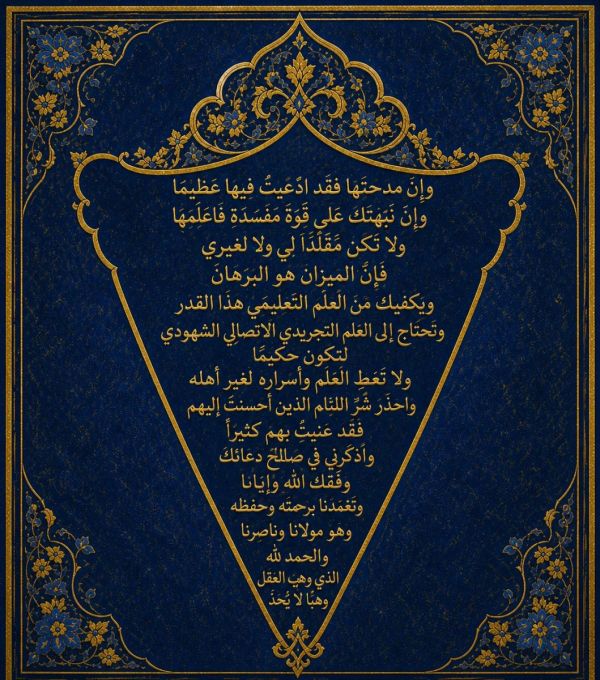
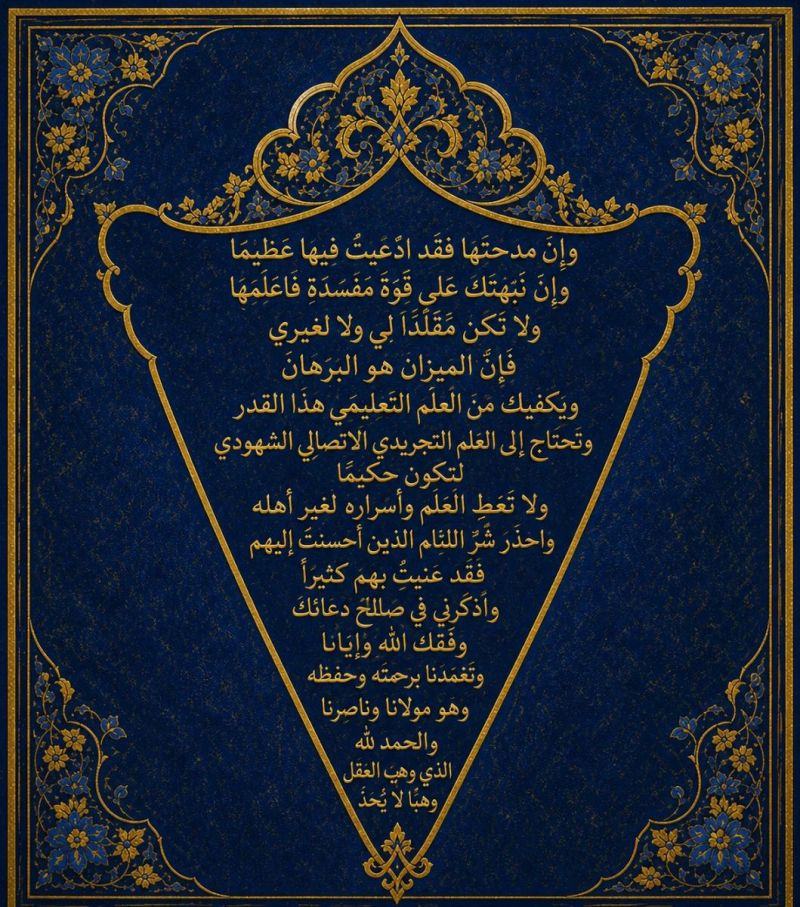
[Page 540] Colophon: If I had praised my [own] claims, I would have made great claims in it. If I have alerted you to a corrupting power, learn it, and do not imitate either me or anyone else—for the criterion is demonstration (burhān). This much of learning-based science (al-‘ilm al-ta‘līmī) suffices you. To become a sage, you need the science that is abstractive, unitive, and witnessed (al-‘ilm al-tajrīdī al-ittiṣālī al-shuhūdī). Do not give knowledge and its secrets to other than their rightful people! Beware the evil of the vile ones to whom you have done good—I have suffered much from them! Mention me in your good supplications! May God grant you and us success! May He envelope us in His mercy and protection! He is our Lord and Master! Praise be to God, who bestowed the intellect without end!
*
Source Notes from Turkish Edition
[Page 531, Note 1]: Reference to Ibn Kammūna, Commentary, Vol. III, p. 542, regarding the section on “Story and Dream.”
[Page 532, Note 1]: Reference to Ibn Kammūna, Commentary, Vol. III, p. 545. This note explains that according to Ibn Kammūna, this section addresses six key issues:
-
- The essence of the soul is existence, nothing added.
- The difference between the soul and the Necessary Being is only in perfection/deficiency.
- Separate Intellects are separate lights, their essence is existence.
- The species of Intellects is one; their realities do not differ.
- Differences in effects arise from ranks of existence and attached accidents.
- Composite species and spatial relations in our world arise from relations between Intellects and their configurations. (See Ibn Kammūna, Sharḥ, III, 545-556).



Leave a Reply