
A Contextual Introduction:
Auguste Viatte, A Scholar Between Worlds
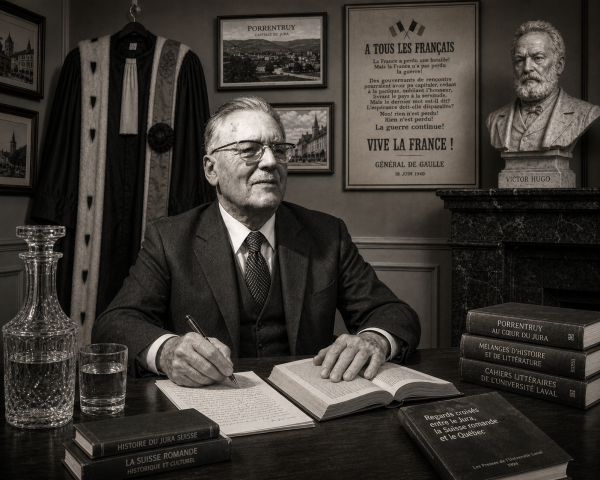
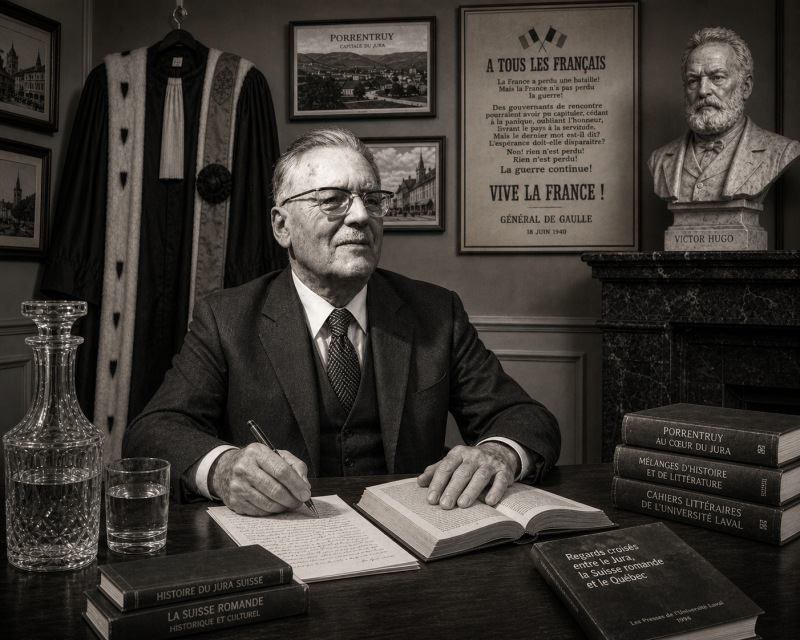
Born in Porrentruy, Switzerland, on June 27, 1901, Auguste Viatte held Swiss, French, and Canadian nationalities. His academic journey was remarkably precocious. At just twenty years old, he earned his first doctorate from the University of Fribourg with a thesis on the relationship between Catholicism and Romanticism. He continued at the Sorbonne in Paris, completing his doctorat d’État in 1927. At twenty-six, he became the youngest doctor of French academia. His seminal thesis, Les Sources occultes du romantisme (The Occult Sources of Romanticism), was published the following year in 1928.
His career as a professor took him across the Atlantic and back. He began teaching at Hunter College in New York in 1925 before being recommended by the French Academician Georges Goyau for a literary chair at Université Laval in Quebec, where he taught from 1933 to 1949.
During the Second World War, he was among the French living in Canada and the United States who, supporting General de Gaulle in Free France, opposed Marshal Pétain.
After the war, he returned to Europe, holding positions at the University of Nancy (1949–1952), the University of Zurich, and the ETH Zurich (1952–1967), before finishing his career at the University of Paris-Nord.
Beyond the academy, Viatte was a devoted champion of the French language and culture. He was a signatory of the Manifeste des intellectuels catholiques européens en Amérique alongside Jacques Maritain. A member of the Académie des sciences d’outre-mer, he was named an Officer of the Legion of Honour in 1987. A staunch Gaullist and antifascist, he was also the founder of the Prix France-Québec, reflecting his lifelong commitment to fostering connections between the Francophone worlds of Europe and the Americas. He passed away in Paris on November 21, 1993. An Auguste-Viatte collection is kept at the Archives of the Canton of Jura and at the Cantonal Library, in Porrentruy, Switzerland.
In the ‘Occult Sources of Romanticism’, his groundbreaking thesis (the work from which the short 1928 article below is drawn), Viatte argued that French Romanticism was not solely a product of Rousseau, Chateaubriand, or the Revolution. Instead, he insisted on the crucial importance of a strange, forgotten stream of esoteric thought: Illuminism.
For Viatte, this underground current of mystics, theosophers, and visionaries was one of the principal catalysts that transformed the rationalist France of the Enlightenment into a nation ready for the emotional upheaval of Romanticism. In doing so, he showed that the history of ideas is often shaped by forces that thrive in the shadows.
*
And now the text:
ILLUMINISM AND THE GENESIS
OF FRENCH ROMANTICISM
(Translated from Auguste Viatte’s 1928 original essay)
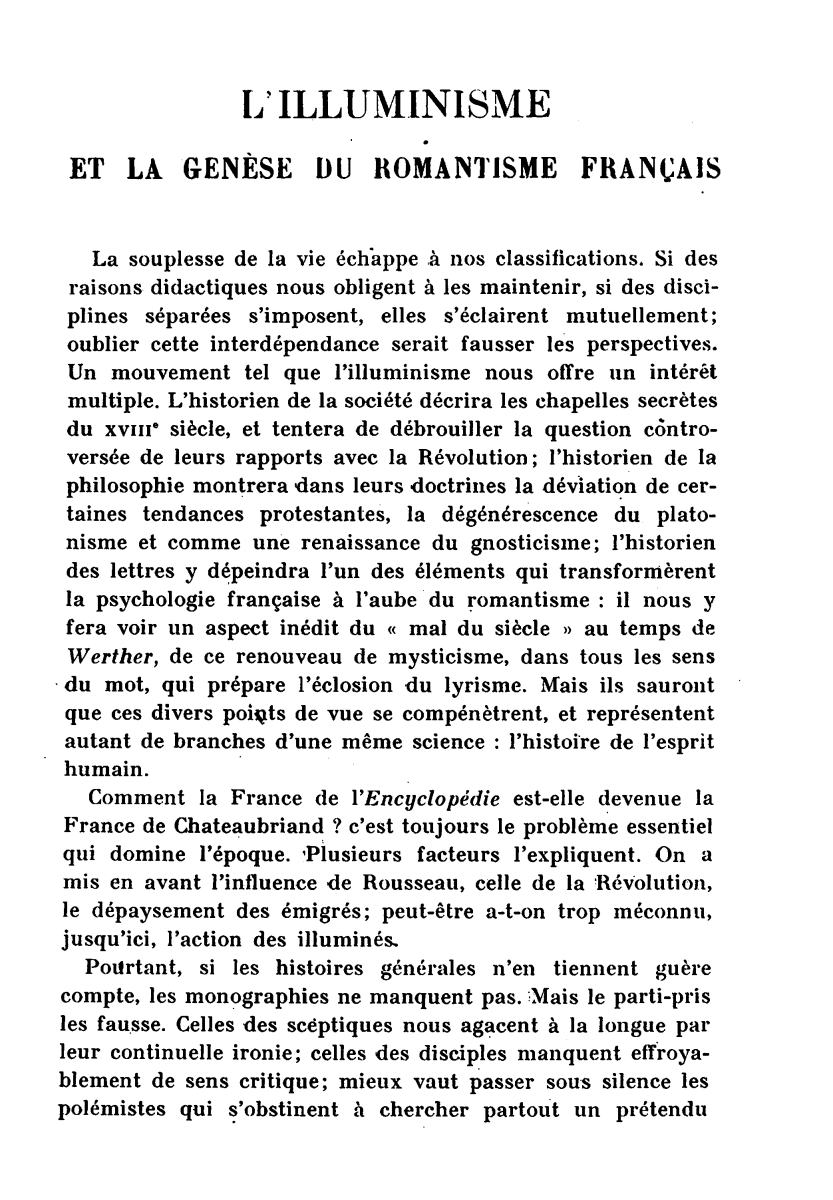
The flexibility of life escapes our classifications. If didactic reasons oblige us to maintain them, if separate disciplines are necessary, they illuminate each other; to forget this interdependence would be to distort perspectives. A movement such as illuminism offers us a multiple interest. The historian of society will describe the secret chapels of the 18th century and attempt to unravel the controversial question of their relations with the Revolution; the historian of philosophy will show in their doctrines the deviation of certain Protestant tendencies, the degeneration of Platonism and a kind of renaissance of Gnosticism; the literary historian will depict there one of the elements that transformed French psychology at the dawn of romanticism: he will show us an unpublished aspect of the ‘mal du siècle‘ (the disease of the age) in the time of Werther, of that renewal of mysticism, in every sense of the word, which prepares the blossoming of lyricism. But they will know that these various points of view interpenetrate each other and represent as many branches of the same science: the history of the human spirit.
How did the France of the Encyclopédie become the France of Chateaubriand? That is always the essential problem dominating the era. Several factors explain it. The influence of Rousseau, that of the Revolution, the disorientation of the émigrés have been put forward; perhaps the action of the illuminists has been too much overlooked until now.
However, if the general histories hardly take it into account, the monographs are not lacking. But bias distorts them. Those of the skeptics irritate us in the long run with their continual irony; those of the disciples are shockingly lacking in critical sense; it is better to pass over in silence the polemicists who obstinately seek everywhere an alleged revolutionary plot. The theoretical explanation of the facts matters little to us: whether one admits divine or diabolical manifestations, unknown natural forces, illusion, charlatanism, only one thing concerns history, and that is the facts themselves, the prestige exerted, even on good minds, by these bizarre doctrines. That is what we must describe. And since most monographs do not observe this objective method at all, we are forced to use them only judiciously; authentic documents must guarantee their veracity. Among these documents themselves, one will choose. Let us be wary of memoirists, who readily collect implausible gossip.
Let us consult, rather, the treatises in which the illuminists present their exoteric doctrine; but their deliberate obscurity requires long patience from the reader; he must familiarize himself with an entire vocabulary; enigmas will always remain. Correspondence provides us with another essential source; it is there that the initiates express themselves with the least restraint; it is through it that we also elucidate the allusions contained in certain literary works; whatever apparent analogy the texts offer, we must conclude nothing before possessing proof of tangible relations between their authors. The reading of manuscripts will therefore completely transform a study of this kind. They are grouped in certain well-defined regions: Paris and its surroundings, the Rhône valley, Switzerland and the Germanic or Scandinavian countries; borderlands where civilizations overflow onto one another, where representatives of all Europe meet. And this underlines one of the characteristic traits of illuminism, a phenomenon that is European much more than French, a phenomenon that can only be well explained in the light of comparative literature.
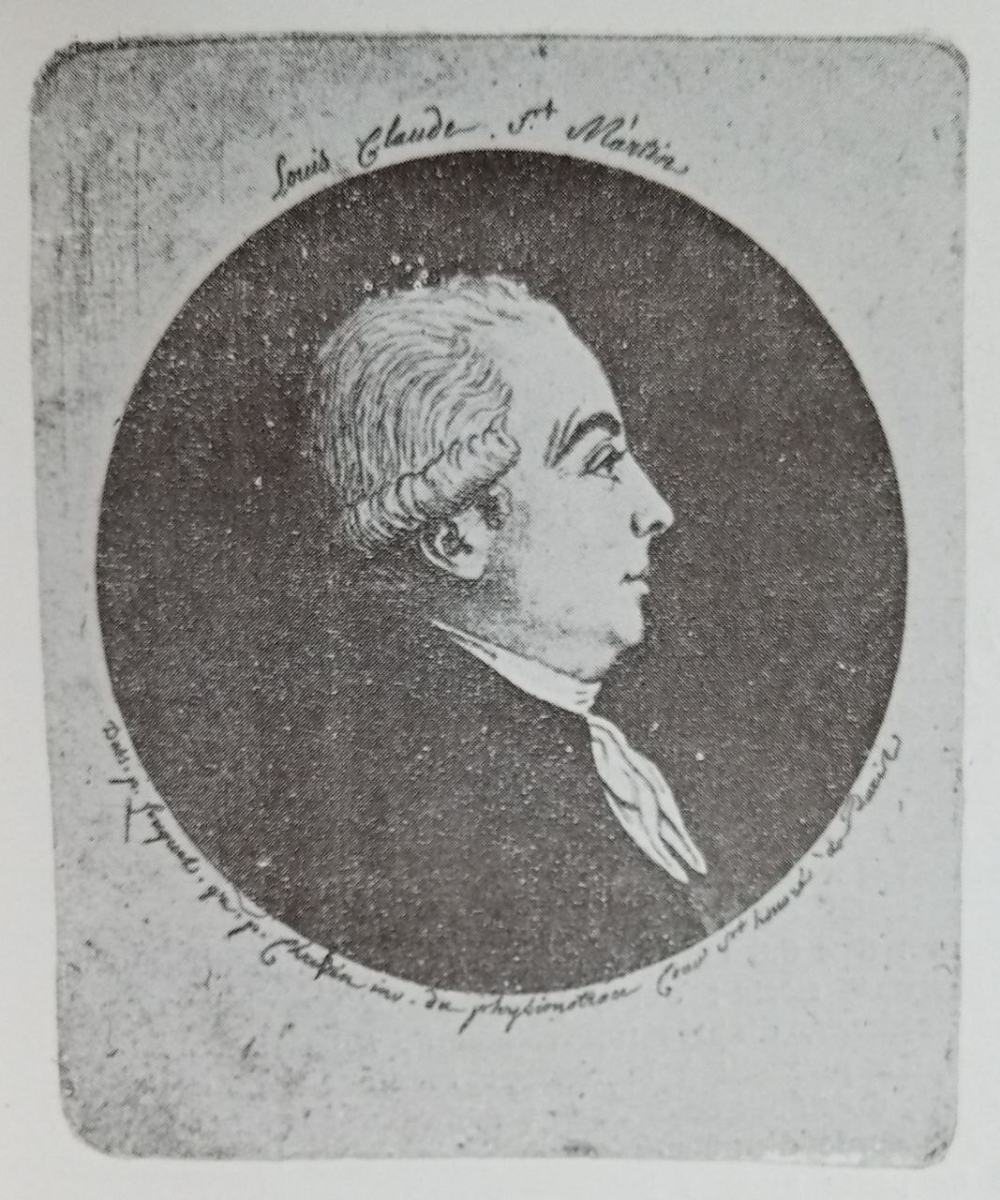
The complexity of this doctrine makes it quite difficult to distinguish periods in its evolution. Only one break strikes us: the one determined, in 1800, by the polemic of Barruel. If one takes the precaution of not imagining too rigid barriers, one can recognize five phases, over which, moreover, certain careers overlap, such as that of Saint-Martin; let us not seek to impose more order: that would be to disfigure a subject whose very essence is confusion.
I. The Origins. The origins of illuminism cannot be delimited; at all times, certain thaumaturges have claimed to be in relation with the Divinity, independently of the Churches; for twenty centuries, a certain number of ideas have crystallized into a genuine occult tradition; we would have to go back to Pythagoras to witness the emergence of these systems which never entirely died out; in the midst of the 17th century, at a time when a state religion was triumphant everywhere, Mme Guyon perpetuated them among Catholics, Gottfried Arnold and John Pordage among the Protestant Enthusiasts. But these systems exert a new attraction from the moment when the Encyclopédie shakes beliefs, when the divorce between reason and sensibility grows. Since the masters of the day flaunt a provocative rationalism, it is natural that others should raise the banner of sensibility, not only spiritual but physical. In reaction against salon life, some return to nature, others embrace even its nocturnal side, as the German theosopher Schubert says; and, at the same time, Mme de Warens, like Saint-Martin, attribute the first rank to quietist love. A new element, the Lodge, characterizes this renaissance. At all times, illuminism had willingly taken refuge in secret societies. Freemasonry, which will henceforth absorb it, comes from professional, occultist and political origins; two or three different sects merge under this name; this is what makes it so difficult to assess its role. Martines de Pasqually, the Swedenborgians, the Illuminated of Copenhagen, all the pseudo-mystics of 1770 use this framework. They appear to us as people terrified by mystery, distrustful of the uninitiated, proud to form the rare elite to whom the spiritual world is revealed.
II. The Salon Era. The fear of the secular arm, and also of ridicule, diminishes, and little by little the notoriety of illuminism spreads in the salons. There we meet apostles, Saint-Martin, Lavater; charlatans, such as Cagliostro, and scholars, like Mesmer, who arbitrarily interpret facts. Illuminism becomes a worldly curiosity. The ‘prophet‘ is listened to as one would look at a curious being; the ‘sensible‘ manifestations of the Most High are succeeded by the coarsest visions; they are ghosts, angels, it is Moses and Elijah descending from heaven to inaugurate the Cagliostrian Lodge of Lyon… Secret societies proliferate at cut-rate prices. Illuminism becomes vulgarized and parodied, so much so that a Saint-Martin, a Cazotte withdraw from it disgusted. But this spurious popularity earns it its first literary emergence, in the life of a Ramond, in the work of Cazotte, Sébastien Mercier, Restif de la Bretonne, Bonneville…
III. The Revolutionary Period. With the latter, we enter the revolutionary period; and one can say of illuminism what Sainte-Beuve says elsewhere of pre-romanticism in general: there was, around 1780, a first wave whose effect was postponed by the Revolution. And yet, just as the Revolution, despite its classical and Greco-Roman plastering, carries along ideas from Rousseau, so too it drains certain extreme currents of illuminism. This is the era when the quietism of the Duchess of Bourbon flourishes, and especially the neo-paganism of Restif and Bonneville. For the first time, illuminism asserts itself independent, not only of Catholicism, but of Christianity; the school thus born will not be long in growing. Nevertheless, the spread of mystical sects is interrupted; a polemic, illustrated by Robison and Barruel, cuts it short. Which historian will undertake the rigorous study of the Memoirs to Serve the History of Jacobinism? We would need to show its origin in that weakness which makes us attribute every great catastrophe to conspiracies, and which incites us to suspect every mysterious society of treachery. Then the detail of these affirmations would be examined. Regarding the Encyclopédie, they would be compared with those of Augustin Cochin, while observing that this historian attacks all the Societies of Thought of which the Lodges are only a part; a careful study of Freemasonry would distinguish, without doubt, the action of the Grand Orient and the rationalist lodges from that of the mystical lodges; regarding Bavarian illuminism, we would probably end up adopting the conclusions of Mr. Le Forestier.
Let us speak here only of illuminism in the French sense. It seems evident to me that Barruel is greatly mistaken about it. In the innumerable papers I have examined, I have not found the slightest trace of a plot – not even in the manuscripts that Corberon encrypted, nor in such a secret bundle of Willermoz’s papers, which the latter asked to be burned. A hypothesis that is not based on any evidence should not count in history, especially when, in the detail of the facts presented, the informed critic notes startling errors.
IV. The Empire. The Empire forms a new period, as important in itself as the other three. Napoleon does not like the idéologues, nor, for the same reasons, the illuminists. They therefore remain in the semi-darkness, and even, in general, leave Freemasonry, which has become too disciplined. Some prolong the sects of the 18th century; these are, in France, Gence, in Germany, Eckartshausen and Jung Stilling. Others accentuate a neo-pagan illuminism, foreign to the biblical tradition: these are Dupont de Nemours, Quintus Aucler, and especially Fabre d’Olivet, the first to combine neo-paganism with Hinduism at the same time when Schlegel and Görres, on the other side of the Rhine, were describing oriental myths. But at the same time, illuminism contaminates great literature. Chateaubriand, the negligent Bonald, although the former had knowledge of it; Joseph de Maistre incorporates into Catholicism what he can save from his youthful Martinism; Mme de Staël surrounds herself with mystics in whom she seeks sentimental comfort, and whom the example of Germany, saturated with theosophy, helps her to accept; Senancour finds in them food for his melancholy, and reasons to doubt his own sanity; Nodier, finally, sees in it a precious asset for the fantastic tale… So many very different states of mind which, nevertheless, lead to identical reveries…
V. The Renaissance. A renaissance begins with the passage of Mme de Krüdener in Paris. This is the era when the émigrés return, bringing in their baggage the seeds of a new lyricism. A prodigious number of sects are born and multiply. They are truly the spiritual daughters of the previous ones; they always claim to offer a third revelation, to preach the primitive Gospel, the secret meaning of the ‘Word‘, the magic that will make man master of the world and that connects him to God without the intermediary of the Churches: but they interpret all this in a concrete and even trivial way. Exceptions, perhaps, are Swedenborgianism, which congeals on the word of its master while seeking to add to it the heritage of Saint-Martin and the magnetizers. All the other sects emancipate themselves more and more from Christianity; they tend towards allegory, which often transforms these verbal mystics into rationalists in fact; the social element occupies a growing part in their speculations, so much so that the third revelation ends up being defined as a social revelation. This illuminism will culminate in the work of an Enfantin or a Pierre Leroux; Fourier, Wronski, already show us the roots of its transformation; and Ballanche appears to us as a transitional figure — Ballanche, disciple of Saint-Martin, of Fabre d’Olivet, although a Christian, but also persuaded that he must play the role of a kind of messiah or, at the very least, a social prophet.
Conclusion: What to conclude? Let us beware of generalizing. Illuminism is not the sole cause of romanticism; it is even a secondary cause compared to Rousseau, for example; it could not have developed without the sentimental upheaval communicated by the Savoyard Vicar; it is true that the latter would not be explicable either without Manon Lescaut, without Mme Guyon, and that by going back and forth from one path to another, we could go back very far. As soon as they abandon their own domain, as soon as they venture into literary theories, the illuminists show a deplorable banality.
The fact remains that they powerfully contributed to restoring to the rationalist world the notion of the supernatural, to germinating that mysticism independent of the Churches which would blossom into pure poetry, sometimes even to mixing into it the social intentions that would harm the purity of that poetry. Witnesses of a state of mind as much as a cause, we cannot say whether they anticipated pre-romanticism or whether they are a manifestation of it; causes and effects are constantly intertwined, and illuminism itself proves infinitely plastic — Christian and tolerant in 1780, revolutionary in 1790, pagan under the Empire… The same restlessness drove some towards nature and the shepherdesses of Trianon, others towards exoticism, melancholy, others towards theurgy and apparitions: all things that denounce this need for novelty, this unfulfilled yearning of the heart, this thirst for the infinite, always a sign of great moral upheavals, an indication of the rebirth of lyricism.
*
Reference Tables
Table 1: Index of People Mentioned in the Article
| Name | Explanation |
|---|---|
| Arnold, Gottfried (1666–1714) | German Lutheran theologian and church historian; his sympathetic treatment of mystical and heretical movements helped keep illuminist ideas alive within Protestantism. |
| Aucler, Quintus (18th–19th c.) | French neo-pagan author who sought to revive ancient religious forms outside Christianity. |
| Ballanche, Pierre-Simon (1776–1847) | French writer and philosopher; a transitional figure blending Christian mysticism, social prophecy, and illuminist ideas. |
| Barruel, Augustin (1741–1820) | French Jesuit priest and polemicist; author of Mémoires pour servir à l’histoire du jacobinisme (1797–98), which blamed the French Revolution on a conspiracy of illuminists, Freemasons, and philosophers. |
| Bonald, Louis de (1754–1840) | French counter-revolutionary philosopher and statesman; Viatte notes he neglected illuminism despite knowing of it. |
| Bonneville, Nicolas de (1760–1828) | French writer, publisher, and revolutionary; involved with mystical and illuminist circles; promoted neo-paganism. |
| Bourbon, Duchess of (1753–1821) | French princess and quietist; her piety was influenced by illuminist spirituality. |
| Cagliostro, Alessandro (1743–1795) | Italian adventurer and occultist; famous for his alleged magical powers, ‘Egyptian’ Masonic rituals, and often accused of charlatanism for what could have been a cover for deeper spiritual work. |
| Cazotte, Jacques (1719–1792) | French writer and mystic; author of fantastic tales; initially attracted to illuminism but later withdrew. |
| Chateaubriand, François-René de (1768–1848) | French writer and diplomat; a key figure of French Romanticism; Viatte notes he knew of illuminism but neglected it. |
| Cochin, Augustin (1876–1916) | French historian who studied the intellectual networks (‘Societies of Thought‘) preceding the Revolution, including Masonic lodges. |
| Corberon, Comte de (18th c.) | French diplomat and illuminist; encrypted his manuscripts; his papers showed no evidence of revolutionary conspiracy. |
| Dupont de Nemours, Pierre (1739–1817) | French economist (Physiocrat); later embraced a form of neo-pagan illuminism. |
| Eckartshausen, Karl von (1752–1803) | German Catholic mystic and theosopher; continued illuminist traditions into the Napoleonic era. |
| Enfantin, Prosper (1796–1864) | French social reformer and Saint-Simonian leader; Viatte sees him as concluding the social transformation of illuminism. |
| Fabre d’Olivet (1767–1825) | French occultist, philologist, and neo-pagan; combined neo-paganism with Hinduism; influenced Ballanche. |
| Fourier, Charles (1772–1837) | French utopian socialist; his ideas show roots in the social turn of later illuminism. |
| Gence (late 18th–early 19th c.) | French illuminist; continued 18th-century sects during the Empire. |
| Goerres / Görres, Joseph (1776–1848) | German Catholic writer; described Oriental myths alongside Schlegel, parallel to Fabre d’Olivet. |
| Guyon, Madame (1648–1717) | French quietist mystic; her spirituality influenced later illuminist currents. |
| Joseph de Maistre (1753–1821) | Savoyard philosopher and counter-revolutionary; incorporated elements of his youthful Martinism into Catholicism. |
| Jung Stilling, Johann Heinrich (1740–1817) | German physician, mystic, and writer; continued illuminist themes during the Napoleonic period. |
| Krüdener, Madame de (1764–1824) | Baltic German mystic and pietist; her arrival in Paris marked a new wave of illuminist revival. |
| Lavater, Johann Kaspar (1741–1801) | Swiss poet, physiognomist, and mystic; a prominent figure in illuminist salons. |
| Le Forestier, René (1868–1951) | French historian of Bavarian illuminism; his conclusions Viatte recommends adopting. |
| Leroux, Pierre (1797–1871) | French philosopher and utopian socialist; continued the social dimension of illuminism. |
| Martines de Pasqually (c. 1710–1774) | French occultist and theurgist; founder of the Élus Coëns (Elect Priests), a Masonic mystical order. |
| Mercier, Sébastien (1740–1814) | French writer; his works show early literary influence of illuminism. |
| Mesmer, Franz (1734–1815) | German physician; developed animal magnetism; interpreted by some as part of illuminist curiosity. |
| Napoleon Bonaparte (1769–1821) | French emperor; disliked both idéologues and illuminists, forcing the latter into semi-obscurity. |
| Nodier, Charles (1780–1844) | French writer; used illuminist themes in his fantastic tales. |
| Pordage, John (1607–1681) | English Anglican clergyman and mystical theosopher; founder of the Philadelphian Society; his writings continued occult traditions in 17th-century England. |
| Pythagoras (6th c. BCE) | Ancient Greek philosopher; Viatte traces occult traditions back to his teachings. |
| Ramond, Louis-François (1755–1827) | French writer and politician; his life reflected early literary illuminism. |
| Restif de la Bretonne (1734–1806) | French novelist; his work shows neo-pagan and illuminist elements. |
| Robison, John (1739–1805) | Scottish physicist and anti-illuminist polemicist; his Proofs of a Conspiracy (1797) linked illuminism to the Revolution. |
| Rousseau, Jean-Jacques (1712–1778) | Key precursor of Romanticism; his Savoyard Vicar provided the sentimental shock that enabled illuminism’s development. |
| Saint-Martin, Louis-Claude de (1743–1803) | French philosopher and mystic, known as ‘le Philosophe inconnu‘; leading figure of Martinism; withdrew from vulgarized illuminism. |
| Schlegel, Friedrich (1772–1829) | German Romantic writer and Orientalist; described Oriental myths alongside Görres. |
| Schubert, Gotthilf Heinrich von (1780–1860) | German theosopher and naturalist; spoke of embracing the ‘nocturnal side‘ of nature. |
| Senancour, Étienne Pivert de (1770–1846) | French writer; found in illuminism an expression of his melancholy and doubt. |
| Staël, Madame de (1766–1817) | French writer; surrounded herself with mystics and was influenced by German theosophy. |
| Swedenborg, Emanuel (1688–1772) | Swedish scientist, theologian, and mystic; his followers (Swedenborgians) formed a key illuminist current. |
| Warens, Madame de (1699–1762) | Rousseau’s protector; Viatte cites her quietist love as parallel to Saint-Martin. |
| Willermoz, Jean-Baptiste (1730–1824) | French occultist and Masonic reformer; his secret papers contained no evidence of conspiracy. |
| Wronski, Józef (1776–1853) | Polish messianist philosopher and mathematician; his work shows transformation of illuminism. |
Table 2: Index of Concepts
| Concept | Explanation |
|---|---|
| Encyclopédie (1751–1772) | The great French Enlightenment publication edited by Diderot and d’Alembert; its rationalism provoked a reaction in favor of sensibility and mysticism. |
| Freemasonry (Franc-maçonnerie) | Secret society that absorbed illuminist currents; Viatte distinguishes rationalist lodges (Grand Orient) from mystical lodges. |
| Gnosticism | Ancient dualist religious movement; Viatte sees 18th-century illuminism as a kind of Gnostic renaissance. |
| Grand Orient | The largest Masonic obedience in France; associated with rationalist, anti-clerical Freemasonry. |
| Illuminism | Esoteric, mystical movement claiming direct contact with the divine, independent of churches; a European phenomenon blending theosophy, magic, and sensibility. |
| Jacobinism | Revolutionary political movement; Barruel and others falsely linked illuminism to Jacobin conspiracies. |
| Lodge (Loge) | Masonic meeting place; became the primary framework for 18th-century illuminism. |
| Lyricism | Personal, emotional poetry; the rebirth of lyricism in Romanticism was prepared by illuminist mysticism. |
| Mal du siècle | The ‘disease of the age‘; Romantic melancholy and spiritual unease; illuminism offered an expression of this state. |
| Martinism | The mystical tradition derived from Saint-Martin and Martines de Pasqually; emphasized theurgy and inner spiritual rebirth. |
| Mysticism | Direct experience of the divine; 18th-century illuminism represented a renewal of mysticism outside church structures. |
| Neo-paganism | Revival of pre-Christian religious forms; appeared in some illuminist circles (e.g., Restif, Fabre d’Olivet). |
| Occult tradition | A hidden, continuous current of esoteric knowledge allegedly stretching back to antiquity (Pythagoras, Gnosticism, etc.); Viatte sees illuminism as its 18th-century manifestation. |
| Platonism | Ancient philosophy; illuminism was seen as a degeneration of Platonic ideas toward theosophy and gnosis. |
| Pre-romanticism | Cultural and literary trends before full Romanticism; illuminism was both a cause and a manifestation of pre-romantic sensibility. |
| Protestantism (specifically ‘Enthusiasm’). | Radical deviations within Protestantism claiming direct divine inspiration (the ‘Inner Light‘) and rejecting institutional authority; Viatte cites these as a primary source for illuminist doctrines. |
| Quietism | Mystical doctrine emphasizing passive contemplation and self-annihilation before God; influenced illuminist spirituality. |
| Revolution, French (1789–1799) | Major political upheaval; illuminism both contributed to its cultural context and was interrupted by it. |
| Romanticism | Artistic, literary, and intellectual movement; illuminism helped bring back the supernatural and prepare lyricism. |
| Savoyard Vicar (Vicaire savoyard) | A section of Rousseau’s Émile (1762); its sentimental deism prepared the ground for illuminist mysticism. |
| Societies of Thought | 18th-century intellectual networks (including Masonic lodges, academies, reading societies) that disseminated Enlightenment and, in some cases, illuminist ideas. |
| Theosophy | Esoteric philosophy seeking direct knowledge of God and spiritual beings; saturated German Romanticism. |
| Third revelation | Claim by illuminist sects to offer a new, final revelation (after the Old and New Testaments), often social or magical in content. |
Leave a Reply