
Circle of Transmission: The Living Loom
Eugène Canseliet – Alchemy In The 18th Century
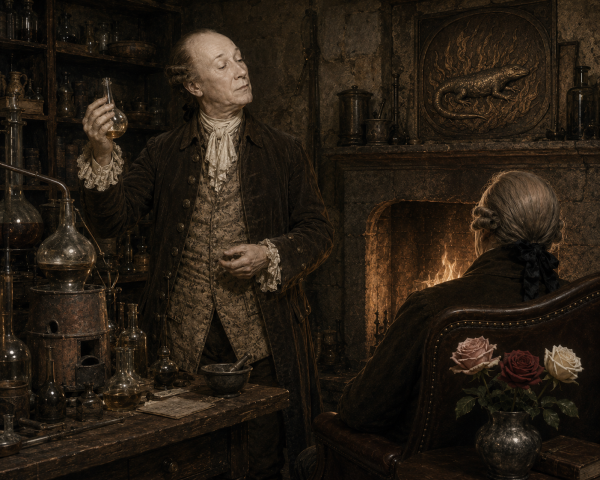
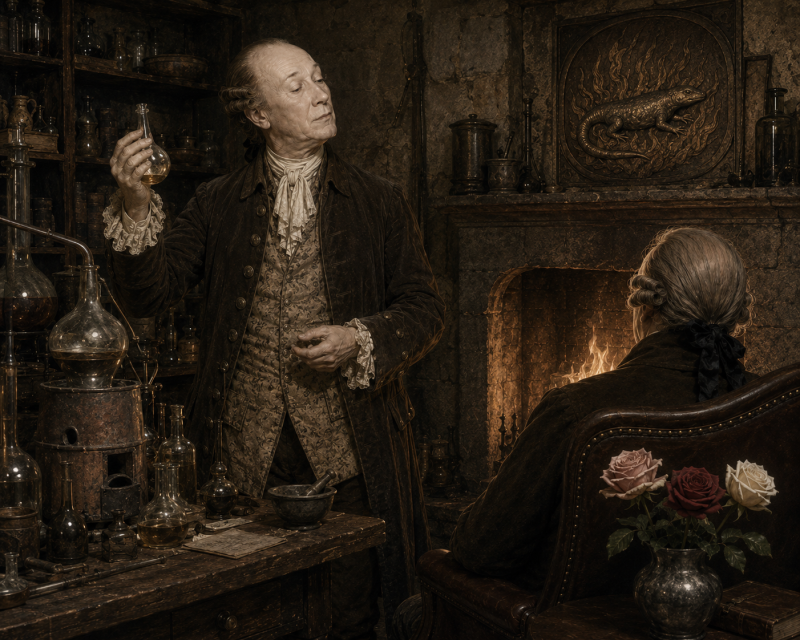
The Alchemist’s Laboratory
An 18th-century adept examines the First Matter,
while the salamander on the chimney
and the tri-colored roses hint at the stages of the Great Work.
*
Today’s selection from the Blue House of Via-HYGEIA features an article by Eugène Canseliet, originally published in the esteemed periodical La Tour Saint-Jacques (issues 2–4, 1960). Far from being a mere collector’s item, this text offers a panoramic view of 18th-century alchemical activity through the eyes of Fulcanelli’s disciple. Canseliet’s writing always rewards careful attention, and here, with his characteristic elegance and unassuming composure, he captures the spirit of the age, conveying praise while subtly suggesting—rather than insisting upon—precious clues regarding the Great Work.
This edition features the tragic tale of ‘Gold, Wine, and Death‘: the lamentable fate of the painter Jacques Touzay-Duchanteau. In an age where the Siècle des Lumières splintered into divergent paths, Canseliet contrasts the sober discipline of Hermetic Philosophy with the tragic confusion of misguided spiritualism. We explore the fate of Duchanteau, a disciple of the Illuminist Martinez de Pasqually, who fatally conflated the sacred pursuit of the Stone with a literal, materialist experiment (Sol sine veste). His story stands as a stark warning: when the inner light is sought through the violent forcing of nature, rather than through patient alignment with it, the result is not illumination, but destruction.
**
Eugène Canseliet
Alchemy In The 18th Century
“But Jesus answered them: Elias indeed shall come, and he shall restore all things.” (Matthew XVII, 11)
“Because Elias the Artist is already born and they announce the glorious things of the City of God.” (Introitus Philaletiae, Chap. XIII, § XXVIII)
However it may appear at first glance, Hermetic Science did not suffer in the 18th century from the disaffection shown to it in the following century, when thought was enslaved by a scientific materialism totally devoid of majestic horizons. Nevertheless, alchemy was not without undergoing the influence of the immense upheaval that agitated the elite of Western nations—nations won over by ideas of emancipation that were undoubtedly new, yet had no connection with true Philosophy. This term, as we have already stated, originally possessed a meaning very different from that abusively lent to it by the discordant chorus of the Encyclopedists.
It is undoubtedly a blessing that Hermetic Philosophy rose up as a powerful obstacle against the Illuminism from across the Rhine. In the second half of the 18th century, this movement threatened the integrity—both literal and figurative—of the Lodges of modern Freemasonry, which remained fundamentally faithful to the grandiose destiny of their distant origin and, consequently, subject to the universal laws governing the harmonious confection of the Great Work. How opposed, therefore, to philosophal elaboration were the Manichean and anarchic principles of Adam Weishaupt, nicknamed Spartacus! According to him, liberty and equality were accessible to men only through the annihilation of all civil and religious institutions, and principally, by the suppression of individual property. Meanwhile, the inquisitorial obligations imposed on each person towards themselves and others, not to mention public and oral confession, resulted, in short, in the most odious manoeuvres of a swiftly abhorred espionage.
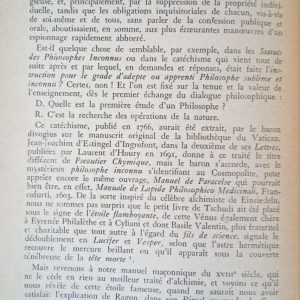
Is there anything similar, for example, in the Statutes of the Unknown Philosophers or in the catechism that immediately follows? In this text, presented in questions and answers, one finds the instruction for the grade of Adept or Apprentice to the sublime and unknown Philosophy. Certainly not! One is immediately struck by the tenor and value of the teaching, evident from the very first exchange of the philosophical dialogue:
Q. What is the first study of a Philosopher?
A. It is the search for the operations of nature.
This catechism, published in 1766, was supposedly extracted by Baron Tschudi from an original manuscript in the Vatican Library. Jean-Jacobin d’Estingel d’Ingrofont, in the second of his Letters published by Laurent d’Houry in 1691, gives this treatise the alternative title of Chymical Psalter. However, the Baron agrees with the mysterious Unknown Philosopher—who identifies himself with the Cosmopolite—in also calling the same work Paracelsus’ Manual. This might well indeed be the Manuale de Lapide Philosophico Medicinali (Frankfurt, 1603). Thus inspired by the famous alchemist of Einsiedeln, we are not surprised that Tschudi’s little book was placed under the sign of the Blazing Star, of that Venus equally dear to Eyrenée Philalèthe and to Cyliani. Basile Valentin, more fraternal and charitable than any other towards the son of science, points out its splitting into Lucifer and Vesper, depending on whether the Hermetic star covers the brilliant Mercury or appears under the dark cover of the death’s head (Cf. The Twelve Keys of Philosophy, Les Editions de Minuit, 1956, pp. 93–94).
But let us return to our 18th-century Masonic manual, which is in no way inferior to the best alchemical treatises, and let us see what it reveals about this famous star, should the explanation given by Ragon in his Ritual of the Fellow Craft not have satisfied us:
Q. What idea would you give me of nature?
A. It is not visible, although it acts visibly, for it is only a volatile spirit which does its office in bodies, and which is animated by the universal spirit, known in vulgar Masonry under the respectable emblem of the Blazing Star.
Q. What does it positively represent?
A. The divine breath, the central and universal fire, which vivifies all that exists.
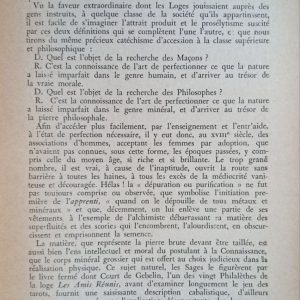
Given the extraordinary favour which the Lodges enjoyed among educated people of all social classes, it is easy to imagine the attraction produced and the proselytism aroused by these two complementary definitions. We draw further insights from the same precious catechism regarding access to the superior and philosophical class:
Q. What is the object of the search of Masons?
A. It is the knowledge of the art of perfecting what nature has left imperfect in the human race, and of arriving at the treasure of true morality.
Q. What is the object of the search of Philosophers?
A. It is the knowledge of the art of perfecting what nature has left imperfect in the mineral kingdom, and of arriving at the treasure of the Philosopher’s Stone.
In order to more easily attain, through teaching and mutual aid, the necessary state of perfection, there existed in the 18th century associations of men accepting women by adoption. These had not been known, in this form, in past ages, not even in the Middle Ages, so rich and brilliant though they were. The excessive number of members, it is true, due to ineptitude, opened the way without barrier to all hatreds and all the excesses of vainglorious and discouraged mediocrity. Alas! The necessary depuration was not always understood or observed. This is symbolized by the first initiation of the apprentice, ‘when he is stripped of all metals and minerals’…and when, decently, part of his clothing is removed. This follows the example of the alchemist ridding his matter of the superfluities and scoriae which encumber it, weigh it down, and obscure or imprison the seed.
The matter, represented by the rough stone to be cut, is as much the intellectual and moral being of the postulant for Knowledge as it is the gross mineral body offered to judicious choice in physical realization. The Sages represent this natural subject by the closed book. Court de Gebelin, one of the twenty Philaletheans of the lodge Les Amis Réunis, provides a striking cabalistic description of it before examining the game of Tarot at length. Moreover, his description is not supported by the disconcerting explanation of the cards usually given:
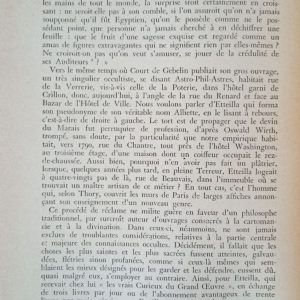
Surprise that the discovery of an Egyptian Book would cause.
‘If it were announced that there still exists today a Work of the ancient Egyptians, one of their Books escaped from the flames that devoured their superb libraries, and which contains their purest doctrine on interesting subjects, everyone would doubtless be eager to know such a precious, so extraordinary a Book. If it were added that this Book is very widespread in a large part of Europe, that for centuries it has been in everyone’s hands, the surprise would certainly grow: would it not be at its peak, if it were assured that it was never suspected of being Egyptian, that it is possessed as if not possessing it, that no one has ever sought to decipher a single leaf: that the fruit of exquisite wisdom is regarded as a heap of extravagant figures which mean nothing by themselves? Would one not think that they want to amuse themselves, to play with the credulity of their Listeners?’ (Cf. Le Monde Primitif analysé et comparé avec le monde moderne… Paris, 1781, p. 365).
Around the same time that Court de Gebelin was publishing his large work, a very singular occultist calling himself ‘Astro-Phil-Astres‘ lived on the Rue de la Verrerie, opposite the Rue de la Poterie, in the Crillon Hotel; thus, today, at the corner of the Rue du Renard and facing the Bazar de l’Hôtel de Ville. We refer to Eteilla, who formed his pseudonym from his real name, Alliette, by reading it backwards (from right to left). It is a mistake to propagate the idea, per Oswald Wirth, that the diviner of the Marais was a wigmaker by profession. Wirth was doubtless misled by the particularity that our empiricist lived, around 1790, on the Rue du Chantre, very close to the Washington Hotel, on the third floor of a house whose ground floor was occupied by a hairdresser. Besides, why not have made him a plasterer, when, a few years later, in the midst of the Terror, Eteilla lodged eighty paces away on the Rue de Beauvais, in a building where there was a master craftsman of that trade? In any case, he is the man who, according to Thory, covered the walls of Paris with large posters announcing his teaching of a new kind.
This advertising method does not exactly argue in favour of a traditional philosopher, especially one who authored works devoted to cartomancy and divination. Nevertheless, troubling considerations relating to the central and major part of occult knowledge are never excluded from these works. Decidedly, the most holy and sacred things had to be attacked, debased, and tarnished, if not profaned, as if those best designated to guard and defend them were compelled, almost despite themselves, to work to the contrary. Thus, for Eteilla, who received at his home “the true Curious of the Great Work” in exchange for three livres per day or the advantageous subscription of thirty livres per month; thus, for Eteilla, Magophon wrote these few benevolent lines in his commentary in hypotyposis on the Mutus Liber, which give much food for thought:
“In The Seven Nuances of the Philosophical Work, Eteilla, who was perhaps worth more than his reputation, seems to have obtained some satisfactory result from a similar moss; but one must read his booklet with good glasses.”
This little book, undated except for the date of 1785 borne by the King Louis XVI coin (obverse and reverse) at the bottom of the symbolic plate, tells us indeed on page 3:
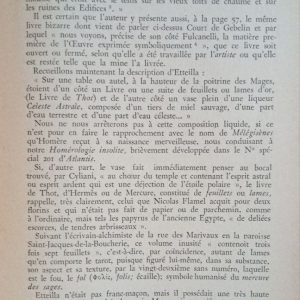
“This first matter seems to me quite well to be this light moss which grows with time on old thatched roofs and on the ruins of Buildings.” (Cf. We mentioned, in the first Cahier de la Tour Saint-Jacques entitled La Drogue, p. 55, this excrescence of which Thomas Corneille notes in his Dictionary that it also comes from the oak, “which has given it the name Usnée”).
It is certain that the author also presents on page 57 the same strange book just mentioned above by Court de Gebelin, and by which, “we see,” specifies Fulcanelli on his side, “the first matter of the Work expressed symbolically,” whether this book is open or closed, depending on whether it has been worked by the artist or whether it has remained as the mine delivered it. (Cf. Le Mystère des Cathédrales, Omnium Littéraire, Paris, 1957, p. 144).
Let us now gather Eteilla’s description:
“On a table or altar, at the height of the chest of the Magi, were on one side a Book or a set of leaves or plates of gold, (the Book of Thoth) and on the other side a vase full of a Celestial Astral liquor, composed of a third of wild honey, one part of earthly water and one part of celestial water...”
We will not dwell on this liquid composition, except to draw a parallel with the name of Melégisènes that Homer received at his marvellous birth, leading us to our unusual Homerology, briefly developed in special issue No. 201 of Atlantis.
If, on the other hand, the vase immediately brings to mind the jar found by Cyliani, “in the choir of the temple and containing the astral spirit or ardent spirit which is a dejection of the polar star,” the Book of Thoth, of Hermes or of Mercury, made of leaves or plates, very clearly recalls the one that Nicolas Flamel acquired for two florins. It was not made of paper or parchment, as usual, but like the papyri of ancient Egypt, “of thin barks, of tender shrubs.”
According to the writer-alchemist of the Rue des Marivaux in the parish of Saint-Jacques-de-la-Boucherie, this unusual volume “contained three times seven leaves,” that is, by coincidence, as many plates as the Tarot contains. Since it is itself figured, in its substance, aspect, and texture, by the twenty-second card, without number, which is the Fool, the Madman (Φολία, folis; scaly): the humanized symbol of the Mercury of the Sages.
Eteilla was not a Freemason, but he had a very high idea of what he called true Masonry, showing for everything related to it “as much respect as a Brother can have who knows its origin and conceives its purpose, Wisdom and the High Sciences.” That is why he advocated nothing less than suppressing all trials in the Lodges, then retaining only that of interpreting the Book of Thoth and of putting the unique thing in the vase, in order to lead it to its state of sublime perfection.
If we have stated that Eteilla did not belong to Freemasonry, it is because he himself declared it in the small treatise on the perfection of metals which accompanies The Seven Nuances of the Work, and which is entitled The Poor Man’s Penny. Four words whose initials, frequently and deliberately repeated by Alliette, do not fail to strike us: L.D.D.P. Would they not recall the famous initials L.P.D. (Lilia Pedibus Destrue; Crush the lilies underfoot), renewing the instruction in a formula by which Monsieur de Voltaire ended his epistles to the Encyclopedists: Crush the infamous one! In short, Eteilla would have completed and put in order the same initials which, from then on, clearly show a Masonic origin, since they relate to the grade of Knight of the East or of the Sword: Le Droit De Passage (The Right of Passage).
“A Golden Knight lived towards the east,” tells us Basile Valentin, “called Orpheus, who abounded in immense riches and who excelled in all good things.” (Cf. Basile Valentin, Les Douze Clefs de la Philosophie).
It is easy to conceive that the socially revolutionary ideal could not harmonize with Hermetic and Traditional Philosophy which, very fortunately for all humanity, had until then curbed all brutal and fatal progression in the experimental and scientific domain. The tri-logic motto, attributed, it is believed, to Louis-Claude de Saint-Martin, which was soon to become that of the French Republic of 1792, could not suit the Royal Art; and curiosity, avidity, or impatience could not fail to trigger perilous and dramatic consequences.
There is no more convincing or more merciless illustration of the fate reserved for unworthy projects, whether born of inconsistency, delusion, or pride, than the lamentable end of the painter Jacques Touzay, alias Duchanteau. A disciple of Martines de Pasqually, this Masonic brother of Les Amis Réunis devoted himself to alchemy in the laboratory adjoining the Lodge, which was without doubt the most important among those in Paris. It was there that the alchemist carried out the, to say the least, extravagant experiment which made him voluntarily more famous than the little book, yet so full of wisdom, ordinarily attributed to him.
Baron d’Holbach had translated some twenty years earlier, at the same time as The Art of Glassmaking by Johann Kunckel von Löwenstern, the booklet by Jean-Christian Orschall. Written in German despite its Latin title, Sol sine veste (The Sun without clothing), it prompted a question: How did the idea come to Duchanteau to repeat, on his own person and freely, the abominable cohabitation that another suffered as a supreme punishment? Was he seduced by Orschall’s declaration in this small treatise, that gold, wine, and man are the noblest productions of Nature and that they maintain for each other the most marvellous sympathy? Certainly, alas, and all the more so because, according to the testimony of Jean-Joachim Becher, the inspector of mines of Hesse-Cassel immediately specifies that gold is in the mineral kingdom, wine in the vegetable kingdom, the serpent in the animal kingdom, and that man, as a small world—sicut microcosmus—contains within himself everything that these three different actors contain.
The dramatic facts, transmitted by Orschall to illustrate his point in the spiritual exaltation of the era preceding another very near and less noble one, were not without pushing Duchanteau to the blind and absurd determination which was quickly to lead him to his death.
Here is what the Abbot of the magnificent convent of Augustinians in Saint-Florian, in Upper Austria, had told Orschall, and which the latter reports, leaving everyone free to believe what they will:
“In a famous monastery, a Religious committed a crime for which he was condemned to death. The Prelate of that time, who was a curious man, promised the guilty man to grant him life, if he could resolve to suffer everything that would be undertaken on him; this wretch, having more fear of death than of all the torments he exposed himself to endure, accepted the proposition all the more willingly as it left him hope of escaping; he was locked up; he was carefully guarded; he was given nothing to drink or eat, and he was obliged for all nourishment to drink his urine as soon as he had passed it, which he did up to twenty times. A diet as rigorous as this reduced this wretch to a pitiful state; for the urine, coming out with pain, burned him sharply and came the last time completely red. This man, who previously was of good build, who had a fine complexion and much wit, not only lost all his embonpoint, but became so thin that he was no longer recognisable; his face was disfigured like that of a corpse; his mind was deranged, and he died on the fourth day. The Prelate carried out Experiments on this urine and found in it the property of a universal dissolvent; after having dissolved the gold radically, it made it rise to the top of the capital in distillation…” (Cf. Neri, Meret et Kunckel, L’Art de la Verrerie. Paris, chez Durand ou chez Pissot, 1752, pp. 478–479).
The irresistible and vast movement towards a generalisation—let us rather say a vulgarisation—of Hermetic Science, aggravated by the incompatible proximity of revolutionary concepts, could not fail to push alchemists and, a fortiori, Adepts towards a more rigorous respect for traditional discretion. We must specify again, even if we end up seeming to repeat ourselves, that we use the term Adept here, not in the sense of partisan or follower, but with the meaning that we provided in our preface to the second edition of Les Demeures Philosophales, the first volume of which will appear next August from Omnium Littéraire:
“According to the Latin word adeptus, the alchemist, from then on, has received the Gift of God, or better still the Present, in the cabalistic play of the double connotation emphasising that he henceforth enjoys the infinite duration of the Actual. Adepti dicuntur in arte chimica — Adepts are said in the chemical art — specifies Du Cange, who also indicates the synonym Mystæ (Myste), exactly those who have attained the highest initiation (imo ἐποπτικὴ).”
As for the age of the Adept, of which the latter sometimes seems to speak complacently, as was the case for Eyrenée Philalèthe, the opinion of Baron Tschudi corroborates that of Fulcanelli and authorises, in this respect, our frequent remarks:
Q. What is the age of a Philosopher?
A. From the moment of his researches until that of his discoveries: he does not grow old.
(Cf. “I, Adept, the anonymous philosopher Philalethes, in the year of the redeemed world one thousand six hundred and forty-five, on the other hand the thirty-third of my age; Adepto me, anonymo Philalethâ philosopho, anno mundi redempti millesimo sexcentesimo quadragesimo quinto, aetatis autem meae trigesimo tertio.” (Introitus, Praefatio.) Joannes Langius, in the Amsterdam edition (1667), even gives the age of twenty-three years; vigesimo tertio).
Here is what we observed in a study which, along with several others by various authors, will accompany the translation of Holmyard’s book, to be published, magnificently illustrated and very soon, by Arthaud:
“Having reached this glorious extremity of his career, the Adept simultaneously dies to the fugitive present of illusory contingencies and is born to the unique and antagonism-free existence, in omnipresence and perpetuity. There ends his age, which he was accustomed to count from the day when the need had seized him to submit the great problem to experiment and to ascend to the Creator through the intermediary of created matter.”
That the valuable alchemists and the Adepts, conforming, moreover, to the ethnic imperatives of the century in ebullition under the ‘universals’, therefore entrusted nothing to printers, does not mean, for all that, that they renounced the transmission of learned messages. We have proof of this in the unpublished manuscripts that we know, in originals or equally rare copies, whether they were found in Fulcanelli’s library, or whether they were kindly communicated to us by Parisian booksellers, in a past already distant where the purchase of books was easier for us.
Thus we can cite, from the end of the 18th century, originating from unknown, solitary authors perfectly initiated into the Great Art by an amateur who added in a note: Mr Desaint, doctor, rue Hacinthe, porte St-Michel, lent me the manuscript on which I made this copy.
Mysterious Torch of Hermetic Philosophers, whose title page provides all the desirable information: Composed of twenty-one plates in hierographic figures, painted in natural and occult colours with the explanation of the subjects for the facility and intelligence of the Children of the art in the conduct and perfection of the Great Work. By an amateur of Truth.
We call the reader’s attention very specially to the number of these symbolic plates.
A treatise, as little known as the two preceding ones, bears the name of Kerdanec de Pornic, who nonetheless leaves it anonymous and perhaps conceals an Adept, even though he presents himself as a disciple of the famous Benedictine Dom Antoine-Joseph Pernety, founder of the Illuminati of Avignon. Kerdanec de Pornic did not fear to declare that he “began this writing on 24 June 1703, the very day of his first transmutation, in sincere testimony, and finished it on the 31st of the same month.”
This last date does not exist in the human calendar and it was used with the double aim of reaching the number seven and of eliciting observation. As a result, one must infer that it is exact and that it concerns the last day of May, if one wishes to remain in agreement with the external and cosmic conditions indispensable to the success of the elaboration.
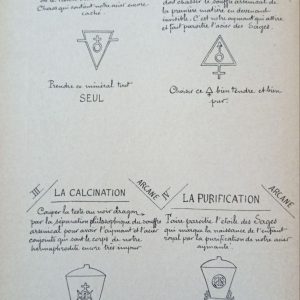
We hope that amateurs and sons of science will be sensitive to the four small pages that we offer them in facsimiles and whose clarity, as regards practice, will not fail to surprise and enthuse them. Here they are as we detached them from the Book of the XXII Hermetic Leaves which we once copied, cursively and freehand, from the presumably original minute, and “each of which reveals a Spagyric Arcana and clearly shows one of the twenty-two operations or doors of the true practice explained in signs intelligible to all sincere disciples who seek the Light of Augmentation”.
Concerning the works depicted by these four plates, with no more obscurity than is borne by the current symbolism proper to ancient spagyria, a treatise belonging to the most classical alchemy provides us, in several places, with an excellent and minute gloss, itself based on the Twelve Keys of Basile Valentin. This work was written by Sabine Stuart de Chevalier, Scottish by birth, based on the lessons her husband gave her ‘in good French’, and, notwithstanding some disorder, it offers the researcher astonishing resources. Indeed, the work, published in 1781 in Paris by Quillau, bookseller, Rue Christine, pivots around the unique subject of the Sages, and responds, throughout its two volumes, to the promises of its title:
Philosophical Discourse on the Three Principles, animal, vegetable and mineral or the Key to the Philosophical Sanctuary.
| Figure | French Original (from Manuscript) | English Translation |
|---|---|---|
| 1. L’EXTRACTION
(Arcane I) |
La première matière c’est un dragon noir et tout couvert d’écailles. On le trouve dans la terre. C’est notre Chaos qui contient notre acier encore caché. Prendre ce minéral tout SEUL | The first matter is a black dragon all covered with scales. One finds it in the earth. It is our Chaos which contains our steel still hidden. Take this mineral all ALONE. |
| 2. L’ATTRACTION
(Arcane II) |
Le souffre secret et visible qui doit chasser le souffre arsenical de la première matière en devenant combustible. C’est notre aimant qui attire et fait paraître l’acier des Sages. Choisir ce ♀ bien tendre et bien pur. | The secret and visible sulfur which must drive out the arsenical sulfur from the first matter by becoming combustible. It is our magnet which attracts and makes the steel of the Sages appear. Choose this ♀ (Copper/Venus) very tender and very pure. |
| 3. LA CALCINATION
(Arcane III) |
Couper la tête au noir dragon par la séparation philosophique du souffre arsenical pour avoir l’aimant et l’acier conjoints qui sont le corps de notre hermaphrodite encore très imparfait. Broyer en poudre & ajouter le ☉ au demy-poids y mélanger ensuite du ♄ noir. Faire un △ violent. On obtient le ♂ des Sages par la mort du ☉ dans le corps du ♀ il faut le chasser par le ♃. | Cut off the black dragon’s head by the philosophical separation of the arsenical sulfur, so as to have the magnet and the steel joined together, which are the body of our hermaphrodite still very imperfect. Grind into powder & add the ☉ (Sun/Gold) at half-weight, then mix in black ♄ (Saturn/Lead). Make a violent △ (fire). One obtains the ♂ (Steel/Mars) of the Sages by the death of the ☉ (Sun/Gold) in the body of the ♀ (Venus/Copper); one must drive it out by the ♃ (Jupiter/Tin). |
| 4. LA PURIFICATION
(Arcane IV) |
Faire paraître l’étoile des Sages qui marque la naissance de l’enfant royal par la purification de notre acier aymanté. Réduire en poudre & calciner avec ☉ subtilement. Faire un △ très violent & recommencer trois fois en retirant ♃ par la fonte des ♄. | Make appear the star of the Sages which marks the birth of the royal child by the purification of our magnetized steel previously hidden. Reduce to powder & calcine subtly with ☉ (Sun/Gold). Make a very violent △ (fire) & repeat three times, removing ♃ (Jupiter/Tin) by the melting of ♄ (Saturn/Lead). |
Note on Symbols: The text uses standard 18th-century alchemical/planetary symbols: ☉ (Sun / Gold), ♀ (Venus / Copper), ♂ (Mars / Philosophical Steel), ♄ (Saturn / Lead), ♃ (Jupiter / Tin), and △ (Fire).
The same year, 1781, appeared in Berlin and Leipzig the Aurea Catena Homeri — Homer’s Golden Chain — under the title Annulus Platonis — Plato’s Ring. This inestimable treatise is attributed to Naxagoras (Johannes Eques von), and our friend, Jean-Louis Bédouin, recently discovered and acquired an unpublished French translation, elegantly written and superior to the three we know, including that of citizen Dufournel.
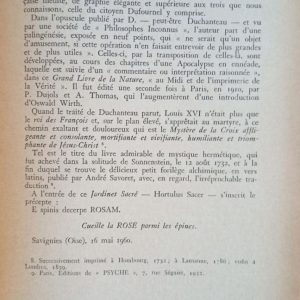
In the booklet published by D. — perhaps Duchanteau — and seen by a society of ‘Unknown Philosophers‘, the author starts from a palingenesis, set out in nine points, which “would only be an object of amusement, if this operation did not allow a glimpse of greater and more useful ones”. These, by the transposition of the former, are developed in the chapters of an Apocalypse in ennead, which is followed by a “commentary or reasoned interpretation”, in this Great Book of Nature, “in the South and from the printing press of Truth”. It was published a second time in Paris in 1910 by Pierre Dujols and Alberic Thomas, who augmented it with an introduction by Oswald Wirth.
When Duchanteau’s treatise appeared, Louis XVI was no longer anything more than the King of the French and, on the high plane, was preparing for martyrdom, for that exalting and painful path which is the Mystery of the Cross affiliated against the consoling, mortifying and vivifying, humiliating and triumphant [side] of Jesus Christ. (Cf. Successively printed in Homburg, 1732; Lausanne, 1786; finally in London, 1859).
Such is the title of the admirable book of Hermetic mysticism, Le Mystere de La Croix (The Mystery of the Cross) attributed to ‘Douzetemps‘, which was finished in the solitude of Sonnestein on 12 August 1732, and at the end of which is found the delicious little alchemical florilegium, in Latin verse, published by André Savoret, with, facing it, the irreproachable translation. (Cf. Paris, Editions de ‘PSYCHE’, 7, rue Séguier, 1953).
At the entrance to this Sacred Little Garden
— Hortulus Sacer — is inscribed the precept:
E spinis decerpe ROSAM.
(Pluck the ROSE from among the thorns.)
Savignies (Oise), 16 May 1960.
*
Source
*
***
Related Articles


Leave a Reply