
Circle of Transmission: The Living Loom
A Little ‘Petrus Talemarianus’ Sampler – Part V: Plato’s Description of Atlantis

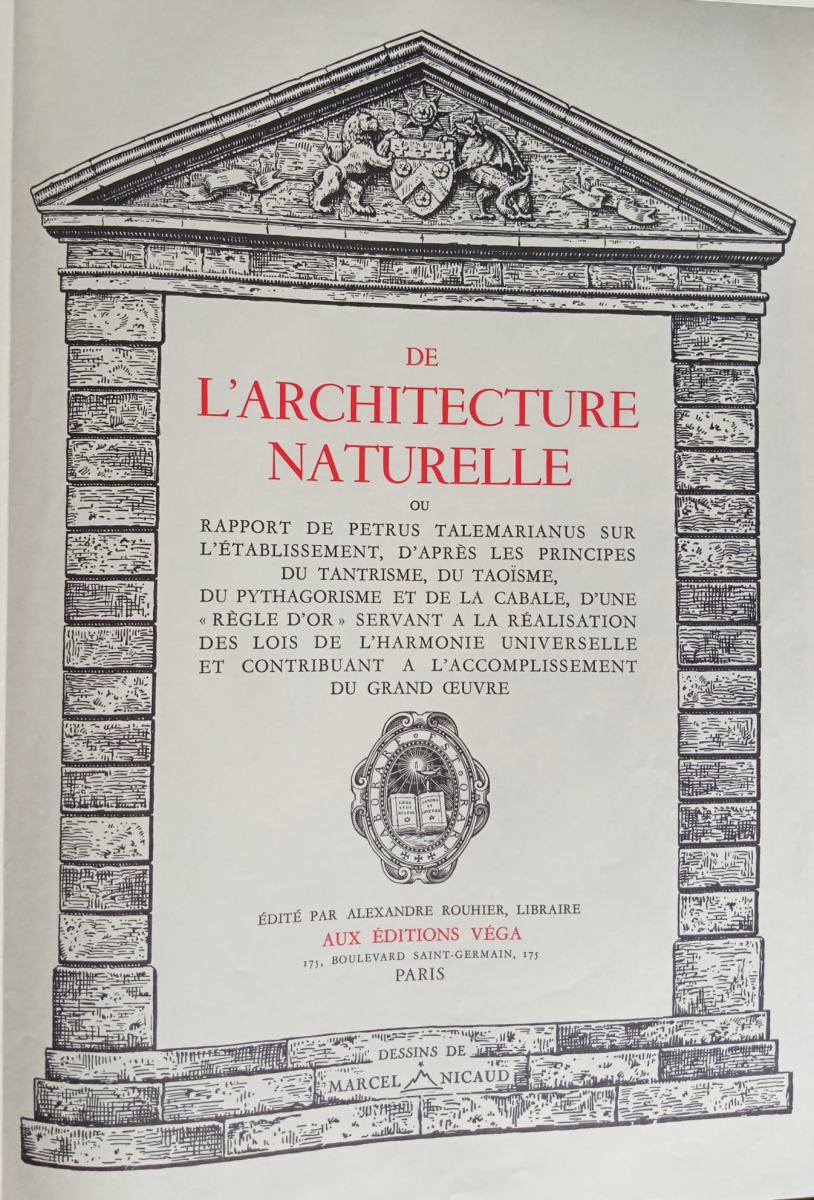
Title page of the 1983 reprint
of the ‘Petrus Talemarianus’.
*
Today’s sharing from the Blue House of Via-HYGEIA presents ‘Plato’s Description of Atlantis’, an excerpt from the second edition (1983) of ‘De l’Architecture Naturelle’ by ‘Petrus Talemarianus‘ (pp. 305–309 + Appendix). A Via-HYGEIA Bibliotherapy English translation of the original French.
The pseudonym ‘Petrus Talemarianus‘ conceals a circle of French esotericists and scholars active in the early-to-mid 20th century, likely led by the mathematician Francis Warrain (1867–1940), alongside hermeticist Alexandre Rouhier, Tibetologist Jacques Bacot, and illustrator Marcel Nicaud.
This text offers a remarkable synthesis of Platonic cosmology, sacred geometry, and comparative mythology. It interprets Plato’s Timaeus and Critias not as mere history, but as a blueprint of symbolic architecture embodying the metaphysical opposition of Athens (Yang, Fire, the ‘Same’, cubic) and Atlantis (Yin, Water, the ‘Other’, circular).
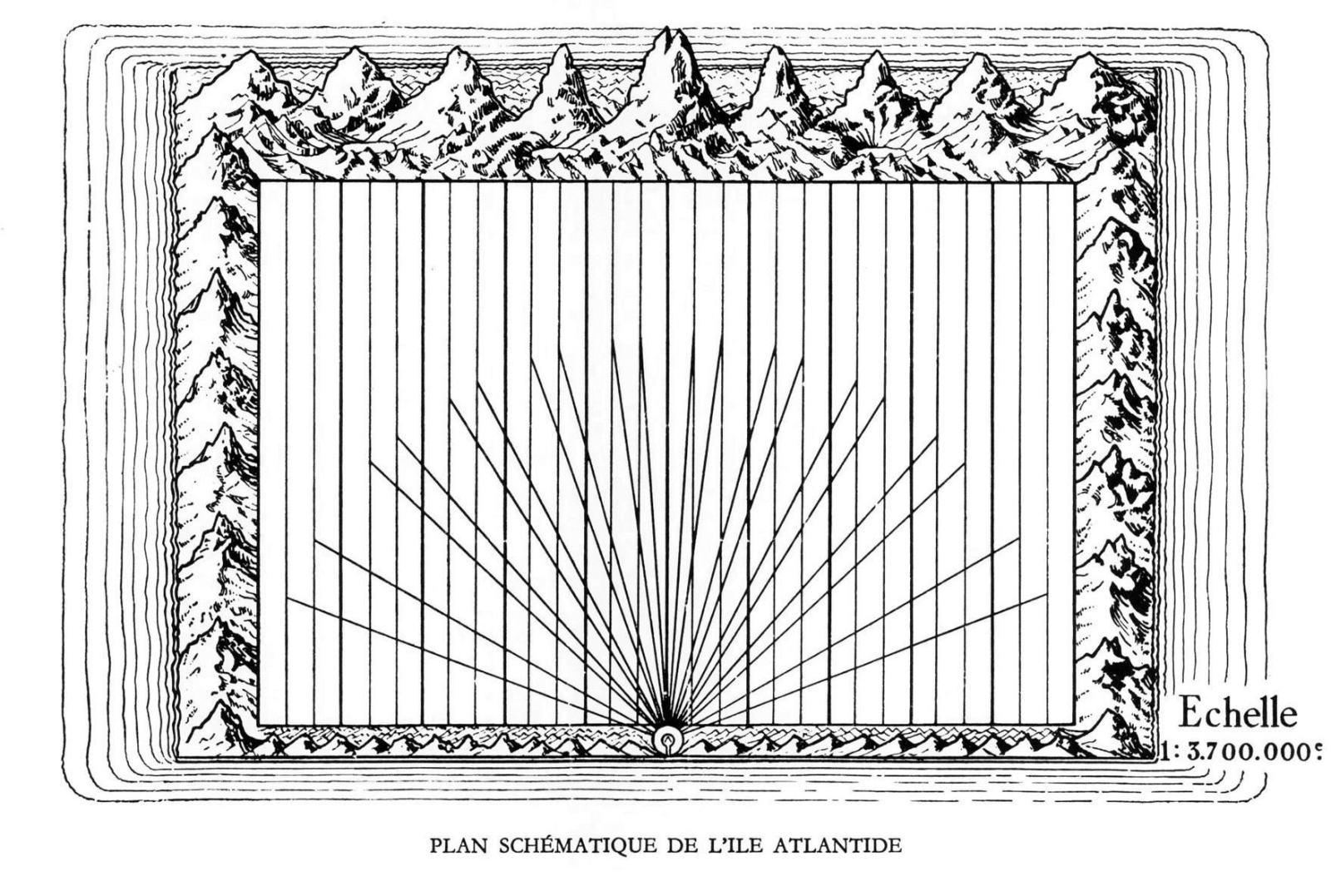
The author reconstructs the Atlantean royal city using the Temple of Poseidon (3 plethra) as a geodetic unit, establishing precise concordances between Plato’s concentric rings and the ‘divine squares‘ of esoteric graphics. Key features analyzed include: 1. Alchemical Enclosures: The three walls clad in copper (Matter/Bhû), tin (Form/Bhuvas), and orichalcum (Universal/Svar). 2. Numerical Harmonics: The governance of the city by ‘mutations‘ of numbers (8⇄9, 5⇄6, 7⇄108) and the quinary/senary assemblies of the kings. 3. The Moral Arc: The degeneration of the Atlanteans from divine virtue into ‘unjust avidity‘, leading to Zeus’s chastisement intended to ‘make them reflect and modify themselves‘. The appendix includes two schematic plans—the Royal City (scale 1:88,800) and the Isle of Atlantis (scale 1:3,700,000).
Coming soon: A Little Petrus Talemarianus Sampler VI on ‘The Foundation of Hebrew Kabbalah’.
**
From The Petrus Talemarianus:
‘Plato’s Description of Atlantis’
This text presents a synthesis of Platonic cosmology, sacred geometry, and comparative mythology by the ‘Petrus Talemarianus’ circle. It interprets Plato’s Timaeus and Critias as a symbolic architecture embodying the opposition of Athens (Yang/Fire) and Atlantis (Yin/Water).
Page 305
Having thus shown the concordances of my theories with the plan of the city of Peking, I was incited to extend still further the field of their applications by studying, in their light, the plans of the Isle of Atlantis and of its royal city, such as one may represent them according to the dialogues of PLATO.
The description of this fabulous country, put by PLATO into the mouth of CRITIAS, at the beginning of the Timaeus first, and in the course of the Critias afterwards, allows the author, under pretext of making known the antediluvian struggle of Athens against a powerful civilization, to reveal the numbers and figures which serve as models to the Manifestation emanating from the bosom of the « Shakti », and to depict its applications in the city.
At the beginning of the Timaeus, PLATO describes for us the voyage to Egypt of SOLON; « the wisest of the seven sages » meets a very old Egyptian priest in the great city of Saïs which a certain goddess (Shakti) founded, named NEITH in Egypt and ATHÉNÉ in Greece, and whose inhabitants call themselves friends and in some sort parents of the Athenians. The priest reveals to the sage that nine thousand years before (that is to say, before the flood) the goddess gave laws and a teaching to Athens, and that a thousand years later (there were thus eight thousand years) (*), the same goddess gave the same laws and the same teaching to Egypt. These laws comprised the traditional distinction of classes into priests (Brâhmanas), artisans and shepherds (Vaishyas), warriors (Kshatriyas) and this teaching had divine sciences for its base: divination (astrology) and medicine (alchemy).
Having thus shown, in the Timaeus, the primordial importance of Wisdom linked to the mutations of 8 and of 9, to the social organization of castes, and to the astrological and alchemical division of universal knowledges, PLATO completes his thought, in the Critias, by making a description of the antediluvian organization of the Athenians and of that, opposed and complementary, of the Atlanteans.
These two peoples, whose royal cities have for center a sacred hill, dedicated to a divine couple and surrounded by the habitations of warriors, artisans and laborers, will incarnate respectively the qualities of the « Same » and of the « Other ». Athens figures the « Same », the Unity, the Center under its severe aspect, the Fire, the new Jerusalem, imperishable cubic city. Atlantis figures the « Other », the Duality, the Center under its gentle aspect, the Waters, the terrestrial Paradise surrounded by circular rivers and destroyed by the pride of ADAM.
Indeed, at Athens, on volcanic earth, the divine couple dedicated to fire, HÉPHAISTOS and ATHÉNÉ, is pure and united intimately by the bonds of blood and by the double love of science and of art. The warriors obey kings who have no gods in their ancestry; they are separated from the rest of the population by a single wall, doubtless rectangular, « as around the garden of a single dwelling ». A unique source flows from the Acropolis.
Page 306
By opposition, on the Isle of Atlantis given in portion to the god of waters, the divine couple POSEIDON and CLITO is impure, for the woman is a mortal. Ten royal families of divine origin, since they descend from the five pairs of male twins engendered by this divine couple, exercise their sovereignty over the isle divided into ten provinces (*). The most ancient royal family is suzerain; it dwells with its most faithful warriors on the sacred hill where CLITO resided, and which the god isolated and fortified by circular and concentric enclosures, two of earth, three of sea, then made fertile by causing to spring forth two sources, one hot, the other cold.
After having shown the paradisiacal riches of the plain of Atlantis, three thousand stades long and two thousand wide, surrounded by mountains and by sea, PLATO exposes how the Atlanteans built their capital around the sacred hill, then irrigated the flat land by canals, as YU the Great did for China. He describes the central temple of the royal city, dedicated to POSEIDON, temple whose plan, in conformity with tradition, is a long silvered square, and which is covered with gold (☉), with silver (☽) and with orichalcum (♃), « the most precious of metals after gold ». At the center of the edifice the god of waters stands upon a chariot drawn by six winged horses (**).
From the hill flows the double source which, after having traversed the sacred wood, spreads its virtues in the diverse parts of the city separated from one another by enclosures of stone and of water (***). The warriors, quartered according to their degree of fidelity in three garrisons, occupy the Acropolis and the two concentric isles of which the most vast possesses a riding school. The houses of the artisans, constituting the city, press themselves between the last enclosure of water and a circular exterior rampart which separates the city from the countryside.
But since the royal city of Atlantis presents a « Yin » character whereas the city of Athens presents a « Yang » character, my constructive theories,
Page 307
which related evidently to realization (Yin), had to concord with the plan of this first city; I drew it therefore, as well as the plan of the isle of the Atlanteans, by faithfully following the text of PLATO.
To this end, I took for unit of measure the width or façade of the temple of POSEIDON, worth three plethra (*), and I figured it on my drawing by the smallest unit of measure used by the inhabitants of my country, that is to say by the French millimeter, whose length is the ten-millionth part of the millionth part of the quarter of the terrestrial meridian. Under these conditions, the scale of this drawing became: 1/(888×100), and the exterior enclosure of the city was constituted by a circle having the same diameter as the length of the square ☉ of my graphics, which I had made equal to ten English inches (**). Naturally the temple of POSEIDON could be considered as superposed to the center of figure of my graphics.
Page 308
Examining then more closely the possible concordances between the different circular enclosures of the royal city of Atlantis and the squares traced on my graphics, I noted first that the squares ♃, ♀ and ♂, necessary to the generation of ARSENIC●M, were found situated between the exterior rampart and the first enclosure of water, at the location of the habitation of the artisans. It was easy to see next that the habitations of the warriors, built on the isles and on the Acropolis, were within the square ●, from which were extracted the white, black and red stones (colors of the Philosopher’s Stone) with which were built the three enclosures destined to protect the center. The exterior wall was constructed in black stone and covered with copper (♀), symbolizing « Bhû » and the aspects « materia »; that of the middle was constructed in white stone and covered with molten tin (☽), symbolizing « Bhuvas » and the aspects « forma »; the interior wall, touching the Acropolis, was constructed in red stone and covered with orichalcum (♃), symbolizing « Svar » and the universal aspects (*).
Within the square ●, the two divine squares ♃n and ♀n, and the virtual square ♄n, presented the following concordances with the plan of the royal city. The divine squares superposed themselves almost exactly to the location of the greatest enclosure of earth, toward the middle of which the Atlanteans had reserved, for the races of horses, a riding school a stade wide and long enough to allow, in racing, the complete turn of the isle (**). Indeed, it was easy to calculate that the length of side of the square ● and that of the divine squares differed from the diameters of the circles limiting exteriorly and interiorly this enclosure, the first by a hundredth and the second by about a thousandth. No correspondence existed with the small isle, upon which PLATO gave no detail.
The virtual square ♄n, in the first manifestation of its development (long silvered square, see p. 5), corresponded to the very location of the temple of POSEIDON, « vital knot » where was concentrated all the material and spiritual activity of the Isle of Atlantis. The plan of the land showed indeed the convergence, toward the center, of the canals which cut up the plain, on its length, into thirty equal parts (***).
It is also around the visible center of the Atlantean empire, that is to say around the column of orichalcum situated in the middle of the sacred enclosure of POSEIDON, that the kings of Atlantis assembled every five years and every six years alternatively, to deliberate on their common affairs and offer together a sacrifice; these periodic assemblies were in harmony with the mutations
Page 309
of the quinary and of the senary, mutations opposed to that of the numbers 9 and 8 announced at the beginning of the Timaeus by CRITIAS (*).
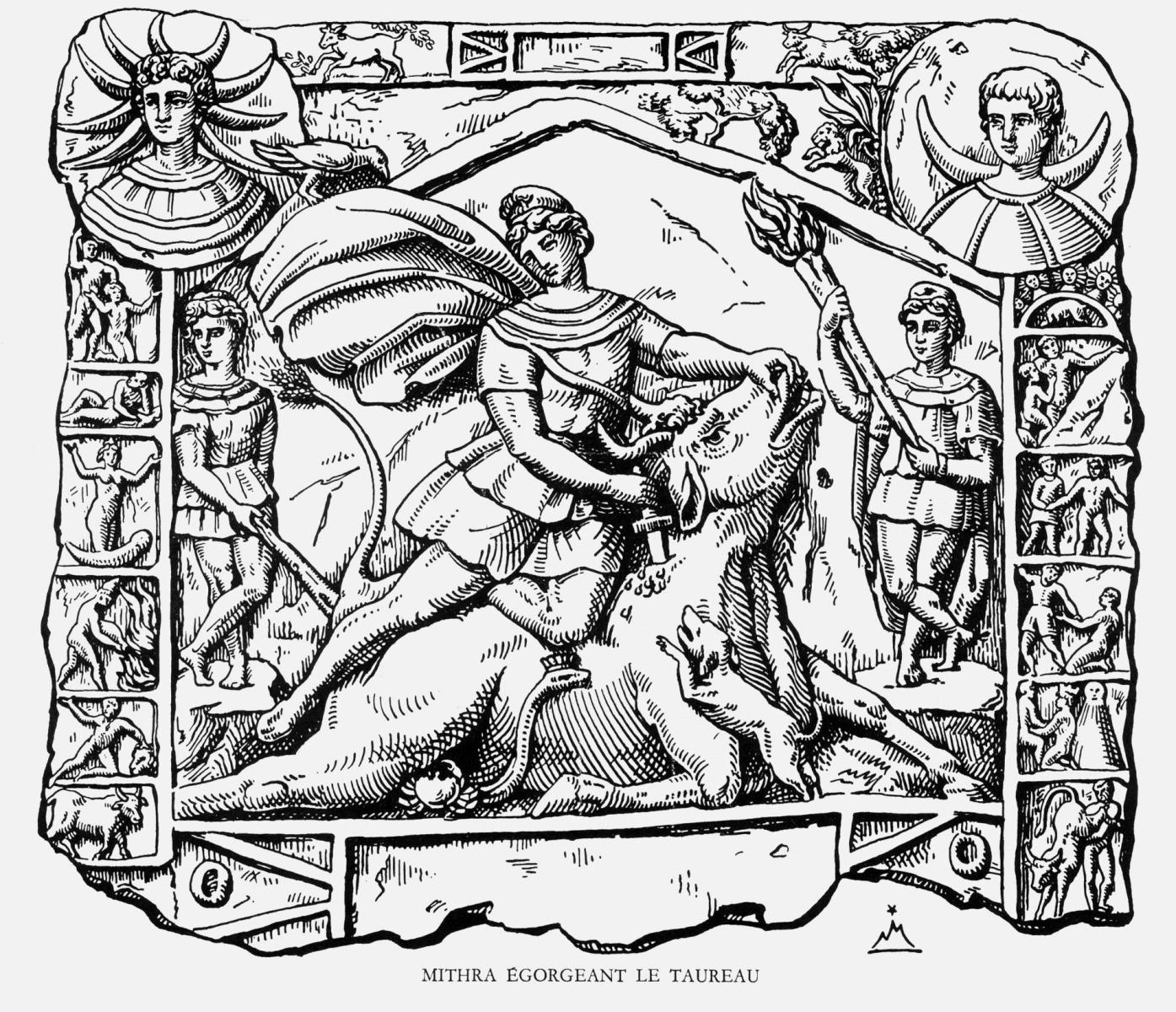
The latter, at the end of the Critias, describes for us the sacrifice of the bull by the kings, slain upon the column of orichalcum, after its capture in the net without the aid of metals but with wooden pikes. The kings collect its blood in a crater and, in the course of the night, enclosed in the temple which no light illuminates, they drink it in common in cups, identifying themselves thus to POSEIDON whose image they have just immolated (**).
The narrative ends with the description of the moral decadence of the Atlanteans, which provoked their chastisement.
But, from the beginning, the origins of this civilization had been impure and marked with the sign of duality. This is why the inhabitants of Atlantis had built circular enclosures around their superior castes (the circle is, from a certain point of view, the symbol of the development and of the instability of individual Manifestation); the caste of warriors, instead of inhabiting the periphery of the city (squares ☉, ♃ and ☽) to fulfill there its protector and magic role, had invaded the central location of the divine squares, reserved for the gods and to their representatives (the pontiff and the priests); it had been broken into fractions of unequal fidelity and had made force and barbarism dominate in the administration of the isle, to the detriment of intelligence and civilization. The Isle disappeared beneath the waves, and the most powerful race in the world was driven out, like a radish. However, it was annihilated only to be reborn under a more perfect form: the circular city of the new Jerusalem will correspond, in time, to the square city of base Athens, the prefiguration of which was a figure (***).
*
Notes
Notes – Page 305
(*) This opposition of 8 and 9 is frequently encountered in Chinese legends.
Notes – Page 306
(*) The division of the Atlantean land into ten regions has as its opposite and complement the division of the ideal city described in the Laws into twelve quarters, inhabited by sixty-two times sixty-seven (= 5,040 = 7!) citizens (see note, p. 188). This is the smallest population count divisible by each of the first ten whole numbers; it corresponds to ten times forty-two inhabitants per quarter. Moreover, PLATO often uses mystical numbers and their interchanges in the Laws. The 360 (= 30 × 12) senators of the city exercise their functions only thirty at a time. The guardians of the law are not promoted to this dignity before the age of fifty and do not remain in charge for more than twenty years (which marks the opposition of 5 and 2). Men marry at the earliest at twenty-five or thirty years (5 or 6 times 5 years), and women at the earliest at sixteen or eighteen years (8 or 9 times 2 years), which recalls the interchanges of 5⇄6 and 8⇄9 associated with the opposition of 5 and 2. The husband and wife cannot invite more than ten persons each to their wedding meal, which limits the number of guests to 22.
(**) The number 6 and the horse are symbols of mediation. POSEIDON is surrounded by the hundred Nereids, who figure the summits and the dual faces of the five Platonic polyhedra, which are themselves a mediation between the spherical form and the plane form.
(***) Just as the sacred hill is protected by a triple wall and a triple ditch, so the plain of Atlantis is surrounded by mountains and water. Stone and water symbolize the severe and gentle character of the « Shakti », mistress of realizing and protective magic.
Notes – Page 307
(*) The plethron corresponds to 29.60 meters.
(**) The diameter of the city was thus (4 × 888) / 10⁶ times the mean terrestrial polar radius, while the width of the temple of POSEIDON was equal to 888 / (4 × 10⁸) times the meridian of the earth.
(Added from French text below the notes on p.307): It was not surprising to see appear, on this plan, an approximate solution to the squaring of the circle, since the diameter of the royal city was equal to 254 (= 127 × 2) times the width of the temple of Poseidon, and 4⁺/π = √g = 1.27⁺. Thus, the dimensions of the Atlantean city were linked to those of the temple by √g, an essential measure of the form of the Great Pyramid and of the various enclosures of the city of Peking.
Notes – Page 308
(*) The diameter of the first enclosure of water had a length of double 7 units of measure, while that of the third enclosure had a length of half 108 units: a new example of the opposition and complement of 7 and 108.
(**) I had already remarked (see note, p. 204) that the divine squares related to the horsemen.
(***) The same division by thirty, of traditional and alchemical character, used moreover on my mediator graphic, also affected the military organization of the land, since the plain was divided, for recruitment, into sixty thousand districts, each measuring ten stades square.
Page 309
(*) The opposition and complement of 6 and of 5 associated with those of 9 and of 8 (ARSENIC☿) are expressed in the « Odyssey » in the course of the narrative of Ulysses at Eumaeus. Having seen Crete again, Ulysses desires to sail toward Egypt; after six days of feasting, he sets sail with nine vessels; after five days of crossing, he lands in Egypt; he dwells there seven years, and then passes a year in Phoenicia.
(**) One can here draw a parallel with the quinquennial communion of the king and the Grand Masters of the « States », on the labyrinth of cathedrals; seven drops of their blood were mixed with the eucharistic wine. The word φιάλη (phialē) designates, in the Critias, the cups of the kings and, in the Apocalypse of Saint John, the sacred cups which the elders hold before the Lamb and which the angels receive.
(***) The plain of Atlantis, whose perimeter measures ten thousand stades, and the New Jerusalem, whose base perimeter measures twelve thousand stades, are thus submitted to the interchanges of the quinary and the senary; that is to say, of the microcosm and the macrocosm, of the Earth and of Heaven.
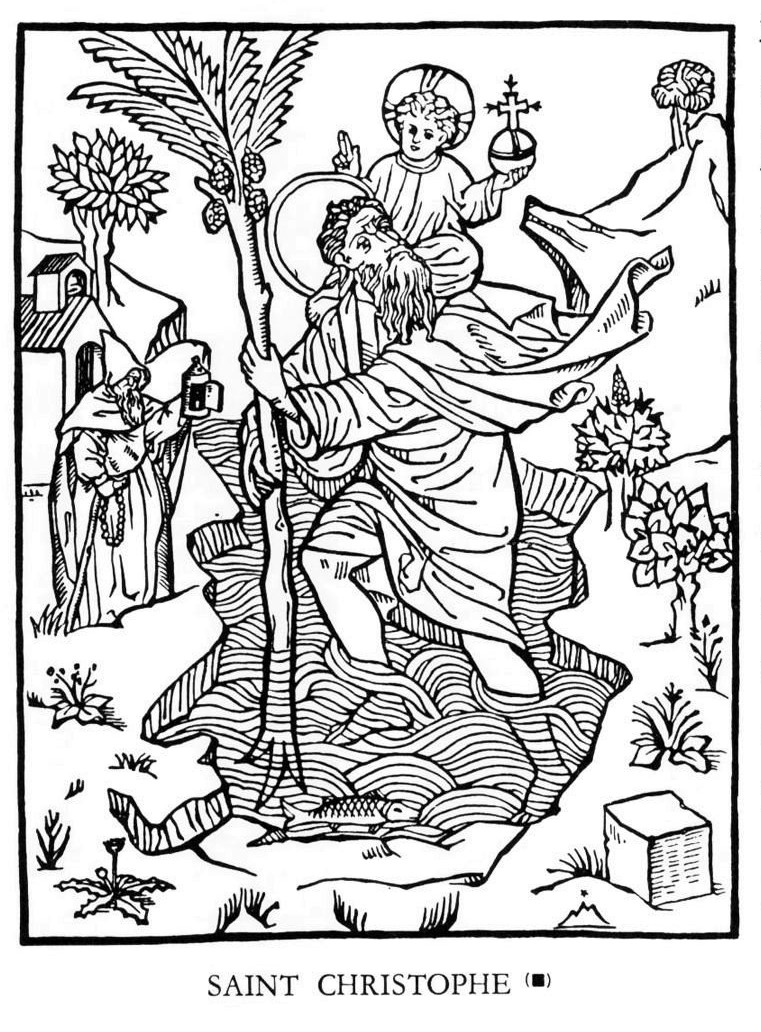
(¤) Saint Christopher is the Christian representation of the Egyptian ANUBIS, of HERMES, and of the Greek HERACLES. His colossal statues were always placed in churches near a door.
*
Appendix
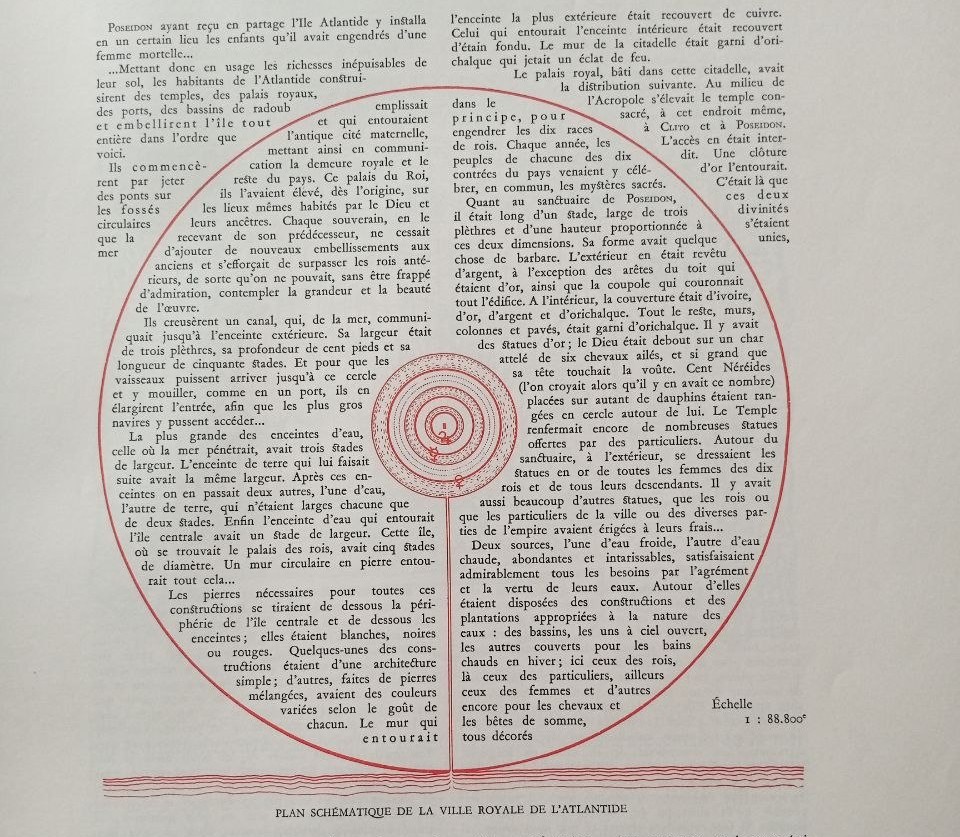
Description of Atlantis
(A schematic reconstruction of Plato’s account from the Critias,
detailing the layout of the Royal City and the surrounding Plain)
*
I. The Royal City and the Acropolis
POSEIDON, having received the Isle of Atlantis as his portion, established himself there, having begotten children by a mortal woman…
Making use, therefore, of the inexhaustible riches of their soil, the inhabitants of Atlantis constructed ports, basins for defensive redoubts, and embellished the whole isle in the order that I have described.
They began by digging ports and circular moats by which the sea entered, surrounding the ancient maternal city, thus putting the royal dwelling in communication with the rest of the country. The palace of the King, elevated from its origin, stood in the midst of the habitation of his ancestors. Each sovereign, receiving it from his predecessor, did not cease to add new embellishments so as to surpass the ancient kings, so that one could not contemplate the grandeur and beauty of the work without being struck with admiration.
They cut a canal, common to the sea, which reached to the exterior enclosure. Its width was three plethra, its depth one hundred feet, and its length fifty stades. And so that vessels could arrive at this circle and moor there as in a port, they enlarged the entry so that the largest ships could pass…
*
The Concentric Enclosures
The greatest of the enclosures of water, that which the sea penetrated, had three stades of width. The enclosure of earth which followed it had the same width. After these enclosures, one passed two others: one of water, the other of earth, each two stades wide. Finally, the enclosure of water which surrounded the central isle had one stade of width. This isle, where the palace of the kings was found, had five stades of diameter. A circular wall of stone enclosed all this…
The stones necessary for all these constructions were drawn from beneath the perimeter of the central isle and beneath the enclosures; they were white, black, or red. Some of the constructions were of simple architecture; others, made of stones of mixed colors, displayed varied hues according to the taste of each.
The wall which enclosed the most exterior enclosure was covered with copper.
That which enclosed the interior enclosure was covered with molten tin.
The wall of the citadel was garnished with orichalcum, which gave forth a flash of fire.
*
The Temple of Poseidon
The royal palace, built within this citadel, had the following distribution. In the middle of the Acropolis was the temple sacred to this very place, to CLITO and to POSEIDON. Access to it was forbidden. It was enclosed with a wall of gold. This was the place where the two divinities had been united, and which served as the principle to engender the ten races of kings. Each year, the peoples of each of the ten districts of the land came there to celebrate, in common, the sacred mysteries.
As a sanctuary of POSEIDON, it was a stade long, three plethra wide, and of a height proportioned to these two dimensions. The form had something of the barbaric.
Exterior: Covered with silver, except the pinnacles of the roof which were of gold; likewise the cupola which crowned the whole edifice.
Interior: The covering was of ivory, gold, silver, and orichalcum. All the rest—walls, columns, and pavements—was garnished with orichalcum.
There were statues of gold; the God stood upon a chariot drawn by six winged horses, of such grandeur that his head touched the vault. A hundred Nereids (one believed then that there were that number) were placed all around as if on dolphins. The Temple was moreover surrounded by numerous statues offered by private individuals. Around the sanctuary, on the exterior, were raised statues in gold of the ten kings and of their wives and descendants. There were also many other statues, which the kings or private individuals had erected at their expense to the gods of the empire…
Two sources, one cold, the other hot, abundant and inexhaustible, satisfied admirably all the needs and the virtue of their baths. Around them were disposed constructions and plantations appropriate to the nature of the waters: basins, some open to the sky, others covered for warm baths in winter; here those of the kings, there those of private individuals, elsewhere those of the women, and others again for the horses and all beasts of burden, all decorated according to their destination. The water which came from there went to water the sacred wood of POSEIDON, where the trees, by the fertility of the soil, reached a beauty and height of divine nature; it flowed thence to the exterior enclosures by aqueducts measured by the length of the ports.
The numerous temples for many gods, the numerous gardens, the gymnasia for men, and the hippodromes for horses had been constructed on each of the enclosures which formed as it were annular isles. Among others, there was, in the middle of the greatest of these, a hippodrome a stade wide and long enough to permit the horses to make, in racing, the complete turn of the enclosure. To the right and to the left were barracks destined to house the greater part of the army. The most faithful troops lodged in the smallest enclosure, the closest to the citadel; and those whose fidelity was absolute were lodged in the citadel itself, near the royal palace. The arsenals were filled with triremes and with all that was necessary for their armament, and the whole was ranged in a perfect order. And thus was all disposed around the palace of the kings.
From there and outside the three ports, one perceived a circular rampart which surrounded the isle and was everywhere distant fifty stades from the most vast enclosure; it formed the greatest port; and this rampart came to close upon itself at the mouth of the canal toward the sea. Numerous habitations pressed against one another within this rampart. The canal and the principal port swarmed with vessels and with a noisy crowd of merchants come from all parts of the world…
*
II. The Organization of the Plain
Here is, thus reported, all that tradition has preserved on the city and the ancient dwelling of the kings. Let us recall now of what nature was the rest of the country and what was its organization.
The territory was very elevated, it is said, and dominated the sea on a peak. Around the city reigned a plain, all surrounded by mountains which prolonged themselves to the sea. This plain was flat, elongated, and of uniform level. It measured on the sides three thousand stades, and two thousand in the middle, from the sea which was found below. This part of the isle was oriented to the south and protected from the north winds. One boasted of the mountains which formed a girdle for it, unequalled today for the number, grandeur, and beauty; they enclosed rich and populous villages, rivers, lakes, prairies where wild and domestic animals found abundant nourishment, and numerous vast forests whose varied essences furnished materials for works of all sorts.
This plain, as much by the nature of the thing as by the work of many kings during a very long duration, was thus arranged. It had the form of a long square whose sides were almost straight. Where they were not, one had corrected this irregularity by tracing a canal of enclosure. The dimensions of this canal in length, width, and depth were so considerable that one could hardly believe it; for, when one compares these immense works to the establishments of our days, it seems impossible that they could have been formed by the hand of men. It must however be repeated what we have heard. The depth of the canal was thus of one plethron, its width of a stade, and its length of ten thousand stades, since it formed an enclosure around the whole plain. It received all the waters of the mountains; it surrounded the plain, returned by its two extremities to the city, and from there went to discharge into the sea.
From the upper part of this canal departed canals of one hundred feet wide, which cut the plain in a straight line, to the right, then went to rejoin the canal near the sea. They were distant of one hundred stades from one another. To transport by water to the city the woods of the mountains and the diverse products of each season, one had dug, starting from these canals, navigable derivations, of oblique directions some with respect to the others and with respect to the city. Note that the countryside yielded two harvests per year, since they were watered in winter by the rains from the sky, and in summer by the waters of the earth which the canals distributed to them…
*
III. The Moral Decline and Chastisement
…For numerous generations, and so long as there remained in them something of the nature of the God from whom they were issued, the kings of Atlantis obeyed the laws which they had received and remained attached to the divine principle which made their parentage. Their thoughts were true and great in all things; they showed themselves full of goodness and of judgment in all circumstances, as well as in their mutual relations.
Also, despising all that was not virtue, they disdained their goods, bore as a burden the weight of their gold and of all their riches, did not let themselves be dazzled by the excess of their fortune, did not lose the mastery of themselves, and did not become the plaything of passions and of error. Highly clear-sighted, they comprehended that these advantages do not increase but by their accord with virtue, and that on the contrary, if one pursues them with too much zeal and ardor, they perish and virtue with them.
So long as they lived animated by this divine spirit and so long as they followed its principles, their happiness did not cease to increase. But when the divine essence diminished more and more in them by a continual mixture with mortal elements more and more numerous, and when the human character dominated, then, become incapable of supporting their prosperity, they degenerated. They appeared ugly to wise men, because they had lost the most precious among goods. On the contrary, it is in the eyes of those who do not know what is the kind of life which contributes truly to happiness, that they seemed arrived at the height of virtue and of happiness, while they were filled with unjust avidity and power.
It is then that ZEUS, God of Gods, WHO REIGNS BY THE LAWS, and whose omniscience knew all this, comprehended the miserable error of this race once so excellent and decided to chastise them to make them reflect and to modify them.
*
Source
*
Coming Soon
A Little ‘Petrus Talemarianus’ Sampler – Part VI:
‘The Foundations of Hebrew Kabbalah‘.
***


Related Articles


Leave a Reply