
Circle of Transmission: The Living Loom
A Little ‘Petrus Talemarianus’ Sampler – Part IV: Appendix XII -‘The Divine Architectural Archetype And Its Paths’

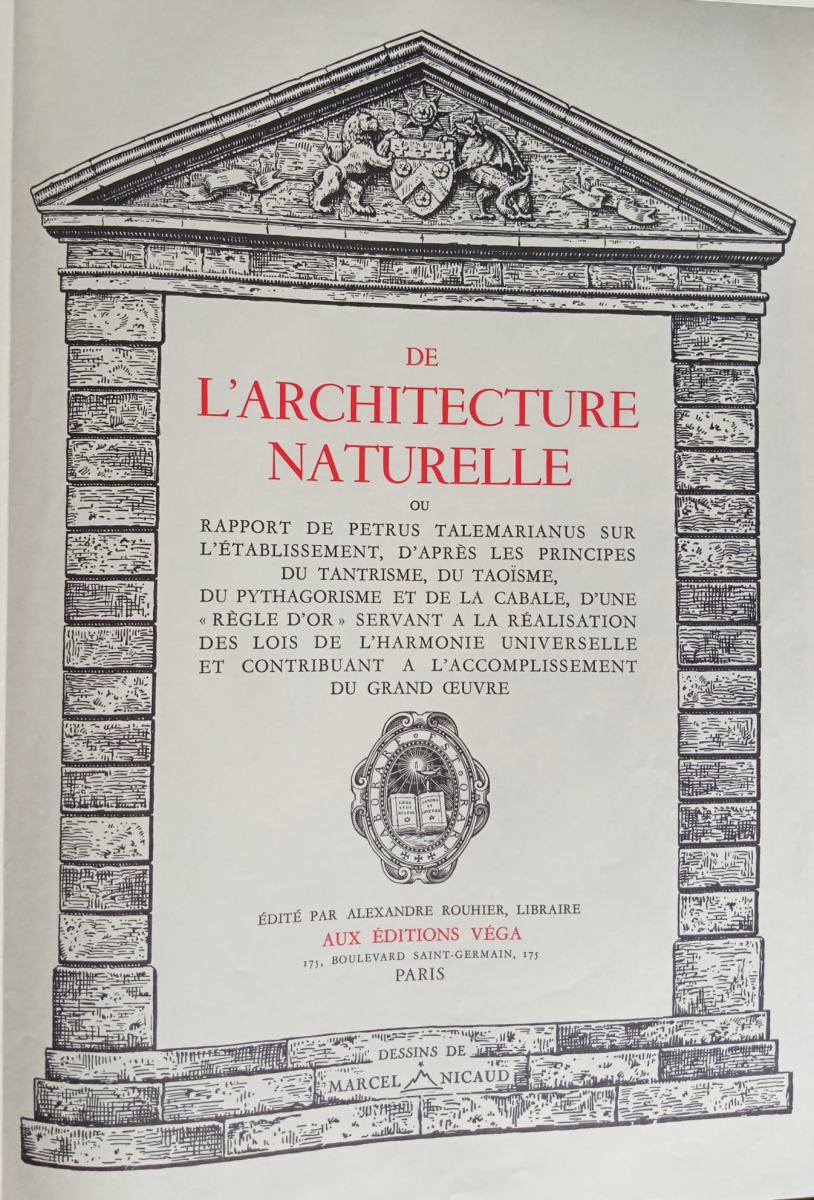
Title page of the 1983 reprint
of the ‘Petrus Talemarianus’.
*
Today’s sharing from the Blue House of Via-HYGEIA is Appendix XII from the ‘Petrus Talemarianus‘ (here in its second edition published in 1983), titled: ‘The Divine Architectural Archetype And Its Paths‘. From page 370 to 376.
What if the visions of Ezekiel were not ecstatic poetry but precise technical drawings? What if the measurements of Solomon’s Temple encoded the same ratios that govern the Great Pyramid and the Gothic cathedral? In this extraordinary appendix, Francis Warrain demonstrates that sacred architecture is never invented—it is received.
Through a rigorous synthesis of Kabbalah, Tantrism, sacred geometry, and biblical exegesis, he reveals a single, immutable archetype that underlies every authentic manifestation of the sacred: from the Tabernacle of Moses to the New Jerusalem, from the mūlādhāra chakra to the Shekinah’s union with the Divine.
The chashmal—that electrum flash between fire and form—still sparks when the proportions are rightly aligned. When ♄ₙ finds its proper place at the center, when ☉ and ☽ dance their 4:1 ratio, when the 5 and 6 embrace in their complementary opposition… the architecture speaks.
What Warrain intuited is that sacred geometry is not about meaning but is meaning. This text does not merely describe; it operates. The mediator diagram applied to Ezekiel’s temple, the 60 names of Genesis mapped onto the 60 divisions, the altar’s hollow where the supreme point below opens toward the supreme point above—all of it constitutes a technology of consciousness veiled as architectural specification. Warrain insists on construction: this is a machine for liberation, not merely its blueprint.
Thus this translation aspires to honor the operative imperative that governs Warrain’s method. The ‘you‘ who reads becomes the initiate who builds. The threshold imagery that structures the entire appendix—the lower gate (♄ₙ, mūlādhāra, the altar’s hollow) opening toward the upper (the frontal eye of Śiva, the supreme point above)—finds its echo here. These proportions breathe: 4:1, 5:6, 60:60. They are not decorative numbers but active agents, just as they are in Warrain’s diagrams.
May this rendering serve as what the text itself describes: a janua, a passage-gate through which you may proceed toward that liberation the geometry encodes.
**
*
A Contextual Introduction
The Petrus Talemarianus and the Quest for Natural Architecture
This text is Appendix XII from De l’Architecture Naturelle (On Natural Architecture), one of the most ambitious and enigmatic works of 20th-century esotericism. Published in a limited edition of 269 copies by Éditions Véga in 1949, the book represents a rare moment of collective creation: a ‘total work‘ (Gesamtkunstwerk) of text, geometry, and symbolism designed to restore the “golden rule” (règle d’or) of cosmic harmony to a civilization perceived as having lost its metaphysical center.
The pseudonym ‘Petrus Talemarianus‘ conceals a circle of French esotericists and scholars active in the early-to-mid 20th century, including the mathematician Francis Warrain (1867–1940; the probable author of this appendix), the hermeticist Alexandre Rouhier, Pierre Bordeaux-Montrieux, the Tibetologist Jacques Bacot, and the illustrator Marcel Nicaud. Their collaboration emerged from the occult revival of the Belle Époque—specifically the Rosicrucian and Kabbalistic circles influenced by Stanislas de Guaita and Joséphin Péladan—yet it transcended sectarian affiliation to pursue what they termed ‘Natural Architecture‘: not a style, but a science of manifesting universal laws in material form.
The work’s audacity lies in its methodological premise. Rejecting the modern separation of disciplines, the Petrus circle sought to demonstrate that Tantric yantras, Pythagorean harmonics, Taoist cosmograms, alchemical operations, and biblical Temple architecture all express a single, underlying geometric grammar. This was not eclecticism for its own sake, but a rigorous attempt to prove that number and proportion constitute the ‘universal language‘ (langue universelle) of sacred tradition—a language that precedes and transcends cultural difference.
While ‘De l’Architecture Naturelle‘ ranges broadly across world traditions, Appendix XII focuses its lens with particular intensity on the Abrahamic lineage. Warrain’s contribution here is to treat the biblical text not as historical narrative or theological allegory, but as a technical manual encoding precise geometric instructions. The visions of Ezekiel—long considered among the most obscure passages of Scripture—become, in his reading, architectural blueprints awaiting decryption.
This approach carries significant implications. It challenges modern assumptions about the nature of prophecy (revelation as spatial vision rather than temporal prediction), the status of sacred scripture (text as diagram), and the relationship between spirituality and material culture (the Temple as operative technology rather than symbolic backdrop). Warrain operates within what the French traditionalist René Guénon called the ‘primordial tradition’, yet his method is distinctively modern in its mathematical precision and its aspiration to a kind of esoteric universitas—a unity of knowledge capable of reconciling apparently disparate wisdom traditions.
The appendix thus serves as a crucial methodological demonstration of the Petrus project. Where other sections of the work treat Eastern traditions or hermetic philosophy, this text anchors the entire enterprise in biblical exegesis—traditionally the most authoritative discourse within Western esotericism. By showing that Ezekiel’s chariot and the Temple measurements yield the same geometric patterns found in Tantric chakras and Gothic cathedrals, Warrain performs a kind of intellectual tikkun: repairing the perceived rupture between East and West, between ‘pagan’ and biblical revelation, between ancient wisdom and modern scientific rigor.
The reader should be prepared for a dense, allusive prose that assumes familiarity with multiple symbolic systems: the four worlds of the Kabbalistic Tree of Life (Atziluth, Beriah, Yetzirah, Assiah), the geometric proportions of the Great Pyramid (particularly the ‘golden‘ and ‘silver‘ rectangles), Tantric subtle anatomy (chakras, Śiva/Śakti polarities), and the technical vocabulary of gematria (Hebrew numerology). Warrain moves rapidly between these registers, not to obscure his meaning, but to demonstrate their inherent coherence.
What emerges is a vision of sacred space as participation rather than representation. The Temple is not merely a building where divine presence might be encountered; it is a geometric analog of cosmic structure, a ‘machine‘ for concentrating and radiating spiritual influence, and a map of the initiate’s own interior landscape. The ‘supreme point below‘ (point suprême d’en bas)—identified with the altar, the mūlādhāra, and the union of God and Shekinah—reveals that architecture, yoga, and mystical theology are ultimately the same discipline practiced at different scales.
This is operative knowledge in the fullest sense: a revelation of laws intended not merely for contemplation but for execution. The Petrus circle believed themselves to be recovering a lost science capable of renewing not just individual consciousness but the very fabric of civilization.
Whether one accepts their metaphysical claims or approaches the text as a remarkable artifact of intellectual history, Appendix XII stands as a masterclass in the esoteric hermeneutic—the art of reading the world as a network of corresponding symbols, each pointing toward the ‘single divine archetype’ that, for Warrain and his collaborators, constitutes the hidden foundation of reality itself.
*
Core Concepts of the Text
This section systematically builds an analogy between biblical accounts of divine construction and the author’s own geometric diagrams, which are derived from the proportions of the Great Pyramid. The core argument is that a single, divine architectural archetype is communicated in different ways throughout the Bible.
The Fourfold Revelation of an Archetype: The text begins by identifying four key pairs of events in the Bible where a divine architectural plan is revealed. It links the construction of the Tabernacle (Moses) and the Temple (Solomon) to the ‘formal‘ worlds of Assiah and Yetzirah. It then connects these to the ideal visions of a new Temple (Ezekiel) and the New Jerusalem (St. John), which correspond to the ‘informal’ worlds of Beriah and Atziluth. This structure places sacred architecture within a complete metaphysical framework, from the material copy to its divine source [p. 371].
The Chariot (Merkabah) as a Geometric Diagram: The author finds a direct correspondence between Ezekiel’s complex vision of the divine Chariot (Merkabah) and his own ‘complete diagram‘ (graphique complet). The four living beings (Kerubim) and the four wheels (Ophanim) are mapped onto specific squares and geometric relationships within the diagram. For instance, the ‘chashmal’ (electrum) is linked to the geometric relationship between the gold and silver squares (☉ and ☽), uniting masculine (fire/Śiva) and feminine (electrum/Śakti) principles. This is a prime example of the text’s attempt to “decode” mystical experience through geometry [pp. 370-372].
The New Temple as a Realized Geometric Plan: The detailed measurements of Ezekiel’s ideal temple (Ezekiel 40-43) are interpreted not as arbitrary numbers but as expressions of specific geometric ratios. The text identifies the recurring use of the square, the ‘silver rectangle’ (module 5:2, approximating √φ), and the ‘golden rectangle‘ (module 5:3, an approximation of φ) in the temple’s enclosures, vestibule, and sanctuaries. The ‘opposition of the quinary and the senary‘ (numbers 5 and 6) is presented as a fundamental magical and structural principle, appearing in measurements throughout the temple [pp. 373-375].
The Mediator Diagram and the Center of the World: The author applies his ‘mediator diagram’ (graphique médiateur)—the same pattern used to analyze Gothic cathedrals—to the plan of Ezekiel’s temple. He discovers that its lines and points align perfectly with the temple’s features: the lines ☉ and ☽ fall in the Holy Place, the center point (♄ₙ) coincides with the altar of burnt offerings. This center, ♄ₙ, is described in profoundly mystical terms: it is the ‘supreme point below’, the synthesis of the ten Sephiroth, the ‘navel’ of the Holy Land, the point of union between God and the Shekinah, and the passageway to liberation (comparing it to the mūlādhāra chakra and the ‘eye of Śiva’) [pp. 374-375].
Names, Numbers, and the Sephirotic Tree: The final pages [pp. 375-376] delve into gematria (the numerical value of Hebrew letters). It analyzes the names of patriarchs, places, and figures like Bétsaléel and David, showing how their numerical values correspond to the numbers and ratios present in the geometric diagrams and the temple’s plan. This links the structural archetype directly to the names and powers of the Sephirotic Tree, the foundation of all creation in Kabbalah.
*
Its Place in Francis Warrain’s Legacy
This appendix perfectly encapsulates Warrain’s intellectual project within the ‘Architecture Naturelle‘ collective. His contribution was likely the rigorous mathematical and geometric framework. While others brought knowledge of specific traditions (e.g., Bacot for Tibetan Buddhism, Rouhier for Hermeticism), Warrain provided the synthetic, almost Platonic, conviction that number and geometry are the universal language underlying all authentic traditions. This text demonstrates his legacy in several ways:
The Primacy of Geometry: It is not enough to describe the visions of Ezekiel or John; one must find the geometric diagram that structures them. For Warrain, geometry is the reality, and the biblical text is a symbolic description of it.
Synthesis of East and West: By equating the biblical chashmal with the Tantric Śakti, and the temple’s center with the mūlādhāra chakra, Warrain and his colleagues were pioneers in a kind of trans-traditional esotericism. They sought to prove that the wisdom of the Kabbalah and the wisdom of the Vedas were ultimately pointing to the same metaphysical and architectural truths.
The ‘Operative’ Nature of Knowledge: The text constantly distinguishes between the ‘speculative’ (the vision) and the ‘operative‘ (the construction). This appendix is not just a philosophical essay; it is presented as a set of instructions or a revelation of the laws that must be followed to create sacred space. This aligns with the book’s subtitle, which promises a ‘golden rule‘ for contributing to the ‘accomplishment of the Great Work‘.
A Monument of 20th-Century Esotericism: The sheer scale and ambition of ‘De l’Architecture Naturelle‘, of which this appendix is a part, represent a high-water mark of traditionalist and esoteric scholarship. It attempted to create a total work of art and knowledge, integrating text, geometry, and symbolism into a single, unified statement. True to the intention of its makers, the ‘Petrus‘ stands as a master standard of timeless esotericism—a reference against which all authentic expressions of sacred tradition may be measured and understood. This appendix, with its intricate weaving of biblical texts, Kabbalistic numerology, Tantric symbolism, and geometric diagrams, is a perfect microcosm of that monumental effort.
*
And now the text:
Appendix XII
The Divine Architectural Archetype And Its Paths
In the Apocalypse of Saint John, the vision of the throne of God and of the Lamb and that of the New Jerusalem are complementary to one another (Apoc. XXII:3); the first is of a speculative order, the second of an operative order (Apoc. XXI:15). They form, as it were, the crowning of three other pairs of facts described in the Bible which are related to the construction or the vision of sanctuaries, palaces, and cities, and which may be set forth as follows.
Yahweh, on Mount Sinai, verbally communicates to Moses the idea of the Tabernacle and of the forecourt (Ex. XXIV:9–XXVII:19), which are executed by Bétsaléel son of Judah and by Ooliab son of Dan (Ex. XXXV:30–XXXVIII:20).
David receives from Yahweh, in written form, the models of the Temple with its furnishings; the sovereign transmits them to his son (I Chron. XXVIII:11–19). With these plans Solomon builds the house of Yahweh on Mount Moriah; then he erects, nearby, his own dwelling (I Kings V:15–VII:12; II Chron. I:18–V:1). Master Hiram executes the two columns of the Temple, the bronze sea, and the utensils (I Kings VII:13–47; II Chron. IV:11–18).
In the course of a series of visions, Ezekiel first sees the glory of Yahweh upon a chariot (Ezek. I:4–28; X:1–17) abandoning the Temple (X:18) and the city of Jerusalem (XI:22 ff.) destroyed by fire; then this same glory, upon the same vehicle, enters again into a new Kingdom which possesses a new Temple built upon a very high mountain and which constitutes a new Holy Land with a new capital (Ezek. XL:1–XLVIII:35).
Just as these four communications of a divine architectural archetype, associated with a mountain, provide plans having a sacred character for temples with their furnishings, for palaces and for cities—’which are as an image and a shadow of the heavenly things‘ (Ex. XXV:40; XXVII:8; Heb. VIII:5)—so likewise a series of geometrical diagrams, associated with the Great Pyramid, furnished me with the models, established according to the rules of the Art, for constructions destined for prayer and for habitation.
This correspondence between divine ideas and their copies, applied to buildings, appears four times throughout the Bible; it is related to the Worlds of the Kabbalah and to those of Tantrism.
The first two pairs of events mentioned above belong to the domain of the Individual, to the worlds of Assiah (עשיה) and Yetzirah (יצירה), therefore to the formal manifestation, both gross and subtle.
In these two pairs, copies of the archetype possess a real existence: one, the Tabernacle of Moses, executed as a movable construction according to oral prescriptions; the other, the Temple of Solomon, established as a fixed construction according to written instructions.
These two realizations, which proceed from the same idea, have the same proportions and the same arrangements in their common part, symbol of the interpenetration of Assiah and Yetzirah; for Solomon added to the primitive plan of Moses only an exterior forecourt for the Temple and a series of palaces.
In both cases, the description of the divine exemplar and its communication are set forth in a succinct manner (Ex. XXIV:10 sqq.; I Chron. XXVIII:19).
Conversely, the last two pairs of events correspond to the domain of the Universal, to the worlds of Beriah and Atziluth, therefore to the informal manifestation and to the Non-manifest.
To the two material edifices—the Tabernacle of Moses and the Temple of Solomon—succeed two ideal constructions: that of the new Kingdom of God according to Ezekiel, and that of the new World according to Saint John, attached to two detailed preliminary visions: the vision of the chariot of the glory of Yahweh for the prophet, and that of the throne of God and of the Lamb for the apostle.
These visions present among themselves great analogies and thus explicate the unique exemplar constructed.
The new Kingdom of God, by its Temple with seven vestibules, corresponds to the real sanctuaries of the Hebrews, just as the informal manifestation corresponds to the formal manifestation of which it is the immediate principle; it also prefigures, by its city with twelve gates, the vision of the New Jerusalem, just as the informal manifestation participates, with the Non-manifest, in the domain of the Universal.
The apocalyptic City, because it represents the principial Non-manifest, concentrates within itself all realizations. It absorbs the Temple (Apoc. XXI:22); it suppresses the distinction between the model and the copy, between the speculative character and the operative character, for within it dwell the throne of God and of the Lamb (Apoc. XXII:3).
It surpasses the plane of the Sun and of the Moon (Apoc. XXI:23; Isa. LX:19), that is to say that of the Paradise which represents the Holy Land of Ezekiel.
It therefore corresponds to the Empire symbolized in the diagrams by the square and by the squares which it contains.
This fourfold correspondence between divine ideas and their copies was prefigured by that of the first two divisions of Genesis, one of which describes the creation of Nature and of man in the Non-manifest, while the other defines their realization in Manifestation, both informal and formal (see p. 216). Recalling that the Kabbalah places human destiny between the history of the genesis of the World (Bereshith, creation, Sepher Yetzirah) and the history of the celestial chariot (Merkabah, redemption, Sepher ha-Zohar), narratives whose symbolic character was taught to the Synagogue in the internal reading of the Bible before the age of thirty (Ps., CXXXIX, 5 sqq.), I conceived the idea of concentrating my study, among the four pairs of facts set forth above, on the sole visions of Ezekiel, in order first to seek the analogy with my diagrams and the plans which derive from them, and then to compare these visions with the three other pairs of facts.
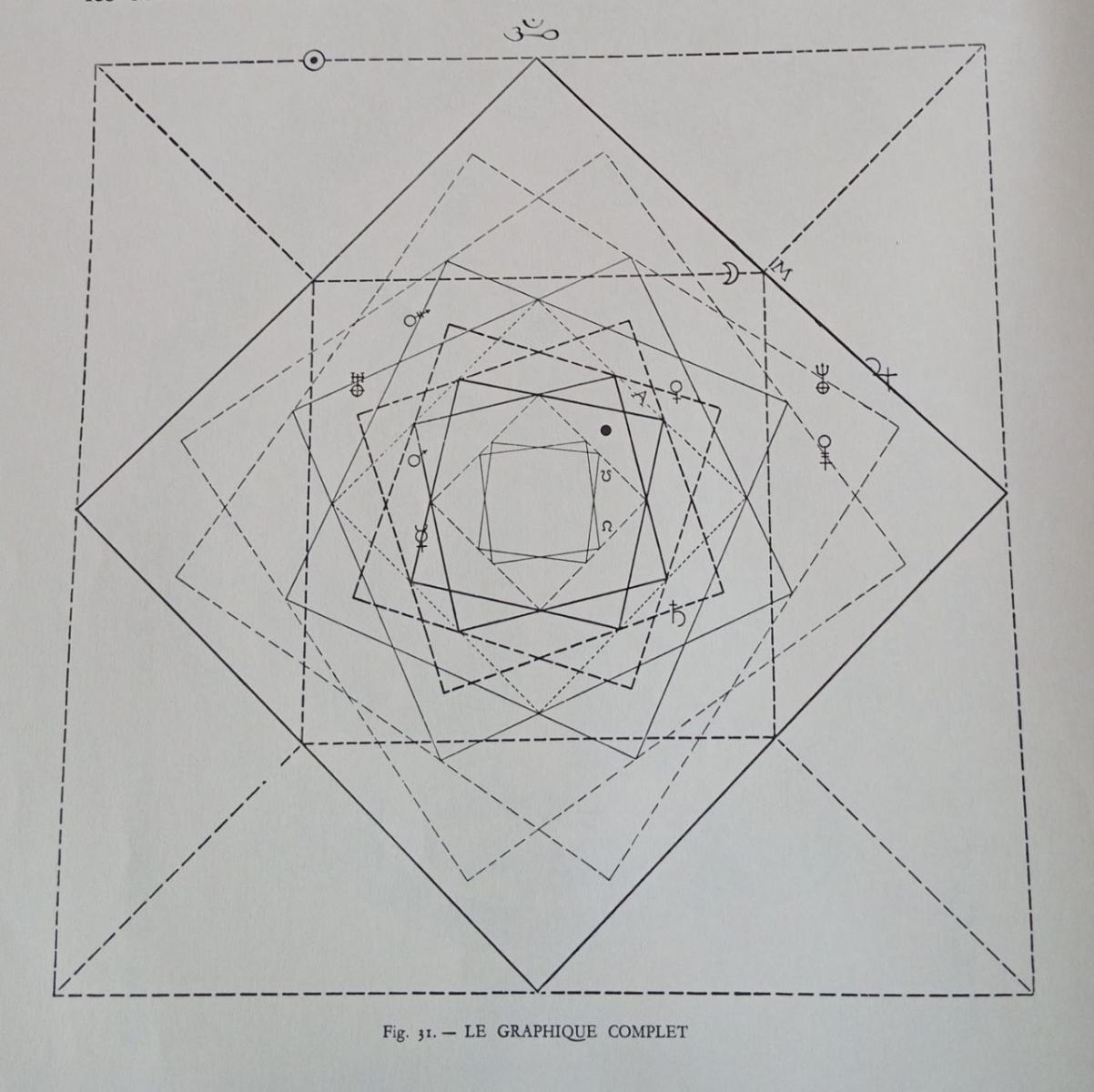
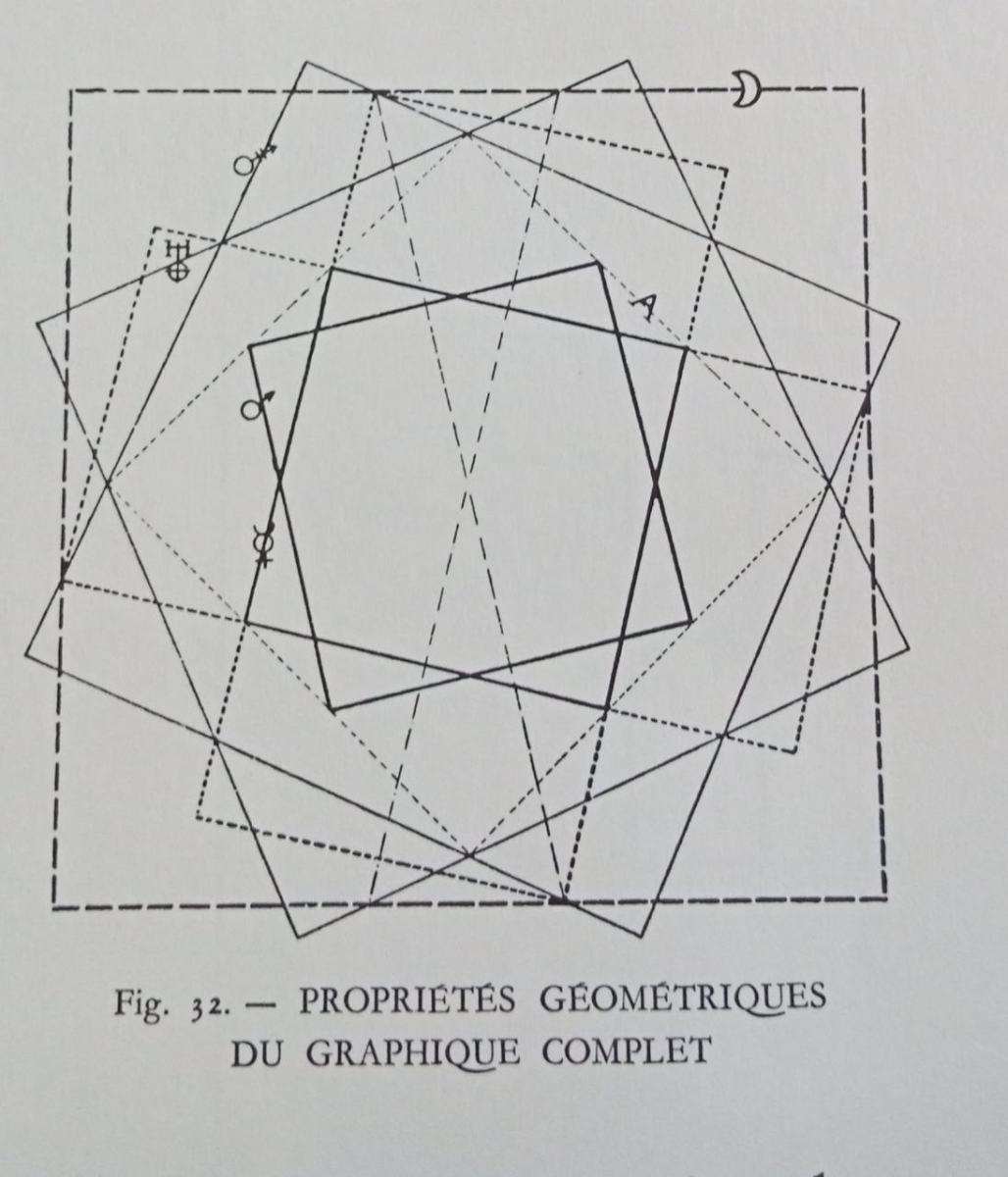
I first noticed the analogy that existed between the vision of the chariot of Ezekiel and my complete diagram (fig. 31). This was composed, in effect, of four groups of squares corresponding two by two and each formed of four elements. Two groups, one at the periphery formed by the square ♃, the squares ☉ and ♁, and the square ♄; the other toward the center formed by the square ☿, the divine squares and the virtual square, could each be considered as a tri-unity (symbolized by the equilateral triangle), that is to say as a ternary to which a fourth element was added (square ♃ and square ☉), image of the unity of the ternary.
The three elements of the tri-unity were constituted by an immobile pivot (Saturn, Śiva, T’ai-ki, square ♄, square A, virtual square) presiding over the mutations of the two opposed and complementary elements which emanate from it (Chit-Ananda, the Śakti, Yin-Yang, the squares ☉ and ☽, the two divine squares). The two other groups, in the median part — the squares ♃ and ☉ on the one hand, the squares ♀, ♂, ♃ and ☿ on the other — could each be considered as a quaternary (symbolized by the cross), that is to say as a double opposition of contraries reconciled by a center which is none other than the tri-unity.
The symbolism of my complete diagram, issuing from the regular partition of the sphere, agreed with that of the mystical vision of the glory of Yahweh which was also composed of four groups of things corresponding to one another two by two. The first two groups, at the beginning of the vision — corresponding to the three exterior squares and to square A — were characterized by the union of fire and the chashmal, which had as support either a luminous cloud driven by the north wind, or a firmament bearing a sapphire stone in the form of a throne. The two other groups, in the median part of the vision, were formed, one by four Kerubim (living beings, כרובים) to which corresponded the squares ‘Forma‘ and ‘Materia‘, and the other by four Ophanim (wheels, אופנים) to which corresponded the squares forma II and materia II (Ez. I, 4–5; 14–21; 26 ff.).
In the first two groups, figures of the tri-unity, fire represented well the immobile pivot (Śiva), presiding over the mutations of two opposed and complementary elements which emanate from it (Śakti), elements symbolized in my diagrams by the squares ☉ and ☽, and in the vision of Ezekiel by the chashmal. Indeed, the chashmal, according to the tradition of the Septuagint and that of the Vulgate, was nothing other than electrum, a formed metal composed, according to Pliny, of four-fifths gold and one-fifth silver.
Now, in the diagrams, the square ☉ had sides double those of the square ☽; consequently the surface of the square ☉, symbolically attached to gold, was quadruple that of the square ☽, attached to silver, and this proportion of gold and silver was precisely that of electrum. Just as the union of the squares ☉ and ☽ formed the square ♃, so likewise electrum, considered in Egypt as a distinct metal and called asem, bore, until Zosimus, as its alchemical sign, that of Jupiter.
Moreover, the chashmal (חשמל = 108 × 7 ÷ 2) was linked by gematria to the square ♃ of length M, whose numerical magnitude, in Tables IV and V, was on the one hand 108, and on the other 7. The chashmal thus played, with regard to fire, the role of Śakti, a role confirmed by the comparison made by Callimachus and Virgil (Georgics III, 522) between the brilliance of electrum and that of a gushing water.
The union of fire and of chashmal, in a human figuration, is a representation of the Christ, who reconciles in his own nature the Unity (fire, ♄) and the Duality (electrum, ☉ and ☽). It was the upper part of the figure seated upon the sapphire throne which was of electrum (Śakti), and the lower part which was of fire (Śiva), arranged in a manner similar to that of the mediating graphic (fig. 27), where the feminine element was placed above the masculine element. In the Buddhist legend, the saint suspended in the air has half of his body formed of water (electrum) and the other half of fire. Moreover Fire, Sun, and Moon (electrum) are the three principal principles of Tantrism.
In summary, within the luminous cloud (the exterior squares), the glory of Yahveh (יהוה) — the virtual square and that of the Elohim — was seated upon a chariot (the square of the wheels), whose wheels were represented by the four Ophanim (אופנים) (the squares materia II and forma II), and whose team was figured by the four Kerubim (כרובים) (the squares materia and forma), drawing the vehicle in the direction of the four cardinal points.
The Ophanim possess a predominantly astrological character, manifested by their eyes (or stars) which filled their circular bodies (wheels) forming crowns. These eyes, recalling those of Argus, complete the astral character of the Ophanim by a character of protectors and vigilant watchers which the Egregores also possess. By complementary opposition, the four Kerubim possess a dominant alchemical and constructive character. Their name: ‘plenitude of knowledge‘, indicates that they know with certainty the operative virtue of the model of the Universe, a virtue whose transmission they assure through the World, in the manner of the four Cosmic Winds (Ps. XVII, 11; CIV, 3; Dan. VII, 2), which are seen by Zechariah as four teams of horses whose robes have the colours of the Great Work (Zech. VI, 1–8; Apoc. VI, 2–8).
The Ophanim and the Kerubim, the wheels and the ‘living beings‘, were related to the number eight in the sublunary World: the former to this World insofar as it is in power, by its forms in the Sphere of the Moon; the latter to this World insofar as it is in act, ‘for the spirit of the living beings was in the wheels‘ (Ezek. I, 20). This is why the Ophanim, to which corresponded the four squares materia II and forma II which divided the square ♂, rightly corresponded to the wheels that assured in power the movement of the chariot; whereas the Kerubim, to which corresponded the four squares materia and forma placed within the square ♂, corresponded to the ‘living beings‘ that realized this movement in act.

Since the four Winds or Kerubim moved according to the four cardinal points, I could observe, by dividing my complete graphic into four equal parts, each sector being aligned with the directions ‘Yang‘, that in each sector were found the geometric elements of the ensemble of the two squares forma and of the two squares materia corresponding to the description given by Ezekiel for the four Kerubim: a quadruple face, four wings, four hands placed beneath the wings, and two legs with cloven feet.
The vision of the throne of God and of the Lamb according to the Apocalypse recalled to me the preliminary vision of the prophet Ezekiel, and its elements agreed equally with those of my graphics. The appearance of jasper and sardine of Him who was seated upon the throne corresponded to the aspect of electrum and of fire seen by Ezekiel: jasper of green colour and sardine of red colour. To this description corresponded therefore the divine squares and the virtual square. The sea of crystal was none other than the firmament which divided the Upper Waters and the Lower Waters; the square ● was attached to it, effecting the separation of the divine squares with the seven squares of the operative graphic which symbolised the seven lamps burning before the throne.
The twenty-four distinct lines which formed the periphery of this graphic — the twelve peripheral triangles — were the image of the twenty-four Elders surrounding the throne. These were doubled by the twenty-four wings of the animals, just as the seven lamps were by the seven seals of the closed book, symbol of the duplication of the elements of the operative graphic necessary to form the complete graphic.
Since I could easily establish concordances between the various elements of my graphics and those of the vision of the divine exemplar, both in the prophet Ezekiel and in the apostle Saint John, it appeared to me that I could also expose — which I shall do — the relations between the rules of Natural Architecture derived from these graphics and the detailed description of the New Temple of Ezekiel (Ez. XL–XLI), which is the realisation of this exemplar.
Fourteen years after the ruin of the temple built in seven years by Solomon, the angel of Yahveh (יהוה), representing Yahveh Himself, caused Ezekiel to visit the new residence of Yahveh, built upon a very high mountain, and measured it with a reed forty-two cubits long. The number 42 (= 30 + 12) indicates the importance of the laws of the regular partition of the sphere in the dispositions of this edifice. The whole temple comprised three quadrangular enclosures, terraced and contained within the thickness of dwellings disposed in a horseshoe form.
Between the exterior enclosure and the median enclosure lay the outer court or atrium of the laity (ח), prefiguring the encampment of the tribes in the desert around the Tent of Meeting (Num. II), and the great court built by Solomon (1 Kings VII, 9). Between the median enclosure and the interior enclosure was placed the inner court or atrium of the priests (ח), prefiguring by its plan the court of Moses (Ex. XXVII, 9–19) and that of Solomon (1 Kings VI, 36). Within this court extended a part of the gizrah (גזרה), the empty space separating the interior enclosure either from the median enclosure or from the isolated great building (B) situated to the west and serving as a storehouse (Ez. XLI, 12).
The interior enclosure (Z) contained the Sanctuary (b) and the Holy of Holies (d) preceded by a vestibule (a), a sanctuary prefiguring the Tabernacle of Moses (Ex. XXVI, 1–37) and the sanctuary of Solomon (1 Kings VI, 16 ff.). The two exterior enclosures (Bhuvas–Bhu) had the same orientation and the same number of openings; the interior enclosure (Svar) possessed an orientation inverse to the preceding ones and a different number of openings. One had to ascend seven steps to reach the first enclosure and eight steps to reach the second; these steps correspond to the fifteen Gradual Psalms (Ps. CXX–CXXXIV) of the Bible. By complementary opposition, the Christian gradual is sung at the jubé which separates the nave from the choir and corresponds to ten steps leading to the third enclosure of the temple.
These enclosures, whose thickness for the first two was determined by the depth of their porticoes, contained chambers (EE, PP, FF), sacristies (NN, OO), and kitchens (OI). There were in the exterior enclosure thirty chambers of the same dimension (EE), and in the interior enclosure thirty cells per storey (FF), a number recalling the division of the mediating graphic. I observed that the different forms of these enclosures were the same as those of the surfaces which I had used to construct my graphics and subsequently to determine the rules of Natural Architecture.
Thus, the perimeter of the temple (ABC) was a square of five hundred cubits per side; it enclosed the outer court (I) containing the median enclosure, limited outwardly by a rectangle two hundred and fifty cubits long by two hundred cubits wide (JKLM), that is to say by a rectangle of module 5:4 (= √φ), and inwardly by a long silver rectangle of two hundred cubits long by one hundred cubits wide (STUV). The interior enclosure (Z), including the exterior balcony (H) and the vestibule (A), was contained within a rectangle one hundred cubits long and sixty cubits wide; that is to say within a rectangle of module 5:3 (= φ), an approximation of the golden rectangle.
These same forms, encountered in the enclosures of the temple, were likewise found within the principal parts of the edifice. Thus, in the sanctuary, the plan of the vestibule (A) was an approximate golden rectangle of module 5:3; that of the ‘Holy‘ (B) was a silver rectangle; that of the ‘Holy of Holies‘ (D) was a square. The interior of the great building isolated to the west (R) was approximately a rectangle of √φ (= 9:7), and the exterior had the same form since its module was 3:4 (= √φ).
In this manner the squares, the √φ rectangles, the silver rectangles, and the golden rectangles — just as the eight coupled ratios of ARSENIC●M in my graphics — formed four pairs of similar figures on the plan of the temple of Ezekiel. The outer court enclosed two rectangular constructions of this kind (the median enclosure and the isolated building), whose exterior module, equal to √φ, characterised, like that of the sacred buildings of the Ming-t’ang, the ratio of the bases of the musical scales and of architecture. The square form of this court, oriented according to the cardinal points, and that of the two rectangular constructions, similar but arranged in pairs, recalled exactly the form and disposition of the base and of the sections of the Pyramid of Cheops (see p. 36), which determined in my graphics the divine squares.
Moreover, the operative graphic was defined by a tracing in which eight diagonals of silver rectangles were inscribed first, then eight diagonals of golden rectangles (see p. 12). This succession of quadrangular figures (square, silver rectangle, golden rectangle) was the same as that which I had encountered during my study of spatial development (see pp. 5–6). Now, in the plan of the temple, these forms appeared in this same order outside the constructions, or in the inverse order within the sanctuary; that is to say the successive appearance of quadrangular forms enclosed in the median enclosure: first the perimeter of the inner court (STUV, silver rectangle) and the frame of the interior enclosure (Z, golden rectangle), then the vestibule (A, golden rectangle), the Holy (B, silver rectangle), and the Holy of Holies (D, square).
The complementary opposition of the numbers 5 and 2, characteristic of the regular partition of the sphere, appeared in the general disposition of the temple of Ezekiel. Indeed, the ratio between the sides of the two squares (perimeters of the temple and of the Holy of Holies) was 5²; the two ratios between the sides of the two silver rectangles (perimeters of the inner court and of the Holy) were equal to 5; the ratio between the sides of the two golden rectangles (perimeters of the interior enclosure and of the vestibule of the sanctuary) was also equal to 5; and the ratio between the sides of the two √φ rectangles (perimeters of the median enclosure and of the isolated building) was equal to 5:2.
The thickness of the interior enclosure and the width of the gizrah (גזרה) were twenty cubits, as was that of the exterior enclosure, whereas the distance between these two enclosures was ten cubits (= 2 × 5). Finally, the oval disposition of Atlantis, described by Plato, left between the diameter of the circular exterior enclosure of the city and the width of its central temple dedicated to Poseidon a ratio approximately double (5 × 2) of that which existed between the side of the square exterior enclosure of the temple of Ezekiel and the interior width of its sanctuary.
The complementary opposition of the quinary and the senary, and that of unity and duality — oppositions which characterised the mediating graphic — were visible, because of their magical character, both at the centre of the new temple and upon its three enclosures. Indeed, the base of the altar of holocausts, placed at the centre of the temple, was a square twenty cubits per side, and its upper part, elevated by ten cubits, was a square twelve cubits per side. Furthermore, the exterior porticoes (HHH) of the enclosure had fifty cubits of length and twenty-five cubits of width, and their pillars were sixty cubits in height.
In these same porticoes, in those of the median enclosure (HHH), I could recognise these same oppositions, for on each side of the central passage ten cubits wide there were three long chambers of six cubits each, separated between them by walls five cubits thick. Moreover, of these six porticoes (three per enclosure), five only were open and had their vestibule turned toward the exterior; on the contrary, the exterior door of the sixth portico, situated between the others, its vestibule serving for the meals of the prince, was turned toward the interior.
The vestibule (A) which preceded the sanctuary was twelve cubits wide and twenty cubits long (Ezek. XL, 49), against ten cubits wide and twenty cubits long in the temple of Solomon (1 Kings VI, 3). Finally, the opposition of the quinary and the senary appeared again in the disposition of the interior enclosure: the exterior wall (G), as well as the exterior pillars of the vestibule (A), were five cubits wide; the interior wall (E) at its base, like the interior pillars of the vestibule, measured six cubits; moreover the balcony (H), five cubits wide, stood six cubits above the ground.
This fundamental opposition thus manifested in the various enclosures of the Temple of Ezekiel, it could also be seen, as I had indicated (see pp. 289 and note p. 300), in the disposition of the foundation courses of the Gothic cathedrals and in that of the stairways giving access to the great terrace of the Forbidden City of Peking.
I then observed that the angel of YHWH, while showing the sanctuary to Ezekiel, had measured it by four times one hundred cubits, twice from east to west, then twice from north to south (Ez. XLI, 13–15). I thought that this quadruple measure must mark the importance of the surface thus determined, that is to say the double square or silver long rectangle, including the isolated building (R), the gizrah (גזרה) and the inner enclosure (Z), a long rectangle having two hundred cubits in length and one hundred cubits in width, whose length stands in the same ratio, 2:5, with one side of the perimeter of the Temple (ABC) as that existing between the perimeters of the separated building (R) and of the median enclosure (JKLM).
I further noted that such a silver long rectangle had precisely the dimensions of the inner court (STUV) surrounding the sanctuary; and I had the idea of applying to this surface the divisions of the mediating graphic that had already served me to specify the plan of the churches; but, for an edifice relating to the Old Testament, I oriented this graphic in the inverse direction of that used for the cathedrals which refer to the New Testament. I therefore placed, facing the east of the Temple of Ezekiel, the line ♀ₙ which indicates the western façade for Christian temples; in these conditions the line ♃ₙ of the church of type H (see outside text, plate X) limited the mediating graphic on the side of the apse and, for the court, bounded it in the neighborhood of the Holy of Holies.
The inner enclosure (Z) lay exactly in the ‘upper‘ part of the mediating graphic. The line ♄ₐ ♄ₑ, passing through the Holy of Holies, marked the position of the Ark of the Covenant; the lines ☉ and ☽ were situated in the Sanctuary, and this symbolism conformed with that which I had attributed to the candlestick and to the table of the bread of the Presence: here the seven globular lamps represent the Moon, and the twelve square loaves the Sun. The Sanctuary thus seemed to figure Paradise (☉ and ☽), while the Holy of Holies was the image of the Empyrean, and the court that of the sublunar world.
The line ♃ₐ crossed the vestibule, while the median line ♂ₙ ♀ₙ came into contact with the columns of the Temple (i and j). Finally it was quite remarkable to observe that the center of the ‘lower‘ part of the graphic — the vital node of the plans of the church of type H (center of the labyrinth), of the Horti Talemariani, and of the Forbidden City of Peking (threshold of the principal dwelling, entrance to the cosmogonic cavern) — coincided exactly with the center of the square plan of the Temple of Ezekiel and marked the place of the hollow altar destined for the holocausts (Ez. XLIII, 15), thus placed in the middle of the line ♄ₐ.
This center of the plan (♄ₙ) symbolized the Earth Holy, center of the continents, where the perfect union of God with the Shekinah is accomplished (see I Kings IV, 34 ff.). This virtual square and center of my graphics was the point from which space expanded in breadth and exaltation in order to form the base and the summit of the Pyramid (see p. 195); it was also the image of the hearth of the Vestal Virgins, of the central fire of the Pythagoreans (see note, p. 196). Now one of the parts of the altar of holocausts was called by the Angel (Ez. XLIII, 15 ff.) the “mountain of God” (הַרְאֵל, har’el), also called ‘lion/hearth of God‘ (אֲרִיאֵל, ariel), and another the ‘hearth of Yah‘ (אֲרִיאֵל יָהּ, ariel Yah).
(Note: ‘Hearth‘: French: foyer-The hearth is where the work happens. Warrain plays on this double meaning: the ariel is both destructive (the lion that tears, the fire that consumes) and constructive (the hearth that warms, the altar that sanctifies). This is the complementary opposition of Rigour and Grace, of the quinary and senary, of ♄ₙ as point of destruction of formal antagonisms and simultaneously gate of liberation. In sum, ‘Hearth‘ is the operative center of the temple, of the body (mūlādhāra as the ‘fire‘ at the base of the spine, and of the cosmos itself).
This center is the supreme point of the lower region, synthesis of the 10 Sephiroth and of the 22 channels or letters that unite them, point of destruction of formal antagonisms; for it is said, it suffices to touch it with the tip of a sword for the whole edifice to collapse. It is the air-altar of the court (Rigour), from which the blood of the victim flows and the red smoke of fats rises (Ez. XLIII, 15), the animal offering (pashu) through which Śiva (Pashupati) causes the universal soul (pashu, Spirit from below, ♃ₐ) to reside, thereby establishing a communication between the revealed Worlds and the hidden Worlds, ‘delivering‘ the victim and the World of which it is the center by transforming them.
It is the point of escape (lower Janua, ‘mūlādhāra‘, Cybele between ☉ and ☽), gate through which the gross world seized by the Spirit may proceed toward its liberation through the 50 gates of Intelligence (the 50 petals or monosyllables of the chakras), in order to arrive at the “supreme point above,” where the Spirit from above resides (♄ₙ, ♃ₙ, ♂ₙ ♀ₙ), at the frontal eye of Śiva (ājñā), which destroys everything, says tradition, by its gaze. Placed here is this central eye (right eye, future, ☉; left eye, past, ☽) as it is on the foreheads of the elect, the redeemers (see note p. 118), on the forehead of the fool, the seven letters traced by the angel bearing the golden and silver keys at the entrance of Purgatory; at the passage-gate from the subtle body to the causal body (janua coeli), gate of the Free Choice, gate of the Jubilee preceding the Cinquale; at the golden altar of the Sanctuary (Grace), whence rises, in white smoke, the human offering of perfumes which alone can attain the mysterious and hidden supreme point in the Holy of Holies, seat of the mysterious and hidden Spirit (♄ₙ, Mercy).
In the Thora, the symbolism of the holocausts is also linked with the 11 elements of the Sephirothic Tree and with the 8 constructive relations that derive from them, since the holocausts of the feast of Weeks include 11 (= 1 + 7 + 3) victims (Lev. XXIII, 12–18) and since that of the alliance of Abraham with God, secretly kindled, applies to 6 species of animals, one male and two females, and to 2 birds (Gen. XV, 9–21), recalling the metaphysical structure of the 8 relations of ARSENIC●M (see p. 53).
To this sacrifice of beasts is opposed, by complement, the human holocaust of Isaac on a mountain whose name, יהוה יראה (22 × 11), is the 22nd of the 60 distinct names which are ‘cried‘ (בר”ד — 7 × 43; see Ps. XXXIII) throughout Genesis. Among these are 6 names of places, 5 names of wells, 32 names of men, and 5 surnames (Gen. I, 5, 8, 10; II, 23; III, 20; IV, 17, 25; V, 29; XI, 9; XVI, 13–15; XVIII, 5–15; XIX, 22, 37; XX, 3; XXI, 14; XXV, 25 ff.; XXVI, 20–22, 33; XXVIII, 19; XXX, 32–35; XXXV, 6, 8, 11, 15, 18, 20 ff., 24; XXXI, 47–49; XXXIII, 3; XXXIII, 17, 20; XXXV, 10, 18; XXXVIII, 3–5, 29 ff.; XLI, 45, 51 ff.; I, 11). Applied to the 60 divisions of the mediating graphic beginning from ♄ₙ, these names lend themselves to a strange symbolism, notably among the 35 names written between chapters XVI and XXXII of a book of 50 chapters, corresponding to the 35 (= 32 + 3) preliminary names אלהים (Gen. I, 1–2).
The names Abraham and Sarah (15th and 16th) frame ♄ₙ, the cave of Machpelah, which corresponds on the one hand to ♂ₐ ♀ₐ (30th and 31st; Reuben and Simeon, the eldest sons of Jacob) and to ☉ (45th and 46th, כנען = [108 − 7] + 1 and בבל = [7 × 9] + 108); on the other hand to ♃ₐ (33rd and 34th: Judah and his sceptre). Dan the judge, whose descendants Bétsaléel and Ooliab are designated by YHWH to Moses to execute the Tabernacle, and ♀ₐ ♄ₐ (51st and 52nd; Benjamin and Hez, son of Judah, whose tribes remained faithful to YHWH around the Temple).
The passage of Genesis (XLVI, 8–27) concerning the sons of Israel is an evident symbol of the constitution of the sacred alphabets and of the laws of the regular partition of the sphere. The 21st name, ♂ₐ ♀ₐ, corresponding to ☽, is באר שבע = (7 × 82) + 1, the place where Abraham makes alliance with Abimelech by offering him seven ewes; it is linked with the 28th, corresponding to ☉, שבע = (7 × 54) − 1, then near it Isaac makes alliance with Abimelech. To these wells attach the three wells named by Isaac, באר עשק = (7 × 96) + 1, שבעה = (7 × 52), and רחבות = (7 × 88), as well as the well of Hagar, באר לחי ראי = (7 × 66), symbols of the Śakti and of the gunas (Gen. XXIX, 2–10).
For Rachel, one of Isaac’s seven daughters-in-law (Ex. II, 16–22), and for Sepphora, one of the seven daughters of Midian (I Sam. XII, 24), these five wells have for their total number (51 × 7) − 17, linked with 1. By complement, the 42nd and 43rd names likewise linked to ☉, יגר שהדותא גלעד, those of the monument of the alliance between Jacob and Laban, also called גלעד, amount to the total 72 (12 × 7) + 1, the square number of rank 37, closely united with the triangular number of rank 36, 666, with the magic square of 36 cells, ☉ (see note p. 139 and Appendix X).
It is astonishing to note that it is on the occasion of the construction of the Tabernacle and the Temple that the Bible reveals, in the order of their procession, all the names — except Kether — of the elements of the Sephirothic Tree, the basis of every construction. Bétsaléel (בצלאל = 14 + 70 + 72) is filled (Ex. XXXI, 2–5) with the Spirit of God (Gen. I, 2), with חכמה (☉), תבונה (♀ₙ) and דעת (♂ₙ). David (דוד = 24) attributes to YHWH גדלה, גבורה, תפארת, נצח, הוד, then יסוד, since לב (= 50) symbolizes the union of Heaven (☉) and Earth (☽) in Adam, male and female (Gen. I, 27), divine faction very good (I, 31) with regard to the separation of the Waters (Gen. I, 7) which is the origin of Evil, and faction which is, for all Creation, at once an accomplishment (כליל), represented by the complementary union of חסד (Grace) and גבורה (Rigour) necessary to sanctify the Sabbath (Ex. XX, 8; Deut. V, 12), and a stabilization (Yesod) obtained by the conjoint presence of the two sexes (Gen. XXXVI, 31–39), symbolized by the member of the Covenant.
Finally David attributes to YHWH מלכות, synonym of מלכות, the Kingdom. It is in the Scroll containing the Name with eleven letters (Esth. IX, 3) that appear כתר (♄ₙ ♄ₑ), transcendence and immanence, opposite and complementary names of the whole of the divine names of the Sephirothic Tree, attributed to אהיה (= 3 × 7 (34 + 1)) representing figure 25 (♄ₙ), to ישראל [= (3 × 7 × 34) + 2] its luciferian rival representing figure 26 (☉), and to ציון (= 7 × 10⁸ : 6) representing figure 27 (♂ₙ ♀ₙ) which unites them (I, 11; II, 17; VI, 8; Zech. I, 8).
The 54 letters forming the names of the 10 sons of Haman (Esth. IX, 7–9) equal 54 × 211 = 2 − [(8 × 814) − 1]; the typographically distinguished letters (ן), (ז), (ת) amount to the total 7 (108 − 7) (Esth. IX, 7–9). The bonds between Mordecai (מרדכי, ♃ₐ; see note p. 222) and Edissa-Esther (♄ₙ), wife of Ahasuerus, fulfilled during 6 × 5 × 6 days, of ☽, ☉, ♃ revealed by the colors of the Great Work (I, 4–6), symbolize the Pyramid (see p. 195); the total of their two names equals:
(5+2+5)
(2+5)(5+2+5)
+
1
*
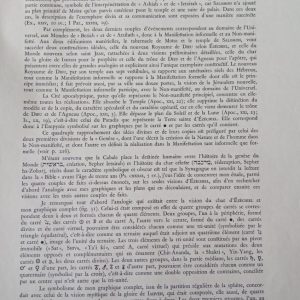
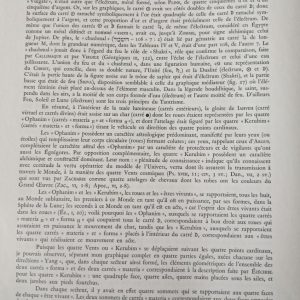
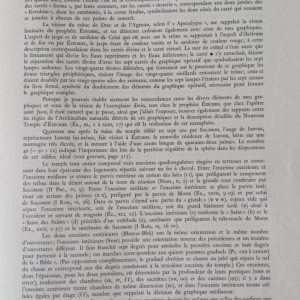
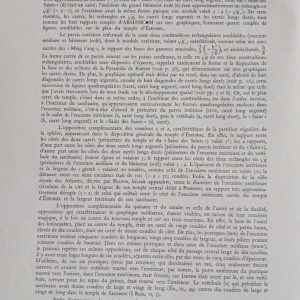
Original French
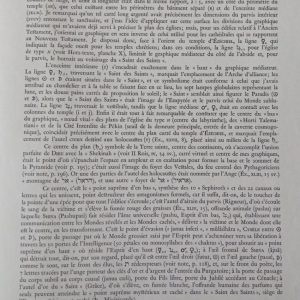
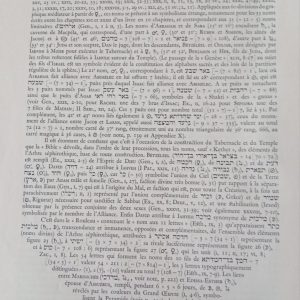
*
More about
the Complete Diagram
*
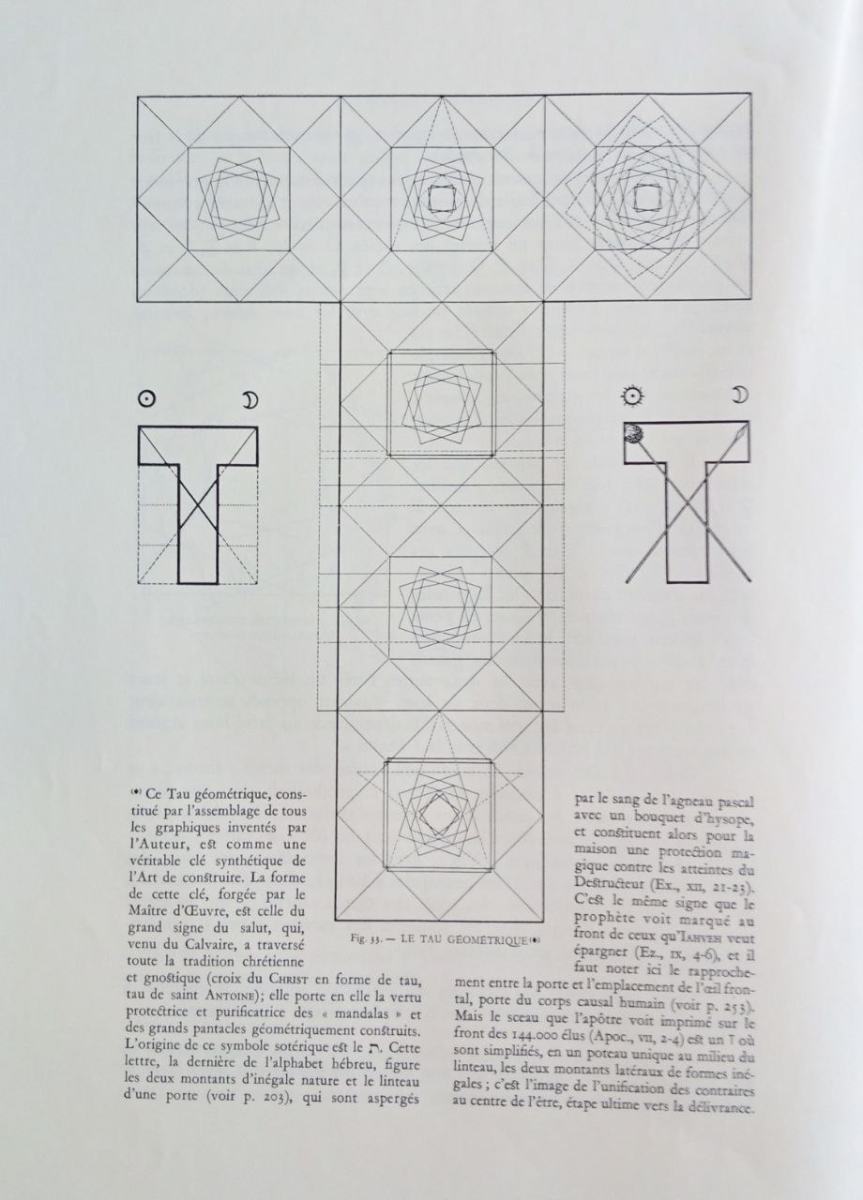
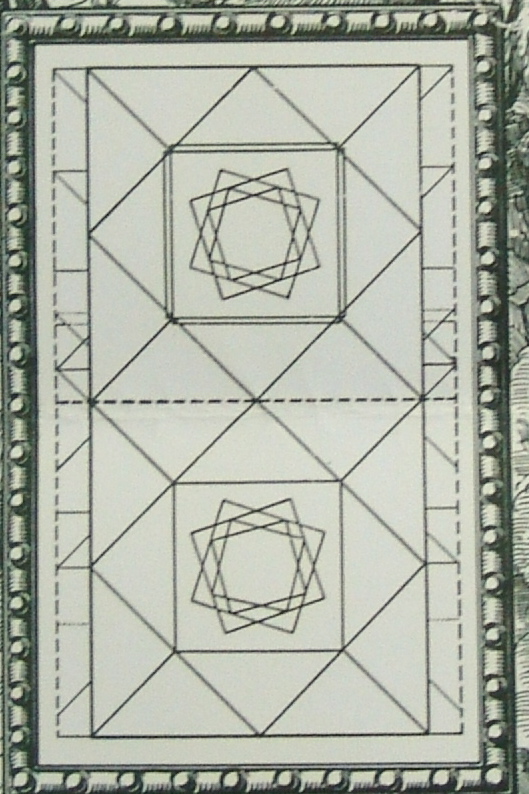
This Geometric Tau, constituted by the assembly of all the graphics invented by the Author, is like a veritable synthetic key of the Art of building. The form of this key, forged by the Master of the Work, is that of the great sign of salvation, which, coming from Calvary, traverses all the Christian and gnostic tradition (cross of the Christ in the form of tau, tau of Saint Anthony); it bears within it the protective and purifying virtue of the “mandalas” and of the great geometrically constructed pantacles. The origin of this esoteric symbol is the ת (Tav). This letter, the last of the Hebrew alphabet, figures the two uprights of unequal nature and the lintel of a door (see p. 203), which are sprinkled with the blood of the paschal lamb with a bouquet of hyssop, and thus constitute for the house a magical protection against the reaches of the Destroyer (Ex. XII, 21-23). It is the same sign that the prophet sees marked on the forehead of those whom Yahweh wishes to spare (Ez. IX, 4-6), and it must be noted here that he brings together the door and the place of the frontal eye, door of the human causal body (see p. 253). But the seal that the apostle sees imprinted on the forehead of the 144,000 elect (Apoc. VII, 2-4) is a Tau where the uprights, the two lateral uprights of unequal forms, are simplified into a single post in the middle of the lintel; it is the image of the unification of the contraries at the center of the being, ultimate stage toward deliverance.
Key observations:
‘Graphics’ not ‘diagrams’ — The French ‘graphiques‘ is Warrain’s technical term for his geometric constructions. ‘Complete Figure‘ (fig. 33) assembles all these ‘graphiques‘ into the Tau form.
The Tau as Janua — This figure explicitly connects to the janua theme: the Hebrew letter ת (Tav) as door, the blood-sprinkled lintel of Passover, the mark of protection on the forehead (Ezekiel’s tav), and finally the simplified seal of the 144,000 elect—unification of contraries at the center.
Figure vs. Diagram — Warrain distinguishes:
Graphique = individual geometric construction (fig. 31, the ‘complete diagram‘)
Figure = synthetic assembly (fig. 33, the ‘Geometric Tau‘)
The operative progression — The text traces an initiatory sequence: physical protection (Passover blood) → prophetic marking (Ezekiel’s forehead) → apocalyptic seal (Revelation’s elect) → unification at the center (the simplified Tau as janua to the causal body).
This Tau is thus the master key that unlocks all Warrain’s individual ‘graphiques‘, transforming them from analytic tools into a synthetic path of liberation. The ‘Complete Figure‘ is the janua made visible.
*
Source
*
Coming Soon
A Little ‘Petrus Talemarianus’ Sampler – Part V:
‘Plato’s Description of Atlantis‘.
***


Related Articles


Leave a Reply