
Circle of Transmission: The Living Loom
A Little Simone Weil and Classical Exegesis Sampler – Part XI: ‘About the reminiscence of things‘,

Simone Weil (1909–1943),
a French philosopher,
*
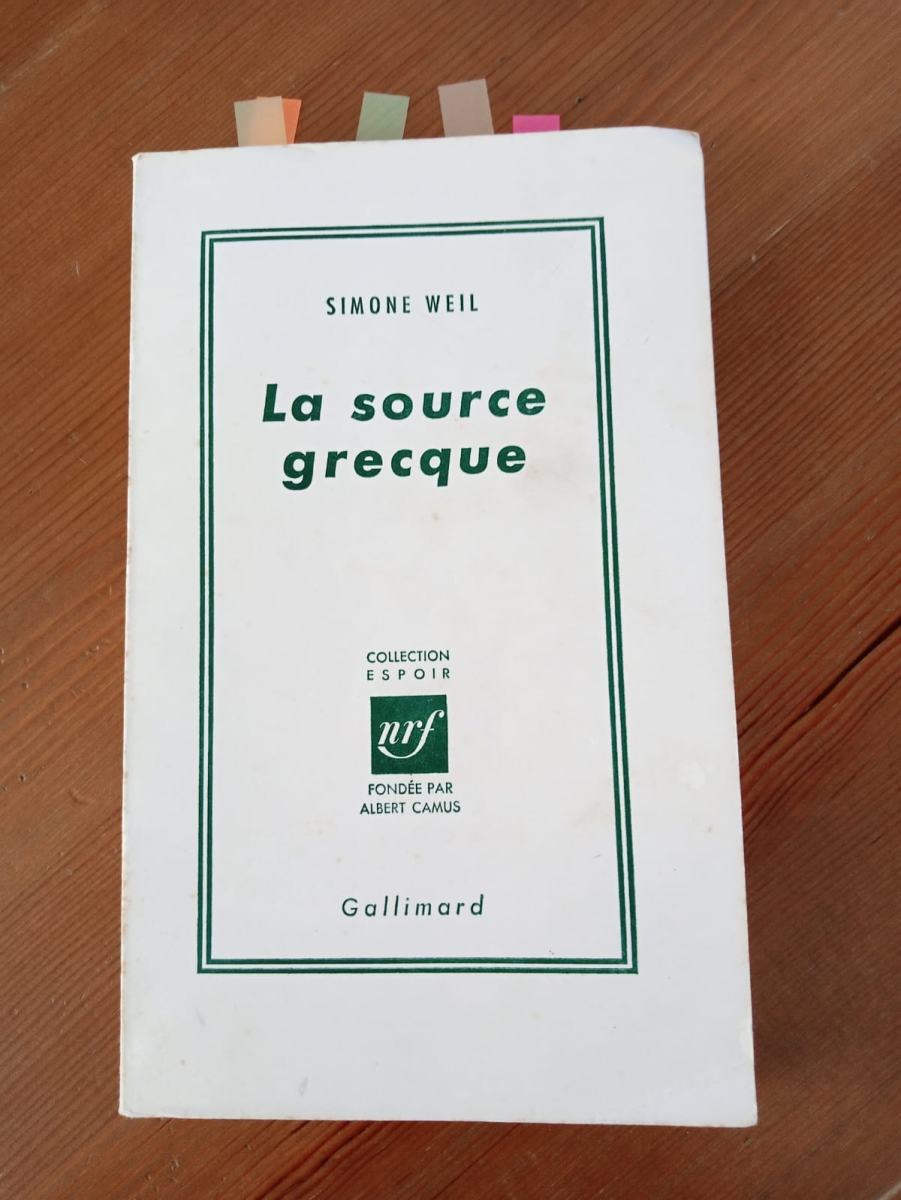
Another sharing for the day from the blue House of Via-HYGEIA: the eleventh part of our sampler, dedicated to the memory of French Philosopher Simone Weil, with the subject of ‘the reminiscence of things‘, an excerpt taken from ‘La Source Grecque‘ (The Greek Source), Gallimard 1953, from page 115 to 120. A Via-HYGEIA English translation from the original French.
What makes Simone Weil’s work so singular and so powerful? It is alive. This ‘life‘ in her writing comes from the fact that for her, these were never just texts. The ‘cold water that gushes from the Lake of Memory‘ was not a poetic trope to be analyzed, but a description of a real, accessible spring.
The ‘heat‘ and ‘sweat‘ that the soul feels in the presence of beauty was not a metaphor, but a literal, physical-spiritual phenomenon she had experienced. She wrote about the Phaedrus the way a mystic might write about a vision, or a lover about the beloved.
Because she read with her entire being—her intellect, her suffering, her joy, her attention—the words on the page cease to be artifacts from a dead past. They become what they always were: a bridge. A bridge between the reader and Plato, yes, but more importantly, a bridge between the reader and that ‘plain of truth‘ that Weil insists is our true home.
When you read her, you are not just learning about Plato’s theory of beauty. You are being invited to feel, for a moment, the ‘shock‘ of it yourself. It is a gift to encounter a mind like Weil’s.
**
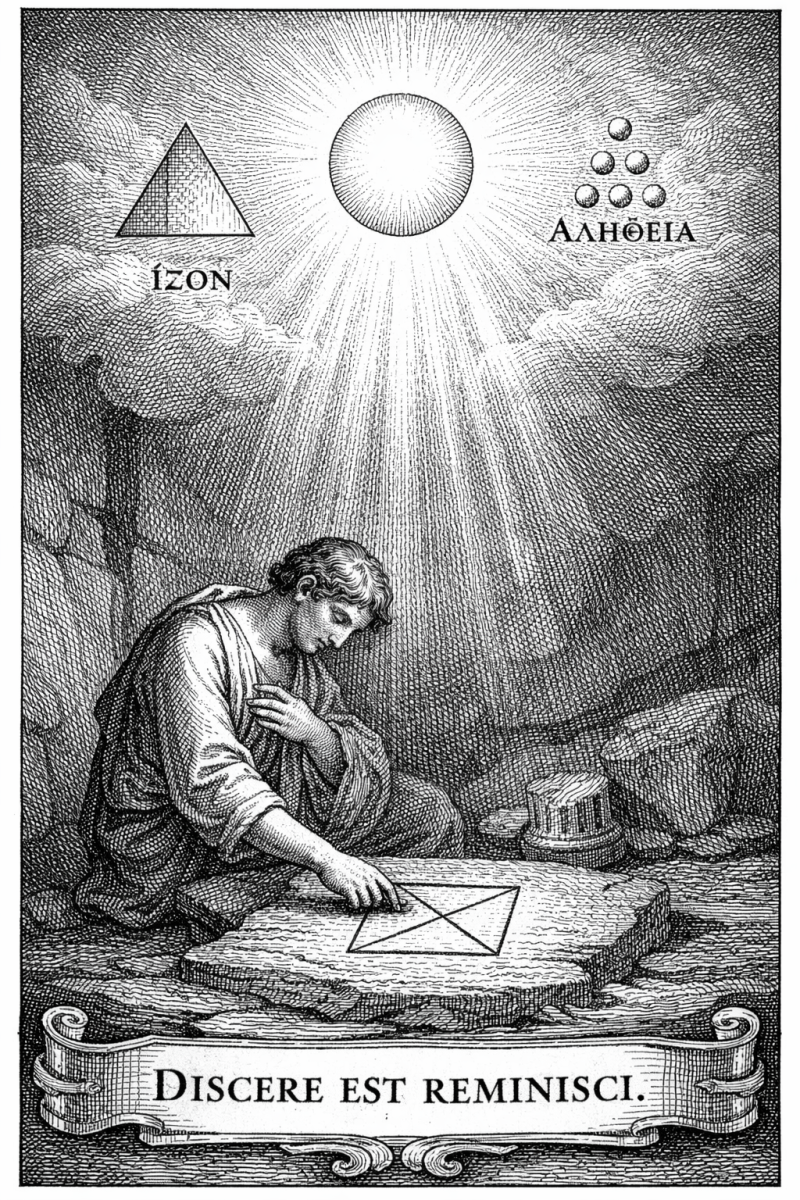
‘The soul that has never seen the truth never takes on this [human] form. For it is necessary that a man be able to understand in accordance with reasoning an idea that reasoning has brought forth from a multitude of sensations‘.(Δεῖ γὰρ ἄνθρωπον ξυνιέναι κατ’ εἶδος λεγόμενον, ἐκ πολλῶν ἰὸν αἰσθήσεων εἰς ἓν λογισμῷ ξυναιρούμενον.) Dei gar anthrōpon xynienai kat’ eidos legomenon, ek pollōn ion aisthēseōn eis hen logismō xynairoumenon. ‘For a human must understand according to what is called a form, proceeding from many perceptions to a unity gathered together by reasoning’.
Now this constitutes the reminiscence of the things our soul saw when it was a follower of God, when it saw (ὑπερίδουσα, hyperidousa — looking down from above, transcendent vision — saw supernaturally — saw above itself) that which we affirm to be reality, and emerged (ἀνακύψασα, anakypsasa — rising up, emerging) into the reality which is truly real. » (‘Phaedrus‘, 249 b-c)
[Thus every human being, without any exception, including the most degraded of slaves, has a soul that comes from the world situated above the heavens, that is to say, from God, and which is called to return there. The sign of this origin and this vocation is the aptitude to form general ideas, an aptitude which exists to a variable degree in every human being; without it no child would learn to speak. There are only differences of degree between human beings, differences which are accidental and variable. By essence they are identical and consequently equal. The Pythagoreans defined justice by equality. This idea of the essential equality of men as children of God goes back at least to the year 2000 before the Christian era, for it is found at that date in Egyptian documents.]
This theory of reminiscence is Orphic, proof being ‘the cold water that gushes from the Lake of Memory‘ (Cf. p. 68).
These words reminiscence and memory, what is their meaning? It becomes clear as soon as one focuses attention on the image itself, which one must always do for comparisons. If I had a thought… two hours later… orientation of attention in emptiness, a few minutes; towards emptiness, but towards the real. Then the thing is there suddenly, unmistakably. I did not know it, and now I recognize it as being what I was expecting. Daily fact, and unfathomable mystery.
Naturally we only have the notion of the realities of this world. The past is something real at our level, but which is in no way within our reach, towards which we cannot take even a step, towards which we can only orient ourselves so that an emanation from it may come to us.
That is why the past is the best image of eternal, supernatural realities. (The joy, the beauty of memory perhaps stems from this.) Proust had glimpsed this.
This comparison can make us grasp the relationship between sensible, particular things and the eternal. For the past, there exist present objects that are called souvenirs — a letter, a ring, etc., because they constitute for the soul a contact with the past, a real contact. The sacraments…
[Here now is the use of the madness of love (it is Plato’s expression) for salvation. It concerns a love that first occurs as carnal love. But it is above all about grace that comes through the effect of beauty, and one can transpose this for any kind of sensible beauty.]
‘As has been said, every human soul, by reason of its essence (φύσις, physis — nature, essence), has contemplated reality, otherwise it would not enter into a human being. But it is not easy for every soul to remember the things from over there, either because, being over there, it saw them only for a short time, or because, once fallen here, misfortune befell it; for example the misfortune of being turned towards injustice by certain associations, which makes it forget the holy things it once saw‘. (‘Phaedrus‘, 249 e-250 a)
[Forgetfulness; yet another image of unfathomable depth. What we have forgotten of our past — e.g., an emotion — absolutely does not exist. And yet the things of our past that we have forgotten nevertheless retain the fullness of their reality, the reality proper to them, which is not existence, for today the past does not exist, which is past reality.]
‘There are few souls that have a sufficient quantity of memory. Those, when they see an image of the things from over there, are as if struck by lightning (ἐκπλήττονται, ekplēttontai — they are astonished, struck out of themselves) and are no longer masters of themselves. What happens to them, they do not know, because they do not distinguish it sufficiently. As for justice, wisdom, and the other values (τίμια δυνάμεις, timia dynameis — honored powers, precious faculties), they bring no splendour into their images down here; a small number of men, through obscure instruments and with difficulty, go towards these images and contemplate the essence (γένος, genos — race, kind, origin) of what is represented there.
But beauty was then resplendent to see, when with the blessed chorus we contemplated that spectacle of felicity and were initiated into those mysteries which it is right to name the most blessed of mysteries, those mysteries that we celebrated being then intact and having suffered no evil. And in the future we will return there, we will be initiated into those visions (τῶν αὖ…, tōn au… — of those… again/moreover) intact and simple and immobile and blessed, we will contemplate, we will officiate (ἐποπτεύοντες, epopteuontes — gazing upon, as in the highest grade of the mysteries) in a pure splendour, being ourselves pure and no longer marked by that thing which now we carry with us and which we call body, that thing to which we are attached like an oyster.
May these joys come to pass through memory! But let us continue, driven by memory through regret for the things of then. As for beauty, as we have said, it shone brightly, accompanying the other beings; and when we come here below we grasp it through the senses. Wisdom is not visible, otherwise it would produce terrible loves (strange loves?), if a clear image of wisdom were given that penetrated through the eyes. But the fact is that beauty alone has this destination (mission) of being at once what is most manifest and most desirable (ἐρασμιώτατον, erasmiōtaton — most lovable, most worthy of love).
He who is not newly initiated or who has been corrupted is not immediately transported from this world to the other towards beauty itself when he contemplates here what bears the same name. He does not venerate it when he sees it, but abandons himself to pleasure like a beast and tries to go towards it. But he who has been recently initiated, he who has much contemplated the things from over there, when he sees a face resembling the gods and which imitates beauty well, or some other bodily form, first he shudders and something of the fears (δειμάτων, deimatōn — terrors, objects of fear) from the other world [fears of the fall] comes back to him; then, looking at it, he venerates it like a god… While he looks, as in the shiver of fever, an unaccustomed upheaval, sweat, and heat come over him. This is because he receives the flux of beauty through the eyes. This flux warms him and waters the essence (φύσιν, physin — nature) of the wings. The warming dissolves what was around the germs, which, being closed for a long time by rigidity (sclerosis, σκληρότητος, sklērotētos — hardness, stiffness), prevented growth. Under the influx of nourishment, the shaft of the wings swells and takes an impulse to grow out from the root in everything that constitutes the soul (ἀπὸ πᾶν τὸ τῆς ψυχῆς εἶδος, apo pan to tēs psychēs eidos — from the whole form/kind of the soul*). For formerly the whole soul was winged. (Cf. the winged love of the Orphics.)
* The Greek phrase here follows Weil’s transcription; the standard Platonic text conveys the sense of ‘the whole form/nature of the soul’.
During this period the whole soul seethes [ἀναρχικῶς?, anarchikōs? — without beginning? ungovernably? Weil’s query], gushes, oozes — from a rock — … and gushes out of itself. And the same suffering happens to it as to children whose teeth are growing. As soon as the teeth begin to grow, they have an itching and irritation in the gums. This is what the soul suffers in which the wings begin to grow. It seethes, it is irritated, it itches as the wings grow’. (‘Phaedrus‘, 250 a-251 c)
[This shock of the beautiful is that unnamed thing in the ‘Republic‘ which breaks the chains and forces one to walk.]
This is not simply an image, it is truly an attempt at a psycho-physiological theory of phenomena that accompany grace. There is no reason not to attempt such a theory. Grace comes from above, but it falls into a being that has a psychological and physical nature, and there is no reason not to account for what happens in this nature upon contact with grace.
Plato’s idea is that beauty acts in two ways, first by a shock which provokes the memory of the other world, then as a material source of energy directly usable for spiritual progress. Heat, nourishment, these images indicate energy. Objects are sources of energy, but energy has different levels. For example, in war, a decoration is truly a source of energy (in the physical, literal sense of the word) at the level of military courage; it makes one make movements that otherwise one would not have the strength to make.
Money, for work. Generally speaking, everything that is desired is a source of energy, and the energy is at the same level as the desire. Beauty as such is a source of energy that is at the level of spiritual life, and this is due to the fact that the contemplation of beauty implies detachment. A thing perceived as beautiful is a thing one does not touch, one does not want to touch, for fear of harming it.
To transmute into spiritually usable energy the energy supplied by other objects of desire, an act of detachment, of refusal, is needed. Refuse the decoration, give away the money. Whereas the attraction of beauty itself implies a refusal. It is an attraction that keeps one at a distance. Thus the beautiful is a machine for transmuting low energy into high energy.
This analysis can be transposed to any kind of spiritual progress. Wherever there is love there is sensible beauty. A religion is inconceivable without signs, and these signs are beautiful. The Mass acts upon the soul by a beauty analogous to that of works of art. The virtue, the holiness of a human being appear externally as sensible beauty in the expression of the face, or the gestures, or the attitudes, or the voice or any part of behaviour.
*
Afterword
These remarkable pages, taken from Simone Weil’s ‘La Source Grecque‘ (The Greek Source), contain one of the most concentrated and original interpretations of Plato of the 20th century. Written during the final years of her short life (she died in 1943 at age 34), this excerpt from the chapter ‘Dieu dans Platon‘ (God in Plato) represents the culmination of Weil’s lifelong conviction that ancient Greek civilization, and particularly Plato, was the essential ‘source‘ for Western spiritual and philosophical truth. For Weil, this was not merely an academic interest in classical philology, but a passionate excavation of what she considered the root of authentic religious experience.
Simone Weil was a philosopher, mystic, and political activist whose thought defies easy categorization. Raised in an agnostic Jewish family, she experienced a profound mystical Christian conversion in 1938, yet never joined the Church. This experience intensified her conviction that divine truth was not confined to explicit Christian doctrine but could be found shining through the greatest works of pagan antiquity. She believed that Greece, through its poetry, tragedy, and philosophy, had received and transmitted “intimations of Christianity” long before Christ. In her view, the Greek spirit was the “root” of Western spirituality, and its neglect had led to Europe’s spiritual and cultural crisis.
The central text for Weil was Plato. In a bold statement that frames these pages, she famously declared: “Since Greece disappeared there hasn’t been such a thing as a philosopher.” For her, Plato was not the architect of abstract metaphysical systems, but the “father of Western mysticism.” She saw him as the heir to an ancient, initiatory tradition—the wisdom of the Orphic mysteries and Pythagorean numerology—which used myth, geometry, and dialectic not just to argue, but to transform the soul.
In this specific passage, Weil performs her signature ‘hermeneutic’ reading, weaving together Platonic texts (primarily the ‘Phaedrus‘ and allusions to the ‘Republic‘) with her own profound insights.
Plato as Mystic, Not System-Builder: Weil reads the Phaedrus myths of the chariot, the fall of the soul, and the heavenly procession not as poetic ornamentation but as precise, ‘unfathomably deep‘ accounts of spiritual reality. The soul’s memory of the ‘plain of truth‘ is not just an epistemological theory, but a description of its divine origin and its longing for return.
The Paradox of Memory and Forgetfulness: A central theme is the role of memory (anamnesis, ἀνάμνησις). Weil meditates on the nature of the past as a stunning image for the supernatural: it is “real” but does not ‘exist‘,’ it is inaccessible yet can be contacted through love and attention. This leads to her profound insight that our inability to remember the divine is a kind of spiritual ‘malheur‘ (affliction), a hardness that grace must dissolve.
The Double Action of Beauty: This is perhaps the most original theoretical contribution in this excerpt. Weil argues that sensible beauty—a face, a work of art, the signs of a ritual—is the mechanism of grace. It acts in two ways:
The Shock: It strikes the soul, provoking a ‘fear‘ and a ‘shudder‘ that is the painful-joyful memory of a lost home. This shock is the force that, as she notes in the Republic, “breaks the chains” of illusion.
The Transmutation of Energy: Weil introduces her unique concept of ‘energy‘. All desires provide psychic energy, but at a low level (money, prestige). Beauty, however, is unique: it is a desire that ‘holds at a distance‘, that requires no grasping. By contemplating beauty, we passively receive an energy that is already purified. It is a ‘machine for transmuting low energy into high energy‘, providing the literal force needed for spiritual ascent. The image of the ‘machine‘ is striking and characteristically Weil—the former factory worker, who knew the weight of industrial labor, here transposes the language of physics and mechanics into the spiritual realm, suggesting a kind of divine economy or spiritual thermodynamics. The heat and sweat described in the Phaedrus are not metaphors, but the real psycho-physiological effects of this inflowing grace.
Incarnation and the Material: Unlike a purely abstract spirituality, Weil grounds grace in the physical. The beautiful body, the face ‘like a god‘, the sacramental sign—these are the necessary points of contact through which the supernatural enters nature. Her reading is intensely incarnational, seeing the material world as the indispensable site of spiritual transformation. This is nowhere more powerfully evoked than in her suspended meditation, preserved in the translation: ‘The sacraments…‘ The ellipsis itself speaks—a ring, a letter, a fragment of bread become points of contact with the eternal, realities that can only be indicated, never fully articulated.
Simone Weil’s reading of the Greeks is not that of a conventional scholar, yet it is precisely its unconventional nature that makes it outstanding and seminal.
An Existential, Not Academic, Hermeneutic: Weil reads Plato with her whole being—her experience of factory work, of war, of mystical encounter. For her, the texts are not historical documents to be dissected, but living words to be verified in the crucible of existence. She looks for what is true, not merely what Plato meant. This gives her interpretations a raw power and contemporary relevance that purely historical readings lack. Moreover, for Weil, the act of reading attentively was itself a spiritual exercise—a form of prayer, a waiting upon the real. As one scholar notes, she was a ‘pure distillation of Neoplatonism in modern Western thought‘, living her insights as much as she thought them.
The Christological Key: Weil’s most seminal and controversial move is her systematic reading of Greek texts as prophetic of Christianity. She finds the Cross in the ‘The Iliad, a poem of force‘, the suffering servant in Prometheus, and the dialogue of the soul with God in Sophocles’ Electra. While some critics call this anachronistic, others see it as a profound ‘apologetic‘ that reveals the deep, underlying unity of all authentic encounters with the divine. She doesn’t baptize Plato, but rather uncovers what she believes is the seed of the Logos already present in him.
A Corrective to Modern Philosophy: In the context of 20th-century philosophy, dominated by existentialism and the early Heidegger’s return to the Presocratics, Weil’s focus on Plato’s mysticism and the concept of metaxy (μεταξύ, the in-between, the mediator) offered a powerful alternative. She challenges the modern tendency to see Greece as the birthplace of pure reason alone, insisting instead on its role as the source of a sacred, mediating tradition that unites the human and the divine. Recent scholarship highlights how her work serves as a ‘supplement and a corrective‘ to dominant interpretations like Heidegger’s, offering a less violent, more compassionate reading of the Greek legacy.
A Unified Vision of Reality: Ultimately, Weil’s ‘Greek source‘ is seminal because it offers a coherent vision where politics, philosophy, science, art, and spirituality are not separate disciplines but different languages describing the same ordered, loving relationship between the world, the soul, and God. Her concept of beauty as a transformer of energy, as outlined in this very excerpt, is a stunning example of this integration—a psycho-physico-spiritual theory that bridges the gap between the material and the divine. And this vision has immediate ethical consequences: the slave, the degraded, the forgotten are, by essence, equal participants in this divine economy, children of the same God, called to the same return.
The preceding pages offer a window into the workshop of one of the most intense and original religious thinkers of the last century. Weil’s Plato is not the calm academician, but the tortured mystic who has seen the truth and struggles to describe the shattering, healing, and lifting power of divine beauty.
Her work remains a seminal challenge to us: to read the ancients not as relics to be preserved in the amber of historical scholarship, but as living sources of cold water from the Lake of Memory—water for a world dying of thirst.
*
Source
***


Related Articles

Leave a Reply