
Circle of Transmission: The Living Loom
A Little Simone Weil and Classical Exegesis Sampler – Part X: The Greek Art of the Ontological Proof

Simone Weil (1909–1943),
a French philosopher,
*
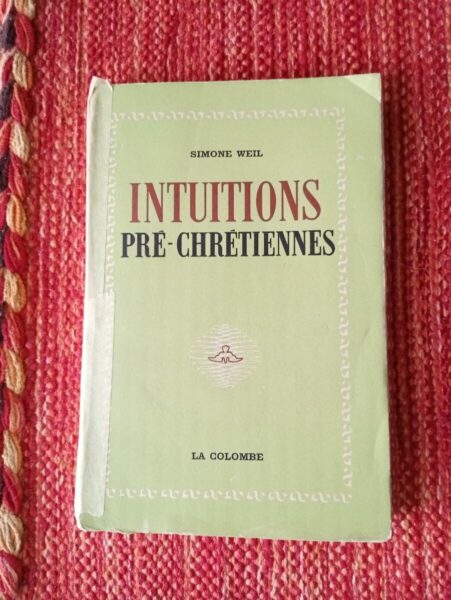
Today’s sharing from the Blue House of Via-HYGEIA, is the tenth part of our sampler, dedicated to the memory of French Philosopher Simone Weil, with the subject of ‘the Greek Art of the Ontological Proof‘. The excerpt is from ‘Intuitions Pré-Chrétiennes‘ (Pre-Christian Intuitions) published by La Colombe, Editions du Vieux Colombier, Paris 1951. From page 124 to 134 & a wee-bit more from pages 142 to 144. It echoes Pierre Deghaye’s ‘Theology of the Image‘ we published on September 18, 2025.
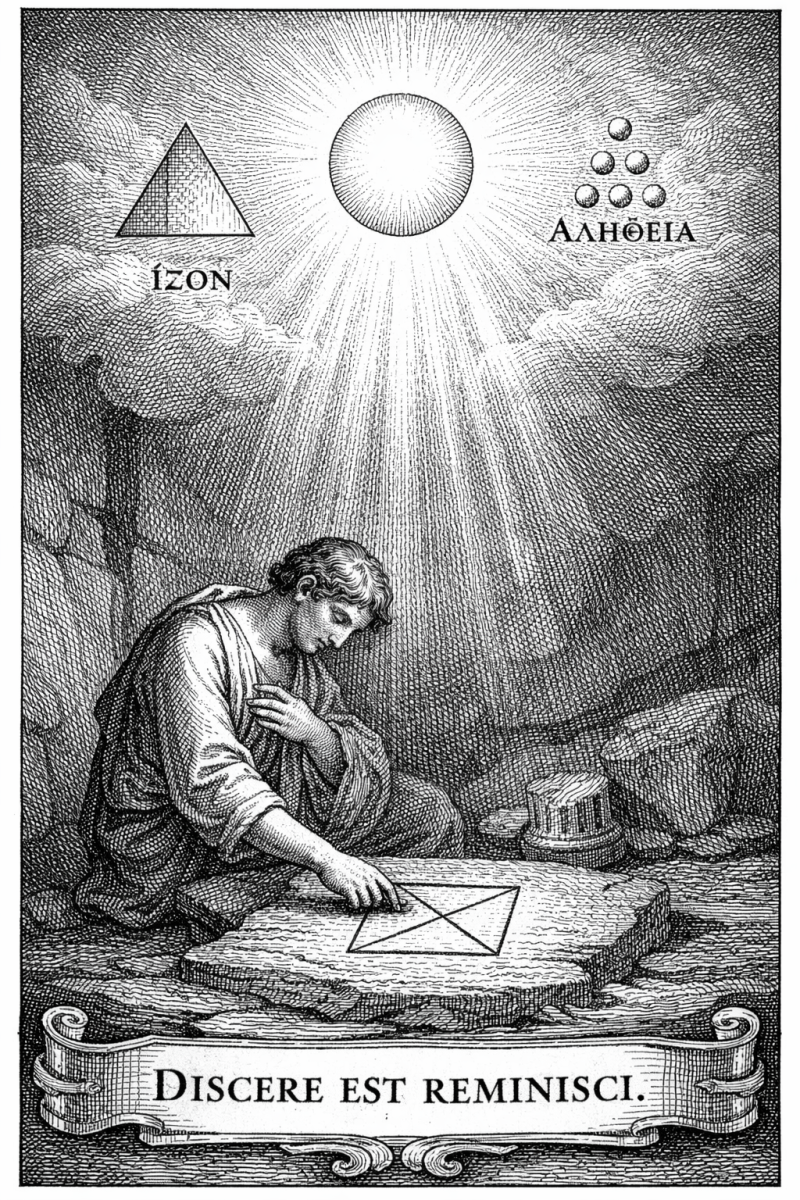
Sampler part XI will be about ‘the reminiscence of things‘, an excerpt taken from ‘La Source Grecque‘ (The Greek Source), Gallimard 1953, from page 115 to 120.
**
The Text
The Greeks had such a need for certitude concerning divine truths that even in the simple image of these truths, they required the maximum of certitude. Perhaps from the origin of the ages, men regarded whole numbers as proper to furnish images of divine truths because of their perfect precision and the mystery contained in their ratios. But this evidence of relations between whole numbers is still close to sensibility.
The Greeks found evidence of a much higher level through the search for non-numerical proportions, all exact, of which all terms are whole numbers. Thus, they found an image even more suitable for divine truths.
That their attachment to geometry was of a religious nature is visible, not only in some texts that testify to it, but also in the fact that very mysterious texts, such as those of Diophantus, author of decadence, did not have algebra. The Babylonians, about two thousand years before the Christian era, had algebra with equations of the second, third, and even fourth degree. One cannot doubt that the Greeks knew this algebra. They did not want to. Their algebraic knowledge, which was very advanced, was all contained within their geometry.
On the other hand, what mattered to them was not the results discovered, nor the importance of the theorems, but solely the rigor of the demonstrations. Those who did not possess this state of mind were despised.
The notion of the real number, provided by the mediation between some number and unity, was the subject of demonstrations as rigorous, and at the same time as incomprehensible to the imagination, as those of arithmetic. This notion forces the intelligence to grasp with certitude relations that it is incapable of representing. This is admirable introduction to the mysteries of faith.
From this, one can conceive an order of certitude, starting from uncertain thoughts, and easily graspable, which concern the sensible world, up to thoughts that are entirely certain and wholly inassimilable, which concern God.
Mathematics is doubly a mediation between the one and the other. It has the intermediate degree of certitude, the intermediate degree of inconceivability. It encloses the summary of the necessity that governs sensible things and the images of divine truths. Finally, it has as its center the notion itself of mediation.
One easily understands that the Greeks, when they perceived this poetry, were enchanted; they had the right to see in it a revelation.
Today, we can no longer conceive of this, because we have lost the idea that absolute certitude belongs solely to divine things. We want certitude for material things. For things concerning God, simple faith suffices. It is true that simple faith achieves great strength when it is heated white-hot by the fire of collective sentiments; but it does not thereby cease to be faith. Its strength is deceptive.
Our intelligence has become so coarse that we can no longer conceive even that it might possess authentic, rigorous certitude concerning incomprehensible mysteries. There would be on this point an infinitely precious usage to make of mathematics. It is irreplaceable in this regard.
The demand for perfect rigor, which inhabited Greek geometers, has disappeared, and for fifty years only mathematicians have rediscovered it. Today, it is still only an ideal analogous to that of art for the modern poets. But this is one of the failures by which true Christianity can once again filter into the modern world. The demand for rigor is not something material. When this demand is absolute, it is too obviously disproportionate, in mathematics, to its object, namely, quantitative relations and their conditions, to know that it destroys axioms arbitrarily chosen. In mathematics, this demand must one day appear as a demand exerted within life itself. The need for certitude will find its true object.
The mercy of God prevents mathematics from sinking into mere technique. For where one cultivates mathematics solely on the technical plane, one does not even succeed on that plane; such an experience was made in Russia. Technical applications are, in relation to pure science, among those things which are obtained only by surplus and which one never finds if one seeks them directly. This providential arrangement has allowed the core of our civilization, if materially based, to remain a nucleus of theoretical, rigorous, and pure science. This nucleus is one of the openings through which the breath and light of God may penetrate. Another opening is the search for beauty in art. A third opening is evil. One must enter through these openings, not through full places.
The formula: ‘Friendship is an equality made of harmony‘ ( φιλίαν εἶναι ἐναρμόνιον ἰσότητα – philian einai enarmonion isoteta), is full of marvelous meanings with respect to God, with respect to the union of God and man, and with respect to men, provided one takes into account the Pythagorean sense of the word ‘harmony‘. Harmony is proportion. It is also the unity of contraries.
To apply this formula to God, one must first approach a definition of harmony that is very strange: ‘δίχα φρονεόντων συμφρόνησις’ (dikha phroneonton sumphronēsis: the common thought of separated thinker).
Separated thinkers who think together—there is only one thing that realizes this with perfect rigor: it is the Trinity.
Aristotle’s formula: ‘Thinking is the thinking of thinking‘, does not exclude the Trinity, because the substantive can also be taken in the active or passive sense. Philolaus’s formula excludes it because the verb is in the active.
Meditation on this formula leads to the best way of accounting for the intelligence of the doctrine of the Trinity.
If one thinks of God as a single entity, one thinks of Him either as a thing, and then He is not an act, or as a subject, and then, to be in act, He would need an object, so that creation would be necessary and not love. We, as human beings, being subjects who are not such that we are in perpetual contact with an object, cannot conceive of God as perfect unless we conceive of Him as at once subject and object.
But God is essentially subject, thinking and not thought. His name is ‘I am‘. This is His name as subject, but also His name as object, and it is also His name as the contact between subject and object. Every human thought implies three terms: a subject who thinks, an object thought, and the thought itself, which is the contact between the two. Aristotle’s formula: ‘Thinking is the thinking of thinking’, designates these three terms, provided one takes the word ‘thought‘ each time in a different sense.
To represent God as a thinking being and not as a thing, we must represent these three terms in divine thought; but divine dignity requires that these three terms each be a single God. Divine dignity forbids that the word ‘think‘, when applied to God, be taken in the passive; the verb ‘to think‘, as applied to God, cannot be taken in the active. That which God thinks is still a being who thinks. This is why it is said that He is the Son, or the Image, or the Wisdom of God.
Such is the perfect thought, of which we other men can grasp the inconceivable character. Another representation we can imagine is easier, but infinitely distant from perfection. This is why the intellect can fully and without hesitation adhere to the doctrine of the Trinity, even though it cannot comprehend it.
If we interpret the definition of friendship through the definition of harmony as the common thought of separated thinkers, it is the Trinity itself that is friendship par excellence. Equality is the equality between one and many, between one and two; the contraries whose harmony constitutes unity are unity and plurality, which form the first couple of contraries. This is why Philolaus speaks of one part of the one as the first origin, and of the other part of the one as the first composite. He calls this latter Hestia, the central hearth, the central fire; and the fire always corresponds to the Holy Spirit. The formula: ‘Friendship is an equality made of harmony‘ excludes the two relations indicated by Saint Augustine in the Trinity: equality and connection. The Trinity is supreme harmony and supreme friendship.
Harmony is the unity of contraries. The first couple of contraries is one and two, unity and plurality, and it constitutes the Trinity. (Plato undoubtedly conceived the Trinity as the first harmony when he named the terms of the first couple of contraries the Same and the Other, in the Timaeus.) The second couple of contraries is the opposition between creator and creation. In Pythagorean language, this opposition expresses itself as the correlation between what is limited and what is unlimited—that is, between what receives limitation from the outside. The principle of all limitation is God. Creation is matter ordered by God, and this action of God’s ordering consists in imposing limits. This is also the conception of Genesis. These limits are quantities or something analogous to quantity. Thus, taking the word in its broadest sense, one can say that the limit is number. From this, Plato’s formula: ‘Number is the intermediary between the One and the Unlimited‘. The supreme is God, and it is He who limits.
In the Philebus, Plato indicates the first two couples of contraries in their order and marks the hierarchy that separates them when he writes: ‘Eternal reality proceeds from the One and the Many, rooted in itself: limit and the unlimited‘; this is creation, whose root is in God. The One and the Many, this is the Trinity, the first origin. Number appears in the Trinity as the second term of opposition, and if one identifies it with the limit, it appears in the principle of creation as the first term. It is therefore something like a mean proportional. One must not forget that in Greek, arithmos and logos are exact synonyms. The conception Plato exposes at the beginning of the Philebus, a conception of profound and marvelous technicality—for example, the study of language, of the alphabet, of music, and so on—must reproduce at its level the order of this primordial hierarchy, namely, unity, number in the broadest sense, and the unlimited. Thus, intelligence is an image of faith.
Since there is in God, as creator, a second couple of contraries, there is also in God a harmony and a friendship not defined by the sole dogma of the Trinity. It must be that there is also in God unity between the principle of limitation and inert matter. For this, it must be not only the principle of limitation, but also inert matter and the union between the two divine Persons, since there can be no relation in God unless the terms are Persons who link them. But inert matter does not think; it cannot be a Person.
The insoluble difficulties are resolved by passing to the limit. There is an intersection between a Person and inert matter; this intersection is a human being at the moment of agony, when the circumstances preceding the agony have been so brutal as to make it a thing. It is an agonizing slave, a miserable piece of flesh nailed to a cross.
If this slave is God, if He is the Second Person of the Trinity, if He is united to the First by the divine link that is the Third Person, we have the perfection of harmony such as the Pythagoreans conceived it: harmony where the maximum distance and the maximum unity meet. ‘The common thought of separated thinkers‘. There cannot be any thought other than the thought of the one God. There cannot be any separated thinkers other than the Father and the Son at the moment when the Son cries out: ‘My God, why have you forsaken me?‘ This moment is the perfection of incomprehensible love. It is love that surpasses all knowledge.
The ontological proof, the proof by perfection, which is not a proof for intelligence as such, but only for intelligence animated by love, this proof does not concern only the reality of God, but also the dogmas of the Trinity, of the Incarnation, and of the Passion. This does not mean, well understood, that these dogmas could have been found by human reason alone without revelation; but once they appear, they impose themselves on the intellect with certainty, if only they are illuminated by love, so that it cannot refuse to adhere to them, whether it affirms or denies them. God is perfect only as Trinity, and love, which constitutes the Trinity, finds its perfection only in the Cross.
God wished to give His Son many brothers. The Pythagorean definition of friendship applies wonderfully and to our friendship with God and to friendships among men.
‘Friendship is an equality made of harmony‘. If we take harmony in the sense of geometric mean, and conceive that the sole mediator between God and man is a being who is at once God and man, we pass directly from this Pythagorean formula to the marvelous formulas of the Gospel of Saint John. Through assimilation with Christ, who is not one with God, but the human being who, in the depths of his misery, attains a kind of equality with God, which is love. Saint John of the Cross, speaking of spiritual marriage with the authority of experience, constantly repeats that in the supreme union, God wishes to establish between the soul and Himself a kind of equality. Saint Augustine also says: ‘God became man so that man might become God‘. Harmony is the principle of this kind of equality, harmony, that is, the proportional mean, Christ. This is not directly equality between God and man; it is something analogous to a link of equality, it is between two relations.
When Plato, in the Gorgias, speaks of geometric equality, this expression is without doubt exactly equivalent to the harmonic equality employed by Pythagoras. One term and the other constitute, without doubt, technical expressions whose meaning was rigorously defined, namely, equality between two ratios having a common term, of the type a/b = b/c. For the adjective ‘geometric‘, used in terms such as geometric mean, indicates proportion. The phrases of Saint John cited above have this aspect of algebraic formula in such a striking way that it is manifest that this is intended and that there is an allusion. Plato could certainly say legitimately: ‘Geometric equality has great power over gods and men‘. According to the definition of friendship, the other expression from the same passage: ‘Friendship unites heaven & earth, gods & men‘ has exactly the same meaning.
By inscribing at the entrance of his school: ‘Let no one enter here who is not a geometer‘, Plato affirmed without doubt, under the form of an enigma, the truth that Christ expressed by the word: ‘No one comes to the Father except through me‘. The other formula of Plato: ‘God is a perpetual geometer‘, is undoubtedly double in meaning and relates to the world and to the mediating function of the Word. In sum, the appearance of geometry in Greece is the most brilliant among all the prophecies that announced Christ. One can thus understand that science, through the effect of unfaithfulness, became a principle of evil, just as the devil entered into Judas when he received the bread from Christ’s hand. Indifferent things remain always indifferent; they are divine things that, by the refusal of love, take on a diabolical efficacy.
Under the influence of science on Spiritual life, since the Renaissance, it seems that there has been something diabolical about it. It would be vain to try to remedy this by keeping science entirely within the domain of simple nature. It belongs to this domain only through its results and practical applications, not through its inspiration; for in science, as in art, all true novelty is the work of genius; and true genius does not belong to the domain of nature through its action on the soul, for it confirms faith or turns it away; it cannot be indifferent. If it were faithful to its origin and its destination, demonstrative rigor would belong to charity in Gregorian chant, just as it does in mathematics. There is a higher degree of technical musicality in Gregorian chant than in Bach and Mozart themselves; Gregorian chant is at once pure technique and pure love, as is all great art. It must be exactly the same for science, which, like art, is nothing other than a certain reflection of the beauty of the world. It was thus in Greece. Demonstrative rigor is the matter of art, just as stone is the matter of sculpture.
*
And a Wee-bit More
It is surprising to read that the number given to things gives them a body. One would rather expect a form. Yet the formula of Philolaus is literally true. Any rigorous analysis of perception, of illusion, of dreaming, of states more or less close to hallucination shows that perception of the real world differs from error only in that it implies contact with necessity. (Three generations of French Philosophers, Maine de Biran, Lagneau, & Alain are on this point those who have had the most discernment.) Necessity always appears to us as a set of laws of variation determined by fixed and invariant relations. Reality for the human mind is nothing other than contact with necessity. There is a contradiction here, for necessity is intelligible, not tangible. Thus, the feeling of reality is a harmony and a mystery. We persuade ourselves of the reality of an object by turning it around, an operation that successively produces appearances determined by a form other than them, transcending them. Through this operation, we know that the object is a thing, not a phantom, that it has a body. The quantitative relations that play the role of the gnomon — thus constituting the body of the object.
Lagneau, who no doubt was unaware of Philolaus’s formula, conducted this analysis using a cubic box. None of the appearances of the box has the form of a cube; yet, for one who turns around the box, it is the form of the cube that determines the variation of the apparent form. This determination constitutes, for us, the very body of the object — even though, strictly speaking, we never see a cube. The ratio of the cube — which, properly speaking, is never seen — is like the ratio of the gnomon’s shadow to its solar shadow. The example of the cube may perhaps be even more beautiful. One and the other relation may provide, by analogy, the key to all human knowledge. It is worth meditating on this indefinitely.
The reality of the universe for us is nothing other than necessity, whose structure is that of the gnomon, supported by something. It needs a support, for necessity in itself is essentially conditional. Without a support, it is nothing but abstraction. It is what the Greeks called the apeiron — that which is at once unlimited and indeterminate. It is what Plato called the receptacle, the matrix, the womb of all things, and at the same time always intact, always virgin. Water is the best image of it, because it has neither form nor color, even though it is visible and tangible. It is impossible not to notice that the words matter, mother, sea, Mary resemble each other to the point of being almost identical. The character of water accounts for its symbolic use in baptism more than its power to cleanse.
For us, matter is simply what is subjected to necessity. We know nothing else. Necessity is constituted for us by quantitative laws of variation. Where there is no quantity to speak of properly, there is something analogous. A quantitative law of variation is a function. The function is what the Greeks called arithmos or logos, and it is this that constitutes the limit. The clearest image of the function is provided by the continuous series of triangles having the same angles. It is a proportion. It is geometry that brings out the notion of function.
End of
the two excerpts
*
A Contextual Commentary
This text is a rare and beautiful synthesis — not because it assembles ideas from disparate sources, but because it reveals them as one living structure: the divine truth not as a doctrine to be believed, but as a form to be perceived — through the eyes of geometry, the heart of love, and the mind of mathematics. It does not ask you to accept the Trinity as a dogma, but to see it — as the perfect proportion between three terms: the One who thinks, the One who is thought, and the thought itself — a triad mirrored in every human act of knowing, yet infinitely beyond it. It does not present Christ as a savior in isolation, but as the geometric mean — the proportional mediator between God and man, the living ‘between‘ that makes union possible. And it does not offer the Cross as an end, but as the culmination of all proportion — the moment where maximum distance and maximum unity meet, where the Son, in abandonment, becomes one with the Father through love, revealing the Trinity not as a mystery to be solved, but as a harmony to be lived.
To see divine truth as structure — not doctrine — is to shift from assent to perception. We do not ‘believe‘ in a cube; we turn it, observe its shadows, and recognize its form through variation. So too with God: we do not grasp Him directly, but through the relations He establishes — in creation, in Christ, in the Spirit. The text invites us to treat theology as geometry: not as a set of fixed truths, but as a dynamic field of proportions — where the limit and the unlimited, the one and the many, the visible and the invisible, are held in tension by a divine harmony. This is why the Greeks, in their search for certitude, turned not to faith alone, but to mathematics — because mathematics, in its rigor, mirrors the necessity of the divine. It is not arbitrary; it is inevitable. And in that inevitability, they sensed the presence of God.
Through the eyes of geometry, the text teaches us to see beyond appearances. The cube is never seen — only its shadows, its angles, its proportions. Yet we know it exists because its form determines the variation of what we see. So too with the divine: we do not see God, but we see His ‘shadow‘ — in the order of nature, in the structure of thought, in the harmony of love. The gnomon — that ancient tool for measuring time and space — becomes a metaphor for perception itself: it is not the object that reveals its body, but the relation between object and light, between form and shadow. In this way, geometry becomes theology — the art of seeing the invisible through the visible, the eternal through the temporal.
And yet, geometry alone is not enough. Without the heart of love, the most rigorous proportion remains cold, abstract, lifeless. The text insists that the ontological proof — the argument for God’s existence — is not a logical syllogism, but a loving recognition. Only intelligence animated by love can perceive the Trinity — not because it is logically deducible, but because it is loved into being. The cry of the Cross — ‘My God, why have you forsaken me?‘ — is not a sign of defeat, but of perfection: it is the moment where the Son, as separated thinker, becomes one with the Father through the act of love. In that cry, distance and unity meet — not as contradiction, but as harmony. Love is not added to truth — it is the condition of its perception. Without love, mathematics remains technique; with love, it becomes revelation.
The mind of mathematics, in this text, is not the calculator, but the contemplative. The Greeks did not seek results — they sought rigor. They did not care about applications — they cared about demonstration. Their mathematics was not a tool, but a sacred discipline — a way of training the soul to perceive necessity, to dwell in the inassimilable, to hold certainty and mystery in one gaze. The real number, the function, the proportion — these are not abstract entities, but images of divine necessity. They teach us that some truths are certain but incomprehensible — like the square root of two, like the Trinity. And in that tension — between certainty and mystery — lies the space where faith and reason meet, not as rivals, but as companions.
This is why the text is a call to recover the sacred in reason. Modern thought has reduced reason to technique, to utility, to calculation. But the text reminds us that reason, at its highest, is not neutral — it is sacramental. To see the world as governed by proportion, by limit, by harmony — is to see it as created, as ordered, as loved. The Cross, then, is not an end — it is the fulfillment of that order. It is the moment where the divine structure becomes visible — not in glory, but in suffering; not in power, but in abandonment; not in unity, but in separation — and yet, in that separation, the deepest unity is revealed. The Cross is the perfect proportion — the mean between heaven and earth, between God and man, between death and life.
In the end, this text is not a treatise — it is an invitation. To see the world as geometry. To love it as theology. To think it as mathematics. To perceive the divine not as a doctrine to be believed, but as a structure to be lived — through the eyes of the geometer, the heart of the lover, and the mind of the mathematician. And in that perception, we do not merely understand God — we become part of His harmony.
*
Source
*
Coming next
A Little Simone Weil and Classical Exegesis Sampler – Part XI:
‘About the reminiscence of things‘,
an extract taken from ‘La Source Grecque’ (The Greek Source),
Editions Gallimard 1953, from page 115 to 120.
***

Related Articles

Leave a Reply