
Circle of Transmission: The Living Loom
Ludwig Klages: The Other Before the Self: On the Illusion of Immediate Self-Knowledge
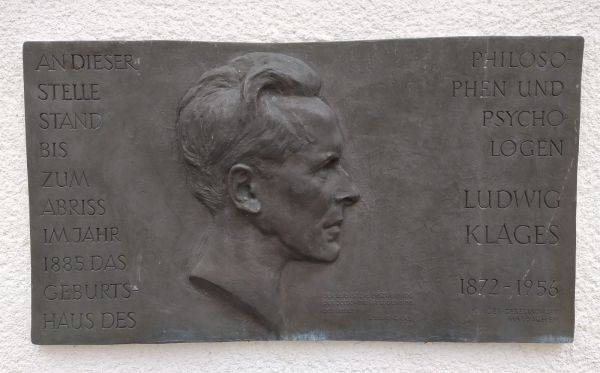
Memorial plaque for Ludwig Klages
at the house Warmbüchenstraße 21 in Hanover.
Picture at Wikimedia Commons.
*
Today’s sharing from the Blue House of Via-HYGEIA is an extract from the works of Ludwig Klages, provided by our friend, Ismail Akgöz, who also provided the Turkish translation. The extract comes from Ludwig Klages’s essay collection ‘Nietzsche’, specifically from the essay in which Klages reflects on Nietzsche’s view of consciousness and the priority of the other over the self. This collection of essays was first published in Berlin & Leipzig by Walter de Gruyter & Co., in 1923. The highlighted essay appears in the chapter often titled ‘Das Delphische: Zur Psychologie der Selbsterkenntnis‘ in subsequent printings.
**
A Contextual Introduction
Ludwig Klages (1872–1956) was a German philosopher, psychologist, and cultural critic associated with the Lebensphilosophie movement and the early reception of Friedrich Nietzsche. Trained in chemistry and psychology, he became known for his radical critique of modern rationality, which he understood as the domination of living soul (Seele) by abstract intellect or spirit (Geist). Klages’s work spans characterology, graphology, psychology, and metaphysics, culminating in his major work ‘Der Geist als Widersacher der Seele‘ (1929–1932), where he developed a sweeping diagnosis of Western civilization as life-denying. Although influential on depth psychology, cultural criticism, and ecological thought, Klages remained an outsider to academic philosophy, his thought occupying a singular position between vitalism, phenomenology, and Nietzschean critique.
Ludwig Klages is not an author one ‘adopts‘ lightly. He belongs to that small group of thinkers whose diagnoses are so penetrating that they risk being mistaken for remedies. The present excerpt is offered here neither as a model nor as a guide, but as a critical lens—one that renders visible a fault line at the heart of modern consciousness.
Klages’s reflection on the Delphic injunction ‘Know thyself‘ strikes at a foundational assumption of modernity: the belief in an immediate, self-transparent interiority. Against this belief, he argues that self-knowledge is late, mediated, and derivative; that the world, the other, and the living presence of things precede reflection upon the self. In this sense, Klages joins a broader counter-current that resists the reduction of human experience to introspection, abstraction, and technical mastery.
This critique resonates with concerns central to Via-Hygeia Bibliotherapy: the loss of symbolic mediation, the neutralization of the cosmos, and the progressive severing of intellect from life, imagination, and rhythm. Klages gives these concerns a sharp and uncompromising formulation, drawing on Nietzsche to expose the historical fragility of what modern psychology and philosophy long took to be axiomatic.
At the same time, Klages marks a limit. His thought remains diagnostic rather than therapeutic, immanent rather than transcendent. While he powerfully unmasks the pathologies of reflective consciousness, he offers no symbolic medicine, no integrative practice, no path of reconciliation between intellect, soul, and world. His opposition between Geist and Seele clarifies a crisis, but does not resolve it.
For this reason, Klages appears here as a necessary interlocutor, not as a presiding authority. His voice sharpens perception and clears ground; it does not provide orientation by itself. Read in this spirit, the present text can deepen our understanding of what is at stake in any genuine work of healing: namely, not a return to immediacy or a rejection of thought, but the restoration of mediated, meaningful, and life-bearing relations between human beings, the world, and the symbolic orders that sustain them.
*
And now, the text:
The Other Before the Self: On the Illusion of Immediate Self-Knowledge
Apollo’s world-famous threshold inscription, “Know thyself,” had—and still has—besides its manifest meaning a hidden one that was known to the ancient esotericists. While the manifest meaning, which we shall consider first, addresses to everyone the injunction to investigate one’s own nature, it has also helped to foster a prejudice whose refutation will lead us step by step to its concealed significance: namely, the prejudice that it lies closer to us to gain knowledge of the self than of the non-self. We shall first demonstrate the truth of the opposite.
Even the most cursory glance at the intellectual history of all peoples, and especially of the European peoples, reveals that the external world constituted the earliest object of questioning, searching, and discovery, whereas inwardness—whether one understands by this term primarily spirit or primarily soul—became such an object only much later. Consciousness of objects generally precedes self-consciousness. The Greeks, for example, the true inventors of philosophy, possessed comprehensive systems concerning the origin and constitution of the cosmos long before they began to reflect upon the soul and the thinking spirit.
The same holds, in another way, for the small child, whose initial perceptual achievements are oriented toward external impressions; the child learns far earlier to touch and eventually even to fixate its own foot than it becomes aware of the belonging of this foot to itself and to personal acts of will. Likewise, it is perceptual objects with which the child’s apprehension of psychic states is first connected. The immature child has long since noticed anger or tenderness in the facial expressions of those who care for it, responding to the former with fear and to the latter with inclination, before it begins to know that it itself can fear and love, and thus becomes capable of thinking what we mean by words such as fear or love.
Just as the object-directed judgment “there stands a tree” must be made in order for the self-reflective judgment “I see that there stands a tree” to occur, so too the apprehension of states belonging to others precedes reflection upon one’s own states—this being no less true with regard to those daemonic occurrences which we still today unwittingly express in countless turns of phrase, as when we say of a storm that it is “threateningly” advancing across the sky.
If, then, all thinking objectification is grounded in the experience of reality, and if the content of experientially accessible reality includes its character of being foreign to the soul, then what is one’s own to the soul (and likewise to consciousness) can be found only by way of a detour through the perceived object and in opposition to it; and it evidently requires more than ordinary mental exertion to place it in the position of an object in its own right.
With the laconic formulation, “The Thou is older than the I,” Nietzsche casts into sharp relief a state of affairs whose opposite had been held to be axiomatic, at least since Descartes, not only among ideologists but even among the so-called sensualists. The other confronts me in the form of appearance, that is, as primary reality; the own-self must first estrange itself from itself in order to become graspable. The other lies in the outward-directed gaze that is natural to both primitive humanity and the child; the own-self is apprehended only through a reversal of this natural direction, or more briefly, through “reflection.”
Anyone who might doubt, in the face of a truth that retrospectively appears almost self-evident, that the legend of the “immediate self-certainty” of consciousness and inwardness was believed in unshakably for fifteen centuries need only be referred to the still influential school psychologist Wundt, who believes he can demarcate psychology from the natural sciences by asserting that the former rests on immediate, the latter on merely mediated experience.
If one sets beside this a single fragment of a sentence by Nietzsche of the following kind—“In place of that ‘immediate certainty’ in which the people (!) may believe in a given case, the philosopher receives … a series of metaphysical questions into his hands, properly speaking questions of conscience of the intellect …”—then one understands once and for all what the guest appearance of a creative thinker of Nietzsche’s ruthlessly combative independence meant for ‘science,’ and why it has not yet fully recovered from the shock even today.
*
Original German
Apollons weltberühmter Schwellenspruch »Erkenne dich selbst« hatte und hat neben seinem offenbaren einen geheimen Sinn, der den alten Esoterikern bekannt war. Indem der offenbare Sinn, den wir zuerst erwägen, an einen jeden die Aufforderung richtet, das eigene Wesen zu erforschen, hat er ein Vorurteil begünstigen helfen, dessen Widerlegung uns schrittweise zu seiner verborgenen Bedeutung hinüberführen wird: das Vorurteil nämlich, es liege uns näher, vom Eigenich als vom Fremdich Kenntnis zu nehmen. Wir zeigen zuvörderst die Wahrheit des Gegenteils.
Zunächst einmal verrät uns der flüchtigste Blick auf die Geistesgeschichte aller, besonders aber der europäischen Völker, daß die Außenwelt den frühesten, die Innerlichkeit einen sehr viel späteren Gegenstand des Fragens, Suchens und Findens gebildet habe, gleichgültig, ob man beim Worte Innerlichkeit mehr an den Geist oder mehr an die Seele denke. Dem Ichbewußtsein geht allgemein das Sachbewußtsein voraus. Die Griechen z. B., die eigentlichen Erfinder der Philosophie, besaßen längst umfassende Systeme über Entstehung und Beschaffenheit des Weltalls, ehe sie anfingen, sich auf die Seele und den denkenden Geist zu besinnen.
Dasselbe gilt in anderer Weise vom kleinen Kinde, dessen anfängliche Wahrnehmungsleistungen an äußeren Eindrücken orientiert sind; das weit eher den eigenen Fuß zu betasten und in der Folge sogar zu fixieren lernt, als es der Zugehörigkeit dieses Fußes zu sich und zu persönlichen Willensregungen innewird. — Und ebenso sind es nun Wahrnehmungsgegenstände, mit denen zuerst sich seine Auffassung seelischer Sachverhalte verbindet. Das unmündige Kind hat bereits lange Zorn oder Zärtlichkeit in den Mienen der es betreuenden Personen bemerkt und jenen mit Furcht, diesen mit Neigung erwidert, bevor es davon zu wissen beginnt, daß es selber fürchten und lieben könne, und dergestalt zu denken vermag, was wir mit Wörtern wie Furcht oder Liebe meinen.
So gewiß das sachbesinnliche Urteil »dort steht ein Baum« gefällt sein muß, damit das selbstbesinnliche Urteil »ich sehe, daß dort ein Baum steht« stattfinden könne, so gewiß geht die Auffassung von Fremdzuständen der Besinnung auf Eigenzustände voraus, und zwar nicht am wenigsten hinsichtlich jener dämonischen Vorkommnisse, die wir mit unzähligen Redewendungen selbst heute noch ahnungslos an den Tag sprechen, so wenn wir etwa von einem Gewitter äußern, es ziehe »drohend« am Himmel herauf!
Fußt nämlich alles denkende Vergegenständlichen auf dem Erleben der Wirklichkeit und gehört zum Gehalt der erlebbaren Wirklichkeit ihr Charakter der Seelenfremdheit, so wird das Seeleneigene (wie ebenso das Bewußtseinseigene) nur auf dem Umwege über das Wahrnehmungsding und in Gegenstellung zu ihm gefunden, und es bedarf offenbar einer mehr als gewöhnlichen Geistesanspannung, um es seinerseits an die Gegenstandsstelle zu rücken.
Mit der lakonischen Wendung: »Das Du ist älter als das Ich« bringt Nietzsche in schattenwerfendes Licht einen Sachverhalt, dessen Gegenteil für ein Axiom zu halten mindestens seit Descartes zum guten Ton gehörte, und zwar nicht nur der Ideologen, sondern sogar auch der »Sensualisten«. Der andere tritt mir in der Form der Erscheinung entgegen, also als primäre Wirklichkeit; das Eigenich muß sich zuerst sich selbst entfremden, damit es erfaßbar sei. Der andere liegt in der nach außen gehenden Blickrichtung, die dem ursprünglichen Menschen wie auch dem Kinde natürlich ist; das Eigenich wird nur durch Umkehrung der natürlichen Richtung aufgefaßt oder kürzer durch »Reflexion«.
Wer es aber angesichts einer hinterdrein wie etwas Selbstverständliches anmutenden Wahrheit bezweifeln sollte, daß an die Legende von der »unmittelbaren Selbstgewißheit« des Bewußtseins und der Innerlichkeit anderthalb Jahrtausende lang unerschütterlich geglaubt wurde, sei nur an den noch immer zugkräftigen Schulpsychologen Wundt verwiesen, der die Seelenkunde gegen die Naturwissenschaft abgrenzen zu können glaubt mit der Festsetzung, jene beruhe auf unmittelbarer, diese dagegen auf bloß mittelbarer Erfahrung!
Hält man daneben ein einziges Satzbruchstück Nietzsches von der Art des folgenden: »Anstelle jener ›unmittelbaren Gewißheit‹, an welche das Volk (!) im gegebenen Falle glauben mag, bekommt … der Philosoph eine Reihe von Fragen der Metaphysik in die Hand, recht eigentlich Gewissensfragen des Intellekts …«, so hat man zugleich ein für allemal begriffen, was die Gastrolle eines schöpferischen Denkers von der rücksichtslos angriffsbereiten Unabhängigkeit Nietzsches in der »Wissenschaft« für diese bedeuten mochte und weshalb man sich dort selbst heute noch nicht völlig vom Schrecken darüber erholte.
***


Leave a Reply