
Circle of Transmission: The Living Loom
John Pordage’s ‘Philosophical Epistle’ To Jane Leade – A New Translation & Introduction
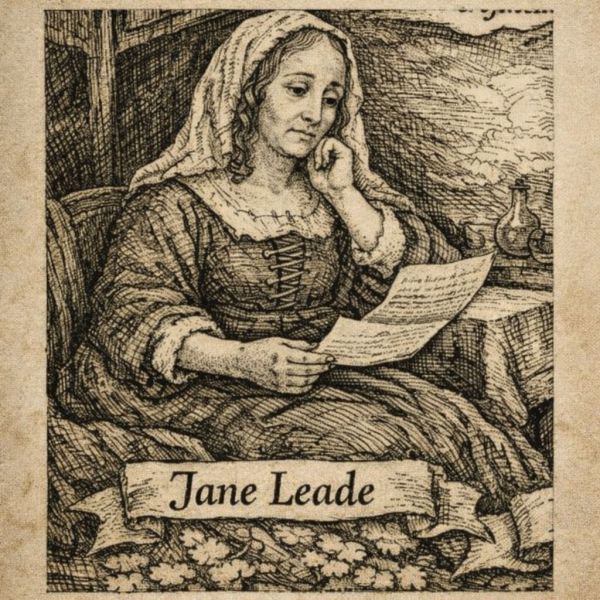
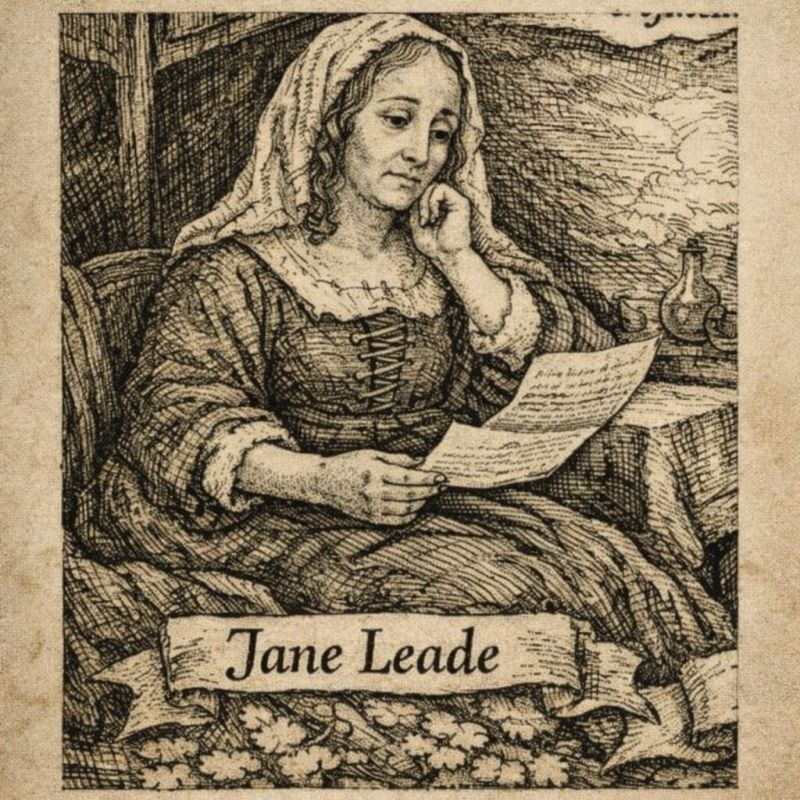
A symbolical portrait of Jane Leade.
*
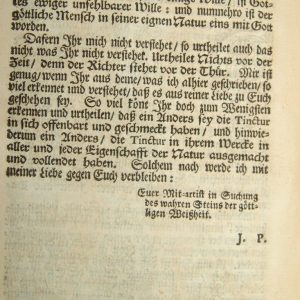
Today’s sharing from the Blue House of Via-HYGEIA presents a new English translation and introduction to John Pordage’s ‘A Thoroughly Philosophical Letter on the True and Right Stone of Wisdom’, written to Jane Leade and first published in 1698 in its German translation in Amsterdam by the renowned Dutch printer Heinrich Wetstein. This edition constitutes the earliest German printing of the Epistle, issued alongside several previously unpublished treatises, in addition to the ‘Theologia Mystica’ (including the ‘Treatise of Eternal Nature’).
A subsequent German edition of the Epistle appeared in 1728, edited by the Silesian compiler Friedrich Roth-Scholzen in volume I (of three) of the ‘Deutsches Theatrum Chemicum’, published in Nürnberg, where it is listed as item 11 of 13.
Our work of updating and re-contextualizing the Epistle was motivated by the fact that the first modern English translation appeared twenty-six years ago—prepared by the distinguished scholar Arthur Versluis in ‘Wisdom’s Book: A Sophia Anthology’, (Paragon House)—within a scholarly context markedly different from our own. That translation was based on a 1779 German edition published in Berlin and marked the first return of the text to its original English form.
Professor Versluis played a pioneering role in the modern Anglophone rediscovery and conceptual articulation of Boehmian theosophy and the Sophianic current, particularly through his translations and synthetic interpretations. This contribution stands alongside, and is complementary to, the foundational philological and historiographical work of scholars such as Bernard Gorceix, Pierre Deghaye, Roland Heidighoffer, and Antoine Faivre, whose research—especially within the EPHE tradition—was instrumental in establishing the academic study of Western esotericism and theosophy in the French and German scholarly contexts.
**
A Contextual Introduction
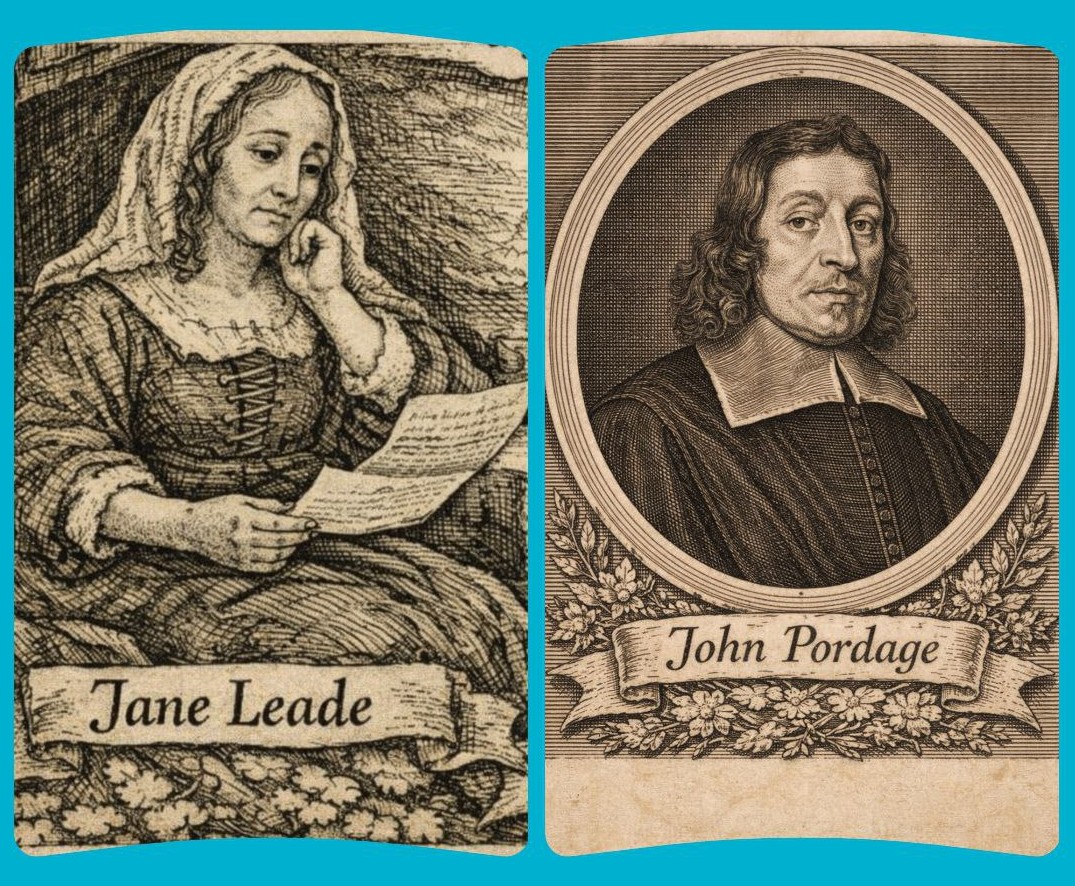
Printed in 1698 by the renowned printer Heinrich Wetstein, Ein Gründlich Philosophisch Sendschreiben vom rechten und wahren Steine der Weisheit (A Thoroughly Philosophical Letter on the True and Right Stone of Wisdom) conveys a message that transcends its time. Its author was John Pordage (1607–1681), a former Anglican priest turned mystic; its recipient, Jane Leade (1624–1704), a widow, visionary, and spiritual leader. Internal evidence suggests that the Epistle was composed between 1670 and 1675.
Having died in 1681, Pordage did not live to see this work published. During his lifetime, only the Theologia Mystica—carefully edited and issued by Jane Leade in collaboration with Edward Hooker—appeared in print.
This Epistle, preserved solely through its German translation after the loss of the original, unpublished English manuscript, is far more than an alchemical treatise. It stands as a radical testament to spiritual equality, a cartography of the soul’s regeneration, and an intimate dialogue between two seekers engaged in the same theosophical path.
What makes Pordage’s letter extraordinary is its very address. In an era when women were barred from theological authority and their mystical visions often dismissed as hysteria, Pordage does not write as a master to a disciple. He opens with a recognition that shatters contemporary convention: he calls Leade his ‘fellow artist in the search for the true Stone of Divine Wisdom‘. This is not mere courtesy, but a radical affirmation. He acknowledges that she has already found the Materie—the raw substance of the soul’s work—and is ready for the next stage of the Opus. Theirs is a collaboration of equals, a spiritual democracy articulated in the hushed, subversive language of mysticism.
At its heart, Pordage’s epistle insists that the Philosopher’s Stone is not a physical object to be manufactured, but a divine reality within. The ‘Stone of Wisdom‘ is the soul’s own purified essence—the ‘pearl of love‘, the ‘child of the virgin‘, the ‘seraphic angel‘ born from the death of the ego. ‘The matter of the Stone is the eternal nature of the Son; it is the essence and being of divine love; it is the soul of Paradise‘, he writes. This is not knowledge to be acquired, but a latent divinity to be awakened. Pordage’s purpose is not to instruct Leade in how to make the Stone, but to remind her that she already possesses its seed: ‘You have the pearl of love‘.
Guiding her through this inner awakening, Pordage structures the letter as a map of the alchemical stages, each corresponding to a spiritual state: The journey begins in Nigredo—the blackness of dissolution. Here, the soul must descend into its own darkness, where suffering and doubt break apart the hardened ego, a necessary ‘incineration‘ symbolized by the black raven. From this ashes arises Albedo, the whiteness of purification, where the soul is cleansed and ‘clothed in white‘, bathed in innocence and heavenly joy. This leads to the golden radiance of Citrinitas, an illumination where the soul begins to shine with its own divine light, prepared for final union. The culmination is Rubedo—the redness of divine birth. The soul, now fixed and united with God, becomes a ‘confirmed seraphic angel‘, an elixir of life capable of healing, wisdom, and transcendent power.
This regenerated self is the ‘child‘, a central symbol in Pordage’s work. He describes it as born from the union of Mars (the fiery, active divine will) and Venus (the gentle, receptive fire of divine love). This new self must be nurtured with ‘heavenly milk‘ in the soul’s inner womb—the Balneum Mariae—until it is strong. This child is no mere metaphor; it is the reality of the soul reborn in divine love, the ‘inner Christ’ fully realized.
Pordage populates this journey with rich alchemical symbolism, each term an anchor for an inner reality. The ‘Matter‘ is the virgin seed, the ‘red earth’ of Paradise, the soul’s own primal essence. The ‘Oven‘ is dual: the external, physical body that must be disciplined, and the internal, sealed vessel of the soul where transformation occurs. The ‘Fire‘ is not destructive but transformative—the ‘love-fire of life‘ flowing from divine Venus, a gentle heat that purifies and unites.
Yet, for all its profound mysticism, the letter’s most enduring shock is its foundational equality. By addressing Jane Leade as a Mit-artist—a fellow artist—Pordage consciously elevates her spiritual authority. In 1698, this was a profoundly counter-cultural act. Leade, a woman claiming direct divine revelations, found in Pordage not a confessor-mentor-corrector but a collaborator who built his entire epistle around the validity of her spiritual journey. This gesture stands as a quiet, powerful testament to a principle that transcended the rigid hierarchies of their day.
Rooted in the theosophy of Jacob Boehme, the alchemy of Paracelsus, and the impulses of Radical Protestantism, Pordage’s Epistle is a bridge between worlds. It links inner experience with symbolic practice, and anticipates later esoteric and psychological thought. Its structure is intentionally that of a personal letter—intimate, urgent, and cyclical—mirroring the non-linear path of the soul itself.
In conclusion, Pordage’s message is ultimately a call to inward awakening. ‘The Stone is not in the earth—it is in the soul. It is not made—it is found. It is not bought—it is given. It is not earned—it is awakened‘. And implicit in this call is its radical corollary: this divine spark knows no gender. The stone waits within all.
In recognizing Jane Leade as his fellow artist, Pordage affirmed that the search for divine wisdom is a shared human odyssey. Beyond its alchemical lexicon, his Epistle remains, at its core, a fraternal love letter—written from one seeker to another, in the timeless language of symbols, guiding the soul home to its own inherent divinity and freedom.
*
And now,
the text:

A Thoroughly Philosophical Letter on the True and Right Stone of Wisdom
— By J.P.M.D. —
Printed in the Year of Christ 1698, Amsterdam, by Henrich Wetstein
Concerning the Entire Process of the Philosophical Work—how one rightly begins, proceeds, and brings to completion the true work of regeneration—here fully described and set forth. Written to instruct and caution a sincere seeker who, having earnestly sought after the first matter of this precious Stone of Divine Tincture, has discovered, prepared, and partially attained it, yet, for lack of sufficient illumination, has not fully perceived or perfected it, and has thus been prematurely formed. This work is therefore offered as instruction and warning to all who engage in this process, expressed here in clear and plain terms.
*
Most Beloved Lady,
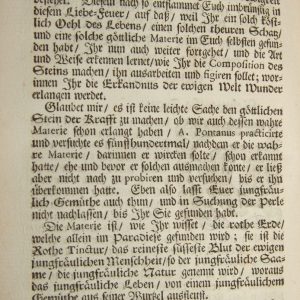
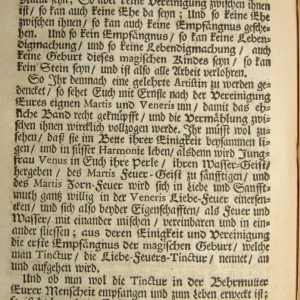
Since it is known to me that you have found the matter of the Stone — that is, the true matter of the Stone of Wisdom — I feel compelled and moved within myself to send you these few lines as comfort. The matter now is, as you know: the eternal nature of the Son; it is the essence and being of divine love; it is the soul of Paradise; it is the heavenly blood of the Virgin; it is the heavenly tincture; it is the seed of pure nature — so that your life may be in itself, and you may be capable of singing the holy Trinity. But this is not enough! You must not remain here: for here is no rest for you; you must go further — namely, to the matter of the great wonder, that is, the divine tincture, which also contains the divine essence — and your first fruit will be enjoyed.
But I will no longer merely advise you, but instruct you how to make the Stone — or how to work in water and fire — which is the wonder of all wonders, wherein lies the true blessing and sanctity of eternity. This inflames you with love, because you have found such a precious treasure in yourself — and you now proceed further, and learn the art and wisdom of making the Stone — to work and figure it out — whereby you attain knowledge of the eternal world’s wonder.
Believe me: it is no easy thing to make the divine Stone of Power — even though we have already attained its true matter. Pontanus practiced it five hundred times after he had recognized the true matter — yet he did not dare to try or attempt it before he had overcome it. Even so, let your virginly maiden also try — until she finds it — and in seeking the pearl.
(A Via-Hygeia note: Dutch historiographer, Johannes Isaacius Pontanus (1571-1639) wrote: ‘Upon The mineral Fire; and the Great Elixir, commonly called The Philosophers Stone‘-first printed in Latin in 1600. When Pordage says Pontanus ‘had overcome it‘ — he means: Pontanus had passed through the Nigredo, endured the putrefaction, and emerged purified — not as a theorist, but as a transformed being. Only then did he dare to proceed).
The matter is, as you know: the red earth — which is found only in Paradise; it is the purest blood of eternal virgin humanity — so that virgin nature is generated — from which virgin life flows forth from its root.
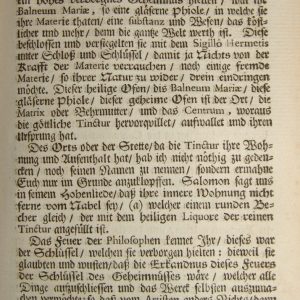
The athanor — namely, the Philosopher’s athanor — is a great mystery. There are two athanors: one external, made of lime and brick — yet it is made wondrously from the spirits of the great world and its constellations — and is no other than your external visible body — made from the four elements together. But after you have found the matter, you do not make or work the Stone before this outer oven is broken — so you have no hope of succeeding — unless this outer oven is broken — you cannot fully work it.
(A Via-Hygeia note: Note: While Pordage uses ‘Ofen‘ (oven), the alchemical tradition refers to the permanent, slow-heating furnace as the ‘Athanor‘. The ‘Balneum Mariae‘ is a separate vessel — often a sealed phial — used for gentle, water-based processes. Here, Pordage may be using ‘oven‘ generically to refer to both the macrocosmic Athanor, the body, and the microcosmic vessel, the phial).
The necessary athanor — which the philosophers called their Balneum Mariae — is a glass phial — in which they placed their matter — and more — for the whole world is worth it. They sealed and enclosed it with the Seal of Hermes — under lock and key — so that the power of the matter might not escape — and might enter its nature — to draw in some foreign matter. This holy athanor — this secret athanor — is the place — the matrix or mother — and the center — from which the divine Tincture emerges and originates.
(A Via-Hygeia note: In Jakob Boehme’s theosophy, ‘Tincture‘ (Tinctur) denotes the living, transformative power that mediates between spirit and nature, uniting divine will with material manifestation. It is not a substance in the chemical sense, but a qualifying, transmuting life-principle operating simultaneously on ontological, cosmological, and spiritual levels).
The place or dwelling — where the Tincture resides — I need not name — nor give it a name — but only hint at its ground. Solomon tells us in his Song: “My inner dwelling is not far from the table” — which is a round vessel — filled with the pure liquor of the heavenly Tincture.
The fire of the philosophers — which they called the key — because they believed and hoped that the knowledge of this fire was the key to the mystery — and that the work itself required flesh and diligence. This fire is the love-fire of life — flowing from divine Venus — or the love of God — of the fire of Mars — which is too sharp and too grim — so that the matter is corrupted and burned — and thus alone the Tincture of life — in this death — and in this poison — and in this bitterness — the highest and most enduring tincture — and the true life — is again revived.
The ancient philosophers called this work — their descent — their incineration — their pulverization — their corruption — their caput mortuum. This blackness — or black color — must not be despised — but must be held in silence — and in stillness — for forty days — until the days of their suffering are fulfilled — so that the seed of life — may rise — may sublime — may purify itself — may become white — and holy — may give itself the red — and may be clarified and figured.
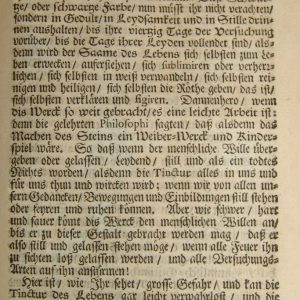
Then — when the work is so far brought — it is an easy task — for the learned philosophers say — that making the Stone is women’s work — and children’s play. So that when the human will is given up — and is still — and becomes dead — then the Tincture acts — and works — within us — when all our thoughts — movements — and imaginations — are still — and silent — and rest.
But how heavy — how hard — how difficult — this work is — when the human will must be brought — to stillness — and left — so that all fire — may be let loose — and all temptations — may attack!
Here you see — great danger — for the Tincture of life — may easily be lost — and the fruit — may be corrupted — by so many devils — and by so many temptations — from all sides — and around. So — these fires — are tests — and severe trials — which bring victory — for then — your resurrection — from hell — begins.
*
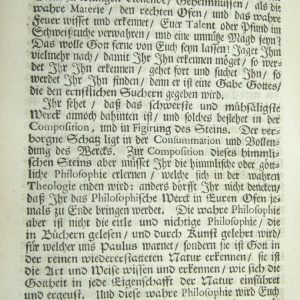
Let me remind you of this, so that you yourself may become a serious seeker — for you must now seek the three great secrets: the true matter, the right athanor, and the true fire — so that you may recognize your talent or gift? Does God wish to be far from you? Let Him seek you — so that you may find Him — For He — the divine tincture — is Himself a gift, given to earnest seekers.
You see that the hardest and most laborious work lies in the composition and figuring of the Stone. The hidden treasure lies in the consummation and completion of the work. To compose this heavenly Stone, you must learn the heavenly or divine philosophy — which ends in true theology; otherwise, you must not think that the philosophical work will ever be completed in your athanors. True philosophy is not read in books — nor taught by art — but rather, as Saint Paul warns, you must recognize God in the renewed nature — and this true philosophy will teach you to recognize the divine properties of nature — and thus you will attain knowledge of the true Stone — which the wise have sought and found in all ages.
This true philosophy will teach you — and you must recognize yourself — so that you may also recognize the true nature within yourself. And when you recognize the pure nature — the true self — you also recognize God — for divinity is hidden and enfolded in pure nature.
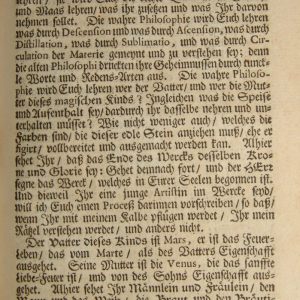
True philosophy will teach you the right quantity and measure — what you must take and what you must leave. True philosophy will teach you what is done by descent, by ascent, by distillation, by sublimation — for the ancient philosophers expressed their secrets through such words and phrases.
True philosophy will teach you — what is the magical child? What is its dwelling and abode? What must you take and retain? What colors must you find — before this noble Stone can be prepared and made?
Here I warn you: that the end of this work is the same as its beginning — and the heart seals the work — which begins in your souls. And since you are a young artist, I will describe a process within it — so that you may understand my meaning — and no other.
The father of this child is Mars — the fiery life — proceeding from Mars — as the father’s property. Its mother is Venus — who is the gentle love-fire — and from the son’s property — the man and the woman — the bride and the bridegroom — Galilea — in the properties and forms of nature — which arise from their state of separation. Mars — or the man — must become divine — otherwise the pure Venus will not receive him — nor enter into holy wedlock. Venus must become a pure virgin — otherwise she will be the lustful Mars — and will not live in unity and harmony — but in strife and enmity — under the properties of nature. So there can be no union between them — no marriage — and thus no conception — no life — no birth of this magical child — and thus no Stone — and thus all work is lost.
(A Via-Hygeia note: Galilea: Not a geographical reference, but a Boehmian-theosophical term denoting the regenerated state of nature in which purified masculine and feminine principles (Mars and Venus) are reunited in divine harmony. As the realm of Resurrection, Galilea signifies the condition in which true conjunction, conception, and the birth of the Stone become possible. In Jakob Böhme and his successors, including John Pordage and Jane Leade, Galilea is repeatedly invoked as the region of the Resurrection—the place where Christ appears after the overcoming of division and death).
So, since you are to become a learned artist — you must unite your own Mars and Venus — so that the earthly bond is rightly joined — and the union between them is truly completed. You must be willing to let your unity lie — and live in sweet harmony — so that the virgin Venus in you gives birth to her pearl — the spirit of Mars’ fire — and the spirit of Venus’ love-fire — will willingly mix — and unite — and from their unity and union — the first conception of the magical birth — which is called the love-fire Tincture — and is given.
And although the Tincture is received in your mother — and awakened to life — yet there is still great danger — for you may still be caught in the flesh or in the mother — or be lost — for you may still be brought into the flesh — and be destroyed — unless you now seek a good nurse — who will take you in your childhood — and rightly care for you — and you must be your own gem — and your own virgin will.
*
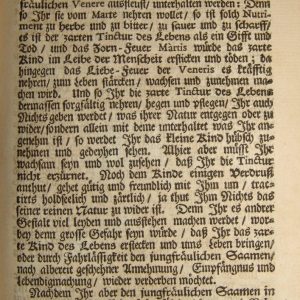
Furthermore, you must sustain the Tincture alone — with such nourishment or food and drink — as is suitable and proper to its nature. Therefore, you must sustain it — with the water of life — with the heavenly blood — which flows from the breasts of the virgin Venus — for if you wish to nourish it — with the bitter and sharp Tincture of Mars — it will become too bitter and too sharp — and will kill the tender child of humanity — whereas the love-fire of Venus will strengthen and nourish it — and make it grow.
And so you must nourish the tender Tincture of life — against its nature — or else — you must take it alone — with your own nature — so that the little child may grow and be seen. But here you must be careful — that the Tincture is not corrupted. Moreover, you must be gentle and friendly with it — so that it does not lose its pure nature. For if you make its form too strong — or too hard — you will bring great danger — and the tender child of life will be destroyed — or corrupted by the impatience and haste of your reception and life.
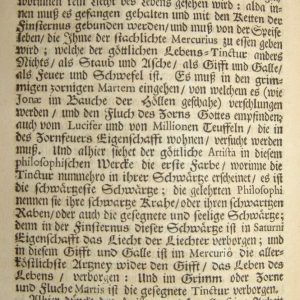
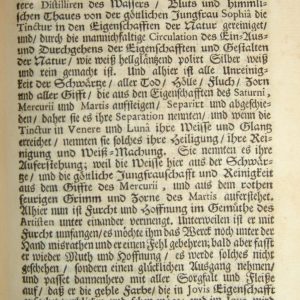
After you have brought the virgin seed — through the power of Venus — into the strength of the male — and have sustained it — with the virgin milk — you must bring the child — into the properties of nature — so that it may be tested and tried — and thus it will become strong — and will carry the tingling life — in the properties of nature — and will be proved and tried — for it must become again great danger and peril — for the tender Tincture — the tender child — must ascend — and must endure the suffering — and must be bound — to the chains of death — in the darkest Saturn — where the light of life is hidden — and must become dust and ash — as poison and gall — as fire and sulfur — and must be cast into the grim, stony grave — (as Jonah in the belly of the whale) — and must be consumed by the fire of Lucifer — and by the millions of devils — who dwell in the property of hell-fire.
And here the divine artist — in this philosophical work — sees the first blackness — which the learned philosophers call their black raven — or their black crow — for in this blackness — the light of life — and the gall — and the poison — and the fire — are hidden — and in this blackness — the life of the child — is hidden.
Here the artist — must lose all his work. What is now to be seen — or to be found — is nothing — for the stone is as nothing — as the most terrible death — as hellish fire — as pain and grief — as death and destruction — for in this putrefaction — the life — is lost — in this fineness — the tincture — is lost.
*
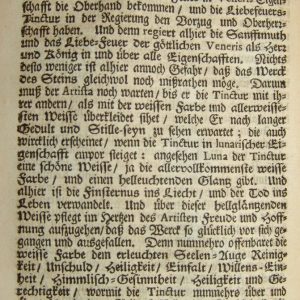
Then the white color reveals the enlightened soul — purity / innocence / holiness / unity / heavenly joy / righteousness — and the Tincture is clothed — as bright as the moon — as beautiful as the morning rose.
Then the divine virginity of life appears — and no stain or spot is seen upon it.
The Ancients called this their white swan — their albification — their whitening — their sublimation — their distillation — their circulation — their purification — their separation.
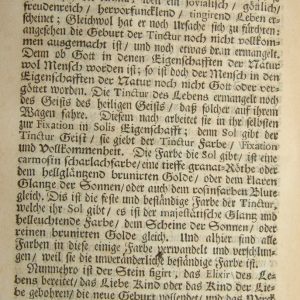
After the Tincture of life is impregnated in the lunar body — and with the living soul in the properties of Jupiter — it is joyfully — divinely — and radiantly brought forth — though the birth of the Tincture is not yet complete — for God — in the properties of nature — is not yet fully revealed — and the human soul — is not yet God — or perfected.
The Tincture of life — must still work — in its own properties — until it is fixed in Sol — for the Sun gives the Tincture color — and completion. The color that the Sun gives — is a deep carmine — a deep garnet-red — or the clear radiance of the sun — or the rosy hue of the Tincture — which the Sun gives — is the majestic radiance — the shining gold — the pure gold — and here all colors are transformed — and become one — for it is the unchanging, enduring color.
Then the Stone is prepared — the Elixir of Life — the child of love — or the child of life — is born — and the new birth is completed — and the work is finished.
Go forth — Curse / Hell / Death / Dragon / Beast / and Serpent! Good night mortality / fear / grief / and sorrow! For now — redemption, salvation, and restoration of all that was lost — is no longer needed — for you have the great secret and mystery of the whole world.
(A Via-Hygeia note: Pordage’s declaration — ‘You have the secret — the mystery — of the whole world’ — can be understood as a Christianized, Boehmian-theosophical echo of the Kabbalistic concept of ‘Tikkun Olam’ — the restoration of the world through the inner transformation of the soul. Here, Jane Leade is not merely a recipient of divine wisdom — she is its living embodiment. The soul’s regeneration is not a private matter — it is a cosmic event. In becoming one with the divine tincture, she becomes the world’s redemption — not by doing, but by being. This is the universal pattern of mystical traditions: that the healing of the world begins within the soul. Whether in Kabbalah, Boehme, Pordage, or Jung — the message is the same: The microcosm heals the macrocosm. The inner Stone is the world’s redemption).
You have the pearl of love — you have the unchanging essence of divine joy — from which all healing virtues and increasing powers proceed. You have the seed of the woman — which has broken the serpent’s head. You have the seed of the virgin — the milk of the virgin — and the blood of the virgin — in one essence and property.
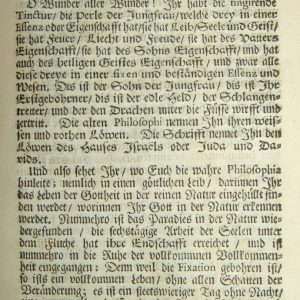
O wonder of all wonders! You have the shining Tincture — the pearl of the virgin — which has three in one — body / soul / and spirit — she has the father’s property — and the son’s property — and the holy spirit’s property — and these three are in one fixed and enduring essence — and the dragon and the lions — the Ancients called them — the lions of the house of Israel — or Judah and David.
And so you see — where true philosophy leads — namely — into the divine body — wherein you are wrapped in God — in pure nature— and the paradise of souls — is reached — and the six-day work — is completed — for when the fixation is accomplished — it is a day without night — an eternal joy without sorrow — for then the paradise-man is clear — as shining glass — as pure gold — bright and clear — without spot or stain.
(A Via-Hygeia note: ‘wrapped in God‘ echoes Boehme’s concept of the soul’s union with divine nature — not identity, but in-dwelling. In mystical Christianity, this is often called ‘theosis‘ — participation in the divine life — not absorption into God’s essence. Also, being ‘wrapped in God‘ corresponds to the interior reality of what Revelation 12:1 expresses outwardly as being ‘clothed with the Sun‘).
The soul is now — a confirmed seraphic angel — she may make herself — into a physician — theologian — astrologer — or a divine magus — she may do what she will — for all properties have only one will — in unity and harmony. And the same one will — is the eternal unchangeable will — and now — the divine human — has become one — with God — in his own nature.
If you do not understand me, then do not judge that which you do not understand either. Judge nothing before the time, for the Judge stands before the door. It is enough for me if, from what I have written here, you recognize and understand enough to know that it was done out of pure love for you.
At the very least, you should be able to recognize and judge this: that it is one thing to have the Tincture revealed and tasted within oneself, and quite another to have the Tincture determined and perfected in its becoming, in each and every property of Nature.
So — I will now remain — with my brotherly love — for you:
Your fellow artist — in the search
of the true Stone of Divine Wisdom.
John Pordage.
(Circa 1670-1675).
*
Source
***
Related Articles


Leave a Reply