
Circle of Transmission: The Living Loom
Music as Medicine: Three Rituals of Healing from a Forgotten Century
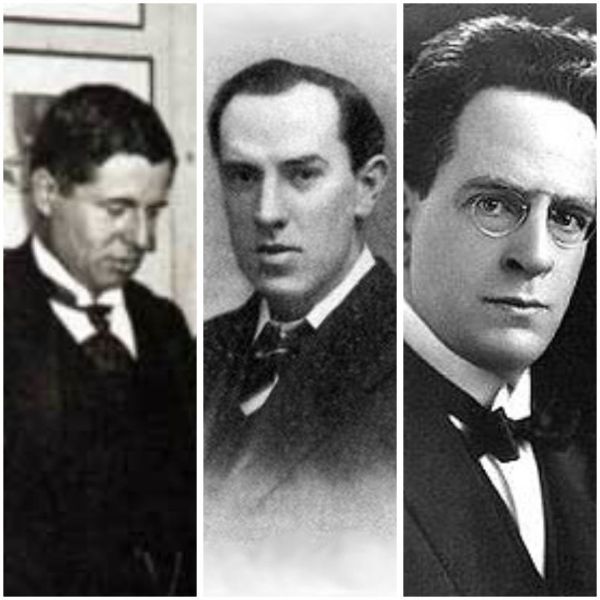
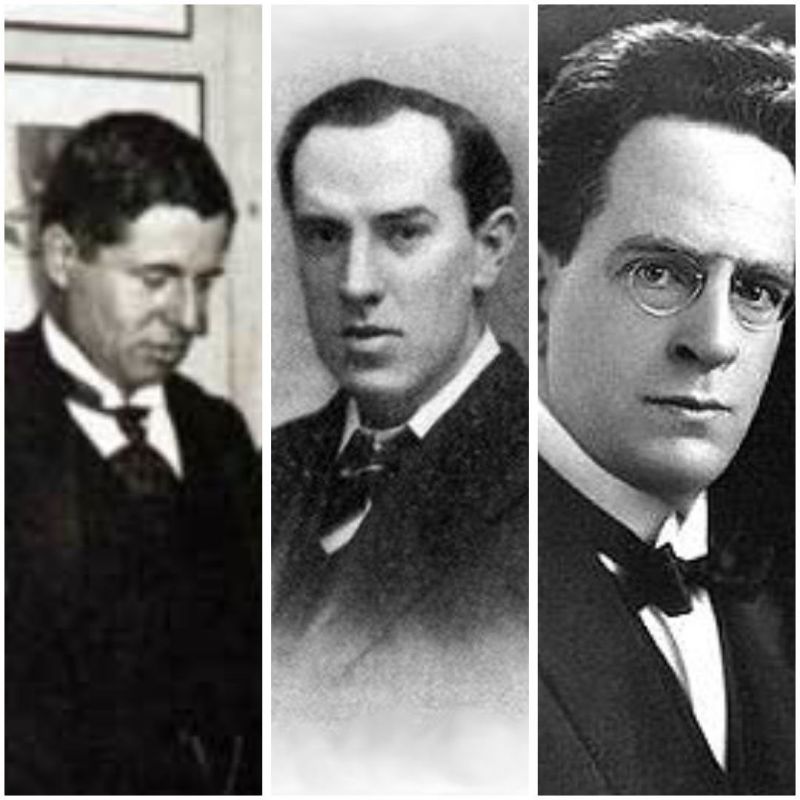
Albéric Magnard,
Sir Henry Walford Davies
& John Herbert Foulds
*
This article is dedicated to Michael Robert Osborne.
*
Today’s sharing from the Blue House of Via-HYGEIA is a contemplation about Music as ritual healing. Via-HYGEIA (from the Greek goddess of health) is our sanctuary for contemplative arts—works that transcend entertainment to become instruments of presence. In a world often quick to offer solutions, we instead offer space. Our intent is not to cure your grief, erase your trauma, or answer your deepest existential questions with simple platitudes. Rather, we wish to guide you toward three forgotten masterpieces of the early twentieth century that have the power to hold your pain, name your fear, and validate your suffering.
The three opuses presented here—John Foulds’s ‘A World Requiem’ (1921), Henry Walford Davies’s ‘Everyman’ (1904), and Albéric Magnard’s ‘Guercœur’ (1897-1901)—emerged from a continent shadowed by war. Two were born directly from its trauma; one gained tragic resonance through its composer’s death in the conflict. All were designed as sacred spaces where the wounded soul could find, if not a remedy, then a profound companionship.
Our wish for you is simple:
That you might find in Foulds a voice from beyond that reassures you that love conquers death.
That you might discover in Davies a faithful companion who reminds you that your good deeds never abandon you, even in solitude.
That you might encounter in Magnard a truth-teller who transforms your disillusionment into wisdom.
We do not ask you to analyze these works academically. We ask only that you make space for them. Prepare your environment, quiet your mind, and let the music do its ancient work. You need not understand every note or every line. You need only be present—with your body, your history, your wounds, and your hope.
The rest is alchemy. The rest is grace.
**
Music as Medicine:
Three Rituals of Healing from a Forgotten Century
There are works of music that are not merely compositions to be studied or recordings to be sampled, but rituals to be undergone—sacred spaces carved from ordinary time, where the wounded soul may find, if not cure, then comfort. Three such works, each emerging from the spiritual ferment of early twentieth-century Europe, have recently returned from decades of neglect to offer their medicine anew: John Foulds’s ‘A World Requiem’ (1921), Henry Walford Davies’s ‘Everyman’ (1904), and Albéric Magnard’s ‘Guercœur’ (1897-1901). Though differing in national tradition and musical language, they share a profound common purpose: the use of words and music as instruments of healing, confronting mortality, processing collective trauma, and offering solace to the living.
*
I. The Consolation of the Dead: John Foulds’s ‘A World Requiem’
Best for: Collective grief, loss of loved ones, post-traumatic processing.
Duration: ~70 minutes.
Emerging from the charnel house of the First World War, Foulds’s subtitle declares its intent: ‘A tribute to the memory of the Dead – a message of consolation to the bereaved of all countries‘. With his wife Maud MacCarthy, Foulds compiled a text drawing from the Latin Mass, the Bible, the Quran, and Hindu scriptures—creating a radical interfaith liturgy unprecedented in 1921, when religious divisions were literally killing millions across continents. Musically, it is grounded in the late-Romantic tradition but imbued with Eastern-inflected harmonies and quarter-tones to depict despair, always aiming for consolation.
When the distant chorus sings from the galleries, the healing lies in the dialogue across the veil:
‘Nay, grieve not for us, O friends of our earthly years, For a perfect peace is ours, a rest that knows no tears. For love hath conquered death, and death hath no more power’.
This is not a prayer for the dead, but a reassurance from them. Upon its 2007 revival, critics recognized a work performed with ‘great conviction‘, acknowledging its sincerity.
*
II. The Companion in Solitude: Henry Walford Davies’s ‘Everyman’
Best for: Anxiety about death, loneliness, finding meaning in one’s life actions.
Duration: ~45 minutes.
Premiered at the 1904 Leeds Festival, ‘Everyman’ offers preparation for the individual soul’s final journey. Setting a Victorian adaptation of the fifteenth-century morality play, it is ‘homespun’ yet powerful, with a clarity of word-setting that reflects Davies’s skill as a choirmaster. Davies’s musical structure specifically honors the medieval tradition of tableau—moments where the action freezes for contemplation—making it particularly suited to ritual engagement.
The protagonist is abandoned by Fellowship, Kindred, and Goods. The moment of utter solitude is the necessary prelude to healing:
‘Here I lie, cold in the ground; My goods, my kin, my friends, are all passed by’.
Once false supports are stripped away, Good-Deeds appears with the work’s climactic promise:
‘Yea, Everyman, I will go with thee, and be thy guide, In thy most need to be by thy side. Though thou hast forgotten me, I remember thee’.
This line of extraordinary tenderness suggests that the love we have shown never forgets us. In performance, the promise is made not to Everyman alone, but to every listener.
*
III. The Wisdom of Disillusionment: Albéric Magnard’s ‘Guercœur’
Best for: Betrayal, political disillusionment, long-term processing of failure.
Duration: ~2 hours (three acts).
Magnard’s tragédie en musique tells of an idealist ruler who dies, resides in Heaven, and returns to Earth only to find betrayal. Murdered again, he returns to Heaven shattered, where the Goddess of Truth offers not comfort but understanding. The work’s history is inseparable from tragedy: Magnard was killed defending his home in 1914, and the manuscript was partially burned when German soldiers set his house ablaze. His friend Guy Ropartz reconstructed the score from memory and fragments, preserving not just notes but the composer’s final testament. This fragility—the work itself nearly lost—mirrors the fragility of hope it depicts.
The healing here is hard-won, lying in validation rather than comfort:
‘You have seen them. Now you know what they are. The ignominy of crowds and the baseness of the great. But you have seen also love, sacrifice, and in the very mire, a ray of light’.
Truth reframes suffering as a contribution to a future ideal:
‘It is for this that you lived, that you suffered. And what was dreamed by you will be realized by others’. Peace, she concludes, ‘is at this price‘—the price of experience transformed into wisdom.
*
IV. The Liturgy: How to Access and Practice This Medicine
Transforming passive listening into active ritual.
The healing power of these works resides not only in their texts but in the ritual of engagement. For the modern reader unable to attend a live performance, the following protocol adapts the concert hall experience for personal or small-group therapeutic practice.
1. Preparation (The Sacred Space)
Environment: Dim the lights. Silence all notifications—consider ‘airplane mode‘ or downloading files to prevent streaming interruptions. If possible, use high-quality headphones or a speaker system that allows you to feel the low-frequency vibrations described in the original text.
Somatic Grounding: Before pressing play, sit comfortably. Place one hand on your chest and one on your abdomen. Take three deep breaths, acknowledging your current emotional state without judgment. Set an intention: ‘I am making space for whatever arises’.
The ‘No-Pause’ Rule: Commit to listening to the selected movement or act without pausing, rewinding, or multitasking. The ritual requires moving through the emotion in real time.
2. The Listening (Active Engagement)
For ‘A World Requiem’: Listen to the ‘Requiem Aeternam‘ or the ‘Confessio‘ (approximately 12-15 minutes each). Visualize the ‘distant chorus‘ surrounding you. Allow tears or physical sensations (tightness in the throat, heaviness in the chest) to occur naturally.
For ‘Everyman’: Listen to the final scene where Good-Deeds speaks (approximately 8 minutes). Focus on the soprano line. Imagine the voice addressing you directly by name.
For ‘Guercœur’: Listen to the final monologue of Truth (Act III, approximately 20 minutes). Do not seek comfort; seek validation. Let the music confirm that your disillusionment is real and shared.
3. Integration
The Sacred Silence: When the music ends, do not speak or move for at least two minutes. This silence is where the catharsis completes itself.
Journaling Prompts: After the silence, write freely for 10 minutes using one of these prompts: Where did I feel the music most strongly in my body? What specific memory surfaced during the silence? If the voice in the music spoke directly to my current situation, what would it say?
4. Access Points
Since live performances are rare, these specific recordings are recommended for home ritual:
Foulds, ‘A World Requiem’: London Philharmonic Orchestra, cond. Leon Botstein (Dutton Epoch, 2007). The 2007 revival recording captures the “great conviction” cited by critics.
Davies, ‘Everyman’: BBC National Orchestra of Wales, cond. David Atherton (Dutton Epoch, 2004). The world premiere recording that brought the work back after a century of silence.
Magnard, ‘Guercœur’: Orchestre National du Capitole de Toulouse, cond. Michel Plasson (EMI, 1986) OR the 2024 Strasbourg production (check current availability). The Plasson recording remains the definitive reference for the French text.
*
V. Triage: Limitations and Safety
Knowing when and how to apply this medicine safely.
Like all potent medicines, these works have appropriate dosages and contraindications. They are not suitable for every condition or stage of grief.
1. Contra-indications: When to Wait
Acute Trauma: ‘Guercœur’, with its themes of betrayal and brutal murder, may be re-traumatizing for individuals in the immediate aftermath of violence or sudden loss. It is best suited for processed grief or existential disillusionment, not fresh wounds.
Severe Depression: The solitude in ‘Everyman’ (‘My goods, my kin, my friends, are all passed by‘) could reinforce feelings of isolation in those suffering from severe clinical depression. In such cases, these works should only be engaged with under the guidance of a therapist.
2. The Risk of Failure
No Guaranteed ‘Cure’: The ritual may not work. You may feel nothing, or you may feel worse. This is not a failure of the listener, but a sign that the timing is not right. Like medicine, these works have expiration dates in personal healing—what helps at year three may not help at month one.
When to Seek Professional Help: If the listening ritual triggers overwhelming panic, dissociation, or suicidal ideation, stop immediately. These works are companions, not replacements for professional mental health care. If comfort is inaccessible, professional support is necessary.
*
Conclusion
Yet the healing power of these works does not reside solely in their texts or scores. It lives in the ritual of live performance—or the dedicated simulation of it—in the alchemy of relationship between composer, performer, and audience. The conductor becomes a kind of priest, interpreting not instructions but testament. The orchestra and chorus, strangers united for this purpose alone, breathe together, surrender their egos, and become vessels. The soloists stand exposed, their voices carrying words of fear and consolation across the footlights. And the audience sits in the dark, each member alone with their own memories yet surrounded by hundreds of others equally vulnerable, equally silent.
We acknowledge a tension: though we have described home ritual, these works ultimately yearn for the concert hall. The recording is a photograph; the performance is a living encounter. Both have healing potential, but the latter remains the ideal.
What we have not spoken of, and cannot fully name, is what the listener brings—their own history, their own wounds, their own particular grief. A widow hearing Foulds in 1923 heard her husband’s voice in that distant chorus. A soldier haunted by the trenches heard his fallen comrades. A child who has lost a parent hears something else entirely. The healing does not reside solely in the work. It resides in the intersection between the work and the listener’s soul—an intersection unique to each person, each performance, each moment in time.
Nor have we spoken enough of the body’s wisdom. Healing through music is not merely intellectual or emotional; it is visceral. The vibration of low strings felt in the chest. The chill along the skin at a soprano’s high note. The involuntary catch in the throat. The tears that come unbidden. These are not secondary effects but the primary language of catharsis. The body knows what the mind cannot yet articulate. In the ritual of performance, the body leads, and the mind follows.
And then comes the silence after the final chord—before the applause, before the lights rise, before the spell is broken. In that sacred pause, something settles. The audience sits motionless, each person interiorizing what has just occurred. It is in the silence that catharsis completes itself. It is in the silence that solace takes root. The music speaks; the silence listens. Both are necessary.
These three works are gifts. They ask nothing of us except our presence. They promise nothing except the possibility of encounter. What happens in that encounter—between composer and listener, between performer and witness, between the music and the silence—is not ours to control or fully understand. It is enough to make space for it. It is enough to listen.
The rest is alchemy. The rest is grace.
*
‘Guercoeur’
*
‘Everyman’
*
‘A World Requiem’
***

Related Articles


Leave a Reply