
Circle of Transmission: The Living Loom
A Little ‘Petrus Talemarianus’ Sampler – Part VI: Towards an Architecture of Being: The Sephiroth as a Universal Translation Engine

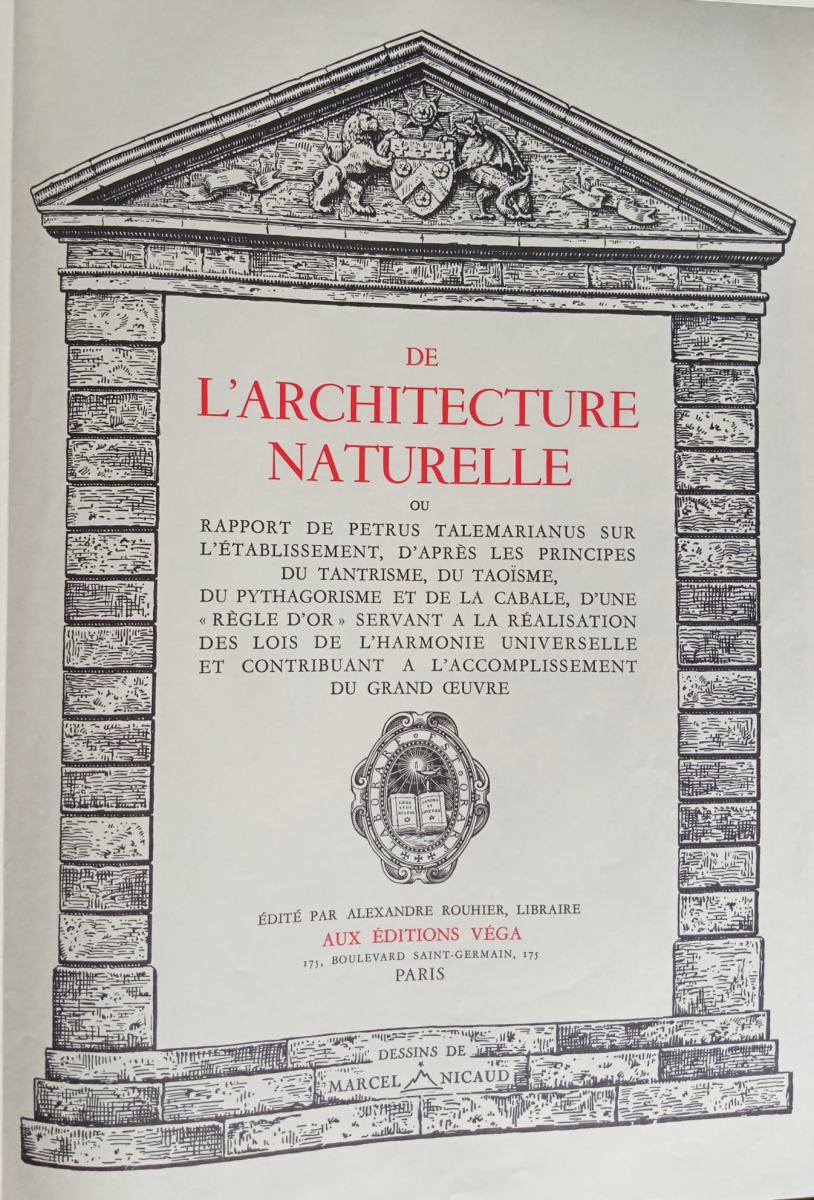
Frontispiece of the 1983 second edition.
*
Today’s sharing from the Blue House of Via-HYGEIA presents ‘Towards an Architecture of Being: The Sephiroth as a Universal Translation Engine’, an excerpt from the second edition (1983) of De l’Architecture Naturelle by ‘Petrus Talemarianus‘ (pp. 94–112). A Via-HYGEIA Bibliotherapy English translation and introduction of the original French.
In this excerpt, ‘Petrus‘ (we recognize here the style and the phenomenal clarity of Francis Warrain) deploys the Hebrew Kabbalah not merely as theology, but as a structural scaffold—a ‘Noah’s Ark‘ designed to harmonize Egyptian cosmogony, Taoist alchemy, and Vedic cosmology under a single geometric roof. He addresses the fundamental ontological antinomy: how the Infinite veils itself through ten luminous Sephiroth and twenty-two channels so that the Absolute might manifest without annihilating the relative. The Tree of Life is unfolded as a living topology where the highest triad (Kether, Chokmah, Binah) holds the mystery of divine self-concentration, while Daath, the hidden knowledge, serves as the critical mediator between the intellectual and constructive worlds.
Through the Tetragrammaton, the Sephiroth become dynamic persons—Father, Mother, King, Queen—whose unions generate the foundation of manifested existence. The author then translates this doctrine into a formal geometric language: the Tree becomes a system of nested squares, ratios, and triangular partitions, rigorously verified through gematria, Fibonacci sequences, and the proportions of sacred architecture.
In this formal space, Kabbalah intersects with Taoist alchemy and Vedic cosmology—the Shekinah and Metatron find their echoes in Shakti and the Tao, Adam Kadmon resonates with the Universal Man of Egypt and the meditator of the Canon Taoïste. All are held together by the ‘Mediator Graph’ (the Tracé Médiateur), a constructible instrument where analogy becomes exact. This text offers more than a theory; it provides a replicable methodology, inviting the investigator to build, not merely contemplate, the Architecture of Being, transforming personal chaos into structural clarity. It is a true Master Class in Analogical Formalism!
Coming Soon, A Little ‘Petrus Talemarianus’ Sampler – Part VII: ‘Dante’s ‘Divine Comedy’ and the Colors of the Alchemical Opus’.
**
A Contextual Introduction:
The Architecture of the Mediator
*
I. The Aim: A Universal Translation Engine for Metaphysics
The author here is not writing a conventional commentary on the Kabbalah. His aim is synthetic recovery: to demonstrate that the Hebrew Sephiroth is not merely a Jewish theological construct, but a universal structural code—a ‘Noah’s Ark‘ capable of housing and harmonizing Egyptian cosmogony, Taoist alchemy, Vedic tattvas, and Pythagorean geometry under one roof.
The driving problem is the classical ontological antinomy: How does the Absolute manifest without ceasing to be Absolute? How does the Infinite become Finite without either dissolving the creation (pantheism) or separating from it entirely (deism)?
The author’s solution is architectural. Instead of a philosophical argument in the modern sense, he constructs a formal mediating graph—a geometric and numerical lattice (the ‘intermediate graph upon triangles‘, the ‘mediator graph‘, the system of squares denoted by planetary and elemental symbols) that translates the ineffable into a manipulable symbolic space. The Kabbalah is chosen as the primary ‘scaffold‘ because its very structure (ten Sephiroth + twenty-two paths) is already a combinatorial machine designed to map the unfolding of the Infinite into the finite.
*
II. The Key Concepts
1. The Veil as Mediation: The core concept is that manifestation is not a fall or a creation ex nihilo in the vulgar sense, but a veiling. The Absolute (Ain Soph) concentrates His Thought into a point (Kether) and then ‘covers‘ His Light with a series of lamps or veils—the Sephiroth. Each veil is simultaneously a concealment (preventing the relative from being annihilated by the Absolute) and a revelation (allowing the relative to participate in divine Life). This is the metaphysical function of the ‘mediator‘: it must be opaque enough to separate, yet transparent enough to connect.
2. The Analogical Web (Correspondentia): The text operates on the principle that truth is fractal. A structure valid at one level repeats at others. Thus:
- The three highest Sephiroth (Kether-Chokmah-Binah) correspond to the three brains, the three Mother letters (א מ ש), the three guṇas, the Egyptian triad (Nout-Shou-Seb), and the three divine persons.
- The seven lower Sephiroth correspond to the seven double letters, the seven planets, the seven chakras, the seven lamps of the Menorah, and the seven edges of certain polyhedra. The author treats these not as poetic metaphors but as isomorphic mappings of a single ontological topology.
3. Geometric Ontology: Abstract metaphysical categories are given spatial form. The Sephirothic Tree is translated into a system of nested squares. Each Sephirah becomes a square with a specific side-length ratio; each relation between Sephiroth becomes a line, an intersection, or a tangent. By doing this, the author topologizes ontology: interiority and exteriority, form and matter, Yin and Yang become literal regions in a geometric field.
4. Number as the Control Mechanism: The web of correspondences is held taut by numerical constraints. The author constantly verifies his analogies through:
- Gematria (יהוה = 26; אהוה = 16; שדי = 314);
- Geometric ratios (the pentagon/hexagon relation, h/g);
- Fibonacci series (3, 5, 8, 13 appearing in the spacing of the “Yang” lines);
- Architectural measures (the base of the Great Pyramid, the proportions of the Tabernacle). Number serves as the universal solvent that prevents the synthesis from collapsing into arbitrary syncretism. If the Taoist “Birth of the Ten Thousand Beings” and the Kabbalistic Tree both resolve into the same numerical proportions, the correspondence is validated as structural, not fanciful.
5. The Double Aspect: Every principle has two faces: interior/exterior, Yang/Yin, Metatron/Shekinah, Purusha/Prakriti. The text refuses dualism by showing that these are complementary phases of a single current. The ‘mediator graph‘ is literally built to house this double aspect: a Yin frame and a Yang frame, a high (summer solstice, ☉) and a low (winter solstice, ♄), bound together by the central square ♃ (Iesod/Buddhi).
*
III. Operational Manual: Using the ‘Mediator Graph‘
The image below, the ‘Mediator Graph‘ (Tracé Médiateur), is not merely an illustration; it is the engine of the author’s method. It is a blank canvas designed to resolve the tension between opposites. For the modern investigator, this diagram serves as a replicable epistemological tool.
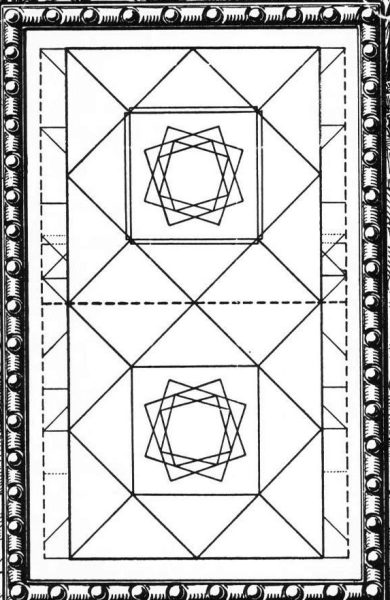
Description: A rectangular frame bordered by an ornamental beaded motif. Within, two identical square rosettes—each formed by the superposition of two overlapping squares rotated 45 degrees, creating an eight-pointed star—are placed symmetrically along the vertical axis, one in the upper half and one in the lower half.
The entire field is subdivided by a network of triangles: diagonals from the rectangle’s corners converge toward the centres of the rosettes, while horizontal dashed lines mark the equator and intermediate zones. Small triangular constructions flank the sides. The composition embodies the double square (☽ above, ☉ below, or vice versa according to orientation) separated by the mediating space of the central horizontal axis, with the overlapping squares within each rosette representing the geometric mutation of quinary (5) and senary (6) principles—the pentagon and hexagon united in a single figure.
How to Use This Tool (The 4-Step Protocol):
-
Define the Polarity (The High and The Low): Identify the two opposing forces in your investigation. In the text, these are Spirit/Matter or Heaven/Earth. In your own work, they might be Logic/Emotion, Order/Chaos, or Self/Other.
- Action: Assign the Upper Square (The High/Yang) to the Active principle and the Lower Square (The Low/Yin) to the Passive principle.
-
Locate the Mediator (The Center): The diagram features a central horizontal axis and a central vertical alignment. This is the Mediator.
- Action: Do not try to solve the tension by choosing one side. Instead, look for the Third Term that connects them. In the text, this is Daath (Knowledge) or Buddhi (Intellect). In your life, what is the function that allows Logic and Emotion to speak to each other? (e.g., Creative Expression, Dialogue, Ritual). Place this concept in the Central Intersection.
-
Map the Intervals (The 22 Steps): The vertical space between the squares is divided into intervals (represented by the horizontal lines and the Hebrew alphabet in the full text).
- Action: Break down the transition from your ‘High‘ concept to your ‘Low‘ concept into discrete steps. How do you get from Idea to Manifestation? What are the intermediate stages? Map these stages onto the horizontal lines of the graph. This forces you to see the process, not just the endpoints.
-
Verify with Structure (The Geometry): Notice the nested squares and the star-like polygons within them. These represent the internal complexity of each pole.
- Action: Analyze your ‘High‘ and ‘Low‘ concepts internally. Are they simple, or do they contain their own internal conflicts (the interlaced lines)? Acknowledge that the ‘Active‘ principle contains passive elements and vice versa. The geometry reminds us that every node is a universe in itself.
*
IV. The Methodology: A Replicable Protocol for Ontological Work
Beyond the specific diagram, the text offers a rigorous, seven-step methodology for any ontological investigation:
Step 1. Define the Antinomy: Begin with a precise structural problem. The author begins with: How does the Absolute relate to the relative? Your investigation must start with an equally sharp tension (e.g., Mind/Matter, Unity/Multiplicity, Time/Eternity).
Step 2. Select a Primary Scaffold: Choose a traditional ‘graph‘ that has already attempted to resolve this tension. The author chooses the Sephirothic Tree, but one could choose the Mandala, the Platonic solids, the I Ching hexagrams, or even modern topological objects. The criterion is that the scaffold must already possess internal relational complexity (nodes, paths, levels).
Step 3. Formalize into a Neutral Language: Translate the scaffold into a non-sectarian formal system. The author uses:
- Algebraic notation (the author’s proprietary ‘ARSENIC●M’ system, a mnemonic lattice for geometric ratios);
- Planetary/elemental symbols (☉, ☽, ♄, ♃, etc.) as variables;
- Geometric figures (squares, triangles, pentalphas) as the ‘syntax‘. This step is crucial: it strips the doctrine of its historical particularity so that it can be compared with other systems.
Step 4. Cross-Reference via Correspondence: Test the formal model against other traditions. The author does this aggressively:
- Does the Taoist Yin-Yang diagram fit the same square lattice?
- Do the Hindu chakras map onto the twenty-two Hebrew intervals?
- Does the Egyptian merkabah (celestial chariot) correspond to the ‘Adam Kadmon‘? When multiple traditions independently generate the same formal pattern, you have found what the author calls a ‘striking analogy‘—a signal that you are dealing with an archetype, not an accident.
Step 5. Verify through Number: Use quantitative constraints to eliminate false analogies. The author does not say “the Menorah is like a tree”; he counts its components (1 shaft, 6 branches, 7 lamps, 10 lilies, 10 spheres, 22 cups) and shows that these numbers instantiate the same combinatorial laws (18 + 22 = 40) that govern the Sephirothic intervals. If the numbers do not align, the analogy is rejected or the model is recalibrated. Number is the falsification mechanism of this esoteric science.
Step 6. Architectonic Synthesis: Arrange your verified correspondences into a single spatial model. The author’s ‘mediator graph‘ is the final synthesis: a long rectangle divided into 60 parts, containing the Hebrew alphabet, the chakras, the solstitial doors, and the Yin-Yang frames all in one field. Your model should likewise aspire to architectural unity—a ‘building‘ that can be mentally inhabited.
Step 7. Operational Application: Show that your model does practical work. The author applies his graph to explain:
- Ritual objects (the Table of the Twelve Loaves, the Menorah);
- Sacred architecture (the Great Pyramid, the Tabernacle);
- Mythic narratives (the separation of Nout and Seb, the Garden of Eden);
- Anthropology (Adam Kadmon, the Taoist meditator). If your ontological model cannot ‘read‘ a real artifact or experience, it remains abstract. If it can, it has become a key.
*
V. Critical Observations for Modern Use
The Discipline of the Mediator: The text’s greatest methodological strength is its insistence on the mediator (the graph, the geometric frame). Without this formal intermediary, cross-traditional comparison devolves into vague ‘perennialism‘. The graph forces the investigator to specify exactly where and how two symbols correspond. If you adopt this method, you must build your own ‘mediator‘—whether it is a geometric diagram, a category-theoretic schema, or a topological manifold—and let the mediator argue with the traditions, rather than forcing them to agree by fiat.
The Risk of Over-Synthesis: The author’s method can, if unchecked, absorb every tradition into a single Procrustean bed. The antidote he implicitly provides is numerical constraint. When a correspondence violates the arithmetic (e.g., if a chakra mapping broke the Fibonacci sequence), the model would have to be revised. In your own work, maintain an equally rigid internal logic; let the formalism be the master, not the servant, of your intuitions.
Toward a Contemporary ‘Natural Architecture’: Today, one might replace the author’s squares and planetary glyphs with:
- Graph theory (nodes = Sephiroth, edges = paths);
- Category theory (morphisms between ontological categories);
- Information geometry (veils as successive coarse-grainings of a probability distribution). The method remains identical: use a formal language to mediate between the ineffable and the manifest, verify through structural invariants, and test against the symbolic archives of humanity.
*
VI. Conclusion: A Therapeutic Architecture
In sum, this text is a masterclass in analogical formalism. It demonstrates that ontology need not be a vague discourse about ‘Being‘, but can become an architecture of Being—a constructible model where theology, geometry, linguistics, and mythology are revealed as different dialects of a single, numerically exact language.
For the Via-Hygeia Bibliotherapy users and of the Scola Hermetica practitioners, this offers a profound therapeutic tool: the ability to translate personal chaos into structural order. By building your own ‘mediator graph‘ for your life’s antinomies, you do not just study the universe; you learn to inhabit it with clarity, precision, and peace. The ‘Tracé Médiateur’ is not just a map of the cosmos; it is a mirror for the mind, inviting you to find the geometric center where your own opposites are reconciled.
*
And now the text:
An Excerpt from ‘De l’Architecture Naturelle’,
by Petrus Talemarianus
(pp. 94–112)
“…But a solution presented itself to my mind: the Hebrews had long been in close contact with the Egyptians, and I had the impression, like others before me, that the ten “Sephiroth” of the Hebrew Kabbalah might well derive from the “Paouit-Noutirou.” Might not the Kabbalah have been one of the secret vehicles of this theodicy? Moses, who governed the Hebrews and gave them the Law, was he not of Egyptian origin, as at least the Companions affirm? Failing to penetrate more surely the meaning of Egyptian conceptions, I therefore turned toward this esoteric doctrine, encouraged moreover by the fact that the starting point of my researches had been the cabalistic word: ABRACADABRA.
Whereas the theories previously set forth show mainly either the development of Manifestation from the Absolute (Hindu doctrines) or the concrete and practical applications of cosmogonic principles (Chinese wisdom), the cabalistic doctrines seek principally to define by what mediation the fundamental antinomy between the Absolute and the relative is bridged. The precise determination of this mediation is necessary to avoid falling either into skepticism or into pantheism.
God, “ex parte creaturæ,” seems, by the very fact of producing within Himself the imperfect images of Himself that are creatures, to strip Himself of His “Absoluteness.” The determination of His Immutable Thought is the very basis of Manifestation. The Kabbalah represents this determination of the “Absoluteness” by the following image. When the Ineffable Absolute, AIN SOPH (אֵין סוֹף), with whom are identified the three supreme “Middoth” or “Most Splendid Lights” (virtual Trinity), wishes to manifest Himself by a voluntary act of divine jubilation, He concentrates Himself into a point which becomes His Thought. He leaves outside Himself, by a differentiating negation, the primitive square space “Avir,” cosmogonic darkness or “Tohu-Bohu.” In the four angles of this primitive square World are found the four “plenitudes” of the Tetragrammaton, which must subsequently produce the four Worlds, namely:
- The World of Emanation: “Atziluth,” אֲצִילוּת (Svar);
- The World of Creation: “Beriah,” בְּרִיאָה (Svar);
- The World of Formation: “Ietzirah,” יְצִירָה (Bhuvas);
- The World of Action: “Ashiah,” עֲשִׂיָּה (Bhû).
To produce and govern these Worlds, the Absolute must veil His Ineffable Light, concentrated in a point of Thought, by a series of veils, assimilated, by opposition and complement, to diverse lamps and called “Sephiroth.” The term “Sephiroth” means “enumeration,” and thus shows the essential role played by Number in Creation.
These “Sephiroth” are ten in number: “Kether,” “Chokmah,” “Binah,” “Chesed,” “Geburah,” “Thiphereth,” “Netzah,” “Hod,” “Iesod,” and “Malkuth”; to each of them corresponds a divine name. Saint Jerome alludes to these ten mystical names in his letter to Marcella. These ten “Sephiroth” and divine names are linked to one another by twenty-two channels, corresponding to the twenty-two letters of the Hebrew alphabet, indicating that it is the relations between the divine attributes or “Sephiroth” which produce Manifestation.
These twenty-two letters or channels are divided by categories, according to the numbers 3, 7, and 12 previously encountered:
- Three Mother letters (א מ ש) correspond to the World of Archetypes (Beriah) and to the ternary.
- Seven double letters (ב ג ד כ פ ר ת) correspond to the World of Elements (Ashiah) and to the quaternary.
- Twelve simple letters (ה ו ז ח ט י ל נ ס ע צ ק) correspond to the World of Orbs (Ietzirah) and to the quinary.
A divine name, the sacred Tetragrammaton (יהוה), designates the whole of the “Sephiroth,” and to each sign of this name corresponds a person:
- To the point of the “yod” (י): the Ancient of Days or Longanimous, anterior to sexual distinction, corresponding to “Kether”.
- To the “yod” (י): the Father “Abba,” corresponding to “Chokmah”.
- To the 1st “he” (ה): the Mother “Imma,” corresponding to “Binah”.
- To the “vau” (ו): the King, corresponding to “Thiphereth”.
- To the 2nd “he” (ה): the Queen, corresponding to “Malkuth”.
The 10 “Sephiroth” and the 4 letters of the Tetragrammaton are distributed upon the branches of an “Aleph” which schematizes Adam, the prototype of man.
The unions of the Father and the Mother, and of the King and the Queen, are not of the same nature. That of the Father and the Mother is uninterrupted; their copulation corresponds to “Daath,” Knowledge, interposed between “Chokmah” and “Binah.” Daath is not a “Sephirah,” but serves as foundation to the other “Sephiroth.” That of the King and the Queen is intermittent and its current is reversed: now the King tends toward the Queen, now the Queen toward the King; their common product, “Iesod” or the Just, is a “Sephirah,” reflection of “Daath,” norm and foundation of the manifested Worlds. The Just also corresponds to the intimate union of “Tiphereth” with “Iesod,” of “Purusha” with “Buddhi.”
From another point of view, the “Sephiroth” are arranged in the form of a tree, composed of a trunk (central column) and two opposite branches (lateral columns), the trunk serving as mediation between the two branches. The lateral columns each contain three elements; the central column contains five.
Here is the description of the eleven elements (ten “Sephiroth” and “Daath”) of which the Sephirothic Tree is formed:
I. — “Kether” (כֶּתֶר) [Crown]: The supreme Thought, final cause, principle of other causes; the cerebellum; corresponds to the divine name אֶהְיֶה [Ehyeh], to “Sat” actual, and to the Father; transcendent and inaccessible synthesis of all the “Sephiroth.”
II. — “Chokmah” (חָכְמָה) [Wisdom]: Formal and exemplary cause, extracting from the Absolute what it wishes to render manifest; the right brain; corresponds to the divine name יָה [Yah], to “Chit” actual, and to the Word; has its reflection in “Tiphereth” and in “Iesod.”
III. — “Binah” / “Thebunah” (בִּינָה, תְּבוּנָה) [Understanding/Intelligence]: Intelligence, Prudence, efficient cause, determinative and realizant, the “Shekinah”; the left brain; corresponds to the divine name אֱלֹהִים [Elohim], to “Ananda” actual, and to the Holy Spirit; has its reflection in “Malkuth.”
“Daath” (דַּעַת) [Knowledge]: Not a “Sephirah”; it is interposed between the three preceding “Sephiroth” (superior/intellectual) and the seven following “Sephiroth” (inferior/constructive). “Daath” is symbolized by the Tree of Knowledge, which separates “Good” (the three superior Sephiroth) from “Evil” (the seven inferior Sephiroth) and reconciles them. It is the Knowledge, common act in which the two poles “Chokmah” and “Binah” neutralize each other; re-establishes, as an immediate reflection, the unity of “Kether”; foundation and norm of the seven constructive “Sephiroth”; the spinal marrow; corresponds to the Principial Being; has a great affinity with “Iesod.”
IV. — “Chesed” / “Gedulah” (חֶסֶד, גְּדוּלָּה) [Mercy/Greatness]: Grace, Grandeur; the right arm, the blessing hand; corresponds to the divine name אֵל [El] and to “Bhuwas forma.”
V. — “Geburah” / “Pachad” (גְּבוּרָה, פַּחַד) [Severity/Terror]: Rigour, Terror; the left arm, the hand of justice; corresponds to the name אֱלֹהִים [Elohim] and to “Bhuvas materia.”
VI. — “Thiphereth” (תִּפְאֶרֶת) [Beauty]: Centralizing and unifying hearth of the six first inferior “Sephiroth”; the heart; corresponds to the divine name יְהוָה [YHWH] and to “Purusha”; has close links with “Iesod” and “Malkuth.”
VII. — “Netzah” (נֵצַח) [Victory/Eternity]: Victory, Time, “Jakin”; the right thigh; corresponds to the divine name יְהוָה צְבָאוֹת [YHWH Tzevaot] and to “Bhû forma.”
VIII. — “Hod” (הוֹד) [Glory]: Glory, Space, “Boaz”; the left thigh; corresponds to the divine name אֱלֹהִים צְבָאוֹת [Elohim Tzevaot] and to “Bhû materia.” “Jakin” and “Boaz” were the two columns erected at the entrance to Solomon’s temple. The sum of their simple and extended gematria equals 2,268. These two columns thus symbolize the numerators of the ritual tables, marking the opposition and complement which are the norm of ritual constructions in the World of “Ashiah.”
IX. — “Iesod” (יְסוֹד) [Foundation]: The Foundation, the Norm of the manifested Worlds, Life; the phallus; corresponds to the divine name שַׁדַּי [Shaddai] and to “Buddhi”; re-establishes, as a mediate reflection, the unity of the three intellectual “Sephiroth”; is closely linked to “Daath.” “Iesod” is symbolized by the Tree of Life. According to Chinese myth, the hollow mulberry “K’ong sang,” Tree of Life and solar tree, grows at the centre of the Cosmos, where the King resides. This Tree is linked to the “Tao,” the Way which unites Heaven and Earth, symbol of the rhythm of universal Life, whose emblem is 11 (= 5 + 6).
X. — “Malkuth” (מַלְכוּת) [Kingdom]: The Kingdom, the presence of GOD in the world, His conservative action, His Providence, the “Shekinah”; the earth beneath the feet; corresponds to the divine name אֲדֹנָי [Adonai] and to “Prakriti”; immanent synthesis of all the “Sephiroth.” These are the two wheels and the body of the celestial chariot (merkabah) which God uses to descend toward His creature.
The Sephirothic Tree of the first World, “Atziluth,” concentrates the emanation. The “Sephiroth” did not issue from nothingness, but from the substance of the Infinite. The “Sephiroth” are of the same nature as the Infinite and inherent in Him, with this difference: the Infinite exists by Himself (causa sine causa), whereas the “Sephiroth,” emanating from Him, are the “caused” of the First Cause.
The Sephirothic Tree (ex parte creaturæ), uniting the Absolute and the relative, divides into an interiority and an exteriority.
- The Interiority, represented by “Kether,” comprises the three supreme “Sephiroth” or Intellectual Splendours: “Kether,” “Chokmah,” and “Binah.” Though distinct, they are but One (unum absolutum) and correspond to the three divine Persons. It is the Long Face, “Arik Anpin,” symbolizing the Absolute who, in His Benevolence, veils Himself at the approach of the relative.
- The Exteriority, synthesized by “Tiphereth,” comprises the six first constructive “Sephiroth.” It is the Short Face, “Zeir Anpin” or the King, symbolizing the Absolute who, in His Rigour, maintains the separation between Himself and the relative.
- The Link between interiority and exteriority is “Malkuth,” term and summary of the whole Sephirothic Tree, symbolizing the “Shekinah.” It is the Spouse of the Queen who stabilizes creation in the rest of the seventh day.
Thus, three of the “Sephiroth” situated on the middle column—“Kether,” “Thiphereth,” “Malkuth”—represent respectively the interiority, the exteriority, and the synthetic link. The union of the divine names which correspond to them (Ehyeh=21, YHWH=26, Adonai=65) sums to 112. Added to this, by hieroglyphic mutation, is Elohim=91, forming the number 203, equivalent to “Bar” (Son/Pure), the “Fountain” from which flow the Love, Truth, and Power of GOD.
As in the great Chinese Triad, the transcendent Absolute renders Himself immanent in the relative by means of the archetype of the macrocosm, “Adam Kadmon” (Primordial Man), who corresponds to the couple “Purusha-Prakriti” and symbolizes the whole of the seven inferior “Sephiroth.” “Adam Kadmon” is analogous to the “Unique Man,” to the “King” of Taoism, and to Vishvakarma, the Great Architect of the Universe.
But the Absolute in His descent toward the relative does not communicate His Nature to the three manifested Worlds (“Beriah,” “Ietzirah,” and “Ashiah”), which are creations ex nihilo. Creation is therefore the work of the “Sephiroth,” inasmuch as the Absolute acts by them and in them.
This mediating and permanent action of GOD in creation is the “Shekinah” (the “Shakti” of Tantrism). Mother of humanity, she is realizant, sanctifying, consoling, and protective. Like every intermediary, the “Shekinah” has two faces: the exterior/inferior face (“Malkuth”/Prakriti) and the interior/superior face (“Binah”/Ananda). The “Shekinah” has a masculine parèdre, “Metatron,” by whom she manifests herself. “Metatron” is the angel of the Word, Michael, the great pontiff who resurrects the dead and judges souls; he is the prefiguration of the Messiah.
Since the “Sephiroth” present themselves in the form of a tree, it is said: “Kether,” mystery of the point, is the hidden root; the three brains with the seven constructive “Sephiroth” form the trunk and branches. As Elijah says in the Zohar: “It is Thou, O Master of the World, who hast produced the ten Perfections… to illuminate by them the invisible and visible worlds… whosoever would separate these ten ‘Sephiroth’ one from another would be guilty as if he had torn and shattered Thee Thyself.”
I could not fail to find a striking analogy between the cabalistic doctrines and the various graphs I had constructed. The successive veils which surround the supreme Thought were represented by my intermediate graph upon triangles, forming a series of square envelopes around the invisible centre. This centre and its envelopes were symbolized as follows:
- The central virtual square represented “Kether”.
- The two small interior squares represented “Chokmah” and “Binah”.
- The square ● (produced by the quadruplicity of ARSENIC●M) represented “Daath”.
- The two mean interior squares represented “Chesed” and “Netzah”.
- The two large interior squares represented “Geburah” and “Hod”.
- The small exterior square represented “Malkuth”.
- The mean exterior square represented “Iesod”.
- The great exterior square represented “Thiphereth”.
“Daath,” reciprocal union of “Chokmah” and “Binah,” serves at once as separation and link between the three Intellectual Splendours and the seven Constructive Splendours. Here the opposition of 7 and 108 found its justification: 7 represented the seven constructive “Sephiroth,” and 108 symbolized the three intellectual “Sephiroth.”
Of the seven following operative “Sephiroth,” two emanate from “Chokmah” (“Chesed” and “Netzah”) and two from “Binah” (“Geburah” and “Hod”). The first two are the synthetic archetypes of the “formæ” of the two inferior Worlds; the last two are the synthetic archetypes of the “materiæ” of these two Worlds.
The three remaining “Sephiroth” on the middle column form, with the four preceding, the exteriority of the Sephirothic Tree. “Thiphereth” is the synthesis of the exteriority. “Iesod” synthesizes the three superior “Sephiroth” and is the hearth from which irradiates all that produces the Manifested. “Malkuth” synthesizes the union between interiority and exteriority.
This synthesis is illustrated by the Candelabrum of the Tabernacle, which comprises 1 shaft and 6 branches (7 lamps total), 10 lilies, 10 spheres, and 22 almond-shaped cups. The disposition of the cups (4 on the shaft and 18 on the branches) is an example of the opposition and complement of the numbers 18 and 22.
Now, the functions of the squares ☉, ♃, and ☽ were of the same nature. The square ☉ synthesized the six other squares and symbolized the exteriority of the graph. The square ♃, in parallelism with the square ●, was a reflection of the centre and symbolized the interiority. Finally, the square ☽ was geometrically situated at equal distance from the central virtual square (interiority) and the square ☉ (exteriority); its side was the arithmetic mean of the sides of the two other squares, symbolizing the synthetic link uniting interiority and exteriority. The correspondence between “Thiphereth,” “Iesod,” “Malkuth” and the squares ☉, ♃, and ☽ was thus well justified.
Having thus established in what manner the Sephirothic Tree was figured by my intermediate graph upon triangles, I recalled that the square M, common numerator and foundation of the eight ratios of ARSENIC●M, corresponded to the “Sephirah” “Iesod” whose divine name SHADAI (שַׁדַּי = 314), name of “Metatron,” had bounded the extent of the World. I found a new correspondence between this graph and the Kabbalah by drawing up the approximate table below of the eight ratios of ARSENIC●M, where the common numerator was expressed by 314, and the denominators by numbers of the FIBONACCI series.
TABLEAU VI (Ratios of ARSENIC●M where M = 314)
- M / A₆ = 314 / 144 → A₆ = A + 2.55% of A
- M / S₆ = 314 / 89 → S₆ = S + 2.55% of S
- M / E₆ = 314 / 55 → E₆ = E + 2.56% of E
- M / R₆ = 314 / 34 → R₆ = R + 2.57% of R
- M / N₆ = 314 / (55 + 8) → N₆ = N – 0.09% of N
- M / I₆ = 314 / (34 + 5) → I₆ = I + 0.08% of I
- M / C₆ = 314 / (89 + 34) → C₆ = C + 2.56% of C
- M / ●₆ = 314 / (55 + 21) → ●₆ = ● + 2.54% of ●
Pursuing my study of the Kabbalah, certain veiled characters of the Tetragrammaton IAHVEH (יהוה) came to my mind. This name is the seal with which the supreme Thought, “Kether,” has sealed “Thiphereth.” It signifies manifestation in potential mode. It expresses itself in numbers by 5, 6, 5, that is by the mutations of the quinary and the senary.
Moreover, I found a connection between the Tetragrammaton and three of my graphs: the two intermediate graphs (upon triangles and pentalphas) and the mediator graph.
- Yod (י), attributed to “Chokmah,” related to the intermediate graph upon triangles.
- He (ה), attributed to “Binah,” related to the intermediate graph upon pentalphas.
- Vav-He (וה), symbol of mutations, related to the double mediator graph.
These three graphs symbolized respectively Heaven, Earth, and Man in the Taoist doctrine, and thus the mediator graph corresponded to “Adam Kadmon,” intermediary between the Absolute and the relative.
A long silvered rectangle having the square ☽ as its construction base took on for me a particular importance. Since this graph related to Man, whose total height is symbolically 60, I imagined dividing the length of the mediator graph into sixty equal parts, and consequently its width into thirty equal parts. The graph presented an analogy with the cosmogonic representations of the Egyptians, figuring the goddess NOUT above the god SEB, separated by the action of SHOU. In the graph, the square ☽ and the square ☉ were separated by the square ♃, symbolizing “Buddhi,” first image of the Word.
I used for this purpose the sacred language of the Kabbalah and I divided the Hebrew alphabet into twenty-two intervals. Attributing to each interval the value of the sixtieth part of the length of the mediator graph, I interposed this formative alphabet between the centres of the two squares. The centre of the “low” symbolized the winter solstice (North), and the centre of the “high” symbolized the summer solstice (South). To fix the position of this alphabet, I recalled that the number 40 was that of mediation in the Great Pyramid. I therefore placed the “mem” (valued at 40) in the middle of the height of the graph, dividing the twenty-two intervals into 12 and 10.
The alphabet being thus placed inside the double square:
- A length valued at 18 extended between the upper border and the initial Aleph.
- A length valued at 20 extended between the final Aleph and the lower border. The length 18 was divided into two equal parts (appearing as the number 9). The length 20 was divided into three unequal parts (appearing as the number 5). This division revealed the duodecimal division already encountered.
Pursuing the examination of the space reserved for the formative word, I remembered that the numbers 1, 5, 12, and 22 (sum = 40) were pentagonal numbers symbolizing the quinary and the World “Ietzirah.” I distinguished the intervals of rank 1, 5, 12, and 22: AB, HV, LM, THA. I noticed that one letter of each interval corresponded to the squares A, ●, and M. Thus, just as V (senary) was hidden in Vav-He, so H (quinary) was hidden in BTHL. BTHL equals 432 (= 4 × 10⁸), representing the base perimeter of the Pyramid. This meant that the quinary served as foundation to the stone erected by Jacob at Bethel.
Symbolizing then BTHL by the centre of the figure, I traced upon my graph the hidden interval Vav-He, leaving veiled the other intervals. This interval corresponded to the double square ☽ of the “high,” to the “Shekinah,” and was mediator itself. I marked the interior with the letter Yod (י). Tradition teaches that the letter Yod separates the ten “Sephiroth” from the eight celestial Spheres and the four Elements. The letters He, Vav, Yod, thus figured, permit writing with the Aleph the two most sacred divine names: Ehyeh and YHWH.
To this sacred alphabet of the Kabbalah (22 Hebrew letters) is opposed by complement the sacred alphabet of Tantrism, formed of 50 Sanskrit letters (monosyllables) corresponding to the 50 petals of the six “chakras.” Starting from the upper border of the mediator graph, I attributed each monosyllable to one of the intervals:
- 18 monosyllables of “sattva” extended to the initial Aleph.
- 22 monosyllables of “rajas” were placed opposite the 22 Hebrew letters.
- 10 monosyllables of “tamas” were placed between the final Aleph and the lower line.
The 50 monosyllables represent the revealed Worlds. The 22 letters represent the hidden Worlds. To these 22 Worlds are added the 10 commandments of the Law symbolizing “Daath”; their ensemble constitutes the 32 paths of “Chokmah,” opposed by complement to the 50 gates of “Binah.” In the two sacred alphabets, “Om” and the Yod represent these two synthetic Worlds.
Table: Chakras and Correspondences
| Chakra | Position | Mantra | Petals | Monosyllables | Guna |
|---|---|---|---|---|---|
| Ajnâ | Between the eyes | Om | 2 | ham, xam | |
| Vishuddha | Towards the throat | ham | 16 | am, âm, im, îm, um, ûm, rim, rîm, lrim, lrîm, em, aim, Om, aum, amm, ahm | sattva |
| Anâhata | Towards the heart | yam | 12 | kam, kham, gam, gham, ngam, cham, chham, jam, jham, nyam, tam, tham | rajas |
| Manipûra | Towards the navel | ram | 10 | dam, dham, nam, tam, tham, dam, dham, nam, pam, pham | |
| Svâdishthâna | Above genital organs | vam | 6 | bam, bham, mam, yam, ram, lam | tamas |
| Mûlâdhâra | Below genital organs | lam | 4 | vam, sham, shham, sam |
I attributed the eleven horizontal “Yang” lines, traced on the mediator graph, to the ten “Sephiroth” and to “Daath,” as well as to the corresponding planetary signs:
- Upper border: “Binah”
- Line touching “materia” squares of the high: “Chesed” and “Geburah”
- Line of initial Aleph: “Thiphereth”
- & 5. Lines of interval Vav-He: “Malkuth”
- Line of Yod: “Iesod”
- Line of Bet: “Daath”
- Line of final Aleph: “Netzah” and “Hod”
- Line touching centre of the low: “Kether”
- Line touching lower intersection: “Netzah” and “Hod” (by reflection)
- Lower border: “Chokmah”
I then carried out my geometric correspondences. Starting from the centre (Kether) and following the “Yin” and “Yang” lines, I mapped the intimate union of “Kether,” “Chokmah,” “Binah,” and “Daath” (interiority) and the correspondence of “Kether” and “Malkuth.”
Examining finally the numbers which separated the eleven “Yang” lines, I noted that within the Hebrew alphabet appeared divisions according to 3, 5, 8, and 13, numbers of the FIBONACCI series. Moreover, considering the line passing through the centre, I saw appear symmetrically the number 15 (= 5 + 10) which I adopted as the characteristic number of “Kether” and of the “T’ai ki.”
Finally, around the interval Vav-He, I saw appear symmetrically the numbers 18 and 22, this double mutation representing the mutations of “Yang.”
It was well to note that the line of “Thiphereth” was quite close to a summit of the square ●, attaching it to “Hiranyagarbha.” The “Yang” line (corresponding to Yod) divided the borders of the “Yin” frame according to the ratio 23/37, and the “Yin” line (corresponding to He) divided the borders of the “Yang” frame according to the ratio 37/23. The “T’ai ki” produces the two Effigies, the four Images, and the eight Trigrams (1+2+4+8 = 15). The numbers 108 and 7 are the two aspects “Yang” and “Yin” of the side M of the square ♃ (Iesod); their ratio is in close union with the number 15 (Kether), since, thanks to the play permitted by the ritual and architectural error (36/35), 108/7 equals 15″.
*
Appendix: The Architect’s Glossary
A Cross-Traditional Index of Key Concepts & Correspondences
This glossary is designed as a reference tool for the Mediator Graph methodology. Terms are grouped by their ontological function to reveal the structural identity between Kabbalah, Hinduism, Taoism, and Geometry.
I. The Absolute & The Veil
The source of manifestation and the mechanism of its concealment.
| Term | Tradition | Definition & Function | Key Correspondence |
|---|---|---|---|
| Ain Soph (אֵין סוֹף) | Kabbalah | The Ineffable Absolute; the Infinite without limit or definition. | Brahman (Hinduism); Tao (in its unmanifest state). |
| The Veil | Universal | The metaphysical mechanism by which the Absolute “hides” its intensity to allow finite existence. | The Sephiroth themselves; the Guṇas; the ‘square envelopes’ in the graph. |
| Avir (אֲוִיר) | Kabbalah | The ‘primitive space’ or cosmogonic darkness created by the Absolute’s self-contraction. | Tohu Bohu (Chaos);
Prakriti (primordial matter). |
| Middoth (מִדּוֹת) | Kabbalah | Literally ‘measures’ or ‘attributes’; the vessels through which the Infinite interacts with the finite. | Tattvas (Hinduism);
Sephiroth. |
II. The Intellectual Triad (The Interiority)
The supreme, non-operative principles of divine thought.
| Term | Tradition | Definition & Function | Key Correspondence |
|---|---|---|---|
| Kether (כֶּתֶר) | Kabbalah | The Crown. The supreme Thought; the point of concentration; the interface with Ain Soph. | Sahasrara (Crown Chakra); Kien (Active Yang); Sat (Being). |
| Chokmah (חָכְמָה) | Kabbalah | Wisdom. The formal cause; the active masculine principle; the ‘Father’. | Shiva (consciousness); Yang;
Purusha; Right Brain. |
| Binah (בִּינָה) | Kabbalah | Understanding. The efficient cause; the passive feminine principle; the ‘Mother’. | Shakti (energy); Yin; Prakriti;
Left Brain; Ananda (Bliss). |
| Arik Anpin | Kabbalah | ‘The Long Face’. The macroscopic configuration of the first three Sephiroth as a unified divine persona. | Ishvara (Supreme Lord); The ‘Longanimous’. |
III. The Mediator (The Bridge)
The critical pivot point that reconciles opposites.
| Term | Tradition | Definition & Function | Key Correspondence |
|---|---|---|---|
| Daath (דַּעַת) | Kabbalah | Knowledge. The ‘hidden’ Sephirah. Not an emanation, but the union of Chokmah and Binah. | Buddhi (Intellect); The Central Axis of the Trace Médiateur. |
| Tiphereth (תִּפְאֶרֶת) | Kabbalah | Beauty. The central sun of the tree; the mediator between the upper and lower worlds. | Sun (☉); Atman; The Heart Chakra (Anahata). |
| Iesod (יְסוֹד) | Kabbalah | Foundation. The collector of energies; the interface between the ideal and the physical. | Moon (☽); Linga; Muladhara (in some mappings); The “Mediator Graph” base. |
| Adam Kadmon | Kabbalah | Primordial Man. The archetype of the universe; the vessel containing all potential manifestation. | Purusha; Universal Man; Manu; The total geometric field. |
IV. The Constructive Seven (The Exteriority)
The operative forces that build the manifested worlds.
| Term | Tradition | Definition & Function | Key Correspondence |
|---|---|---|---|
| Chesed (חֶסֶד) | Kabbalah | Mercy. Expansion, grace,
the right arm. |
Jupiter (♃); Sattva (purity). |
| Geburah (גְּבוּרָה) | Kabbalah | Severity. Restriction, judgment, the left arm. | Mars (♂); Tamas (inertia);
Pachad (Terror). |
| Netzah (נֵצַח) | Kabbalah | Victory. Endurance, time,
the right leg. |
Venus (♀); Rajas (activity). |
| Hod (הוֹד) | Kabbalah | Glory. Space, form,
the left leg. |
Mercury (☿);
The intellectual reflection. |
| Malkuth (מַלְכוּת) | Kabbalah | Kingdom. The physical world; the ‘Shekinah’ immanent in matter. | Earth; Prakriti (matter);
The ‘Low’ square in the graph. |
| Shekinah (שְׁכִינָה) | Kabbalah | The Divine Presence dwelling in the world; the feminine aspect of God. | Shakti (Hinduism); Kundalini;
The ‘Mediator’ energy. |
| Metatron | Kabbalah | The ‘Angel of the Face’; the masculine counterpart to Shekinah; the active scribe. | Identified with Michael; embodies the ‘High’ Solar Logos. |
V. The Geometric & Numerical Syntax
The formal language used to verify the correspondences.
| Term | Context | Definition & Function |
|---|---|---|
| Tracé Médiateur | Geometry | The ‘Mediator Graph’. A rectangular lattice divided into Yin/Yang frames, used to map the intervals between opposites. |
| ARSENIC●M | Notation | The author’s proprietary algebraic system for denoting geometric ratios and side-lengths of the sacred squares. |
| Gematria | Numerology | The assignment of numerical values to Hebrew letters (e.g., YHWH = 26) to reveal hidden structural links. |
| Tetragrammaton (יהוה) | Theology | The four-letter name of God. In this system, it is a formula for manifestation: Yod (Father) + He (Mother) + Vav (Son) + He (Daughter). |
| Fibonacci Series | Math | The sequence (3, 5, 8, 13…) found in the spacing of the graph’s lines, representing the rhythm of organic growth. |
| Isomorphism | Logic | The structural identity between two different systems (e.g., Kabbalah and Taoism) proving they share the same underlying “code.” |
| Yin / Yang | Taoism | The dual forces of passive/receptive (Yin) and active/creative (Yang). Mapped to the ‘Low/High’ squares of the graph. |
| Guṇas (Sattva, Rajas, Tamas) | Hinduism | The three qualities of nature (purity, activity, inertia) mapped to the Chakras and the intervals of the Hebrew alphabet. |
| Chakras | Hinduism | The seven energy centers of the subtle body. Mapped here to the 22 intervals of the mediator graph via Sanskrit monosyllables. |
| Antinomy | Philosophy | A contradiction between two apparently reasonable principles (e.g., Absolute vs. Relative) which the Mediator resolves. |
VI. The Four Worlds
The stages of descent from the Infinite to the Physical.
- Atziluth (Emanation): The world of pure archetypes; the domain of the highest Sephiroth.
- Beriah (Creation): The world of the throne; the domain of the intellectual triad.
- Ietzirah (Formation): The world of angels and forms; the domain of the constructive seven.
- Ashiah (Action): The physical world; the domain of Malkuth.
Note: Use this glossary as a ‘legend’ for your own mental map. When you encounter a term in the text, locate its function in this table to see its echoes in other traditions.
*
Source
*
Coming Soon
A Little ‘Petrus Talemarianus’ Sampler – Part VII:
“Dante’s ‘Divine Comedy’ and the Colors of the Alchemical Opus“.
***

Related Articles


Leave a Reply