
Introduction: Beyond Basset’s Philology
When René Basset published his translation of the Prayer of the Virgin at Bartos and the Prayer of the Virgin at Golgotha in 1894, he identified a “mixture of orthodoxy and heterodoxy” that baffled his contemporaries. He correctly intuited a Coptic origin and noted the presence of Gnostic elements, yet the tools of his era limited him primarily to textual criticism. Over a century later, with the publication of the Corpus Papyrorum Magicarum Copticarum, the digitization of Ethiopian manuscripts via the Beta maṣāḥǝft project, and the rise of ritual studies, we can move significantly beyond Basset’s descriptive framework.
This study argues that the efficacy of these prayers rests not on narrative logic but on a sophisticated architecture of power built from three pillars: onomastic taxonomy (the classification of names), somatic performance (the physical act of recitation), and material agency (the transformation of text into amulet). By analyzing the specific names invoked, their transmission from Coptic to Ge’ez, and their deployment by the Virgin Mary as a female hierophant, we reveal these texts not as ‘superstitious corruptions‘ but as highly engineered technologies of the sacred designed to manipulate the cosmic order.
*
The Taxonomy of Names: A Tripartite Structure
The prayers operate through a precise hierarchy of invocation, blending three distinct categories of names to create a ‘totalizing‘ ritual language that leaves no part of the cosmos unaddressed.
First, the Divine Cryptonyms anchor the ritual. The prayers open with secret names for the Trinity—Félélmyo (Father), T’ino Tiqános (Son), and Kuérkuéryanos (Holy Spirit). These are not standard liturgical titles but voces magicae likely derived from Gnostic aeons or corrupted Coptic epithets. Their unintelligibility is their strength; in late antique magic, a name that cannot be translated is a name that cannot be controlled by human reason, marking it as inherently divine.
Second, the text deploys a massive Angelological Hierarchy, mixing canonical archangels like Michael and Gabriel with obscure entities like Sadâkyâl (Angel of Justice/Compassion), Tèryàl, and the Twenty-Four Elders. Many of these names bear morphological markers suggesting Coptic or Greek origins (such as the suffixes -yâl or -êl), functioning as the ‘middle management‘ of the cosmos who execute the specific commands of the ritual.
Finally, the core of the magical force lies in the Barbarous Strings: repetitive, non-semantic sequences like Iyâèl, Iyâèl, Iyâèl… or Omis, Omis, Omis…. These are phonetic fossils—sounds preserved across linguistic shifts from Greek to Coptic to Ge’ez purely for their acoustic vibration. They function as adynata, overwhelming the listener and the demonic forces with a sheer density of sacred sound that bypasses intellectual comprehension.
*
Illustration 1:
The Sonic Architecture of Names
(Abstract Cosmogram)
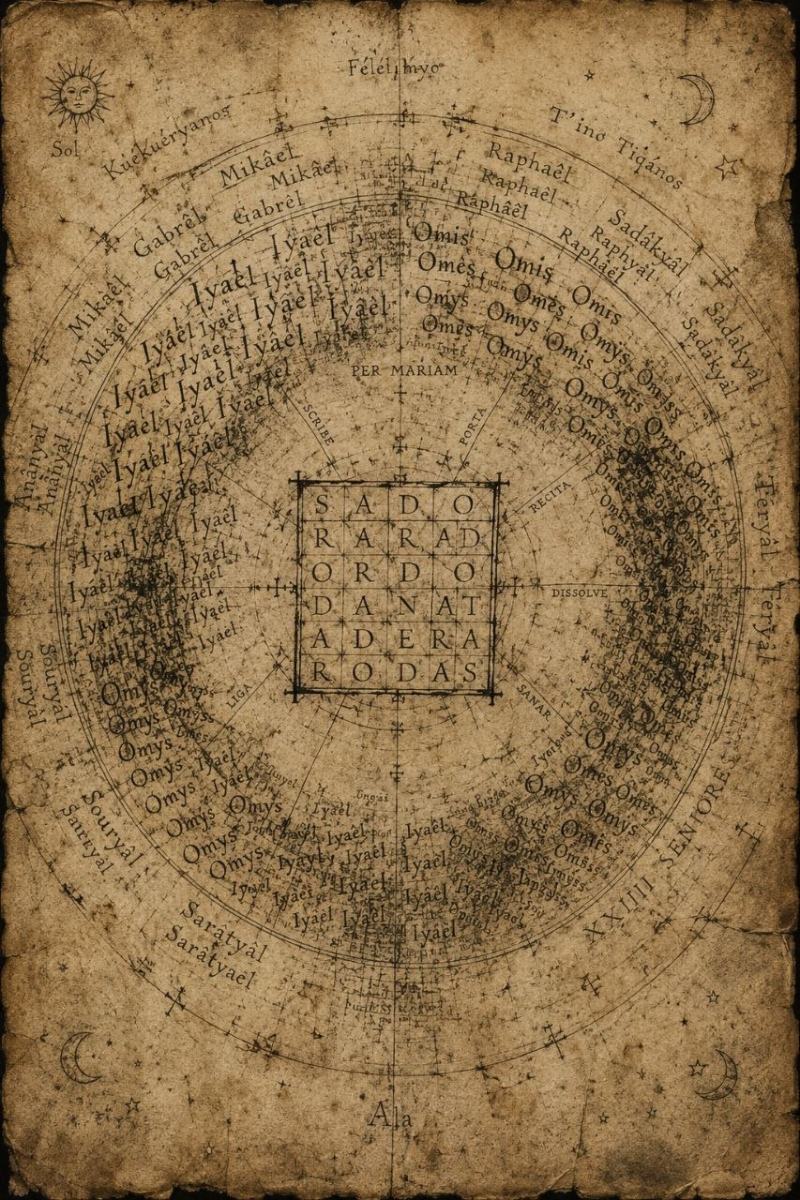
Visual Exegesis: This plate renders the prayer as an operative system rather than a narrative image. At its center, the distorted SADOR square functions as a binding seal in which the corrupted SATOR palindrome has been reconstituted as a device of power rather than meaning. From this core radiate vectors of ritual action—writing, wearing, reciting, dissolving—while concentric, unstable rings of names enact the descent of authority. Notice specifically the instability and density of the outer rings. This visual ‘noise‘ corresponds to the barbarous strings discussed above. Unlike the clear, legible names of the archangels, these rings are dense and nearly illegible, visually mimicking the acoustic overload and trance-inducing repetition that bypasses intellectual comprehension. The diagram proves that the prayer’s power increases as semantic meaning decreases. The thin vertical axis marked Per Mariam silently restores agency, indicating that the system is not self-operating but activated through Marian mediation.
*
The Coptic Ghost: Linguistic Forensics and Transmission
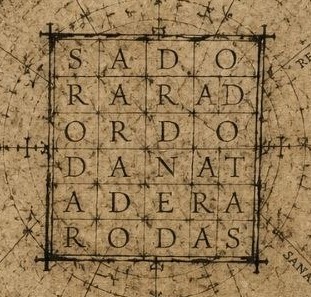
Basset hypothesized a Coptic original based on the corruption of the SATOR square, and modern comparative analysis confirms this with greater precision. The transformation of the Latin palindrome SATOR AREPO TENET OPERA ROTAS into the Ethiopic SADOR ARADOR DANAT ADERA RODAS serves as a linguistic map of the text’s journey. The change of T to D (as in Sator becoming Sador) is a hallmark of Coptic phonology, where tenuis and media consonants often blur. Furthermore, the shift of P to D (transforming Arepo into Arador) likely occurred during the transcription from Coptic uncial script to Ge’ez, where similar graphemes were frequently confused.
Crucially, once the original Latin meaning (‘The sower Arepo holds…’) was lost, the sounds were re-consecrated. In the Prayer of Bartos, they become the Names of the Five Nails; in the Prayer of Golgotha, they become the Names of Christ. This proves that the ‘corruption‘ was not an error to be fixed, but a necessary step in the ritual’s adaptation: the nonsense syllables became more powerful because they were now ‘secret‘ divine codes. Comparisons with the London-Leiden Magical Papyrus (P. Leiden I 384) reveal striking parallels in the structure of angelic invocations and the use of barbarous names to command celestial bodies. The specific adjuration of the Sun and Moon by ‘secret names‘ in Bartos mirrors spells in the Greek Magical Papyri (PGM), suggesting a continuous ‘Mediterranean magical koine‘ that survived the Islamization of Egypt by migrating to Ethiopia.
*
The Voice and the Vessel: Phenomenology and Somatic Performance
The text is not meant to be read silently; it is a script for embodied performance. The repetition of names serves a somatic function, altering the practitioner’s state of consciousness. The incantatory repetition—listing sixty names of the Father, then twenty-four Elders, then seven Angels of the Veils—forces a specific breathing pattern. This rhythmic breathing, combined with the vocalization of guttural Ge’ez and ‘barbarous‘ vowels, induces a light trance state, positioning the reciter as a vessel for the divine voice.
Furthermore, the syntax of the prayer marks a shift in authority. Unlike standard liturgy which petitions God, these prayers often command creation. Mary does not ask the sun to stop; she adjures it, declaring, “I conjure you… do not leave.” This shift from petition to imperative transforms the prayer from a request into a legal binding contract enforced by the names themselves.
*
Illustration 2:
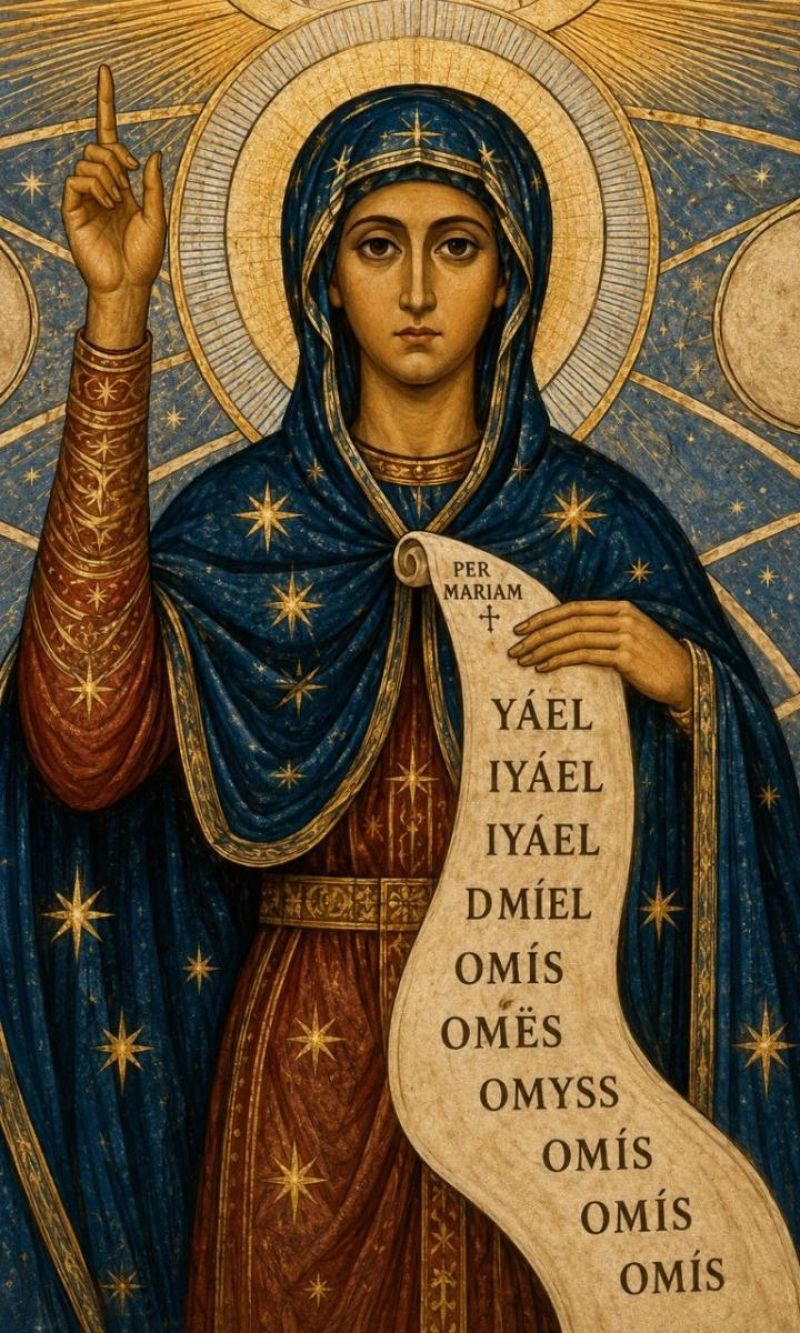
The Hieratic Architecture of Names
(Iconic Cosmogram)
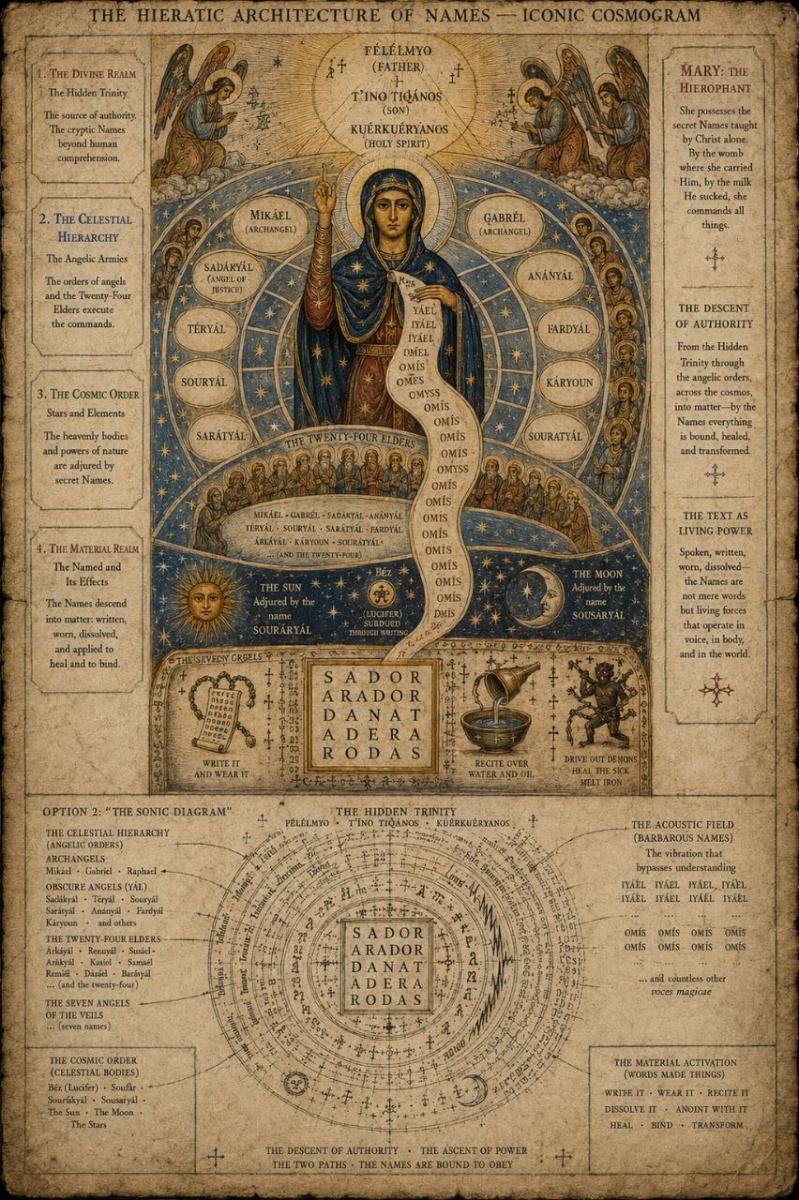
Visual Exegesis: This plate presents the same system in iconographic form, organizing the architecture of sacred power around the commanding figure of the Virgin as female hierophant. Positioned at the center, Mary mediates between the hidden Trinity above—invoked through cryptic, non-liturgical names—and the ordered ranks of angels who execute divine will. Pay close attention to the direction of Mary’s gaze and gesture. She is not looking up in supplication to the Trinity; she is looking outward at the viewer/cosmos, while her hand holds the scroll of names as a weapon/tool. This visualizes the imperative voice analyzed in the previous section. She is not a passive conduit but the active operator of the machine, reinforcing the argument that she holds exclusive ‘password‘ authority that even the angels must obey. Below, celestial bodies and the SADOR square anchor this authority in material practice, where the names become amulets, liquids, and instruments of healing or binding.
*
Comparative Analysis of Visual Models
| Feature | Illustration 1: The Sonic Diagram | Illustration 2: The Iconic Cosmogram |
|---|---|---|
| Primary Focus | Acoustic Architecture: How sound vibrates and structures reality. | Hieratic Authority: Who commands whom in the celestial hierarchy. |
| Representation of Power | Centrifugal: Power radiates outward from the secret core (SADOR square) through layers of sound. | Vertical: Power descends from the Trinity → Mary → Angels → Matter. |
| Role of Mary | Implicit Axis: Marked only as ‘Per Mariam‘, suggesting she is the hidden engine. | Explicit Hierophant: Central figure actively deploying the names. |
| The ‘Barbarous‘ Names | Visual Noise: Rendered as dense, chaotic waves to simulate sonic overload. | Sacred Scroll: Rendered as a legible text flowing from Mary, emphasizing tradition. |
| Scholarly Utility | Demonstrates the phenomenology of recitation (Section: Voice & Vessel). | Demonstrates the sociology of ritual agency (Section: Female Hierophant). |
*
The Female Hierophant: Mary’s Ritual Agency
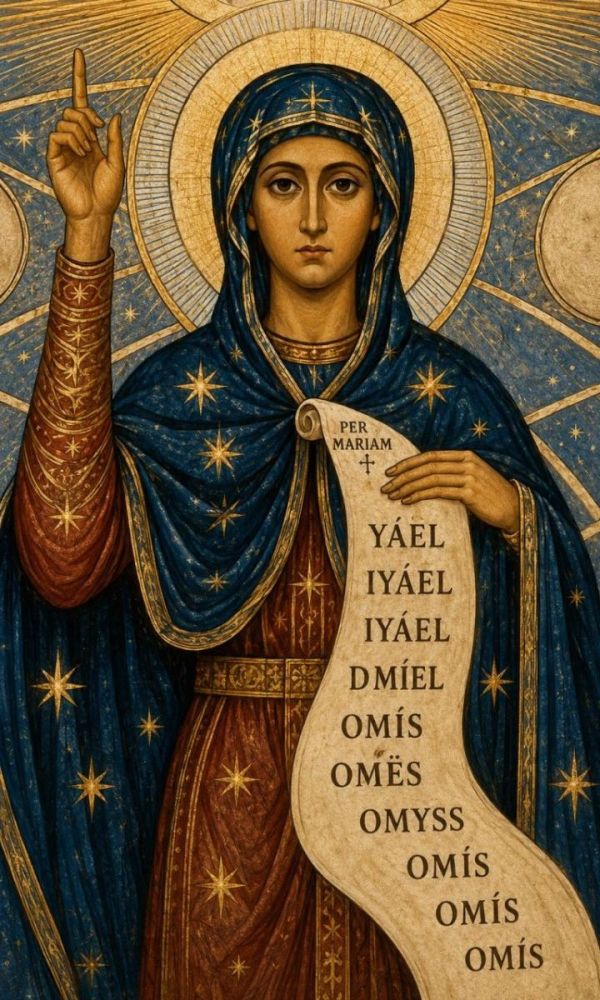
Perhaps the most radical element of these prayers is the role of Mary. In a patriarchal celestial hierarchy, she operates as a Female Hierophant who possesses exclusive access to the ‘passwords‘ of the universe. Mary commands male archangels like Michael and Gabriel, as well as cosmic forces like the Sun and Moon, with absolute authority. She leverages her unique biological relationship with Christ—’by the womb where I carried you‘, ‘by the milk you sucked’—as the source of her magical power.
The text explicitly states that this prayer was taught by Christ to Mary alone: “No celestial or terrestrial being knows this prayer, except me, my Father, and the Holy Spirit.” This positions Mary not merely as an intercessor but as the sole custodian of the technique required to melt iron, heal the sick, and bind demons. This reflects a broader late antique tradition, seen also in Gnostic texts like the Pistis Sophia, where female figures mediate the most potent mystical secrets.
*
Ink and Amulet: The Materiality of the Names
The power of these names extends beyond the spoken word into the material realm. The prayers explicitly instruct the user to write, wear, and wash with the text. The instruction to ‘write this prayer… and hang it on the neck‘ transforms the manuscript into an amulet. In Ethiopian tradition, the visual arrangement of the names—often in grids, crosses, or spirals on parchment scrolls known as sənǝǝl—is believed to hold power independent of recitation. The SATOR square, for instance, functions as a visual diagram, a ‘seal‘ that traps evil.
Moreover, the command to recite the prayer over ‘water and oil‘ and then wash the patient with it turns the liquid into a pharmakon (medicine/poison). The names are effectively dissolved into the water, making the act of drinking or anointing a literal ingestion of the divine names. This materializes the theology: the Word becomes flesh (and fluid) to heal the body.
Note on Material Context: While Illustrations 1 and 2 schematize the cosmic architecture for analytical clarity, they draw inspiration from the actual material culture of Ethiopian sənǝǝl (healing scrolls). In practice, these names are often arranged in grids, ladders, or spirals rather than perfect circles, and the SATOR square is frequently drawn as a standalone ‘seal’ at the bottom of the scroll. The illustrations here serve as ‘ideal types’ to reveal the internal logic that might be obscured in the dense, idiosyncratic layout of a specific historical manuscript.
*
Living Prayers: Reception in Modern Ethiopia
The legacy of Basset’s texts is not confined to history. These prayers remain part of the living tradition of the Ethiopian Orthodox Tewahedo Church. Modern Mäṣḥafä Ṣällot (Prayer Books) still contain variants of these invocations, and Ethiopian priests continue to write scrolls containing the SATOR square (often rendered as Sador Arador) for protection against the ‘evil eye‘ and demonic possession. Contemporary ethnographic studies, such as those by Stephen Kaplan and Getatchew Haile, document the use of these specific ‘barbarous names‘ in exorcism rituals (tsebel). The persistence of the corrupted Latin names demonstrates that the sound and tradition have survived even when the etymological meaning was lost centuries ago. The ‘error‘ Basset identified is, in fact, the engine of the prayer’s enduring vitality.
*
Conclusion: The Enduring Architecture of Sacred Sound
René Basset provided the foundation; modern scholarship provides the context. The Prayers at Bartos and at Golgotha are not degenerate survivals of a dead Gnosticism but sophisticated examples of ‘ritual bricolage’. They weave together Orthodox dogma, Coptic magic, and pagan cosmology into a unified system where knowledge of names equals power over reality. By analyzing the taxonomy of these names, their phonetic journey from Latin to Ge’ez, their somatic performance, and their material deployment as amulets, we see that the ‘magic‘ lies in the total integration of voice, text, and body. Mary’s authority in these texts challenges simple hierarchical models, presenting a vision of salvation where the faithful, armed with the correct names and the intercession of the Mother of God, can actively command the forces of the cosmos.
*
Appendices
*
Appendix A: Sample Concordance of Names (Prayer at Bartos)
Selected entries demonstrating the mix of Canonical, Gnostic,
and ‘Barbarous’ names found in the Ethiopic text.
| Name Category | Name Variant (Ethiopic) | Proposed Etymology / Context | Function in Text |
|---|---|---|---|
| Divine Cryptonym | Félélmyo | Unknown (possibly Coptic/Gnostic corruption) | Secret name of the Father |
| Divine Cryptonym | T’ino Tiqános | Unknown | Secret name of the Son |
| Divine Cryptonym | Kuérkuéryanos | Unknown | Secret name of the Holy Spirit |
| Archangel | Mikâel (Michael) | Hebrew (Mi-ka-El) | Chief of angels, warrior |
| Archangel | Gabrêl (Gabriel) | Hebrew (Gavri-El) | Messenger of the Annunciation |
| Obscure Angel | Sadâkyâl | Ethiopic/Coptic (Sadq = Justice) | Angel of compassion/consoler |
| Obscure Angel | Tèryàl | Unknown (Var. Tèryon) | Invoked by secret names |
| ‘Barbarous‘ Name | Iyâèl (repeated 8x) | Likely Vox Magica (no clear root) | Part of the 60 names of the Father |
| “Barbarous” Name | Omis (repeated 8x) | Unknown | Part of the 60 names of the Father |
| Celestial Body | Bèz (Lucifer) | Ethiopic (Bez = Morning Star) | Adjured by secret name Soufàr |
| Celestial Body | Soufàr | Coptic/Greek (Saphir?) | Secret name of the Morning Star |
| Corrupted Latin | Sador, Arador, Danat | Latin (Sator, Arepo, Tenet) | Names of the Five Nails of Crucifixion |
Appendix B: Map of Distribution – The Descent of Authority
Structural logic of the prayer: from Divine source to Material effect.
| Realm | Key Names Invoked | Location in Text | Ritual Purpose |
|---|---|---|---|
| 1. Divine Realm | Félélmyo, T’ino Tiqános, Kuérkuéryanos, Alpha | Opening address to Trinity | Establishes divine authority source. |
| 2. Celestial Hierarchy | Michael, Gabriel, Sadâkyâl, 24 Elders, 7 Angels of Veils | Middle section (Command to open heavens) | Mobilizes angelic armies to execute will. |
| 3. Cosmic Order | Bèz (Lucifer), Soufàr, Souràkiyàl, Sun, Moon | Adjuration of celestial bodies | Controls time (stopping sun/moon) & nature. |
| 4. Material Realm | Sador/Arador (Nails), Abyar, Abrâq, Râq, Râdâ | Final commands (healing/exorcism) | Direct manipulation of matter/body/iron. |
Appendix C: Tracing the SATOR Square – A Philological Journey
Transmission path: Latin → Coptic → Ethiopic.
| Stage | Process | Resulting Form | Significance |
|---|---|---|---|
| 1. Latin Source
(1st Century) |
Original Roman palindrome. | SATOR AREPO TENET OPERA ROTAS
(‘The sower Arepo holds the wheels…’) |
Agricultural/Magical meaning intact. |
| 2. Coptic Shift
(Phonetic) |
Latin T blurs to D (common in Coptic). | SADOR… DANAT… | Semantic meaning begins to dissolve; sound prioritized. |
| 3. Ethiopic Shift
(Visual/Graphic) |
Grapheme P confused with D in script. | AREPO → ARADOR
OPERA → ADERA |
Original Latin becomes unrecognizable; ‘corruption‘ complete. |
| 4. Magical Rebirth
(The Formula) |
Nonsense syllables re-interpreted as holy secrets. | SADOR ARADOR DANAT ADERA RODAS | Becomes Names of the Nails (Bartos) or Christ (Golgotha). Loss of meaning creates sacred code. |


Leave a Reply