
Circle of Transmission: The Living Loom
Francis Warrain’s Architecture of the Mediator: A Universal Key to Sacred Expression
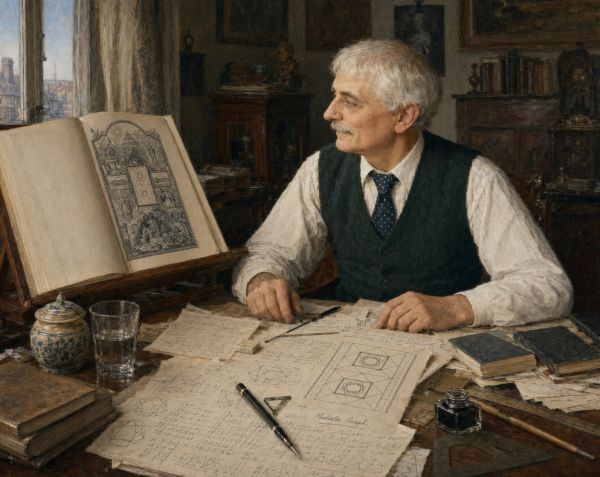
An symbolic representation of Francis Warrain (1867–1940)
in his study at Le Val-la-Reine, Honfleur, France.
*
Today’s sharing from the Blue House of Via-HYGEIA is an immediate follow-up to our English translation of the excerpt from De l’Architecture Naturelle (pages 94–112), which we titled: ‘Towards an Architecture of Being: The Sephiroth as a Universal Translation Engine’.
Having established the theoretical framework of the Petrus Talemarianus-Warrain geometric lattice, we now move from theory to practice. This article aims to demonstrate that the Mediator Graph is not merely a diagram for scholars, but a living engine of universal translation, capable of generating sacred expression across diverse traditions.
By applying Francis Warrain’s rigorous numerical and structural constraints to Kabbalah, the Vedas, and Taoism, we reveal how a single ontological topology can breathe life into Hebrew hymns, Sanskrit mantras, and Chinese parables alike.
This is a pedagogical experiment—a joyful ludus in sacred architecture—showing how the Infinite can be clothed in the Finite without shattering the vessel, while honoring the distinct sacred voice of every cultural tradition.
**
Introduction:
The Problem of the Infinite and the Finite
How does the Absolute become relative? How does the Infinite Light enter a finite vessel without shattering it? This is the central ontological antinomy faced by every mystical tradition.
The French artist, philosopher and mathematician Francis Warrain (1867-1940), writing under his group project pseudonym Petrus Talemarianus in De l’Architecture Naturelle, proposed a rigorous solution: ‘The Mediator Graph’ (Le Tracé Médiateur). Rather than relying on vague philosophical analogies, Warrain constructed a formal geometric and numerical lattice—a ‘universal translation engine‘—that maps the descent of the Divine into matter.
His method rests on three pillars:
- The Triad (3): The Upper Principle, the Lower Principle, and the Mediator (the Bridge).
- The Heptad (7): The seven intermediate stages or ‘veils‘ through which the Light descends.
- Numerical Verification: Using gematria, sacred ratios, and structural constraints to ensure the synthesis is not arbitrary syncretism, but a reflection of a single ontological topology.
This article demonstrates the Warrain Method in action. We present three pedagogical experiments—one from Kabbalah, one from the Vedas, and one from Taoism. Each includes a hymn and a tale, constructed using the Mediator Graph, presented in original script, transliteration, and translation, followed by an exegesis of the hidden architecture.
*
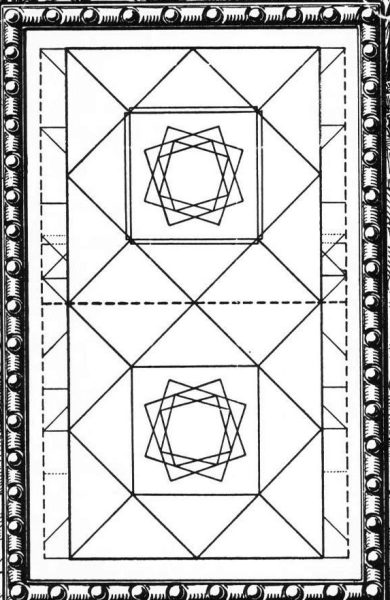
The Mediator Graph: A Formal Description
Before entering the three traditions, we must see the instrument itself. The Mediator Graph is a double rectangular lattice whose proportions are derived from the human form (symbolic height = 60 units, width = 30 units). It is divided into two domains:
- The Upper Square (☉, the Sun): Symbolizing exteriority, synthesis, and the six constructive Sephiroth. In the Kabbalistic mapping, this is Tiphereth (Beauty), the Short Face (Zeir Anpin), the King.
- The Lower Square (♃, Jupiter): Symbolizing interiority, reflection, and the three intellectual Sephiroth. This is Iesod (Foundation), the hidden root, the norm of manifested worlds.
- The Mediating Square (☽, the Moon): Situated at equal distance between the two, its side is the arithmetic mean of the other two. This is Malkuth (Kingdom), the Shekinah, the synthetic link uniting interiority and exteriority.
Between these squares, Warrain interposed the 22 letters of the Hebrew alphabet as a ‘formative word‘, and the 50 Sanskrit monosyllables of the chakras as the revealed worlds. The graph thus becomes not merely a diagram but a therapeutic architecture—a space where contradictions meet, reconcile, and dwell in peace.
The numerical keys are precise:
- 314 (= שַׁדַּי, Shaddai, the name of Metatron) serves as the common numerator of the eight ratios of ARSENIC●M, with denominators drawn from the Fibonacci series (144, 89, 55, 34, 63, 39, 123, 76).
- 112 = אֶהְיֶה (Ehyeh = 21) + יְהוָה (YHWH = 26) + אֲדֹנָי (Adonai = 65), the sum of the divine names of the three middle-column Sephiroth (Kether, Tiphereth, Malkuth).
- 203 = 112 + 91 (אֱלֹהִים, Elohim, by hieroglyphic mutation), equivalent to בַּר (Bar, ‘Son‘ or ‘Fountain‘), from which flow the Love, Truth, and Power of God.
- 15 (= 5 + 10) is the characteristic number of Kether and of the T’ai ki (Taiji), producing the Two Effigies, Four Images, and Eight Trigrams (1 + 2 + 4 + 8 = 15).
The graph is thus a formal machine, not an analogy. It generates correspondences because its geometry is isomorphic to the structure of manifestation itself.
*
I. The Jewish Tradition: The Veil of Mercy
Theme: Tzimtzum (Divine Contraction) The Mediator: Tiferet (Beauty/Compassion) — the heart of the Tree, where Chesed (Mercy) and Gevurah (Severity) are balanced.
A. The Hymn: ‘The Garment of Light’
| Hebrew Original | Transliteration | English Translation |
|---|---|---|
| אוֹר אֵין סוֹף, צַר לְךָ בְּחָלָל הָעוֹלָם, צִמְצַמְתָּ זוֹהַרְךָ כְּדֵי לָתֵת מָקוֹם. לֹא בְחֶרֶב תָּבוֹא, לֹא בְּקוֹל רַעַם, רַק כְּטַל עַל דֶּשֶׁא, רַךְ וְנִסְתָּם. |
Or Ein Sof, tzar lekha b’khalal ha’olam, Tzimtzamta zoharkha k’dei latet makom. Lo b’kherev tavo, lo b’kol ra’am, Rak k’tal al deshe, rakh v’nistam. |
Infinite Light, You narrowed Yourself for the world’s space, You contracted Your brilliance to give room for our place. Not with sword do You come, nor with thunderous sound, But like dew on the grass, soft and silently found. |
| שִׁבְעָה רְקִיעִים גָּנְזוּ אֶת הַלַּהַט, מִכֶּתֶר עַד מַלְכוּת, נִתְלַבֵּשׁ הָאוֹר בְּשֶׁקֶט. בְּאֶמְצַע הַלֵּב, רַחֲמִים יִפְתְּחוּ שַׁעַר, שֶׁיִּשְׁכֹּן הַגָּדוֹל בְּתוֹךְ הַקָּטָן כְּאוֹרֵחַ. |
Shiv’a r’ki’im ganzu et ha’lahat, Mi’Keter ad Malkhut, nitlabesh ha’or b’sheket. B’emtza ha’lev, rachamim yift’chu sha’ar, She’yishkon ha’gadol b’tokh ha’katan k’ore’ach. |
Seven firmaments hid the flame’s searing heat, From Crown to Kingdom, the Light clothes Its feet. In the heart’s center, Mercy opens the gate, So the Great may dwell with the Small, as a guest at the gate. |
| יָרַד הַשֶּׁפַע כְּמוֹ נָהָר שׁוֹקֵט, לֹא יִשְׂרֹף הַכְּלִי, רַק יְמַלֵּא וְיַחֲזִיק. כִּי הַסּוֹד הוּא הַגֶּשֶׁר, הַדַּעַת הַצַּחְצָחָה, שֶׁמַּחְבֶּרֶת שָׁמַיִם וָאָרֶץ בִּנְשִׁיקָה רַכָּה. |
Yarad ha’shefa k’mo nahar shoket, Lo yisrof ha’kli, rak y’male v’yachzik. Ki ha’sod hu ha’gesher, ha’Da’at ha’tzachtzacha, She’machberet shamayim va’aretz bi’nshika raka. |
The flow descends like a river at rest, Not shattering the vessel, but filling its chest. For the secret is the Bridge, the Knowledge so clear, Joining Heaven and |
B. The Tale: ‘The King’s Too-Bright Ring’
The elders told of a King whose face was too bright for his subjects to see. He wished to give a ring to his small son, but the gold burned like fire. “If I touch him”, said the King, “he will turn to ash“.
He called three artisans: the Wind, the Water, and the Dust. The Wind blew and scattered the great heat. The Water fell as dew and cooled the flame. The Dust shaped a vessel to hold the light in measure. Seven days they labored, seven layers they placed upon the gold.
On the seventh day, the gold was seen no more, only a gemstone with a sun shining inside, burning without scorching. The son brought the ring, and the light smiled at him. “The secret”, whispered the father, “is not to hide the light, but to clothe it in measure, so the heart can bear it”.
C. Exegesis: The Hidden Architecture
- The Triad: The King (Kether/Infinite), the Son (Malkuth/Finite), and the Ring (The Mediator/Vessel).
- The Three Artisans: Correspond to the Three Mother Letters of the Sefer Yetzirah: Aleph (Wind/Air), Mem (Water), Shin (Fire/Dust kiln). They represent the primal elements that veil the light.
- The Seven Layers: The narrative explicitly mentions “Seven days” and “Seven layers,” mapping the descent through the Seven Lower Sephiroth (Chesed to Yesod).
- The Mediator: The “Gemstone” is the structural center. It is not the gold (too hot) nor the setting (too dark), but the fusion of both. In Kabbalah, this is Tiferet (Beauty), the balance of Justice and Mercy. Warrain’s graph places Tiphereth at the square ☉, synthesizing the six other squares and symbolizing the exteriority of the graph.
- Numerical Verification:
- The story moves from 1 (King) → 3 (Artisans) → 7 (Days) → 1 (Unified Ring), mirroring the Kabbalistic formula of Yichud (Union).
- The gematria of Tiferet (תִּפְאֶרֶת) = 1081. The name Shaddai (שַׁדַּי) = 314, which Warrain identified as the common numerator bounding the world. The ratio 1081/314 ≈ 3.44, close to the sacred proportion governing the graph’s construction.
- The divine names of the three middle-column Sephiroth sum to 112 (21 + 26 + 65), the number of the synthetic link.
*
II. The Hindu Tradition: The Sound of the Void
Theme: Brahman manifesting through Maya The Mediator: Om (Pranava) — the Sound that becomes the veil, the golden mist between Shiva and Shakti.
A. The Hymn: ‘The Song of the Silent Drum’
| Sanskrit (Devanagari) | Transliteration (IAST) | English Translation |
|---|---|---|
| ॐ तत् सत्, ब्रह्मैकम् अनन्तम् अमृतम्, माया तनुते, यथा दीपो घटे स्थितः। आकाश वायु अग्नि जल पृथिवी — पञ्च भूत, तेजोऽवृत्य स्पन्दन्ति मध्ये। |
Oṃ Tat Sat, brahmaikam anantam amṛtam, Māyā tanute, yathā dīpo ghaṭe sthitaḥ. Ākāśa vāyu agni jala pṛthivī — pañca bhūta, Tejo’vṛtya spandanti madhye. |
Om, That Is Truth. One Brahman, Infinite, Immortal, Maya clothes It, as a lamp within a pot. Sky, Wind, Fire, Water, Earth — the five elements, Veiling the Radiance, they pulse in the center. |
| सप्त स्वराः, सप्त चक्राणि, सप्त नाड्यः, ऊर्ध्वं मूलाधार, अधि सहस्रार, मध्ये सुषुम्ना, ओङ्कार सेतु भवति। न दहति, न शोषयति, केवलं धारयति। |
Sapta svarāḥ, sapta cakrāṇi, sapta nāḍyaḥ, Ūrdhvaṃ mūlādhāra, adhi sahasrāra, Madhye suṣumnā, oṅkāra setu bhavati. Na dahati, na śoṣayati, kevalaṃ dhārayati. |
Seven tones, seven wheels, seven rivers flow, From the root below to the crown above, In the middle, the Suṣumnā, where Om becomes the Bridge. It burns not, dries not, but only sustains. |
| यथा गङ्गा अवतरति हिमालयमस्तकात्, न वेगेन भुनक्ति, किन्तु मीनजीवनं ददाति, तथा ज्योतिर् अवतरति, नाम्नोऽवच्छादनेन। एकं सत् विप्रा बहुधा वदन्ति। |
Yathā gaṅgā avatarati himālayamastakāt, Na vegena bhunakti, kintu mīnajīvanaṃ dadāti, Tathā jyotir avatarati, nāmno’vacchādanena. Ekaṃ sat viprā bahudhā vadanti. |
As the Ganga descends from the Himalayan peak, Not to crush with speed, but to give life to the fish, So descends the Light, through the veil of Name. Truth is One; the sages call it by many names. |
B. The Tale: ‘The Dancer Who Forgot Her Name’
In the beginning, there was only the Dancer (Shakti) and the Silent Witness (Shiva). The Dancer wished to be seen, but her light was too fierce; the worlds were blind. “How shall I dance”, she asked, “if my movement shatters the stage?”
The Witness smiled and whispered the Sound: Om. The Sound became a veil, a golden mist. First, the mist became Space, vast and quiet. Then Wind, to stir the silence. Then Fire, to warm the void. Then Water, to bind the dust. Then Earth, to hold the foot. And between them, the Rhythm, the seventh secret, that holds the steps together.
The Dancer stepped onto the Earth. Her light was now soft, filtered through the mist. She was no longer the Blinding Sun, but the Moon of the Mind. The creatures saw her and did not burn; they danced with her. They thought, “This is a story, this is a play’. But the Dancer knew: “The veil is not a lie; it is the love that lets you see me”. And in the center of the dance, where the foot meets the ground, the Witness and the Dancer became One.
C. Exegesis: The Hidden Architecture
- The Triad: Shakti (Active/Dynamic), Shiva (Stillness/Consciousness), and Om (The Mediator/Sound). Note: We do not call Shiva “Passive/Yin” in the Chinese sense; he is niṣkriya — action-without-action, pure Awareness.
- The Five Elements: The story lists the Pañca Bhūta (Space, Wind, Fire, Water, Earth) as the sequential veiling of the light, corresponding to the densification of matter.
- The Seven Steps: The “Seven secrets” (Space, Wind, Fire, Water, Earth, + Rhythm + The Step itself) mirror the Seven Chakras.
- The Mediator: The “Rhythm” is the central axis (Suṣumnā). Without rhythm, the elements are chaotic; with it, they become a dance (Līlā). Warrain mapped the 50 Sanskrit monosyllables to the 50 petals of the six chakras, placing them within the Mediator Graph as the revealed worlds opposing the 22 hidden Hebrew letters.
- Numerical Verification:
- The progression 1 (Witness) → 5 (Elements) → 7 (Steps) → 1 (Union) reflects the Vedic cosmogony of the Tattvas.
- The Bīja mantras of the chakras (lam, vam, ram, yam, ham, om) total 6, plus the 2 of Ājñā (ham, kṣam) = 8, plus the 50 petals = 58, which Warrain linked to the 22 + 50 = 72 sacred signs (minus the uncounted Unity = 70).
*
III. The Chinese Tradition: The Utility of Emptiness
Theme: Dao generating the Ten Thousand Things The Mediator: Wu (The Void/Emptiness) — the hollow that is not a thing but a non-thing, allowing the interaction of things.
A. The Hymn: ‘The River That Flows Uphill’
| Chinese (Original Script) | Pinyin Transliteration | English Translation |
|---|---|---|
| 道可道,非常道。無極生太極,一氣生兩儀。陽升於天,陰降於地,中和為氣,流通萬物。 | Dào kě dào, fēi cháng dào. Wú jí shēng tài jí, yī qì shēng liǎng yí. Yáng shēng yú tiān, yīn jiàng yú dì, Zhōng hé wéi qì, liú tōng wàn wù. | The Tao that can be told is not the eternal Tao. The Void births the Supreme, the One breaths the Two. Yang rises to Heaven, Yin sinks to Earth, Harmony is the Qi that flows through all things. |
| 三才立,四象成,五行動,六氣調,七情平。水善弱,而利強,空中有心,虛而不屈。 | Sān cái lì, sì xiàng chéng, wǔ xíng dòng, Liù qì tiáo, qī qíng píng. Shuǐ shàn ruò, ér lì qiáng, Kōng zhōng yǒu xīn, xū ér bù qū. | Three Powers stand, Four Images form, Five Elements move, Six Energies tune, Seven Emotions calm. Water seems soft, yet overcomes the strong, Empty yet full, hollow yet never exhausted. |
| 古追月,今追日,中間有門,名曰「德」。不爭,不強,不居,萬物自化,歸根曰靜。 | Gǔ zhuī yuè, jīn zhuī rì, Zhōng jiān yǒu mén, míng yuē ‘Dé’. Bù zhēng, bù qiáng, bù jū, Wàn wù zì huà, guī gēn yuē jìng. | The past chases the moon, the present chases the sun, Between them is a gate, named ‘Virtue‘ (De). Not striving, not forcing, not holding, The ten thousand things transform themselves, returning to the Root. |
B. The Tale: ‘The Potter and the Empty Space’
A Master Potter wanted to make a vase that could hold the whole sky. He took the clay (Earth/Yin) and spun it on the wheel (Heaven/Yang). But the clay was too heavy, and the sky was too vast. “It will crack”, said the apprentices.
The Master smiled and did not add more clay. Instead, he removed the center. He hollowed it out. He made it empty. First, he shaped the bottom (Water). Then, he raised the walls (Wood/Fire). Then, he glazed it with stone (Metal). Seven turns of the wheel, seven breaths of the bellows.
In the center, he left nothing. And because there was nothing, the sky could enter. “The vase is not the clay’, the Master taught. “The vase is the space the clay holds”. The heavy earth and the light sky met in the hollow. They did not fight; they danced in the empty middle. And the vase held the rain, the tea, and the stars, all at once.
C. Exegesis: The Hidden Architecture
- The Triad: Clay (Yin/Matter), Wheel/Sky (Yang/Spirit), and Emptiness (The Mediator). Here, uniquely, the mediator is a non-thing — the hollow space. This is the quintessential Taoist insight: the useful part of the vessel is the emptiness (Daodejing, Chapter 11).
- The Five Elements: The story implicitly uses the Wu Xing (Water, Wood, Fire, Metal, Earth) as the stages of the potter’s craft.
- The Seven Turns: The “Seven turns of the wheel” correspond to the seven stages of qi transformation.
- The Mediator: The “Hollow” is the transparent separator — it is not a “thing” but a “non-thing” that allows the interaction of things. Warrain explicitly linked this to his concept of the “Veil” as a transparent separator. The Taoist graph in De l’Architecture Naturelle (p. 104) shows the birth and transformation of the ten thousand beings, with Yin and Yang separated by the mediating Earth element (土) — the “Buddhi” or first image of the Word.
- Numerical Verification:
- The sequence moves from 2 (Clay/Wheel) → 5 (Elements) → 7 (Turns) → 0 (The Void) → 10,000 (The Things held).
- Warrain noted that the T’ai ki (Taiji) produces the Two Effigies, Four Images, and Eight Trigrams (1 + 2 + 4 + 8 = 15), the characteristic number of Kether.
- The ratio 23/37 and 37/23 appears in the graph’s Yin-Yang frame divisions, reflecting the interplay of emptiness and form.
*
IV. Resume: How to Use the Warrain Method
You can use this method as a contemplative tool to structure your own prayers, stories, or meditations. The goal is not to copy these examples, but to use the graph to find the ‘Third Term‘ in your own life’s contradictions.
The 5-Step Protocol
-
Define the Antinomy (The High and The Low)
- Identify two opposing forces in your life or study.
- Examples: Logic vs. Emotion, Silence vs. Speech, God vs. World, Self vs. Other.
- Action: Assign the Upper Square to the Active principle and the Lower Square to the Passive principle.
-
Identify the Mediator (The Center)
- Do not choose one side. Ask: “What is the Third Term that allows these two to speak to each other?“
- In Kabbalah: It was Mercy. In Vedas: It was Om. In Taoism: It was Emptiness.
- In your life: Is it Creative Expression? Ritual? Breath? Love?
- Action: Place this concept in the Central Intersection of your mental graph.
-
Map the Intervals (The 7 Steps)
- How do you get from the High concept to the Low concept? It is never instant.
- Action: Break the transition into 7 discrete stages.
- Tip: Use traditional numbers (7 days, 7 chakras, 7 colors) or create your own (7 breaths, 7 letters, 7 actions). This forces you to see the process, not just the endpoints.
-
Verify with Structure (The 3 Mothers)
- Ensure your ‘High‘ and ‘Low‘ are not simple. They contain internal complexity.
- Action: Introduce 3 primal elements (e.g., Fire/Water/Air, or Body/Mind/Spirit) that act as the “artisans” or “veils” shaping the transition.
-
Compose the Artifact
- Write a hymn, tell a story, or draw a diagram.
- Constraint: Do not explicitly name the steps (e.g., ‘Step 1’). Let the structure be invisible. Use metaphor, rhythm, and imagery.
- Goal: The reader should feel the harmony without seeing the scaffolding.
A Note on Contemplation
The ‘Warrain Method’ is not a machine to generate text; it is a mirror for the mind. By forcing yourself to find the ‘Mediator‘ and the ‘7 Steps‘, you train your intellect to reject dualism. You learn that opposites are not enemies to be defeated, but poles of a single current that require a bridge to flow.
When you compose using this method, you are not just writing; you are building a Contemplative Architecture. You are creating a space where your own inner contradictions can meet, reconcile, and dwell in peace.
“The ‘Tracé Médiateur’ is not just a map of the cosmos;
it is a key to inhabiting it.” —
Francis Warrain.
*
Appendix:
Key Correspondences
from ‘De l’Architecture Naturelle‘
| Graph Element | Sephirah | Divine Name | Value | Function |
|---|---|---|---|---|
| Central virtual square (☿) | Kether | Ehyeh (אֶהְיֶה) | 21 | Interiority, the hidden root |
| Small interior squares (☽, ♀) | Chokmah, Binah | Yah (יָה), Elohim (אֱלֹהִים) | 15, 86 | The divine Father and Mother |
| Square ● (Mars, Venus) | Da’at | — | — | The hidden Sephirah, separator and link |
| Mean interior squares (♀, ♂) | Chesed, Netzah | El (אֵל), YHWH Tzevaot | 31, 129 | Form archetypes |
| Large interior squares (♂, ♀) | Geburah, Hod | Elohim (אֱלֹהִים), Elohim Tzevaot | 86, 153 | Matter archetypes |
| Small exterior square (☽) | Malkuth | Adonai (אֲדֹנָי) | 65 | The synthetic link, Shekinah |
| Mean exterior square (♃) | Iesod | Shaddai (שַׁדַּי) | 314 | Foundation, the norm |
| Great exterior square (☉) | Tiphereth | YHWH (יְהוָה) | 26 | Exteriority, the King |
The Three Graphs:
- Intermediate graph on triangles (Yod): Heaven, Chokmah, formal cause.
- Intermediate graph on pentalphas (He): Earth, Binah, material cause.
- Double Mediator Graph (Vav-He): Man, Adam Kadmon, the union of Heaven and Earth.
The Mediator Graph teaches that every opposition is an invitation to discover the Third Term. Not synthesis, not compromise, but the precise geometric point where two infinities touch without collapsing into one another. That point — whether called Tiferet, Om, or Wu — is the door through which the Absolute enters the world, and through which the soul returns to its Source.
***

Leave a Reply