A Little Constantin François de Chassebœuf, comte de Volney Sampler-Part 2: An excerpt from ‘A History of Samuel, Originator of the Sacred Anointing of Kings’- Chapter XIII — The Origin of Ritual Unction
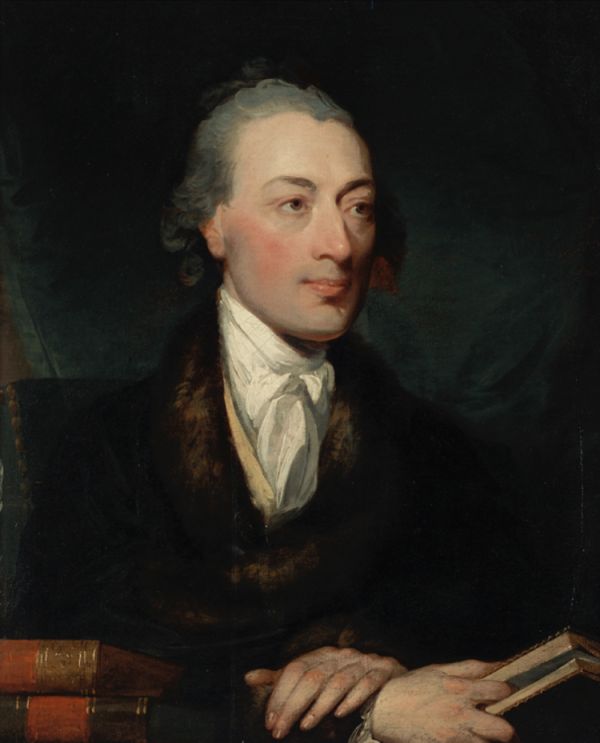
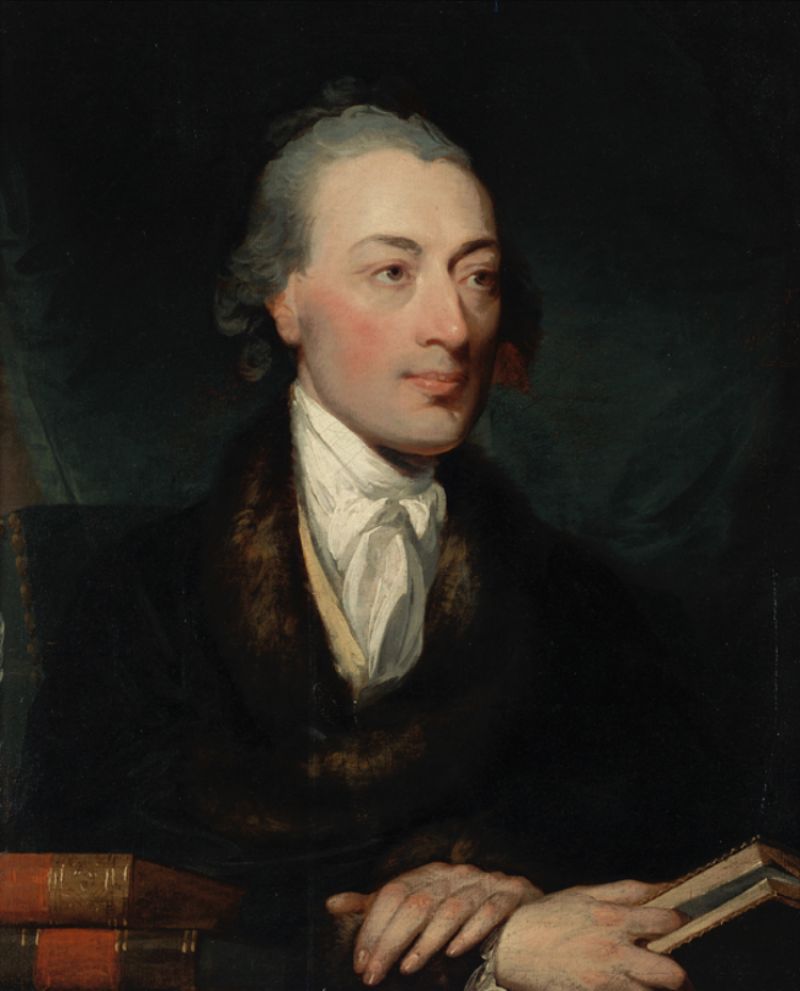
Volney’s 1795 portrait by Gilbert Stuart, in the collections
of the Pennsylvania Academy of the Fine Arts
in Philadelphia.
*
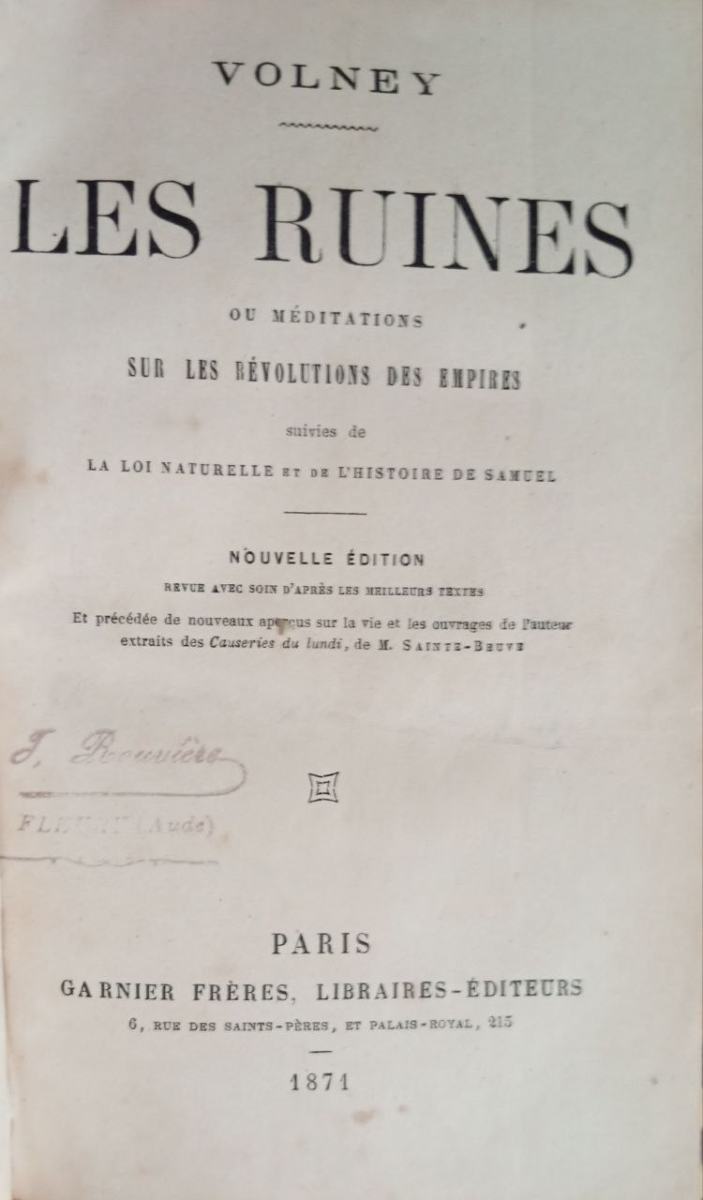
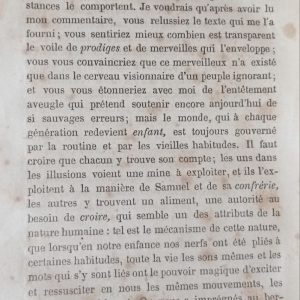
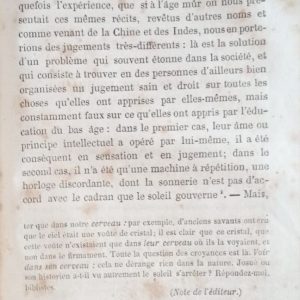
Today’s sharing from the Blue House of Via-HYGEIA is part 2 of a sampler devoted to the memory of Constantin François de Chassebœuf, comte de Volney, here chapter XIII of his essay, A History of Samuel, Originator of the Sacred Anointing of Kings: The Origin of Ritual Unction (with Oil or Animal Fat). From page 411 to 420, in the 1871 Garnier Freres edition. English translation by Via-Hygeia.
Volney’s chapter is a remarkable artifact of Enlightenment critical thought. His methodology—naturalistic, comparative, psychologically astute, institutionally skeptical—is not merely still relevant; it is the unacknowledged ancestor of much contemporary critical religious studies.
This excerpt is followed by an appendix in which we focus upon Volney’s methodology and ‘the continuity of Sacred Unction throughout the ages‘.
Sampler part 3 will be focusing upon Volney’s treatise, ‘Of natural Law‘, followed by a study about the concept’s context and time.
**
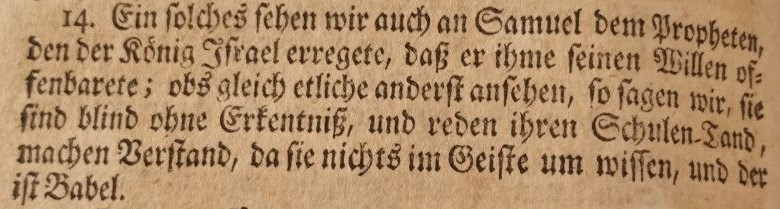
From Jacob Boehme’s ’40 questions of the Soul’-Question 26, paragraph 14.
The following text by Volney stands in stark contrast to the mystical view of the German theosopher Jakob Boehme, who, writing two centuries earlier, warned against analyzing such events through the lens of reason:
“We also see such an example in Samuel the Prophet, whom the King of Israel stirred up so that he might reveal his will to him; although some view it differently, we say they are blind without knowledge, and speak their school-jargon, making understanding where they know nothing in the Spirit, and this is Babel“.
*
A Contextual Introduction
In this second sampler, attention shifts from Volney’s general interpretive framework of civilizations to a more focused application of his method: the reconstruction of a specific ritual and political threshold, namely the emergence of sacral kingship through anointing. Chapter XIII of A History of Samuel, Originator of the Sacred Anointing of Kings concentrates on the origin of unction as a constitutive act of authority. Here, Volney’s inquiry narrows from broad civilizational comparison to the precise material and symbolic operations through which sovereignty is produced. The figure of Samuel is treated not as a purely theological character, but as a historical operator within a system where legitimacy is conferred through substances, gestures, and prescribed rites.
What is at stake in this chapter is the passage from force to consecration: how political power becomes stabilized through ritual media such as oil or animal fat, and how these substances function as vehicles of transformation, marking a body as separated, authorized, and elevated above ordinary status. Volney’s analysis situates this transition within a wider anthropological logic in which sovereignty is inseparable from controlled forms of material mediation.
Unlike the broader reflections in Les Ruines, this chapter is more tightly bound to the genealogy of a single institution: the sacralization of kingship through unction. It offers a concentrated case study in Volney’s method, where historical reconstruction and comparative reasoning converge on a specific ritual technology. The emphasis is not on doctrine, but on procedure—on how authority is manufactured through repeated acts, transmitted formulas, and regulated substances.
Read in continuity with the first sampler, this section illustrates the operative dimension of Volney’s thought: the shift from interpreting civilization as a whole to isolating the mechanisms by which symbolic systems produce political reality. Volney’s chapter is a remarkable artifact of Enlightenment critical thought. His methodology—naturalistic, comparative, psychologically astute, and institutionally skeptical—is not merely still relevant; it is the unacknowledged ancestor of much contemporary critical religious studies.
When we ask today, “How did a symbolic act of pouring oil acquire such power?” or “Why do adults believe what they learned as children?“, we are walking in Volney’s footsteps. His greatest insight may be the final one: that the magic of ritual and scripture lies not in the heavens but in the neural pathways laid down in childhood, which later “persist mechanically all our lives.” That is a hypothesis as provocative now as it was two centuries ago.
In the analysis that follows the text, we will explore how Volney’s core insights have been absorbed, refined, and vindicated by subsequent scholarship, from the naturalistic study of religion to the cognitive science of belief.
*
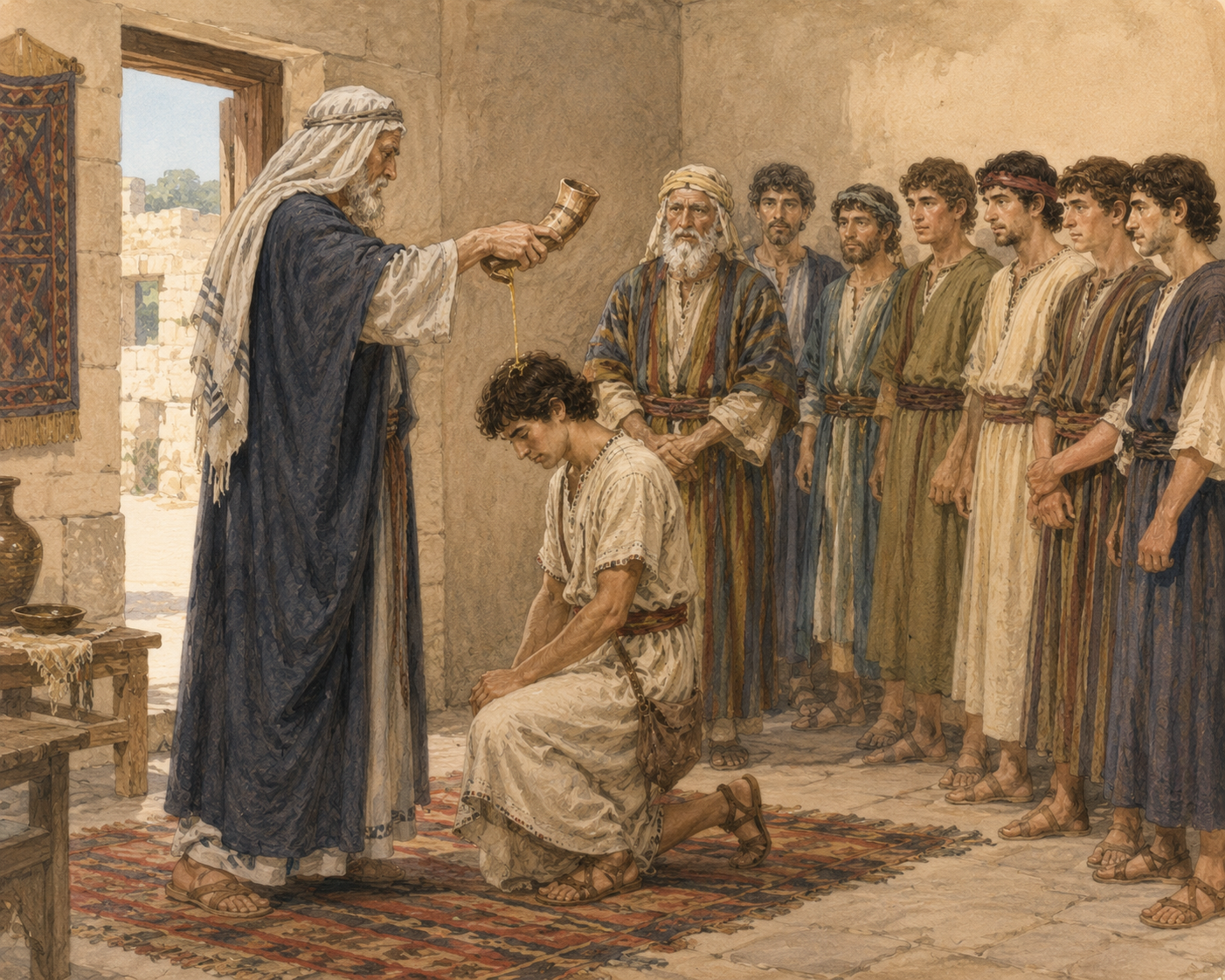
1 Samuel 16:1-13. Samuel Anoints David.
And now the text:
Origin of Anointing (with Oil or Fat)(¹)
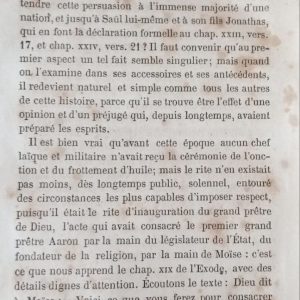
But another difficulty remains to be explained. How could an act so insignificant in itself, so trivial as pouring a little oil or fat on the head or rubbing it on the forehead, have had the prodigious effect not only of persuading a simple shepherd that he was seriously called to be king, but also of extending this persuasion to the vast majority of a nation, and even to Saul himself and his son Jonathan, who make a formal declaration of it in 1 Samuel 23:17, and 1 Samuel 24, verse 21? It must be admitted that at first glance such a fact seems singular; but when examined in its attendant circumstances and antecedents, it becomes as natural and simple as all the others in this history, because it turns out to be the effect of an opinion and a prejudice that had long been preparing people’s minds.
It is quite true that before this time no lay and military leader had received the ceremony of anointing and rubbing with oil; but the rite nonetheless had long existed, public, solemn, surrounded by circumstances most capable of commanding respect, since it was the rite of inauguration of the high priest of God, the act which had consecrated the first high priest Aaron by the hand of the legislator of the State, the founder of the religion, by the hand of Moses. This is what chapter xix of Exodus teaches us, with details worthy of attention. Let us listen to the text: God said to Moses: “This is what you shall do to consecrate Aaron and his sons to the priestly office.
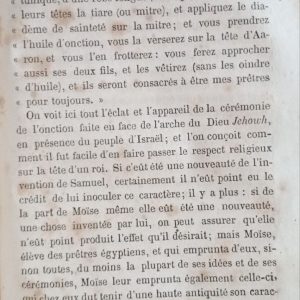
Take a young bull and two rams without blemish, unleavened bread, unleavened cakes moistened with oil, made of wheat flour; place them in a basket; present them with the young bull and the two rams; bring Aaron and his sons to the door of the tent where the ark is; wash them with water; take the (appropriate) garments, and clothe Aaron with a tunic, a long robe (the cope), etc.; place the tiara (or mitre) on their heads, and apply the diadem of holiness to the mitre; and you shall take the anointing oil, pour it on Aaron’s head, and rub it in; you shall also bring his two sons, and clothe them (without anointing them with oil), and they shall be consecrated to be my priests forever.”
Here we see all the splendor and pomp of the ceremony of anointing performed before the ark of the God Jehováh, in the presence of the people of Israel; and one can understand how easy it was to transfer the religious respect for it onto the head of a king. If it had been a novelty of Samuel’s invention, certainly he would not have had the credit to instill this character into it; what’s more: if on the part of Moses himself it had been a novelty, something invented by him, one can assure that it would not have produced the desired effect; but Moses, a pupil of the Egyptian priests, who borrowed from them, if not all, at least most of his ideas and ceremonies, Moses likewise borrowed this one from them, which among the Egyptians must have derived its holy and mysterious character from high antiquity.
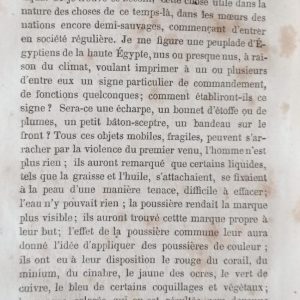
Nevertheless, since in that remote antiquity it had, like all things, a beginning, a first motive for its origin, what could this motive have been, what idea led its first inventor or inventors to imagine this singular practice? This motive must have been a need, something useful to the society that practiced it. Now I find this need, this useful thing, in the nature of things at that time, in the customs of nations that were still semi-savage, beginning to enter into regular society. I picture a tribe of Egyptians from Upper Egypt, naked or nearly naked due to the climate, wanting to imprint upon one or more of them a particular sign of command or of some function.
How will they establish this sign? Will it be a scarf, a cap of cloth or feathers, a little scepter-stick, a band on the forehead? All these movable, fragile objects can be snatched away by the violence of the first comer; the man is then nothing. They would have noticed that certain liquids, such as fat and oil, adhered and fixed themselves to the skin in a tenacious manner, difficult to erase; water could do nothing to remove them; dust made the mark more visible. They would have found this mark suitable for their purpose. The effect of common dust would have given them the idea of applying colored dusts; they had at their disposal the red of coral, red lead, cinnabar, the yellow of ochres, copper green, the blue of certain shells and plants. The colored mark resulting from this would have become among the first peoples a sign of utility and beauty, which we later find at all times and in all countries, among most peoples, even civilized ones.
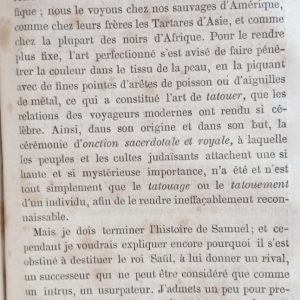
This kind of sign is striking among the Indians, where it bears a religious character, since the worshippers of the three gods distinguish themselves from one another by the colors and forms of these marks on the forehead. It is found throughout the islands of the Indian and Pacific Oceans; we see it among our American savages, as among their brothers the Tartars of Asia, and among most blacks of Africa. To make it more permanent, perfected art devised the method of making the color penetrate the tissue of the skin by pricking it with fine points of fish bones or metal needles, which constituted the art of tattooing, made so famous by the accounts of modern travelers. Thus, in its origin and in its purpose, the ceremony of priestly and royal anointing, to which Judaizing peoples and cults attach such high and mysterious importance, was and is simply the tattooing of an individual, in order to make him indelibly recognizable.
But I must finish the history of Samuel; and yet I would like to explain further why he persisted in deposing King Saul, in giving him a rival, a successor who can only be considered an intruder, an usurper. I admit partly the priest’s resentment against Saul’s pretensions to meddle in the functions of sacrificer and soothsayer; nevertheless, this motive seems insufficient, when one considers the more than expiatory repentance to which the king stoops. There must have been another, more radical cause, and I find it in Saul’s physical infirmity, which, examined medically, could only have been epilepsy.
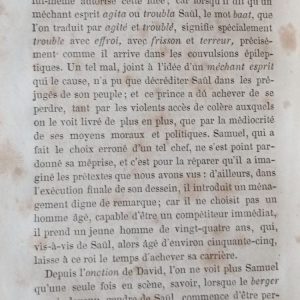
The Hebrew text itself authorizes this idea; for when it says that an evil spirit agitated or troubled Saul, the word baat, translated as agitated and troubled, specifically means trouble with fright, with shivering and terror, precisely as occurs in epileptic convulsions. Such an ailment, combined with the idea of an evil spirit causing it, could only discredit Saul in the prejudices of his people; and this prince must have ended up ruining himself, both by the violent fits of anger to which we see him increasingly given, and by the mediocrity of his moral and political means. Samuel, who made the erroneous choice of such a leader, never forgave himself for his mistake, and it is to repair it that he devised the pretexts we have seen.
Moreover, in the final execution of his plan, he shows a consideration worthy of note; for he does not choose an old man capable of being an immediate competitor; he takes a young man of twenty-four years, who, compared to Saul, then aged about fifty-five, leaves this king time to finish his career.
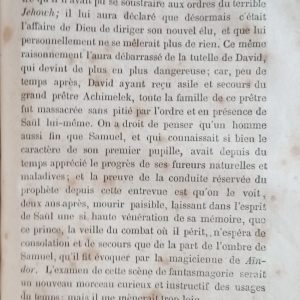
After David’s anointing, Samuel is seen on stage only once more, namely, when the sacred shepherd, having become Saul’s son-in-law, begins to be persecuted by this king, and takes refuge in Ramatha, whence Samuel takes him to seek common shelter in the brotherhood of the prophets at Niout. We have seen earlier that the enraged Saul rushed there himself: the case was perilous, because at that time he must have been well informed of David’s secret anointing; but Samuel, always cunning, would have taken advantage of this interview to calm the king and make peace with him; he would have pointed out that he could not avoid the orders of the terrible Jehováh; he would have declared to him that henceforth it was God’s affair to direct his newly chosen one, and that he personally would no longer get involved in anything.
This same reasoning would have rid him of David’s tutelage, which was becoming increasingly dangerous; for, shortly after, David having received asylum and aid from the high priest Ahimelech, the entire family of this priest was mercilessly massacred by order and in the presence of Saul himself. One has the right to think that a man as shrewd as Samuel, who knew so well the character of his first pupil, had long since assessed the progress of his natural and morbid furies; and the proof of the prophet’s reserved conduct since this interview is that we see him, two years later, die peacefully, leaving in Saul’s mind such a high veneration for his memory that this prince, on the eve of the battle in which he perished, hoped for consolation and help only from the ghost of Samuel, which he had conjured up by the witch of Endor. The examination of this scene of phantasmagoria would be another curious and instructive piece about the customs of the time; but it would lead me too far.
In summary, you see Samuel’s conduct explained in all its details by natural causes, drawn from the customs and prejudices of his nation; you see all his actions finding their palpable motives in his personal character, always the same, always calculating, astute, hypocritical, ambitious for power, and tacking through the difficulties of his position with as much art as circumstances allowed. I wish that after reading my commentary, you would re-read the text that provided it to me; you would better feel how transparent is the veil of prodigies and wonders that envelops it; you would convince yourselves that this marvelous element existed only in the visionary brain of an ignorant people; and you would be astonished with me at the blind stubbornness that still today pretends to uphold such savage errors; but the world, which in each generation becomes a child again, is always governed by routine and old habits.
One must believe that everyone finds their account in it; some see a mine to exploit in illusions, and they exploit it in the manner of Samuel and his brotherhood; others find there nourishment, an authority for the need to believe, which seems one of the attributes of human nature. Such is the mechanism of this nature, that when in our childhood our nerves have been bent to certain habits, all our lives long the very sounds and words that were linked to them have the magical power to excite and resurrect in us the same movements, the same dispositions (2).
We have been impregnated at the cradle with the stories of the Bible; the names of its characters have been linked to certain opinions, certain ideas; and so the judgments that were infused into us become incorporated with us, and persist mechanically all our lives. I have often thought, and have sometimes experimented, that if in mature age these same stories were presented to us, clothed in other names and as coming from China or India, we would form very different judgments about them. Therein lies the solution to a problem that often surprises one in society, which consists of finding in otherwise well-organized persons a sound and right judgment on all things they learned by themselves, but a consistently false judgment on what they learned through early childhood education. In the first case, their soul or intellectual principle operated by itself, it was consistent in sensation and judgment; in the second case, it was only a repeating machine, a discordant clock, whose chiming does not agree with the dial governed by the sun (3).
But, speaking of clocks, I think I hear, as in the Arabian Nights, the hour warning me to close my vigil or night: happy if, not having found it as amusing as its thousand and one sisters, you judge it at least more useful in its results.
I am, etc.
*
Footnotes from the original text
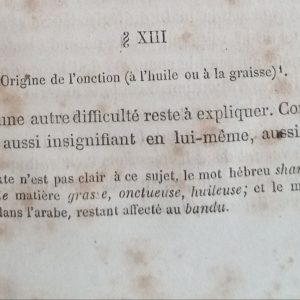
(1) The text is not clear on this subject; the Hebrew word shamm signifying any fat, unctuous, oily matter; and the Aramaic word frosenemru, in Arabic, remaining specific to bandu.
(A Via-Hygeia note: Volney cites ‘bandu’ here. While the term can refer to a curry in some contexts, in this linguistic discussion regarding skin marking and dyes, it refers to a colored pigment or stain used for ritual marking, distinct from but functionally similar to henna.)
(2) What is belief? I ask the most skilled metaphysician. Is it not seeing as existing what we are told exists? But this image that one sees or imagines seeing may exist only in our brain. For example, ancient scholars believed that the sky was a crystal vault; it is clear that this crystal, this vault, existed only in their brain where they saw it, and not in the firmament. The whole question of beliefs lies there. To see in one’s brain: that changes nothing in nature. Did Joshua or his historian see the sun stop any differently? Answer me, biblicists. (Editor’s note.)
(3) It is also by this mechanism that one often sees in old age the reappearance of childhood impressions, which had slept throughout mature age. For example, the physicist Brisson, raised in the Poitevin dialect, had lost sight of it during his very long residence in Paris… Having become old, he had an apoplectic attack which, while otherwise leaving him his physical faculties, erased all his ideas and knowledge acquired through study, even the memory of the French language: but the first impressions of the dialect of childhood reappeared and continued until his death, which occurred a few months later. In mature age, our strained reason rejects werewolves and ghosts with contempt. In old age, our nerves, having fallen back into a state of purely animal vegetation, recover the terrors of childhood. (Editor’s note.)
*
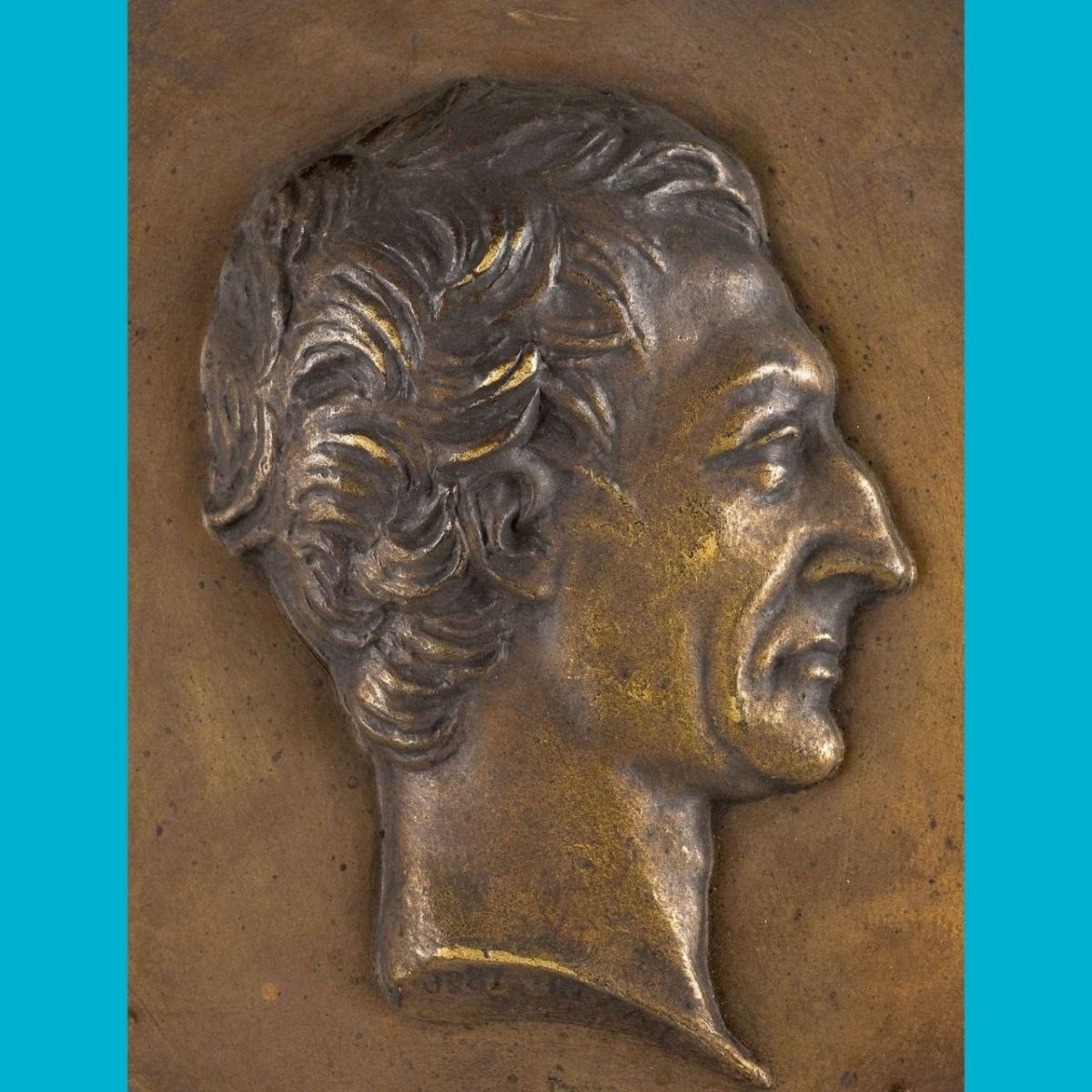
1826 Volney relief by David d’Angers, Pierre-Jean (Angers, 12–03–1788 – Paris, 05–01–1856), sculptor & Richard, Louis (Paris, in 1791 – in 1879), foundryman.
Apendix
Volney’s Methodology
and the Continuity of Sacred Unction
Volney’s argument in this chapter unfolds with a precision that anticipates modern critical theory. He addresses a central puzzle: how did a trivial act—pouring oil on someone’s head—come to possess the extraordinary power to convince an entire nation that a simple shepherd was divinely appointed king, and even persuade the reigning king himself of this legitimacy? Volney’s explanation proceeds in three logical steps.
First, he establishes that the rite was not a novelty; Samuel could not have invented it from scratch. The anointing of priests, established by Moses following Egyptian precedents, already carried immense religious authority, which Samuel merely transferred to a royal context.
Second, he argues that the ultimate origin of anointing is mundane. Volney speculates that in primitive societies, people needed a durable mark to designate leaders. Oil and fat adhered to the skin, trapping dust to create a visible sign, a practice that evolved into the use of colored pigments and eventually tattooing. He posits that the ceremony of priestly and royal anointing was, in its origin, simply a form of tattooing designed to make an individual indelibly recognizable.
Third, Volney suggests that Samuel’s real motive for deposing Saul was not divine command but Saul’s epilepsy. The ‘evil spirit‘ that troubled Saul is medically identifiable as a neurological condition that discredited him in the popular prejudice. Samuel, covering his own error in choosing Saul, used religious pretexts to substitute David, a young man who would not immediately challenge the throne. Volney concludes by attacking religious credulity as a product of childhood conditioning, arguing that if the same Bible stories were presented as coming from China or India, adults would judge them quite differently.
Volney’s methodological toolkit combines several critical strategies that were remarkably ahead of his time and remain deeply relevant today. He employs historical contextualism by interpreting biblical events not as miracles but as products of specific social, political, and psychological conditions. His use of comparative anthropology is evident in his observations of contemporary Druze, Native American, and Indian practices as analogies for ancient Hebrew customs, a approach that anticipated modern ethnography. Furthermore, his naturalistic explanation reduces supernatural claims to natural causes, such as identifying epilepsy in demonic possession or weather prediction in thunder miracles.
Volney also engages in source criticism, noting contradictions between biblical accounts—such as the two different stories of David’s introduction to Saul—and suggesting multiple authors or late redaction, a conclusion that aligns with the modern Documentary Hypothesis. Perhaps most striking is his psycho-social analysis of belief, where he explains religious credulity through childhood conditioning, habit, and the interests of priestly corporations who ‘exploit‘ illusions. This demystification of ritual, tracing sacred ceremonies back to utilitarian origins, is a foundational move in critical anthropology.
The enduring relevance of Volney’s methodology is visible in several contemporary fields. In the naturalistic study of religion, scholars like Pascal Boyer and Daniel Dennett ask the same questions Volney did regarding how irrational beliefs arise and persist, often concluding that they serve the interests of elites and exploit cognitive biases. His comparative method is now standard in the history of religion, while his medical reading of religious phenomena prefigures modern neurological and psychiatric examinations of possession trances and prophetic ecstasies.
Moreover, his critique of priestly interests echoes in the works of Marx and Nietzsche, and his insights into the psychology of credulity anticipate modern research on confirmation bias and the resilience of early-acquired concepts. While Volney’s work shows its age in its overly reductive tendencies, its Eurocentric evolutionism, and its polemical tone, these flaws do not invalidate his core methodology. They merely mark him as a pioneer who laid the groundwork for the secular academic study of religion.
To fully appreciate the depth of the ritual Volney analyzes, it is necessary to view the Jewish ritual of anointing not in isolation but as part of a broader Mediterranean continuum:
The Jewish ritual did not emerge in a vacuum; the Greeks and Romans possessed parallel traditions involving sacred oils, perfumed unguents, blood rites, and the consecration of rulers, athletes, and priests, all of which Christianity later synthesized. Across the ancient Mediterranean, oil was never merely cosmetic. It carried meanings of vitality, divine favor, purification, kingship, beauty, immortality, and solar radiance.
The basic substances were remarkably stable across cultures: olive oil symbolized life and light; blood represented covenant and vitality; resin and balsam signified incorruptibility; and incense denoted prayer and ascent. In Greek traditions, oil held a quasi-sacred status. Athletes were anointed before competition for strength, purification, and heroic beauty, their shining bodies reflecting divine harmony and Apollo-like luminosity.
This ‘radiance theology‘ was inherited by Christian saints. Greek temples used perfumed oils and aromatic fumigation to wash, clothe, and anoint statues of gods, particularly in the cults of Apollo, Aphrodite, and Dionysus, where divine fragrance itself became evidence of epiphany. The Greek mystery religions, such as the Eleusinian and Orphic rites, used oils, honey, wine, and blood symbolism to effect a ritual death-and-rebirth, transforming the initiate much like the consecrated priest or king in Hebrew ritual.
The Romans inherited Greek perfumery but amplified it enormously, developing sophisticated unguenta containing olive oil, rose, saffron, myrrh, and nard. Elite Roman religion associated fragrance with civilization, divine favor, and imperial majesty.
Although Roman emperors were not initially crowned through Hebrew-style anointing, the imperial cult gradually adopted quasi-sacred consecration rituals involving incense and sacred oils, influencing Byzantine Christian imperial theology.
The evolution of these compositions moved from the early Semitic phase, characterized by olive oil, myrrh, and cinnamon, to the Hellenistic phase where Greek pharmacology and Egyptian perfumery merged, adding saffron, iris, and frankincense.
The Roman imperial phase industrialized perfumery, utilizing Arabian frankincense and Judean balsam, merging religious and funerary uses. Early Christian chrism preserved the Jewish base of olive oil but added balsam and aromatic resins, shifting the symbolism toward the Holy Spirit, incorruptibility, and resurrection.
This tradition culminated in the Byzantine myron, an extraordinarily sophisticated mixture sometimes containing over forty ingredients, including wine, storax, mastic, and cloves. The preparation of the myron itself became a liturgical act performed by the Patriarch during Holy Week, symbolizing Pentecost and Paradise restored.
Throughout this long history, from ancient Israel to Byzantium, a continuous symbolic chain persists. Sacred oil functioned as condensed divine presence—not merely perfume, medicine, or coronation, but a material theology where spirit enters matter, authority enters flesh, and light enters the body. This continuity survives from the Mosaic priesthood to the Byzantine myron, to royal coronations, and into sacramental Christianity.
Volney stands at a fascinating transitional moment in the understanding of these rituals. Writing before modern anthropology and comparative religion became academic disciplines, yet after classical philology had expanded enormously, he still reads ritual through the lenses of symbolism, ancient astronomy, sacerdotal power, and political theology. In this sense, he stands between Enlightenment rationalism and nineteenth-century mythography.
His work invites us to link ancient Hebrew anointing oil with Egyptian temple perfumery, noting structural similarities in consecrated aromatic mixtures, restricted priestly formulas, and the concept of a perfumed divine presence.
The Egyptian temple tradition of divine fragrance is particularly ancient, and Volney’s insight allows us to see the anointing of kings not as a unique divine revelation, but as part of a vast, human history of using material substances to manufacture and transmit sacred authority.
*
Source
*
Original French
*
Coming soon
A Little Constantin François de Chassebœuf, comte de Volney Sampler-Part 3:
‘Of Natural Law‘ (1880),
followed by a study about the concept’s context and time.
***
More about Volney: https://en.wikipedia.org/wiki/Constantin_François_de_Chassebœuf,_comte_de_Volney




Leave a Reply