
Circle of Transmission: The Living Loom
The Rope of the Ever-Upright – ‘The Chapter on Fleeing to God’ from Ibn Masarra’s ‘El-Müntekâ Min Kelâmi Ehli’t-Tûka’: Discerning True Beauty from Worldly Adornment

Legend of the Illustration:
‘The Rope of the Ever-Upright‘.
Set within an ornate frame that echoes the inherited beauty of tradition, a solitary figure stands at the threshold between two worlds: below, a richly adorned landscape of forms, dwellings, and subtle distractions; above, an open and silent expanse. From a single luminous source descends the ever-upright rope—inscribed with the invocation ‘yā Ḥabl Allāh‘ (‘O Rope of God’)—forming the unbroken axis of Divine connection that remains when all human guidance has disappeared. The calligraphy is not merely decorative but constitutive: it becomes the very substance of the rope, so that the Word and the Path are one, and the seeker’s orientation is guided by invocation as much as by form. Small and anonymous, the figure does not ascend by his own power but turns in stillness toward this vertical light, which alone neither bends nor deceives. The composition reflects Ibn Masarra’s teaching: that true flight to God begins where appearances lose their authority, and that beyond the seduction of outward adornment lies a more demanding beauty—the purity of orientation, sincerity of heart, and unwavering adherence to the Real.
*
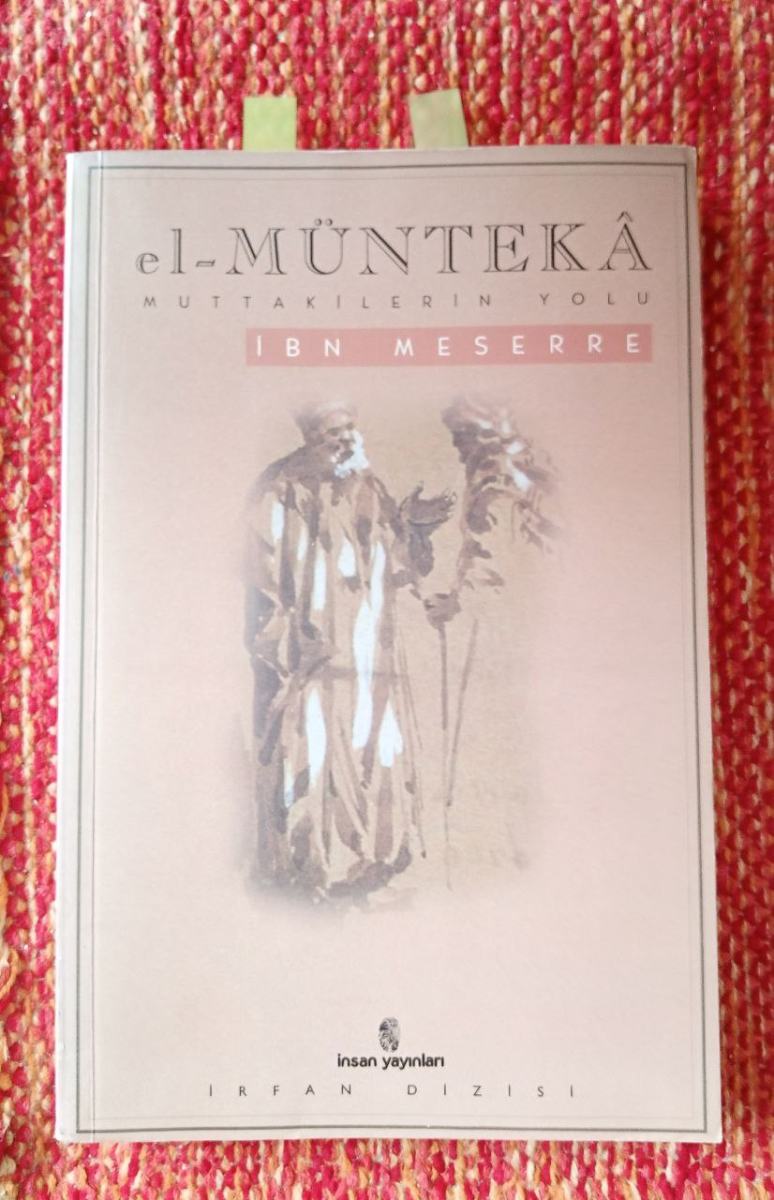
Today’s sharing from the Blue House of Via-HYGEIA, presenting ‘The Rope of the Ever-Upright‘—the pivotal chapter on ‘Fleeing to God Almighty’ from ‘El-Müntekâ Min Kelâmi Ehli’t-Tûka’ (İnsan Yayınları, 1999, edited by Professor Mehmet Necmettin Bardakçı).
Drawn from the only known manuscript in the world, preserved in Turkey, and originally published as part of the prestigious ‘Irfan‘ (Gnosis) Series, this text breathes the authentic spirit of Ibn Masarra (883–931)—the first philosopher-mystic of Cordoba. Compiled by the Andalusian master Ibn Hamis to preserve a fading legacy, these pages offer a rare glimpse into the batini (inner) tradition of Al-Andalus.
Why ‘The Rope of the Ever-Upright‘? The title reflects the chapter’s opening definition: true flight to God occurs when human guides vanish, leaving only the ‘ever-upright rope‘ of Divine connection. In an age of distraction, Ibn Masarra draws a sharp line between worldly adornment (gold, silk, ornate displays) and God’s true adornment (purity of character, humility, and sincerity). He warns that when the heart loves the world, it becomes deaf to the Divine; yet for the solitary seeker who clings to this Rope, the path opens to a beauty far greater than the eyes can see.
Offered here as a compass for the solitary seeker navigating a time of vanishing guides—a call to distinguish the eternal from the ephemeral.
**
A Contextual Introduction:
The Path of the Solitary Seeker
This chapter, ‘Fleeing to God Almighty‘, stands as the spiritual core of Ibn Masarra’s ‘El-Müntekâ’. While the previous text offered a prayer of invocation, this treatise offers a map of survival. It addresses a specific, terrifying spiritual reality: the epoch where ‘helpers have disappeared and guides have departed’. In such a time, the seeker cannot rely on external authorities, popular consensus, or the comfort of tradition, for these have often been co-opted by the very worldliness the prophets warned against.
Ibn Masarra’s argument is radical in its clarity: Flight is not running away from responsibility, but running toward the only reality that endures. He posits that when the world becomes a cacophony of ‘caprice‘ (hawā) and ‘adornment‘(zīna), the only safe harbor is the ‘ever-upright rope’ of direct, sincere connection to the Divine.
The Central Conflict: Two Adornments
The genius of this chapter lies in its redefinition of Beauty. Ibn Masarra observes that his contemporaries (and ours) have conflated God’s Adornment with The World’s Adornment.
The World’s Adornment is external: gold, silk, ornate mosques, luxurious food, and social status. It is designed to please the eye and the ego. Ibn Masarra argues that loving this adornment makes the heart “deaf and blind” to spiritual truth.
God’s Adornment is internal: it is the beauty of character (akhlāq), the purity of innate nature (fiṭra), and the light of sincerity (ikhlāṣ). This is the ‘true beauty‘ that God loves—a beauty that often looks like simplicity, hardship, or even ugliness to the worldly eye.
The Trap of Misinterpretation
A significant portion of the text is dedicated to exposing how religious texts are manipulated to justify worldly comfort. Ibn Masarra critiques those who cite the verse ‘Who has forbidden the adornment of God?’ to justify excess, while ignoring the Prophet’s own life of asceticism (zuhd). He warns that Satan’s greatest trick in this age is not to make people deny God, but to make them love the world so much that they interpret religion to suit their desires.
The Three Categories of Desire
Perhaps the most practical contribution of this chapter is its psychological taxonomy of desire. Ibn Masarra does not simply say “all desire is bad.” Instead, he divides worldly desires into three distinct categories, offering a nuanced guide for the seeker:
1. Destructive Desires: Those that are clearly forbidden (haram) and lead to spiritual ruin.
2. Distancing Desires: The ambiguous (mutashābihāt) matters that, while not strictly forbidden, occupy the heart and prevent it from remembering God.
3. Lagging Desires: Those that are lawful (halal) but keep the seeker from the highest stations of nearness to God. This is a crucial warning: even permissible things can become barriers to excellence.
How to Read This Text
Do not read this chapter as a historical artifact of 10th-century Andalusia. Read it as a diagnosis of the present moment. When Ibn Masarra speaks of people who ‘decorate mosques with gold but have hearts empty of reverence‘, or those who ‘race for worldly wealth like snarling dogs‘, he is describing a timeless spiritual disease.
The text calls for a Great Refusal: a refusal to accept the world’s definition of success, beauty, and happiness. It invites the reader to join the “small community” of those who, though few in number, possess the insight (baṣīra) to see the world as it truly is: a fleeting shadow compared to the enduring light of the Divine.
*
Index of Key Terms & Concepts
To aid in your study of this chapter, here is a glossary of the essential Arabic terms and concepts used by Ibn Masarra, defined within the context of his argument.
A
Akhlāq (Character): The true ‘adornment‘ of the believer. Unlike external decoration, this refers to internal virtues such as humility, patience, kindness, and truthfulness. Ibn Masarra asserts that character is the only beauty God values.
Awliyā’ (Friends of God): The spiritual elite who have successfully fled to God. They are often unrecognized by society, sometimes mocked as ‘companions of devils‘ because their ascetic lifestyle contradicts worldly norms. They are characterized by hunger, thirst for God, and sincerity.
B
Baṣīra (Insight/Inner Vision): The spiritual eye that opens when one turns toward God. It allows the seeker to see the truth of things beyond their physical appearance. Without baṣīra, a person is spiritually ‘deaf and blind’, even if physically sighted.
Batini (Inner/Esoteric): Refers to the hidden, spiritual meaning of texts and actions, as opposed to the zahiri (outer/exoteric) form. Ibn Masarra champions the batini understanding that prioritizes intention and heart-state over ritual display.
F
Fiṭra (Innate Nature): The original, pure state of the human soul, created in harmony with God. Spiritual practice, for Ibn Masarra, is largely about purifying the fiṭra from the ‘dirt and filth‘ of worldly attachment to return to this natural state.
Fitna (Trial/Temptation/Discord): Often translated as ‘temptation‘, but deeper: it is a chaotic trial that tests one’s faith. Ibn Masarra describes the ‘adornment of fitna‘ as the seductive beauty of the world that leads people astray.
H
Hawā (Caprice/Whim): The lower self’s desires and impulses. It is the opposite of Divine Guidance. Ibn Masarra warns that when a person follows their hawā, it becomes their ‘god‘, rendering them deaf to true prayer.
Hanifiyya: The primordial, monotheistic religion of Abraham, characterized by purity and uprightness. Ibn Masarra links this to the fiṭra and true Islamic character, distinct from the cultural innovations of his time.
I
Ikhlāṣ (Sincerity/Purity of Intention): The cornerstone of the chapter. It means performing deeds solely for God, free from any desire for praise, status, or worldly gain. Ibn Masarra states that without ikhlāṣ, even great deeds are worthless.
Ifrāṭ (Excess/Extremism): Going beyond the bounds of moderation. Ibn Masarra warns against two types: the excess of those who indulge in the world, and the false excess of those who perform worship to the point of exhaustion for show rather than sincerity.
J
Jamāl (Beauty): A central theme. Ibn Masarra distinguishes between Jamāl al-Dunyā (worldly beauty, which is fleeting and often deceptive) and Jamāl Allāh (Divine Beauty, found in character and sincerity). He argues that God is Beautiful and loves beauty, but His beauty is moral and spiritual, not material.
K
Khushū‘ (Reverent Humility): The state of the heart during prayer and worship. It is the opposite of arrogance and distraction. Ibn Masarra notes that worldly attachment destroys khushū‘, leaving only empty physical movements.
M
Malakūt (Divine Dominion/Kingdom): The spiritual reality behind the physical world. True worship involves reflecting (tafakkur) on the Malakūt to awaken the heart.
Mutashābihāt (Ambiguous Matters): Actions or things that are not clearly forbidden (haram) nor clearly permitted (halal), or which lie in a gray area. Ibn Masarra warns that these are often the trap that distances a seeker from God, even if they don’t lead to immediate destruction.
R
Riyā’ (Ostentation/Show): Performing good deeds to be seen by others. It is the “hidden shirk” (associating partners with God) and the direct opposite of ikhlāṣ. Ibn Masarra warns that adornment often leads to riyā’.
S
Ṣiddīqūn (The Truthful): Those who are utterly steadfast in truth and sincerity. They are the role models for the seeker, distinct from the arrogant or the heedless.
T
Tafakkur (Reflection/Contemplation): The active use of the intellect and heart to ponder God’s creation and commands. It is a form of “heart worship” that Ibn Masarra places above mere physical ritual.
Taqwā (Piety/God-Consciousness): The shield against sin and error. It involves being acutely aware of God’s presence in every moment.
W
Wilāya (Divine Friendship/Sainthood): The state of being close to God, achieved through sincerity and asceticism. The awliyā’ (friends) are those who have attained this station.
Z
Zahid (Ascetic): One who practices zuhd. Crucially, Ibn Masarra defines zuhd not merely as poverty, but as detachment of the heart. A zahid may possess things, but those things do not possess him.
Zuhd (Asceticism): The discipline of renouncing worldly attachment to focus on the Hereafter. It is the primary method of “fleeing to God” described in this chapter.
Zīna (Adornment/Decoration): The double-edged concept of the chapter. It can be the deceptive lure of the world (gold, silk) or the true adornment of God (good character). Discerning between the two is the seeker’s main task.
*
With this framework in mind, the following text reveals the urgent, timeless call of Ibn Masarra to flee the illusion of the world and cling to the Reality of God.
*
And now the text:
FLEEING TO GOD ALMIGHTY
Fleeing to God occurs when human helpers vanish and guides depart, in a time when only the foolish and the weak remain, and the diligent and hardworking are no more. Fleeing to God is to cling to His rope, which is ever-upright and enduring. God Almighty—exalted is His glory—guarantees its protection. In it, there is neither alteration nor any shadow of doubt. *”This Book is the very truth (there is no doubt in it); it is a guide for the God-fearing (muttaqīn).”*¹⁴
It speaks to the one who seeks to understand, tells the truth to the one who inquires of it, and makes the one who wishes to hear it listen. The insight (baṣīra) of the one who turns towards it is opened, and he attains guidance (hidāya). The one who turns away from it cannot hear it nor see it; he becomes deaf and blind.
Pay heed! The Book has gathered together that which calls for asceticism (zuhd) in this world and desire for the Hereafter. In it are God’s good pleasure (riḍā), preferring religion over the world, and patience over caprice (hawā). Let not the arrogant make you proud. Whoever wishes to worship must protect his soul from evils and from the things it loves. Every act of worship that is difficult for the soul is also heavy on the scales. Its value with God is greater and more abundant.
The Messenger of God said: *”Whoever separates from his companions in travel or worship and is excessive, perhaps he will destroy himself before attaining what he seeks.”*¹⁵ He also said, *”Be content with the deeds you are capable of.”*¹⁶ Because of the fatigue warned against in these hadiths, one does not waver left and right into doubt.
The Messenger of God forbade an excess that abandons its possessor. This excess leaves its possessor free and permits him to exert effort until it grows. Between patience and excess lies a wide axis, a spacious domain, and an open field. For the one who tastes the sweetness of a deed at the end of his life, that deed is an advance payment of the reward that will bring him near to his Lord. Surely, he attains virtue, gains its profit, and enters the protection of divine friendship (wilāya). This matter is by no means confused or dubious for an intelligent person.
A certain contemplative servant of God (walī), one of His friends, said: “I perform the deed with which I find delight, in order to invite others to it. For they do not abandon things that displease them, and this deed is not beloved to them. So how then can they invite to a deed that is displeasing and ugly? They reach the station of ease through the station of ugliness. By God, you will not attain this affair until you abandon it and plunge into the evils of the soul from which many doubts arise.”
Fantasies come to a servant suggesting he desires a certain deed. But he desires it only because a degree of adornment and ostentation (riyā), which is the opposite of sincerity (ikhlāṣ), has entered him. It cannot be otherwise. A truthful person only directs his soul towards hardship and difficulty. If he wishes to reach high stations, he endures the difficulties of obedience (ṭā‘a). Help is from God, and strength and power are with Him.
If the trial is true, then the faults of those who are content with this—those who doubt truthfulness and are called to truth unjustly—are exposed. What will be the state of those who encounter God’s trial when they are called to it? *”That is a Day when the truthfulness of the truthful will benefit them.”*¹⁷ Is not their call in the world to warn and caution? *”O you who believe! Fear God and be with the truthful.”*¹⁸
Whoever does not reflect on the majesty of God and does not look upon our present time with the light of God, let him know that he will not heed one who prays to God, nor will he see anything among people that reminds him of his Lord, nor will he hear the things that distress his soul from its passions. He is seen only as one who has lost his way, heedless, a wavering ignoramus, devoted to his passions and in love with the world. He has taken his caprice (hawā) as his god. Thus he becomes deaf and dumb. He sees only the adornment of trial (fitna) and arrogance.
For those who find contentment and peace of heart, God Almighty forbade the adornment and decoration of the world. But these others tear down the signs of religion and place it on the path of the world and its adornment. They make the listener hear only caprice and falsehood—excessive craving (like a dog’s), greed, delight in boasting of abundance, preferring worldly affairs, venerating the people of the world, and elevating their ranks. They decorate mosques with ornaments, beautiful calligraphy, and pleasing colors to allure hearts and eyes. Even the copies of the Qur’an are decorated with paints, gilded with gold, and ornamented with silver. For those who do this, the world becomes a Lord to be desired, and caprice becomes a god to be worshipped. They rush towards it, go to it, and seek it. They weep for it. They race for worldly wealth and snarl like dogs. Their speech is of caprice, they decide according to it, they seek only it, and they work for it. For one whose love is caprice and whose effort is caprice, where is God? For one who turns to his caprice and turns away and distances himself from his Lord, where is God? Whoever turns away from his Lord, his Lord distances Himself from him. Whoever’s Lord distances Himself from him, He abandons helping him. Satan takes as a friend the one whom his Lord does not help. And whomever Satan befriends, he leads astray and drives to the punishment of Hell.
God Almighty says: *”Surely Satan is an enemy to you, so take him as an enemy.”*¹⁹ One who is habituated to the world cannot be an enemy to Satan. On the contrary, he becomes one of Satan’s partisans and one of the prey he manages as he wills. When Satan sees the condition of such people in our time, he says: “All of these are my callers and my helpers.”
Satan’s effort with the young is to exalt the worth and value of their fathers and families in their eyes, to make their path seem beautiful, and to have them be content with their views. When he reaches the age of understanding, he sees only an adorned house, a benefit to be enjoyed, the chase after worldly provision, and desire and excessive craving for it. He hears nothing except thanking the greedy ones who advise this and disparaging those who restrain their desires and wishes. He becomes accustomed to honor, adornment, arrogance, and boastful pride in the affairs of livelihood. Then, when he reaches the age of puberty, the self-conceit of the people of his time also affects him. Satan does not destroy him in his misguidance, but he makes him love sitting together and in company by habituating him to people and making them beloved to him. To such an extent that those around him speak with his tongue and work with his doing, cutting him off from the safety of solitude and a life of seclusion, in order to separate him from others. Today is a day when seclusion has been granted, and retreat has become the custom.
For one who is with his Lord, companionship with Satan and being occupied with his remembrance cannot coexist with remaining in retreat. Today, Satan’s help to man is to set this trap and deceit for him. In this matter, people fulfill each other’s needs and even assist him against themselves. Their young ones fall into this sea of vanity; he waters them with this cup of passion, snaring them before they can reflect. He adorns speech and amusement for them. He delivers them to his partisans, companions, callers, and friends. These are the people of your time, except those whom God protects. He feeds them with every evil, harms them with every trial, and makes them companions with every kind of affliction and calamity. Until his flesh grows upon him, his body is formed and lives there, the blood in his veins mixes and harmonizes with it, his nerves become accustomed to it. So much so that what is good with Satan becomes good, and what is good with himself becomes bad. Good, which is the opposite of this, departs from him. In their view, there is no deceit except the excess of desiring the world and hoping for prosperity in the Hereafter without doing the deeds of the Hereafter, while considering them bad. In the world, they are content only with the superiority of their own souls.
For them, the honor of the Hereafter is excess and transgression. Truthfulness in the command of God Almighty is weakness. When one of them hears a truthful word of guiding wisdom, they flee from goodness and take its opposite. A person is an enemy to what he does not know, and a friend to what he knows. When he encounters it, he is very quick to deny it, because his heart has not recognized it, and his tongue is not accustomed to it. Satan is with him and initially suggests to him the notion that he alone, among the people of his time, sees what they do not see, knows what they do not know, and is the sole guardian of this goodness. Satan continues to lead him astray and drag him into misguidance until he abandons the veneration that seeks grandeur, pride, and the denial of falsehood. He tries to cover his deficiency and says: “If this were true, that which we are upon would not be true. But we learned later, as the early ones said: ‘If something were good, they would not have preceded us to it.'”
May God guide you! O brother, beware of the one who distances you from the remembrance of God, as God has commanded you. Their capital from knowledge is only the desire for worldly life. Beware of turning the meanings of the Truth into falsehood. It is not fitting for you to be a leader, but rather a follower, of those who interpret the creation of the heavens and the earth only to fulfill their worldly needs. They are content with open and hidden passions and recite the verse: *”Say, ‘Who has forbidden the adornment of God which He has produced for His servants?'”*²⁰ They gather the hadith of the Prophet for this purpose: *”God is beautiful and loves beauty.”*²¹ They force the verse and the hadith into the path of their caprice and the mold of their customs. They think evil (sū’ al-ẓann) of God and His Messenger regarding the Truth.
God forbid that He sent prophets and revealed books to command asceticism in the world! While the verse indicates the opposite, contradicting the path of the Prophets and the Truthful (ṣiddīqūn), they interpret the verses according to their own whims. Indeed, God Almighty described, verse by verse, those immersed in the world with every ugly attribute, including the attributes of the disbelievers.
God says regarding the people of Hell: *”Indeed, they before that were transgressors.”*²² *”And We did not send a warner to a town except that its affluent ones said, ‘Indeed we are disbelievers in what you have been sent with.'”*²³ *”But the eminent among his people who disbelieved and denied the meeting of the Hereafter, while We had given them luxury in the worldly life…”*²⁴ *”Leave them to eat and enjoy themselves and be diverted by false hope, for they are going to know.”*²⁵ *”Those who disbelieve enjoy themselves and eat as cattle eat, and the Fire will be their residence.”*²⁶ *”That God may distinguish the wicked from the good, and place the wicked, some of them upon others, and heap them all together and put them into Hell.”*²⁷
Is not the good only that which is for God Almighty? And the evil only that which is for the perishable world? Regarding the interpretation of the verse, *”Say, ‘Who has forbidden the adornment of God…'”*²⁸ there is a tradition informed of the unseen that is utterly unlike the interpretation of the people of our time. It is related that the Messenger of God said to Usāma b. Zayd: “O Usāma! Set out on the path to Paradise. Beware of sitting anywhere else besides it.” Usāma said, “May my father and mother be ransomed for you, O Messenger of God. How can I most easily traverse this path?”
The Messenger of God said: “By enduring thirst in extreme heat and by turning away from what your soul desires. O Usāma! Fast, for there is no act of worship more beloved to God than fasting. O Usāma! Prostrate much to God to draw near to Him. When God looks upon you while you are prostrating, He rejoices in your state and grants you the station of His angels. O Usāma! Every living being is an adversary to you on the path to God. Strive to obtain the prayers of God’s friends (awliyā’). They are those whose skins are burned and flesh is melted by hunger and thirst.” Then the Messenger of God wept, his weeping and sobs intensifying. The people were too overwhelmed to speak to him. After a while, the Messenger of God raised his head and said: “What is the matter with this community! What will they encounter? How can one who obeys his Lord be denied and killed?”²⁹
‘Umar b. al-Khaṭṭāb asked the Messenger of God: “Will the people on that day be upon Islam?” Then the Messenger of God said: “O ‘Umar, the path has been abandoned. People have inclined towards passions and pleasures.” They boast about the best and most excellent of foods and the softest and highest quality of garments. When the friends of God (awliyā’), who wear coarse wool, who sacrifice their souls with hunger and thirst, speak, they deny them. They say to them, “You are the companions of devils and the heads of misguidance.” They interpret the verse where God says, *”Say, ‘Who has forbidden the adornment of God which He has produced for His servants?'”*30 They interpret God’s Book outside the religion of God. Thus, they belittle the friends of God, viewing them with contempt and disgrace.
When we reflect upon God’s Book, we see that adornment is part of the world, which is condemned from beginning to end. For example: *”Whoever desires the life of the world and its adornment,”*³¹ and *”What you have been given is the enjoyment of the life of the world and its adornment.”*³² There is nothing like this in all of God’s Books. We hear God saying: *”Who has forbidden the adornment of God which He has produced for His servants?”*³³ and we are content with that much.
If we were to consider only the first wording, we would see that it is said, “the adornment of God,” not “the adornment of the world.” From this, we understand that the adornment of God is distinct from the adornment of the world. Because God turned away from the world and its adornment and warned against it. He protected His friends (awliyā’) from it and made them ascetic (zāhid) in the world. In return for this asceticism, He gave Paradise. And in return for desiring the world, He gave Hell.
God Almighty says: *”Whoever desires the life of the world and its adornment…”*³⁴ In His Book, God never attributed any worldly cause to Himself, nor did He mention it as a means of drawing near to Him. This is an indication of God turning away from the world.
During the pre-Islamic period of ignorance (jāhiliyya), the Arabs innovated the practice of circumambulating the Ka‘ba naked. They also abstained from eating during certain months. Regarding this practice, as the commentators have noted, God sent down the verse:
*”O children of Adam! Take your adornment at every place of prostration; eat and drink, but be not excessive. Indeed, He does not like those who are excessive.”*³⁵ In this verse, He did not suddenly abandon the two phrases; rather, He followed it by saying: “but be not excessive. Indeed, He does not like those who are excessive.” Then, in reference to this same context, He said: *”Say, ‘Who has forbidden the adornment of God which He has produced for His servants?'”*³⁶ He attributed this adornment to Himself because it pertains to covering the private parts, which is the station of clothing. Fine clothing is the adornment of God. The adornment of God is superior to the adornment of the world.
This verse was revealed in this context: “O Muhammad! Say to those who are on this path of misguidance, who discarded their garments during circumambulation and abstained from eating on certain days: Who made this forbidden in His law? Who brought it forth?” God Almighty did not forbid covering the private parts or eating what is lawful. Where are those who, submitting to the adornments of the world, are blind to understanding God’s Book and guidance? God Almighty did not go to any excess in this matter, nor did He make it obscure or confused for those who seek His knowledge.
Surely, the gardens of sublime remembrance belong to God. The beauty of the worlds is a radiant light. Its fruit and gain are healing, its water is sweet, the source of its knowledge is a sweet spring. Then He made for it a dense veil. This density is denser than the heavens and the earth. He created wide gates leading to it. If we were to come to these gates, we would enter there, just as our predecessors before us entered. Then we would quench our thirst and fill our hunger from the Book of God, needing nothing else besides it. Whoever wishes to perish by being buried under the adornments of the world, the adornment of the world rushes upon him from behind and assaults him. He does not submit to the command of his Lord, nor does he remember Him, except that he cries out when he is agitated. Whoever performs his deed with sincerity (ikhlāṣ) for God, He guides him. Whoever seeks to adorn himself in the world with it, He abases him.
Regarding the meaning of the hadith, *”God is beautiful and loves beauty,”*³⁷ the true meaning of “Beauty” (Jamāl) is the gathering together of all beauties. The interpretation of this hadith is that the perfection and totality of all kinds of beauty belong to Him. “He loves beauty” means that when a person adorns himself with what is with his Lord, he gathers together all beauties. Now let him know what is beautiful and what is shameful in God’s sight. We know from God’s Book that He condemned the pleasures of the world and forbade them, and He also condemned the people of the world.
Wearing soft, pleasant, and high-quality garments, and the comfort of soft bodies, is not adornment in God’s sight. Adornment in God’s sight is to abandon that which the heedless equate with adornment. In His sight, Beauty is to abandon that which the ignorant name as beauty. According to Him, beauty is in the body. Character (akhlāq) is the adornment and beauty of religion. This consists in the purity of one’s innate nature (fiṭra) and the Hanifiyya (the religion of Islam), and the beauty of one’s character. The purity of innate nature includes: bathing after major ritual impurity, shortening the mustache, using the tooth-stick (miswāk), cutting the nails, removing hair from the known parts of the body, washing with water, covering the private parts, and avoiding filth.
As for actions: forbearance, dignity, humility, overcoming anger and rage, guarding the tongue, good etiquette, good neighborliness, visiting relatives to maintain family ties, striving for goodness, keeping one’s word, gentleness in mutual dealings, kindness to the poor, faithfulness to covenants—these and similar things that call to this, as found in the language of prophethood and the traditions of the prophets, constitute the beautification of character.
This adornment is itself the Beauty that gathers together the various kinds of beauty in bodies and actions. This is the greatest Beauty loved by God. This is the adornment that God has produced for His servants. This is what they mean by their saying, “Adorn yourselves for a great display.” We find difficulty in its meaning and fear that people will distort it. They understood it to mean looking handsome on Fridays and other festivals. Their caprice gradually leads them into the love of adornment and boasting. They exceed the intended meaning in this regard and rise to the point of excess. They turn the adornment of religion, which they are commanded to follow, into the adornment of the world.
They also misinterpret the hadith of the Prophet: *”Let each of you obtain two garments for Friday, apart from his work clothes.”*³⁸ When one looks at this with healthy, unafflicted eyes, one sees how caprice and passions drive their eyes down the path they follow, and how the meaning of this hadith is distorted. Its original meaning is as ‘Ā’isha (may God be pleased with her) said: “People are the carriers of their own souls. They used to wear wool, which produced an odor on them.”
The interpretation of the hadith is this: the command to wear two garments means to wash and to apply perfume. This was prescribed to remove discomfort. Some meanings resemble others. The phrase that fully clarifies the cause makes it evident. How could the command of the Prophet, *”Let each of you obtain two garments for Friday,”*³⁹ be such a permissive matter allowing excess in clothing? How can this hadith be interpreted as adorning oneself with the colorful, silken garments of the Chosroes, with bird-patterned cloaks and robes, and with bright shirts? Some even adorn themselves like women, exceeding all bounds through extravagance, appearing in the attire and garb of artisans. The Prophet clarified the limit in this matter. The meaning is clear in the hadith itself: “apart from his two work clothes.”
It is known that the Mother of the Believers explained this for those who reflect. With these words, the Messenger of God intended the replacement of work clothes to relieve this condition. How can it be permissible to express an opinion on a matter that is forbidden? Or how could the Prophet, who recommended poverty, command them on great days like Friday, when they gather to seek God’s pleasure and implore His mercy during their prayers, to appear with garments that make them boast, to transgress, to be extravagant, to abandon humility and become arrogant?
Every person of reason knows God’s command and His religion. He mixes what he knows with his own allotted portion. Humility, which is to abase the soul and destroy pride, is among the greatest means of drawing near to God Almighty and attaining His mercy. Humility is the foundation and pillar of religious devotion (diyāna). Everything that is breathed into the soul and incites pride is a cause of distance from God, a reason for turning away from Him, something that generates hardness in the hearts and extinguishes the light of reverential fear (khashya). Where are they in relation to what comes from the hadith? A man walks away looking at his garment, and God distances Himself from him. If he loves God, he will abandon that garment.
Ṭāwūs has a saying: “He who says that garments do not change hearts has lied. I wash my garment, and my heart does not welcome it.”
‘Umar said to Aḥnaf regarding a garment he bought for twelve dirhams: “It is not good that you do not leave the finest garments for the Hereafter.” Do they not consider that excess is not a means of drawing near to God and His mercy? God sent the prophets to practice asceticism (zuhd) in the world, to protect people from what is forbidden and to distance them from it.
God does not make it difficult for them in that for which He sent them. They neither abandon anything of His commands nor call people to any of the adornment of the world or to adorning themselves beautifully. Those who exceed bounds and are extravagant in clothing and food are condemned in God’s sight.
May God have mercy on Ḥasan al-Baṣrī, it is related that he looked upon a group of people laughing, jesting, and gesturing to one another after the dawn prayer on the day of Ramadan festival (‘Īd al-Fiṭr) and said: “O congregation! God Almighty made the month of Ramadan a racecourse in which His servants race towards obedience and the attainment of His pleasure. Some groups took the lead and won, while others remained behind and lost. On a day when the righteous are successful, and the efforts of those immersed in falsehood are wasted and they suffer loss, it is truly astonishing to see those who are engrossed in play and amusement laughing! By God, if the veil were lifted, the righteous would be occupied with their righteousness, and the wicked would be occupied with their wickedness through poetry and renewing their garments.”⁴⁰
Whoever finds it difficult to benefit from even a small amount of the world that distances him from God—when he renounces it, he draws near to God Almighty, in measure according to what is decreed for him, be it little or much. All that has come from the predecessors (salaf) regarding the difficulty and hardship of maintaining this state, the warding off and limiting of attentive glances, and the cutting off of its subtle and pleasant means—all of this is true. There is no doubt in it. Nothing to the contrary has come from them. Later generations inclined towards various aspects of reports transmitted in distorted form by the people of the world. They transmitted these narrations to use as evidence for their own doctrines before the ignorant, always doing what their souls desired, establishing their own leadership. They make people imagine that their path is the path of the earlier ones. They do not disapprove of following passions or taking the most worthless of worldly goods.
The Book of God is sufficient for us. On this matter, God says: *”There followed after them a succession who neglected prayer and followed their own desires.”*⁴¹ And: *”Then there succeeded them a wicked generation who inherited the Book, taking the fleeting goods of this world and saying, ‘It will be forgiven us.’ If similar fleeting goods came to them, they would take them.”*⁴²
They followed the oppressors who swim in comfort and ease. When a person attains something of this world, his level in the station of asceticism decreases, in proportion to what he possesses and desires.
If it is true that some of the Companions of the Messenger of God attained a measure of asceticism, through which they were able to perceive what is purely and completely lawful, then the people of earlier times had their deeds, and people of the present have their deeds.
These walk alongside, with knowledge and understanding of the illness and the cure. Today, even a small expansion—a single dirham—is, without doubt, a distance from God Almighty and hatred towards Him. For it is a mixed impurity. The time when impurity, grief, and sorrow give rise to weeping and tears is the time when blessings abound.
By God, if provision were not necessary for life, we would have to fear it. Today, when benefiting from it is something to be hated, what then of having more of it? In this age, whoever desires the Hereafter should bind his soul as a captive in this world. He should despise what he desires until God Almighty frees it from captivity by His mercy.
All the desires of this world are divided into three categories: those that lead to destruction, those that distance one from God, and those that cause one to lag behind. Desires that lead to destruction are those that necessitate punishment in the Hereafter and are clearly forbidden. Desires that distance one from God are those that necessitate accountability in the Hereafter. These are the ambiguous (mutashābihāt) matters. Desires that cause one to lag behind are those that, though lawful, prevent one from reaching the rank of those who race ahead (sābiqūn) and joining those brought near (muqarrabūn). These are the things that kill their possessors’ aspirations in the Hereafter and necessitate punishment for hearts and bodies in this world.
The forbidden leaves diseases in the hearts. Then, through persistence, it becomes habitual for the person, persisting as doubt (shakk) and arrogance (kibr), resembling unbelief (kufr). Weakness comes to the body in performing the obligatory acts. Then come the ambiguous matters, which bequeath hardness to the hearts. This calls for plunging into clear forbidden acts. It prevents attaining remembrance (dhikr) and the humility (khushū‘) of the heart. Weakness comes to the body after performing the emphasized and prophetic virtues and what follows them. Weakness also settles in the heart after giving due care to the obligatory acts.
As for the lawful: the light of the heart covers it, and the fruits of certainty (yaqīn) such as trust (tawakkul) and reliance protect it, as do the benefits of knowledge (ma‘rifa) such as the special elevated sciences and the proofs of the intellect. Weakness comes to the body from performing the virtuous deeds known as supererogatory acts (nawāfil). This creates conflict in the desire for ease. These three categories apply to bodily desires, just as they apply to the desires and longings of character.
The Companions of the Prophet and the God-fearing (muttaqūn), the devout, the truthful, and the people of certainty among them and others, followed a path that no one in this time of ours has followed, except for a small community. They cast the world behind them, turned their hearts towards the Hereafter, and divided their determination and impetus between two rights. One of these two rights is protection from errors, whether small or great. They guarded their tongues, ears, eyes, hands, and feet from every word and every moment that was not in obedience to God, for the sake of their purity. Because of their nearness to their Lord, they abandoned deeds that weaken the hearts. The other right is that they combined this state with the worship of the heart, which is reflection (tafakkur) on God’s dominion (malakūt), and with understanding in religion that leads to sincerity (ikhlāṣ). They filled their hearts with the lights of God’s grandeur (‘aẓama) and majesty (jalāl). They protected their deeds from being mixed with adornment, ostentation (riyā‘), or anything that hinders the high virtues. They increased their desire for what is with God. The world became low and insignificant in their eyes.
For one of them, a single utterance of glorification (tasbīḥ) is equal to a day’s worth of deeds for us. The truthfulness and goodness of one of them equals the knowledge of God, the reverential fear (khawf), and the humility (khushū‘) of many communities today. Their hearts, as required by their knowledge of their Lord (ma‘rifat Allāh), see and witness the grandeur of God with the insight of the heart (baṣīrat al-qalb). It is as if they are in His hands, their eyes fixed upon Him. They do not attain multiplicity of deeds through the multiplicity of movements. Rather, they desire multiplicity of deeds for God’s pleasure and to excel over others. None of them displays many deeds performed during the day. They practice piety (taqwā), salvation from sins, humility, and reverence, unlike our adorning our words and appearance.
When people incline towards the world, the first thing taken from them is the worship of the heart and the perfection of sincerity. Humility (khushū‘) departs from the outward and inward. Even if deeds increase in the outward layer visible to the eyes, sincerity diminishes. Even if the multiplicity of movements increases, their honor decreases. Then, the grandeur of God Almighty continues to depart from our midst. Knowledge and light decrease in our hearts, to the point that the inward becomes ruined. When ruin settles in the heart, the ruin of the outward follows it. The result is that inward and outward worship disappear, leaving only its outward trace and form. But if the sincerity and purity that God—who has no equal, likeness, or partner—desires are realized, veils you never imagined are torn away.
God, may He be exalted and glorified, desires that His servants worship Him with their hearts. The worship of the heart is only achieved through detachment from the world. For God Almighty is the Creator of the world, and He is the Most High of the high. The world is low. One turns towards the high by turning away from the low. If God Almighty wanted His servants to begin acts of worship in such a way that they could perform the worship of the heart perfectly, they would have the power to do so. For no one can reach the depths of His religion without having within his heart the dirt and filth of the world that require washing and purification.
He commands them to perform with their bodies the deeds that are necessary for them. If you test all of them, you will see that whoever turns away from the world, his means are in accordance with this. God Almighty has explained the laws (sharā’i‘) and rulings (aḥkām) of religion.
Among these rulings is the prayer (ṣalāt). Whoever enters the prayer properly and perfectly emerges completely from the world and moves towards his Lord with his heart and body. The alms-tax (zakāt) is to emerge from one’s worldly wealth; it elevates the one who gives it from his soul. Striving (jihād) is to break free from one’s family and child, to exert effort with body and soul, and to leave one’s entire world behind. Fasting (ṣawm) is to emerge from food and drink. Pilgrimage (ḥajj) is to distance oneself from women, pleasures, and garments, from making ease permissible, and to turn towards God with humility, through remembrance and supplication. God Almighty made these deeds obligatory upon the bodies as a means to ascend to the deeds of the heart—which can be described as the soul’s turning to God while belittling everything other than Him—for the sake of knowing His Majesty and Grandeur. Whoever cannot attain this is content with the outward deeds, the movements of the outward organs, a degree from which no one in creation is prevented. Whoever receives his portion of provision sees the station of arrival and reaches it. If he loses it, he is prevented.
The stations are set according to our knowledge, from the lowest and farthest to the nearest to God, from the outward to the inward. The world is outward; the Hereafter is inward. Bodies are outward; hearts are inward. The stations of the deeds of the bodies are ascending, step by step, to the level of the deeds of the hearts. Whoever perceives this meaning has received the greatest help. You know that the meaning is turning away from the world. If the meaning is in your deed, then protect your heart and body from being mixed with worldly means and the calls of the soul. When you are free from the necessary deed, strive to distance yourself from this state forever, struggle to the end. Direct your heart and intention to your Lord. Your turning away from these worldly means will satisfy your soul and bind you to God. Do not take lightly or belittle anything in this regard, whether small or great. It is only realized through persistence; desire it. For some aspects of a thing are perceived through other aspects. Little, when gathered and pursued, becomes much.
When your Master sees you standing in His hands, asking, persisting in supplication, and turning to Him in need, He extends His help to you. Things that are difficult and arduous for others are made easy for you. And you attain great stations. You are astonished when you imagine these stations! Then think: what will your state be when you see Him?
*
Notes & References
- Qur’an 2:2
- Hadith
- Hadith
- Qur’an 5:119
- Qur’an 9:119
- Qur’an 35:6
- Qur’an 7:32
- Hadith
- Qur’an 82:13-14
- Qur’an 34:34
- Qur’an 7:60
- Qur’an 15:3
- Qur’an 47:12
- Qur’an 8:37
- Qur’an 7:32
- Hadith
- Qur’an 7:32
- Qur’an 11:15
- Qur’an 28:60
- Qur’an 7:32
- Qur’an 11:15
- Qur’an 7:31
- Qur’an 7:32
- Hadith (as mentioned on page 241)
- Hadith (as mentioned on pages 241-242)
- Hadith (as mentioned on page 242)
- Reported saying of Ḥasan al-Baṣrī
- Qur’an 19:59
- Qur’an 7:169
*
Source
*
Appendix:
The Universal Axis – A Comparative Reflection
On the Convergence of Ibn Masarra’s ‘Rope’, Jacob Boehme’s ‘Ladder’,and the Mutus Liber
The spiritual vision presented in this chapter—‘Fleeing to God Almighty’—resonates with a profound frequency that transcends its specific historical and religious context. When placed alongside the Christian mystic Jacob Boehme (1575–1624) and the anonymous authors of the Hermetic masterpiece Mutus Liber (1677), a striking convergence emerges. This triad illuminates the Sophia Perennis (Perennial Wisdom): the timeless truth that appears across traditions, pointing to a single, universal reality.
1. The Textual Convergence: Ibn Masarra & Jacob Boehme
When Ibn Masarra speaks of the ‘Rope of God‘ and Boehme comments on ‘Jacob’s Ladder’, they are describing the same spiritual mechanism.
Jacob Boehme – Mysterium Magnum (Chapter 56) Böhme describes the ladder not as a historical artifact, but as a living spiritual reality for the “Children of God”: ‘How Jacob Departed Because of Esau‘.
7. Which shall be a great comfort to the Children of God, who turn from their father’s house—that is, from the vanity of this world—to this Ladder of Jacob: that they may know for certain that God’s angels are upon this Ladder, turned towards them, coming to them, and gladly surrounding them.
8. For this Ladder properly signifies the Pilgrim-Path of Christ through this world into God’s Kingdom. However, as long as the Kingdom of the corrupted Adamic nature still clings to them, and holds them back in flesh and blood in the spirit of this world, they must, according to the inward man in Christ’s Spirit, without ceasing ascend this Ladder through much Cross and Tribulation, and follow Christ under His banner of Cross and Blood.
9. In contrast, the World lives in lust in its father Adam’s house, in mockery and vexation. All that it can do contrary to these Children of Jacob is a joy to it, and it mocks them alone. Of this, we have an example in Esau, how he took Ishmaelite women from the line of mockery, to the defiance and vexation of his father and mother, which both Isaac and Rebecca took as pure heart’s sorrow.
10. Here one sees clearly how the Devil, in the kingdom of this world, in the corrupted human property, has his power; and without ceasing resists God’s Children, frightens and plagues them, and fights with them for his kingdom—which he has lost—envying them and not granting it to them.
11. And one sees quite beautifully how the Lord stands above on this Ladder, on the Pilgrim-Path of Christ, just as with Jacob; and to the Children of Christ He calls unceasingly and comforts them, that they should only climb confidently upon it. He will not leave them, but rather their Seed and Fruit shall come to them and bless them, that they shall green like dust upon the earth; that is, that in the inward divine Kingdom, in their toil and anguish, they shall sprout forth.

*
Introducing Figure 2
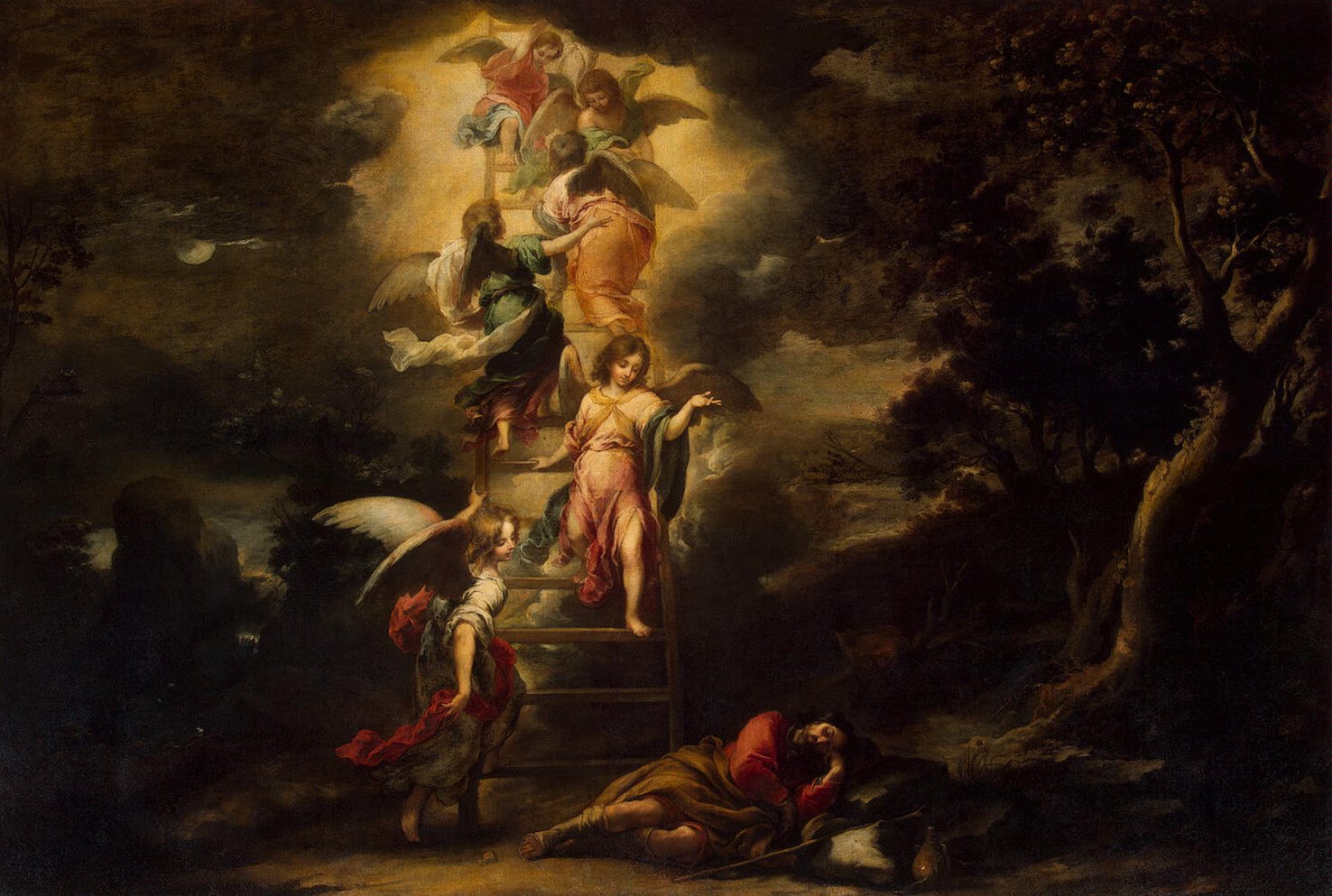
The visual below parallel to Ibn Masarra’s ‘Rope of the Ever-Upright‘: the solitary soul, having fled the world, becomes the meeting point of Heaven and Earth. The ladder is not built by human hands; it is revealed by Grace to those who surrender. Note how Murillo places Jacob in humble repose on the bare earth, while the divine light pierces the darkness above—the same vertical axis described by both the Andalusian mystic and the German theosopher.
‘And he dreamed, and behold a ladder set up on the earth, and the top of it reached to heaven: and behold the angels of God ascending and descending on it‘. — Genesis 28:12.
The Parallel:
- Ibn Masarra: ‘Fleeing to God is to cling to His rope, which is ever-upright and enduring… God Almighty guarantees its protection’.
- Boehme: ‘The Lord stands above on this Ladder… He will not leave them’.
- Insight: Both mystics agree: The path is vertical, the struggle is real (‘Cross and Tribulation’ / ‘Fleeing when guides vanish’), but the Divine Presence at the summit is guaranteed.
2. The Visual Confirmation:
The Mutus Liber
This textual convergence finds its most striking visual expression in the Mutus Liber (‘The Mute Book’), a 17th-century French alchemical text published in La Rochelle in 1677. Allegedly authored by ‘Altus‘, this book contains only 15 engravings, intending to teach the ‘Great Work‘ of spiritual transformation without words.
Plate 1:
The Ascent Begins The opening plate depicts Jacob’s Dream explicitly.
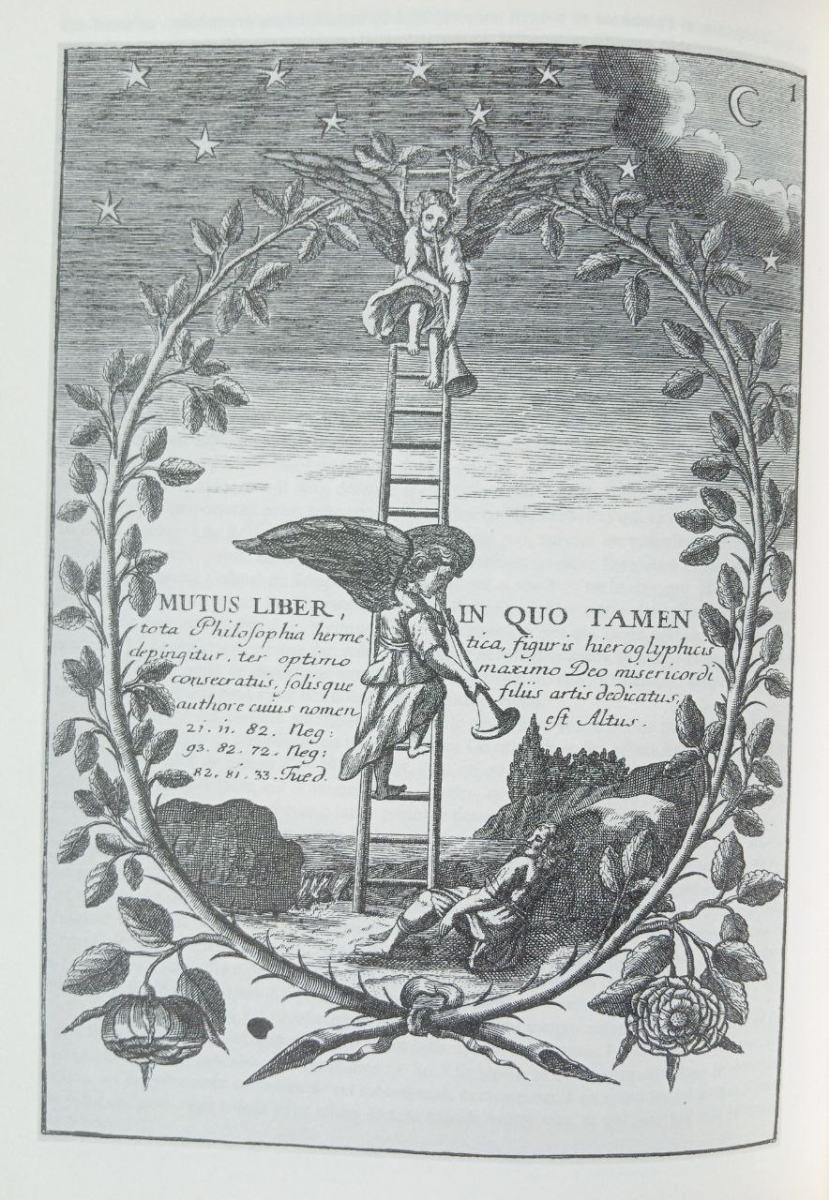
- The Image: A ladder stretches from the dark earth to the starry heavens. An angel climbs down, while another figure sits at the very top, near the moon and stars. Below, a man sleeps on a stone, while two figures pray.
- The Connection: This is the exact visual counterpart to Ibn Masarra’s ‘solitary figure‘ and Boehme’s ‘Children of God’. The sleeper on the stone represents the soul asleep in the world, unaware of the vertical path opening above them. The ladder is the Axis Mundi—the only connection between the mundane and the Divine.
Plate 15:
The Work Completed The final plate shows the culmination of the journey.
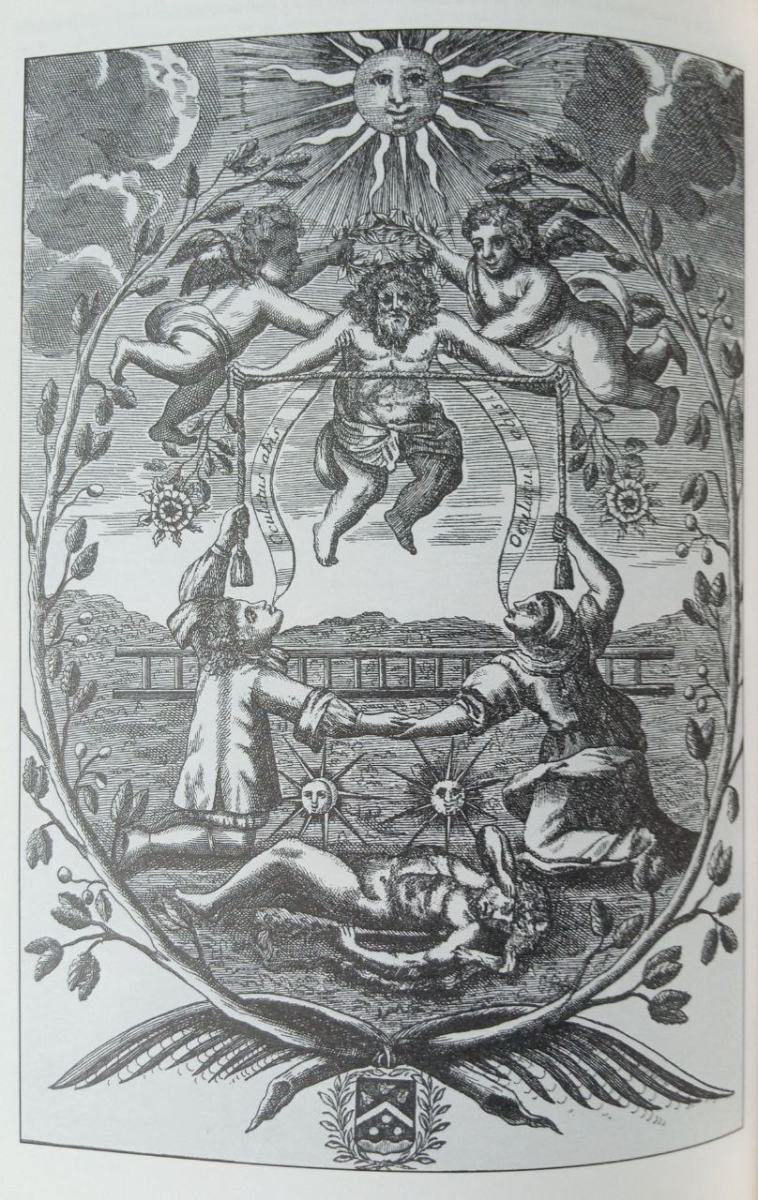
- The Image: The ‘dead‘ matter (the soul) is resurrected and glorified. The sun and moon shine together, symbolizing the union of opposites. The figures who were once kneeling in prayer now stand in triumph.
- The Connection: This mirrors Ibn Masarra’s promise: ‘When your Master sees you standing in His hands… He extends His help to you. Things that are difficult and arduous for others are made easy for you. And you attain great stations’. It also reflects Boehme’s promise that the seeker’s fruit shall ‘green like dust upon the earth’.
The Alchemical Insight: In alchemy, the ladder represents the stages of purification (calcination, dissolution, coagulation) required to transform the ‘lead‘ of the ego into the ‘gold‘ of the Divine Self.
- Ibn Masarra calls this process ‘purifying the fiṭra from the dirt and filth of the world’.
- Boehme calls it ‘ascending through much Cross and Tribulation’.
- The Mutus Liber shows it as the Opus Magnum (Great Work).
The Universal Truth: Whether called Fleeing to God, Following Christ, or The Great Work, the path is identical: a vertical ascent through purification, guided by a Divine Light that descends to meet the seeker.
3. The Axis Mundi: Rope, Ladder, and Qutb
In comparative mythology and mysticism, this vertical symbol is known as the Axis Mundi (the World Axis). It is the central pillar that connects the earthly realm (dunyā) with the Divine Realm (malakūt).
- In Sufi Cosmology: This axis is often associated with the Qutb (the Pole). The Qutb is the spiritual center of the age, the ‘Perfect Human’ (al-Insān al-Kāmil) who acts as the living conduit of Divine grace. When Ibn Masarra writes that ‘guides have departed’, he is lamenting the absence of visible Qutbs, urging the seeker to cling directly to the invisible Axis—the Divine Rope itself.
- In Christian Theosophy: For Boehme, the ladder is Christ Himself, the mediator who bridges the gap between the ‘corrupted Adamic nature‘ and the ‘Kingdom of God’.
- In Hermeticism: The Mutus Liber presents the ladder as the process of alchemical transmutation, where the seeker must “die to the world” (sleep on the stone) to awaken to the celestial light.
The Final Insight: The lamps are different, but the Light is the same.
- Ibn Masarra offers the Rope (Ḥabl Allāh)—a call to Tawḥīd (Unity).
- Boehme offers the Ladder—a call to Theosis (Union).
- The Mutus Liber offers the Work—a call to Transformation.
All three invite the reader to become a ‘Solitary Seeker‘: one who, seeing the vanity of the illuminated cities of the world, chooses instead the narrow, vertical path of light that leads Home.
‘The lamps are different, but the Light is the same.
It comes from beyond’.
— Jalāl al-Dīn Rūmī.

***



Related Articles


Leave a Reply