
Circle of Transmission: The Living Loom
A Little Dr. Auguste-Edouard Chauvet Sampler – Part 2: From ‘L’Esotérisme de la Genèse’-Chapter 1-‘Revelation and Primitive Traditions’ (The Opening Part)

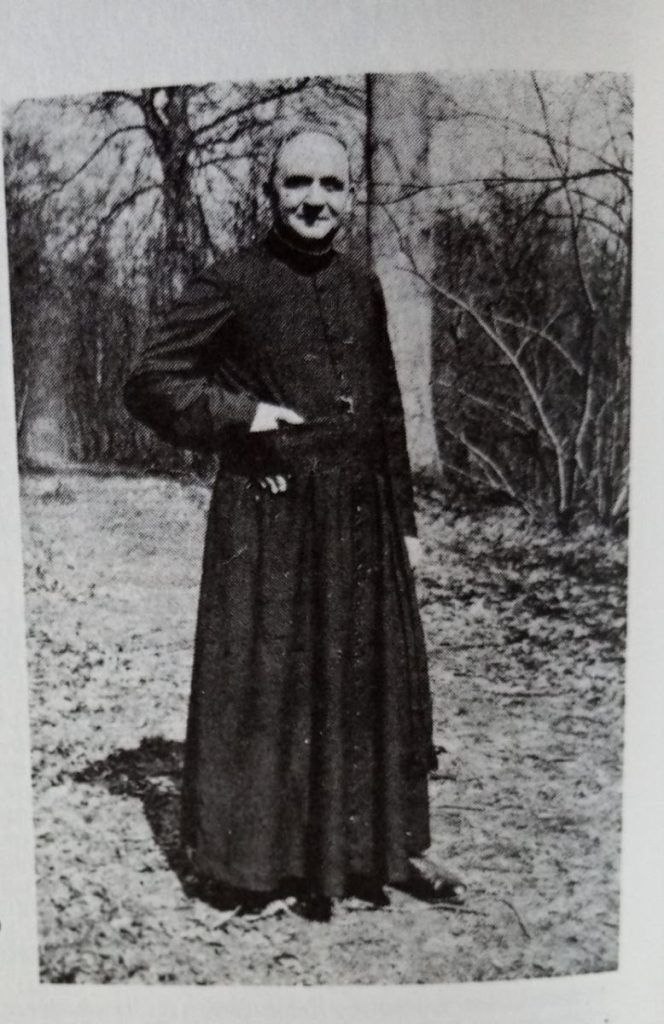
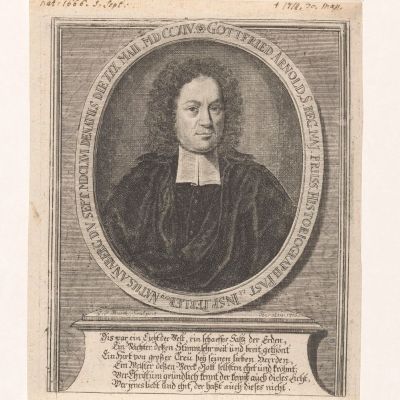
Portrait of Dr. Auguste-Edouard Chauvet, a.k.a. ‘Dr Saïr‘
A picture in Robert Amadou’s publication,
‘Le Graal en Compagnie au XXe siècle.’ Cariscript 1987.
*
Today’s sharing from the Blue House of Via-HYGEIA is the second installment of a planned few in memory of Doctor Auguste-Edouard Chauvet and of his masterpiece, ‘L’Esotérisme de la Genèse’. Our excerpts are two-fold: The first one is the foreword to volume 1 by ‘Jean Saïridès’, a.k.a. Abbé Eugène Bertaud, the faithful disciple; and the second offering is the beginning of volume 1-chapter 1, ‘Révélation et traditions primitives’. From page 5 to 8 and from page 13 to 20.
The foreword by Jean Saïridès (Abbé Eugène Bertaud) serves as a passionate defense of Dr. Chauvet’s methodology, framing the work as the recovery of a lost ‘Secret Science‘ accessible only to initiates. Saïridès argues that the apparent contradictions in the literal text of Genesis—such as the conflicting creation timelines and the mystery of Cain’s fear—are not errors, but rather deliberate cryptographic veils. He posits that Chauvet has successfully rediscovered the key to these hieroglyphic Hebrew roots, distinguishing between divine ‘creation’ (Baroa) and material ‘effectuation’ (Ghashoah), thereby reconciling ancient scripture with logical coherence and even modern scientific insight.
Following this introduction, the excerpt from Chapter 1, ‘Revelation and Primitive Traditions,’ establishes the philosophical groundwork for Dr. Chauvet’s entire thesis. Here, the author asserts the existence of a ‘primitive orthodox’ tradition—a pure, primordial revelation underlying all major sacred texts, from the Vedas to the Bible. Chauvet critiques previous esotericists like Fabre d’Olivet and Saint-Yves d’Alveydre for allowing personal philosophy to cloud their interpretations, arguing instead for a rigorous, analytical return to the text itself. He defines true Revelation not as a product of human religious evolution, but as a divine memory inherent in the human soul, obscured by materialism but recoverable through the specific esoteric lens he intends to apply to the Bereshith.
Coming soon: A Little Auguste-Edouard Chauvet Sampler – Part 3. This next installment will present the continuation and conclusion of Chapter 1 (‘Revelation and Primitive Traditions’), focusing essentially on the author’s analysis of the Vedas.
**
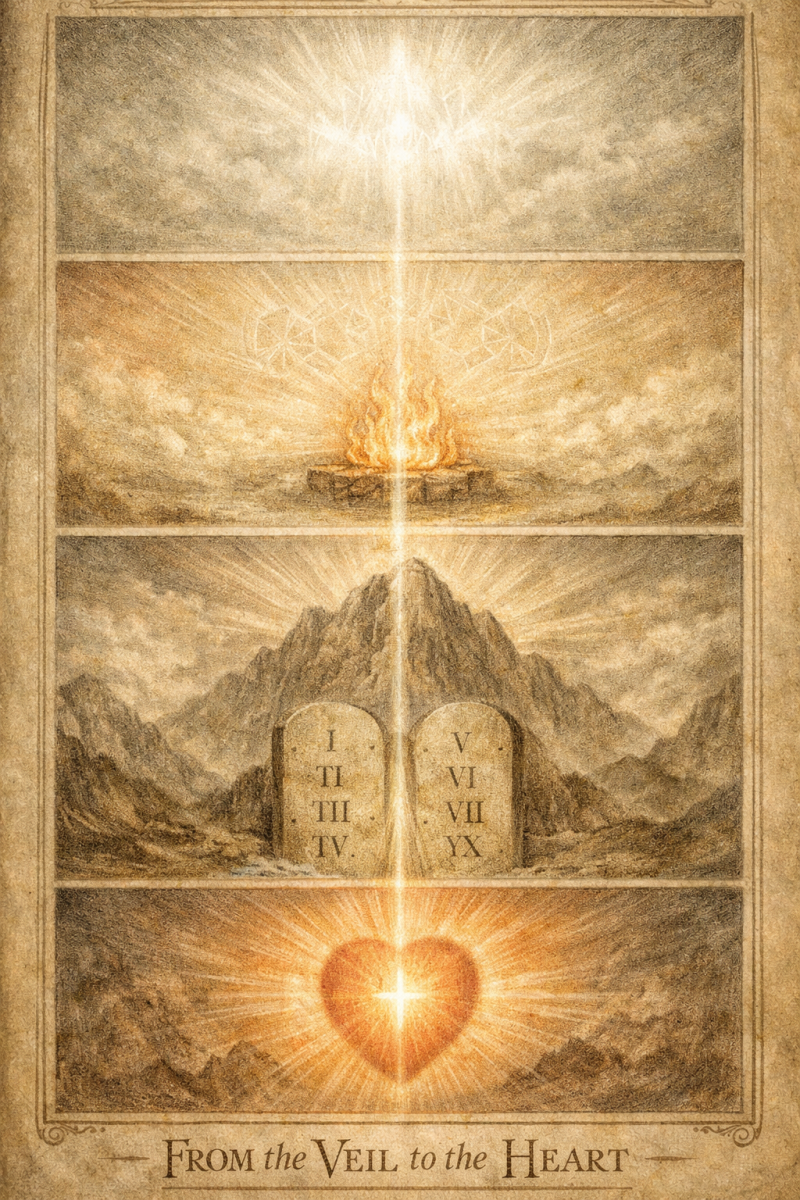
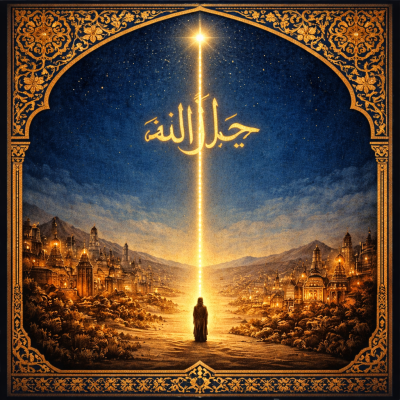
A Hermeneutic Ekphrasis
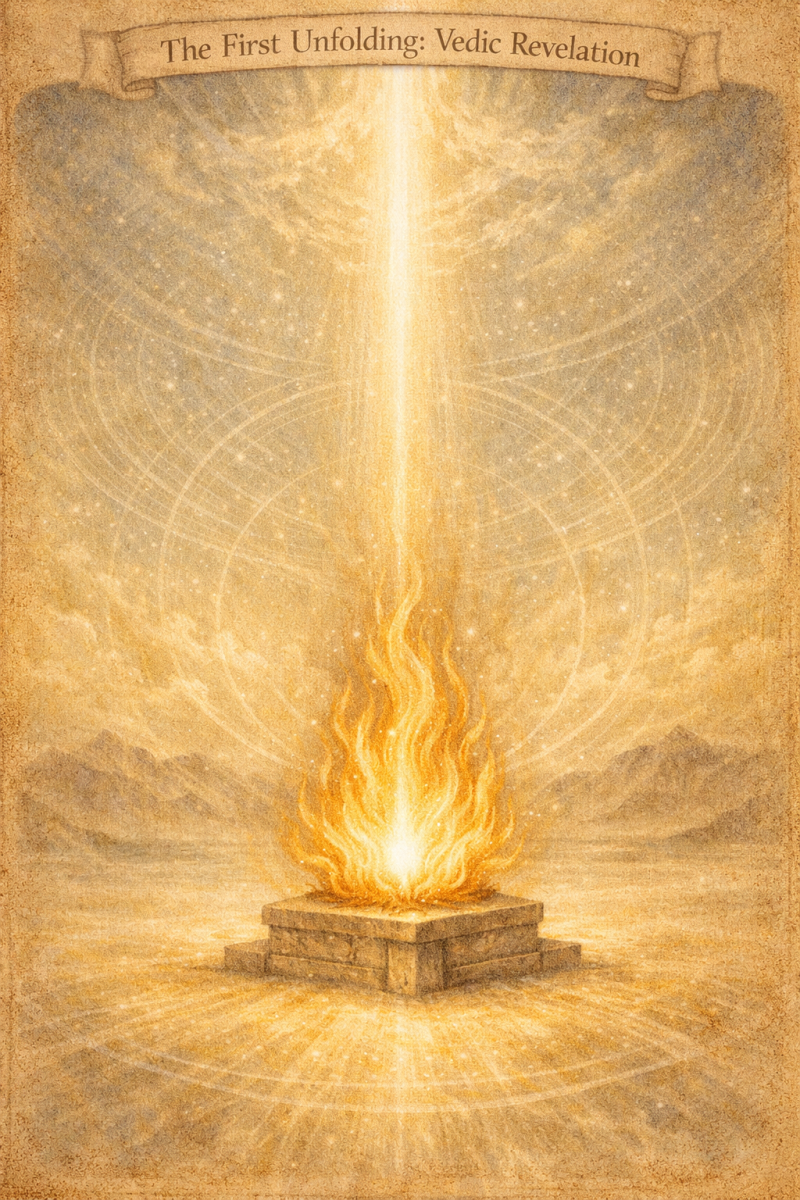
The following reflection serves as an hermeneutic commentary on the accompanying image, ‘From the Veil to the Heart.‘ It traces the descent of primordial Revelation through its Vedic, Mosaic, and Christian expressions, revealing them not as separate historical events, but as unified stages of a single divine manifestation:
From the unseen Source, a single light descends and unfolds across distinct yet continuous planes, expressing one primordial Revelation through successive modes of manifestation. The image is structured in four layers, not as separations, but as degrees of condensation of the same presence.
At the highest level, the light remains veiled in its unity—beyond form, beyond differentiation. Below, it begins to expand into the cosmic register: this is the Vedic moment, where revelation diffuses into the vastness of the world, still unbounded, still resonant, apprehended through rhythm and fire.
Further down, the same light gathers and takes on structure: this is the Mosaic moment, where revelation becomes oriented, delimited, and inscribed as Law. The movement is no longer expansion, but alignment—establishing a clear axis between the divine and the human.
At the lowest level, the light enters interiority: this is the Christian moment, where revelation is no longer only received from without, but awakened within the heart. What was cosmic and external becomes intimate and living.
Two readings traverse the whole. Exoterically, these appear as successive historical forms. Esoterically, they reveal a single, continuous descent of light—present at every level, but progressively unveiled, until it becomes fully conscious at the center of the being.
*
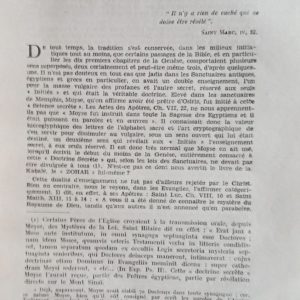
Jean Saïridès’s Foreword
“There is nothing hidden that shall not be revealed.” — Saint Mark, IV, 22.
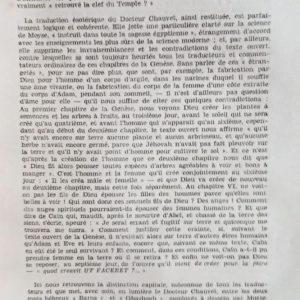
From time immemorial, tradition has been preserved – at least in initiatory circles – that certain passages of the Bible, and particularly the first ten chapters of Genesis, contain several superimposed meanings: two certainly, and perhaps even three, according to some. There is no doubt, in any case, that in the ancient sanctuaries, especially those of Egypt and Greece, a twofold teaching existed: one for the vulgar masses of the uninitiated, and another, secret one, reserved for the ‘Initiates‘ alone, which was the true doctrine. Moses, raised in the sanctuaries of Memphis and said to have been a priest of Osiris, was initiated into this ‘Secret Science‘. Do not the Acts of the Apostles, chapter VII, verse 22, tell us that ‘Moses was instructed in all the wisdom of the Egyptians, and he was mighty in words and deeds‘? He therefore knew the hieroglyphic value of the letters of the sacred alphabet and the cryptographic art of using them to conceal from the vulgar, beneath an open sense intended for them, a second sense that revealed to the “Initiates” the secret teaching reserved for them alone. It is therefore entirely natural that Moses used this method when he wrote at least the beginning of Genesis, which is wholly devoted to that ‘Secret Doctrine‘ which, according to the laws of the Sanctuaries, was not to be divulged to everyone (¹). Is this not what the book of Kabbalah, the Zohar itself, warns us about?
This duality of teaching was not rejected by Christ. Quite the contrary, we see Him affirming it categorically in the Gospels. Indeed, He says to His Apostles: Saint Luke, chapter VIII, verse 10, and Saint Matthew XIII, verses 11–14: ‘To you it is given to know the mystery of the Kingdom of God; but to others it is announced only in parables, so that seeing, they may not see, and hearing, they may not understand.” For them the prophecy of Isaiah is fulfilled: “You shall hear with your ears and shall not understand; you shall see with your eyes and shall not see‘. And Saint Mark, IV, 12, even affirms that Christ speaks to the crowds in parables ‘so that (ut videntes… etc.) seeing with their eyes, they may not see, and hearing with their ears, they may not understand; lest they should convert and obtain forgiveness of their sins.” It seems very difficult to admit that Christ could have uttered such words; therefore we believe, with certain critics, that the Greek negative “οὐ” must have been omitted in the copy of the first manuscript, and the meaning would be: “I speak to them in parables so that they may not understand, lest they should convert and should obtain forgiveness of their sins (by refusing to believe a doctrine that surpasses them)’.
For his part, Saint Paul, the great Initiate, declares to us: ‘And I, brethren, could not speak to you as unto spiritual, but as unto carnal, even as unto babes in Christ. I have fed you with milk, not with meat; for you were not able to bear it, neither yet now are you able, because you are still carnal‘. (1 Corinthians III, 1–3 – cf. Hebrews V, 12–14). And this ‘solid food‘ is ‘the wisdom of God, mysterious and hidden‘ (1 Corinthians II, 7). This is what he calls four times in his epistles ‘super-knowledge, epignosis‘ (ἐπίγνωσις): Romans X, 3; Philippians I, 9; Colossians I, 10; 2 Timothy III, 7 – to distinguish it clearly from what he elsewhere calls simple knowledge, science, gnosis (γνῶσις). Does he not say, on the other hand, in 2 Corinthians III, 14–15, that ‘a veil has been laid by Moses over the Old Testament and that this same veil remains, because it is in Christ that the veil is taken away; that this veil will be removed only when hearts turn to the Lord. Now the Lord is the Spirit, and where the Spirit is, there is liberty’. Saint Denis the Areopagite specified that there were two theological doctrines: one hidden and mysterious, the other more well-known (Epistle IX, § II). Saint Clement of Alexandria declared: ‘Do not cause the source of the ancient traditions to gush forth before everyone‘ (‘Stromata’, Book I, chapters X and XII); and Saint Irenaeus tells us that there are in Christianity mysteries too high to be revealed to the people, which were taught only to the perfect – ‘quos seorsim et latenter a reliquis perfectos docebant‘ (‘Against Heresies’, Book III, chapter 3). And is it not to this custom that the famous ‘Discipline of the Secret‘ of the early centuries refers, before the loss of esotericism?
Just as Christ spoke to the crowds in parables and reserved the secret of the Kingdom of God for those who were called to know it; just as Saint Paul gave only milk to drink to those who were carnal, and not the solid food intended for the spiritual alone; so Moses, in accordance with the millennial tradition of the sacred Sanctuaries, in the essentially dogmatic passages of Genesis, likewise has a twofold teaching: one open to all, the external sense, and the other within the reach of initiates alone, the esoteric sense – the latter hidden beneath the former and written according to a sacred and secret cryptography based on the ideographic and hieroglyphic meaning of the Hebrew letters.
It is the great merit of Dr. Chauvet that, after long research and in the light (it is true) of the attempts of his less fortunate predecessors, he has succeeded in reconstructing this “sacred cryptography”, in recovering the secret value of the Hebrew letters, and in restoring the true meaning of the words they compose within the open text. Despite no doubt some errors of detail, almost inevitable in such a work, he seems truly to have erected a solid edifice, as scientific as it is good-faith, and of immense reach. Is it not troubling, at the very least – and is it not, as it were, a factual proof, a ‘pragmatic sanction‘, so to speak (without punning) – that thanks to this cryptography which he has rediscovered and whose secrets and rules he reveals to us in the introduction of his work, throughout these first ten chapters of Genesis, without making the slightest distortion, without indulging in any fanciful acrobatics of interpretation, he has been able to establish a coherent meaning in perfect conformity with the sound primitive Judeo-Christian tradition? And is it not a singular counter-test that this ‘success‘ proves impossible in the non-initial passages which do not contain a double meaning? Are we not entitled to affirm, in such a case, that the author has truly, in the customary expression, ‘found the key of the Temple‘?
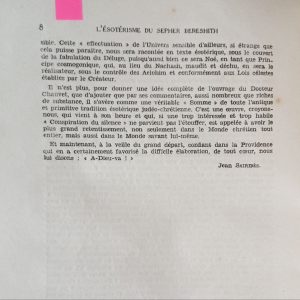
Dr. Chauvet’s esoteric translation, thus restored, is perfectly logical and coherent. It sheds a particular light on the science of Moses, ‘instructed in all the wisdom of the Egyptians‘, strangely in agreement with the surest teachings of modern science; and, moreover, it eliminates the implausibilities and contradictions of the open text against which all ordinary translators and commentators of these chapters of Genesis have always stumbled. Not to mention those ‘oddities‘, not to say worse, such as, for example, God’s fashioning for man a body of clay into whose nostrils He breathes a living soul, or the making of woman’s body from a rib taken from Adam’s body while he slept – it is not a question of loss – let it suffice to cite a few contradictions: In the first chapter of Genesis, we see God creating seed-bearing plants and fruit trees on the third day, before the sun which will only be created on the fourth, and before man who appears only on the sixth; whereas at the beginning of the second chapter, the open text asserts that ‘there was still no plant and no shrub on the earth, and no herb had yet germinated, because Jehovah had not caused it to rain upon the earth and there was no man to till the ground‘. And it is only after the creation of man that this second chapter tells us that ‘God then made all kinds of trees grow, pleasant to see and good to eat‘. It is man and woman that He creates jointly on the sixth day: ‘Male and female He created them‘ – and yet God will create them again in the second chapter, but this time separately. In chapter VI, do we not see the sons of God marrying the daughters of men because they are beautiful to behold? Who then are these sensual sons of God? Angels! How could spiritual angels marry human women? And what of Cain, who, cursed after the murder of Abel and driven out of the land of his kin, cries out in fear: ‘I shall be a wanderer and a fugitive on the earth, and whoever finds me will kill me‘. How to justify this fear if, according to the open text of Genesis, there existed on earth no other human beings than Adam and Eve and their children – even though, according to the same text, Cain would be the sole survivor? And how, under these conditions, could Cain have taken a wife in the land where he withdrew? And finally, do we not see God resting on the seventh day from the work He had just created to make – ‘quod creavit UT FACERET?...’
Here we find the capital distinction, overlooked by all translators, which Dr. Chauvet carefully highlights: between the two Hebrew words Baroa and Ghashoah used by Moses. Baroa means ‘to create‘ in the theological sense of that word, and Ghashoah means simply ‘to effect, to realize‘. For indeed, the ‘creation‘ of the World took place in two distinct stages. First, the WORD of God creates (baroa) His Effectuating Powers, the Aelohim, to whom He communicates His creative plan; then the Principles and the Substances which these Aelohim must use, with the help of the primordial Adam and the Nachash (the serpent of Genesis) – also created by God – to effect (ghashoah), in accordance with the Celestial Laws (Shamaim), at the time marked by Providence, the World of the sensible Universe. This ‘effectuation‘ of the sensible Universe, moreover – strange as it may seem – will be told to us in esoteric text under the guise of the fable of the Deluge, since now it is Noah, as a cosmogonic Principle, who (in place of the Nachash, cursed and fallen) will be the realization of it, under the control of the Aelohim and in accordance with the celestial laws established by the Creator.
To give a complete idea of Dr. Chauvet’s work, it remains only to add that through his commentaries – as numerous as they are rich in substance – it proves to be a veritable ‘Summa‘ of the entire ancient and primitive Judeo-Christian esoteric tradition. It is a work, we believe, that comes at the right time and which, if a too self-interested and too clever ‘Conspiracy of Silence‘ does not succeed in stifling it, is destined to have the greatest impact, not only in the entire Christian world, but also in the scholarly world itself.
And now, on the eve of the great departure, trusting in Providence which has certainly favoured its difficult elaboration, we say to it with all our heart: ‘A-Dieu-va!‘ [A play on words: ‘Go with God‘ / ‘It is in God’s hands‘]
Jean Saïridès.
*
Notes for the foreword
(¹) Certain Church Fathers believed in the oral transmission, since Moses, of the Mysteries of the Law. Saint Hilary says indeed: ‘Erat jam a Mose ante institutum, in omni synagoga septuaginta esse Doctores; nam idem Moses, quamvis veteris Testamenti verba in litteris condidisset, tamen separatum quoddam ex occultis Legis secretoria mysteria septuaginta senioribus, qui Doctores deinceps manerent, intimaverat: cujus doctrinae etiam Dominus in Evangelii meminit dicens: super cathedram Moysi sederunt’, etc. (In Exp. Ps. II). This ‘secret doctrine‘ Moses would have received partly from the Egyptian priests, partly by direct revelation on Mount Sinai.
(‘Already, before, Moses had established 70 Doctors of the Law in every synagogue; for this same Moses, although he had consigned the words of the Old Testament to writing, nevertheless had separately entrusted the more secret mysteries of the Law to 70 elders, so that they might thereafter be ‘Doctors’. The Lord Himself remembered this doctrine when He said: ‘They sit on the chair of Moses’, etc‘ – Quoted by Paul Vulliaud, in ‘La Kabbale Juive’, Vol. II, p. 180.)
*
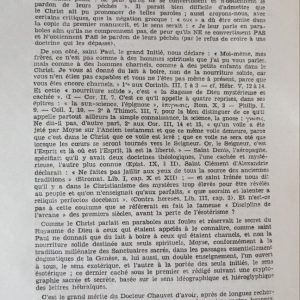
Dr. Auguste-Edouard Chauvet
‘L’Esotérisme de la Genèse’, Chapter 1:
‘Revelation and Primitive Traditions’
(The Opening Part)
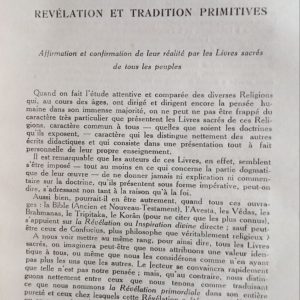
Affirmation and confirmation of their reality by the Sacred Books of all peoples
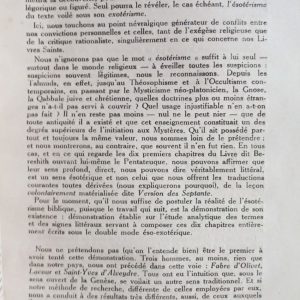
When one makes a careful and comparative study of the various religions which, over the course of the ages, have guided and still guide the immense majority of human thought, one cannot but be struck by the very particular character presented by the Sacred Books of these religions – a character common to all, regardless of the doctrines they expound – a character that clearly distinguishes them from other didactic writings and consists in a wholly personal presentation of their own teaching.
It is remarkable that the authors of these Books seem to have imposed upon themselves – at least as regards the dogmatic part of their work – never to give any explanation or commentary on the doctrine, which they present in an imperative form, one might say, addressing themselves not so much to reason as to faith.
Indeed, could it be otherwise, when all these works: the Bible (Old and New Testament), the Avesta, the Vedas, the Brahmanas, the Tripitaka, the Qur’an (to mention only the best known), rest upon direct Revelation or Divine Inspiration; except perhaps those of Confucius, who is more a philosopher than truly religious?
By thus placing, as it were, all the Sacred Books on the same level, one might imagine that we attribute an identical value to all, or even that we consider them as having no more value one than another. The reader will quickly convince himself that such is not our thought; but that, on the contrary, we clearly distinguish between those which we hold as translating what we call primordial Revelation in its complete purity, and those in which this Revelation has been, either completely or in greater or lesser proportion, soiled and disfigured by foreign additions.
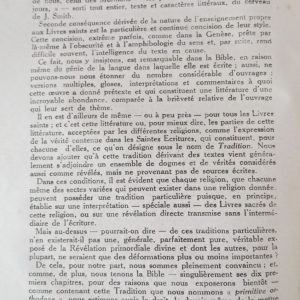
As a first consequence of the postulate of Revelation as the original source of the Sacred Books and of their teaching, it is evidently necessary that only Revelation can justify both that teaching and its particular mode. That is why we see even those who are undeniably apocryphal works claiming it: the so-called Books of Thoth, for example; those of the Gnostics; or, closer to us, that of the Mormons – the pretended ‘Latter-day Saints‘ – produced entirely, text and literal characters, from the brain of J. Smith.
A second consequence derived from the nature of the teaching proper to the Holy Books is the particular and continuous conciseness of their style. This conciseness, sometimes extreme – as in Genesis – lends itself thereby to obscurity and ambiguity of meaning and, consequently, often makes the understanding of the text in question difficult.
This fact, we insist, is remarkable in the Bible, by reason of the very genius of the language in which it is written; hence we cannot be astonished at the considerable number of works – multiple versions, glosses, interpretations, and commentaries – to which this work has given rise and which constitute a literature of incredible abundance, compared to the relative brevity of the work that serves as their theme.
It is the same – or nearly so – for all the Holy Books; and it is this literature, or rather the parts of this literature accepted by the different religions as the expression of the truth contained in the Holy Scriptures, which constitute, for each of them, what is designated by the name of Tradition. We must add that to this tradition derived from the texts there generally joins a body of dogmas and truths also considered as revealed, but not coming from written sources.
In these conditions, it is evident that each religion, and even each of the various sects that may exist within a given religion, can possess a particular tradition since, in principle, it is based on an interpretation – also special – of the Sacred Books of that religion, or on a direct revelation transmitted without the intermediary of writing.
But above – so to speak – these particular traditions, would there not exist a general one, perfectly pure, a true exposition of the primordial divine Revelation, of which the others, for the most part, would be only more or less significant deformations?
For our part, we are fully convinced of this; and, since moreover we hold the Bible – particularly its first ten chapters, for reasons we shall soon explain – as containing this Tradition which we call ‘primitive orthodox‘, we deem ourselves to have the right, even the duty, to bring it to light. To bring it to light, indeed. For, as extraordinary as it may seem to many, this Tradition is far from always being fully illuminated by the meaning commonly attributed to the biblical text. Moreover, the very considerable number, already mentioned, of commentators, exegetes, apologists who have devoted themselves to this research, is a guarantee of what we assert.
But this should not astonish anyone who knows the mode of ancient traditional teaching and the wholly special nature of the books that contain it; no more than it will astonish this affirmation: that the literal open sense of an ancient Sacred Book containing an exposition – however fragmentary – of pure Tradition will never permit its discovery, even if one pushes that sense to the furthest limits of the allegorical or figurative. Only the esotericism of the text, veiled beneath its exteriority, can reveal it, if occasion arises.
Here we touch upon the sensitive point that generates conflicts between our personal convictions and those of both religious exegesis and rationalist criticism, particularly with regard to our Holy Books.
We are not unaware that the word “esotericism” alone suffices – especially in religious circles – to arouse all suspicions: suspicions often legitimate, we admit. From the Talmuds, indeed, to contemporary Theosophism and Occultism, passing through Neoplatonic Mysticism, Gnosis, Jewish and Christian Kabbalah – what more or less strange doctrines has it not served to cover? What unjustifiable use has been made of it? It remains nonetheless – no one can deny it – that from the most remote antiquity it has existed and that this teaching constituted one of the higher degrees of initiation into the Mysteries. That it possessed the same value everywhere and always, we are far from claiming; and we shall show, on the contrary, that often this was not the case. In any event, and with regard to the first ten chapters of the Book called Bereshith which itself opens the Pentateuch, we can affirm that their profound, direct – we might say truly literal – sense is an esoteric sense, and not that offered by the current translations, all derived (we shall explain why) from the deliberately materialized recension known as the Septuagint Version.
For the moment, let it suffice to postulate the reality of biblical esotericism, since the work that follows is the demonstration of its existence: a demonstration established upon the analytical study of the terms and literal signs used to compose these ten chapters, written entirely in the double eso-exoteric mode.
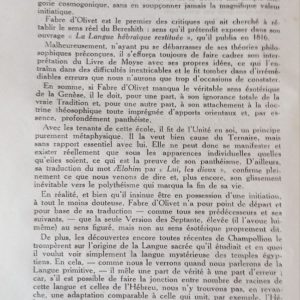
We do not claim (let it be well understood) to be the first to have attempted this demonstration. Three men, at least, in our country alone, preceded us in this path: Fabre d’Olivet, Lacour, and Saint-Yves d’Alveydre. All had the intuition that beneath the open sense of Genesis veiled another traditional sense. And if our method of research, different from those employed by them, has led us to very different results from those they themselves attained, it is only strict justice on our part to recognize that their works – at least as regards the first and the last – have often been useful to us.
This is beyond doubt regarding Saint-Yves d’Alveydre, that very great Christian who was kind enough to be for us not only a master but a friend; for it was he who opened the way for us and guided our first steps. We are happy to render to his venerated memory the respectful and grateful homage we owe him.
We shall say nothing of Lacour who, imbued with encyclopedic ideas and certainly sharing those of Dupuis, in his book entitled ‘Eloïm ou les Dieux de Moïse’ makes of Genesis a simple cosmogonic allegory, never suspecting its magnificent initiatory value.
Fabre d’Olivet is the first of the critics who sought to restore the real meaning of the Bereshith: a meaning he claimed to expound in his work ‘La Langue hébraïque restituée’, published in 1816.
Unfortunately, unable to rid himself of his preconceived philosophical theories, he always strove to make his interpretation of the Book of Moses fit his own ideas, which leads him into inextricable difficulties and made him fall into irretrievable errors that we shall have only too many occasions to note.
In short, if Fabre d’Olivet missed the true esoteric sense of Genesis, he owes it partly to his total ignorance of the true Tradition and partly to his attachment to theosophical doctrine, thoroughly impregnated with oriental contributions and, by its essence, deeply pantheistic.
With the adherents of that school, he made Unity-in-itself a purely metaphysical principle. He wishes it indeed to be the cause of the Ternary, but without essential relation to it. It can therefore manifest and really exist only under individual appearances, whatever they may be, which is the proof of his pantheism. Moreover, his translation of the word Elohim by “Him, the gods” fully confirms what we have just said, and even more so his inevitable slide towards the polytheism that marked the end of his life.
In reality, and although he insinuates that he is in possession of an initiation (at the very least doubtful), Fabre d’Olivet has as his starting point and basis for his translation – like all his predecessors and followers – only the Septuagint Version, raised (he admits it himself) to the figurative sense, but not to the properly esoteric sense.
Moreover, the then very recent discoveries of Champollion misled him as to the origin of the Sacred Language he was studying, in which he wished to see simply the mysterious language of the Egyptian temples. In this – as we shall see when we speak of the Primitive Language – he mixes a part of truth with a part of error; for, if it is possible to make a connection between many roots of that language and those of Hebrew, we do not find in return an adaptation comparable to that which unites, for example, Hebrew not only to Assyrian (which cannot surprise, given the common origin of the two languages) but also, and more curiously, to Aryan Sanskrit as well as to the Celto-Nordic languages derived from Vedism.
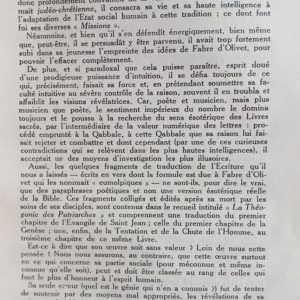
All this shows how much, in studies of this kind, it is important to free one’s mind from every preconceived idea and to hold to the sense that emerges from the text itself, however different that sense may be from the one commonly accepted (when it is not contradictory to it) and even from what one thought or wished a priori to find there.
Above all, one must beware of being taken in by mere phonetic analogies, not only valueless but often leading only to the worst errors of interpretation.
For Saint-Yves, it was not the same. Deeply Christian, therefore deeply convinced of the truth of the tradition he called Judeo-Christian, he devoted his life and his high intelligence to the adaptation of human social State to that tradition; as his various ‘Missions‘ bear witness.
Nevertheless, and although he vigorously defended himself against it, even though perhaps he persuaded himself that he had achieved it, he had too strongly undergone in his youth the imprint of Fabre d’Olivet’s ideas to be able to erase it completely.
Moreover, and as paradoxical as this may seem, a mind gifted with a prodigious power of intuition, he always mistrusted what precisely constituted his strength; and by claiming to subject his intuitive faculty to the severe control of reason, he often disturbed and weakened its revelatory visions. For, poet and musician, but more musician than poet, the imperious feeling of number always dominated him and drove him to seek the esoteric sense of the Sacred Books through the numerical value of letters – a procedure borrowed from the Kabbalah, from that Kabbalah which his reason made him reject and combat, and yet (by one of those curious contradictions found in the highest intelligences) he accepted one of its most illusory means of investigation.
Hence, the few fragments of translation of Scripture he left us – written in verse whose formula is due to Fabre d’Olivet, who called them ‘eumolpiques‘ – are, to tell the truth, only poetic paraphrases and not a real esoteric version of the Bible. These fragments, collected and edited after his death by his disciples, are contained in the collection entitled ‘La Théogonie des Patriarches’ and include a translation of the first chapter of the Gospel of Saint John; that of the first chapter of Genesis; and finally, one of the Temptation and the Fall of Man, in the third chapter of that same Book.
Does this mean that his work is without value? Far be that thought from us! We assert, on the contrary, that this work – especially as regards its social part (however misunderstood and even unknown it may be) – can and must be ranked among those that do the greatest honour to the human mind.
His only mistake (and what genius has not committed any?) was to try to support the revelations of his intuitive power by ill‑suited means – a power that amply sufficed by itself, allowing him to predict – more than ten years before 1914 – in a true prophetic vision, the seizure of Europe by America as an inevitable consequence of the anti‑Christian policy, generator of internal and external hatreds, which has caused and still causes (despite the terrible lessons of the world war) the peoples of our unhappy continent to tear each other apart.
If we cite this fact among so many others with which his work abounds, it is to justify what we said earlier about his faculty of intuition, which had sufficed to bring him to the sacred Revelation – a true supernatural compass, the sole guide of Humanity during its earthly pilgrimage; the only thing capable of bringing it back to the super‑eminent state in which it was created; the only thing capable also of leading it to intimate union with its creative Principle, without loss of its own personality, without confusion with that Principle.
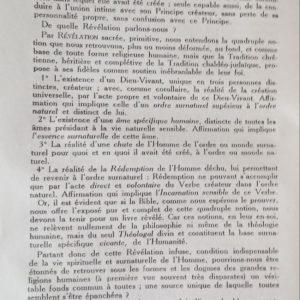
Of what Revelation do we speak?
By sacred, primitive REVELATION we mean the fourfold notion which we find, more or less deformed, at the heart and as the basis of every human religious form, but which the Christian tradition – heir and complement of the Chaldeo‑Jewish tradition – proposes to its faithful as the unshakable support of their faith:
1° The existence of a living God, unique in three distinct persons, the Creator; with, as a corollary, the reality of universal creation by the proper and voluntary act of this living God. An affirmation that implies that of a supernatural order superior to the natural order and distinct from it.
2° The existence of a specific human soul, distinct from all the souls presiding over natural sentient life. An affirmation that implies the supernatural essence of this soul.
3° The reality of a fall of Man from the supernatural order or world – for which and into which he had been created – to the natural order or world.
4° The reality of the Redemption of fallen Man, allowing him to return to the supernatural order: a Redemption that can only be accomplished by the direct and voluntary act of the creative Word in the natural order. An affirmation that implies the sensible Incarnation of that Word.
Now, it is evident that if the Bible, as we hope to prove, offers us the pure and complete exposition of this fourfold notion, we must hold it as a revealed book. For these notions, in themselves, are in no way dependent on philosophy or even on human theology, but only on the divine Theologal, and they constitute the living specific supernatural basis of Humanity.
Starting, therefore, from this infused Revelation – the indispensable condition of the spiritual and supernatural life of Man – could we be astonished to find, beneath the forms and dogmas of the great human religions (often very disparate at first glance), a true common foundation to all; a single source from which all seem to have flowed?
This source, the original centre, has generated innumerable currents opposed to one another, which have covered and enveloped, like a network of indestructible forces, the spirit of Man, from the earliest ages of the world down to the time in which we live; and it will continue, we are convinced, to exercise its empire over the terrestrial human race until the disappearance of that race. This unique source, springing forth, as it were, from living Eternity, is the intimate feeling of the existence of a unitary, living, eternal, infinite Cause; existing by itself and depending only on itself.
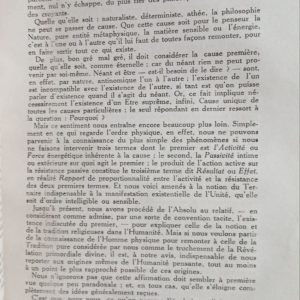
And this feeling is not the exclusive attribute of religious man alone; it belongs to all Humanity. Consciously or unconsciously, no one escapes it, from the proudest of philosophers to the humblest of believers.
Whatever it may be – naturalist, determinist, atheist – philosophy cannot do without a cause. Whether that cause is for the thinker Nature, a pure metaphysical entity, sensible matter, or energy, it must in any case go back to one or the other, to make everything that exists come forth from it.
Moreover, willy‑nilly, he must consider the first cause, whatever it is, as eternal; for from nothing, nothing can arise by itself. Nothingness and being – need it be said? – are, in fact, by nature antinomic to each other; the existence of one is incompatible with the existence of the other, if indeed one can speak of existence when it comes to nothingness. Now, this fact necessarily implies the existence of a supreme, infinite Being – the sole Cause of all particular causes; the only one that ultimately answers the question: Why?
But this feeling carries us much further still. Simply with regard to the physical order, indeed, we cannot arrive at the knowledge of the simplest phenomenon unless we bring into play three terms, of which the first is the Activity or energetic Force inherent in the cause; the second, the intimate or exterior Passivity upon which the first acts; the product of the active action upon the passive resistance constitutes the third term, called Result or Effect – in reality, a proportion‑relation between the activity and the resistance of the first two terms. And here we are led to the notion of the Ternary, indispensable to the existential manifestation of Unity, whether that Unity be of the intelligible or sensible order.
So far, we have proceeded from the Absolute to the relative – considering the existence of the former as admitted by a kind of tacit convention – in order to explain that of the notion and tradition of religion in Humanity. But if we wish to start from the knowledge of physical Man to ascend to that of pure Tradition, considered by us as the medium of primordial divine Revelation, it is, in our opinion, indispensable to go back to the very origins of thinking Humanity, at least to a point as close as possible to those origins.
We are not unaware that this affirmation may at first glance seem somewhat paradoxical; and, in any case, that it is completely removed from generally received ideas.
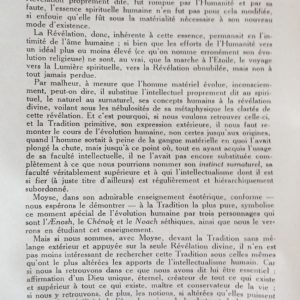
For us, what is called the religious evolution in man is, in fact, only a return to the primordial and supernatural state, an effort to re‑establish contact with the Divinity and, consequently, with the primordial Revelation that has been obscured in him for a time, following a fault imputable to the universal Adam – that is, to primitive Humanity, by nature pure spirit and in close communion with its divine Creator.
We shall return to all these points of primary importance in the course of our work, when we study them in detail in the light of the esotericism of the Bereshith. What we can say at once is that if this intimate communion which bound Man to God, human thought to divine thought, and thereby constituted Revelation properly so called, was broken by Humanity and through its fault, the human spiritual essence was not thereby modified, however buried it might be under the materiality necessary to its new mode of existence.
Revelation, therefore, inherent in this essence, remained in the intimacy of the human soul; so much so that the efforts of Humanity towards a more or less lofty ideal (what is erroneously called its religious evolution) are, in truth, only the march towards the Star, the journey towards the spiritual Light, towards the obscured but not forever lost Revelation. (To be continued…)
*
Original French:
Foreword
Revelation and Primitive Tradition
*
Source
*
Coming soon
A Little Auguste-Edouard Chauvet Sampler- Part 3:
From ‘L’Esotérisme de la Genèse‘-Chapter 1-
‘Revelation and Primitive Traditions‘,
(continuation & closing).
***

Related Articles

Leave a Reply