
Circle of Transmission: The Living Loom
‘Dilatato Corde’ (with a dilated heart): A Meditation From The Christian Monastic World

Dom Philippe Piron.
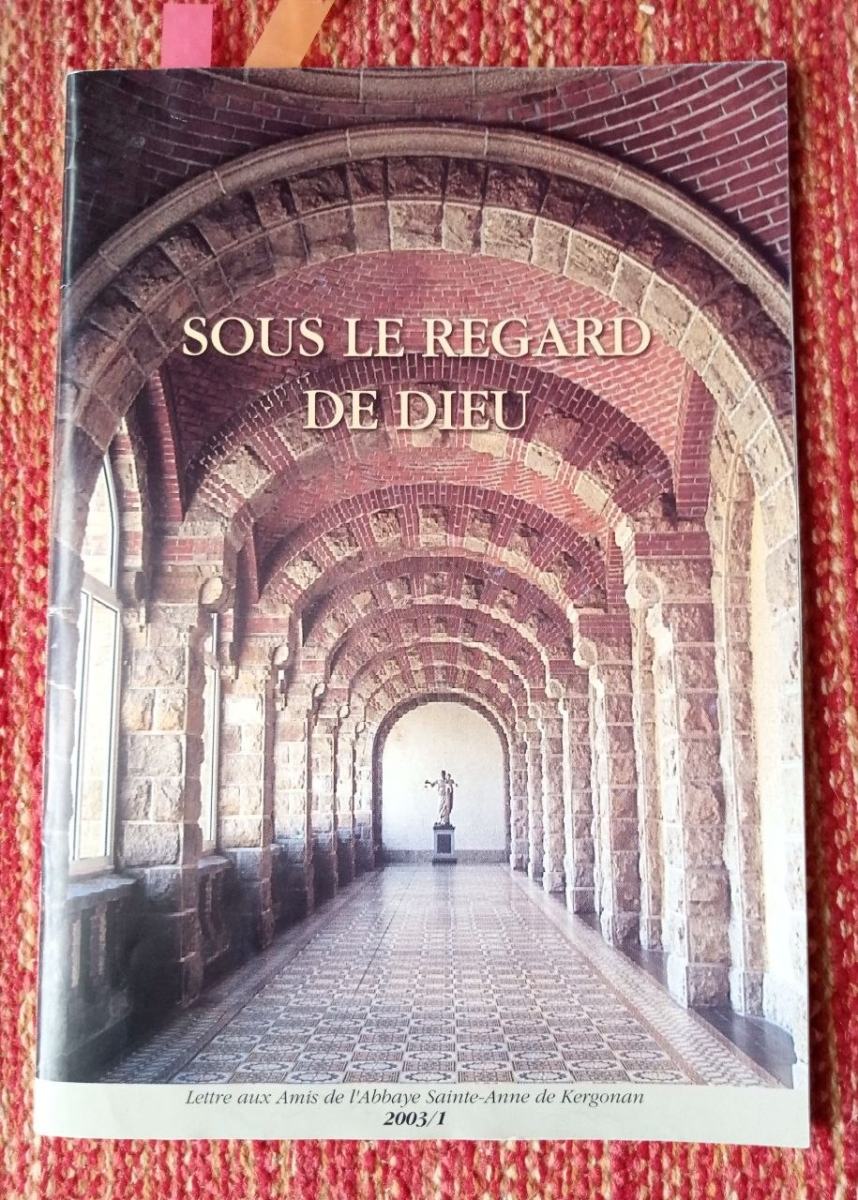
Picture at Monastery St Ann of Kergonan,
Brittany, France
*
Today’s sharing from the Blue House presents a meditative text from the Christian monastic world—Benedictine, to be precise-written by Dom Philippe Piron at the time of his election as abbot of the St Ann of Kergonan monastery. In foreword below, opening the featured following meditation, he explains the meaning of the coat of arms he chose and the motto that guided his service: ‘Dilatato Corde’ (‘with a dilated heart‘).
The text unfolds this expression through Scripture, the Rule of Saint Benedict, and the lived realities of monastic life: conversion, obedience, humility, vigilance of the heart, and the experience of suffering. What emerges is a vision of the ‘dilated heart‘ not as an expansion of the self, but as a capacity opened by grace—through which one becomes able to receive, endure, and love.
It is a vision of growth that isn’t about self-expansion in the modern sense, but about being stretched by God’s love until we have room for others, for silence, for the cross—and, finally, for true joy.
**
Foreword
It has now been a little over a year since my abbatial blessing on February 2, 2002. On that day, I promised I would speak to you about my motto, and it seems to me that the moment has come to do so.
Indeed, after my election as abbot, and according to a fine tradition still in use in our Congregation, I had to choose a coat of arms and a motto. Some might think that in our day and age this seems a bit medieval, chivalrous, or romantic. Be that as it may, it seems to me that one must know how to look more deeply.
One then understands that it is above all a matter of wanting to freely give a direction, a meaning, a general orientation to our entire life. This is not to be imprisoned by it in any way, but to establish a fundamental orientation to which it will always be possible to refer when times of crisis or storm arise—which, by all accounts, will inevitably mark the journey.
I can readily admit that, having given no prior thought to the election, the coat of arms, or the motto, it was not easy for me to make a decision in this area. So, after much hesitation and wavering which sometimes seemed interminable to me—supported, of course, as is proper, by prayer, especially to the Virgin Mary—I finally made my choice. I repeat, it was somewhat laborious!
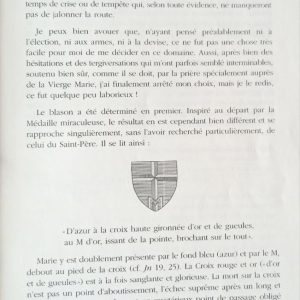
The blazon was determined first. Initially inspired by the Miraculous Medal, the result, however, is quite different and is remarkably close, without having particularly sought it, to that of the Holy Father. It reads as follows:
D’azur à la croix haute gironnée d’or et de gueules, au M d’or, issant de la pointe, brochant sur le tout.
(Azure, a high cross gyronny of Or and Gueules, an M of Or, issuing from the base, broaching over the whole).
Mary is doubly present through the blue background (azure) and through the M, standing at the foot of the cross (cf. Jn 19:25). The red and gold cross is both bloody and glorious. Death on the cross is not an endpoint, the supreme failure after a long and cruel martyrdom, but only a mysterious obligatory point of passage that leads to the light and glory of the Resurrection. It is good and even necessary to remember this at certain times in life.

Regarding the motto, I wanted it to be Marian. Several proposals were ‘running through‘ my head, but difficulties kept piling up. It had to sound good in Latin; one was too long, another too complicated, the third too commonplace, the fourth had something else wrong with it. Days and even weeks passed; it was becoming urgent to decide, and my quest seemed unlikely to succeed. I was worried and impatient at the same time.
But one evening, after having prayed especially to the Virgin for this intention, as I was returning to my cell after the office of Compline, suddenly, two little words I had never thought of before rose up to my heart and immediately won me over. Two little words from the Prologue of the Rule of Saint Benedict: ‘Dilatato Corde’ – ‘the heart dilated’. They imposed themselves, as it were. Such is therefore the motto I chose. Some might say, perhaps more accurately, such is the motto that was given to me; why not? Personally, I truly have the feeling that Mary had something to do with it.
But the motto, one might object, is not Marian. Certainly, it is Benedictine, taken from the Rule. Besides, after the Sacred Heart, is there a heart more dilated than that of the Virgin?
May the Name of the Lord be blessed!
Fr. Philippe Piron
Abbot of Sainte-Anne of Kergonan
(2002–2018)
*
DILATATO CORDE
‘Dilatato Corde’ – such is the motto I chose, or, to put it in a more modern or charismatic way, such is the motto that was given to me.
I should specify right away, for those who are not in the regular and habitual practice of the Rule of Saint Benedict, that these two little words are taken from the Prologue of the Rule, where we read (v. 49):
‘Processu vero conversationis et fidei, dilatato corde, inenarrabili dilectionis dulcedine curritur via mandatorum Dei’.
‘For as one advances in the life of conversion and in faith, the heart is dilated, and one runs the way of God’s commandments with unspeakable sweetness of love’.
Similar expressions are also found in Scripture, notably in Psalm 118 (119), verse 32: Viam mandatorum tuorum curram, quia dilatasti cor meum – ‘I will run the way of your commandments, for you have set my heart at liberty’.
In these pages, I propose to consider the place of the word ‘heart’, first in Scripture, then in the Rule of Saint Benedict, before adding a few texts and reflections on the dilation of the heart and on the difficult problem of suffering. Finally, before concluding, I will offer the testimony of Saint Gregory the Great on the power of intercession of a loving and dilated heart.
The Heart in Scripture
Words convey our ideas, translate our images, impressions, and feelings. They are our principal instruments for expressing even our most abstract thoughts, and with their help, we must attempt to explain the fruits of our experience and reflection, as well as what we sense and feel.
So it is with the word ‘heart‘, which is often used in the language of the Bible. If we consult a biblical concordance—a systematic alphabetical index of the words used in the biblical books—we find that there are more than a thousand occurrences of this word in the sacred text: exactly 1,024.
Quite rarely, however, does it designate the organ itself, the cardiac muscle. That does happen, as in verse 11 of Psalm 37 (38): Palpitat cor meum, dereliquit me virtus mea – ‘My heart throbs, my strength abandons me’.
More often it takes on multiple meanings. While for us the heart evokes little more than the affective life, for the Hebrew, the heart is the ‘interior‘ of man in a much broader sense.
In the Old Testament, the heart expresses, in a fairly classic way, the totality of the soul’s powers. If a man is miserable, it is because his heart fails him (Josh 2:11; 5:1; Ps 40:13); his heart turns over within him (Lam 1:20). In anguish, the heart pours out like water (Lam 2:19). If one does not grasp, if one does not believe, it is because the heart remains cold, inert (Gen 45:26); if one does not turn toward the Lord, it is because one has an uncircumcised heart (Jer 4:4); if one changes one’s mind, if one doubts, it is because the heart wavers (Ezek 21:20). It is the heart that grows soft, that dries up, finally that is broken (Ps 69:21).
The revelation of the prophets, from around 750 BC, brings with it religious enrichment and at the same time broadens this notion of the heart. According to the prophet Hosea (between 800 and 700 BC), God, in order to convert Israel, leads her into the desert to speak to her heart (2:16); there the New Covenant begins. Instead of being founded, like the Old Covenant, on a law—with all the rigidity that this notion can have, a law inscribed, engraved in stone, the tables of the law—this one, the New, is linked to an interior action of God upon the soul.
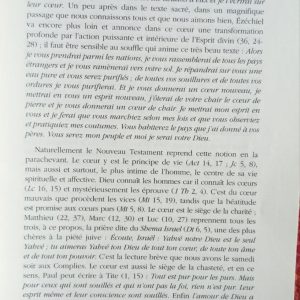
In the same movement, Jeremiah happily takes up this notion when he speaks of the New Covenant. Thus, he places these words in the mouth of the Lord (31:33): I will put my law within them, and I will write it on their heart’. A little later in the sacred text, in a magnificent passage that we all know and love, Ezekiel goes even further and announces in this heart a profound transformation through the powerful and interior action of the divine Spirit (36:24-28). We must be sensitive to the breath that animates this very beautiful text:
‘I will take you from the nations, and gather you from all the foreign lands, and bring you to your own soil. I will sprinkle clean water upon you, and you shall be clean from all your uncleannesses, and from all your idols I will cleanse you. A new heart I will give you, and a new spirit I will put within you; and I will remove from your body the heart of stone and give you a heart of flesh. I will put my spirit within you, and make you follow my statutes and be careful to observe my ordinances. You shall live in the land that I gave to your ancestors; and you shall be my people, and I will be your God’.
Naturally, the New Testament takes up this notion and brings it to completion. The heart is the principle of life (Acts 14:17; James 5:8), but also, and above all, the innermost part of man, the center of his spiritual and affective life. God knows men because he knows hearts (Luke 16:15) and mysteriously tests them (1 Thess 2:4). From the evil heart come vices (Matt 15:19), while beatitude is promised to the pure of heart (Matt 5:8).
The heart is the seat of charity; Matthew (22:37), Mark (12:30), and Luke (10:27) all three, in this regard, take up the prayer known as the Shema Israel (Deut 6:5), one of the most cherished in Jewish piety: ‘Hear, O Israel: the Lord our God, the Lord is one; you shall love the Lord your God with all your heart, and with all your soul, and with all your might’. This is the short reading we have on Saturday evening at Compline. The heart is also the seat of chastity, and in this sense Paul can write to Titus (1:15): ‘To the pure all things are pure, but to the corrupt and unbelieving nothing is pure; their very minds and consciences are corrupted’. Finally, ‘the love of God has been poured into our hearts through the Holy Spirit’ (Rom 5:5; Gal 4:6) and ‘Christ dwells in our hearts‘ (Eph 3:17).
Thus, man’s heart is the very source of his conscious, intelligent, and free personality, the place of his decisive choices and of the mysterious action of God. The heart is the place par excellence where man seeks and encounters his God—an encounter fully and mysteriously realized in the human heart of the Son of God.
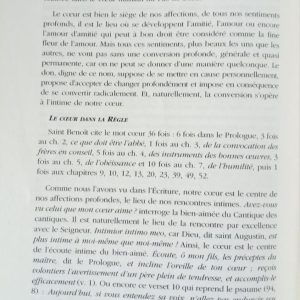
The heart is indeed the seat of our affections, of all our deep feelings; it is the place where friendship, love, or even the love of friendship—which can rightly be considered the finest flower of love—develop. But all these feelings, each more beautiful than the next, do not come about without a profound, general, and almost permanent conversion. One cannot give of oneself in just any way. Giving, worthy of the name, presupposes calling oneself into question, proposes accepting deep change, and consequently imposes radical conversion. And, naturally, conversion takes place in the intimacy of our heart.
The Heart in the Rule
Saint Benedict cites the word ‘heart‘ 36 times: 6 times in the Prologue, 3 times in chapter 2 (on the qualities of the abbot), once in chapter 3 (on calling the brothers to council), 5 times in chapter 4 (the instruments of good works), 3 times in chapter 5 (on obedience), 10 times in chapter 7 (on humility), and then once each in chapters 9, 10, 12, 13, 20, 23, 39, 49, 52.
As we have seen in Scripture, our heart is the center of our deepest affections, the place of our intimate encounters. ‘Have you seen him whom my heart loves?’ asks the beloved in the Song of Songs. It is naturally the place of the encounter par excellence with the Lord. Intimior intimò meo (‘more intimate to me than I am to myself’); for God, says Saint Augustine, is more intimate to me than I am to myself! Thus the heart is the center of intimate listening to the Beloved.
‘Listen, O my son, to the precepts of the Master’, says the Prologue, ‘and incline the ear of your heart; willingly receive the admonition of a tender father, and carry it out effectively’ (v. 1). Or again verse 10, which takes up the psalm (95:8): ‘Today, if you hear his voice, do not harden your hearts’. In passing, I emphasize: do not harden your hearts. Not hardening means, in a way, keeping one’s heart supple, making it receptive; we are not far from dilation, from dilatato.
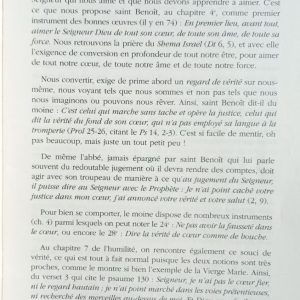
The heart is therefore the place, par excellence, for the reception of the Word (with a capital W), for an exchange and a better knowledge of the Lord who loves us and whom we must learn to love. This is what Saint Benedict proposes to us, in chapter 4, as the first instrument of good works (there are seventy-four of them): ‘In the first place, to love the Lord God with all one’s heart, all one’s soul, all one’s strength’. We find again the prayer of the Shema Israel (Deut 6:5), and with it the demand for a profound conversion of our whole being, in order to love with all our heart, all our soul, and all our strength.
To convert ourselves demands first of all a look of truth upon ourselves, seeing ourselves as we are and not as we imagine or can dream ourselves to be. Thus, Saint Benedict says of the monk: ‘This is the one who walks without stain and works justice, who speaks the truth from his heart, who has not used his tongue for deceit’ (Prologue 25-26, quoting Ps 15:2-3). It is so easy to lie – oh, not much, but just a tiny bit!
Likewise the abbot, never spared by Saint Benedict who often speaks to him of the fearsome judgment in which he will have to render an account, must act with his flock in such a way that at the judgment of the Lord he can say to the Lord with the Prophet: ‘I have not hidden your justice in my heart; I have declared your truth and your salvation’ (2:9).
To behave well, the monk has many instruments (ch. 4), among which we may note the twenty-fourth: ‘Not to harbour deceit in the heart’, or again the twenty-eighth: ‘To speak the truth from heart as well as from mouth’.
In chapter 7 on humility, we also encounter this concern for truth, which is quite normal since the two notions are very close, as the example of the Virgin Mary so well shows. Thus, verse 3 quotes Psalm 130 (131): ‘Lord, my heart is not proud, nor are my eyes haughty; I have not walked in pretentious ways, nor sought things too wonderful for me’. And God easily has proof of this since he ‘searches the kidneys and hearts’ (v. 14).
In the same sense, the fifth degree of humility is ‘to reveal to one’s abbot, by humble confession, all the evil thoughts that arise in the soul, and the faults one has committed in secret’ (v. 44). Or again this same degree, taking up the psalm (32:5): ‘I will declare my injustices to the Lord, and you have forgiven the impiety of my heart’ (v. 48).
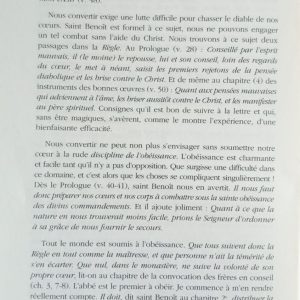
To convert ourselves demands a difficult struggle to drive the devil out of our hearts. Saint Benedict is formal on this subject: we cannot engage in such a struggle without the help of Christ. We find two passages on this in the Rule. In the Prologue (v. 28): ‘Advised by the evil spirit, he (the monk) repels him and his advice far from the sight of the heart, brings him to nothing, seizes the first shoots of diabolical thought and dashes them against Christ’. And likewise in the chapter on the instruments of good works (4:50): ‘As for the evil thoughts that arise in the soul, to dash them immediately against Christ and to reveal them to the spiritual father’. Instructions that are good to follow to the letter and which, without being magical, prove, as experience shows, to be beneficially effective.
To convert ourselves also cannot be envisioned without submitting our heart to the harsh discipline of obedience. Obedience is charming and easy as long as there is no opposition. Should a difficulty arise in this area, then things become singularly complicated! From the Prologue (v. 40-41), Saint Benedict warns us about this. We must therefore ‘prepare our hearts and our bodies to fight under the holy obedience of the divine commandments’. And he adds nicely: ‘What nature in us finds less easy, let us ask the Lord to command his grace to provide the help’.
Everyone is subject to obedience. ‘Let all therefore follow the Rule in everything as their mistress, and let no one be so rash as to depart from it. Let no one in the monastery follow the will of his own heart’, we read in the chapter on calling the brothers to council (ch. 3, 7-8). The abbot is the first to obey. I am beginning to realize this in truth. He must, says Saint Benedict in chapter 2, ‘distribute the doctrine to his disciples in two ways: showing them all that is good and holy by his works more than by his words, so that to his intelligent disciples he may proclaim the Lord’s commandments in words, while to those who are hard of heart or of simpler minds he may manifest the divine precepts by his deeds’ (ch. 2, 11-12). And Saint Benedict ends the chapter by saying: ‘Living thus in continual apprehension of the examination the shepherd will make regarding the sheep entrusted to him, the account he must render for others will make him more attentive regarding his own situation, and while he procures the amendment of others by his instructions, he will also correct his own faults’ (v. 39-40).
Obedience is without any doubt one of the most demanding asceticisms in the life of a monk, all the more so because Saint Benedict is not content with a superficial obedience of the kind ‘not seen, not caught!’ No, he asks his disciple for a deep obedience of the heart. This obedience, he says, ‘will be pleasing to God and sweet to men only if what is commanded is carried out without hesitation, without delay, without lukewarmness, without murmuring and without any word of resistance; because the obedience shown to the superior is rendered to God’ (ch. 5, 14-15). He always has a lofty view of things, which can have unsuspected consequences. Let us listen also to the passage that follows:
‘And the disciples must render obedience gladly, for ‘God loves a cheerful giver.’ For if the disciple submits grudgingly and murmurs, not only with his mouth but even in his heart, even though he fulfills the order he has received, his work will not be accepted by God, who sees in his heart the murmuring; and far from obtaining any grace for such conduct, he will rather incur the punishment of murmurers, unless he corrects himself and makes amends‘ (v. 16-19).
To convert ourselves also demands engaging in an active and constant struggle against pride, which is so natural to us, whatever we may think, by assiduously seeking humility of heart. The chapter on humility is the longest chapter of the Rule, which in itself already means something. For Saint Benedict, it is absolutely fundamental. He builds it like a ladder with twelve rungs between two uprights. The uprights represent our body and our soul, and the rungs, the twelve degrees of humility. It is, however, a very particular ladder on which one descends by self-exaltation and ascends by humility (ch. 7, 7).
This ladder thus set up is our life in this world, which the Lord raises up to heaven if our heart humbles itself (v. 8). Thus we find the great paradox of the Christian life expressed several times by Jesus in the Gospels: ‘For whoever wants to save his life will lose it, but whoever loses his life for my sake will save it.’ (Luke 9:24), or again: ‘Many who are first will be last, and the last will be first’ (Matt 19:30). Although we have been forewarned, we will surely have surprises when we get up there: ‘Truly I tell you’, Jesus says then to the chief priests and the elders of the people, ‘the tax collectors and the prostitutes are entering the kingdom of God ahead of you’ (Matt 21:31). We have often heard this saying, but, it must be admitted, we hardly believe it; we do not feel directly concerned. It is for others, for those who are not ‘good Christians’, meaning those who do not think like us. We are barely aware of our blindness in this area.
There is in each of us a foundation of pride that is almost ineradicable, against which we must struggle ardently and without respite. In our life, pride does in relief what humility does in hollow, which means we must hollow out this mass of pride to rediscover this hollow, this capacity to welcome grace, which is humility. Dilated indeed, but badly dilated by pride, one might say, our heart becomes dry, proud, taut, like a wineskin dried in smoke as the psalm says (119:83); conversely, humility and love give our heart this capacity for welcome, this openness, this dilation, while preserving its freshness and suppleness. ‘Lord, give me a liquid heart’, the Curé of Ars used to pray.
In the same vein, the son of Saint Benedict is invited to take up Psalm 130 (131), already quoted: ‘Lord, my heart is not proud, nor are my eyes haughty; I have not walked in pretentious ways, nor sought things too wonderful for me’ (ch. 7, 3), and, in a concern for truth, he must not only say with his mouth that he is the least and the lowest, but also believe it in the most intimate feeling of his heart (7th degree of humility, v. 51). A perfection that cannot be reached without much asceticism and self-renunciation, because, while it is relatively easy to say that one is the last of all, it is much more difficult to truly believe it. We will truly believe it when we accept, without reaction, without inner emotion, that our interlocutor considers us as such. Everything must be done to achieve this, and, in this sense, Saint Benedict asks the monk to manifest a humble attitude even in his outward bearing.
‘It is fitting for the monk, in all circumstances, to keep his head inclined, his eyes fixed on the ground’ (v. 63), and without fearing to appear affected or pious, in the wrong sense of the term, but with a view of faith, he adds, ‘feeling at every hour that he is burdened with his sins, as if about to appear before the fearful judgment of God’ (this is a constant with Saint Benedict), ‘and continually repeating in his heart what the publican in the Gospel said, his eyes fixed on the ground: ‘Lord, I am not worthy, I a sinner, to lift up my eyes to heaven.’ And again, with the Prophet (Ps 119:107): ‘I have been bowed down and humbled constantly” (v. 64-66).
Humility is so unnatural to us and so difficult that we must neglect nothing. In this area, illusions are numerous and tenacious. Pride is subtle and false humility is not always easy to discern. Family or community life, with its little jabs, often brings us back to reality.
Gifted with the apparitions of the All-Humble at the grotto of Massabielle, Bernadette Soubirous affirmed that one must live many humiliations (she knew what she was talking about) in order to live a little humility. This golden little phrase we must keep somewhere and meditate upon in our hearts.
Our conversion also demands that we work to keep our heart pure and vigilant in prayer. The custody of the heart must be a constant concern in the life of a monk. This is a subject widely developed in monastic literature.
John Cassian deals with it in his first Conference with Abbot Moses: On the Goal and Purpose of the Monk. Like every art and discipline, monastic life has its particular goal and its proper end. This, we have no doubt, is the attainment of the Kingdom of Heaven. As for the immediate aim, says Abbot Moses, it is purity of heart, that is, a disposition of the soul, an application of the spirit from which one must never depart. Failing to be faithful to it with all ardor and perseverance, one would not attain the desired end, namely, the Kingdom.
Purity of heart, Cassian continues, will therefore be the sole aim of our actions and desires. It is for this that we must embrace solitude, endure fasts, vigils, labor, nakedness, devote ourselves to reading and the practice of other virtues, intending through them only to render and keep our heart invulnerable to all evil passions, and to ascend, as if by so many steps, to the perfection of charity. This must be the primary aim of our efforts, the unchanging purpose and constant passion of our heart to adhere to God and divine things. To achieve this, we must keep watch at the door of our heart over our thoughts. Vigilance and attention are necessary to filter, as it were, everything that presents itself there, to detect and stop every evil desire, every malicious thought. The goal, acknowledged and praiseworthy, is to fill our heart with the thought of God.
This is what we will do worthily, says Saint Benedict, in chapter 49, On the Observance of Lent (v. 4), by abstaining from all kinds of vices, by applying ourselves to prayer with tears, to reading, to compunction of heart, and to abstinence.
We must realize that in ourselves, we are nothing. The true attitude is not that of the Pharisee, satisfied with himself, happy with what he is. Saint Benedict, on the contrary, asks that the monk ‘continually repeat in his heart what the publican in the Gospel said, his eyes fixed on the ground: ‘Lord, I am not worthy, I a sinner, to lift up my eyes to heaven’ (ch. 7, 65). The right attitude is that of one who expects everything from the Lord with patience: ‘Let your heart be steadfast and wait for the Lord’ (ch. 7, 37).
The truly humble brother, says Saint Benedict, must therefore say unceasingly in his heart, if he wants to be on guard against his perverse thoughts: ‘I will be blameless before God if I keep myself from my iniquity’ (1st degree of humility, 18).
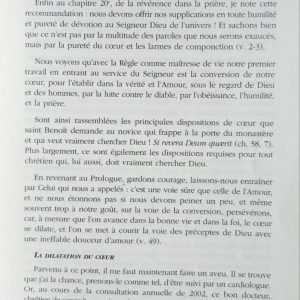
Finally, in chapter 20, On Reverence in Prayer, I note this recommendation: ‘we must offer our supplications with all humility and purity of devotion to the Lord God of the universe! And let us know that it is not by much speaking that we will be heard, but by purity of heart and tears of compunction’ (v. 2-3).
We see that with the Rule as the mistress of life, our first work upon entering the service of the Lord is the conversion of our heart, to establish it in truth and Love, under the gaze of God and men, through struggle against the devil, through obedience, humility, and prayer.
Thus are gathered the principal dispositions of heart that Saint Benedict asks of the novice who knocks at the door of the monastery and ‘truly seeks God!’ (Si revera Deum quaerit, ch. 58, 7). More broadly, these are also the dispositions required for every Christian who, likewise, must truly seek God.
Returning to the Prologue, let us take courage, let us let ourselves be led by Him who has called us: the way of Love is a sure one, and let us not be surprised if we must toil a little, and even often too much for our taste, on the path of conversion; let us persevere, because ‘as one advances in the life of conversion and in faith, the heart is dilated, and one runs the way of God’s commandments with unspeakable sweetness of love’. (v. 49).
The Dilatation of the Heart
Having reached this point, I must now make a confession. It so happens that I have the good fortune – let us take it as such – of being followed by a cardiologist. Now, during the annual consultation in 2002, this good doctor, a Christian as well (which does not hurt), told me he vaguely remembered that there was some connection between the heart and my abbatial blessing, which had gone very well. I congratulated him on remembering that much and so told him about my motto: ‘Dilatato Corde’.
After listening to me wisely, he told me, not without a smile, that without wanting in any way to harm my spiritual intentions, he regretted to inform me that, physiologically, he had detected no dilation of the heart. He added that I should be glad of this and that it was clinically much better that way. Rejoicing that there is decidedly nothing perfect on this earth, I was glad of this good news and thanked the Lord for sparing me, at least for now, an additional worry!
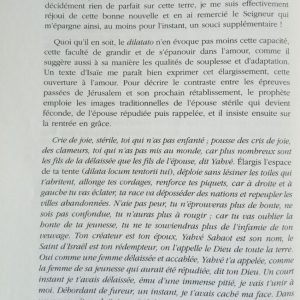
Be that as it may, ‘dilatato’ nonetheless evokes this capacity, this faculty to grow and flourish in love, as it also suggests in its own way the qualities of suppleness and adaptation. A text from Isaiah seems to me to express well this widening, this opening to love. To describe the contrast between Jerusalem’s past trials and its imminent restoration, the prophet uses the traditional images of the barren wife who becomes fertile, of the repudiated wife then recalled, and he then insists on the restoration to favor.
‘Sing, O barren one, who did not bear; burst into song and shout, you who have not been in labor! For the children of the desolate woman will be more than the children of her that is married, says the Lord. Enlarge the site of your tent (dilata locum tentorii tui), and let the curtains of your habitations be stretched out; do not hold back; lengthen your cords and strengthen your stakes. For you will spread out to the right and to the left, and your descendants will possess the nations and will settle the desolate towns. Do not fear, for you will not be ashamed; do not be discouraged, for you will not suffer disgrace; for you will forget the shame of your youth, and the disgrace of your widowhood you will remember no more. For your Maker is your husband, the Lord of hosts is his name; the Holy One of Israel is your Redeemer, the God of the whole earth he is called. For the Lord has called you like a wife forsaken and grieved in spirit, like the wife of a man’s youth when she is cast off, says your God. For a brief moment I abandoned you, but with great compassion I will gather you. In overflowing wrath for a moment, I hid my face from you, but with everlasting love I will have compassion on you, says the Lord, your Redeemer… For the mountains may depart and the hills be removed, but my steadfast love shall not depart from you, and my covenant of peace shall not be removed, says the Lord, who has compassion on you‘ (Is 54:1-8, 10).
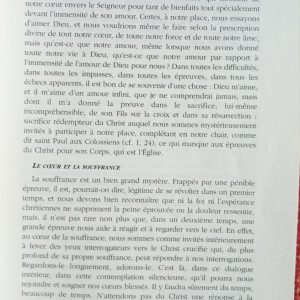
It is sentiments of infinite gratitude that rise from our heart towards the Lord for so many benefits, especially before the immensity of his love. Certainly, in our place, we try to love God, and we would even like to do so according to the divine precept with all our heart, all our strength, and all our soul, but what is our love, even when we have given our whole life to God, what is our love compared to the immensity of God’s love for us?
In all difficulties, in all impasses, in all trials, in all apparent failures, it is good to remember one thing: God loves me, and he loves me with an infinite love, which I will never understand, but of which he has given me proof in the sacrifice, itself incomprehensible, of his Son on the cross and in his resurrection: the redemptive sacrifice of Christ in which we are mysteriously invited to participate in our own place, ‘completing in our flesh’, as Saint Paul says to the Colossians (cf. 1:24), ‘what is lacking in Christ’s afflictions for the sake of his body, which is the Church’.
The Heart and Suffering
Suffering is a great mystery. Struck by a painful trial, it is, one might say, legitimate to rebel at first, and we must recognize that neither Christian faith nor hope suppress the pain experienced or the suffering felt. But, it is also not uncommon that, in a second phase, a great trial helps us to react and to look towards heaven. Indeed, in the heart of suffering, we are as if interiorly invited to raise questioning eyes towards the crucified Christ who, from the depths of his own suffering, can answer our questions.
Let us gaze upon him at length, let us adore him. It is there, in this inner dialogue, in this silent contemplation, that he can reach us and heal our wounded hearts. It will surely take time, much time. Let us not expect from Christ an answer in a human way, but by communing through our sufferings with the very sufferings of Christ, we will then perceive something of his answer. By his own suffering, Christ is at the very heart of our suffering and can act from within, by the power of his Spirit. In the very depths of our suffering, we more easily let all suffering come to meet ours, and this silent and painful contact facilitates the opening of the heart and the passage of love. Thus, hidden mysteriously within suffering itself is a particular force that draws us closer interiorly to Christ, a force that wounds our heart but also dilates it and opens it to love.
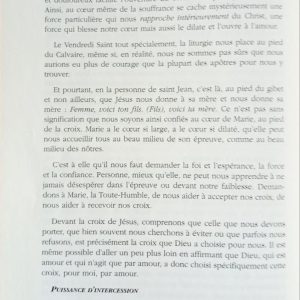
On Good Friday especially, the liturgy places us at the foot of Calvary, even if, in reality, we are not sure that we would have had more courage than most of the apostles to be there.
And yet, in the person of Saint John, it is there, at the foot of the cross and nowhere else, that Jesus gives us to his mother and gives us his mother: ‘Woman, here is your son. (Son), here is your mother’. It is not without significance that we are thus entrusted to the heart of Mary, at the foot of the cross. Mary has a heart so wide, a heart so dilated, that she can welcome us all in the midst of her trial, just as in the midst of ours.
It is to her that we must ask for faith and hope, strength and trust. No one better than she can teach us never to despair in trial or in the face of our weakness. Let us ask Mary, the All-Humble, to help us accept our crosses, to help us receive our crosses.
Before the cross of Jesus, let us understand that the cross we must carry, which we often seek to avoid or sometimes refuse, is precisely the cross that God has chosen for us. It is even possible to go a little further by affirming that God, who is love and who acts only out of love, has therefore specifically chosen this cross, for me, out of love.
Power of Intercession
Before concluding, I would like, with the help of a very beautiful example, to mention the power of intercession of a dilated heart before the Lord. I will take my example from the second Book of the Dialogues of Saint Gregory the Great (Pope from 590 to 604), a book we read every year in the refectory for the feast of Saint Benedict, on July 11. It is chapter XXXIII, entitled: On the Miracle of Saint Scholastica, His Sister.
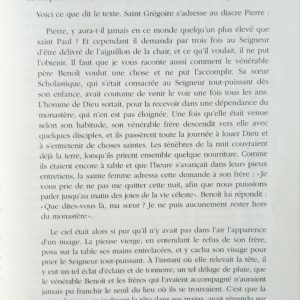
Here is what the text says. Saint Gregory addresses the deacon Peter:
‘Peter, will there ever be in this world anyone greater than Saint Paul? Yet he asked three times to be delivered from the thorn in the flesh, and what he wanted, he could not obtain. I must also tell you how the venerable father Benedict wanted something and could not accomplish it. His sister Scholastica, who had been consecrated to Almighty God from her childhood, used to come to visit him once a year. The man of God would go out to meet her at a dependency of the monastery, not far away. One day when she had come as usual, her venerable brother went down to her with some disciples, and they spent the whole day praising God and speaking of holy things. The darkness of night had already covered the earth when they took some food together. As they were still at table and the hour grew late in their pious conversation, the holy woman made this request to her brother: ‘I beg you not to leave me tonight, so that we may speak until morning of the joys of the heavenly life.’ Benedict answered her: ‘What are you saying, sister? I cannot possibly stay outside the monastery.’
Now the sky was so clear that there was no sign of a cloud in the air. The pious virgin, hearing her brother’s refusal, placed her intertwined hands on the table, and hid her face in them to pray to Almighty God. The instant she lifted her head, there was such a burst of lightning and thunder, such a deluge of rain, that the venerable Benedict and the brothers who had accompanied him could never have crossed the threshold of the place where they were. For the holy woman, bowing her head in her hands, had poured out rivers of tears on the table, which changed the serenity of the sky into rain. The storm followed close upon her prayer, and there was such a connection between this prayer and this tempest that the thunder rumbled at the very moment she raised her head, and the rain fell at the same time.
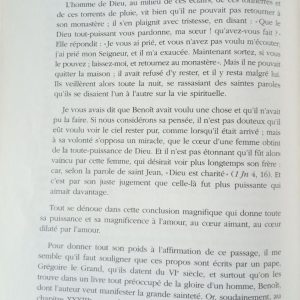
The man of God, in the midst of these flashes, these thunderclaps and these torrents of rain, clearly saw that he could not return to his monastery; he complained sorrowfully, saying: ‘May Almighty God forgive you, sister! What have you done?’ She answered: ‘I asked you, and you would not listen to me; I asked my Lord, and he heard me. Now go out, if you can; leave me, and return to the monastery.’ But he could not leave the house; he had refused to stay, and he stayed despite himself. They watched then all night, feasting on the holy words they exchanged with one another about the spiritual life.
I told you that Benedict wanted something and could not do it. If we consider his intention, there is no doubt that he would have wanted the sky to remain as clear as when he had arrived; but a miracle opposed his will, a miracle that a woman’s heart obtained from the almighty power of God. And it is not surprising that he was then overcome by this woman, who desired to see her brother longer: for, according to the word of Saint John, ‘God is love’ (1 John 4:16). And it was by his just judgment that the one who loved more was more powerful.”
Everything is resolved in this magnificent conclusion, which gives all its power and magnificence to love, to the loving heart, to the heart dilated by love.
To give full weight to the affirmation of this passage, it seems to me that we must emphasize that these words are written by a pope, Gregory the Great, that they date from the sixth century, and above all that they are found in a book entirely concerned with the glory of a man, Benedict, whose great holiness the author wishes to manifest. Yet suddenly, in chapter XXXIII, our hero is surpassed by a woman, even though she was his sister, and supplanted in holiness by the strength of a loving heart.
It is true, of course, that love makes us fragile or vulnerable, simply because it gives itself, but it is no less true that it also contains a strength unlike any other, as the epilogue of the Song of Songs (8:6-7) still sings:
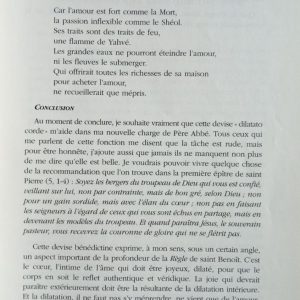
‘For love is strong as Death, passion relentless as Sheol. Its flashes are flashes of fire, a flame of the Lord. Many waters cannot quench love, neither can floods drown it. If a man offered for love all the wealth of his house, he would be utterly despised‘.
Conclusion
At the moment of concluding, I truly hope that this motto “Dilatato Corde” will help me in my new charge as Father Abbot. All those who speak to me about this office tell me that the task is arduous, but to be honest, they also never fail to tell me that it is beautiful. I would like to be able to live something of the recommendation found in the first letter of Saint Peter (5:1-4):
‘Be shepherds of the flock of God that is in your charge, watching over it, not under compulsion but willingly, according to God; not for sordid gain but with eagerness; not as lording it over those who are allotted to you, but becoming examples to the flock. And when Jesus, the chief Shepherd, appears, you will receive the crown of glory that never fades away‘.
This Benedictine motto expresses, in my view, from a certain angle, an important aspect of the depth of the Rule of Saint Benedict. It is the heart, the innermost soul, that must be joyful, dilated, so that the body may be its authentic and truthful reflection. The joy that should appear outwardly must be the result of this interior dilation. And dilation, make no mistake, comes only from love. I would therefore like these two words “Dilatato corde” – for me, who am now at the helm of this community – to help me live fully in the presence of God in faith and permanent conversion, and, at the same time, to lead me to be fully a man, able to listen to my brothers, understand them, and bring them true joy.
May the Virgin Mary, Saint Anne and Saint Benedict
watch over the community and its abbot!
Fr. Philippe Piron
Abbot of Sainte-Anne of Kergonan
(2002–2018)
*
Original French

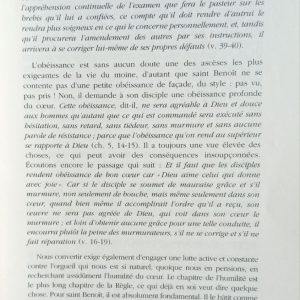
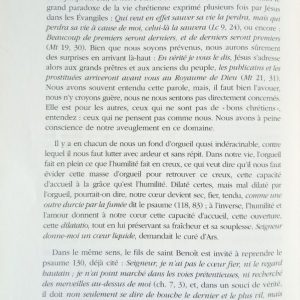
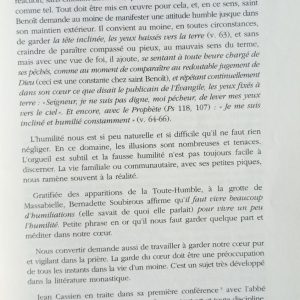
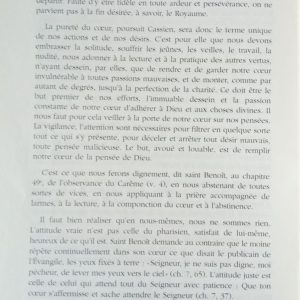
*
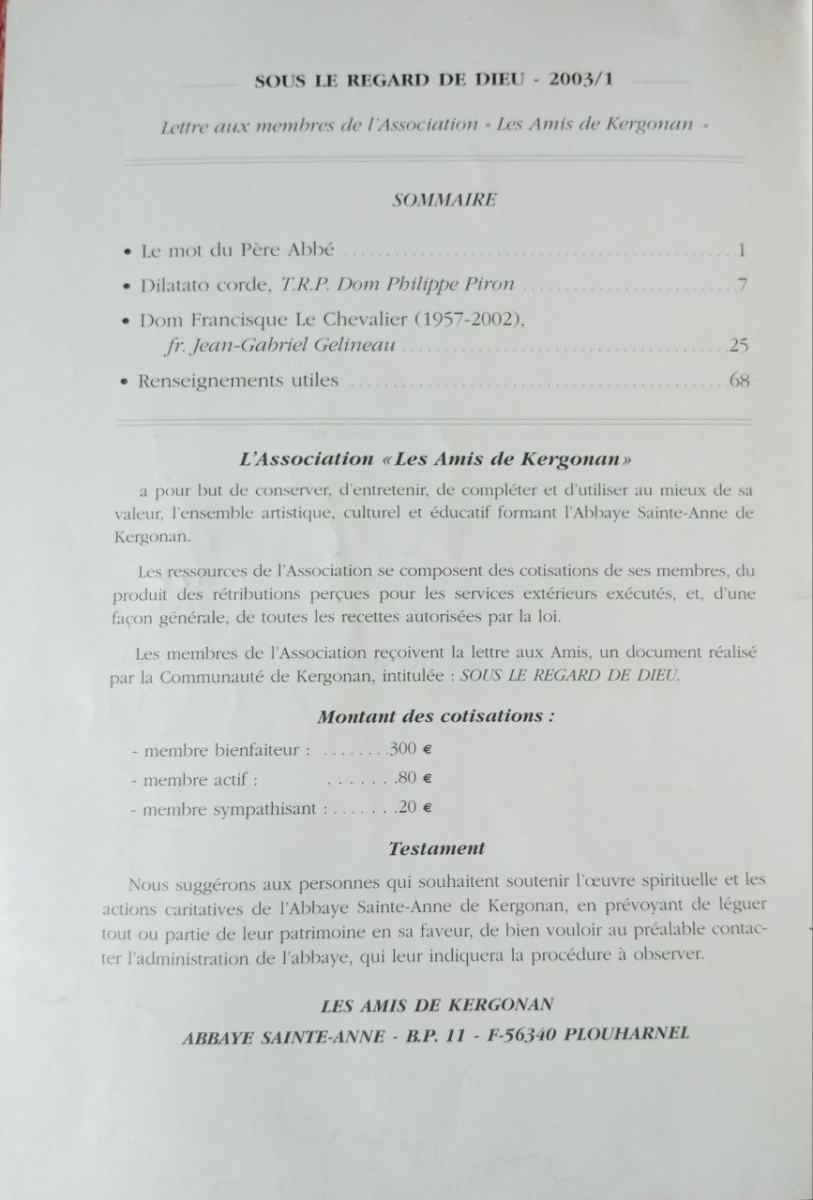
Source
*
*
A Via-Hygeia Post-scriptum
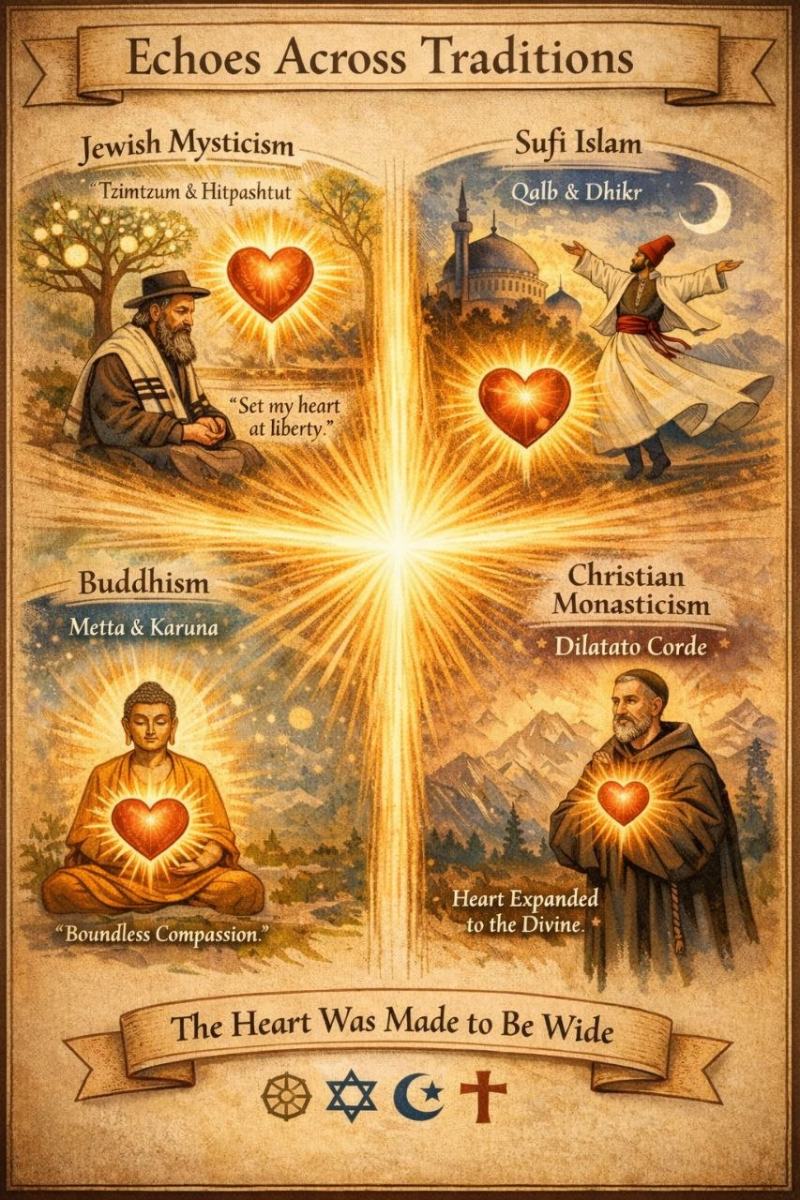
Echoes Across Traditions
While ‘Dilatato Corde‘ is deeply rooted in the soil of Benedictine Christianity, the intuition that the human heart must expand to contain the Divine is a universal cry found across wisdom traditions. It is as if the spiritual geography of humanity converges on this same summit: the heart must break its narrow limits to become a vessel for the Infinite.
In Jewish mysticism (Kabbalah), this concept resonates with the idea of Tzimtzum—the divine contraction to make space for creation—mirrored in the human soul’s need to expand (hitpashtut) to receive the divine light. The Hasidic masters often speak of the heart needing to be ‘broken open‘ to let the light in, much like the Benedictine call to humility. Similarly, the Psalmist’s cry, ‘You have set my heart at liberty‘, echoes the Jewish understanding that true freedom is not autonomy from God, but the capacity to hold more of God’s Torah within one’s inner being.
In Islam, and particularly within the Sufi tradition, the heart (qalb) is the central organ of spiritual perception. The great Sufi poet Rumi frequently describes the heart as a vessel that must be widened by the pain of longing and the fire of love. ‘The wound is the place where the Light enters you‘, he writes, a sentiment that parallels Dom Piron’s reflection on suffering. For the Sufi, the heart is initially narrow, confined by the ego (nafs), but through dhikr (remembrance of God) and love, it expands until it can contain the entire universe, for ‘neither My Earth nor My Heaven can contain Me, but the heart of My believing servant contains Me‘, says a famous Hadith Qudsi.
In Buddhism, while the theological framework differs, the movement of expansion is strikingly similar through the practice of Metta (loving-kindness). The meditation on Metta explicitly instructs the practitioner to ‘dilate‘ their heart, starting with oneself, then expanding to a loved one, a neutral person, a difficult person, and finally to all sentient beings in the ten directions. The goal is to cultivate a heart that is ‘boundless, free from enmity, and free from ill will‘. Here, the dilation is not caused by a personal God’s grace but by the intentional cultivation of compassion (karuṇā), yet the result is the same: a heart that has outgrown the prison of the self.
These converging paths suggest that ‘Dilatato Corde‘ is not merely a monastic slogan, but a description of a fundamental spiritual law: life shrinks when centered on the self, and it expands only when opened to the Other—whether that Other is God, the Neighbor, or all Living Beings. The Benedictine monk, the Jewish mystic, the Sufi poet, and the Buddhist practitioner all agree on one thing: the heart was made to be wide.
***



Leave a Reply