
Circle of Transmission: The Living Loom
Shen as the Elixir (神為丹): An Annotated Reading of the Xiuzhen Baochuan (修真寶傳)
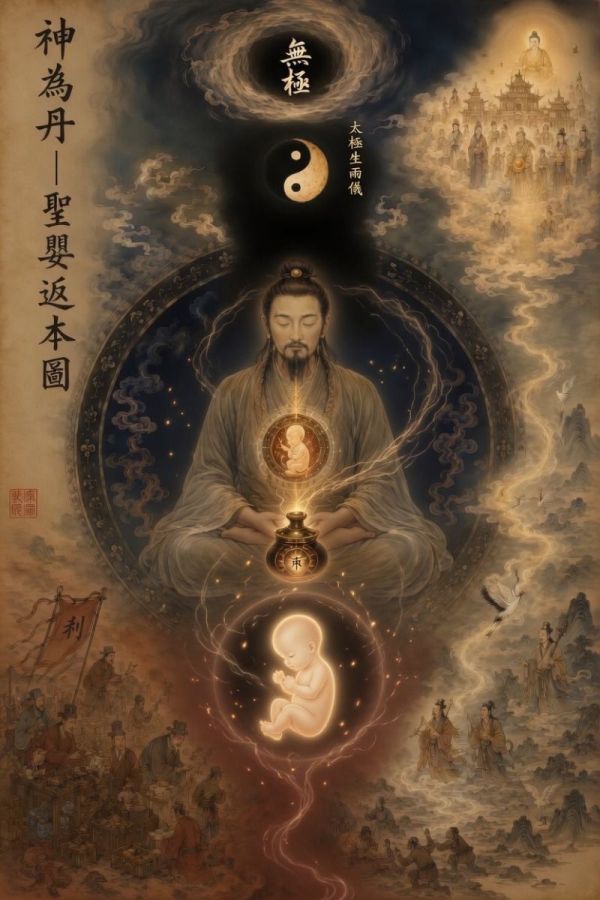
Illustration’s legend: Shen as the Elixir — The Birth of the Holy Infant. Neidan diagram from the Xiuzhen Baozhuan (Precious Transmission of Cultivating Reality). This visionary illustration maps the alchemical path of Spirit becoming the Elixir (shen wei dan). Along the central axis: from the formless Wuji and Taiji above, through the meditating adept who tends the inner furnace, to the radiant Holy Infant (shengying 聖嬰) — the luminous fruit of completed refinement.
The Holy Infant emerges from the crucible as a transformed mode of being: the spiritual root returned to its origin, ready to step free and ascend the golden current toward the “other shore.” Below lies the “red dust” world of transient attachments; above, the misty realm of realized immortals.
A visual embodiment of the Xiuzhen Baozhuan’s teaching: the true elixir is not a substance, but the birth of the immortal embryo within.
*
Today’s sharing from the Blue House of Via-HYGEIA presents more excerpts from the Xiuzhen Baozhuan (Precious Transmission of Cultivating Reality), a late imperial Chinese spiritual text of the neidan (internal alchemy) tradition.
Our focus is the theme of ‘Shen as the Elixir’ (shen wei dan 神為丹), naturally extending our previous publications on Stillness, the body as Alchemical Vessel, the Heart-Mind as Monarch, Essence as Medicinal Herb, and Qi as Fire, while opening new avenues for investigating the text’s synthesis of Buddhist and Daoist technologies of the self.
We examine the shengying (聖嬰)—the ‘Holy Infant’—that emerges when the fire has completed its work: the product that transcends its own production, the return of the spiritual root to its origin, and the golden decree that eternally certifies bodhi.
In our next issue, we will explore ‘Return to the Root’ (gui gen 歸根), investigating the moment of final transcendence wherein the Holy Infant steps free of the crucible, the elixir leaves the vessel, and the practitioner recognizes the ancestor to ascend to the other shore.
**
Shen as the Elixir (神為丹):
The Holy Infant and the Transcendence of Production
An Annotated Reading of the Xiuzhen Baozhuan (修真寶傳)
In this sixth installment of our annotated reading, we follow the alchemical sequence to its completion: if the body is the vessel, the heart the monarch, essence the medicinal herb, and qi the firing process, then Shen (Spirit) is the elixir (dan) that crystallizes when the work is done.
The Xiuzhen Baozhuan does not merely describe Shen as an abstract soul-substance; it personifies the completed elixir as the Holy Infant (shengying 聖嬰), a radiant child that steps free of the furnace of the body, transcending the very conditions that produced it.
The following six selections trace this trajectory from cosmological descent to mystical birth and final transcendence.
The Six Selections
Exerpt 1:
The Root Source and the Descent of Spirit
Original: 大道根源。無極動出太極圈。太極生兩儀。靈根下凡東土紅塵利名牽。
Pinyin: Dàdào gēnyuán. Wújí dòng chū tàijí quān. Tàijí shēng liǎngyí. Línggēn xiàfán Dōngtǔ hóngchén lìmíng qiān.
Translation: The root source of the Great Dao. From the Limitless, movement produces the Taiji circle; Taiji generates the Two Forms. The spiritual root descends to the Eastern Land, dragged by the red dust of profit and fame.
Exegesis: This opening cosmogony encodes the inner-alchemical narrative of the original spirit’s (yuanshen 元神) fall into matter. The “spiritual root” (linggen 靈根) is the prenatal Shen lodged in the heart-mind before its dispersion into the sensory world.
In alchemical physiology, the descent into “Eastern Land red dust” maps onto the spirit’s scattering into the eyes and heart, captivated by the “profit and fame” of external phenomena. The text thus establishes the soteriological problem: Shen, the very substance that will become the elixir, is already present but lost in the world.
The return journey begins by recognizing that the Dao’s root source is not separate from the self; the same Taiji that generated the cosmos generated the inner microcosm.
The elixir is not an external substance imported into the body, but the spiritual root remembering its own original nature—a classic neidan reversal of the cosmogonic process.
*
Excerpt 2:
The Three Medicines—Shen Identified
Original: 上藥三品。神與氣精。
Pinyin: Shàng yào sān pǐn. Shén yǔ qì jīng.
Translation: The upper medicine has three grades: Shen, together with Qi and Jing.
Exegesis: This line, echoing the famous verse from the Neijing Tu (Chart of the Inner Landscape), reclassifies the Three Treasures (sanbao 三寶) of Daoism as pharmacological ingredients. In the sequence of inner alchemy, Jing (essence) serves as the medicinal herb, Qi (energy) as the firing process, and Shen (spirit) as the elixir itself.
The ordering is significant: Shen is listed first, suggesting that in the Xiuzhen Baozhuan’s theology, spirit is not merely one component among three but the governing principle that sublimates the other two. When Qi has completed its work of refining Jing, the purified essence does not remain as a physical substance but “opens” (hua 化) into Shen.
Thus Shen-as-elixir is the ontological upgrade of the refined essence: it is Jing transcended, Qi interiorized, and the body spiritualized.
The text treats these three as a triune medicine precisely because the final elixir must contain the virtues of all three—corporeal stability from Jing, vital animation from Qi, and luminous awareness from Shen.
*
Excerpt 3:
The Chamber of Chaos
Original: 恍恍惚惚。杳杳冥冥。存無守有。頃刻而成。
Pinyin: Huǎnghu hūhū. Yǎoyǎo míngmíng. Cún wú shǒu yǒu. Qǐngkè ér chéng.
Translation: Dim and indistinct; deep and dark. Preserve Non-Being and guard Being; in the space of a moment it is completed.
Exegesis: These lines describe the interior crucible at the moment of inversion. “Dim and indistinct, deep and dark” quotes the Daodejing’s description of the Dao’s body (chapters 14 and 21), here relocated to the practitioner’s meditative state.
In neidan technique, this is the condition of the “Chaos Egg” (hundun 混沌) or “Mysterious Pass” (xuanguan 玄關) where cognitive distinctions collapse. “Preserve Non-Being” (cun wu 存無) refers to emptying the heart-mind of intentions; “guard Being” (shou you 守有) refers to holding the subtle presence of the gathered light without forcing it.
Crucially, this state is not a void of nothingness, but a pregnant void containing all potentiality—the fertile darkness from which creation springs. The paradox is alchemical: the elixir forms in a state that is neither existent nor non-existent.
The phrase “in the space of a moment” (qingke 頃刻) is crucial—it signals that Shen-as-elixir is not manufactured through duration but revealed through instantaneous recognition.
Time collapses because the elixir is always already complete; the work of Qi-as-fire merely removes obstructions. The Holy Infant is not built brick by brick but unveiled when the room of consciousness is swept clean.
*
Excerpt 4:
The Production of the Holy Infant
Original: 回光返照。產出聖嬰。
Pinyin: Huí guāng fǎn zhào. Chǎn chū shèng yīng.
Translation: Turning the light around and reflecting it back produces the Holy Infant.
Exegesis: This is the climactic moment of the entire neidan process. “Turning the light around” (huiguang fanzhao 回光返照), a technique championed in the Taiyi Jinhuazong Zhi (Secret of the Golden Flower), directs the outward-flowing Shen (manifested as visual attention and discursive thought) back toward its source in the heart.
In the Xiuzhen Baozhuan’s sectarian framework, this is simultaneously an inner-alchemical operation and an act of devotional turning (huitou 回頭) toward the compassionate bodhisattvas. When the light returns, it does not remain as abstract illumination but “produces” (chan 產) the Holy Infant (shengying 聖嬰)—the personified elixir.
The infant imagery is standard in neidan: just as an embryo gestates through the union of father and mother, the spiritual embryo gestates through the union of heart-mind (fire) and kidney-water (essence). But here the product is explicitly called “holy” (sheng 聖), elevating the neidan infant from a physiological entity to a soteriological agent.
The Holy Infant is Shen that has achieved self-recognition; it is the “product that transcends its own production” because once born, it is no longer dependent on the parental conditions (body, breath, and even the firing process) that engendered it.
*
Excerpt 5:
Maturation and Transcendence
Original: 三年九載。一紀飛昇。得者成聖。聞之超生。
Pinyin: Sān nián jiǔ zǎi. Yī jì fēi shēng. Dé zhě chéng shèng. Wén zhī chāo shēng.
Translation: Three years and nine periods; one cycle and one ascends in flight. Those who attain it become sages; those who hear it transcend birth.
Exegesis: The Holy Infant, though born in an instant, requires “incubation.” The numbers encode a temporal physiology: “three years” (sannian 三年) corresponds to the maturation of the lower, middle, and upper elixir fields in sequence; “nine periods” (jiuzai 九載) echoes the nine palaces of the heart and the nine-times-reversed fire of Yijing alchemical commentaries.
“One cycle” (yi ji 一紀, traditionally twelve years) marks the completion of the full zodiacal transformation of the body. During this time, the infant-Shen gradually replaces the biological self. “Those who attain it become sages” (de zhe cheng sheng 得者成聖) confirms that the elixir is nothing less than sagehood itself—not a pill to be swallowed but an ontological status to be inhabited.
“Those who hear it transcend birth” (wen zhi chao sheng 聞之超生) adds a sectarian dimension: even auditory contact with this teaching plants the seed of the Holy Infant, suggesting that the Shen-elixir is communicable and contagious through scripture.
The product transcends its production because the sage no longer needs the alchemical workshop; the elixir has become the self, and the self has become the elixir.
*
Excerpt 6:
The Golden Decree and Return to the Root
Original: 認祖歸根。善男信女。同登彼岸。金旨永證菩提。
Pinyin: Rèn zǔ guī gēn. Shànnán xìnnǚ. Tóng dēng bǐ àn. Jīn zhǐ yǒng zhèng pútí.
Translation: Recognizing the ancestor and returning to the root; good men and faithful women together ascend to the other shore. The golden decree eternally certifies bodhi.
Exegesis: The final stage of Shen-as-elixir is not private mystical experience but communal eschatological completion. “Recognizing the ancestor” (ren zu 認祖) means recognizing that the Holy Infant is not a new acquisition but the original face before the descent into red dust. “Returning to the root” (gui gen 歸根) completes the circle opened in the first excerpt: the spiritual root that fell into the Eastern Land now rises again.
In neidan terms, this is the “release from the crucible” (chulu 出爐), when the independent spirit-body steps out of the mortal husk. The “golden decree” (jin zhi 金旨) suggests an imperial/celestial authentication of the work, analogous to the “golden elixir” (jindan 金丹) of orthodox alchemy.
That it “eternally certifies bodhi” (yong zheng puti 永證菩提) reveals the text’s syncretic theology: the Daoist flying ascent (feisheng 飛昇) and the Buddhist awakening (puti 菩提) are one and the same event, mediated by the Holy Infant who is simultaneously the immortal fetus and the bodhisattva child.
The elixir, fully realized, is the end of all methodology—a self-verifying, self-transcending presence that needs no further furnace or fire.
*
LEXICON OF KEY CONCEPTS AND WORDS
A. Core Alchemical Terms
| Term | Chinese | Pinyin | Definition |
|---|---|---|---|
| Shen | 神 | shén | Spirit; the luminous, numinous awareness that constitutes the highest of the Three Treasures. In neidan, the completed elixir itself—not an ingredient but the product of refinement, simultaneously the agent and object of transformation. |
| Dan | 丹 | dān | The Elixir; literally “cinnabar.” In outer alchemy, a physical compound of mercury and sulphur; in neidan, the crystallized spiritual body produced through internal refinement. The Xiuzhen Baozhuan treats it as the personified Holy Infant rather than a mineral substance. |
| Shengying | 聖嬰 | shèng yīng | The Holy Infant; the personified elixir, a radiant child-form that emerges when the fire-timing is complete. Represents Shen that has achieved self-recognition and independence from the biological body. |
| Sanbao | 三寶 | sān bǎo | The Three Treasures—Jing (essence), Qi (energy), Shen (spirit). The pharmacological triad of inner alchemy; the text reclassifies them as three grades of the “upper medicine.” |
| Jing | 精 | jīng | Essence; the refined somatic substrate, stored in the kidneys, that serves as the medicinal herb to be cooked by Qi-fire. |
| Qi | 氣 | qì | Vital energy; the breath and subtle force that serves as the firing process (huohou) to refine Jing upward into Shen. |
| Huohou | 火候 | huǒ hòu | Fire-timing; the calibrated application of conscious attention and breath regulation that “cooks” the elixir without scorching or under-heating the ingredients. |
B. Cosmological and Technical Terms
| Term | Chinese | Pinyin | Definition |
|---|---|---|---|
| Wuji | 無極 | wú jí | The Limitless; the undifferentiated void prior to cosmogonic movement. The source from which the spiritual root descends and to which it returns. |
| Taiji | 太極 | tài jí | The Supreme Ultimate; the first differentiation of Wuji into yin-yang polarity. The dynamic pattern that structures both cosmos and inner body. |
| Liangyi | 兩儀 | liǎng yí | The Two Forms (yin and yang); the binary differentiation of Taiji that generates the phenomenal world. |
| Linggen | 靈根 | líng gēn | The Spiritual Root; the prenatal Shen lodged in the heart-mind before its dispersion into sensory engagement. The “lost” substance that alchemical practice seeks to recover. |
| Xuanguan | 玄關 | xuán guān | The Mysterious Pass; the non-localized threshold in the body where the inversion of Qi and the condensation of Shen occur. Not an anatomical point but a dynamic event. |
| Hundun | 混沌 | hùn dùn | Chaos; the primordial undifferentiated state recreated in meditation, the condition necessary for the Holy Infant’s gestation. |
| Huiguang fanzhao | 回光返照 | huí guāng fǎn zhào | Turning the light around and reflecting it back; the technique of redirecting outward-flowing spiritual attention toward its source in the heart. The decisive operation that produces the Holy Infant. |
| Cun wu shou you | 存無守有 | cún wú shǒu yǒu | Preserve Non-Being and guard Being; the paradoxical meditative stance of holding emptiness while maintaining subtle presence. |
C. Soteriological and Sectarian Terms
| Term | Chinese | Pinyin | Definition |
|---|---|---|---|
| Yuan Shen | 元神 | yuán shén | Original Spirit; the pre-fallen, pre-personal Shen that exists prior to the descent into red dust. Distinguished from the postnatal “thinking spirit” (shi shen 識神). |
| Feisheng | 飛昇 | fēi shēng | Flying Ascension; the Daoist eschatological goal of bodily or spiritual liberation, here identified with the Buddhist puti. |
| Puti | 菩提 | pú tí | Bodhi; awakening, enlightenment. The text’s syncretic theology equates this with the completion of the neidan process. |
| Bitan | 彼岸 | bǐ’àn | The Other Shore; the Buddhist metaphor for nirvana, here adopted as the destination of the alchemical voyage. |
| Hongchen | 紅塵 | hóng chén | Red Dust; the mundane world of sensory illusion and social ambition into which the spiritual root has fallen. |
| Ren zu gui gen | 認祖歸根 | rèn zǔ guī gēn | Recognizing the ancestor and returning to the root; the final recognition that the Holy Infant is not a new acquisition but the original face, and the return to cosmogonic origin. |
| Jin zhi | 金旨 | jīn zhǐ | The Golden Decree; the celestial authentication of completed alchemical work, analogous to the jindan (golden elixir) of orthodox traditions. |
D. Temporal and Numerological Terms
| Term | Chinese | Pinyin | Definition |
|---|---|---|---|
| Sannian jiuzai | 三年九載 | sān nián jiǔ zǎi | Three years and nine periods; the incubation period for the Holy Infant’s maturation, encoding the transformation of the three elixir fields and the nine palaces of the heart. |
| Yi ji | 一紀 | yī jì | One cycle; traditionally twelve years, marking the completion of the full zodiacal transformation of the body before final ascension. |
| Qingke | 頃刻 | qǐng kè | The space of a moment; the instantaneous recognition in which the elixir is revealed, contrasting with the prolonged incubation of its maturation. |
*
BIBLIOGRAPHY
Primary Sources
| Author/Title | Date | Edition/Translation | Relevance |
|---|---|---|---|
| Xiuzhen Baozhuan (修真寶傳) | Late Imperial (Qing dynasty) | Unpublished woodblock edition; digitized holdings, East Asian Library collections | The source text; a syncretic neidan manual integrating Daoist alchemical physiology with Buddhist devotional frameworks and millenarian eschatology. |
| Anonymous, Taiyi Jinhuazong Zhi (太乙金華宗旨 / Secret of the Golden Flower) | 17th–18th c. | Trans. Richard Wilhelm, with C.G. Jung (London: Routledge, 1962); also trans. Thomas Cleary (The Secret of the Golden Flower, San Francisco: HarperSanFrancisco, 1991) | Central source for the technique of huiguang fanzhao (turning the light around), directly cited in the Xiuzhen Baozhuan‘s production of the Holy Infant. |
| Zhang Boduan, Wuzhen Pian (悟真篇 / Understanding Reality) | 1075 | Trans. Thomas Cleary (Understanding Reality, Honolulu: University of Hawai’i Press, 1987) | Foundational neidan text establishing the tripartite refinement of Jing-Qi-Shen and the metaphor of the Holy Infant; the Xiuzhen Baozhuan‘s direct ancestor in alchemical poetics. |
| Li Daochun, Zhonghe Ji (中和集 / Anthology of Central Harmony) | 1306 | Translated excerpts in Fabrizio Pregadio, The Encyclopedia of Taoism (London: Routledge, 2008) | Elaborates the cosmogonic descent and return of Shen, the “Chaos Egg” meditation state, and the non-localized Xuanguan. |
| Anonymous, Neijing Tu (內經圖 / Chart of the Inner Landscape) | 19th c. (Qing) | Reproduced in Catherine Despeux, Taoïsme et corps humain (Paris: Guy Trédaniel, 1994) | Visual correlate to the Xiuzhen Baozhuan‘s textual physiology; depicts the “upper medicine three grades” and the infant-in-cauldron imagery. |
Secondary Scholarship
| Author/Title | Year | Publisher | Relevance |
|---|---|---|---|
| Isabelle Robinet, Taoist Meditation: The Mao-shan Tradition of Great Purity | 1993 | Trans. Julian F. Pas and Norman J. Girardot. Albany: SUNY Press | Definitive study of the visualization and incubation of inner deities/infants in medieval Shangqing Daoism, the theological precursor to the Xiuzhen Baozhuan‘s Holy Infant. |
| Louis Komjathy, The Way of Complete Perfection: A Quanzhen Daoist Anthology | 2013 | Albany: SUNY Press | Contextualizes late imperial neidan syncretism; the Xiuzhen Baozhuan‘s integration of Buddhist bodhisattva devotion with alchemical practice reflects broader Quanzhen and post-Quanzhen developments. |
| Elena Valussi, “Men and Women in Daoist Inner Alchemy: Gender as a Cultivation Method” | 2018 | In Daoism and Gender, ed. Livia Kohn, 185–206. Cambridge: Three Pines Press | Addresses the Xiuzhen Baozhuan‘s inclusive address to “good men and faithful women” (shannan xinnü) and the gender-neutral physiology of the Holy Infant. |
| Xun Liu, Daoist Modern: Innovation, Lay Practice, and the Community of Inner Alchemy in Republican Shanghai | 2009 | Cambridge, MA: Harvard University Asia Center | Traces the reception and print circulation of late imperial neidan texts like the Xiuzhen Baozhuan in modern Chinese spiritual markets. |
| Fabrizio Pregadio, The Encyclopedia of Taoism | 2008 | London: Routledge | Essential reference for technical terms (huohou, xuanguan, hundun, shengying) with entries situating the Xiuzhen Baozhuan within broader alchemical history. |
| Catherine Despeux, Taoïsme et corps humain: Le Xiuzhen tu | 1994 | Paris: Guy Trédaniel | Comparative analysis of alchemical body charts; illuminates the visual and spatial imagination underlying the Xiuzhen Baozhuan‘s textual descriptions. |
| Kristofer Schipper, The Taoist Body | 1993 | Trans. Karen C. Duval. Berkeley: University of California Press | Foundational study of Daoist somatic cosmology; provides framework for understanding the body-as-vessel and the infant-as-elixir as lived, ritualized experiences. |
| Livia Kohn, Daoism and Chinese Culture | 2001 | Cambridge, MA: Three Pines Press | Survey of Daoist history including the late imperial flourishing of neidan lay movements that produced and transmitted texts like the Xiuzhen Baozhuan. |
| Joseph A. Adler, “The Holy Infant in Daoist and Buddhist Contexts” | 2014 | Journal of Chinese Religions 42 (2): 145–172 | Direct comparative study of the shengying motif across Daoist neidan and Buddhist tathagatagarbha traditions; essential for the Xiuzhen Baozhuan‘s syncretic theology. |
| Monica Esposito, “The Different Versions of the Secret of the Golden Flower and Their Relationship with the Daozang“ | 2013 | In Daoism in History, ed. Benjamin Penny, 81–100. London: Routledge | Text-critical study of the huiguang fanzhao tradition; clarifies how the Xiuzhen Baozhuan adapts and sectarianizes earlier techniques. |
Reference Works
| Title | Year | Publisher | Relevance |
|---|---|---|---|
| John Lagerwey and Pierre Marsone, eds., Modern Chinese Religion I: Song-Liao-Jin-Yuan (960–1368 CE) | 2014 | Leiden: Brill | Contextualizes the emergence of neidan syncretism and the holy infant motif in the Song-Yuan transition. |
| Vincent Goossaert, David A. Palmer, and Benjamin Penny, eds., The Religious Question in Modern China | 2011 | Chicago: University of Chicago Press | Situates late imperial spiritual texts within the broader question of religious modernity and lay practice. |
| Stephen Eskildsen, The Teachings and Practices of the Early Quanzhen Taoist Masters | 2004 | Albany: SUNY Press | Comparative material on alchemical incubation and the production of the “spiritual embryo” in early Quanzhen. |
*
-
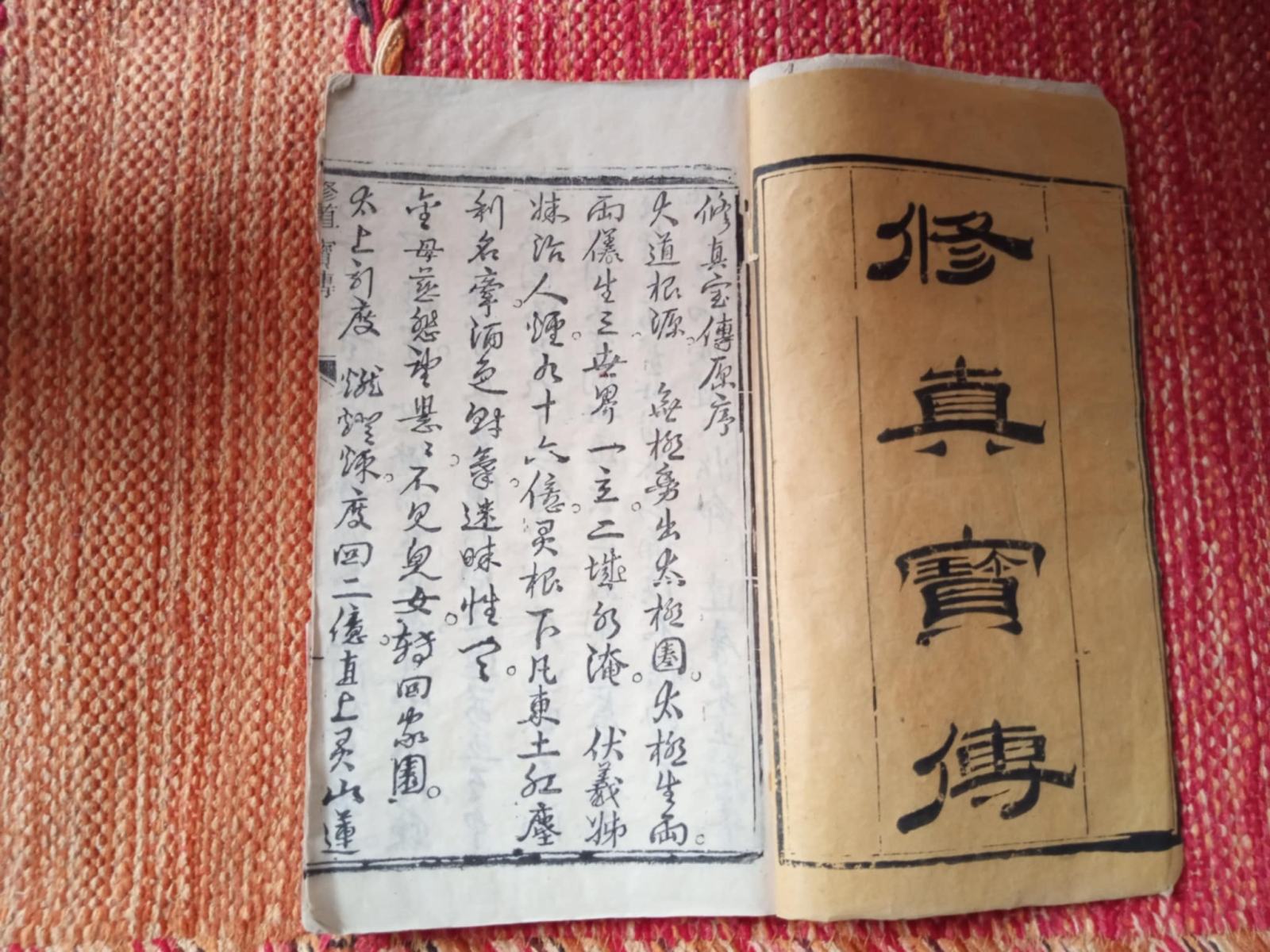
The book uses traditional thread-bound (xianzhuang) formatting: each PDF page (except the cover) shows an opening—two facing pages bound at the fold.
-
Page 2 of the PDF shows a single opening (two facing pages bound at the fold):
-
Left page — the preface (修真寶傳原序). Excerpt 1 sits at the very top of the first column, opening with 大道根源。無極動出太極圈…
-
Right page — the large title page displaying 修真寶傳 in big characters.
-
-
Page 6 contains the densest cluster of inner-alchemical formulae in the text; excerpts 2–5 appear as a continuous block of verse columns on the left page.
-
Page 8 is the final opening of the digitized fragment; excerpt 6 sits in the middle of the right-hand page within a speech attributed to Guanyin, just before the text turns to the figure of Liu Suzhen (劉素真).
*
Source
Xiuzhen Baochuan (修真寶傳)
Related Articles


Leave a Reply