
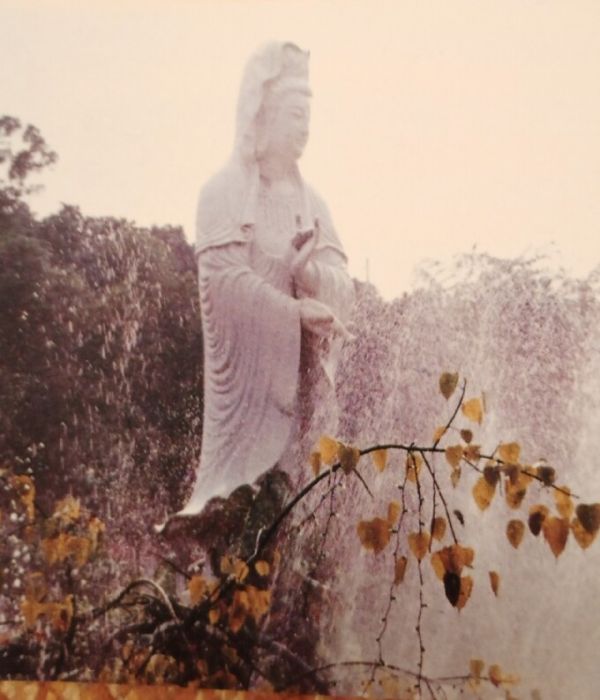
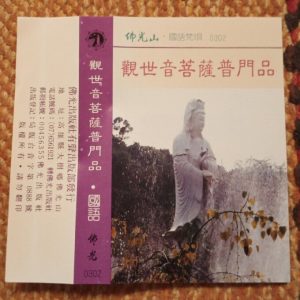



1. Description of the Tape
Cassette Wording:
Side A — Mandarin Buddhist Chant (國語梵唄)
| Track | Title | Translation |
|---|---|---|
| 1 | 楊枝淨水讚 | Willow Branch Purification Praise |
| 2 | 開經偈 | Sutra Opening Gatha |
| 3 | 普門品 | The Universal Gate (Chapter 25 of the Lotus Sutra) |
| 4 | 大悲咒 | Great Compassion Mantra (Dhāraṇī of Avalokiteśvara) |
Label text: Mandarin Buddhist Chant · GIO Taiwan Audio Publication No. 0888 · All Rights Reserved · Do Not Reproduce
Catalogue: Fo Guangshan 0302.
*
Side B — Mandarin Buddhist Chant (國語梵唄)
| Track | Title | Translation |
|---|---|---|
| 1 | 觀音菩薩偈 | Avalokiteśvara Bodhisattva Gatha |
| 2 | 觀音菩薩聖號 | Holy Name of Avalokiteśvara |
| 3 | 三皈依 | Three Refuges |
| 4 | 回向 | Dedication of Merit |
Label text: Mandarin Buddhist Chant · GIO Taiwan Audio Publication No. 0888 · All Rights Reserved · Do Not Reproduce.
Catalogue: Fo Guangshan 0302.
*
J-Card / Sleeve Text
- Front: Fo Guangshan · Mandarin Buddhist Chant 0302 / The Universal Gate of Avalokiteśvara Bodhisattva
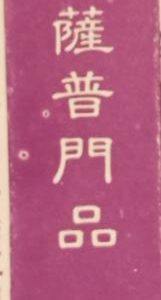
- Spine: The Universal Gate of Avalokiteśvara Bodhisattva · Mandarin / Fo Guang 0302
- Back panel (publisher data):
- Published by the Audio Publishing Division of Fo Guang Publishing House
- Address: Fo Guangshan, Dashu Township, Kaohsiung County
- Telephone: (07) 6561921, transfer to Fo Guang Publishing House
- Postal Transfer Account: 00456355 Fo Guang Publishing House
- Publication Registration: GIO Taiwan Audio Publication No. 0888
- All Rights Reserved · Do Not Reproduce
- Back flap (tracklist & date):
- Side A: Willow Branch Purification Praise · Sutra Opening Gatha · The Universal Gate · Great Compassion Mantra
- Side B: Avalokiteśvara Bodhisattva Gatha · Holy Name of Avalokiteśvara · Three Refuges · Dedication of Merit
- Publication Date: 1988
Notes on Translation Choices:
- 局版台音字第0888號 → “GIO Taiwan Audio Publication No. 0888” — Juban refers to the Government Information Office (GIO) publication licensing system; Taiyinzi specifies audio publications in Taiwan.
- 郵撥帳號 → “Postal Transfer Account” — a common pre-digital banking method in Taiwan where payments were made through post office transfers.
- 國語梵唄 → “Mandarin Buddhist Chant” — fanbai (梵唄) is the traditional Buddhist liturgical chant; guoyu (國語) specifies the Mandarin (as opposed to classical liturgical or Taiwanese) pronunciation.
*
2. A Contextual Commentary
I. Publisher Context: Fo Guangshan Audio Publishing
This cassette (catalogue 0302) was issued in 1988 by the 佛光出版社有聲出版部 (Fo Guang Publishing House, Audio Division), based at Fo Guangshan in Dashu Township, Kaohsiung County (now Kaohsiung City). The registration number 局版台音字第0888號 identifies it as a Taiwanese audio publication licensed under the Government Information Office (GIO) system. The postal transfer account 00456355 and telephone (07)6561921 are characteristic of mid-to-late 1980s Taiwanese religious publishing infrastructure, predating digital distribution.
Fo Guangshan, founded by Venerable Master Hsing Yun (星雲大師, 1927–2023), was by the 1980s already one of the “Four Great Mountains” (四大名山) of Taiwanese Buddhism. The “國語梵唄” (Mandarin fanbai) designation on this specific cassette is significant: it marks a deliberate liturgical shift from the traditional Buddhist liturgical pronunciation (fanyin) toward Modern Standard Mandarin. This democratized access for lay practitioners who lacked training in classical chant, while preserving the melodic structures (qiang 腔) of the tradition.
However, this Mandarin focus represents only half of Fo Guangshan’s linguistic strategy. While catalogue 0302 targeted a standardized, global, and mainland-refugee demographic, the organization simultaneously produced a vast parallel library of Taiwanese (Minnan/Hoklo) chants. For the local Taiwanese population—particularly the elderly who had been marginalized by the KMT’s strict “Mandarin-only” policies during the martial law era—the Dharma was often accessed through Taiyu (Taiwanese language) cassettes. Master Hsing Yun himself was a master code-switcher, preaching in Mandarin for the formal record and in Taiwanese for emotional resonance. The existence of this Mandarin cassette alongside a robust Taiwanese catalog reveals a sophisticated “dual-track” proselytism: Mandarin for unity and global export, Taiwanese for local rootedness and grassroots inclusion.
The catalogue number 0302 suggests this was part of a numbered series of liturgical cassettes, positioned within a broader programme of audio evangelism (fóguāng 佛光, “Buddha-light”) that disseminated standardised ritual forms across Fo Guangshan’s growing global network.
*
II. Side A: The Ritual Arc of Invocation
1. 楊枝淨水讚 (Yángzhī Jìngshuǐ Zàn) — Willow Branch Purification Praise
The Willow Branch Purification opens the liturgical sequence. In East Asian Buddhist ritual, the willow branch (楊枝, yangzhi) serves as the emblematic attribute of Avalokiteśvara. While its iconographic roots lie in the Indian Salvadora persica (the “toothbrush tree” used for oral hygiene and purification), in the context of 1980s Taiwan, this symbol had long been assimilated into the native Salix (weeping willow) imagery familiar to Chinese culture. The bodhisattva sprinkles blessed water to purify devotees and realms. The praise (讚, zan) is a metrical hymn, typically in seven-character lines, sung to a slow, reverent qiang. Its function here is consecratory: it establishes ritual space, purifies the auditory and physical environment, and invokes the presence of the bodhisattva before the sutra recitation proper. The water imagery prefigures the aquatic miracles described in the Universal Gate text itself.
2. 開經偈 (Kāijīng Jì) — Sutra Opening Gatha
The Sutra Opening Gatha is a pan-Buddhist formula, traditionally attributed to the Tang Emperor Xuanzong (唐玄宗) or to the Tang monk Xuanzang (玄奘). The standard text reads:
無上甚深微妙法,百千萬劫難遭遇。
我今見聞得受持,願解如來真實義。
(“The supreme, profound, subtle, and wonderful Dharma / Is difficult to encounter in hundreds of thousands of millions of kalpas. / Now that I have seen, heard, received, and upheld it / I vow to understand the Tathāgata’s true meaning.”)
Its placement here serves as a hermeneutical threshold: it frames the subsequent Universal Gate not merely as textual recitation but as Dharma encounter — an event in the listener’s soteriological timeline. The gatha transforms the cassette from passive audio into active ritual participation.
3. 普門品 (Pǔmén Pǐn) — The Universal Gate (Chapter 25 of the Lotus Sutra)
The Universal Gate of Avalokiteśvara Bodhisattva is the twenty-fifth chapter of Kumārajīva’s translation of the Saddharma Puṇḍarīka Sūtra (妙法蓮華經, Miàofǎ Liánhuá Jīng, ca. 406 CE). It enumerates the thirty-three manifestations (or “response bodies,” 應化身) through which Avalokiteśvara rescues beings from seven specific perils (fire, drowning, demons, weapons, bandits, imprisonment, and poison), and responds to the needs of beings in various social stations.
The term 普門 (pǔmén, “Universal Gate”) carries technical Mahāyāna weight: pǔ (universal, pervasive) denotes the non-discriminating scope of the bodhisattva’s compassion; mén (gate, method, portal) denotes the upāya (skillful means) through which liberation becomes accessible. The chapter is thus a soteriological topology — a map of how compassion enters the world through specific, situated forms. In the Fo Guang Shan liturgical context, its recitation in Mandarin rather than liturgical pronunciation underscores Master Hsing Yun’s humanistic Buddhism (人間佛教, rénjiān fójiào) — the insistence that the Dharma must be comprehensible to ordinary people in their own language.
4. 大悲咒 (Dàbēi Zhòu) — Great Compassion Mantra (Nīlakaṇṭha Dhāraṇī)
The Mahākaruṇikā Dhāraṇī (大悲咒), traditionally associated with the thousand-armed form of Avalokiteśvara, is an esoteric mantra of eighty-four (or, in some recensions, eighty-seven) Sanskrit phrases transliterated into Chinese characters. Its placement after the Universal Gate creates a textual-mantric continuum: the narrative exposition of the bodhisattva’s compassion (普門品) is followed by its sonic-ritual activation (大悲咒). The mantra operates at the threshold of semantic and performative language — its power resides not in discursive meaning but in phonetic accuracy and vocal intention. The “國語” rendition here thus raises interesting questions: does the Mandarin phonetic approximation retain the same ritual efficacy as the traditional transliteration, or does it represent a deliberate shift toward devotional accessibility over esoteric precision?
*
III. Side B: The Ritual Arc of Response and Closure
1. 觀音菩薩偈 (Guānyīn Púsà Jì) — Avalokiteśvara Bodhisattva Gatha
This gatha is a metrical hymn of praise to the bodhisattva, typically drawing on imagery from the Universal Gate and the Heart Sutra. Its function is anamnetic: it summarises and internalises the preceding sutra recitation into a condensed devotional utterance. In the liturgical sequence, it marks the transition from scriptural recitation to personal devotion — from the public reading of the sūtra to the private response of the heart.
2. 觀音菩薩聖號 (Guānyīn Púsà Shènghào) — Holy Name of Avalokiteśvara
The recitation of the holy name — typically 南無觀世音菩薩 (Námó Guānshìyīn Púsà, “Homage to Avalokiteśvara Bodhisattva”) — is the core nembutsu-like practice of Chinese Pure Land and Guanyin devotion. Its placement here transforms the cassette into a portable devotional tool: the listener is invited not merely to hear but to chant along, accumulating merit through vocal repetition. The “聖號” (holy name) functions as a sonic refuge, a compressed invocation of the bodhisattva’s entire salvific field.
3. 三皈依 (Sānguīyī) — Three Refuges
The Three Refuges (皈依佛,皈依法,皈依僧 — “I take refuge in the Buddha, the Dharma, and the Sangha”) is the foundational formula of Buddhist identity, marking the threshold of formal commitment. Its placement near the end of the cassette serves as a ritual re-grounding: after the expansive visionary space of the Universal Gate and the mantra, the practitioner returns to the basic structure of Buddhist refuge. It prevents the spectacular (miracles, manifestations, sonic power) from eclipsing the fundamental (the Three Jewels as the axis of practice).
4. 回向 (Huíxiàng) — Dedication of Merit
The Dedication of Merit closes the liturgical sequence, transferring the merit accumulated through the recitation to all sentient beings. The standard formula includes:
願以此功德,普及於一切。
我等與眾生,皆共成佛道。
(“May this merit be universally extended to all. / May we together with all sentient beings / Attain the Buddha-way.”)
This is the ethical and cosmological closure of the ritual: it prevents the accumulation of merit from becoming self-serving, insisting instead on the Mahāyāna bodhisattva ideal of universal liberation. The cassette thus ends not with the listener’s private devotion but with their reinsertion into the collective soteriological project.
*
IV. Synthesis: The Cassette as Ritual Object
The 0302 cassette is not merely an audio recording but a portable liturgy — a complete ritual sequence compressed into magnetic tape. Its structure follows the classic invocation-text-response-dedication pattern of East Asian Buddhist liturgy:
| Phase | Side A | Side B |
|---|---|---|
| Invocation | 楊枝淨水讚 | — |
| Threshold | 開經偈 | — |
| Scripture | 普門品 | — |
| Mantra | 大悲咒 | — |
| Praise | — | 觀音菩薩偈 |
| Devotion | — | 觀音菩薩聖號 |
| Commitment | — | 三皈依 |
| Dedication | — | 回向 |
The 1988 publication date places this object at a pivotal moment: Taiwanese Buddhism was emerging from the suppression of the martial law period (lifted in 1987) into a period of explosive growth and globalisation. The “國語梵唄” format reflects Master Hsing Yun’s modernising agenda — making Buddhist practice accessible, standardised, and reproducible across linguistic and national boundaries. Yet, this standardization existed in tension with the vibrant vernacular movement. While this cassette served the “universal” mandate, Fo Guangshan’s simultaneous production of Taiwanese-language materials ensured that the “local” was not erased. The cassette medium itself — cheap, duplicable, playable in domestic spaces — extends the temple into the home, transforming private listening into public ritual, whether in Mandarin or Taiwanese.
The catalogue number 0302 and the systematic publisher data (postal transfer, telephone, registration) reveal an organisation already operating with institutional sophistication, anticipating the global media presence that Fo Guangshan would achieve in the 1990s and 2000s. This small cassette is thus a material trace of Buddhist modernity — the moment when the Dharma, the bodhisattva’s compassion, and the salvific power of the Universal Gate became available at the press of a play button.
*
Appendix: The Liturgical Texts
The following texts correspond to the key tracks on the Fo Guangshan 0302 cassette. They are presented in Traditional Chinese (as on the label), Hanyu Pinyin (reflecting the 1988 Mandarin pronunciation), and English translation.
A. The Sutra Opening Gatha (開經偈)
Recited before the reading of any Sutra to establish the correct mindset.
Chinese:
無上甚深微妙法
百千萬劫難遭遇
我今見聞得受持
願解如來真實義
Pinyin:
Wúshàng shènshēn wēimiào fǎ
Bǎi qiān wàn jié nán zāoyù
Wǒ jīn jiànwén dé shòuchí
Yuàn jiě Rúlái zhēnshí yì
Translation:
The supreme, profound, subtle, and wonderful Dharma,
Is difficult to encounter in hundreds of thousands of millions of kalpas.
Now that I have seen, heard, received, and upheld it,
I vow to understand the Tathāgata’s true meaning.
*
B. The Great Compassion Mantra (大悲咒)
The Nīlakaṇṭha Dhāraṇī. This is the sonic core of Side A. While the cassette features the full 84-phrase version, the power of the mantra lies in its phonetic vibration rather than discursive meaning. Below is the opening and closing sequence to illustrate the Mandarin phonetic structure used in this recording.
Opening Invocation (Repeated 3x)
Chinese: 南無大悲觀世音,願我速知一切法。
Pinyin: Námó dàbēi Guānshìyīn, yuàn wǒ sù zhī yīqiè fǎ.
Translation: Homage to the Greatly Compassionate Avalokiteśvara; may I swiftly know all Dharmas.
The Mantra Body (Excerpt of the first 5 phrases)
Note: These are transliterations of Sanskrit sounds into Chinese characters, pronounced here in 1980s Mandarin.
-
Chinese: 南無喝囉怛那哆囉夜耶
Pinyin: Námó Hélàdánà Duōlà Yè Yé
Sanskrit: Namo ratna-trayāya (Homage to the Three Jewels) -
Chinese: 南無阿唎耶婆盧羯帝爍缽囉耶
Pinyin: Námó Ālìyé Pólújiédì Shuòbōlà Yé
Sanskrit: Namo ārya-avalokiteśvarāya (Homage to the Noble Avalokiteśvara) -
Chinese: 菩提薩埵婆耶
Pinyin: Pútísàduǒ Pó Yé
Sanskrit: Bodhisattvāya (To the Bodhisattva) -
Chinese: 摩訶薩埵婆耶
Pinyin: Móhē Sàduǒ Pó Yé
Sanskrit: Mahāsattvāya (To the Great Being) -
Chinese: 摩訶迦盧尼迦耶
Pinyin: Móhē Jiālúníjiā Yé
Sanskrit: Mahā-kāruṇikāya (To the Greatly Compassionate One)
(The full mantra continues for 84 lines, invoking various deities, natural forces, and states of enlightenment, culminating in the Svāhā conclusion.)
Closing (Svāhā)
Chinese: 娑婆訶
Pinyin: Suōpóhē
Sanskrit: Svāhā (So be it / Hail!)
*
C. The Three Refuges (三皈依)
Recited on Side B to re-ground the practitioner in the foundational vows of Buddhism.
Chinese:
自皈依佛,當願眾生,體解大道,發無上心。
自皈依法,當願眾生,深入經藏,智慧如海。
自皈依僧,當願眾生,統理大眾,一切無礙。
Pinyin:
Zì guīyī Fó, dāng yuàn zhòngshēng, tǐjiě dàdào, fā wúshàng xīn.
Zì guīyī Fǎ, dāng yuàn zhòngshēng, shēnrù jīngzàng, zhìhuì rú hǎi.
Zì guīyī Sēng, dāng yuàn zhòngshēng, tǒnglǐ dàzhòng, yīqiè wúài.
Translation:
I take refuge in the Buddha; may all beings embody the Great Path and awaken the supreme mind.
I take refuge in the Dharma; may all beings deeply enter the Sutra treasury and possess wisdom like an ocean.
I take refuge in the Sangha; may all beings guide the great community without any obstruction.
*
D. Dedication of Merit (回向)
The closing verse of Side B, transferring the merit of the practice to all beings.
Chinese:
願以此功德
普及於一切
我等與眾生
皆共成佛道
Pinyin:
Yuàn yǐ cǐ gōngdé
Pǔjí yú yīqiè
Wǒ děng yǔ zhòngshēng
Jiē gòng chéng fó dào
Translation:
May this merit be universally extended to all,
That we, together with all sentient beings,
May together attain the Buddha-Way.
*
A Note on Pronunciation: The 1988 Linguistic Landscape
To hear the “Humanistic Buddhism” of Master Hsing Yun in action, one must understand the choice made for this cassette. Fo Guangshan operated a dual-track system: Mandarin for standardization and global reach, and Taiwanese (Minnan) for local grassroots connection.
| Phrase | Traditional Liturgical (Approx. Tang/Song) | 1988 Mandarin (This Cassette) | Taiwanese (Minnan) Alternative | Effect of the Mandarin Choice |
|---|---|---|---|---|
| Avalokiteśvara | Guān-zì-zài | Guān-shì-yīn | Koan-sè-im | Aligns with daily speech for mainland refugees; removes “priestly” barrier, though Taiwanese would have resonated deeper with local elders. |
| Svāhā | Suō-pó-hē (Clipped) | Suō-pó-hē (Clear tones) | Soa-phō-ho | Makes the esoteric closing accessible to a lay ear accustomed to Mandarin education. |
| Refuge | Guī-yī (Melismatic) | Guī-yī (Spoken rhythm) | Kui-i | Shifts focus from musical performance to semantic understanding; reflects the KMT-era push for Mandarin fluency. |
This cassette records a specific historical decision: while Taiwanese chants were widely produced for local temples, this 0302 edition prioritized comprehension across dialect groups and global exportability, turning the listener from a passive observer into an active participant in a standardized, transnational Buddhist identity.




Leave a Reply