
Circle of Transmission: The Living Loom
Du Fu & Li Bai: Two Responses to Catastrophe — Under the Tutelary Figure of Su Wu
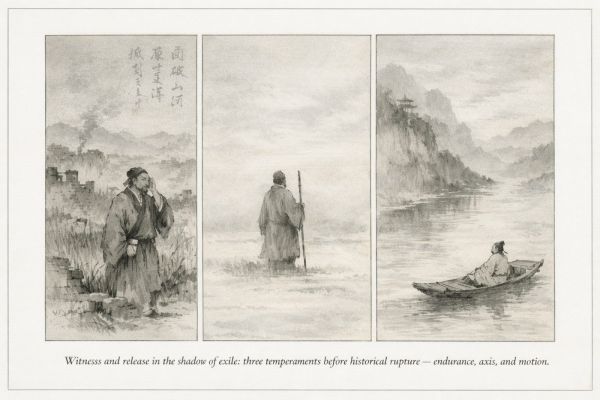
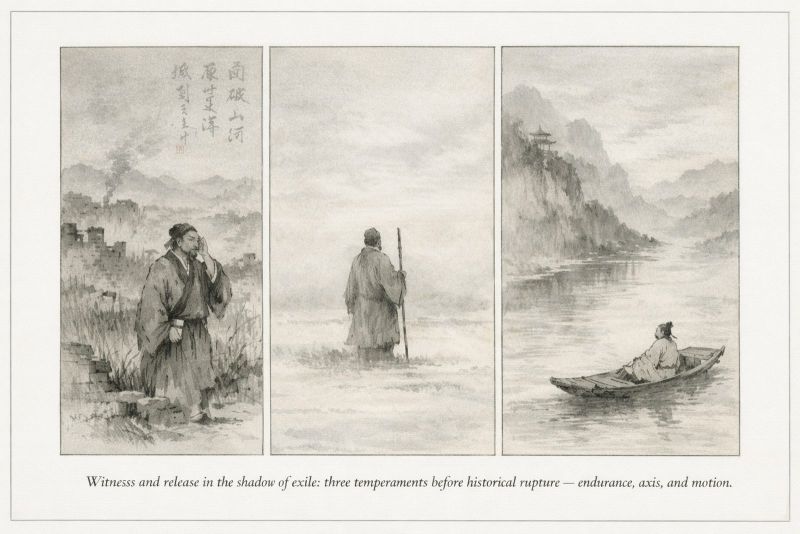
Triptych Legend
Witness and release under the tutelary gaze: three temperaments before historical rupture — endurance, axis, motion.
Left: Du Fu as witness amid ruins — endurance shaped by form.
Center: The archetypal exile, echoing Su Wu — loyalty as vertical axis.
Right: Li Bai in motion — release borne on light water.*
Today’s sharing from the Blue House of Via-HYGEIA is a quiet meditation on two pillars of Tang poetry — Du Fu’s ‘Spring View’ (春望) and Li Bai’s ‘Departure at Dawn from Baidi City’ (早发白帝城) — and the enduring tutelary figure of Su Wu, the Han diplomat who chose nineteen years of exile over betrayal.
I grew up steeped in Chinese poetry — Du Fu, Li Bai, Su Dongpo, Wang Wei, Tao Yuanming, Li Qingzhao, Han Shan… Yet it was these two poems, in their stark contrast, that left the deepest imprint. Their echoes — one anchored in grief, the other in flight — resonate with Su Wu’s story, whose unwavering loyalty became a moral compass woven into my own identity.
Nineteen years have also passed since I left China after living there for fifteen formative and substantial years. I’ve long wanted to share the power of these poems, and the culture that shaped them. Now, at last, is the time.
These are not merely contrasting poems — they are opposing philosophies of being human in the face of collapse. Their divergence is sharpened by the ‘Su Wu problem‘: how each poet engages with the Han dynasty’s paragon of loyalty. The poems appear immediately after their historical context, allowing the reader to anchor the analysis in the original text — with translations crafted to honor the emotional and philosophical weight of the originals. This post is dedicated to Wong Yuen-Ming.
**
Du Fu & Li Bai: Two Responses to Catastrophe — With the tutelary figure of Su Wu
In the wake of the An Lushan Rebellion (755–763), Tang poetry fractured into two distinct modes of survival: one anchored in witness, the other in flight. Du Fu’s ‘Spring View’ (春望, 757) and Li Bai’s ‘Departure at Dawn from Baidi City’ (早发白帝城, 759) are not merely contrasting poems — they are opposing philosophies of being human in the face of collapse. Their divergence is sharpened by the ‘Su Wu problem‘: how each poet engages with the Han dynasty’s paragon of loyalty.
*
Du Fu: The Confucian Captive Who Measured Himself Against Su Wu
Historical Context
Du Fu wrote ‘Spring View’ in 757, imprisoned in rebel-held Chang’an. The Tang capital had fallen. The emperor had fled. Du Fu, who had failed the civil service examination twice, who had known poverty and obscurity, now faced the ultimate test: how to remain loyal to a dynasty that had abandoned its own people.
He never named Su Wu in this poem. But Su Wu was there — in the white hair too thin to hold a hairpin, in the letter from home worth more than gold, in the quiet endurance that measures itself against an impossible standard.
Du Fu’s Explicit Su Wu References
Du Fu invoked Su Wu explicitly in multiple poems, establishing the Han envoy as his primary model for loyalty under duress:
1. ‘Miscellaneous Poems of Qinzhou, No. 7‘ (秦州杂诗·其七, 759)
Written two years after ‘Spring View’, when Du Fu had fled west to Qinzhou (modern Tianshui, Gansu), this poem directly names Su Wu:
Original Chinese
莽莽万重山,孤城山谷间。
无风云出塞,不夜月临关。
属国归何晚? 楼兰斩未还。
烟尘一长望,衰飒正摧颜。
Pinyin
Mǎngmǎng wàn chóng shān, gū chéng shāngǔ jiān.
Wú fēng yún chū sài, bù yè yuè lín guān.
Shǔguó guī hé wǎn? Lóulán zhǎn wèi huán.
Yānchén yī cháng wàng, shuāisà zhèng cuī yán.
English Translation
Stephen Owen, ‘The Poetry of Du Fu‘ (De Gruyter, 2015)
Overgrown, countless rugged peaks
Lonely city, inside the mountain valley
No wind, but clouds cross the border
Not yet night, though moon overlooks the pass
The envoy returns why so late?
Beheading Loulan, one hasn’t come back
Smoke and dust alone I gaze on
Failing strength sallows my looks
‘The envoy‘ (属国) refers to Su Wu, who upon his return from Xiongnu captivity was appointed Dian Shu Guo (典属国) — ‘Director of Dependent States‘. Du Fu uses this title metonymically to invoke the entire Su Wu narrative: nineteen years of herding sheep, the imperial staff (jie 节) with its yak-tail banner degraded by time, the unwavering refusal to serve the enemy. The poem contrasts Han dynasty strength with Tang weakness: Su Wu returned because Han was mighty; now, envoys are delayed, military victories unachieved. Du Fu’s ‘failing strength sallows my looks‘ mirrors Su Wu’s physical degradation — but where Su Wu’s endurance was rewarded, Du Fu fears his may not be.
2. ‘To Li Bai: Twenty Couplets‘ (寄李十二白二十韵, 762)
When Li Bai was banished for joining the wrong prince’s rebellion, Du Fu defended him by explicitly comparing him to Su Wu:
Original Chinese
五岭炎蒸地,三危放逐臣。
几年遭鵩鸟,独泣向麒麟。
苏武先还汉,黄公岂事秦。
Pinyin
Wǔ lǐng yán zhēng dì, sān wēi fàngzhú chén.
Jǐ nián zāo fú niǎo, dú qì xiàng qílín.
Sū Wǔ xiān huán Hàn, Huáng Gōng qǐ shì Qín.
English Translation
(adapted from published versions)
The five ridges — a steaming, sweltering land;
Three Perils — the place of an exile official.
For years now you’ve met the owl of ill omen,
Wept alone before the unicorn.
Su Wu returned to Han at last;
How could Lord Huang have served the Qin?
Here Su Wu becomes exculpatory precedent: just as Su Wu’s loyalty was proven by his return, so Li Bai’s will be. The pairing with ‘Lord Huang‘ (Xia Huang Gong, a hermit who refused to serve the Qin usurper) reinforces that true loyalty may look like disloyalty to the world. Du Fu uses Su Wu not merely as historical allusion but as legal argument, moral defense, friend’s plea.
3. ‘To Zheng Qian, Eighteenth in the Family, Former Editorial Director‘ (题郑十八著作虔, 758)
Most tellingly, Du Fu compared his friend Zheng Qian — a fellow official accused of collaboration with the rebels — to Su Wu:
Original Chinese
贾生对鵩伤王傅,苏武看羊陷贼庭。
可念此翁怀直道,也沾新国用轻刑。
Pinyin
Jiǎ Shēng duì fú shāng Wáng Fù, Sū Wǔ kàn yáng xiàn zéi tíng.
Kě niàn cǐ wēng huái zhí dào, yě zhān xīn guó yòng qīng xíng.
English Translation
(Adapted/compiled for this essay)
Jia Yi, facing the owl, grieved for the tutor;
Su Wu, herding sheep, was trapped in the rebel court.
One feels for this old man, embracing his straight way;
He too received the new state’s lighter punishment.
Zheng Qian had been forced to serve the rebel administration; like Du Fu, he had survived captivity. Du Fu’s defense is precise: Su Wu was ‘trapped‘ (陷) too — not a willing collaborator but a prisoner. The ‘sheep herding‘ (看羊) references Su Wu’s forced labor among the Xiongnu, his degradation, his maintenance of inner loyalty despite outer compliance.
This is the key to Du Fu’s self-understanding in ‘Spring View‘: he too was ‘trapped in the rebel court‘. He too herded no sheep but endured psychological captivity. He too awaited recognition that might never come.
The Poem: ‘Spring View’ (春望)
Original Chinese
国破山河在,
城春草木深。
感时花溅泪,
恨别鸟惊心。
烽火连三月,
家书抵万金。
白头搔更短,
浑欲不胜簪。
Pinyin
Guó pò shānhé zài,
Chéng chūn cǎomù shēn.
Gǎn shí huā jiàn lèi,
Hèn bié niǎo jīng xīn.
Fēnghuǒ lián sān yuè,
Jiāshū dǐ wàn jīn.
Báitóu sāo gèng duǎn,
Hún yù bù shèng zān.
English Translation
Stephen Owen, The Great Age of Chinese Poetry (Yale University Press, 1981), p. 183:
The country is broken, but mountains and rivers remain.
In the city’s spring, grass and trees grow deep.
Moved by the times, flowers shed tears.
Hating separation, birds startle the heart.
Beacon fires have burned for three months.
A letter from home is worth ten thousand in gold.
White hair grows thinner as I scratch it,
Barely able to hold a hairpin.
Reflection
Du Fu’s grief is chenyu (沉郁) — profound, restrained, internalized. His regulated verse (lüshi) imposes formal order on chaos. He does not escape; he witnesses. The ‘letter from home worth ten thousand in gold‘ mirrors Su Wu’s longing for Han — but where Su Wu eventually received word of his emperor’s death and return order, Du Fu receives nothing. The white hair, too thin to hold a hairpin, is not merely aging — it is the physical mark of a man who sees himself as failed Su Wu: not in grand defiance, but in the quiet endurance of grief that may never be recognized.
*
Li Bai: The Daoist Escapee Who Rejected the Su Wu Model
Sū Wǔ zài Xiōngnú,
Shí nián chí Hàn jié.
Bái yàn Shànglín fēi,
Kōng chuán yī shū zhá.
Mù yáng biān dì kǔ,
Luò rì guī xīn jué.
Kě yǐn yuè kū bīng,
Jī cān tiān shàng xuě.
Dōng huán shā sài yuǎn,
Běi chuàng hé liáng bié.
Qì bǎ Lǐ Líng yī,
Xiāng kàn lèi chéng xuè.
English Translation
(adapted from published versions)
Su Wu lived among the Tartars, ten years holding the Han staff; white geese flew over Shanglin Park, vainly carrying a letter; herding sheep in the bitter borderlands, his heart to return lost with the setting sun; thirsty, he drank ice from the moon’s cave, hungry, he ate snow from the heavens; returning east, the sandy passes far, grieving north, parting at the river bridge; weeping, he grasped Li Ling’s robe, looking at each other, tears became blood.
English Translation
Stephen Owen, The Great Age of Chinese Poetry (Yale University Press, 1981), p. 127:
At dawn I left Baidi City, veiled in colorful clouds,
A thousand miles to Jiangling, returned in one day.
On both banks, monkey cries without cease,
The light boat has passed ten thousand mountains.
*
The Su Wu Problem: Loyalty as a Mirror, Not a Model
The ‘problem‘ lies in how each poet uses Su Wu:
-
Du Fu internalizes Su Wu as an ethical standard. His captivity is not just political — it is moral. He measures his own suffering against Su Wu’s, finding in his white hair and unread letters the evidence of a loyalty tested but never proven. His silence on Su Wu in ‘Spring View’ may be humility — or despair.
-
Li Bai externalizes Su Wu as a legendary figure. He admires Su Wu’s suffering but does not claim it. His poem celebrates the freedom Su Wu never knew. The ‘ten thousand mountains‘ he passes are not just geography — they are the layers of his past burdens, left behind.
*
Conclusion
The Conversation Across the Abyss
Li Bai and Du Fu met only once, in 744. Legend says they drank wine — one the immortal, the other the sage. When the rebellion shattered their world, they wrote poems of release — but from opposite ends of the catastrophe. Du Fu remained in the ruins, holding the broken country in language that refuses to look away. Li Bai departed on light water, dissolving his suffering into motion.
Their poems are not opposites — they are complements. Du Fu’s ‘Spring View’ preserves the wound; Li Bai’s ‘Departure at Dawn’ dissolves it. Together, they show that Chinese poetry’s greatest gift is not beauty alone, but the full spectrum of moral and emotional response to a broken world. The Su Wu problem reveals the depth of their divergence: one poet made Su Wu real — a man of flesh, hair, and failing strength; the other made him beautiful — a myth of ice, moonlight, and endurance. Both are true. Both are necessary.
On a broader scale, we might also consider a Silk Road dimension: the An Lushan Rebellion was not merely a dynastic crisis — it was a rupture in the cosmopolitan fabric of Tang China. An Lushan himself was of Sogdian-Turkic descent, a product of the very crossroads the Silk Road had nurtured. In their own ways, Du Fu and Li Bai wrote the end of that world — one through grief, the other through escape. Their poems are not just personal responses to trauma; they are elegies for a civilization in transformation.
*
Appendix
Three companion videos offer visual and auditory companionship to today’s reflections — exploring Du Fu’s ‘Spring View‘, Li Bai’s ‘Departure at Dawn from Baidi City‘, and the enduring story of Loyal Su Wu.
Enjoy.
Note: These videos are created by independent voices and do not represent the philosophical or spiritual framework of Via-HYGEIA Bibliotherapy. We share them not as endorsements, but as resonant echoes — to enrich the journey, not define it.
*
*
*
Further Reading
- Du Fu — ‘Spring View’ — CN Poetry (original text, pinyin, translation, and historical context).
- Li Bai — ‘Departure at Dawn from Baidi City’ — CN Poetry (original text, pinyin, translation, and historical context).
- Loyal Su Wu — Historical Overview — New World Encyclopedia (comprehensive, peer-reviewed).
***

Related Articles


Leave a Reply