
Circle of Transmission: The Living Loom
Francis Warrain: The System of Reality according to Hoëné Wroński

2 Portraits
Top: Francis Warrain, posthumous portrait by Arlette Ryan (1956). Source: Antoine Mercier, his great-grandson.
Bottom: Józef Maria Hoëné-Wroński, by Laurent-Charles Maréchal (1845), pastel. On display at the Metz Museum of Fine Arts, France.
*
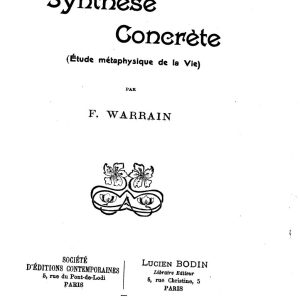
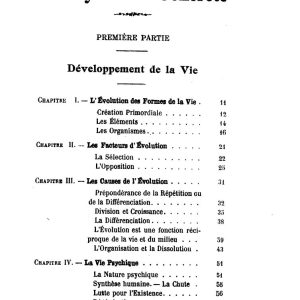
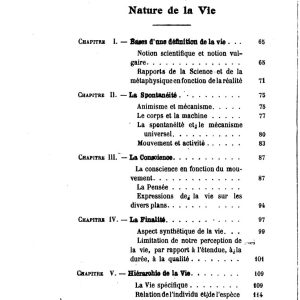
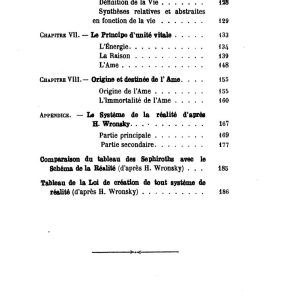
Today’s sharing from the blue House of Via-HYGEIA is an article written by Francis Warrain, published as an appendix in his book ‘La Synthèse Concrète’ (The Concrete Synthesis) published in 1906 in the library of the periodical ‘La Voie‘ (the Path). We have published earlier, the 1928 Sorbonne conference ‘Wronski’s Law of Creation‘ followed by ‘The Synthesis of Quantity, according to Hoëné Wroński’. Forthcoming publications will be chapters from ‘La Synthèse Concrète‘: ‘La Vie Psychique‘ (the Psychical Life) which is its chapter IV & ‘Origine et destinee de l’Ame‘ (Origin and destiny of the soul) which is chapter VIII.
**
Contextual Introduction
Francis Warrain, a sophisticated philosopher, mathematician, and esotericist, devoted decades to recovering and articulating Hoëné Wroński’s thought. His 1928 Sorbonne lecture — delivered on the 150th anniversary of Wroński’s birth — presents the Law of Creation in broad outlines for an academic audience. The present text, an appendix article from his ‘La Synthèse Concrète’ (1906), is a working document — a philosophical toolbox. It lays out the internal architecture of the system with diagrammatic clarity: the seven elements, the four systematic classes, the distinction between Theory and Technics, between Content and Form, between the Elementary and the Systematic.
What makes this appendix particularly valuable is its explicit engagement with the Kabbalistic tradition. Despite Wroński’s own reservations about the Pythagorean decade, Warrain demonstrates a striking correspondence between the eleven functional parts of the Law of Creation and the ten sephiroth of the Kabbalistic Tree. This correlation is not merely illustrative; it reveals Warrain’s conviction that Wroński’s ‘ontological pentacle’ participates in a perennial architecture of reality — one that finds expression in the Sephiroth, in the Chinese Yin-Yang, in the Seal of Solomon, and in the Sign of the Cross, as he notes in his lecture, ‘Wronski’s Law of Creation‘.
The reader should approach this text as Warrain himself suggests: as an invitation to study, not a substitute for it. The diagrams, the tabular presentations, the careful distinctions — all are signposts pointing toward a system that demands sustained meditation. Yet within these pages lies the essential framework: the primordial triad of Being, Knowledge, and the Neutral element; the derived Universal and Transitive elements; the systematic classes of Partial Influence, Final Concourse, and Coronary Parity; and the overarching distinction between what is given (Theory) and what must be done (Technics). For students of metaphysics, esoteric philosophy, and comparative symbolism, Warrain’s article remains an indispensable guide to one of the most ambitious philosophical constructions of the nineteenth century.
*
Key Themes and Messages
The Law of Creation as Architectural Blueprint
Unlike the lecture, which argues for the system’s validity, the appendix article simply presents its structure. It is a philosophical anatomy — showing how any conceivable reality must be constituted.
The Septenary of Elements
The complete derivation from the primordial triad (EN, ES, EE) through the Universals (UK, UB) to the Transitives (TK, TB) — seven elements that exhaust all elementary combinations.
The Four Systematic Classes
How Being and Knowledge reunite after their elementary differentiation: Partial Influences (K-in-B, B-in-K), Final Concourse (harmony), and Coronary Parity (full accomplishment).
Content vs. Form
The fundamental distinction between what a thing is in itself (essence/transcendental) and how it relates to others (mode of being/logical).
Theory vs. Technics
Perhaps the most original distinction — between ‘what is‘ (autothesis, individual generation) and ‘what must be done‘ (autogeny, universal generation).
Kabbalistic Correlation
The systematic mapping of Wroński’s abstract elements onto the living geometry of the Sephirotic Tree, showing how the Neutral element radiates through Beauty, how the Transitives find their places as Victory and Glory, how the Final Concourse operates at the Foundation, and how the Coronary Parity completes the work in the Kingdom.
The Tables as Philosophical Instruments
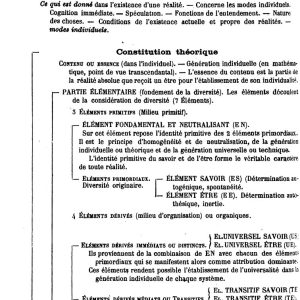
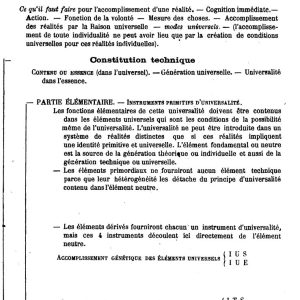
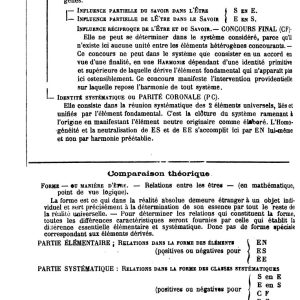
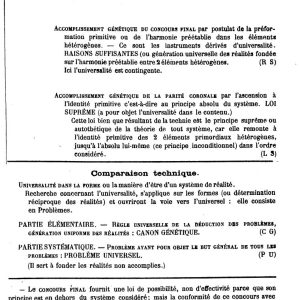
The two large tables (pages 198–201) are not mere summaries — they are the system, showing the parallel structure of Theory and Technics at every level.
*
Comparison: Appendix vs. Sorbonne Lecture
| Aspect | Appendix (Translated Text) | Sorbonne Lecture |
|---|---|---|
| Audience | Students undertaking serious study | Academic audience at the Sorbonne |
| Purpose | Present internal structure with diagrammatic clarity | Argue for system’s validity and foundations |
| Tone | Dense, schematic, analytical | Discursive, philosophical, historical |
| Structure | Tabular and diagrammatic — shows relationships | Linear argument — builds from first principles |
| Key Innovation | Detailed Kabbalistic correlation (pp. 195–196) | Argument from transcendental skepticism |
| Treatment of the Absolute | Implicit — system presupposes it | Explicit — Section I develops the notion |
| The Triad | Presented as given (EN, ES, EE) | Argued for through analysis of Being, Knowledge, Action |
| Practical Application | Briefly mentioned (mathematics, biology) | Extended discussion (Architectonics, Music, etc.) |
| Mystical Dimension | Present in Kabbalistic correlation | Explicit in conclusion on Love and Absolute |
| The Tables | Central — they are the exposition | Mentioned but not reproduced |
How They Complement Each Other
The lecture provides the why — the philosophical justification, historical context, argument for why this system is necessary and valid. It builds from the notion of the Absolute, through the critique of skepticism, to the demonstration that the triad is the necessary constitution of all reality.
The appendix provides the what — the detailed architecture, the precise relationships, the functional elements that must be present in any system of reality. It is less concerned with proving the system than with showing how it works.
Together, they form a complete introduction: the lecture for orientation, the appendix for study. As Warrain himself says in the appendix article: ‘no commentary can replace the personal effort necessary to penetrate its depth and solidity’. These two texts, read together, provide the best possible preparation for that effort.
*
The Text:
The System of Reality According to Hoëné Wroński
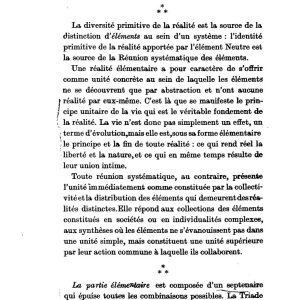
I conclude this first study on concrete synthesis by summarizing the system of Reality according to Wroński and by indicating some applications, because this system seems to me to encompass the sphere we have studied and to contain its principle. With the exception of some details, I align myself with Wroński’s doctrine, for it appears to provide the general solutions to most of the antinomies that contemporary philosophy encounters, and whose resolution in some special cases is barely glimpsed nowadays.
Wroński’s system is the only one that logically reconciles criticism and realism, modern analysis and esoteric synthesis, rationalism and religious faith. In the study that will follow this one, which will focus on quantitative synthesis, we will constantly rely on Wroński’s system. I have condensed here the various explanations scattered throughout the considerable work of this philosopher, and I have also provided certain clarifications drawn from my own resources, which seemed to me inevitable.
However, I am not unaware of the imperfection inherent in my interpretations; my goal is not to spare the reader the effort of turning to Wroński’s original work, but on the contrary to encourage him to undertake its study by attempting here to make its approach less arduous. Wroński’s system requires, to be understood, serious study and sustained meditation; and no commentary can replace the personal effort necessary to penetrate its depth and solidity. It is only progressively and through studies undertaken on various subjects that one grasps the value of this brilliant work which helps to resolve many questions.
We have already seen that all conceivable reality is constituted by an original diversity of Knowledge and Being, neutralized by a fundamental element or Neutral.
The Knowledge element is ‘that which, in reality, can be the object of knowledge; the Being element, that which, in a reality, is the substratum independent of all knowledge. Knowledge is that which can determine something, and Being is that which is susceptible to receiving a determination. Knowledge is the active, spontaneous element; Being the passive, inert element. But, Being is only possible as an object of Knowledge; Knowledge is only possible in its relation with Being‘.
The Neutral element which founds reality by uniting Being and Knowledge (which only exist in relation to each other) distinguishes them at the same time. It has the double aspect of a primitive source and a resultant. It is what establishes the primitive identity of Knowledge and Being, an identity that forms the true character of Reality.
This constitution of Reality evokes the first sephirothic ternary where the Neutral element corresponds to the Crown with its center and its periphery, having as its virtual radiation Knowledge, or Wisdom, and as its expanse defined by this radiation, Intelligence, passivity of that which is, in relation to the choice of Wisdom.
From the point of view of the created world which concerns us, this ternary is represented by freedom (ES), nature (EE) and Life (EN).
The primitive diversity of reality is the source of the distinction of elements within a system: the primitive identity of reality brought by the Neutral element is the source of the systematic Reunion of elements.
An elementary reality is characterized by offering itself as a concrete unit within which the elements are discovered only through abstraction and have no reality by themselves. It is here that the unitary principle of life manifests itself, which is the true foundation of reality. Life is therefore not simply an effect, a term of evolution, but it is, in its elementary form, the principle and the end of all reality: that which makes freedom and nature real, and which at the same time results from their intimate union.
Every systematic reunion, on the contrary, presents unity immediately as constituted by the collectivity and the distribution of elements that remain distinct realities. It corresponds to collections of elements constituted as societies or complex individualities, to syntheses where the elements do not vanish into a simple unity, but constitute a superior unity through their common action to which they collaborate.
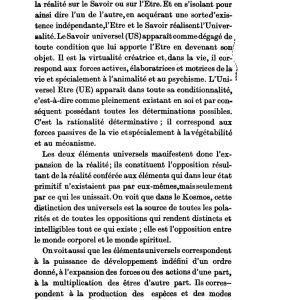
The elementary part is composed of a septenary that exhausts all possible combinations. The primordial Triad gives rise to 4 derived elements. The immediate derivation consists of the combination of the Being element or the Knowledge element with the Neutral element. This combination thus realizes a kind of concentration of reality on Knowledge or on Being. And by isolating themselves, so to speak, from one another, by acquiring a kind of independent existence, Being and Knowledge realize Universality. Universal Knowledge (UK) appears freed from any condition that Being brings to it by becoming its object. It is creative virtuality and, in life, it corresponds to the active, elaborating and driving forces of life and especially to animality and psychism. The Universality Being (UB) appears in all its conditionality, that is to say as fully existing in itself and consequently possessing all possible determinations. It is deterministic rationality; it corresponds to the passive forces of life and especially to vegetability and mechanism.
The two universal elements thus manifest the expansion of reality; they constitute the opposition resulting from the reality conferred upon elements which in their primitive state did not exist by themselves, but only by what united them. We see that in the Kosmos, this distinction of universals is the source of all polarities and all oppositions that make distinct and intelligible everything that exists; it is the opposition between the corporeal world and the spiritual world.
We also see that the universal elements correspond to the power of indefinite development of a given order, to the expansion of forces or actions on the one hand, to the multiplication of beings on the other. They correspond to the production of species and modes of action.
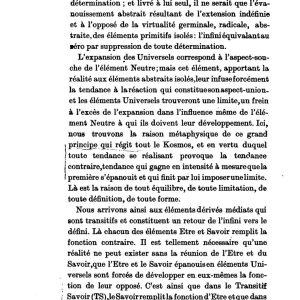
But every expansion carries with it the germ of the reaction that will limit and define it. For the universal, in itself, by the very excess of reality, tends towards indeterminacy; and left to itself alone, it would only be the abstract evanescence resulting from indefinite extension and opposite to the germinal, radical, abstract virtuality of isolated primitive elements: the infinite equivalent to zero by suppression of all determination.
The expansion of Universals corresponds to the source-aspect of the Neutral element; but this element, bringing reality to isolated abstract elements, forcibly infuses them with the tendency towards reaction which constitutes its union-aspect and the Universal elements will find a limit, a brake on the excess of expansion in the very influence of the Neutral element to which they owe their development. Here, we find the metaphysical reason for this great principle which governs the entire Kosmos, and by virtue of which every tendency realizing itself provokes the opposite tendency, a tendency that gains in intensity as the first unfolds and which ends up imposing a limit on it. Therein lies the reason for all equilibrium, all limitation, all definition, all form.
Thus we arrive at the mediate derived elements which are transitive and constitute a return from the infinite towards the finite. There each of the elements Being and Knowledge fulfills the opposite function. It is so necessary that a reality cannot exist without the union of Being and Knowledge, that Being and Knowledge expanded into Universal elements are forced to develop within themselves the function of their opposite. Thus it is that in the Transitive Knowledge (TK), Knowledge fulfills the function of Being and that in the Transitive Being (TB), Being fulfills the function of Knowledge.
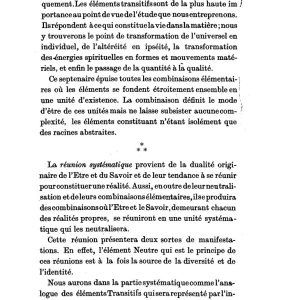
Now, the Kosmos and Life show us that matter engenders force and that force engenders matter, that the passive principle sometimes functions as activity and vice versa. The transitive elements are of the highest importance from the point of view of the study we are undertaking. They correspond to what constitutes life in matter; we will find there the point of transformation from the universal to the individual, from otherness to selfhood, the transformation of spiritual energies into material forms and movements, and finally the passage from quantity to quality.
This septenary exhausts all the elementary combinations where the elements merge closely together into a unity of existence. The combination defines the mode of being of these units but leaves no complexity subsisting, the constituent elements being only abstract roots in isolation.
The systematic reunion arises from the original duality of Being and Knowledge and from their tendency to reunite to constitute a reality. Consequently, in addition to their neutralization and their elementary combinations, combinations will occur where Being and Knowledge, each remaining proper realities, will reunite into a systematic unity that will neutralize them.
This reunion will present two kinds of manifestations. Indeed, the Neutral element which is the principle of these reunions is at the same time the source of diversity and identity.
We will have in the systematic part, as it were, the analysis of the Transitive elements which will be represented by the influence of one of the primordial elements upon the other, one functioning as Knowledge in its opposite functioning as Being. It is no longer upon itself that each element operates by assuming the opposite role as in the transitives, it is upon the opposite element.
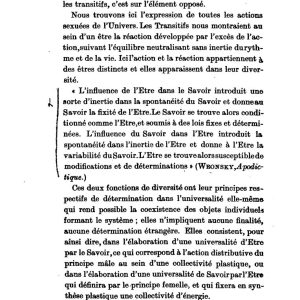
We find here the expression of all sexed actions in the Universe. The Transitives showed us within a being the reaction developed by the excess of action, following the neutralizing equilibrium without inertia of the theme and of life. Here, action and reaction belong to distinct beings and they appear in their diversity.
“The influence of Being upon Knowledge introduces a kind of inertia into the spontaneity of Knowledge and gives to Knowledge the fixity of Being. Knowledge then finds itself conditioned like Being, and subject to fixed and determined laws. The influence of Knowledge upon Being introduces spontaneity into the inertia of Being and gives to Being the variability of Knowledge. Being then finds itself susceptible to modifications and determinations.” (Wroński, ‘Apodictic’).
These two functions of diversity have their respective principles of determination in universality itself, which makes possible the coexistence of the individual objects forming the system; they imply no finality, no foreign determination. They consist, so to speak, in the elaboration of a universality of Being by Knowledge, which corresponds to the distributive action of the male principle within a plastic collectivity, or in the elaboration of a universality of Knowledge by Being which will be defined by the female principle, and which will fix in plastic synthesis a collectivity of energy.
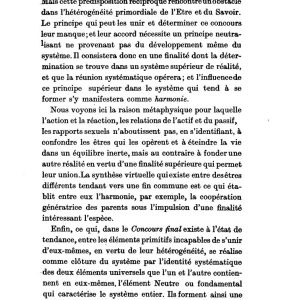
There exists a third mode of systematic reunion where Being and Knowledge tend to influence each other reciprocally without preponderance of one or the other, but by virtue of this tendency to merge which founds reality. But this reciprocal predisposition encounters an obstacle in the primordial heterogeneity of Being and Knowledge. The principle that can unite them and determine this concurrence is lacking to them; and their agreement necessitates a neutralizing principle not arising from the very development of the system. It will therefore consist of a finality whose determination is found in a superior system of reality, and which the systematic reunion will bring about; and the influence of this superior principle within the system tending to form itself will manifest there as harmony.
We see here the metaphysical reason why action and reaction, the relations of the active and the passive, sexual relations do not result, by identifying themselves, in merging the beings that perform them and extinguishing life in an inert equilibrium, but on the contrary in founding another reality by virtue of a superior finality that permits their union. The virtual synthesis that exists between different beings tending towards a common end is what establishes harmony between them, for example, the generative cooperation of parents under the impulse of a finality concerning the species.
Finally, what, in the final Concurrence exists as a tendency, between the primitive elements incapable of uniting by themselves, by virtue of their heterogeneity, is realized as the closure of the system by the systematic identity of the two universal elements that both contain within themselves the Neutral or fundamental element that characterizes the entire system. They thus form a Coronary Parity (CP) reproducing primitive reality, but universalizing it. This triad is thus only a reproduction, a systematic identity reproducing the Neutral element.
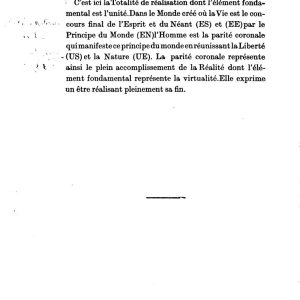
Here is the Totality of realization whose fundamental element is unity. In the created World where Life is the final concurrence of Spirit and Nothingness (ES) and (EE) through the Principle of the World (EN), Man is the coronary parity that manifests this principle of the world by reuniting Freedom (UK) and Nature (UB). The coronary parity thus represents the full accomplishment of Reality whose fundamental element represents virtuality. It expresses a being fully realizing its end.
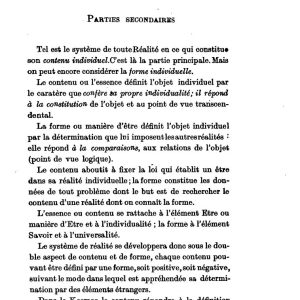
Such is the system of all Reality in terms of what constitutes its individual content. This is the principal part. But one can also consider the individual form.
Content or essence defines the individual object by the character conferred by its own individuality; it corresponds to the constitution of the object and to the transcendental point of view.
Form or mode of being defines the individual object by the determination imposed upon it by other realities: it corresponds to comparison, to the relations of the object (logical point of view).
Content culminates in fixing the law that establishes a being in its individual reality; form constitutes the givens of every problem whose goal is to seek the content of a reality whose form is known.
Essence or content is connected to the element Being or mode of Being and to individuality; form to the element Knowledge and to universality.
The system of reality will therefore develop under the double aspect of content and form, each content being capable of being defined by a form, either positive or negative, according to the mode in which its determination by foreign elements is apprehended.
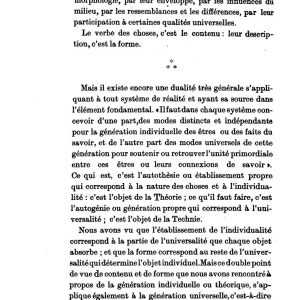
In the Kosmos, content will correspond to the definition of things by their structure, by their axial framework, by their characteristic action and their defined finality; form will correspond to the determination of things by their morphology, by their envelope, by environmental influences, by resemblances and differences, by their participation in certain universal qualities.
The verb of things is content: their description is form.
But there also exists a very general duality applying to every system of reality and having its source in the fundamental element. ‘In each system one must conceive, on the one hand, distinct and independent modes for the individual generation of beings or facts of knowledge, and on the other hand universal modes of this generation to support or rediscover the primordial unity between these beings or their knowledge connections’. What is, is autothesis or proper establishment which corresponds to the nature of things and to individuability: it is the object of Theory; what must be done, is autogeny or proper generation which corresponds to universality: it is the object of Technique.
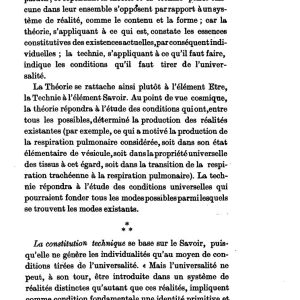
We have seen that the establishment of individuality corresponds to the part of universality that each object absorbs; and that form corresponds to the remainder of universality that determines the individual object. But this double point of view of content and form that we encountered concerning individual or theoretical generation, applies equally to universal generation, that is to say to what must be done to produce possible objects (of a system), consequently, to technique.
Technics will thus present the transcendental or constitutive point of view, and the logical or comparative point of view; and yet theory and technics taken each as a whole are opposed with respect to a system of reality, like content and form; for theory, applying to what is, ascertains the constitutive essences of actual existences, consequently individual ones; technics, applying to what must be done, indicates the conditions that must be drawn from universality.
Theory is thus connected rather to the element Being, Technics to the element Knowledge. From the cosmic point of view, theory will correspond to the study of the conditions which have, among all possibles, determined the production of existing realities (for example, what motivated the production of pulmonary respiration considered, either in its elementary state of vesicle, or in the universal property of tissues in this regard, or in the transition from tracheal respiration to pulmonary respiration). Technics will correspond to the study of universal conditions that could ground all possible modes among which the existing modes are found.
Technical constitution is based on Knowledge, since it generates individualities only by means of conditions drawn from universality. ‘But universality cannot, in turn, be introduced into a system of distinct realities except insofar as these realities imply, as a fundamental condition, a primitive and universal identity. And it is this identity that the fundamental element gives them. Consequently, it is only in those realities that openly imply this fundamental element that the universality in question can be established’.
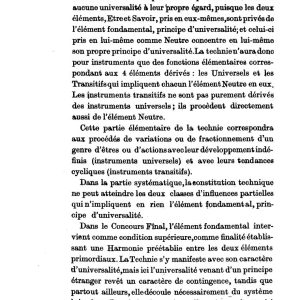
And the three primitive elements cannot give rise to any universality with respect to themselves, since the two elements, Being and Knowledge, taken in themselves, are deprived of the fundamental element, the principle of universality; and the latter, taken in itself as the Neutral, concentrates its own principle of universality within itself. Technique will therefore have as its instruments only the elementary functions corresponding to the 4 derived elements: the Universals and the Transitives, each of which implies the Neutral element within them. The transitive instruments are not purely derived from the universal instruments; they proceed directly as well from the Neutral element.
This elementary part of technics will correspond to the procedures of variation or fractionation of a kind of beings or actions with their indefinite development (universal instruments) and with their cyclic tendencies (transitive instruments).
In the systematic part, technical constitution cannot attain the two classes of partial influences which in no way imply the fundamental element, the principle of universality.
In the Final Concurrence, the fundamental element intervenes as a superior condition, as a finality establishing a pre-established Harmony between the two primordial elements. Technics manifests itself there with its character of universality, but here the universality coming from a foreign principle takes on a character of contingency, whereas everywhere else, it flows necessarily from the system itself. The universal generation which presents itself here as Sufficient Reasons is founded on the pre-established harmony of heterogeneous elements. (There, we will place the groups defined by certain numerical sets, kinds of determinative coefficients of their specific essences, for example, the 5 species of regular polyhedra constrained to have such and such a number of faces, angles, edges, etc.).
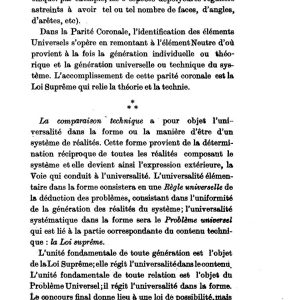
In the Coronary Parity, the identification of the Universal elements is accomplished by ascending to the Neutral element from which proceed simultaneously the individual or theoretical generation and the universal or technical generation of the system. The accomplishment of this coronary parity is the Supreme Law which connects theory and technics.
Technical comparison has as its object universality in the form or mode of being of a system of realities. This form proceeds from the reciprocal determination of all the realities composing the system and it thus becomes the external expression, the Way that leads to universality. Elementary universality in form will consist of a universal Rule for the deduction of problems, consisting in the uniformity of the generation of the realities of the system; systematic universality in form will be the universal Problem which is linked to the corresponding part of the technical content: the Supreme Law.
The fundamental unity of all generation is the object of the Supreme Law; it governs universality in content. The fundamental unity of all relation is the object of the universal Problem; it governs universality in form. The final concurrence gives rise to a law of possibility, but not of effectivity, for effectivity proceeds here from a teleological principle; the Supreme Law can only bring to it its possibility, not its effectivity. This teleological principle determines the final contingency of the system.
Supreme Law, universal Problem and Teleological Law will summarize Cosmology by seeking to define the universal principle of the evolutionary virtualities of the universe, and the finality towards which it tends by virtue of the Providential Harmony that directs it.
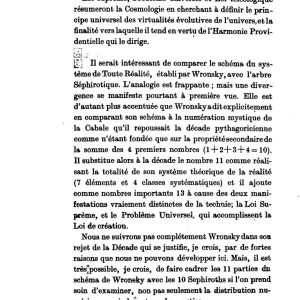
It would be interesting to compare the schema of the system of All Reality, established by Wroński, with the Sephirotic Tree. The analogy is striking; but a divergence nevertheless manifests itself at first glance. It is all the more accentuated because Wroński explicitly said, in comparing his schema to the mystical numeration of the Kabbalah, that he rejected the Pythagorean decade as being founded only on the secondary property of the sum of the first 4 numbers (1 + 2 + 3 + 4 = 10). He then substitutes for the decade the number 11 as realizing the totality of his theoretical system of reality (7 elements and 4 systematic classes) and he adds as important numbers 13 because of the two truly distinct manifestations of technics: the Supreme Law, and the universal Problem, which accomplish the Law of creation.
We will not completely follow Wroński in his rejection of the Decade, which is justified, I believe, by strong reasons that we cannot develop here. But, it is very possible, I think, to make the 11 parts of Wroński’s schema correspond with the 10 Sephiroth if one takes care to examine, not only the numerical distribution, but the nature of the parts.
Here then is how I conceive the correlation:
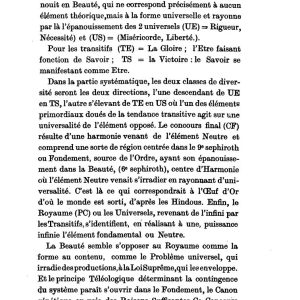
(EN) = the Crown as neutralizing (ES) := Wisdom and (EE) = Intelligence. But (EN) is at the same time the source of Universality, and as such, it expands into Beauty, which corresponds precisely to no theoretical element, but to the universal form and thereby radiates the unfolding of the 2 universals (UB) := (Severity, Necessity) and (UK) = (Mercy, Freedom).
For the transitives (TB) = Glory; Being functioning as Knowledge; TK = Victory: Knowledge manifesting itself as Being.
In the systematic part, the two classes of diversity will be the two directions, one descending from UB to TK, the other rising from TB to UK where one of the primordial elements endowed with the transitive tendency acts upon a universality of the opposite element. The final concurrence (FC) results from a harmony coming from the Neutral element and comprises a kind of region centered in the 9th sephirah or Foundation, source of Order, having its unfolding in Beauty (6th sephirah), center of Harmony where the Neutral element came to radiate forth, shining with universality. This is what would correspond to the Golden Egg from which the world emerged, according to the Hindus. Finally, the Kingdom (CP) where the Universals, returning from the infinite through the Transitives, are identified, realizing at an infinite power the fundamental or Neutral element.
Beauty seems opposed to the Kingdom as form to content, as the universal Problem, which radiates productions, to the Supreme Law, which envelops them. And the Teleological principle determining the contingency of the system appears to open up in the Foundation, the genetic Canon or way of Sufficient Reasons. This Final Concurrence seems to function between the Supreme Law and the universal Problem, between the Kingdom and Beauty, like the Neutral element between the element Being and the element Knowledge.
The Law of Creation: Theory vs. Technics
N.B. — In this table, we have inserted explanatory notes taken from the works of Mr. Wroński but scattered in various passages.
| THEORY (Autothesy) — What is given in existence of a reality. | TECHNICS (Autogeny) — What must be done for the accomplishment of a reality. |
|---|---|
| Concerns individual modes. | Concerns universal modes. |
| Immediate cognition. — Speculation. — Functions of understanding. — Nature of things. — Conditions of the actual and proper existence of realities. — Individual modes. | Immediate cognition. — Action. — Functions of the will. — Measure of things. — Accomplishment of realities by universal Reason. — Universal modes. (The accomplishment of every individuality can only take place through the creation of universal conditions for these individual realities). |
| Theoretical Constitution | Technical Constitution |
| CONTENT OR ESSENCE (in the individual) — Individual generation (in mathematics, transcendental point of view). — The essence of content is the part of absolute reality that a being receives for the establishment of its individuality. | CONTENT OR ESSENCE (in the universal) — Universal generation. — Universality in essence. |
| ELEMENTARY PART (foundation of diversity) | ELEMENTARY PART — PRIMITIVE INSTRUMENTS OF UNIVERSALITY |
| Elements deriving from the consideration of diversity (7 Elements). | The elementary functions of this universality must be contained in the universal elements which are the conditions of the very possibility of universality. |
| 3 PRIMITIVE ELEMENTS (Primitive medium) | — The primordial elements will provide no technical element because their heterogeneity detaches them from the principle of universality contained in the neutral element. |
| FUNDAMENTAL AND NEUTRALIZING ELEMENT (EN) — Upon this element rests the primitive identity of the 2 primordial elements. It is the principle of homogeneity and neutralization, of individual or theoretical generation and of universal or technical generation. The primitive identity of knowledge and being forms the true character of all reality. | — The derived elements will each provide an instrument of universality, but these instruments derive here directly from the neutral element. |
| PRIMORDIAL ELEMENTS — Original diversity. | GENETIC ACCOMPLISHMENT OF UNIVERSAL ELEMENTS: { UK — UB } |
| KNOWLEDGE ELEMENT (ES) — Autogenic determination, spontaneity. | GENETIC ACCOMPLISHMENT OF TRANSITIVE ELEMENTS: { TK — TB } |
| BEING ELEMENT (EE) — Autothetic determination, inertia. | |
| 4 DERIVED ELEMENTS (medium of organization) or organic elements | SYSTEMATIC PART — ESSENTIAL CLASSES OF UNIVERSALITY |
| IMMEDIATE OR DISTINCT DERIVED ELEMENTS — Proceed from the combination of EN with each of the primordial elements which then manifest as dominant attribution. These elements make possible the establishment of universality in the individual generation of each system. | (For the preceding reasons, no technical class corresponding to the classes of partial influences). |
| UNIVERSAL KNOWLEDGE (UK) | GENETIC ACCOMPLISHMENT OF THE FINAL CONCOURSE — by postulate of primitive preformation or of pre-established harmony in the heterogeneous elements. — These are the derived instruments of universality. SUFFICIENT REASONS (or universal generation of realities founded on the pre-established harmony between 2 heterogeneous elements). Here universality is contingent. |
| UNIVERSAL BEING (UB) | GENETIC ACCOMPLISHMENT OF THE CORONARY PARITY — by ascension to primitive identity, that is to say to the absolute principle of the system. SUPREME LAW (has as its object universality in content.) This law, although resulting from technics, is the supreme or autothetic principle of the theory of every system, for it ascends to the primitive identity of the 2 heterogeneous primordial elements, up to the absolute itself (this unconditional principle) in the order considered. |
| MEDIATE OR TRANSITIVE DERIVED ELEMENTS — Proceeding from the connection maintained between the universal elements by the neutral element. In these elements, Knowledge functions as Being, and Being functions as Knowledge. | |
| TRANSITIVE KNOWLEDGE (TK) | |
| TRANSITIVE BEING (TB) | |
| SYSTEMATIC PART | Theoretical Comparison |
| From primordial polarity results not only a neutralization or combination within each object, but also a systematic reunion of the 2 proper functions of the 2 primordial elements (4 classes). | FORM — OR MODE OF BEING — Relations between beings — (in mathematics, logical point of view). Form is that which, in absolute reality, remains foreign to an individual object and serves precisely for the determination of its essence by all the rest of universal reality. — To determine the relations that constitute form, all characteristic differences will be provided by that which establishes the elementary and systematic essential difference. Therefore no special form corresponding to derived elements. |
| Systematic Diversity — Results from the immediate derived or universal elements each contributing through the unity of connection they hold from the fundamental element: This makes possible the coexistence of heterogeneous individual objects. | Elementary Part: Relations in the form of elements — {EN}, {ES}, {EE} |
| PARTIAL INFLUENCE OF KNOWLEDGE IN BEING (K in B) | Systematic Part: Relations in the form of system classes — {K in B}, {B in K}, {FC}, {CP} |
| PARTIAL INFLUENCE OF BEING IN KNOWLEDGE (B in K) | The Teleological Concourse is in a way the identification of the Supreme Law and the universal Problem: that is to say between theoretical autothesy and technical autogeny. (It corresponds to the Law of Progress) i.e., the unconditional characters of the good and the true. |
| RECIPROCAL INFLUENCE OF BEING AND KNOWLEDGE — FINAL CONCOURSE (FC) — It cannot be determined within the system under consideration, because there is no unity here between the concurring heterogeneous elements. — This concourse can, within the system, only consist of an agreement with a view to a finality, in a harmony depending on a primitive and superior identity from which derives the fundamental element that does not appear here ostensibly. This concourse manifests the providential intervention upon which the harmony of every system rests. | Technical Comparison — UNIVERSALITY IN THE FORM or mode of being of a system of reality. Inquiry concerning universality, applies to forms (or reciprocal determination of realities) and will open the way towards the universal: it consists of Problems. |
| Systematic Identity or Coronary Parity (CP) — It consists in the systematic reunion of the 2 universal elements, linked and unified by the fundamental element. It is the closure of the system returning to the origin by manifesting the original neutral element as elaborated. The Homogeneity and neutralization of ES and EE is accomplished here by EN itself and not by pre-established harmony. | Elementary Part — UNIVERSAL RULE FOR THE DEDUCTION OF PROBLEMS, UNIFORM GENERATION OF REALITIES: GENETIC CANON. |
| Systematic Part — PROBLEM HAVING AS ITS OBJECT THE GENERAL PURPOSE OF ALL PROBLEMS: UNIVERSAL PROBLEM. (It serves to found unaccomplished realities.) | |
| The FINAL CONCOURSE provides a law of possibility, not of effectivity because its principle is outside the system considered; but the conformity of this concourse with the universality of the system establishes a subordination of concurring facts, hence a secondary determination founded on a special principle that must be able to be established at least contingently as objective finality (while technics has a subjective finality). TELEOLOGICAL PRINCIPLE (determines the final contingency of the system). |
Glossary of Abbreviations
| Abbreviation | Full Term (French / English) | Description |
|---|---|---|
| EN | Élément Neutre / Neutral Element | Foundational element unifying Knowledge and Being; source of identity and universality. |
| ES | Élément de Savoir / Knowledge Element | Active, spontaneous element; that which determines. |
| EE | Élément d’Être / Being Element | Passive, inert element; that which receives determination. |
| UK | Universel Savoir / Universal Knowledge | Creative virtuality; active, elaborating force (e.g., animality, psychism). |
| UB | Universel Être / Universal Being | Deterministic rationality; passive, conditional force (e.g., vegetability, mechanism). |
| TK | Transitif Savoir / Transitive Knowledge | Knowledge functioning as Being; e.g., force engendering matter. |
| TB | Transitif Être / Transitive Being | Being functioning as Knowledge; e.g., matter engendering force. |
| FC | Concours Final / Final Concourse | Harmonious union of heterogeneous elements via a superior finality (e.g., Foundation/Yesod). |
| CP | Parité Coronale / Coronary Parity | Systemic closure; identity of Universals via EN (e.g., Kingdom/Malkuth). |
| LS | Loi Suprême / Supreme Law | Governs universality in content; ascends to absolute identity. |
| PU | Problème Universel / Universal Problem | Governs universality in form; the “Way” to universal realization. |
| RS | Règle Suprême / Supreme Rule (or Genetic Canon) | Elementary universal rule for deduction of problems. |
| TP | Téléologique / Teleological Principle | Determines final contingency; external finality for the system. |
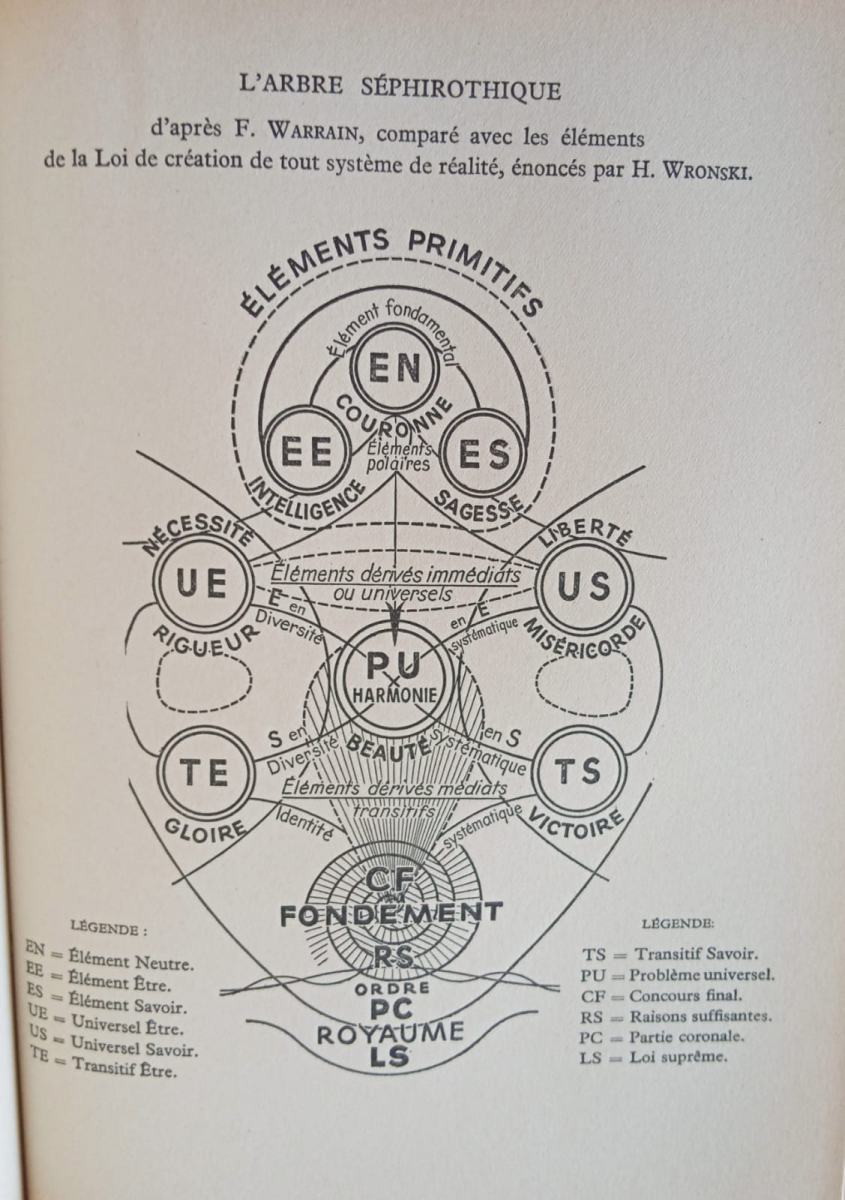
Diagram Structure:
The Kabbalistic Correlation
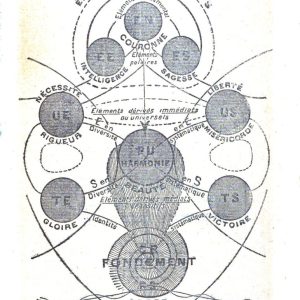
The diagram maintains the classic Kabbalistic tree structure with its three pillars and ten sephiroth. Warrain has mapped Wroński’s elements onto this traditional framework. The Correspondences Warrain proposed in the text (pages 195-196) are visually represented here:
-
EN (Élément Neutre/Neutral Element ) at the top as Kether (Crown) – the fundamental neutralizing element
-
ES (Savoir/Knowledge Element) as Chokmah (Wisdom) and EE (Être) as Binah (Intelligence) – the primordial pair
-
US (Universel Savoir/Universal Knowledge) and UE (Universel Être) – corresponding to Mercy and Severity
-
TS (Transitif Savoir/Transitive Knowledge) as Netzach (Victory) and TE (Transitif Être) as Hod (Glory)
-
CF (Concours Final/Final Concourse) positioned at Yesod (Foundation) – the “centre de possibilité”
-
PC (Parité Coronale/Coronary Parity) at Malkuth (Kingdom) and LS (Loi Suprême) – the full accomplishment
-
Beauty (Tiphereth) in the center, which Warrain describes as the ‘forme universelle‘ (Universal Form) where EN radiates
The diagram also shows the flow between elements—the ‘directions‘ Warrain mentions: one descending from UE to TS, another rising from TE to US.
This visual synthesis is particularly valuable because it shows how Wroński’s abstract philosophical system (with its 7 elements and 4 systematic classes) can be mapped onto the living geometry of the Kabbalistic Tree, despite Wroński’s own reservations about the decimal system. Warrain has found a way to ‘faire cadrer les 11 parties du schéma de Wronsky avec les 10 Sephiroths’ (frame the 11 parts of Wroński’s diagram with the 10 Sephiroths) by looking at the nature of the parts rather than just the numerical count.
The diagram serves as a kind of mnemonic key to the entire system, showing the relationships between the primitive elements (EN, ES, EE), the derived elements (US, UE, TS, TE), and the systematic classes (CF, PC, LS, PU, RS) that together constitute the complete ‘Law of Creation’.
Finally, Warrain reconciles Wroński’s 11-part system with the 10 Sephiroth not by forcing numerical correspondence, but by attending to the nature of each element: he identifies Beauty (Tiphereth) as the radiant form of the Neutral element (EN), and Yesod (Foundation) as the ‘center of possibility‘ for the Final Concourse — thus preserving the integrity of both systems without doing violence to either. It is a masterful example of how perennial philosophy can harmonize symbolic frameworks through qualitative resonance rather than quantitative alignment.
*
Original French Article
***

Related Articles


Leave a Reply