
Circle of Transmission: The Living Loom
《无事贵人颂 · 静心方》 The Nobility of Wu-Wei — A Prescription for the Quiet Mind
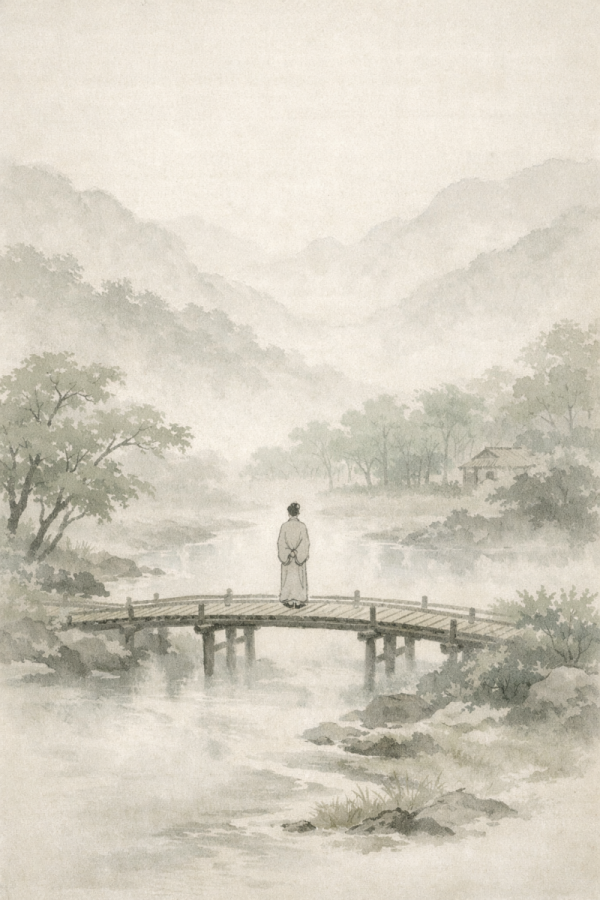
‘A quiet valley that asks nothing’.
*
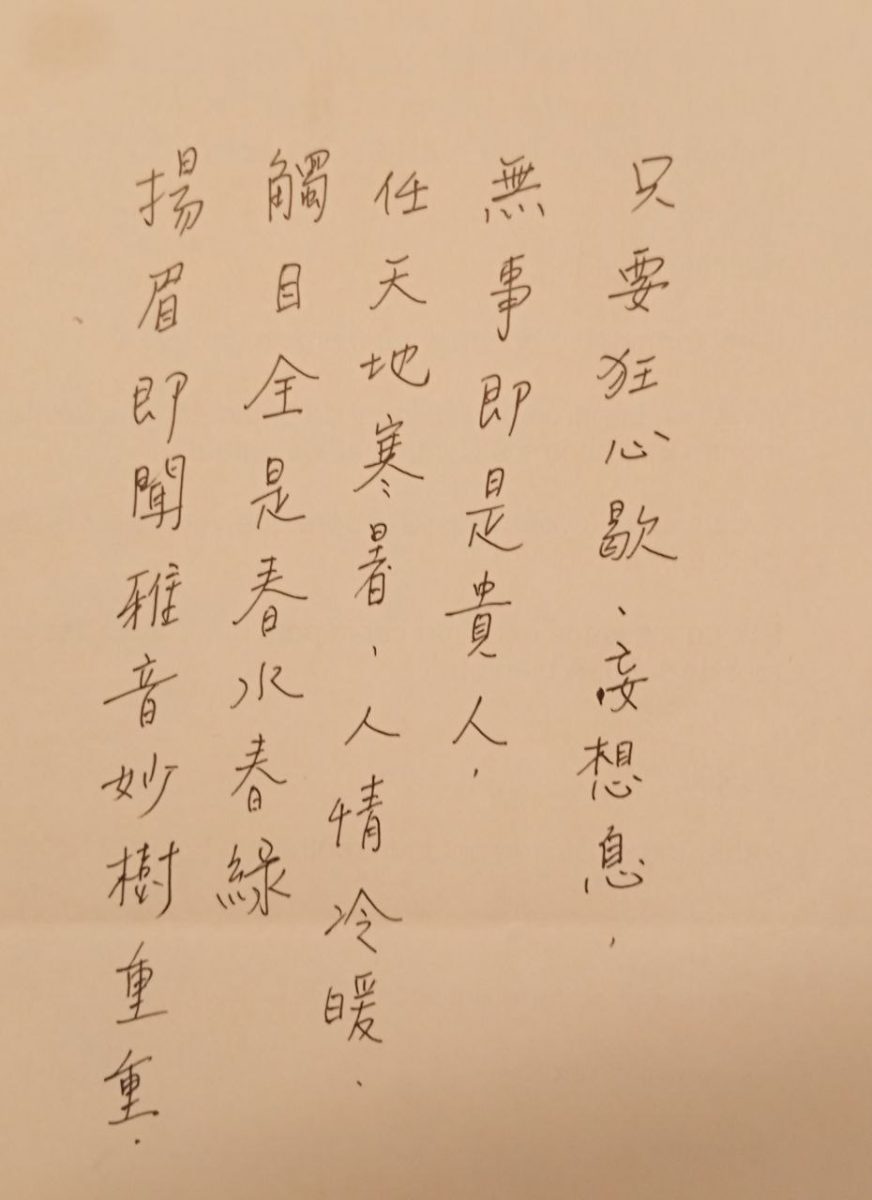
Today’s sharing from the Blue House of Via-HYGEIA is a Chinese poem. It was handwritten and gifted as a spiritual prescription following a private consultation for a back pain with a Taoist healer-priest at the Bai Yun Guan (White Cloud Temple) in Beijing, in the year 2000. It was offered as a personal takeaway from our session — a quiet reminder to return to stillness, presence, and inner nobility, regardless of outer circumstance. This reads like a long-term correction, not a quick fix.
This poem does not appear in any of the classical sources listed (Yu Xuanji, Bai Juyi, Lu You, Li Qingzhao, Cao Zhi, etc.), nor in modern anthologies or academic databases referenced (Virginia CTI, Silkqin, Chinese Poetry Translation, etc.). It is most likely an original composition — possibly actualized by the Taoist priest during our consultation. Such personalized, handwritten prescriptions are common in Taoist healing traditions, especially within the Quanzhen lineage, where poetry is used as a vehicle for spiritual instruction and energetic alignment.
**
Transcription
(Traditional Chinese)
只要狂心歇,妄想息,
無事即是貴人,
任天地寒暑,人情冷暖,
觸目全是春水春綠,
揚眉即聞雅音妙樹重重。
*
Pinyin
Zhǐyào kuáng xīn xiē, wàng xiǎng xī,
Wúshì jíshì guìrén,
Rèn tiāndì hánshǔ, rénqíng lěngnuǎn,
Chùmù quán shì chūnshuǐ chūnlǜ,
Yángméi jí wén yǎyīn miào shù chóngchóng.
*
English Translation
As long as the wild mind ceases, and delusive thoughts subside,
Non-activity itself is the noble person.
Let heaven and earth endure cold and heat,
Let human feelings be warm or cold —
Every sight becomes spring water, spring green;
A lifted brow, and you hear elegant sounds, wondrous trees layered upon layered.
*
Commentary: The Nobility of Wu Wei —
A Prescription for the Quiet Mind
This poem is not merely poetic. It is a spiritual prescription, given not to fix the back, but to heal the whole being. In the integrated wisdom of Ch’an, Quanzhen Taoism, and Confucian ethics, the body is never separate from the mind, and pain is rarely only physical. It is often a signal — a cry from the qi, the xin, the de — asking for stillness, for release, for return to alignment.
*
The Core Insight: Awakening Through Non-Doing
At its heart, this poem expresses a truth shared by Ch’an Buddhism and Daoism: Inner peace does not depend on external conditions — it arises when the restless, grasping ‘wild mind’ (狂心) quiets down.
The first line — ‘只要狂心歇,妄想息’ — speaks not of ceasing action, but of ceasing agitation. When delusions (妄想) fall away, one naturally becomes a ‘noble person’ (貴人) — not by status or achievement, but by presence, by clarity. This is not passivity. It is Wu Wei (无为): effortless action, aligned with the Dao.
The second stanza — ‘任天地寒暑,人情冷暖’ — invites radical acceptance. Let heaven and earth be cold or hot. Let people be warm or cold. This is not resignation — it is non-resistance, the freedom that comes from releasing attachment to how things ‘should‘ be. In Taoism, this is shun tian (顺天) — following Heaven’s flow. In Ch’an, it is zazen: sitting without striving.
The final lines — ‘觸目全是春水春綠,揚眉即聞雅音妙樹重重’— reveal the transformed perception that arises from stillness. When the mind stops chasing, the world itself becomes luminous: spring water, spring green, elegant sounds, wondrous trees. Beauty is not ‘out there‘ — it is unveiled when the inner noise ceases. The ‘lifted brow‘ (揚眉) is not a grand gesture — it is a micro-awakening, a moment when the spirit returns to clarity. In Quanzhen practice, such small movements signal the return of shen (神) — the spirit’s harmony.
*
Ch’an Lens: Stillness as Healing
In Ch’an Buddhism, ‘wild mind‘ (狂心) is the restless, discursive consciousness that creates suffering. Chronic back pain — often resistant to purely physical treatment — can be understood as embodied karma, or habitual tension rooted in mental agitation. The instruction is not to ‘fix‘ the body, but to rest the mind. When you stop chasing, resisting, or fearing — the body naturally softens. This is the core of zazen: stillness as medicine.
“無事即是貴人” — “Non-activity itself is the noble person” — is not laziness. It is Wu Wei in action: effortless presence. The noble person is not one of status, but of awakened awareness. When you stop striving — even against pain — you become your own healer.
*
Taoist Quanzhen & Neidan: Cultivating Qi Through Stillness
The Quanzhen School, centered at Bai Yun Guan, teaches that true health arises from harmonizing jing (精 — essence), qi (气 — energy), and shen (神 — spirit). Back pain, in this view, may signal stagnation of qi in the Governing Vessel (督脉) or Kidney meridian — channels associated with willpower, fear, and ancestral vitality.
‘任天地寒暑,人情冷暖’— ‘Let heaven and earth endure cold and heat, let human feelings be warm or cold‘ — is the Taoist ideal of shun tian. The body, like nature, must adapt — not resist. In Neidan, pain is not to be fought, but observed without attachment. By surrendering to the ‘cold and heat‘ — both external and internal — one allows qi to circulate freely again.
‘觸目全是春水春綠’ — ‘Every sight becomes spring water, spring green‘ — is the alchemical transformation. ‘Spring water‘ (春水) symbolizes yin renewal; ‘spring green‘ (春綠) — yang vitality. In Neidan, this is the union of yin and yang within — the elixir of longevity.
‘揚眉即聞雅音妙樹重重’ — ‘A lifted brow, and you hear elegant sounds, wondrous trees layered upon layered‘ — the ‘lifted brow‘ is a moment of awakening. ‘Elegant sounds‘ (雅音) are the harmonics of the Dao; ‘wondrous trees‘ (妙樹) — the flourishing of the inner garden. Pain dissolves when the spirit awakens to its own harmony.
*
Confucian Ethics: The Noble Person in Daily Life
Confucianism, often seen as moralistic, also teaches that virtue (德) is cultivated through self-discipline, propriety, and inner harmony. Back pain, in this context, may reflect a life out of balance — too much striving, not enough rest; too much external validation, not enough inner reflection.
‘無事即是貴人’ — ‘The Nobility of Wu-Wei ” — echoes the Confucian junzi (君子): the cultivated person who acts with integrity, not for reward, but because it is right. To “do nothing” is not laziness — it is moral clarity: knowing when to act, and when to rest. The junzi does not force the body; they listen to it.
‘任天地寒暑,人情冷暖’— ‘Let heaven and earth endure cold and heat, let human feelings be warm or cold‘ — is ren (仁 — benevolence) in action: accepting the world as it is, without resentment. Chronic pain often carries emotional residue — frustration, blame, fear. Confucian self-cultivation teaches that healing begins when one releases the need to control outcomes and instead cultivates li (礼 — ritual propriety) in daily life — even in suffering.
*
The Healing Context: Why This Was Given for Back Pain
In traditional Chinese medicine, back pain often relates to the Kidney system (肾, shèn) — not just the anatomical organ, but the energetic foundation of the body storing essence (jīng 精) and willpower (zhì 志). The Kidneys govern the bones and ‘open into‘ the lower back. Chronic pain here often signals emotional or spiritual constriction — the body holding what the mind cannot release.
The poem as prescription:
| Element | Healing Resonance |
|---|---|
| 狂心歇 — ‘wild mind rests’ | Chronic pain tightens the sinews; mental agitation perpetuates physical constriction. |
| 無事是貴人 — ‘no affairs, noble person’ | Releasing the “shoulds” and “musts” that tighten the back; the body softens when obligations loosen. |
| 任天地寒暑 — ‘let heaven and earth be cold or hot’ | Accepting sensation without resistance; pain is sensation + aversion. |
| 触目春水春绿 — ‘eyes meet spring water, spring green‘ | Redirecting attention from pain-signal to life-signal; the body’s inherent vitality. |
The healer at Bai Yun Guan did not prescribe pills or exercises — he prescribed awareness. Because in Taoism, Ch’an, and Confucianism — the body heals when the mind returns to its source.
*
Synthesis: A Multi-Dimensional Remedy
This poem is not advice.
It is a mirror.
Look into it — and you will see:
- Physically: The invitation to release tension — not through force, but through surrender. Back pain is not just muscle; it is qi stuck in the spine. Stillness unblocks it.
- Mentally: The teaching to stop fighting thoughts — ‘wild mind‘ is the root of suffering. Let thoughts come and go like clouds.
- Spiritually: The revelation that healing is not external — it is the return to your own luminous nature. ‘Spring green‘ is your innate vitality; ‘elegant sounds‘ are the Dao singing within you.
- Ethically: The reminder that true nobility is not status — it is presence. To be still, to accept, to listen — this is the highest virtue.
*
Final Note: The Poem as a Living Key
This poem was not written to be read — it was written to be lived. It is not a cure — it is a compass. It does not tell you to change the world — it invites you to change your relationship to it.
When you stop chasing, the world becomes spring water. When you stop resisting, the trees become won-drous. When you stop striving, you become the noble person — not by title, but by presence.
The nobility of Wu Wei is not in doing,
it is in being. And in being, you heal.
*
Source
(Read from right top to bottom, then to the next column left & so on)
***
Related Articles


Leave a Reply