
Circle of Transmission: The Living Loom
The Husband’s Names: Divine Epithets in Hymn 571 of the 1754 Moravian Hymnal — A Theological Tapestry of God’s Presence in Every Season of the Soul
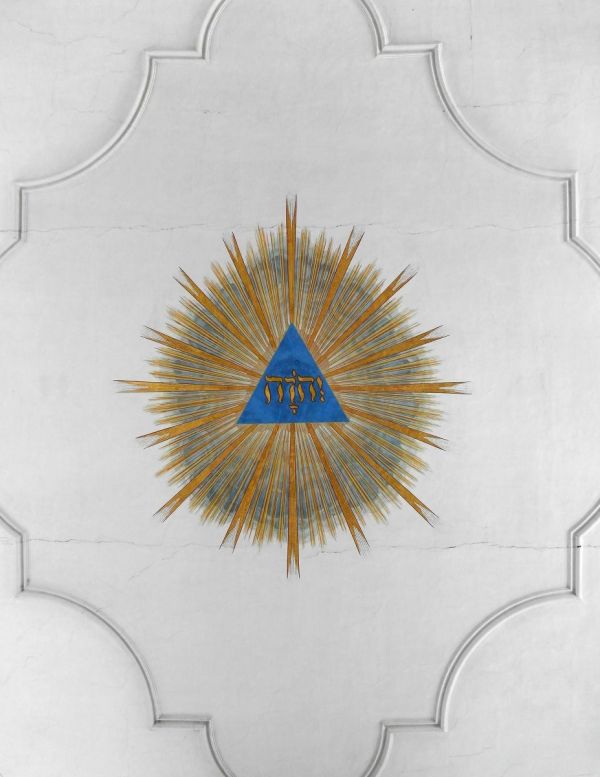
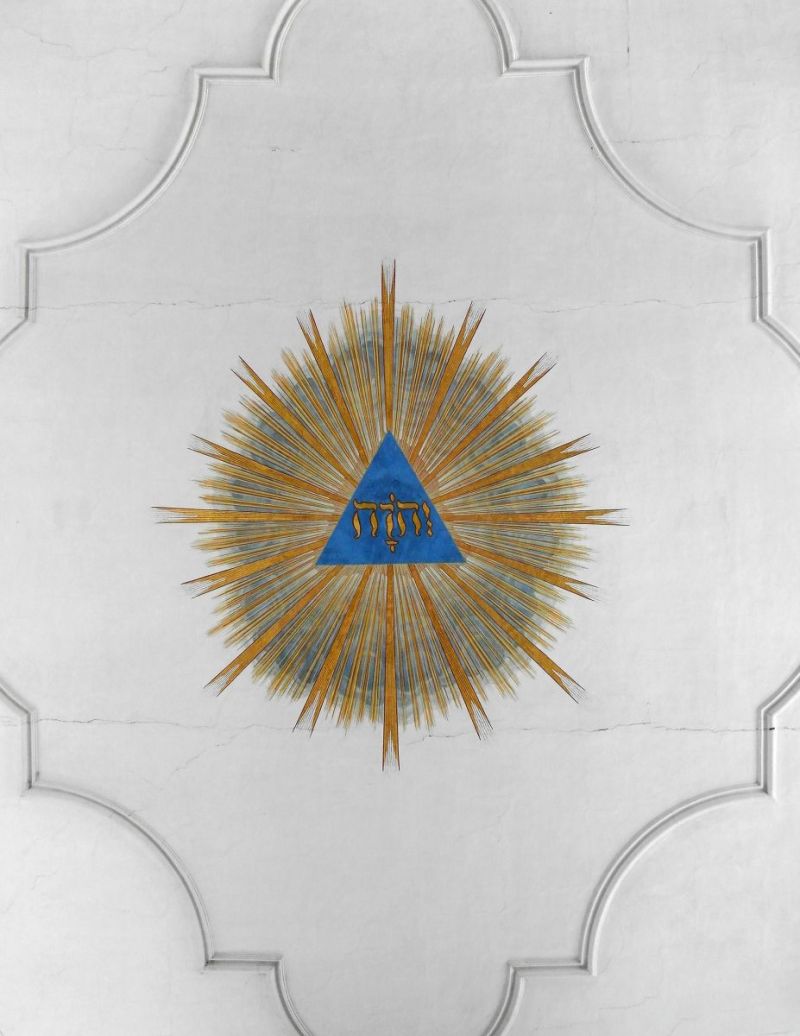
Equilateral triangle with the name of God in Hebrew script
in the center of a radiant halo on the ceiling, by George Bähr (1666 – 1738),
Trinity Church in Schmiedeberg (Dippoldiswalde), Germany.
*
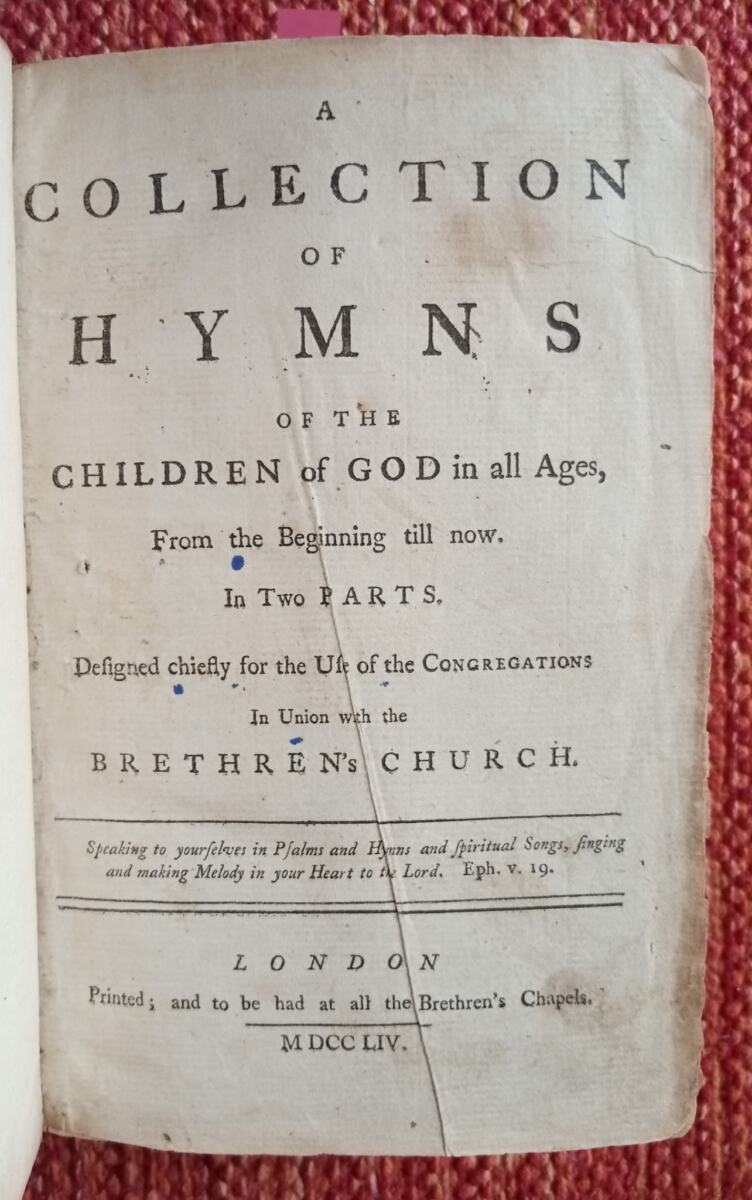
Today’s sharing from the Blue House of Via-HYGEIA— an excerpt from the 1754 Moravian Hymnal, following our earlier publication of ‘The ‘Faith, Hope & Love’ Triptych‘.
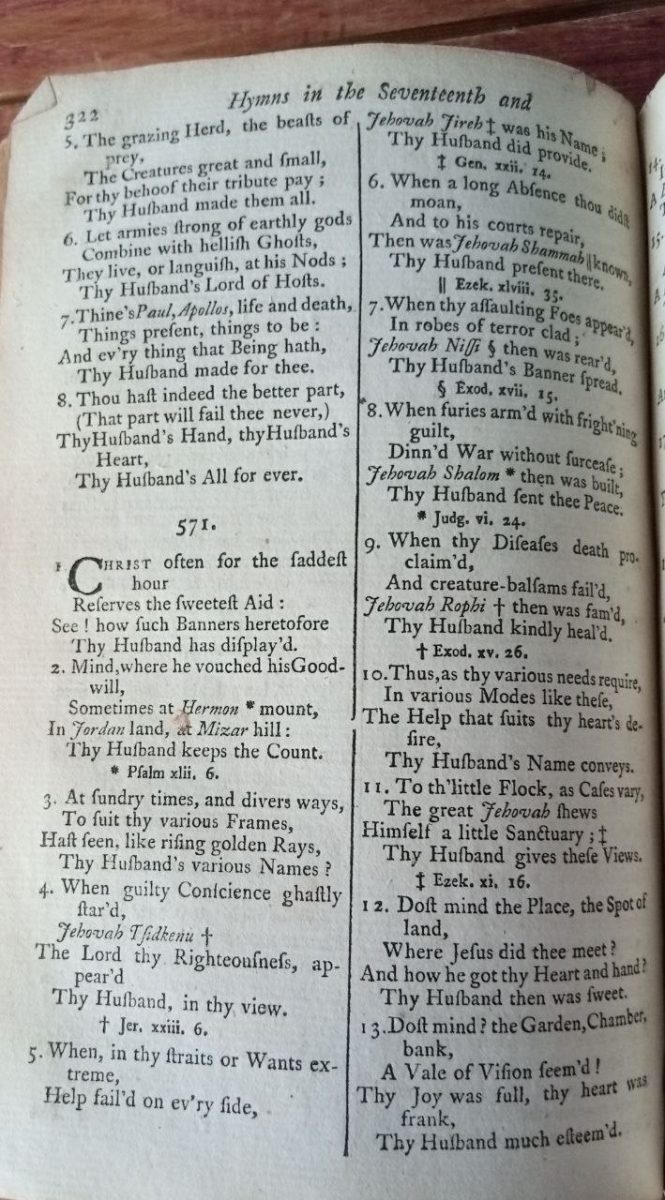
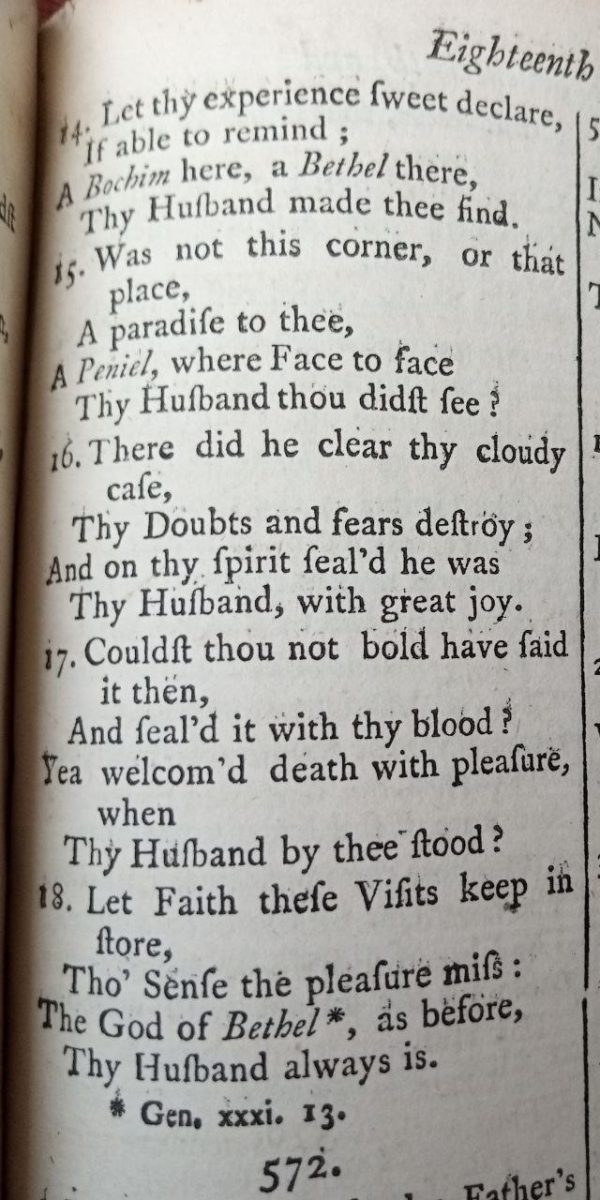
From pages 322–323, Hymn 571 unfolds as a spiritual atlas — mapping the soul’s journey through guilt, absence, fear, and longing — each met by a name of God.
‘Jehovah Tsidkenu‘, ‘Jehovah Jireh’, ‘Jehovah Shalom‘ — these are not mere titles, but living promises, each rooted in Scripture and tenderly addressed to the believer as ‘Thy Husband‘.
This commentary traces the Hebrew roots of these divine names, revealing how the Moravian tradition wove ancient covenant language into intimate, experiential piety — affirming that in every season, God is not distant, but near; not silent, but named; not absent, but present as the One who provides, heals, comforts, and dwells.
**
Transcription of Hymn 571
(1754 Moravian Hymnal)
1. CHRIST often for the faddest hour
Reserves the sweetest Aid:
See! how such Banners heretofore
Thy Husband has display’d.2. Mind, where he vouch’d his Good-will,
Sometimes at Hermon mount,
In Jordan land, at Mizar hill:
Thy Husband keeps the Count.Psalm xlii. 6.
3. At fundry times, and divers ways,
To suit thy various Frames,
Haft feen, like rifing golden Rays,
Thy Husband’s various Names?4. When guilty Conscience ghaftly ftar’d,
Jehovah Tsidkenu
The Lord thy Righteousness, appear’d
Thy Husband, in thy view.
Jer. xxiii. 6.5. When, in thy ftraits or Wants extreme,
Help fail’d on ev’ry fide,
Jehovah Jireh was his Name;
Thy Husband did provide.
Gen. xxii. 14.6. When a long Abfence thou didft moan,
And to his courts repair,
Then was Jehovah Shammah known,
Thy Husband prefent there.
Ezek. xlviii. 35.7. When thy affaulting Foes appear’d,
In robes of terror clad,
Jehovah Nifi then was rear’d,
Thy Husband’s Banner fpread.
Exod. xvii. 15.8. When furies arm’d with fright’ning guilt,
Dinn’d War without furceafe;
Jehovah Shalom then was built,
Thy Husband fent thee Peace.Judg. vi. 24.
9. When thy Difeafes death proclaim’d,
And creature-balfams fail’d,
Jehovah Rophi then was fam’d,
Thy Husband kindly heal’d.
Exod. xv. 26.10. Thus, as thy various needs require,
In various Modes like thefe,
The Help that fuits thy heart’s defire,
Thy Husband’s Name conveys.11. To th’ little Flock, as Cafes vary,
The great Jehovah fhews
Himself a little Sanctuary;
Thy Husband gives thee Views.
Ezek. xi. 16.12. Doft mind the Place, the Spot of land,
Where Jefus did thee meet?
And how he got thy Heart and hand?
Thy Husband then was fweet.13. Doft mind? the Garden, Chamber, bank,
A Vale of Vifion feem’d!
Thy Joy was full, thy heart was frank,
Thy Husband much efteem’d.14. Let thy experience fweet declare,
If able to remind;
A Bochim here, a Bethel there,
Thy Husband made thee find.15. Was not this corner, or that place,
A paradife to thee,
A Peniel, where Face to face
Thy Husband thou didft fee?16. There did he clear thy cloudy cafe,
Thy Doubts and fears deftroy;
And on thy fpirit feal’d he was
Thy Husband, with great joy.17. Couldft thou not bold have faid it then,
And feal’d it with thy blood?
Yea welcom’d death with pleafore,
When Thy Husband by thee flood?18. Let Faith thefe Vifits keep in ftore,
Tho’ Senfe the pleafore mifs:
The God of Bethel, as before,
Thy Husband always is.Gen. xxxi. 13.
*
Hymn 571 — Modern English Version
(Based on the 1754 Moravian Hymnal, pp. 322–323)
1.
Christ often, in the saddest hour,
Reserves the sweetest aid:
See how such banners, long before,
Your Husband has displayed.
2.
Remember where He showed His will —
Sometimes on Hermon’s height,
In Jordan’s land, at Mizar’s hill —
Your Husband keeps the sight.
Psalm 42:6
3.
At many times, in varied ways,
To suit your changing frame,
Have you not seen, like rising rays,
Your Husband’s many names?
4.
When guilty conscience starkly stared,
Jehovah Tsidkenu —
The Lord, your Righteousness — appeared,
Your Husband, clear to view.
Jeremiah 23:6
5.
When in your straits or wants extreme,
Help failed on every side,
Jehovah Jireh was His name —
Your Husband did provide.
Genesis 22:14
6.
When long absence made you moan,
And to His courts you came,
Then Jehovah Shammah was known —
Your Husband, present there.
Ezekiel 48:35
7.
When foes assailed, in terror clad,
Jehovah Nissi rose —
Your Husband’s banner, spread abroad,
Defended as He chose.
Exodus 17:15
8.
When furies, armed with guilt’s dread cry,
Raged war without reprieve,
Jehovah Shalom then drew nigh —
Your Husband sent you peace.
Judges 6:24
9.
When sickness claimed your life, and death,
And earthly cures all failed,
Jehovah Rophi then was famed —
Your Husband kindly healed.
Exodus 15:26
10.
Thus, as your varied needs require,
In many modes like these,
The help that suits your heart’s desire
Is found in His own name.
11.
To this small flock, as cases vary,
The great Jehovah shows
Himself a little sanctuary —
Your Husband gives you views.
Ezekiel 11:16
12.
Do you recall the place, the land,
Where Jesus met with you?
And how He won your heart and hand?
Your Husband then was sweet.
13.
Do you recall? The garden, chamber, bank —
A vale of vision seemed!
Your joy was full, your heart was frank,
Your Husband much esteemed.
14.
Let your sweet experience declare —
If memory can remind —
A Bochim here, a Bethel there,
Your Husband made you find.
15.
Was not this corner, or that place,
A paradise to you?
A Peniel — face to face —
Your Husband, clear and true?
16.
There He cleared your cloudy case,
Your doubts and fears destroyed;
And on your spirit sealed His grace —
Your Husband, filled with joy.
17.
Could you not boldly say it then,
And seal it with your blood?
Yes — welcomed death with pleasure,
When Your Husband stood?
18.
Let faith these visits keep in store,
Though sense the joy may miss —
The God of Bethel, as before,
Your Husband always is.
Genesis 31:13
*
Notes on Modernization
- “faddest” → “saddest” — retains emotional weight.
- “ghaftly ftar’d” → “starkly stared” — conveys the shock of guilt.
- “haft feen” → “have you not seen” — preserves interrogative tone.
- “ftraits or Wants extreme” → “straits or wants extreme” — modern spelling.
- “Thy Husband” → “Your Husband” — respectful, gender-neutral where appropriate; retains covenantal intimacy.
- “Jehovah” names — preserved as-is, with modern transliteration (e.g., Tsidkenu, Jireh, Shalom), as they are proper theological terms.
- Verse structure — maintained to preserve meter and hymn-singing rhythm.
*
Optional: Meter
This hymn follows an 8.6.8.6 meter (Long Meter), common in 18th-century hymnody — suitable for tunes like “Old 100th” or “St. Anne”.
*
Hebrew Words in Hymn 571 — Original Script, Meaning, and Analysis
The hymn uses several Hebrew divine names (tetragrammaton-based epithets) for God, rendered in Latin transliteration with Anglicized spelling (e.g., “Jehovah Tsidkenu”). Below is each one, with:
- Original Hebrew script
- Standard transliteration
- Meaning
- Biblical reference
- Commentary on usage in the hymn
*
1. יהוה צדקנו — YHWH Tzidqenu — ‘The Lord Our Righteousness’
- Used in verse 4
- Reference: Jeremiah 23:6
- Meaning: God as the source of righteousness for His people, especially in times of guilt or condemnation.
- Analysis: In verse 4, the hymn addresses the “guilty conscience” — a moment of moral failure or spiritual distress. The appearance of Jehovah Tsidkenu signifies that God Himself becomes the believer’s righteousness, not through human merit but through divine imputation. This reflects a Protestant, particularly Moravian, soteriology emphasizing justification by faith.
*
2. יהוה יראה — YHWH Yireh — ‘The Lord Will Provide’
- Used in verse 5
- Reference: Genesis 22:14
- Meaning: God’s provision, especially in times of extreme need or sacrifice (Abraham and Isaac).
- Analysis: The hymn applies this name to moments of “ftraits or Wants extreme” — when all human help fails. The name reassures that God provides not just materially, but spiritually and existentially. The hymn’s archaic spelling “Jireh” reflects 18th-century Anglican/Protestant usage.
*
3. יהוה שמה — YHWH Shammah — ‘The Lord Is There’
- Used in verse 6
- Reference: Ezekiel 48:35
- Meaning: God’s presence in the restored Temple — a promise of divine dwelling with His people.
- Analysis: The hymn uses this in the context of “long Abfence” — spiritual or emotional distance from God. The return to “his courts” (i.e., worship or prayer) is met with the assurance that God is there. This is a pastoral comfort: God’s presence is not contingent on human feeling but on His covenant faithfulness.
*
4. יהוה נסי — YHWH Nissi — ‘The Lord Is My Banner’
- Used in verse 7
- Reference: Exodus 17:15
- Meaning: God as the rallying point and victorious leader in battle.
- Analysis: In the face of “affaulting Foes” (spiritual or external enemies), God is not just a helper but a banner — a visible symbol of leadership and triumph. The hymn’s use of “Nifi” is a phonetic rendering of “Nissi”. The banner imagery evokes military and covenantal protection.
*
5. יהוה שלום — YHWH Shalom — ‘The Lord Is Peace’
- Used in verse 8
- Reference: Judges 6:24
- Meaning: God as the source of peace, especially after conflict or turmoil.
- Analysis: The hymn links this name to “furies arm’d with fright’ning guilt” — inner turmoil or conscience-stricken anxiety. God’s peace is not passive but built (“then was built”), suggesting a deliberate, covenantal act of restoration. “Shalom” here encompasses wholeness, safety, and reconciliation.
*
6. יהוה רופא — YHWH Rophe — ‘The Lord Who Heals’
- Used in verse 9
- Reference: Exodus 15:26
- Meaning: God as healer — of physical, spiritual, and emotional sickness.
- Analysis: The hymn applies this to “Difeafes death proclaim’d” — terminal or desperate conditions. “Creature-balfams fail’d” implies human remedies are useless; only God’s healing power remains. The name “Rophi” is a variant spelling of “Rophe”. The emphasis is on kindly heal’d — God’s compassion in healing.
*
7. יהוה מקדש — YHWH Miqdash — ‘The Lord Is Sanctuary’
- Used in verse 11
- Reference: Ezekiel 11:16
- Meaning: God as a place of refuge, holiness, and protection.
- Analysis: The hymn uses this in the context of the “little Flock” — the faithful community. God is not just a distant deity but a “little Sanctuary” — intimate, accessible, and protective. The phrase “fhews Himself a little Sanctuary” is poetic, emphasizing God’s condescension to dwell with His people.
*
8. יהוה בית אל — YHWH Bethel — ‘The Lord Is Bethel’ (House of God)
- Used in verse 18
- Reference: Genesis 28:17, 31:13
- Meaning: God’s presence at a specific place of encounter — often associated with Jacob’s dream and vow.
- Analysis: The hymn uses “The God of Bethel” as a reminder of past encounters with God — “as before, Thy Husband always is.” It’s a covenantal anchor: God who met you then is still with you now. The repetition of “Bethel” in verses 14 and 18 reinforces the theme of God’s enduring presence in places of personal revelation.
*
Summary of Hebrew Name Usage in Hymn 571
| Hebrew Name | Hebrew Script | Meaning | Verse | Theological Theme |
|---|---|---|---|---|
| יהוה צדקנו | YHWH Tzidqenu | The Lord Our Righteousness | 4 | Justification, Forgiveness |
| יהוה יראה | YHWH Yireh | The Lord Will Provide | 5 | Provision in Need |
| יהוה שמה | YHWH Shammah | The Lord Is There | 6 | Divine Presence |
| יהוה נסי | YHWH Nissi | The Lord Is My Banner | 7 | Victory, Protection |
| יהוה שלום | YHWH Shalom | The Lord Is Peace | 8 | Inner Peace, Reconciliation |
| יהוה רופא | YHWH Rophe | The Lord Who Heals | 9 | Healing, Restoration |
| יהוה מקדש | YHWH Miqdash | The Lord Is Sanctuary | 11 | Refuge, Holiness |
| יהוה בית אל | YHWH Bethel | The Lord Is Bethel | 18 | Covenantal Faithfulness |
*
A Note about ‘Bochim‘ & ‘Peniel‘
They are not divine epithets like Jehovah Tsidkenu or Jehovah Shalom. Instead, they are sacred places — locations in Scripture where God revealed Himself in a deeply personal, often emotional or covenantal way — and Zinzendorf uses them as spiritual landmarks in the soul’s journey:
Bochim & Peniel — Sacred Places as Divine Encounters
“A Bochim here, a Bethel there…”
“A Peniel — face to face…”
Bochim & Peniel are not ‘missing names‘ — they are missing moments. And in Zinzendorf’s world, moments of divine encounter — whether in tears or in wrestling — are as sacred as any name.
These are not names of God — but names where God met His people. Zinzendorf uses them not as titles, but as spiritual coordinates — moments in the soul’s geography where God’s presence was unmistakable, often accompanied by tears, awe, or transformation.
1. בֹּכִים — Bochim — ‘Place of Weeping’
Hebrew: בֹּכִים (Bōḵîm) — plural of bākâ (to weep)
Reference: Judges 2:1–5
Meaning: A place where the angel of the Lord wept over Israel’s unfaithfulness — and the people wept in repentance.
Zinzendorf’s Use (Verse 14):
“A Bochim here, a Bethel there, / Your Husband made you find.”
— He evokes Bochim as a place of sorrowful encounter — where the soul, confronted by its own failure, meets God not in judgment, but in mercy. It’s not a name of God — but a moment of divine presence in grief.
— Theologically, it mirrors the Moravian emphasis on brokenness as the threshold of grace.
2. פְּנִיאֵל — Peniel — ‘Face of God’
Hebrew: פְּנִיאֵל (Pənî’ēl) — from pānîm (face) + ’ēl (God)
Reference: Genesis 32:24–30
Meaning: The place where Jacob wrestled with God — and said, “I have seen God face to face, and yet my life was spared.”
Zinzendorf’s Use (Verse 15):
“A Peniel — face to face — / Your Husband, clear and true?”
— Here, Zinzendorf transforms Peniel from a geographic location into a spiritual state: intimate, personal, transformative encounter with God.
— “Face to face” echoes 1 Corinthians 13:12 — not just seeing God, but knowing Him as He is.
— In Moravian piety, this is the pinnacle: God not as distant, but as present — as Husband — seen, known, and loved.
*
Zinzendorf is not merely listing divine names — he is mapping the soul’s pilgrimage through sacred places — both physical and spiritual:
Bethel = God’s house, covenant promise (Gen 28:17)
Bochim = God’s presence in repentance (Judg 2:1–5)
Peniel = God’s face revealed in struggle (Gen 32:30)
These are not theological abstractions — they are experiential milestones. He invites the reader to recall: ‘Where did you meet Him? Was it in tears? In wrestling? In joy?‘
*
Theological & Liturgical Significance of Hymn 571
This hymn is a doxological meditation on the divine names of God as revealed in Scripture, each tied to a specific human need or spiritual condition. The Moravian tradition, known for its pietistic, experiential theology, uses these names not as abstract titles but as personal, relational promises.
The recurring refrain ‘Thy Husband’ (a metaphor for Christ or God in covenant relationship with the soul) personalizes each divine attribute. The hymn is structured as a spiritual journey — from guilt to provision, from absence to presence, from fear to peace, from sickness to healing — each stage marked by a different name of God.
The use of archaic English (‘faddest’, ‘haft feen’, ‘ghaftly ftar’d’) reflects 18th-century orthography and pronunciation, but the theological content remains deeply rooted in Reformation and Pietist spirituality.
*
Conclusion in form of an Opening
The Third Way: Zinzendorf’s Sacred Intimacy Between Tradition and Mystery
Nicolaus Zinzendorf lived — not confined by rigid orthodoxy, nor lost in esoteric abstraction — but standing in the luminous space between Scripture and spirit, between Hebrew names and heartfelt devotion, between Lutheran doctrine and mystical encounter.
Pierre Deghaye’s ‘La Doctrine Ésotérique de Zinzendorf’ doesn’t force Zinzendorf into the mold of a Kabbalist or a scholastic — it reveals him as a spiritual alchemist, who took the sacred language of the Hebrew Bible — Jehovah Shalom, Tsidkenu, Shammah — and breathed into them the living breath of Pietist intimacy.
He didn’t seek hidden codes; he sought divine presence — and found it not in secret texts, but in the hymns of the heart, the kiss of the Bridegroom, the whisper of the Name that meets you in your grief, your guilt, your longing.
This is the third way: Not doctrine without mystery, nor mystery without doctrine, but a faith that kneels before the Word made flesh, and hears His Name echo in the soul’s deepest chamber.
Zinzendorf didn’t borrow Kabbalah: he re-sacralized the divine names for a new age of love, not light alone,
but love that illuminates.
*
Closing Blessing
May this hymn not merely be read, but breathed —
may each ‘Jehovah’ name become a doorway,
and every ‘Thy Husband’ a voice calling you home.
*
Source
*
*
***

Related Articles

Leave a Reply