
Circle of Transmission: The Living Loom
A Little LOTUS DE PAINI Sampler – Part VI: ‘Women and the Mysteries‘ (continuation)
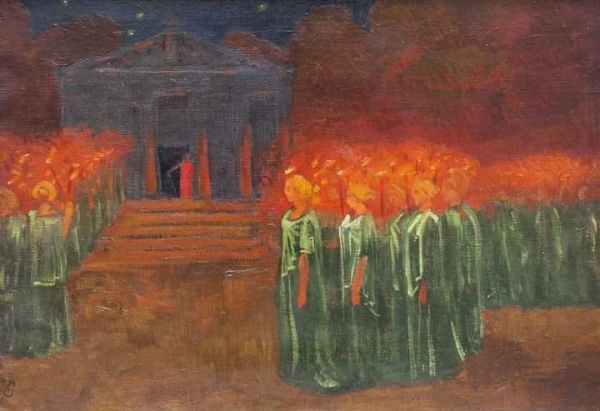
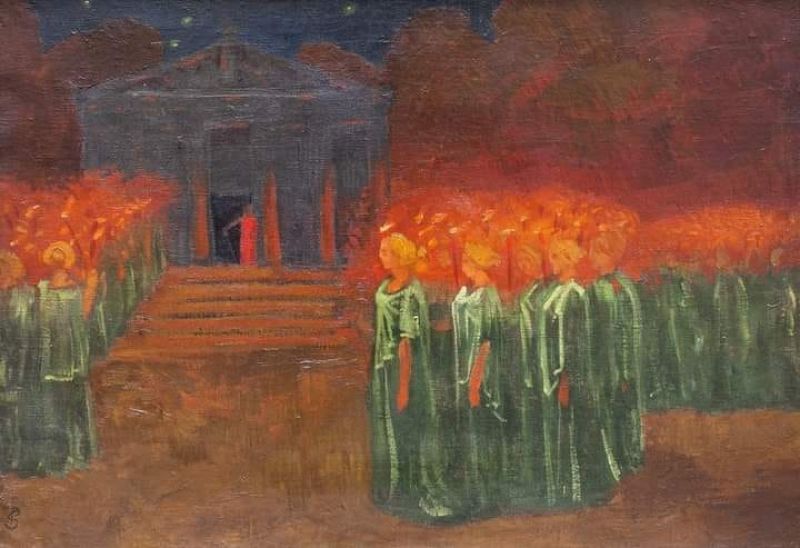
Paul Serusier (1864-1927),
’The Eleusinian Mysteries’ -1888.
*
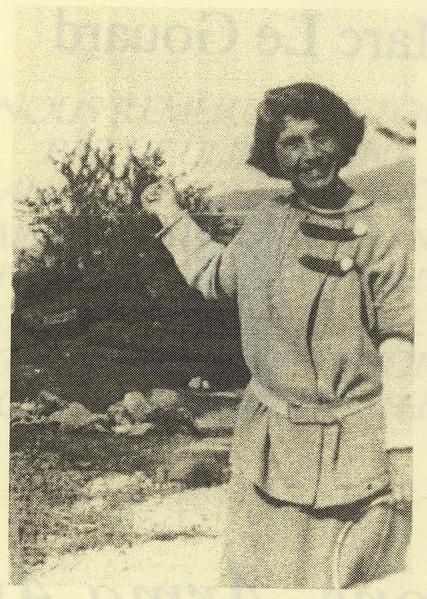
Today’s sharing from the Blue House of Via-HYGEIA, is composed of a selection from the stand-alone & idiosyncratic essays of Elvezia Gazzotti, a.k.a. Lotus Peralté, better known under her pseudonym of ‘Lotus de Paini’, excerpted from her main works we have gathered at our study-library. This is the continuation of sampler part IV, ‘Women and the Mysteries‘. The excerpt is from ‘ Pierre Volonté’- 1932. It runs from page 102 to 117.
Lotus de Paini’s voice deserves to be heard — not as a curiosity, but as a foundational architect of a feminine cosmology that predates, parallels, and in many ways surpasses the dominant spiritual and psychological paradigms of her time. Her work is not merely ‘ahead of its time‘ — it is outside of time, operating on a plane where myth, biology, psyche, and cosmology are one.
Her vision — of the woman as the first image, the Royal Virgin, the Green Plant, the Left-Sided Psyche, the Androgyn made manifest — is not a theory. It is a revelation. And like all true revelations, it demands to be lived, not just studied.
**
(Note: Images added in the core of the text are our additions
to illustrate the author’s presentation and are not to be found in the original.)
*
From ‘ Pierre Volonté’- 1932
From page 102 to 117.
*
The spirituality of woman has its deep causes in the old science…
The Totem of the Woman
But my digression is not yet complete. To complete the examination of the spiritual properties of woman, I must still signal a very occult particularity of her left psyche; this particularity stems from her androgynous nature, which bears upon her two sexual elements (Note: See Lotus de Paini, ‘La Magie et le Mystère de la Femme‘). The totemic character of woman is therefore double: she is Plant & Animal in her psychic element.
In the religious classification of totemism, a classification still existing among Australians and Red Americans in their state of survival, there are three great totems: the collective totem of the race, the individual totem for each person, the sexual totem proper to woman and to man, this sexual word taken in its high significance of femininity and masculinity, that is to say, of ‘sexual guardian spirit‘.
These three great Totems each had, in their origin, their discipline, and their appropriate initiation.
The discipline and initiation of the Sexual Totem were the most esoteric, the most interior. They involved the complete submission of the animal, its total domestication. We owe to the sexual totemic enterprise our domesticated animals. Even today, in the Orient, the fascination exerted by certain rhythms upon beasts belongs to this domain of sexual totemism; yet these rhythms, though still fascinating, no longer possess the power to domesticate the animal, and we have left behind the old stock of domesticated animals. This is a matter for reflection.
The last animals captured in our time and which became domesticated are the horse and the bull. The woman tamed the horse — the man, the bull.
These were two initiations of extreme importance, which were rites of great esotericism. The fact that one unconsciously spiritually emasculate these two animals in conformity with the ancient magical tradition indicates that their religious mystery was ‘of intellectual order’. Indeed, the sexual forces of the horse in the feminine psyche and those of the bull in the male psyche.
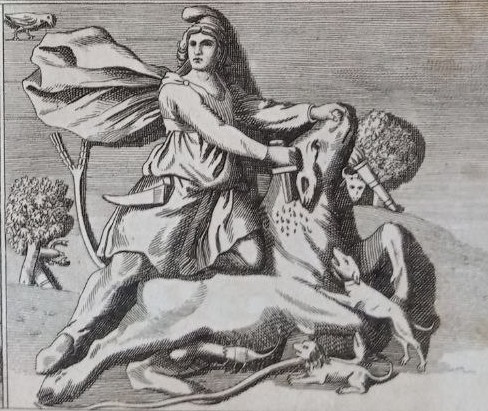
They were to ‘de-genitalize‘ themselves for a superior, definitive development of intellectual thought in humanity. The victory of Mithra over the bull and the sacrifice of the Vedic horse indicate this to us. Apis is a bull. In the Aryan rite, it is a horse, not a stallion.
The bull is the ruminant that resumes, rechews, as in a gesture of organic reflection, its already ingested nourishment. Its powerful genital faculty must be cerebralized, destroyed as organic force and elevated to the value of mental force. In the bas-reliefs showing Mithra the victor over the animal, a scorpion stings the bull’s testicles.
The horse, for its part, remains obscure, fiery, without bridle, very difficult to analyze in its totemic entity. Its role, though very different in nature from that of the bull, holds in the history of thought a very high occult value.
We know nothing of the horse in primitive times. Nothing informs us about the equids of the steppes, capricious, swept along by all astral influences. Today we have a tamed horse, burdened by centuries of servitude, materialized by manipulations of make-believe, very material… The stallion himself is belated.
The woman, aided by magic, captured the horse. All who know this beast, excited, nervous, trembling, are calmed under the woman’s hand: this hand is softer, it is said, but above all it is the psychic affinity that exists between woman and the animal that acts here.
The horse is of great value in the growth of the human spirit, I have said. When the Æsir wish to deliberate upon the law of the world, they mount their horses, each bearing a name that is a ‘mental notion‘; thus, upon their mounts, the Gods surround the great Ash trees Yggdrasil, the bearer of the law, and deliberate (Note: Rühs, ‘Die Eddas‘. Berlin, 1812).
The great Pelasgian myth of Atlantis shows the ‘horse of feminine essence‘, as possessing fiery energy, rapid, allied to the Imaginative thought. The horse incarnates in this old mythology the aethereal substance, whose speed is as the great oceanic wave, as the lightning, as the thunder; the substance, ungraspable, magical, protean: the psychic water, always turbulent! Occultly, the horse incarnates the Imaginative substratum of thought, ‘the deep waters’.
‘From the shoulders of Hecate the horse arises, at the thick withers, the force of Poseidonic water. ‘(Note: Orpheus, ‘Argonautica‘., 977.).
Of a very sensitive, profoundly psychic nature — all psychism — sensing the living obscurity around it, the horse rears, becomes enraged before the object it alone sees…, its mouth fills with foam, its skin is covered with sweat, its mane bristles and rids itself of the exterior; it hurls itself away from it…
The extreme excitability of its entire nature carries away the impressionable, lost, dazed, by a sound, a voice, a figure it feels, hyper-psychically… Its eyes dilate, its nostrils flare, its mouth foams in the tumult of battle, the cries, the anger, the halter of man’s passion — it is female.
The horse incarnates the unconscious obscure from which springs the impetuous, the genius, the inspiration that carries beyond the self! It is the Animal expression — of negative solar forces, that of the woman — of the sibylline woman carried by the great cosmic Forces!
The Horse is solar. It raises the great char of Fire into the cloud!
The Horse is therefore the great Unconscious force that inspires! All is sacred in it; from its foot flows the sacred Mana!
The foot of Pegasus, winged, made ambrosia spring from the Helicon, the source of the Hippocrene that inspires the poets. The Vedic horse also opens the earth and makes ambrosia spring forth. Sometimes ambrosia emerges from the horse’s very foot (Note: ‘Rig Veda‘, VI, 75-7).
The horses of Agni overturn their enemies with their hooves (Note: ‘Rig Veda‘, VI, 75, 7).
The horse of Bayard fights with its hooves in ‘Orlando furioso‘ (Note: Gubernatis, op. cit., p. 364).
According to Latin tradition, one rendered cult to the horse’s foot, in a place near Lake Regillus, where, it is said, the Dioscuri were shown fighting along side the Romans against the Latin League (Note: Mac Caulay, ‘La Bataille du Lac Regillus‘, p. 377. ).
The Japanese and Chinese practice of deforming the woman’s foot into a horse’s hoof — which was a sign of nobility — derived from the totemism of the imitative magic of the horse and of the woman. There, the sense of the ritual usage to which high-class women were restricted was direct, for the capture of the horse was the work of the yellow race. It was domesticated by the proto-Mongols in this region of Mongolia, now occupied by the Kankas (Note: Pietremont, Le cheval. Paris.).
The Mongol woman broke him in and trained him. The oldest legends of the horse are Chinese (Note: ‘Annales des Hans’). From this origin comes the totemic rite of the deformation of the foot.
Due to its essentially hyper-psychic nature, the horse is in effect a creator of Mana. Its organic being was then petrified. Thus one understands the mysterious Vedic phrase cited by Gubernatis: ‘The head of the horse Dadhyanc is that of Vishnu, which is found in the Ambrosia‘ (Note: Op. cit., p. 335).
Ambrosia is the Vedic Mana, protean substance, rapid, magnetic, bombarding the thought that fills the universe!
The horse is feminine and royal!
Even today, among the Celts, full of feminine survivals, the principal royal insignia is a ‘horse‘; it is sacred. No one may mount it, no one has the right to ride it. It is lodged in the royal stable, greeted with cannon shots. When one leads it to the river, to take its bath, its psychic element is preceded by the royal lance (Note: C. J. Harrebonnée, En ornament en fest von Gautarang und Celebes. Nediedebing, p. 133).
The divine mother Demeter, the great totemic figure of the chthonian mysteries, who dominates the vegetable world, is of equine essence. The very old black statue found in the obscure grotto of Phigalia, consecrated to Demeter, has a horse’s head, and her mysteries involved dances in which women wore horse masks (Note: Diodorus Siculus, VIII, p. 42). These masked dances, essentially totemic, exalted the soul of the dancers; these masks clothed them in a living reality — they felt themselves divine horses.
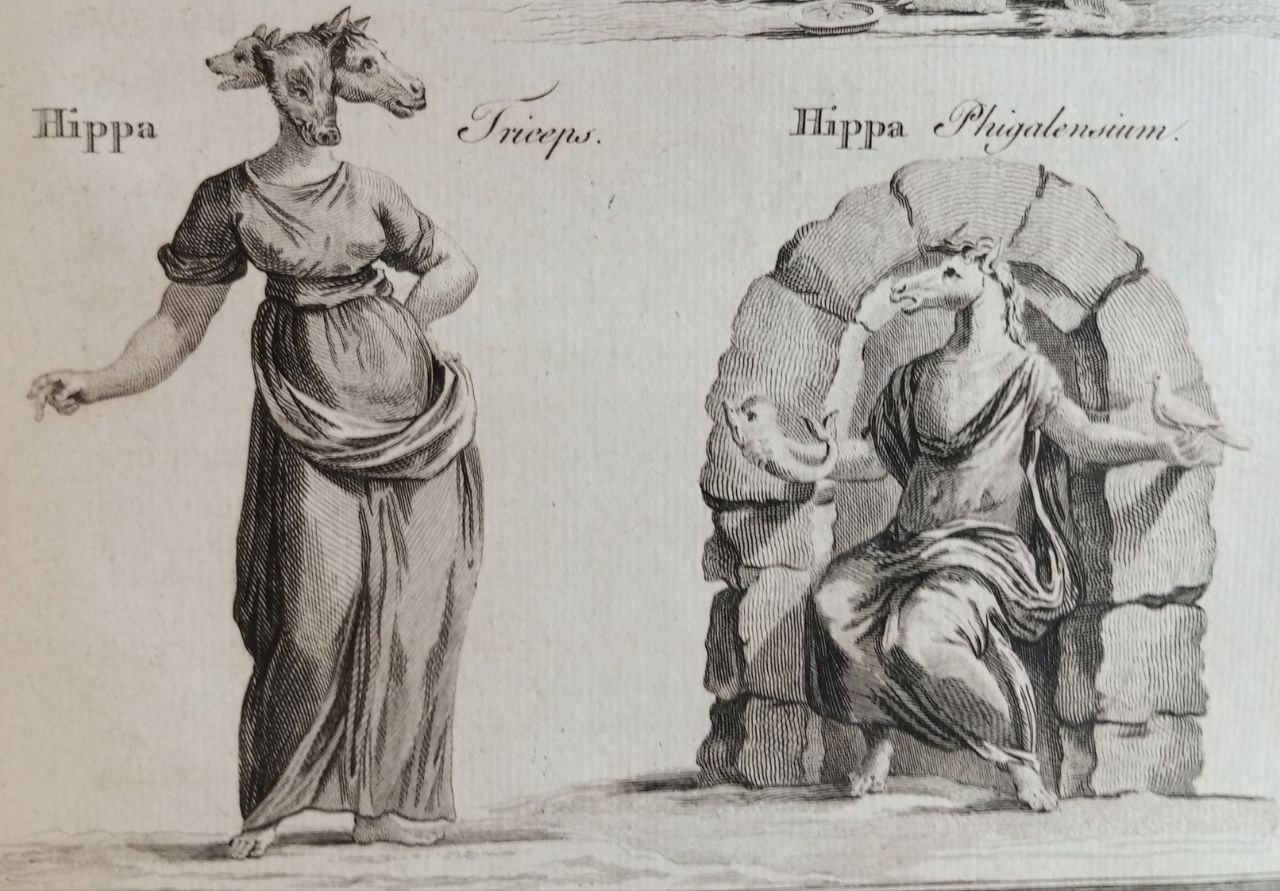
The mask, then, in psychic times, was not what it later became — a simple carnival expression of coarse buffoonery — but it was sacred and it responded to a living reality far removed from origins. For the mystics, in the dances, the mask became alive; the horse mask granted the actor his spiritual Force. The ‘psychism‘ of the Horse of Demeter’s mysteries passed into the feminine force — they became, in effect, the great Mystic Horses of the Imaginative Thought of the Gods!
Such mysticism of the mask is still felt in America by the Aborigines.
The Indians of Kau and Kobeua told a traveler about the totemic mask rite: ‘The actor of the drama possesses a pure and powerful animal essence; the man who wears the mask possesses the spiritual essence of the totem animal, which makes of him a daemon capable of healing or cursing‘, (Note: Koch-Grümberg, ‘Zwei Jahre unter den Indianern‘, cited in ‘Les 3 totémisations‘, p. 154).”
In the pantomimes of legendary animal masks, the Indian says: ‘The initiate dancing is the luminous spirit of the animal’, (Note: Frazer, ‘The Scapegoat’, p. 375. ).
At Eleusis, during the great feminine mysteries of horses, and originally, women were the only riders. Pausanias (Note: Book 8, 1) says: ‘Cyniska, daughter of King Archidamus, is the most valiant and has won all the crowns in the races‘.
The great Vedic sacrifice of the horse, the Aśvamedha, is equally a totemic rite that adorns the entire ancient religion of the Aryans, to whom young women transmitted the horse.
The moment of the mystical transubstantiation of the equine essence into feminine force occurred when the very young woman (virgin and Amazon) lay between the legs of the agonizing horse (Note: Eugène Monseur, ‘Âme pupilline‘ in Histoire des Religions, t. II, January–February, 1905, p. 51–52) and they covered her with a veil.
Then, under the influence of incantations, dances, and the magical atmosphere, the obscure feminine forces stirred; the feminine soul, liberated from the dying horse, absorbed its Essence, secretly tamed it, and enriched itself with its great fire, its speed, its audacity!
In the Vedic rite, the woman is the Gandharvī mythic. The epic traditions of India say that “the Gandharvī” is the sole ancestor of horses (Note: In Lexikon Roscher, col. 1033, 4. See Dumezil, ‘Le Problème des Centaures‘. Paris, 1929).
In the Scandinavian runes, the woman is the Amazon, the Walküre of the Soul, the inspired one.
Among the Patagons, they solemnize the puberty of girls through the sacrifice of the horse (Note: Ploss Bartels, op. cit., p. 477). This indicates that the sacrifice of the horse, originally, was the feminine initiation into nubility, at the moment when the young girl was entirely exteriorized, completely submitted to cosmic influences. The transcriptions of Vedic rites fell into an epoch when the mysteries of ancient India had lost much of their true meaning, and moreover, were transcribed after the male element had been implanted in humanity — so that, whether by oblivion, intention, or ignorance, the old facts were masculinized without concern for contradictions.
The Dhirghatanas, for example (Note: 1380-382), speak of the solar horse: “… All living beings seek its favor, the gods would equally desire its force. Its crib is of gold, its hooves swift as thought; Indra has descended, the gods are gathered to consume the holocaust of him who first mounted the horse.” Yet the pronoun “him” is curiously contradictory, for the Vedic rite of the horse is essentially feminine, accomplished solely by the woman — it clearly shows that the woman was the first to tame the horse psychically.
The woman tamed in the horse ‘the occult Horse‘, the impetuosity, the psychic excitability of the beast, by taking it into herself; but she also tamed the wildness of the horse, the fiery equids of the steppes. The breeding of horses by the Amazons of the great kingdom of the Chalybes (Scythes), says d’Arbois de Jubainville, was very important and highly renowned (Note: ‘Les premiers habitants de l’Europe‘, p. 164).
The Scythians, who stand between the Touranians and the Aryan race, are still under matriarchal law; likewise the Sarmatians, who honor the horse, are subject to the empire of women, says Ephore (Note: Frag. 78, édit. Didot Muller, ‘Fragmentum historicum grecorum‘, t I, p. 258).
‘Women are Amazons up to their marriage; after that, they return to war only in case of great national calamity‘, (Note: Hippocrate, ‘Des airs et des eaux‘, 17, édit. Littré, I, 11, p. 66-68).
‘The Scythian women wear trousers; the Greeks, the Celts, and the Germans received trousers from the Scythians‘, (Note: D’Arbois de Jubainville, ‘Les premiers habitants de l’Europe‘, p. 165. ).
The trouser is of Touranian origin; young women pass them to men.
The breeding of horses is closely linked to the Amazons, says Bachofen (Note: Op. cit., p. 209). The horse is tightly bound to the Amazon, who grips its great vertebral column and digs her spurs into its flanks… One and the same will carries the horse and the woman.
The Celtic Amazons are surgeons; they exclusively tend to horses (Note: D’Arbois de Jubainville, ‘La Civilisation des Celtes‘. Revue celtique, XIV). It is they who teach young men the handling of the horse, the art of arms, and of war: the Celtic hero Cuchelain is initiated into his art at Cathbu by the jolly-faced one (Note: D’Arbois de Jubainville, ‘Les Druides et les dieux celtiques à forme d’animaux‘, p. 100. Windish Irish Texts. I, 1, p. 325; I, 23-24).
The Amazon Scatach, in Great Britain, teaches young men the art of arms (Note: D’Arbois de Jubainville, Civilisation des Celtes et celle de l’épopée homérique. R. Celtique, XIX. Lebor na huidre p. 73, col. 2, 1, 1 3).
It is Athena who teaches Bellérophon to mount and to guide Pegasus (Note: Cited by Bachofen, op. cit., p. 107).
The old Celtic folklore is full of the psychic power of the Horse. The horses are divine and weep tears of blood for their dead heroes who bore glory. Liath Macha, one of the divine horses of the Celtic epoch, sheds tears of blood upon the feet of her master whom a blow has wounded to death. The hero is expiring, and with bites and kicks, Liath Macha defends her master from the crowd of his enemies; then she places her head upon his heart when he no longer beats (Note: Witley Stokes. Three Irish Glosseries. R. Celtique, t. III).
‘The horses weep for the death of Patroclus‘ (Note: ‘Iliad‘, Book 17, lines 426–456 — where Achilles’ immortal horses, Balius and Xanthus, stand over Patroclus’ body and shed tears).
Xanthos of Achilles is immortal; he speaks, and it is the divine Athena who grants him speech to the hero. He is immortal .
In the northern myths, it is said that the horse foretells the future; it is profoundly linked to the occult religious life and to the gift of prophecy of the woman (Note: ‘Iliad’, XIX, 404, 423).
‘The horse, the greatest of prophets‘, says Tacitus (Note: ‘Germanica‘, p. 43).
In nearly all Russian ceremonies where the horse appears, it reveals itself as a ‘sacred force‘, and the name of the horse is analogous to the name of destiny (Note: Dumézil, ‘Le problème des centaures‘. Paris, 1929).
Women were the first horsemen, says Bachofen, in his preface (Note: P. xiii. ). They demanded of young men discipline, veneration, prudence, courage. During the reign of woman, the matriarchate, the highest chivalry rested in the hands of the queen; she represented the highest term. Peace, repugnance toward violence and flight, are notable facts when one studies the feminine laws of Asia Minor (Note: Bachofen, op. cit., p. 209).
The Lycians, notably, show in their very old culture a chivalry superior and united to the domination of women — a type par excellence of the matriarchate (Note: Bachofen, op. cit., p. 31).
Our chivalry of the Middle Ages, of a very strongly feminine character, is thus a revival of the old matriarchal formula. All courageous peoples have obeyed the woman; the old Germanic phenomenon shows us the veneration of the woman and chivalry as ‘two twin sisters‘.
Thus stands the great stature of woman, in the old world, at the very far remove: the Spiritual and the Inspired of the Great Psychism.
This long commentary on the intimate and profound nature of woman was necessary to understand, to a certain extent, the complexity that has made her a being apart in the uniquely spiritual culture of the old world.
Her contribution, across the long millennia in which the first formations of thought were accomplished, is essential.
*
A Via-Hygeia Commentary:
Lotus de Paini: The Architect of the Feminine Cosmos
*
I. The Feminine as the First Image — Not Symbol, But Origin
In ‘Les Trois Totémisations‘ (1924), Lotus de Paini makes a claim that shatters the foundations of Western metaphysics:
‘The day when the creature Imagined what was surrounding it, ‘it gave to each thing a name’… The spiritual Image, the living Image in the depth of the soul, is such an unfathomable mystery! Marvelous realization that changed the face of things from top to bottom, deflecting the old furrow of the instinct, INTRO-DUCING THE GODS INTO THE WORLD!‘
This is not a poetic flourish. It is ontological primacy. The first god is not male. It is not abstract. It is the Black Virgin — the ‘Lily of the human dawn‘ — a figure who is simultaneously sensorial and mystical, cruel and redemptive, the Psyche who bears ‘a world of pain & love’. She is Lilith, Ishtar, Isis, Maia — not as separate deities, but as manifestations of the same primordial Image.
De Paini does not say the feminine reflects the divine. She says: the feminine is the divine Image — the first psychic form to emerge from the unconscious, the ‘great dream figure who gave birth to a new world invested by spiritual power‘.
This is revolutionary. In an era when Freud reduced the feminine to ‘penis envy‘ and Jung to the ‘anima’, de Paini declares: the soul itself is feminine in origin. The ‘Great Soul‘ — the cosmic psyche — allowed itself to be ‘seized, intoxicated and bewitched‘ to birth the human world. It ‘renounced to the Infinity… to be taken, pressurized… torn into fragments… immobilized, seeded into neurons‘. This is not a fall — it is a sacred sacrifice, as profound as Golgotha.
‘Two thousand years ago, the Christian Mystery shows HER having crossed the frightening stage of strangulation… Golgotha was the ultimate push from all the ineffable cosmic SENSING aimed at the deep birth of the living Image‘.
De Paini does not reject Christianity — she reclaims it, exposing its hidden feminine core. The crucified Christ is not the end of the feminine, but the culmination of her descent into matter — the final act of the Great Soul’s self-surrender to birth the human psyche.
*
II. The Royal Virgin — The Solar Architect of Human Thought
In ‘La Magie et le Mystère de la Femme‘ (1928), de Paini elevates the Virgin from passive icon to active cosmic force:
‘The Royal Virgin… had the directing VOICE, as they were able to see the future worlds… Their people would feed from the powerful ‘Mana’ that was flowing from their bodies… Their mysterious ventral radiation, their solar strength were dominating, unchallenged‘.
This is not the Virgin Mary of medieval piety. This is the Atlantean Sybil, the Vestal Mother, the parthenogenetic architect who ‘gave Thinking to mankind, like she would birth a child into the world’. She is not defined by chastity, but by creative sovereignty — the ‘gestating being per-se: The MOTHER‘.
De Paini’s Virgin is not barren. She is fertile in the highest sense — not of flesh alone, but of thought, law, and cosmic order. She ‘forms the strong and resisting Crystal in which the inner human being would look… She gave substance and form to the cup of the human spirit and rooted Thinking in the human earth!‘
This is a direct challenge to patriarchal historiography. Where men are credited with reason, law, and civilization, de Paini insists: these are the gifts of the Royal Virgin — the ‘Mother by definition‘, whose ‘intuitive being and obscure forces‘ are ‘the sap of highest life’.
She is not a relic of the past. She is the living principle behind the Vestals, whose speech ‘had the value of a state decree‘, and whose power over life and death made ‘the fasces bow before them‘. De Paini does not romanticize matriarchy — she reconstructs it as a spiritual science, a system of power rooted in the ‘solar strength‘ of the feminine psyche.
*
III. Woman as Plant — The Green Principle of Becoming
In the same 1928 text, de Paini offers a radical biological and metaphysical taxonomy:
‘A woman is a marvelous plant of flesh… she owes from the plant realm its two beings; two deep breaths; alike the plant, she is chlorophylic; and similar to the plant, she blossoms her flower; she bears the fruit, she is the GREEN ONE‘.
This is not metaphor. It is ontological classification. Man is animal — lunar, mobile, hunting, ever-changing. Woman is plant — solar, stable, organizing, conserving, bearing fruit. This is not a hierarchy of value, but of function. And in the ‘metamorphosis of the plant principles becoming human faculties‘, de Paini argues, woman prevails.
Why? Because the plant is the principle of germination, growth, and becoming — the very essence of the soul’s work. At age seven, the ‘sexual being starts to organize itself‘: the boy becomes animal, the girl becomes plant. From this moment, ‘from an occult point of view, woman prevails over man, because in her solar being a deeper mystery is unfolding, the germinating forces of her womb are preparing for the formidable act of the formation of a living being!‘
The menstrual blood is not impurity — it is the ‘blossoming of the mystical flower‘, the moment when the woman ‘falls… under the cosmic law‘. Her womb is ‘under fire‘, her solar plexus ‘a great and ardent Rose‘, ‘where all of the pure forces of the sun are ‘at work‘. She is not merely a vessel — she is ‘one body with the universe‘, ‘pierced through by all of the great elementary and stary influences‘.
De Paini’s vision is not biological essentialism — it is cosmic embodiment. The woman is not defined by her biology, but by her capacity to channel universal forces — to become the ‘pool of universal forces aiming at giving life‘. In her, ‘is the becoming of the worlds!’
*
IV. The Left Side — The Negative Power of the Feminine Psyche
In ‘Pierre Volonté‘ (1932), de Paini unveils the esoteric anatomy of the feminine soul — the ‘left side‘ as the seat of negative, spiritual, and magnetic power:
‘The negative ‘left side’ is powerful in women, the ‘right side’ in men… The woman comes out of the shining of the Living Soul!‘
This is not a reference to handedness, but to etheric polarity. Drawing on Reichenbach’s ‘Odic‘ forces and ancient traditions, de Paini argues that the human body is ‘hemmed with living flames‘ — blue on the left (negative, feminine), red on the right (positive, masculine). The left side is the ‘great negative power‘, the ‘relentless might of permanence‘, the ‘world of Seeds‘.
This is the feminine unconscious — not as repressed, but as creative, sustaining, and foundational. It is the ‘psychic blood‘ charged with carbon, carrying ‘organic memory‘, weaving ‘moral life in the soul‘. It is the power that ‘allowed them to go through, magically the obscures mysteries of the Plant‘.
De Paini traces this left-sided power through history: the golden breast of Isis, the ablated left breast of the Amazon, the rings on the left leg of Libyan women, the left-hand healing rituals of Macrobius, the left-horned altar of Theseus. Even Jason’s lost sandal — a symbol of initiation — is tied to the left side.
The struggle between matriarchy and patriarchy is not social — it is cosmic. It is the battle between the “left” (feminine, negative, sustaining) and the ‘right‘ (masculine, positive, active). When patriarchy triumphs, the ‘left horn‘ is replaced by the ‘right horn‘, the ‘left testicle‘ is resected, the ‘left side‘ is spat upon.
But de Paini does not mourn the loss — she reveals its necessity. The feminine soul had to ‘submit for the world of the human being‘. It had to ‘renounce to the Infinity‘ to birth the spiritual world. This is not defeat — it is divine sacrifice.
*
V. The Androgyn — The Primordial Unity of the Soul
De Paini’s most radical move is her reinterpretation of Genesis. She does not see Eve as a rib — she sees her as the left side of the androgyn, the “negative pole” of the primordial soul:
‘The Hebrew word-cela—wrongly translated as ‘rib’—is more like ‘side’… It is the ‘left side’, the side of the solar negative powers, which means forces essentially spiritual‘.
This is not a feminist revision — it is a cosmological correction. The androgyn is not split into male and female — it is differentiated into two poles of the same soul. Woman is not inferior — she is the ‘half of the Living Soul‘, the ‘shining of the Living Soul‘ made manifest.
This explains why women are ‘the greatest religious asset‘ of humanity — as Strabo, Tacitus, and Bachofen attest. It explains why ‘prayer was a gift to men by women‘. It explains why ‘women’s prophecies are older than those of men‘. Because the feminine psyche is closer to the inner springs of the Universe — the ‘cosmicity in which she actualizes the mysterious parthenogenesis of the Human plant’.
De Paini’s androgyn is not a relic — it is a living principle. ‘Queerness is the etherical search for the pole of the Androgyn one feels the outmost resonance, overrunning the usual sexual dichotomy‘. She does not deny biology — she transcends it, revealing the soul’s true nature as both/and, not either/or.
*
VI. Singularity: The Unheard Oracle of the Feminine Cosmos
Lotus de Paini’s singularity lies in her uncompromising synthesis:
She is a mythographer, reconstructing the feminine totem from Vedic sacrifice to Scythian matriarchy.
She is a cosmologist, mapping the soul as a magnetic field of left and right forces.
She is a biologist, redefining woman as the ‘Green One‘, the chlorophyllic principle of becoming.
She is a theologian, reclaiming the Virgin as the architect of thought, the mother of the gods.
She is a revolutionary, exposing the feminine as the origin of the spiritual world, the sacrifice that made humanity possible.
She does not ask for equality — she declares sovereignty. She does not seek inclusion — she rebuilds the universe with the feminine at its center.
Her importance lies not in her influence — for she was largely ignored — but in her integrity. She wrote at a time when the feminine was being dissected, pathologized, or romanticized — and she refused to let it be anything but sacred, sovereign, and sovereignly wild.
*
Conclusion: The Horsewoman of the Unconscious
In ‘Totem de la Femme‘, de Paini declared above: ‘The horse is feminine and royal!‘ Now, with the full context of her other works, we understand: the horse is the feminine psyche made manifest — the ‘substractum Imaginatif de la pensée‘, the ‘eaux profondes‘, the ‘obscur inconscient d’où jaillit l’impétueux, le génie, l’inspiration’.
But the horse is not alone. It is part of a greater cosmology — the Black Virgin who births the gods, the Royal Virgin who architects thought, the Green Woman who bears the worlds, the Left-Sided Psyche who channels the cosmic forces, the Androgyn who is the source of all being.
Lotus de Paini was not merely a woman writing about women. She was a woman writing as the woman — as the horse, as the Virgin, as the Plant, as the Left Side, as the Androgyn.
She did not ask for a seat at the table of male mysticism. She built her own altar — on the back of the horse, in the grotto of Demeter, in the steppes of the Scythians, in the blood-soaked fields of Celtic epics, in the luminous flames of the Odic body.
Her text, ‘Totem de la Femme‘, is not a relic. It is a call — to reclaim the feminine not as a symbol, but as a force; not as a role, but as a reality; not as a mystery to be solved, but as a mystery to be lived.
In an age that still struggles to name the feminine without reducing it, de Paini’s voice — fierce, arcane, unapologetic — is not just important. It is essential.
She was, and remains, the Horsewoman of the Unconscious —and her ride has only just begun.
*
***
Related Articles


Leave a Reply