
Circle of Transmission: The Living Loom
Maurice Nicoll- The Conception Of Entropy In Science & The Conception Of Effort In the Work
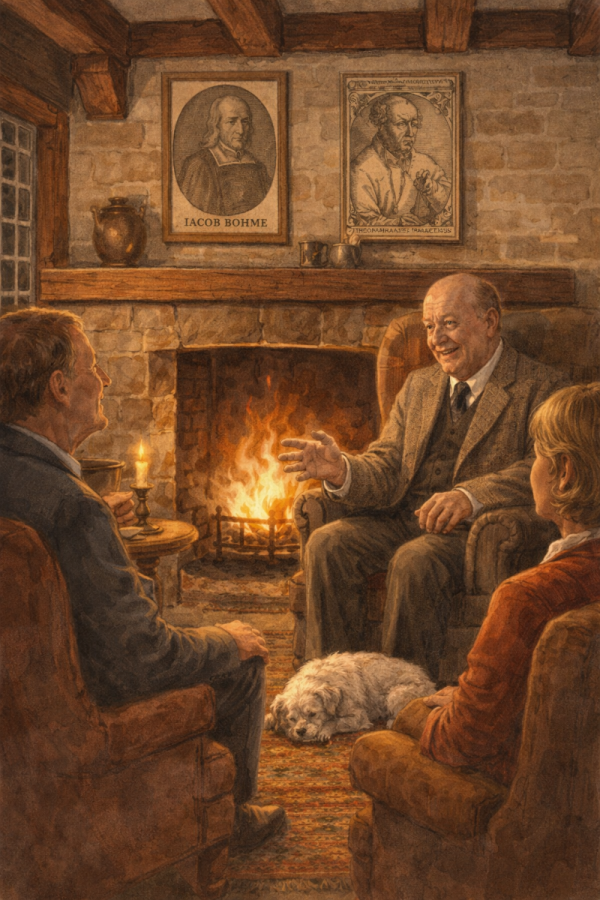
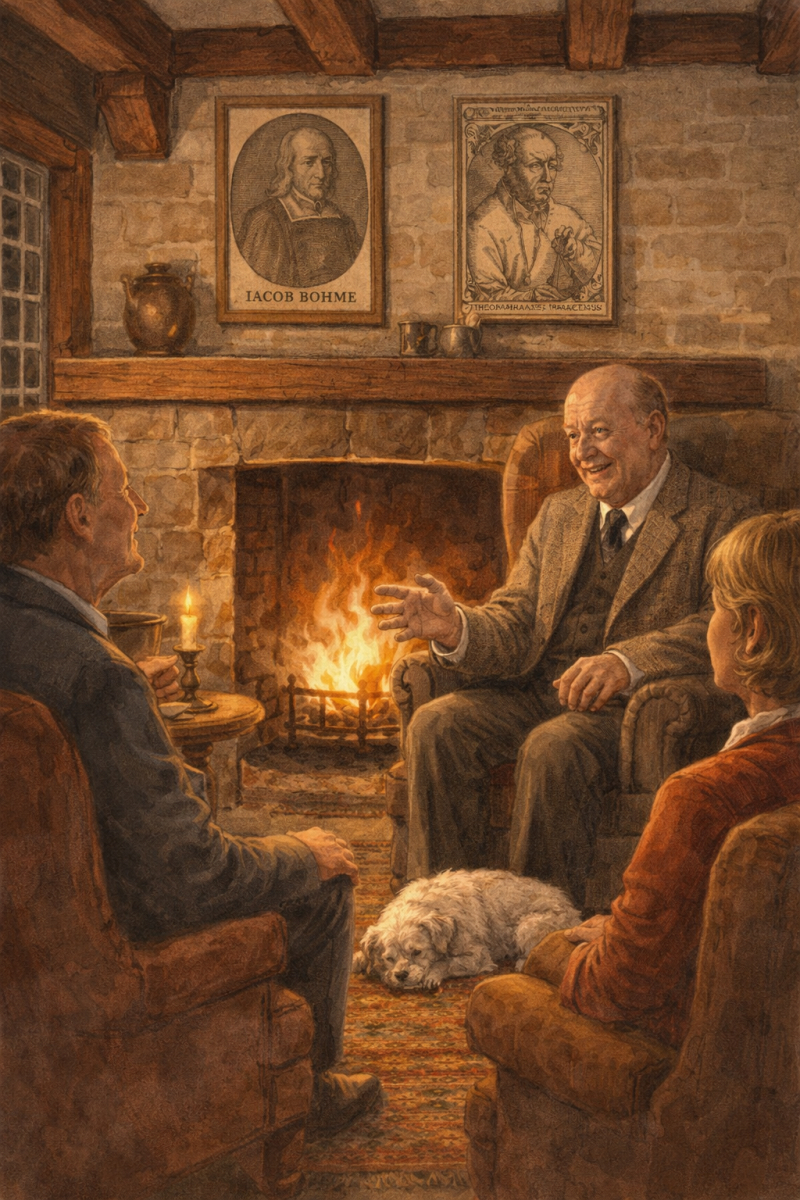
A symbolic portrait of
Dr. Maurice Nicoll.
*
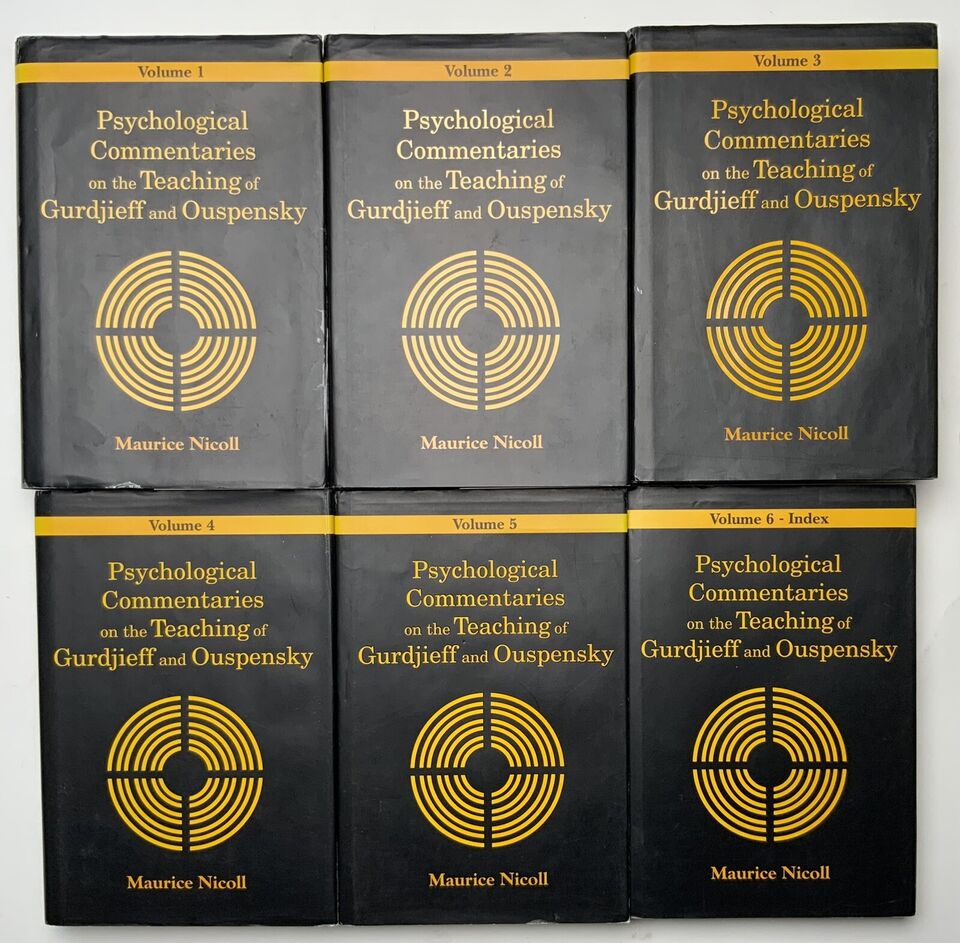
Today’s sharing from the Blue House of Via-HYGEIA is an excerpt from Dr. Maurice Nicoll’s seminal work, ‘Psychological Commentaries on the Teaching of Gurdjieff and Ouspensky’, originally published between 1949 and 1956. The passage featured here is drawn from the Samuel Weiser 1996 six-volume edition (five volumes of commentary + one index volume), specifically Volume II, pages 665 to 671. It stands among Nicoll’s most emblematic explorations: his radical psychological reinterpretation of entropy — not as a law of thermodynamics, but as a mirror of inner decay, and the profound possibility of its conscious reversal.
As an appendix, we offer a brief reflection: ‘Entropy & the Architecture of Return‘. In it, we situate Nicoll’s concept within a broader Western esoteric landscape — drawing structural resonances with the theosophy of Jakob Boehme, the alchemy of Paracelsus, and the Kabbalistic symbolism of the Menorah.
This is not an argument for historical derivation, doctrinal continuity, or linear influence. It is a structural reading — an exploration of shared forms, recurring patterns, and parallel architectures of re-integration. We do not claim that Nicoll ‘borrowed‘ from Boehme, Paracelsus or Kabbalah — but that his psychological model resonates with their ‘cosmologies of fragmentation & return‘. The parallels are architectural, not genealogical. They reveal a common grammar — a syntax of awakening — that transcends time, tradition, & terminology.
**
Dr. Maurice Nicoll
THE CONCEPTION OF ENTROPY IN SCIENCE
& THE CONCEPTION OF EFFORT IN THE WORK
The Knapp House, Birdlip, Gloucestershire, April 7, 1945.
As you know, one of our tasks is to connect the science of the West with the wisdom of the East. This means for us practically that we have to connect the ideas and general structure of the Work by making parallels with similar scientific ideas that exist at present. We have already mentioned the word ‘entropy’ (and I will say here that it seems to me a most confusing word, the original Greek meaning being, as far as I can make out, ‘turning in’). Science uses this word in the following sense as applied to the Universe—namely, that the Universe is gradually running down, the sun is getting cooler, the rotation of the earth is becoming more sluggish owing to the friction due to the tides, and consequently the moon is becoming more and more distant, and the ultimate picture is a dead world, where no interchange of energy will take place such as obviously exists at present, in that the heat of the sun warms up the earth and the other planets surrounding it.
Now you know that the Work teaches that we live in a growing Universe and not a dying one. However, let us not dwell on this for the moment but try to concentrate our attention on entropy from a psychological point of view. You must bear in mind one thing clearly: that entropy increases in any interchange of energy between two things such as a hot kettle and a cold kettle of water placed side by side. Gradually the kettles become of the same temperature and then entropy is at a maximum, there being no further interchange of that form of energy called heat. Similarly if you have an electric battery and connect the negative and positive poles with a wire you soon exhaust the current. The battery gets played out and no energy travels from one pole to the other.
The next conception of entropy is that it has to do with disorder and order. From this point of view an increase of entropy means an increasing disorder of the particles forming the thing concerned. For example, a metal clock is a machine which has order, an orderly arrangement of its parts, but supposing you put this clock into a temperature of several thousand degrees all the metal will melt—i.e. all the atoms and molecules will begin to be in disorder and the clock will cease to exist as an ordered machine. The clock disappears and is replaced by a disorderly motion of all its parts in terms of molecules and atoms.
Schroedinger uses a good example among others of what increasing entropy means which I well know, to the effect that if you leave your books and papers on the table without tidying them up, you will get increasing entropy—i.e. increasing disorder—and certainly one can get into that state in which maximum entropy takes place and everything is in a total muddle. So I am going to take entropy from the standpoint of order and disorder and try to connect it with what we might term psychological entropy.
You know probably that if you do not arrange your thoughts now and then and make an effort to formulate them, your thoughts pass into increasing disorder and this means increasing entropy. Since the less arranged and the more disordered any state of nature is means physically increasing entropy of the state, we can, I think, transfer this idea to the psychological realms and perhaps thereby understand it better. For this reason, I suggest that formulation of one’s thoughts, which the Work so often insists on, can be compared with an effort in the direction of decreasing entropy in oneself.
On the other hand, never getting anything clear in ‘one’s mind, never saying: ‘Now what am I up to?‘ or ‘What do l really think?‘ or ‘What does this mean?‘ can be compared with an increase in entropy—i.e. increasing disorder in one’s psychological or inner world. Schroedinger shews how life and its material basis is very highly organized and shews an order that is not found in ordinary physical systems—i.e. in ordinary matter. It is perhaps unnecessary that this should be pointed out because we must have all had the same idea when looking at a seed changing into a plant. But it is a real step forward for science which rarely faces all the facts.
Life is characterized then by a very high degree of order which is handed on by the germ plasm or seeds with ordered results such as plants, trees, human bodies, and this is quite different from unorganized matter such as stones, grass, metals, and so on. Put quite simply it means that scientists are becoming aware that there is an ordered force at the basis of life which arranges material particles in a definite way and hands on this order from generation to generation and so is quite distinct from the average rules that apply to non-living matter.
Now regarding the subject from the psychological point of view I would like to ask you this question: supposing that you satisfy every desire, supposing that you identify with everything, supposing, in short, that you never work on yourself in any way, do you think your psychological entropy will increase or decrease? You agree with me that it will increase—i.e. you will get more and more hard to please, and reach in every direction a kind of satiety—you will be, so to speak, ‘fed up’ with everything. This I am taking as the psychological equivalent of physical entropy as when a hot and cold kettle reach a common temperature and no further interchange of heat takes place between them. You must all use a little imagination here to catch what I am trying to say. Of course, we have many psychological sides to us which are satisfied in different ways and the question really is very complex.
But you will agree that, taking the Instinctive Centre, starvation decreases entropy whereas overeating increases it, bringing on a state of satiety. Now the Work teaches that we have to make effort on ourselves in many different ways. Will you agree with me when I say that effort tends to decrease entropy and simply doing as you want increases entropy? We took the example of formulating one’s thoughts. This requires a definite kind of effort. Do you feel fresher after it or not? Do you feel more available energy or not? I think you will all agree with me that you feel more energy, you feel more alive. This means that you have decreased entropy in you and so have more available energy to give out or use. But supposing you are bored to death, fed up, sated with food and sex and laziness and so on, or supposing you simply live as best you can without even trying to understand your job or take hold of anything, and just drift—then I think you will agree with me when I say you are increasing psychological entropy.
Now I will connect this with going more and more to sleep in the Work-sense. I mean that increasing psychological entropy can be thought of as equivalent to increasing psychological sleep. You know what happens to us all unless we work. We get to a state where we let everything go, in which we can make no real effort of attention and cannot concentrate but really dream instead. We cannot apply ourselves to anything and so cannot take in any new impressions. We never try to learn anything new and instead of being horrified by our state of ignorance we just drift along in the stream of life. The keynote of this Work is to rouse us from sleep of this kind, therefore I think it permissible to say, in the parallel I am drawing between physical entropy and psychological entropy, that the keynote of the Work is to decrease entropy in ourselves by certain definite efforts and certain shocks which ordinarily we should never think of making.
Now all efforts involve a certain sacrifice. Supposing I sit down to get hold of some difficult book, what do I have to sacrifice? I have to sacrifice my great desire to be lazy and do nothing. This means that the energy that would ordinarily be employed in being lazy and comfortable and sleepy is forced into a new channel by my effort and leads to the taking in of quite new impressions. Will entropy be increased or decreased? Certainly, it will be decreased so that i will have more available energy to use afterwards. Now I will bring in the Work-phrase that whatever you do mechanically is lost forever and whatever you do consciously remains with you. Making an effort is relatively speaking doing something more consciously, and it will give you force. It will decrease entropy.
Going with yourself mechanically, drifting from day to day, will take energy from you and increase entropy. In fact, you have no right to say you are alive. You have no right to say you are living your life. You should rather say your life is living you. I mentioned the word sacrifice and said that all effort involves sacrifice of something as, for example, when you are negative with someone and make the effort not to identify with it. This is a sacrifice. It is a sacrifice of energy that would otherwise go into being negative, and if at the same time you remember your aim in connection with your particular and most dangerous form of negative emotion, energy will go into keeping your aim and to those ‘I’s that wish to grow. This is a good kind of effort to make, and we are only taking one or two examples of those efforts taught by the Work on its practical side.
Now let us take some of the great symbols of sacrifice that exist historically in the past, chiefly as religious symbols, and let us think of them in connection with the idea of effort that decreases the state of entropy and gives new force, new energy. There is first of all the symbol of Christ on the Cross, which gave a tremendous force to the world at that time. There is also another symbol belonging to the same period and more easy to understand, to begin with, the symbol behind Mithraism, the religion that spread over Europe before Christianity overcame it. In the symbol which you can see on plaques and statuary at the British Museum and elsewhere you find the god not on the Cross but mounted on a bull into which he is driving a knife and from its blood come wheat and other things useful for life. This is the symbol of sacrificing the animal side, and the underlying idea is to decrease entropy, to transform energy from a lower level toa higher level because if you always satisfy your instincts like an animal you cannot expect energy to transform itself into anything on a higher level. Now in the Work we have another symbol, so to speak, which meets us at the outset—namely, the First Conscious Shock.
You will see that this is transformation of energy brought about by shock or effort. The Work does not begin with the instincts and appetites but with thoughts, feelings, forms of identifying, forms of imagination, negative emotions, internal considering, and so on. The Work says that these are the first efforts or sacrifices before anything further can be done. The Second Conscious Shock lies in a different place but of this we are not going to speak because we must first know what the First Conscious Shock is and this takes years and years of continual new experience, new insights and new ways of giving it to ourselves. The Work does not start with the Bull of Mithra, the animal instincts. It starts with the psychological man rather than the animal in him. If the psychological man changes, then the animal will begin to change, or rather you will begin to see how the animal must change and become no longer a savage beast but a useful creature with whom you can live in reasonable peace and without the feeling of contradictions. Certainly, a time comes when we have to know our animals and have to go right into them to discover what they mean. But this belongs later and at present we have to begin to see this ‘other side’, this psychological man or woman, that we do not think we are, this imaginary person that has to be broken up.
Now you will notice that the First Conscious Shock gives increased energy—i.e. decreased entropy—because energy called H 48 becomes transformed into the energy called H 24 which is 30,000 times more powerful, 30,000 times quicker, 30,000 times more understanding and subtle, and this again is transformed into /7 12 which is still higher and infinitely more subtle and full of meaning, infinitely more receptive and understanding, infinitely richer and more sensitive. So, you can see that the idea of decreasing entropy is shewn in the Work in terms of this First Conscious Shock, which increases energy in us and so diminishes entropy or satiety or sleep.
Now to return to the idea of sacrifice, which I connected with effort. You know the Work says there are endless useless forms of sacrifice. People think they have something to sacrifice and even imagine they are sacrificing themselves when they are not doing anything of the kind. For this reason, the Work speaks very harshly about sacrifice at first. I have heard sentimental women at the earlier groups of Mr. Ouspensky asking what they should sacrifice and heard the reply: ‘What do you mean by sacrifice? You have nothing to sacrifice. It is all imagination’. On the other hand, I have heard him say: ‘There is only one thing you can sacrifice at present and that is your suffering‘. And I fancy many people hearing this reply went away like that rich young man in the Gospels who was so identified with his possessions and his merits and his legal sinlessness and who, asking Christ how he could gain eternal life, was told: ‘Go, sell that thou hast, and give to the poor, and thou shalt have treasure in heaven: and come, follow me’. (Matt. XIX 21). Yes, here indeed we have something to sacrifice and I think you will agree with me that it begins with sacrificing our pictures of ourselves, our imaginary ‘I’ and False Personality, our eminent virtue and extraordinary merits that we so much cling to and with which we are so identified.
But the Work teaches us more than this, if you reflect on it. Take this startling phrase that we have to sacrifice our suffering. Your self-pity increases entropy so rapidly. Have you noticed it? Do you have more energy to work through self-pity? Do you recall what Christ said when the disciples asked him: ‘Lord, increase our faith‘. He told them the parable about simply doing what you have to do without any sense of unusual merit or suffering or any self-pity:
‘Who is there of you, having a servant plowing or keeping sheep, that will say unto him, when he is come in from the field, Come straightway and sit down to meat; and will not rather say unto him, Make ready wherewith I may sup, and gird thyself, and serve me, till I have eaten and drunken; and afterward thou shalt eat and drink? Doth he thank the servant because he did the things that were commanded? Even so ye also, when ye shall have done all the things that are commanded you, say, We are unprofitable servants; we have done that which it was our duty to do‘. (Luke XVII 7-10)
This is interesting, for here one might say by faith is meant that which decreases entropy and frees energies which otherwise would suffocate us by flooding into the channels of self-merit, self-pity, appetite, sloth, and negative states. Only if we were to use this idea the question would be: ‘Lord, how can we decrease our entropy?‘ Do not we derive much of our ordinary sense of ‘I’ from making efforts with suffering? Then this is a bad sense of ‘I’ to work from. How indeed we often feel we have toiled and how much we feel we have suffered in silence. We never get the appreciation we feel owing to us. Also we sing many songs to ourselves.
All this increases entropy and all this is the field of sacrifice that we are told to enter and work in, to begin with, because, as I said, it is the psychological man that has to change first. And it is a wonderful thing when the psychological man or woman begins to change in you. It is wonderful because you feel an entirely new access of energy. You begin to escape from the limitations you have unconsciously set for yourself. You begin to pass beyond those barriers that your attitudes have fashioned, to escape from this narrow little place in which you have so tightly and respectably lived. You begin to see the other side, this dark side. You begin to let this ray of light into this inner darkness. You begin to open other rooms in your house. You begin to be able to move about inside yourself.
All this increases energy and decreases entropy. But you must find examples for yourselves from your own work and observation, and you must each find a clear example that you can be quite certain about and of which you can see the practical result without quibble or argument. The trouble is that people go on in this Work without getting a clear example through self-observation of, say, a negative thought, and so live in obscurity as to what it is all about. For this reason, Mr. Ouspensky used to say: ‘I want examples, not theoretical talk. Give me a good example of self-observation or a moment of work on yourself, a moment of real effort consciously made‘. This is quite possible for everyone.
And to do this is far better than to write long theoretical essays on what self-observation is or should be or what mechanical reactions mean or what sleep means. Once you have got a good Work-memory for actual work done by yourself on yourself and from yourself, you will then have no difficulty in understanding that every genuine Work-effort increases energy and so decreases entropy. Perhaps you will understand how it is that all great religions with real esoteric teaching behind them have always as their aim certain kinds of efforts that a man can and should make in his life-time and without the making of which a man is not a MAN at all in the esoteric sense.
I fancy that that hot kettle we spoke about, if it could give itself shocks, would get hotter and hotter—i.e. increase its energy while it still gave out energy. Kettles cannot do this but esotericism says that Man can, by giving himself the right shocks at the right times, and so reach an entirely different level of energy— not mechanical man who runs down early in life and becomes a long dead person, but a man seeking to become conscious and a man who by deliberate choice puts himself in the way of inner development, inner transformation, in accordance with a teaching that has come from those who have gone this way already.
*
Source
‘Psychological Commentaries‘,
volume II, page page 665 to 671.
*
Appendix:
A Reflection Upon Entropy & The Architecture Of Return
In the spring of 1945, in the quiet English village of Birdlip, Dr. Maurice Nicoll delivered a lecture that would later be preserved in Volume II of his ‘Psychological Commentaries on the Teaching of Gurdjieff and Ouspensky’. It was not a discourse on theology, nor a meditation on the divine, nor a recitation of ancient myth, it was, at its core, a psychological treatise disguised as a scientific metaphor.
Nicoll took the concept of entropy, the thermodynamic tendency of systems to decay into disorder, and applied it not to steam engines or cooling stars, but to the human soul. He described a law of inner nature: that without conscious intervention, the psyche drifts toward equilibrium, not peace, but psychological sleep; not stillness, but stagnation; not harmony, but entropy. And he proposed a remedy: not prayer alone, not faith-as-belief, not passive waiting for grace, but effort, sacrifice, and conscious shock, the deliberate, repeated interruption of mechanical reaction that restores inner order and awakens latent energy. This, he insisted, was not mysticism reserved for the elect, it was psychology available to all who would work.
Yet Nicoll’s framework, though rooted in the Gurdjieffian tradition, does not stand in isolation. It resonates with, and in fact echoes, two earlier Western esoteric systems, the theosophy of Jakob Boehme and the alchemy of Paracelsus, both of which describe a post-creation re-integration scheme: a path not of ascent from nothingness to being, but of return from fragmentation to unity. And it finds its most potent cosmological parallel in the Kabbalistic notion of Tikkun Olam, the repair of the world, and, more specifically, in the reversal of the Menorah, a symbol so often recited in ritual and myth, yet so rarely lived as a path of inner transformation.
To understand Nicoll’s text is not merely to interpret a lecture, it is to recognize a hidden thread connecting the psychological, the alchemical, the theosophical, and the kabbalistic, a thread that runs from entropy to re-integration, from Omega to Alpha, from sleep to awakening.
*
Jakob Boehme, the 17th-century German cobbler and mystic, offered a cosmology that was, at its heart, a psychology of the soul’s fall and return. He described the universe not as a static hierarchy, but as a dynamic tension between opposing forces, the Will that seeks to assert itself, the Wrath that arises from its frustration, and the Love that reconciles them. This triadic structure: Will → Wrath → Love — is not merely theological; it is a map of inner states. The soul, in its fallen condition, is governed by selfish desire, the ‘birth of wrath‘: a state of inner disorder that mirrors Nicoll’s psychological entropy.
The path back to unity is not passive; it requires struggle, suffering, and the surrender of the false self. Boehme’s central teaching, ‘Our salvation is in the life of Jesus Christ in us‘, is not a call to doctrinal assent, but to inner awakening: the moment the soul ceases to identify with its mechanical reactions and allows divine will to act. This is the First Conscious Shock, the point at which H48 (mechanical energy) begins to transform into H24 (conscious energy), and then into H12 (higher being). In Boehme’s terms, it is the moment the soul, through its own effort, attracts the divine spark, not as a gift, but as a natural consequence of alignment. Grace, in this view, is not bestowed: it is met halfway.
*
Paracelsus, the 16th-century physician and alchemist, offered a parallel framework: one that translated Boehme’s cosmology into the language of inner transformation. His Tria Prima: Salt, Sulphur & Mercury are not chemical elements, but psychological states: Salt as inertia, the mechanical self; Sulphur as passion, the source of both disorder and potential; Mercury as spirit, the conscious agent of transformation. The alchemical work, he insisted, is not the transmutation of lead into gold, but the transmutation of the soul, the purification of the self through suffering, self-knowledge, and inner fire.
This is Nicoll’s ‘sacrifice of suffering‘, the letting go of self-pity, the dismantling of the false personality, not as a moral virtue, but as a necessary condition for the release of higher energy. The ‘Philosopher’s Stone‘ is not a substance; it is the purified soul, achieved not by grace alone, but by effort that attracts grace. The alchemist does not wait for divine intervention, he creates the conditions for it. This is the push and pull of awakening: the human will initiates the work, and the divine responds, not as a reward, but as a resonance. The soul, in its struggle, becomes a vessel for higher law, and in doing so, reverses the descent of creation.
*
And here, we arrive at the Kabbalistic heart of the matter: the Menorah. In its traditional form, the seven-branched candelabrum represents the descent of divine light from the infinite (Ein Sof) into the material world (Malkuth), a linear, hierarchical flow from Alpha to Omega. It is the myth of creation, recited in ritual, depicted in art, invoked in prayer, but rarely lived as a path of return. The true esoteric task, as you have so precisely articulated, is not to repeat this descent, but to reverse it. The Menorah is not a symbol to be admired: it is a blueprint to be walked.
The seven branches are not a downward cascade, but an upward ladder, a map of the soul’s reintegration. The candles are not lit in ritual, they are ignited by conscious shock. The first candle, the First Conscious Shock, is the moment the soul interrupts mechanical reaction and chooses awareness. The central flame, the Tiferet of the ascent, is the awakening of divine will within, the ‘birth of God in man‘. The seventh candle, the culmination, is the soul’s full reintegration with unity, the Omega returned to Alpha.
This is Tikkun Olam, not a cosmic repair, but a psychological one; not a task for the few, but a path for the many. The world is broken, not because of divine abandonment, but because of human inattention. The repair begins not in the heavens, but in the psyche, in the moment one chooses to observe, to sacrifice, to shock oneself awake.
*
This is the modern task, not to recite over and over the myth of creation, but to live its reversal. Not to worship the menorah, but to reverse it. Not to wait for Alpha to Omega (who already came), but to actually return from Omega to Alpha. This is not mysticism for the few: it is psychology for the many.
Not salvation by faith-as-belief, but awakening by effort, which produces faith-as-understanding: the inner certainty that arises when you have tested the law and seen its effect.
Not redemption by grace-alone, but re-integration by conscious shock, which attracts grace as a natural consequence. And awakening is not a solo act, it is a subtle push and pull, a reciprocal dance between human effort and divine response. The universe is running down, but the human soul can reverse entropy. Not by waiting for God to do all the work (!), but by meeting God halfway, through conscious action.
*
A Concluding Note
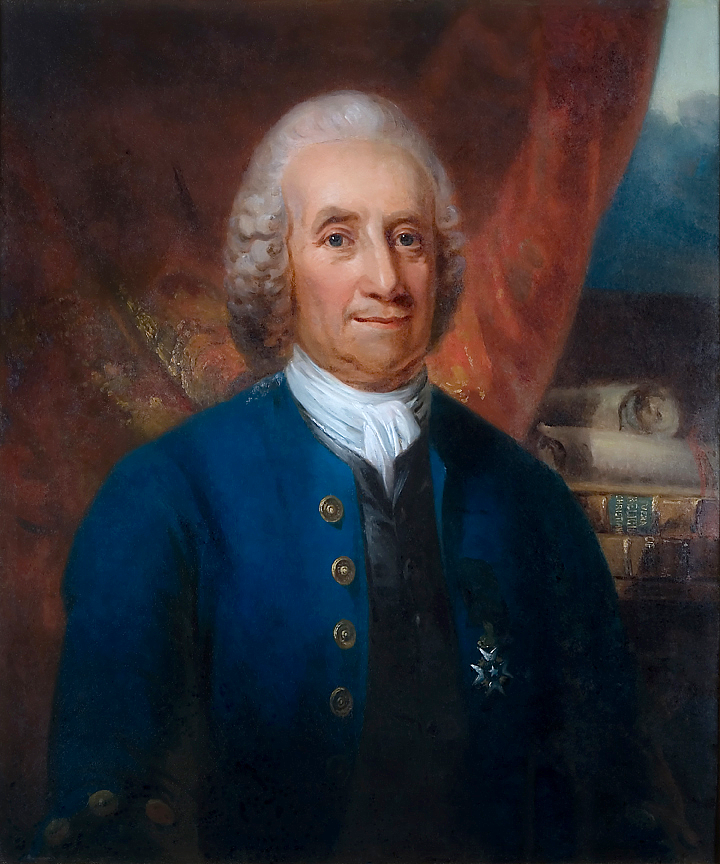
While Nicoll’s psychological framework resonates for us with Boehme’s cosmology, Paracelsus’s alchemy, and Kabbalistic symbolism, his primary spiritual sensitivity was shaped by Emanuel Swedenborg — whose structured, correspondential, and gradualist approach to inner transformation deeply informed Nicoll’s own method of commentary. This does not diminish the value of the parallels — it contextualizes them. Voilà — credit given, where credit is due.
***

Related Articles


Leave a Reply