
Circle of Transmission: The Living Loom
Wellcome MS. 4328: ‘Notes Of Observation, Comparison And Hypothesis’, by Vincent Mercier

A portrait of Vincent Mercier
reading the Sabbathier.
*
Today’s sharing from the Blue House of Via-HYGEIA brings the latest editorial and bibliographic news by Vincent Mercier, about Esprit Sabbathier’s The Ideal Shadow of Universal Wisdom, of which we have just published a modern edition based upon Wellcome MS. 4328. There is a lot to tell, and Vincent does it very well.
**
Manuscript MS 4328
of the Wellcome Library
(A very special thanks to Nicolas Lecerf, who succeeded in awakening
my curiosity and inciting me to probe this manuscript more deeply).
Notes of observation,
comparison and hypothesis,
by Vincent Mercier
A very long time ago, during my youth, I had fallen asleep, as it were, in the ideal shadow of General Wisdom. After several years, a friend and fellow researcher, also engaged upon the path of that same wisdom, awakened my curiosity regarding MS 4328, preserved at the Wellcome Library.
Awakening then from my torpor, I gathered the leaves of my documents, which were beginning to fly away on the green grass beside the tree of the sages. A profound desire then took hold of me to reunite what was scattered. Contemplating the multitude of plates, notes and documents accumulated over all those years, I suddenly felt myself transported in spirit to the Wellcome Library; all at once, I was seated at a reading table. The volume placed before me, I observe it even before taking it in hand. It is a quarto of approximately 21.5 × 15.5 cm: a format large enough to occupy both hands, yet still manageable.
The spine first attracts my gaze. Long, narrow, covered with a clear vellum yellowed by time, it bears several traces of identification. At the top, a small old label, framed by a double blue line, contains a shelfmark written by hand today difficult to read: “736”. Lower down, in black ink, one reads “R.P. Esprit Sabbath…”, then the Latin title inscribed in capitals: IDEALIS UMBRA SAPIENTIAE. The writing is simple, irregular, utilitarian. At the very bottom of the spine appear two further old library or classification marks: “66071” and the date “1678”. These figures, added at different moments, give the spine the appearance of an object passed through several hands and several systems of shelving.
When I take up the book, I immediately feel the material of the vellum. It is dry, firm, slightly cold. Its surface is not perfectly smooth: it catches in places, while certain zones, polished by rubbing, appear more shiny. The corners, the caps and the edges are worn; the spine shows small deformations, like skin stretched then retracted around the body of the volume.
By gently turning the book, I observe the boards. The vellum, of an irregular ivory beige, is marked with brown, grey and ochre stains. On the upper board, one distinguishes handwritten inscriptions in dark ink: the name “Sabbathier”, then words of the Latin title, Idealis Umbra Sapientiae generalis. Lower down, another old notation, paler and partially effaced, written upside-down, resembles a shelfmark or a date: “26134”.
The flap of the binding appears on the board, like a piece of folded vellum intended to protect the leaves. One sees darker stains there, rubbings, creases and small rectangular traces linked to an old fastening system. The opposite board is less written upon, but just as marked: diffuse soiling, greyed zones, pressure marks and wear to the corners.
Viewed by the fore-edge, the volume appears compact. The quires are tight; the edges of the leaves are darkened and slightly wavy. The bibliographical description—a volume of seventy leaves, the last four blank—then becomes concrete: it transforms into a true thickness of old paper, contained in an original vellum binding with flap.
I then open the volume with care. The interior of the binding immediately confirms the material history of the book. On the first pastedown, a blue typewritten slip, glued to the page, gives several pieces of information. It identifies the manuscript as a CABALISTIC MS., entitled IDEALIS UMBRA SAPIENTIAE GENERALIS, translated as The ideal shadow of universal wisdom, and attributed to the reverend father Esprit Sabbathier. The slip specifies that it is a quarto manuscript in white vellum, and describes the text as a copy in fine handwriting, probably executed at the end of the 17th century. It also mentions the nine magic seals and the numerous synoptic tables that accompany the manuscript.
In lifting this slip, other writings become visible. At the top appears the number “2333”, a cross, then the handwritten formula Soli Deo Gloria. Lower down, a glued note bears the mention From Baron Kirkup’s books and gives indications on the work. One reads there the Latin title Idealis umbra sapientiae generalis, underlined by a red line, as well as notes in English and in Italian evoking the cabalistic character of the text and its provenance.
Under this note, a handwritten signature, Walter Moseley, appears on the pastedown. The page itself is stained, greyed, marked with rubbings, small tears and traces of glue.
On the other inner pastedown, a label of the Wellcome Historical Medical Library is glued in the centre. The red stamp, very clear, contrasts with the pale vellum. One reads there MS 4328 and the number 66071, also repeated by hand in the upper right corner. These institutional marks answer to the old handwritten inscriptions: the book thus passes from a history of collectors to a history of library. From the very first pages, the object presents itself therefore not only as an old manuscript, but also as a dossier of provenances, classifications and readings.
After the first notes of provenance appears a glued and folded plate. In unfolding it with care, the page opens widely and almost exceeds the ordinary format of the volume. This gesture changes the scale of reading: I am no longer simply before a page, but before a table to consult.
The plate is entirely organized in columns ruled in ink. It mixes Latin, Hebrew, letters, signs and angelic names. The column titles indicate a logic of correspondences: Sphærarum Intelligentiæ, Ordines Beatorum, Tituli Zephiristici, Nomina Dei secundum litterarum numerum exprimunt, then Kabalystica Dei nomina. Each line associates Latin names, Hebrew names, transcriptions, letters and signs placed in the margins. One recognizes there a structure of Christian Kabbalah: Hebrew and sephirotic notions are set in relation with Latin, angelic and theological categories.
This plate is therefore not a decorative illustration. It functions as a synoptic table, a key to reading the manuscript. It permits seeing at a single glance a system of correspondences between the spheres, the intelligences, the celestial orders, the divine names and the signs. The fact that it also appears in the engraved edition of 1679 shows that it belongs to the very apparatus of the work: it is not an isolated owner’s note, but an element transmitted with the text, intended to guide the understanding and use of the treatise.
After this large folded table appears another plate, this time composed of nine seals drawn in pen and arranged in three rows. The circular figures are carefully traced: some contain radiant suns, others triangles, stars, an eye, a human figure or geometric signs. The whole gives an impression more operative than descriptive. Where the preceding plate classified correspondences, this one materializes the signs themselves.
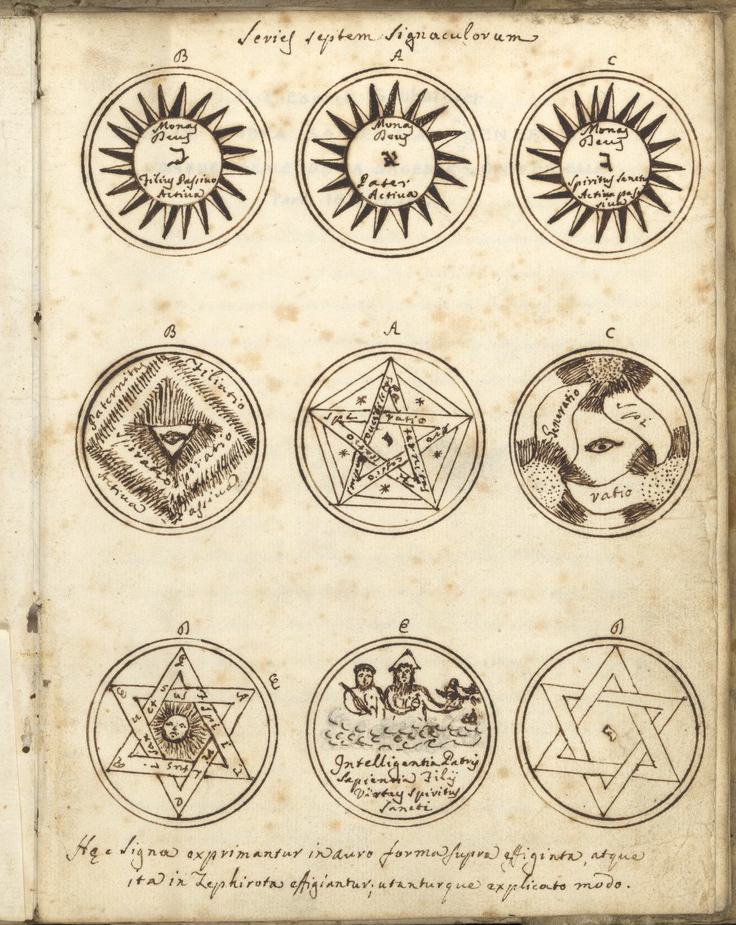
Image from MS 4328.
The title placed at the top of the plate is the following: Series septem signaculorum — “Series of the seven seals”
At the bottom of the plate one also reads: Hæc signa exprimantur in auro, formâ suprà effigiâtâ, atque ita in Zephirota affigiantur; utanturque explicato modo.
Which may be translated thus: “Let these signs be reproduced in gold, according to the form figured above, then fixed to the Sephiroth; and let them be used according to the explained mode.”
This first plate, called that of the seven seals, calls to me all the more because it is not present as such in the engraved edition of 1679, except in the large circular plate where one finds a multitude of drawings engraved by the sculptor-engraver F. Caumartin. One finds there these nine seals scattered throughout the engraving.
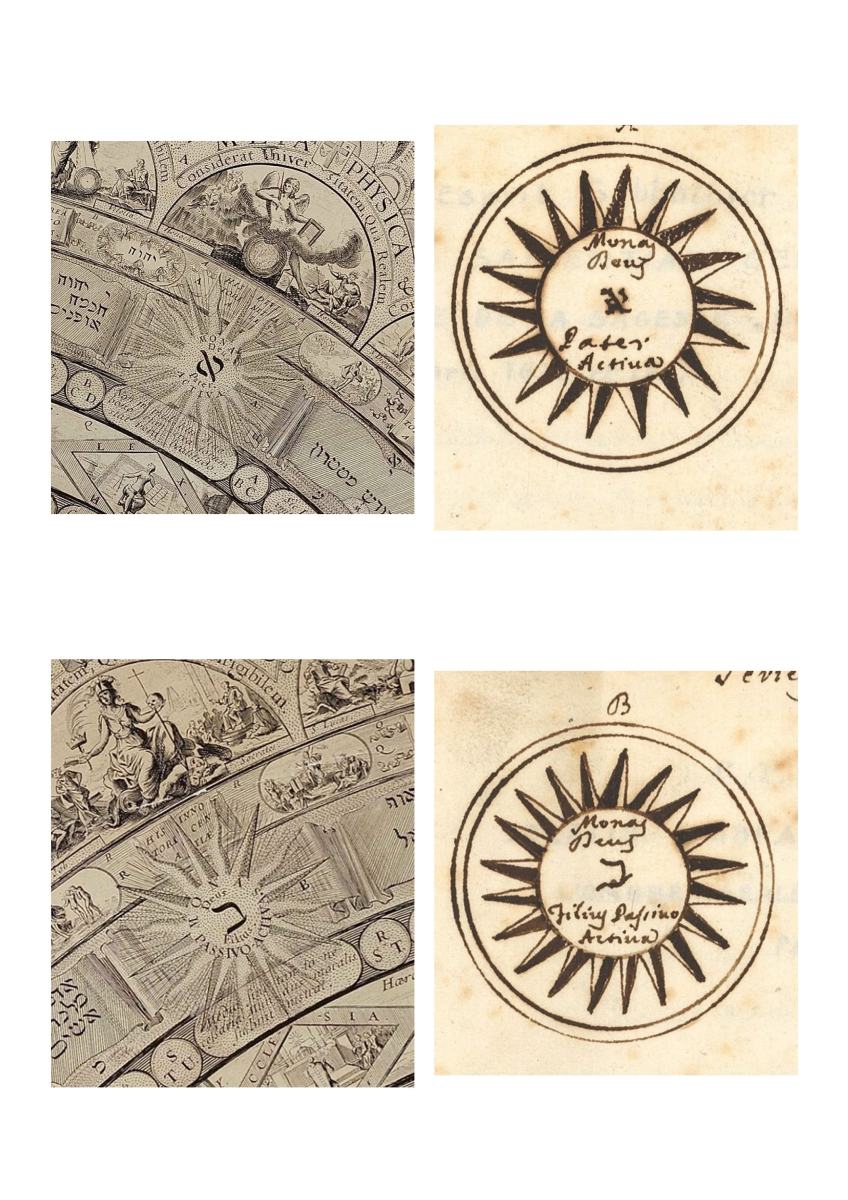
Comparison between the so-called F. Caumartin 1679 chart and the Wellcome manuscript.
After the plates comes the preamble, followed by the explanations that develop the content of the large correspondence plate. These explanations must be compared with the Latin plate known from the 1679 edition. It is necessary here to distinguish this Latin version from the chart engraved in French: the approbations and indications are not exactly the same, and certain pieces of information seem to have been voluntarily omitted in the French version.
The manuscript therefore preserves a more complete form, or at least one closer to the Latin apparatus. The preamble and explanations occupy the entirety of the body of the volume: seventy leaves in total, sixty-nine written and one blank leaf.
However, on the following leaf, my surprise is great: I discover for the first time a description of the large circular plate in Italian. The chapter bears an explicit title: Li seguenti Capitoli formati in Libretto in lingua Francese che dichiarano la misteriosa Carta intitolata Dell’Ombra Sapientiae Generalis, sono stati portati in lingua Italiana.
That is: “The following chapters, formed into a little book, written in the French language and explaining the mysterious chart entitled Of the Shadow of General Wisdom, have been translated into the Italian language.”
This mention is capital. It indicates that the Italian text is not an independent composition, but the translation of a French booklet intended to explain a “mysterious chart” entitled Dell’Ombra Sapientiae Generalis. It thus confirms that the edition produced in 1679 by the engraver Caumartin was indeed accompanied by a large figure or chart, and that this chart was the object of an explanation organized into chapters.
The manuscript therefore transmits not only the doctrinal content of the work: it also preserves the memory of its graphic apparatus. The large circular plate was not a simple ornament, but a central element, designed to be read, deciphered and commented upon. The Italian passage becomes then a precious testimony, for it directly links the manuscript text, the French tradition and the 1679 engraved chart.
This chapter describes the large chart as the image of a universal science, capable of relating all sciences to a single order and a single method. The figure is divided into four parts: the frame, the four large lateral figures, the solar centre with the Crucified, then the circles and spheres that radiate around him.
The frame affirms the fundamental unity of God, the Church, Truth and Science. At the centre, the universe is presented in three states: the Chaos, or “confused unity”; Christ on the cross, as “contained universality”; then the deployed whole of the figure, as “explained unity”.
The circles then organize the three great worlds: physical, moral and theological. Each world possesses its principles, its oppositions, its degrees and its correspondences, expressed by Latin, Hebrew, theological and cabalistic names.
The chart also puts in order the particular sciences—metaphysics, morals, physics, theology, jurisprudence, politics, rhetoric, magic—around a general science called Ideosophistic. The rays, the letters, the signs and the figures serve to establish rules of direction, laws of correspondence and links between all parts of the system.
The chapter finally insists upon the presence of twenty-four alphabets, or series of twenty-four elements, which structure the chart. Thus, the large circular plate appears not as a simple image, but as a true instrument of classification, meditation and explanation of General Wisdom. It is also important to note that one finds there the nine seals figuring at the beginning of the manuscript.
It is then that I think again of a large chart currently offered for sale on the internet, presented wrongly as a “Rosicrucian chart”. In reality, it is not an autonomous Rosicrucian image, but a scheme reproduced very exactly after the large engraving executed by F. Caumartin in 1679 for the Idealis Umbra Sapientiae Generalis. The copyist, visibly less skilled in drawing than in writing, replaced several complex figures with handwritten commentaries, while conserving the general architecture of the plate.
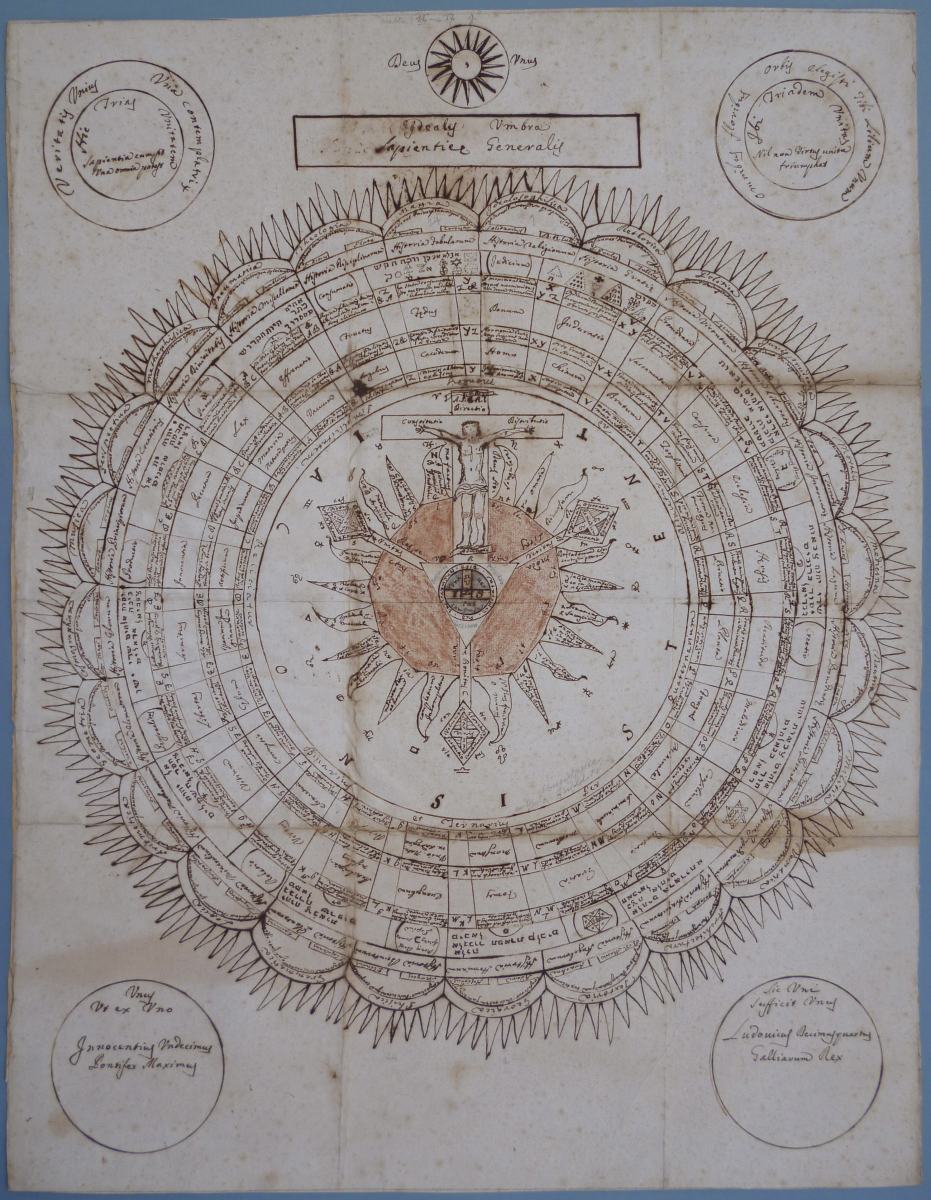
Photo by Jules Petroz, shared on his AbeBooks account.
One detail particularly attracts my attention: the circular seal placed at the top of the chart, containing the Hebrew letter yod. Its form, its tracing and its organization recall in a striking manner the seals of MS 4328 of the Wellcome Library. I then push the comparison further, observing not only the signs, but also the penmanship, the manner of forming the letters, the curves, the spacings and certain graphic gestures. The resemblance is so precise that it no longer seems to be a simple coincidence.
This comparison leads me today to a strong conclusion: this large chart very probably belonged to the same ensemble as the Wellcome Library manuscript. It could have been detached from the volume at an unknown date, then circulated separately. If this hypothesis is confirmed by the material examination of the paper, the dimensions, the folds and the ink, the chart currently for sale would not be an isolated document, but a missing piece of the original manuscript apparatus.
But the surprise does not stop there. The continuation of the manuscript, totally unknown until this day, does not content itself with explaining the large chart: it also gives its mode of employment. The text then takes on a new, almost operative dimension, under a particularly revealing title:
Explication de l’Idéolosophysique, ou de l’Ombre idéale de la Sagesse générale, catholico-chrétienne et christiano-kabbalistique, ainsi qu’une méthode exacte pour s’en servir.
This title profoundly changes the understanding of the whole. The Idealis Umbra Sapientiae Generalis no longer appears only as an encyclopedic, theological or symbolic construction, but as an instrument intended to be used according to a precise method. The large figure, the seals, the Hebrew correspondences, the signs and the tables therefore belong not solely to learned speculation: they seem to participate in a ritual apparatus, framed by a Catholic, Christian and Kabbalistic thought.
This discovery gives the manuscript a particular importance. It transmits not only the explanation of a lost or detached image: it also preserves the manner in which this image was to be understood, manipulated and put into operation. From this point, the book ceases to be only the commentary of a chart: it becomes the witness of a practice.
The text reveals a true ritual mode of employment of the Ideal Shadow of General Wisdom. The operator must first place himself under the invocation of the Trinity and seek divine Wisdom not out of curiosity, but in humility, purity of heart and obedience to God. The first instrument is the sign of the hexagon, called the sign of the Universal Intelligence: engraved in pure gold, worn on the right arm by a silk tie, it prepares the operator and renders his hand apt to form the characters. This sign acts as a seal of introduction and promise; it must communicate intelligence within a delay that can go up to fifty days.
After this first period come the seals of accomplishment: those of the Father, the Son and the Holy Spirit, likewise engraved in gold and attached to the arm by a yellow silk tie. Their disposition answers to the Trinity: the Father at the centre, the Word at the right, the Spirit at the left. A final seal of confirmation completes the ensemble, accompanied by prayers, a hymn to the Holy Spirit and a series of daily orations. The ritual therefore aims not only at consulting a figure, but at interiorly transforming the operator so that he may receive intelligence, science and wisdom.
The text, however, strictly frames this practice. The operator must avoid pride, forbidden curiosity and any request contrary to faith, to one’s neighbour or to the divine will. He is notably forbidden to inquire into secrets reserved to God, the death of others, the faults of his neighbour, the state of deceased souls or anything harmful. When the signs are laid aside, they must be purified, wiped with a white cloth, enclosed in a new case and sealed with white wax.
The ritual thus appears as a procedure of sanctification and knowledge, where the large chart, the seals, the prayers and the prohibitions form a complete apparatus of controlled access to Wisdom.
In some sense, this figure of the Ideal Shadow of General Wisdom, its study and its practice, infuse in him who renders himself worthy of it the grace of God. Thus closes the manuscript.
There would still be much to say and numerous researches to conduct on the subject. To this day, we know of four charts.
The first, and the oldest, is that engraved by F. Caumartin in 1679. The second could be that drawn in pen, which, in my opinion, belongs to manuscript MS 4328 of the Wellcome Library, but was separated from it at a date still unknown. The third would be the tableau executed in oil painting, which hangs in the study hall of the University of Philosophy of Padua, with the abbreviated signature of the painter and the date: J.G.F., a. 1713. The most recent would be that realized by David Rosenberg to accompany his explanatory work dating from 1844.
I would like, through these few lines, to invite researchers, academics, historians of the book, specialists in Christian Kabbalah, in the history of science, in learned esotericism and in the visual culture of the 17th century to pay new attention to the Idealis Umbra Sapientiae Generalis and to manuscript MS 4328 preserved at the Wellcome Library.
This manuscript, by the richness of its texts, its plates, its seals, its correspondences and its traces of provenance, seems still far from having delivered all its secrets. It opens a fascinating field of study, at the crossroads of theology, philosophy, Christian Kabbalah, iconography, the history of libraries and practices.
I am convinced that there remains, around this document and its history, a multitude of treasures to discover, to compare, to interpret and to transmit. Each material detail, each inscription, each plate, each known or supposed version of the large chart can contribute to better understanding the singular place of this work in the intellectual and spiritual history of its time.
My wish is therefore not to close the subject, but on the contrary to open it further. May this first approach be able to stimulate exchanges, verifications, collaborations and new researches. For it is often by crossing perspectives, disciplines and competences that old manuscripts recover their voice, their context and their true depth.
Vincent Mercier,
June 2026.
Le manuscrit MS.4328
de la Wellcome Library
(Un remerciement tout particulier à Nicolas Lecerf,
qui a su éveiller ma curiosité et m’inciter à sonder plus profondément ce manuscrit).
Notes d’observation,
de comparaison et d’hypothèse,
par Vincent Mercier.
Il y a bien longtemps, durant ma jeunesse, je m’étais comme assoupi à l’ombre idéale de la Sagesse générale. Après plusieurs années , un ami chercheur, engagé lui aussi sur le chemin de cette même sagesse, éveilla ma curiosité au sujet du MS.4328, conservé à la Wellcome Library.
Me réveillant alors de ma torpeur, je rassemblai les feuilles de mes documents, qui commençaient à s’envoler sur l’herbe verte jouxtant l’arbre des sages. Il me prit alors le profond désir de réunir ce qui était épars. En contemplant la multitude des planches, des notes et des documents accumulés durant toutes ces années, je me sentis soudain transporté en esprit à la Wellcome Library, tout à coup, j’étais assis à une table de consultation. Le volume posé devant moi, je l’observe avant même de le prendre en main. C’est un in-quarto d’environ 21,5 × 15,5 cm : un format assez grand pour occuper les deux mains, mais encore maniable.
Le dos attire d’abord mon regard. Long, étroit, couvert d’un vélin clair jauni par le temps, il porte plusieurs traces d’identification. En haut, une petite étiquette ancienne, encadrée d’un double trait bleu, contient une cote manuscrite aujourd’hui difficile à lire : « 73 6 ». Plus bas, à l’encre noire, on lit « R. P. Esprit Sabbath… », puis le titre latin inscrit en capitales : IDEALIS UMBRA SAPIENTIAE. L’écriture est simple, irrégulière, utilitaire. Tout en bas du dos apparaissent encore deux anciennes marques de bibliothèque ou de classement : « 66071 » et la date « 1678 ». Ces chiffres, ajoutés à des moments différents, donnent au dos l’aspect d’un objet passé par plusieurs mains et plusieurs systèmes de rangement.
Lorsque je prends le livre, je sens aussitôt la matière du vélin. Elle est sèche, ferme, légèrement froide. Sa surface n’est pas parfaitement lisse : elle accroche par endroits, tandis que certaines zones, polies par les frottements, paraissent plus brillantes. Les coins, les coiffes et les bords sont usés ; le dos montre de petites déformations, comme une peau tendue puis rétractée autour du corps du volume.
En faisant doucement tourner le livre, j’observe les plats. Le vélin, d’un beige ivoire irrégulier, est marqué de taches brunes, grises et ocre. Sur le plat supérieur, on distingue des inscriptions manuscrites à l’encre sombre : le nom « Sabbathier », puis des mots du titre latin, Idealis Umbra Sapientiae generalis. Plus bas, une autre notation ancienne, plus pâle et partiellement effacée, écrite à l’envers, ressemble à une cote ou à une date : « 26 134 ».
Le rabat de la reliure apparaît sur le plat, comme une pièce de vélin repliée destinée à protéger les feuillets. On y voit des taches plus sombres, des frottements, des plis et de petites traces rectangulaires liées à un ancien système de fermeture. Le plat opposé est moins écrit, mais tout aussi marqué : salissures diffuses, zones grisées, traces de pression et usure des coins.
Vu par la tranche, le volume paraît compact. Les cahiers sont serrés ; les bords des feuillets sont assombris et légèrement ondulés. La description bibliographique — un volume de soixante-dix feuillets, dont les quatre derniers blancs — devient alors concrète : elle se transforme en une véritable épaisseur de papier ancien, contenue dans une reliure d’origine en vélin à rabat.
J’ouvre ensuite le volume avec précaution. L’intérieur de la reliure confirme aussitôt l’histoire matérielle du livre. Sur la première garde, une fiche dactylographiée bleue, collée sur la page, donne plusieurs informations. Elle identifie le manuscrit comme un CABALISTIC MS., intitulé IDEALIS UMBRA SAPIENTIAE GENERALIS, traduit par The ideal shadow of universal wisdom, et attribué au révérend père Esprit Sabbathier. La fiche précise qu’il s’agit d’un manuscrit in-quarto, en vélin blanc, et décrit le texte comme une copie de belle écriture, probablement exécutée à la fin du XVIIe siècle. Elle mentionne aussi les neuf sceaux magiques et les nombreuses tables synoptiques qui accompagnent le manuscrit.
En soulevant cette fiche, d’autres écritures deviennent visibles. En haut apparaissent le numéro « 2333 », une croix, puis la formule manuscrite Soli Deo Gloria. Plus bas, une note collée porte la mention From Baron Kirkup’s books et donne des indications sur l’ouvrage. On y lit le titre latin Idealis umbra sapientiae generalis, souligné d’un trait rouge, ainsi que des notes en anglais et en italien évoquant le caractère cabalistique du texte et sa provenance.
Sous cette note, une signature manuscrite, Walter Moseley, apparaît sur la garde. La page elle-même est tachée, grisée, marquée de frottements, de petites déchirures et de traces de colle.
Sur l’autre garde intérieure, une étiquette de la Wellcome Historical Medical Library est collée au centre. Le cachet rouge, très net, contraste avec le vélin pâle. On y lit MS. 4328 et le numéro 66071, repris aussi à la main dans l’angle supérieur droit. Ces marques institutionnelles répondent aux anciennes inscriptions manuscrites : le livre passe ainsi d’une histoire de collectionneurs à une histoire de bibliothèque. Dès les premières pages, l’objet se présente donc non seulement comme un manuscrit ancien, mais aussi comme un dossier de provenances, de classements et de lectures successives.
Après les premières notes de provenance apparaît une planche collée et pliée. En la dépliant avec précaution, la page s’ouvre largement et dépasse presque le format ordinaire du volume. Ce geste change l’échelle de la lecture : je ne suis plus simplement devant une page, mais devant un tableau à consulter.
La planche est entièrement organisée en colonnes réglées à l’encre. Elle mêle latin, hébreu, lettres, signes et noms angéliques. Les titres des colonnes indiquent une logique de correspondances : Sphærarum Intelligentiæ, Ordines Beatorum, Tituli Zephiristici, Nomina Dei secundum litterarum numerum exprimunt, puis Kabalystica Dei nomina. Chaque ligne associe des noms latins, des noms hébreux, des transcriptions, des lettres et des signes placés dans les marges.
On y reconnaît une structure de kabbale chrétienne : les notions hébraïques et séphirotiques sont mises en relation avec des catégories latines, angéliques et théologiques.
Cette planche n’est donc pas une illustration décorative. Elle fonctionne comme une table synoptique, une clé de lecture du manuscrit. Elle permet de voir d’un seul coup d’œil un système de correspondances entre les sphères, les intelligences, les ordres célestes, les noms divins et les signes. Le fait qu’elle figure aussi dans l’édition gravée de 1679 montre qu’elle appartient au dispositif même de l’ouvrage : elle n’est pas une note isolée de possesseur, mais un élément transmis avec le texte, destiné à guider la compréhension et l’usage du traité.
Après cette grande table pliée apparaît une autre planche, cette fois composée de neuf sceaux dessinés à la plume et disposés en trois rangées. Les figures circulaires sont tracées avec soin : certaines contiennent des soleils rayonnants, d’autres des triangles, des étoiles, un œil, une figure humaine ou des signes géométriques. L’ensemble donne une impression plus opérative que descriptive. Là où la planche précédente classait les correspondances, celle-ci matérialise les signes eux-mêmes.
Image provenant du MS. 4328.
Le titre placé en haut de la planche est le suivant :
Series septem signaculorum
« Série des sept sceaux »
Au bas de la planche, on lit également :
Hæc signa exprimantur in auro, formâ suprà effigiatâ, atque ita in Zephirota affigiantur; utanturque explicato modo.
Ce que l’on peut traduire ainsi :
« Que ces signes soient reproduits en or, selon la forme figurée ci-dessus, puis fixés aux Zephiroth ; et qu’on les utilise selon le mode expliqué. »
Cette première planche, dite des sept sceaux, m’interpelle d’autant plus qu’elle n’est pas présente comme telle dans l’édition gravée de 1679, si ce n’est dans la grande planche circulaire où se trouve une multitude de dessins gravés par le sculpteur-graveur F. Caumartin. On y retrouve ces neuf sceaux disséminés dans la gravure.
Comparatif entre la carte dite de F.Caumartin 1679 et le manuscrit de la Wellcome MS.4328.
Après les planches vient le préambule, suivi des explications qui développent le contenu de la grande planche de correspondances. Ces explications doivent être rapprochées de la planche latine connue par l’édition de 1679. Il faut ici distinguer cette version latine de la carte gravée en français : les approbations et les indications n’y sont pas exactement les mêmes, et certaines informations semblent avoir été volontairement omises dans la version française.
Le manuscrit conserve donc une forme plus complète ou, du moins, plus proche du dispositif latin. Le préambule et les explications occupent l’ensemble du corps du volume : soixante-dix feuillets au total, dont soixante-neuf écrits et un feuillet vierge.
Cependant, au feuillet suivant, ma surprise est grande : je découvre pour la première fois un descriptif de la grande planche circulaire en italien. Le chapitre porte un titre explicite :
Li seguenti Capitoli formati in Libretto
in lingua Francese che dichiarano la misteriosa
Carta intitolata
Dell’Ombra Sapientiae Generalis,
sono stati portati in lingua Italiana.
C’est-à-dire :
« Les chapitres suivants, formés en petit livre, rédigés en langue française et expliquant la mystérieuse carte intitulée De l’Ombre de la Sagesse générale, ont été traduits en langue italienne. »
Cette mention est capitale. Elle indique que le texte italien n’est pas une composition indépendante, mais la traduction d’un livret français destiné à expliquer une « carte mystérieuse » intitulée Dell’Ombra Sapientiae Generalis. Elle confirme ainsi que l’édition réalisée en 1679 par le graveur Caumartin était bien accompagnée d’une grande figure ou carte, et que cette carte faisait l’objet d’une explication organisée en chapitres.
Le manuscrit ne transmet donc pas seulement le contenu doctrinal de l’ouvrage : il conserve aussi la mémoire de son dispositif graphique. La grande planche circulaire n’était pas un simple ornement, mais un élément central, pensé pour être lu, déchiffré et commenté. Le passage italien devient alors un témoignage précieux, car il relie directement le texte manuscrit, la tradition française et la carte gravée de 1679.
Ce chapitre décrit la grande carte comme l’image d’une science universelle, capable de rapporter toutes les sciences à un même ordre et à une même méthode. La figure se divise en quatre parties : le cadre, les quatre grandes figures latérales, le centre solaire avec le Crucifié, puis les cercles et sphères qui rayonnent autour de lui.
Le cadre affirme l’unité fondamentale de Dieu, de l’Église, de la Vérité et de la Science. Au centre, l’univers est présenté en trois états : le Chaos, ou « unité confuse » ; le Christ en croix, comme « universalité contenue » ; puis l’ensemble déployé de la figure, comme « unité expliquée ».
Les cercles organisent ensuite les trois grands mondes : physique, moral et théologique. Chaque monde possède ses principes, ses oppositions, ses degrés et ses correspondances, exprimés par des noms latins, hébreux, théologiques et cabalistiques.
La carte met aussi en ordre les sciences particulières — métaphysique, morale, physique, théologie, jurisprudence, politique, rhétorique, magie — autour d’une science générale appelée Idéosophistique. Les rayons, les lettres, les signes et les figures servent à établir des règles de direction, des lois de correspondance et des liens entre toutes les parties du système.
Le chapitre insiste enfin sur la présence de vingt-quatre alphabets, ou séries de vingt-quatre éléments, qui structurent la carte. Ainsi, la grande planche circulaire apparaît non comme une simple image, mais comme un véritable instrument de classement, de méditation et d’explication de la Sagesse générale. Il est également important de noter qu’on y retrouve les neuf sceaux figurant au début du manuscrit.
C’est alors que je repense à une grande carte actuellement proposée à la vente sur internet, présentée à tort comme une « carte rosicrucienne ». En réalité, il ne s’agit pas d’une image rosicrucienne autonome, mais d’un schéma repris très exactement d’après la grande gravure exécutée par F. Caumartin en 1679 pour l’Idealis Umbra Sapientiae Generalis. Le copiste, visiblement moins habile dans le dessin que dans l’écriture, a remplacé plusieurs figures complexes par des commentaires manuscrits, tout en conservant l’architecture générale de la planche.
Photo Jules Petroz et partagée sur son compte Abebook.
Un détail attire particulièrement mon attention : le sceau circulaire placé en haut de la carte, contenant la lettre hébraïque yod. Sa forme, son tracé et son organisation rappellent de manière frappante les sceaux du MS.4328 de la Wellcome Library. Je pousse alors la comparaison plus loin, en observant non seulement les signes, mais aussi l’écriture à la plume, la manière de former les lettres, les courbes, les espacements et certains gestes graphiques. La ressemblance est si précise qu’elle ne paraît plus relever d’une simple coïncidence.
Cette comparaison m’amène aujourd’hui à une conclusion forte : cette grande carte a très probablement appartenu au même ensemble que le manuscrit de la Wellcome Library. Elle aurait pu être détachée du volume à une date inconnue, puis circuler séparément. Si cette hypothèse se confirme par l’examen matériel du papier, des dimensions, des plis et de l’encre, la carte actuellement en vente ne serait pas un document isolé, mais une pièce manquante du dispositif original du manuscrit.
Mais la surprise ne s’arrête pas là. La suite du manuscrit, totalement inconnue jusqu’à ce jour, ne se contente pas d’expliquer la grande carte : elle en donne aussi le mode d’emploi. Le texte prend alors une dimension nouvelle, presque opérative, sous un titre particulièrement révélateur :
Explication de l’Idéolosophysique,
ou de l’Ombre idéale de la Sagesse générale,
catholico-chrétienne et christiano-kabbalistique,
ainsi qu’une méthode exacte pour s’en servir.
Ce titre change profondément la compréhension de l’ensemble. L’Idealis Umbra Sapientiae Generalis n’apparaît plus seulement comme une construction encyclopédique, théologique ou symbolique, mais comme un instrument destiné à être utilisé selon une méthode précise. La grande figure, les sceaux, les correspondances hébraïques, les signes et les tables ne relèvent donc pas uniquement de la spéculation savante : ils semblent participer d’un dispositif rituel, encadré par une pensée catholique, chrétienne et kabbalistique.
Cette découverte donne au manuscrit une importance particulière. Il ne transmet pas seulement l’explication d’une image perdue ou détachée ; il conserve aussi la manière dont cette image devait être comprise, manipulée et mise en œuvre. À partir de ce point, le livre cesse d’être seulement le commentaire d’une carte : il devient le témoin d’une pratique.
Le texte révèle un véritable mode d’emploi rituel de l’Ombre idéale de la Sagesse générale. L’opérateur doit d’abord se placer sous l’invocation de la Trinité et rechercher la Sagesse divine non par curiosité, mais dans l’humilité, la pureté du cœur et l’obéissance à Dieu. Le premier instrument est le signe de l’hexagone, appelé signe de l’Intelligence universelle : gravé dans l’or pur, porté au bras droit par un lien de soie, il prépare l’opérateur et rend sa main apte à former les caractères. Ce signe agit comme sceau d’introduction et de promesse ; il doit communiquer l’intelligence dans un délai pouvant aller jusqu’à cinquante jours.
Après cette première période viennent les sceaux d’accomplissement : ceux du Père, du Fils et du Saint-Esprit, également gravés dans l’or et attachés au bras par un lien de soie jaune. Leur disposition répond à la Trinité : le Père au centre, le Verbe à droite, l’Esprit à gauche. Un dernier sceau de confirmation complète l’ensemble, accompagné de prières, d’un hymne à l’Esprit Saint et d’une série d’oraisons journalières. Le rituel ne vise donc pas seulement à consulter une figure, mais à transformer intérieurement l’opérateur afin qu’il puisse recevoir intelligence, science et sagesse.
Le texte encadre cependant strictement cette pratique. L’opérateur doit éviter l’orgueil, la curiosité interdite et toute demande contraire à la foi, au prochain ou à la volonté divine. Il lui est notamment défendu d’interroger les secrets réservés à Dieu, la mort d’autrui, les fautes du prochain, l’état des âmes défuntes ou toute chose nuisible. Lorsque les signes sont déposés, ils doivent être purifiés, essuyés avec un linge blanc, enfermés dans un étui neuf et scellés à la cire blanche.
Le rituel apparaît ainsi comme une procédure de sanctification et de connaissance, où la grande carte, les sceaux, les prières et les interdits forment un dispositif complet d’accès contrôlé à la Sagesse.
En quelque sorte, cette figure de l’Ombre idéale de la Sagesse générale, son étude et sa mise en pratique, infusent chez celui qui s’en rend digne la grâce de Dieu. C’est ainsi que se clôt le manuscrit.
Il y aurait encore beaucoup à dire et de nombreuses recherches à mener sur le sujet. À ce jour, nous connaissons quatre cartes existantes.
La première, et la plus ancienne, est celle gravée par F. Caumartin en 1679. La seconde pourrait être celle dessinée à la plume, qui, selon moi, appartient au manuscrit MS.4328 de la Wellcome Library, mais en a été séparée à une date encore inconnue. La troisième serait le tableau réalisé à la peinture à l’huile, qui trône dans la salle d’étude de l’Université de philosophie de Padoue, avec la signature abrégée du peintre et la date : J.G.F., a. 1713. La plus récente serait celle réalisée par David Rosenberg pour accompagner son ouvrage explicatif datant de 1844.
J’aimerais, par ces quelques lignes, inviter les chercheurs, universitaires, historiens du livre, spécialistes de la kabbale chrétienne, de l’histoire des sciences, de l’ésotérisme savant et de la culture visuelle du XVIIe siècle à porter une attention nouvelle à l’Idealis Umbra Sapientiae Generalis et au manuscrit MS.4328 conservé à la Wellcome Library.
Ce manuscrit, par la richesse de ses textes, de ses planches, de ses sceaux, de ses correspondances et de ses traces de provenance, semble encore loin d’avoir livré tous ses secrets. Il ouvre un champ d’étude passionnant, à la croisée de la théologie, de la philosophie, de la kabbale chrétienne, de l’iconographie, de l’histoire des bibliothèques et des pratiques savantes.
Je suis convaincu qu’il reste, autour de ce document et de son histoire, une multitude de trésors à découvrir, à comparer, à interpréter et à transmettre. Chaque détail matériel, chaque inscription, chaque planche, chaque version connue ou supposée de la grande carte peut contribuer à mieux comprendre la place singulière de cette œuvre dans l’histoire intellectuelle et spirituelle de son temps.
Mon souhait n’est donc pas de clore le sujet, mais au contraire de l’ouvrir davantage. Que cette première approche puisse susciter des échanges, des vérifications, des collaborations et de nouvelles recherches. Car c’est souvent en croisant les regards, les disciplines et les compétences que les manuscrits anciens retrouvent leur voix, leur contexte et leur véritable profondeur.
Vincent Mercier,
Juin 2026.
***

Related Articles


Leave a Reply