
Circle of Transmission: The Living Loom
Emir Abd el-Kader – The Geometry of the Invisible: The Smala as a Mobile Temple: Ibn ‘Arabi’s Cosmology in the Algerian Resistance
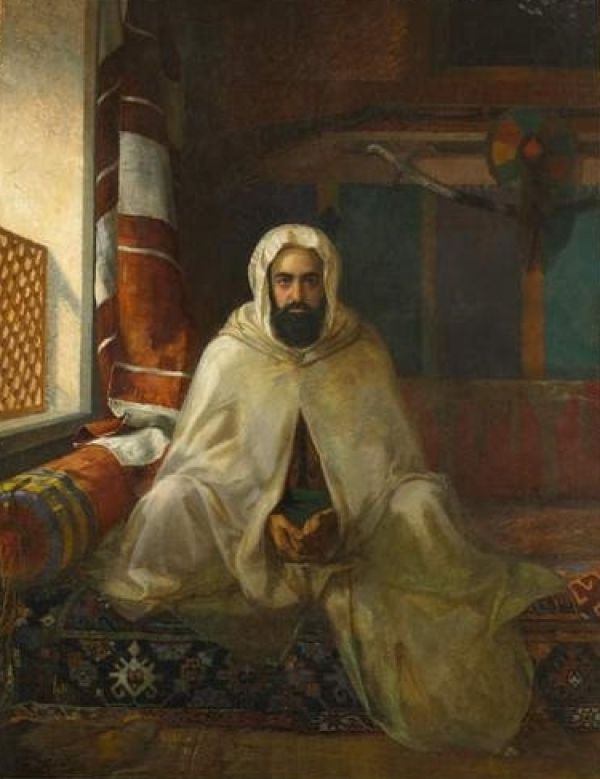
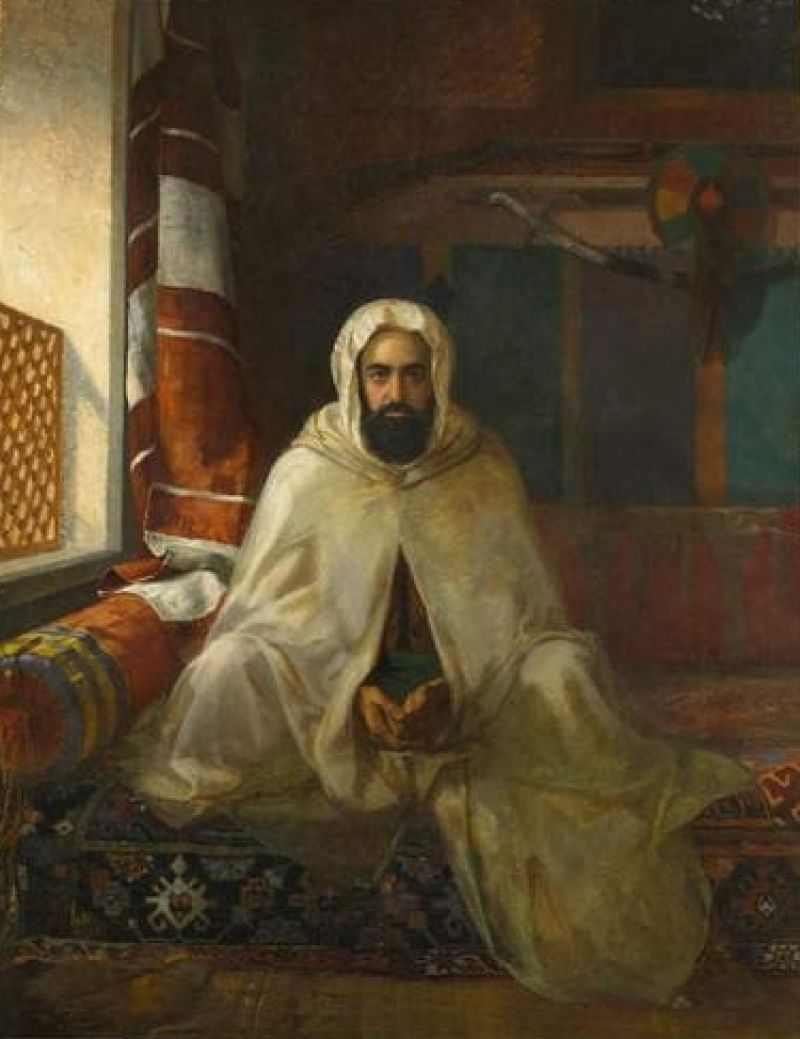
Portrait of Abd el-Kader by Stanisław Chlebowski, 1864.
Picture at Wikimedia Commons.
*
Today’s sharing from the Blue House of Via-HYGEIA presents a fascinating extract from Professor Bruno Etienne’s magisterial 1994 biography, Abdelkader. Excerpted from pages 192 to 201 of the 2006 third reedition by Hachette Littérature, Collection PLURIEL.
Focusing on the chapter devoted to the Emir’s legendary ‘Smala’, this text unveils the dual nature of this mobile capital: it was simultaneously a formidable military strategy designed to unify fractious tribes against French colonization, and a profound spiritual manifestation—a “nomadic zawiya”—where sacred geometry, Sufi cosmology, and the quest for divine unity shaped every tent, every movement, and every hierarchy within the camp.
**
A Contextual Introduction
Abd el-Kader’s decision to keep the Smala in perpetual motion was a strategic and spiritual necessity born from the “precariousness of the State” following the destruction of Tagdempt. Politically, he recognized that settling in fixed cities would trigger the “reflex of the horde,” causing the tribes to fragment and return to their private, conflicting interests, whereas a mobile capital allowed him to demonstrate his power directly on tribal terrain and enforce a unified bond to God that transcended local loyalties.
Militarily, this nomadism was a masterstroke of asymmetrical warfare: by placing the vulnerable population (women, children, the elderly) and the economic base (livestock, artisans) within a protected, moving fortress, he freed his cavalry to range far and wide to strike the French or retreat into the Sahara, making his forces elusive and impossible to pin down.
Spiritually, this constant displacement was a living hijra (emigration), a “graduated voyage toward transcendence” that prevented the stagnation of the soul and kept the community in a state of readiness for a potential exodus to the Orient, effectively turning the entire camp into a “nomadic zawiya” where the search for the divine center was mirrored by the physical journey across the land.
The Smala was far more than a mere military encampment; it was conceived by Emir Abd el-Kader as a “mobile capital” and a “nomadic zawiya,” a spiritual lodge where the organization of daily life was a direct reflection of sacred order. Functioning as a microcosm of the universe, its layout replicated the cosmic structure on a human scale: the tent poles and tension cords symbolized the connection between earth and sky, while the camp’s geometry blended the circle—representing the cosmic sphere and the totality of the community—with the square and octagon, symbols of terrestrial stability and intelligence.
Inspired by the cubic Kaaba of Mecca and the octagonal plans of Jerusalem, Abd el-Kader traced this “double square” in the sand to solidify the nomadic round camp, establishing his own tent as the axis mundi, the fixed central point from which all sacred space radiated. This physical architecture was inseparable from a rigorous spiritual hierarchy that fused Sufi metaphysics with political command.
At the absolute center sat the Emir, the Murshid (guide) and “master of the point and of the marrow,” whose legitimacy flowed from the Sirr (initiatic secret). Around him, the community was arranged in concentric circles of power: from the core of personal guards and key lieutenants positioned at the cardinal points, through the loyal Hachem tribes acting as intermediaries, to the outer rings of allied confederations, all bound by the Baraka (grace) and Da’wa (transcendent instruction) that defined their ranks (Hudud).
Ultimately, this cosmology was a profound solution to the fragility of tribal society; by replacing the “reflex of the horde” with a unified bond to God, the Smala became a total system—a spiritual brotherhood, a political state, and a highly mobile military force capable of protecting its vulnerable while striking decisively, all centered on the divine authority of the Emir.
But to understand the Smala fully, one must delve into the rich tapestry of symbols and metaphysical concepts that Bruno Etienne so generously details. The Emir’s tent, the Outak, was not just a command center; it was the “center of the center,” a microcosm where the “Verb surges that attains Being”. Here, Abd el-Kader, surrounded by his thirty superb black guards and his manuscripts, embodied the NQT (the Point) and SLB (the Marrow), the still point around which the cosmos turned.
The camp’s layout was a living mandala, with three concentric circles representing the three levels of divine lieutenancy (Khalifat): the Murid (disciple), the Aschab (companions), and the Cheikh (master). This was not merely administrative; it was a “graduated voyage toward transcendence,” a pilgrimage to the “center of the Center.”
The geometry was precise and laden with meaning. The octagon, inspired by Jerusalem (al-Qods), allowed seven fractions to surround the center, then fourteen, like Templar knights guarding a temple. The square, representing the Kaaba, was the “terrestrial cube supporting the celestial dome”, its four corners aligned with the cardinal points, the elements (cold, heat, dry, humid), and the colors (blue, red, yellow, green).
This “double square” was a spiritual fortress against the “magic of the square abused by soothsayers”, a way to anchor the nomadic camp in divine order. The “inverted triangles” of the marbub (vassal) and rabb (lord) symbolized the bond between the knight and his Emir, with Abd el-Kader’s white color signifying purity and divine light.
This structure was also a response to a profound political and spiritual crisis. The traditional tribal system, with its “reflex of the horde,” was fragile and prone to disintegration. Abd el-Kader sought to replace this with a new ethical pillar, a bond based purely on the connection to God, with himself as the sole intermediary.
The Smala’s rigid, sacred structure created a unified entity that transcended individual tribal interests. It was a “Qadirian projection” of the monist thought of Tawhid (the unity of God), a representation of the “silent creation” (al-Ghayb al-Mutlaq).
The Smala was thus a total system. It was a spiritual brotherhood (Tariqa) where initiation was ascending (Balagh), flowing through levels (Hudud) by providential grace (Baraka). It was a political state, with a clear hierarchy and chain of command. And it was a highly effective military force, capable of immense mobility.
The camp could protect the vulnerable—women, children, the elderly, and livestock—within its nested circles, while the cavalry ranged far afield to strike the French. It was a “biblical camp” of 20,000 souls, 12,000 horses, and countless camels, a bustling city of armorers, saddlers, and merchants, yet always ready to vanish into the desert, a “fugitive movement” contained and bridled by the sacred geometry of the Emir’s vision.
In the end, the Smala was a ‘mobile temple‘, a perfect response to the problem of nomadism and the sedentarization of the Temple, a fleeting manifestation of divine order in the sands of Algeria, before the “great return to the Orient.”
*
And Now
The Text:
BRUNO ETIENNE
‘Abdelkader’, page 192 to 201
I. The Nomadic Zawiya: A Mobile Capital
The failure and destruction of Tagdempt taught Emir Abd el-Kader much about the precariousness of the State. He recalled the discussions between his father, the tribal chiefs who came to the zawiya, and above all, the debates surrounding the Bey of Oran. Should he persist in settling in cities?
What was the path that led every Muslim city from Medina to Mecca? The former had indeed been conquered by arms, while the latter had been given by faith… How to utilize the concentration of forces and their mobility without the tribes dispersing and returning to their private interests? For the city holds no sense of “being-together” for the Bedouin. Each remains apart, watching the other with a suspicious gaze. Like the Prophet himself, the Emir understood that the tribal reflex—the very reflex of the horde that constitutes the pillar of the Ethics of the Arab of Ignorance (Jahiliyya)—must be broken at all costs. For since the Revelation, the only bond of man must be the one that binds him to God, without intermediary.
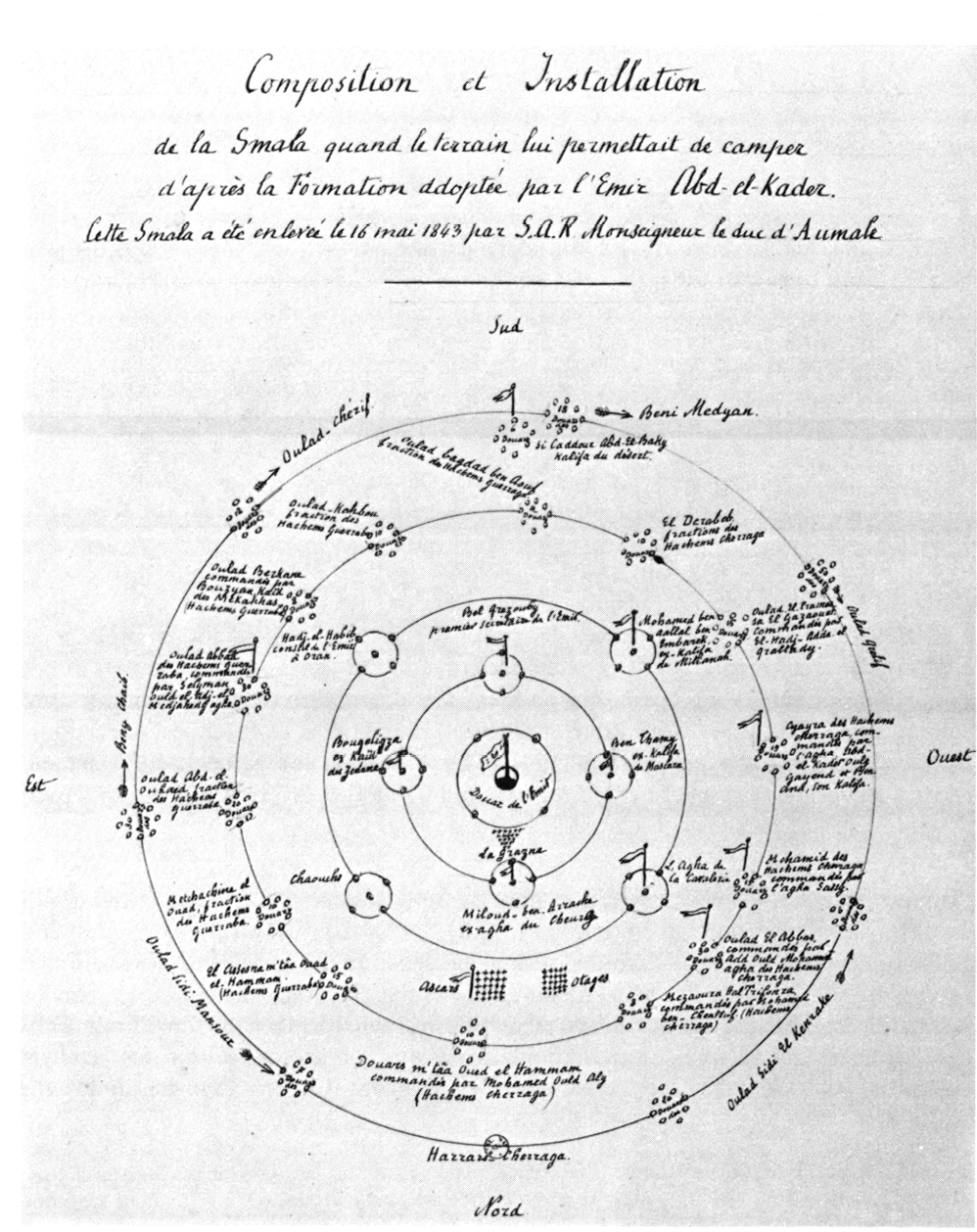
Abd el-Kader then conceived a new mobile capital, this time with two objectives: to demonstrate his power through his massive presence among the tribes on their own terrain, and to accustom them to migration, thus making them renounce their ancient tradition. An implacable order reigned in the spatial organization of the city, which represented a series of nested circles according to a cosmogonic and segmentary order simultaneously. It allowed the community to shelter and protect all the elderly, the sick, the wounded, women, children, and livestock, while the cavalry went far afield to fight the French. Its mobility allowed him to follow the pastures or to retreat toward the Sahara, following the fluctuations of the French troops.
A corps of regulars mounted guard, and four tribes successively monitored the great movements of the Smala. Abd el-Kader thought above all of emigration (hijra): if he had to one day lead his people toward the Orient, they would be reunited and ready. At the same time, he made of this great concentration a means of fighting against the disaffection of the tribes, to whom he thus offered the protection of their goods, livestock, women, and children.
Some understood it as a threat and a means of pressure; he had to maintain part of his lieutenants in position toward Kabylia, but even the great South submitted, including the Mzab.
Abd el-Kader drew in the sand the ideal plan of the city and of the mosque. That of al-Qods (Jerusalem) seemed very pertinent to him: an octagon allowing seven fractions to slide around it, then fourteen to turn around like a camp of Templar knights guarding the Temple. He had read this somewhere during his voyage to the Orient without being able to remember exactly where.
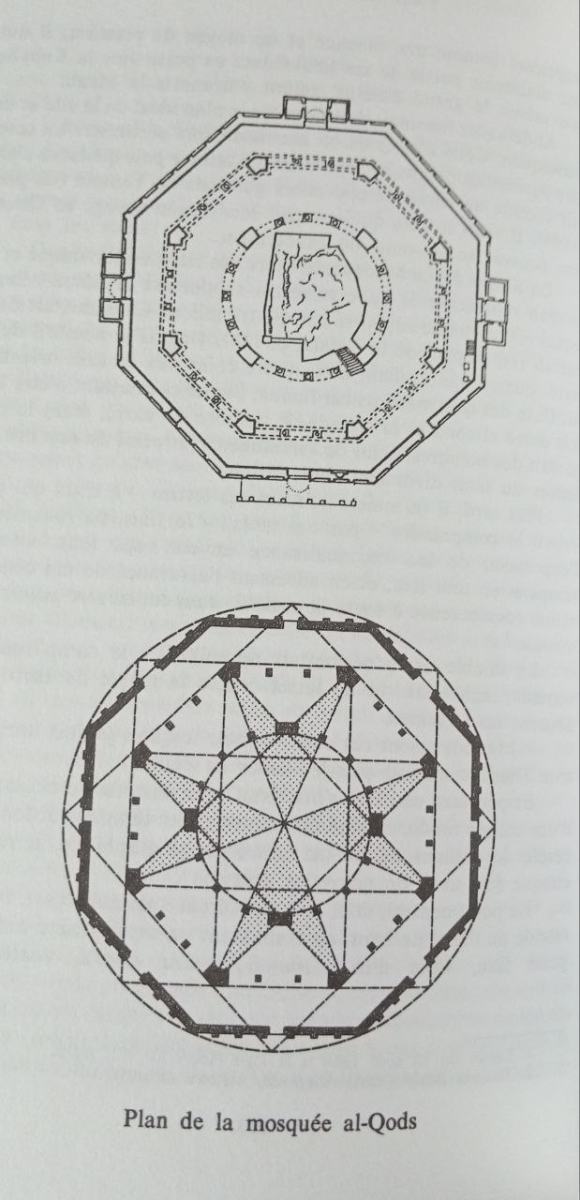
(A Via-Hygeia Note: When the text refers to the ‘plan of al-Qods‘, it is specifically referring to the Al-Aqsa Mosque compound (the Haram al-Sharif or Noble Sanctuary), which includes the Dome of the Rock. Why this matters in Etienne’s text: Abd el-Kader was fascinated by the geometry of this site. The Dome of the Rock is famous for its octagonal shape (an eight-sided polygon). Etienne explains that Abd el-Kader tried to replicate this specific sacred geometry in his Smala: He used an octagon to arrange the first circle of tribes around his central tent.This was meant to mirror the way the Dome of the Rock sits at the center of the sacred precinct in Jerusalem, creating a ‘Temple‘ in the desert. So, when you read ‘al-Qods‘ in the text, you can visualize the Dome of the Rock in Jerusalem and its unique eight-sided structure, which became the blueprint for the Emir’s mobile capital).
The Kaaba of Mecca, the Mother of Cities, was cubic, and the qubbah (dome) represents the terrestrial cube supporting the celestial dome, which is itself supported by four pillars. This plan was thus perfect. From the navel of the earth, four lines going to the four corners, the arcana oriented on the axis of the four cardinal points, the unity allowing itself to be at once square and round; and the tetrad, the number of the square, being the most perfect of numbers—that of intelligence and that of the number of letters of the ineffable divine Name: Allah!
Later, he would often end his letters—to those who could understand them—with these words: “I finish, renewing the expression of my gratitude toward you all, in all times and in all places, and addressing the assurance of my respectful consideration to the whole of society, in the four cardinal points.”
The double square allowed him to solidify the round camp of the nomad, insha’Allah!, and to fight against the magic of the square abused by soothsayers. — “Cursed be these cults against which I must struggle! O, my God! How can I lead this people?”
And yet this square was well inscribed in a circle, at the summit of a round hill, like camps and temples set against a background of a circle of hills; and from this geographical interior, it returned each time with new energies.
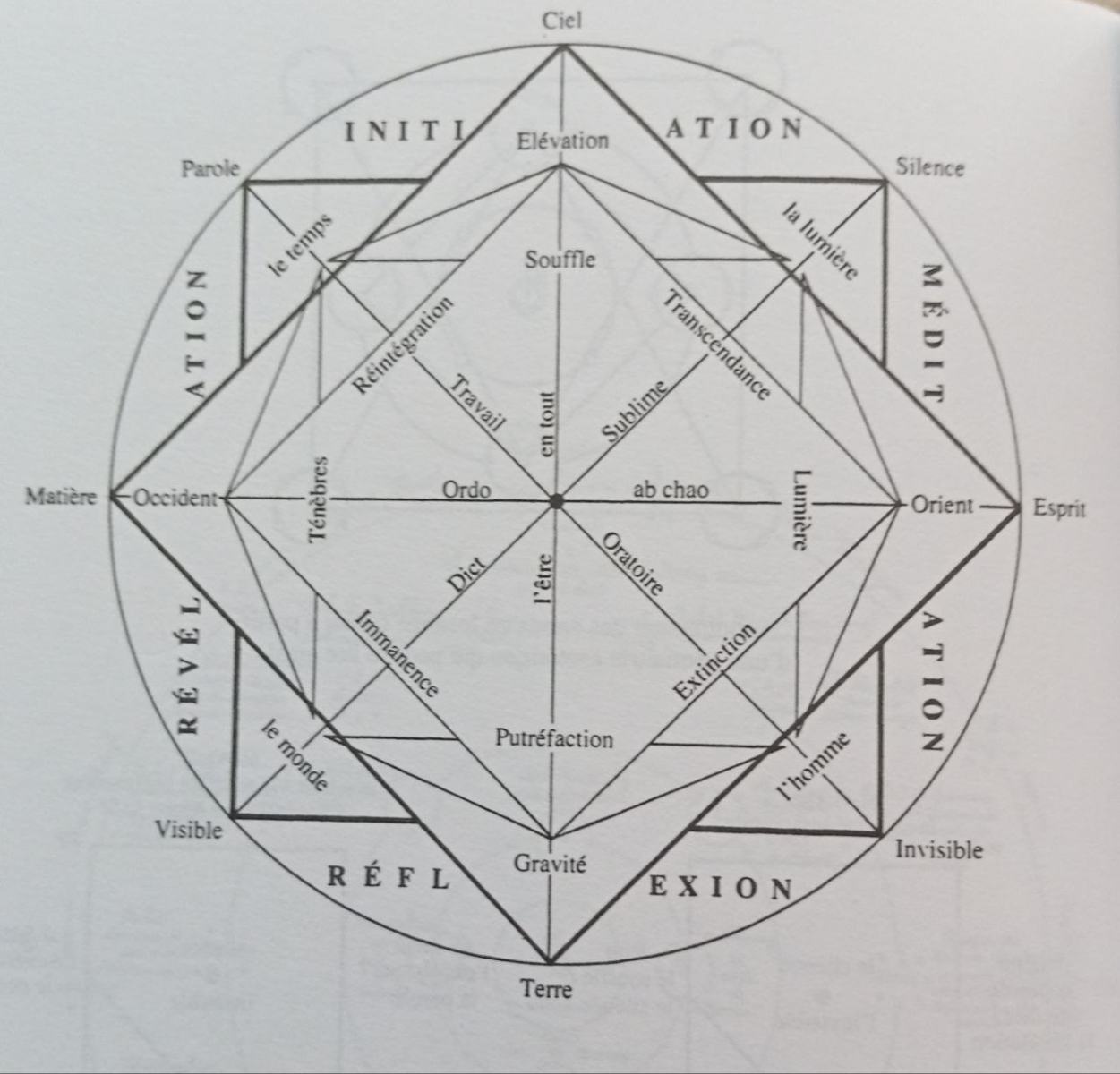
The central point, whose circumference is nowhere, founds the abode of the “High Man,” establishing a sacred space around the fixed point, a sort of axis mundi / suratu al-ard, conferring to the whole (the dwelling and the camp-city) a vertical cosmic structure, a vertical Orient that the accomplished man must traverse via the transcendent that connects it to the world, and horizontal via the opening that institutes the play of the circular and infinite gaze… He departed from Ibn ‘Arabi’s schema on the order of the world drawn from primordial chaos through the three circles from the most manifest to the most hidden, and he reflected night and day by tracing circles and squares in the sand.
There was silence and there was speech. There was heaven and earth, the Occident and the Orient. There was the possible of the possible, wisdom, mercy, and the heart. There was the visible and the invisible, the dictated book and the legacy of Him. There was the light given, the vision, the dawn of dawn, and grace. There were these cursed and satanic idol-goddesses around the ancient Kaaba: Manat, Allat, and Uzza, and yet also al-Ilah, the divinity. There was the naked truth.
The sacred instruction (da’wa), the dictated law (shari’a), and the initiatic secret (sirr). The recited reading (al-Qur’an) and the injunction (al-amr). There was al-batin and al-zahir, al-fikr and al-azali, which encaged al-ghayb al-mutlaq… And there were certain other things still that he did not master, but he knew that he had to order the unthinkable in a constraining geometry so that man might accomplish himself through al-baqa, al-fana, and al-nur by the pilgrimage to the center of the Center.
Abd el-Kader watched the spectacle of these hundreds of tents that filled the valley up to the mountain slopes: the fires shone in the cold night. Was the Arab people nomadic or sedentary, he wondered with anguish? He loved this atmosphere of sounds and strong odors like life. The hammering of the wandering blacksmiths rhythmically beat the soul of this immense biblical camp of more than twenty thousand beings confident in the mission with which God had invested their Sultan.
Turning around, he could see if each fraction of tribes was in its place, and if such a chief gone far away had left his women and his livestock there… Twelve thousand horses, three thousand mules and donkeys, as many camels produced an unbelievable amount of droppings requiring tons of fodder, barley; thus the din was constant between the stablemen, the grain loaders, the merchants, the buyers; heaps of all sorts but easily packable in large covers of fibrous material, for it was necessary to be able to leave quickly, very quickly, without losing too much food…
“My Smala included armorers, saddlers, tailors, in short all the trades necessary to its organization. A huge market was held there, frequented by the Arabs of the Tell. As for our grain, wheat or barley, it was brought to us unless we had to go fetch it from the tribes of the North…”
Abd el-Kader was thus at the center of a circumference whose limits extended everywhere to the horizon, therefore nowhere, like angels scattered by love gravitating around the cosmic sphere. The cold, the heat, the dry, and the humid were at the four cardinal points: blue, red, yellow, green…
The Outak, his tent at the center of the center, held his books and his manuscripts in chests, his horses, and his personal guard composed of thirty superb blacks, his horsemen dressed in red vests and blue breeches with two burnouses, one white and the other brown. Magnificent, attentive to the slightest sign of the Emir.
The tent of the master of meaning at the center makes the Verb surge that attains Being. The tent is the microcosm with its pegs retaining cords of tension on the ground, planted in earth and in sky, a supreme macrocosm symbol of all that sustains, carries, and aids construction, like the supreme Muhandis (Architect).
But the base remains the master himself and him alone: the Smala is an immense exoteric sign, a signifier from without, overcoded, like a sign on the margin of vastnesses trodden only by the fugitive movement of nomads, here contained, bridled but far from the turpitudes of the city… for the city does not have the sense of being-together… Before the entrance, the banners embroidered with verses of the Koran, white, green, and satin banners, yellow and red, topped with balls of gold and silver.
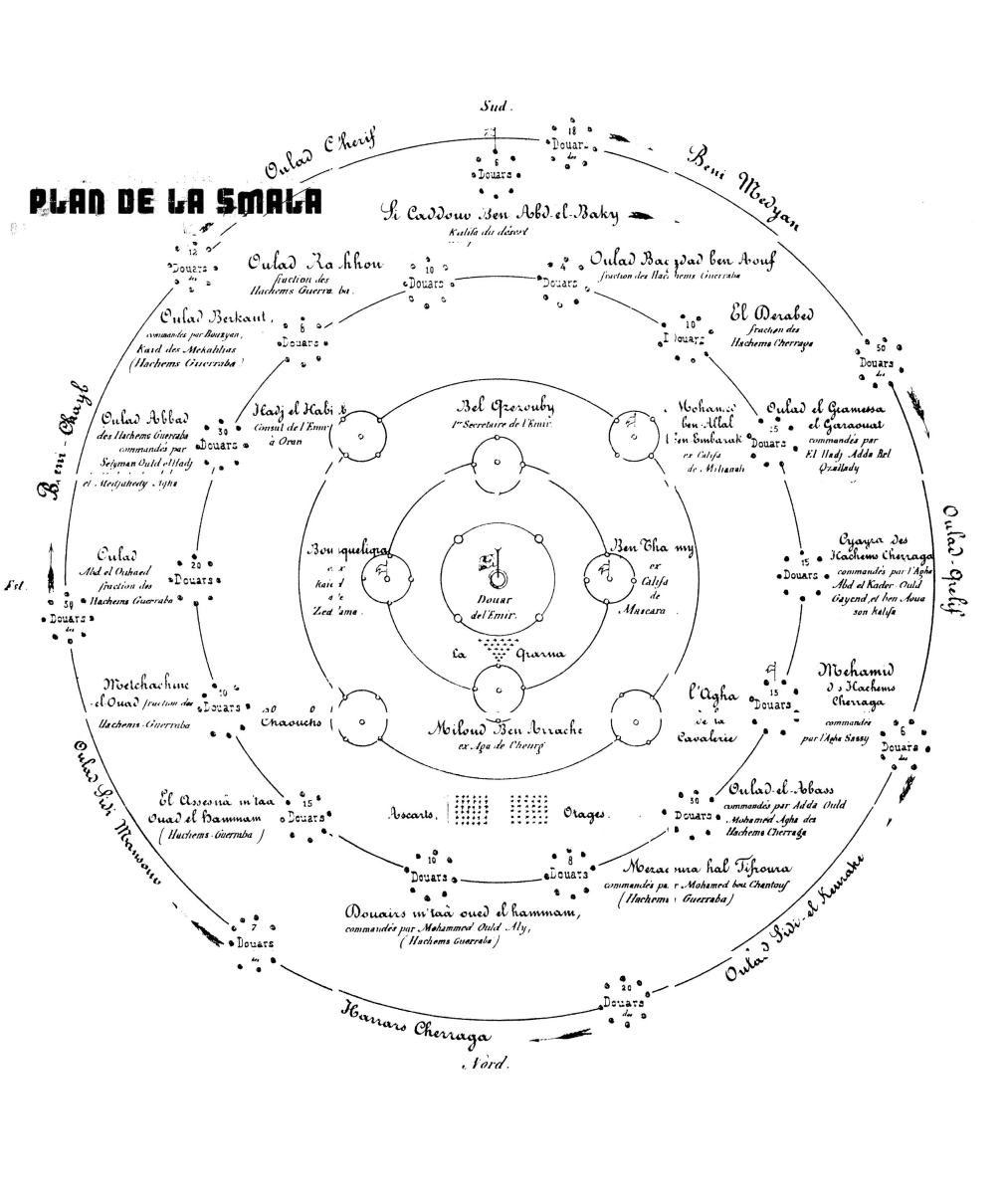
His own douar, at the center, was framed by four points in a quincunx: to the south his secretary (Bel Kharoubi), to the north Miloud Ben Arrach, to the west Ben Thami obviously, and to the east Abd el-Kader Bouklika, the qaïd of Tagdempt. Between them, but on the following circle: Muhammad ben Allal ben Embarak and Hajj al-Habib. To the south and north the agha of the cavalry and the chaouch, with, between them, the soldiers of the guard and the hostages. He thus had the whole world within reach of his voice.
The third circle comprised fourteen douars (of eight to thirty tents and annexes) of different tribes, and the last circle, further out, seven douars of confederations. But the Hachem of the different fractions were arranged in a quincunx, they too, as intermediaries between the less certain of the tribes…
From the central point, the Illuminated One could read the seven heavens and the seven limbs of the earth. The south gate was reserved for the Caliph of the Desert (Si Kaddour ben Abd al-Baki for the occasion). The whole formed two series of nested squares and inverted triangles that obliged each person to be seen by all everywhere he passed, but above all, the numerology satisfied the Emir. The octopole was guarded by three enclosures and the One-Eyed (le Borgne) controlled the double cardinal points.
But above all, the two inverted triangles, that of the marbub and that of the rabb, indicated the relationship between the knight and his lord: the marbub bears the colors of his rabb, and the color of Abd el-Kader was white… The secret tracing of the Smala is thus the expression of the esoteric counter-culture whose initiatic secret (the word sirr no longer has the Khaldunian sense of tribal nerve!) is the legitimacy and the master, the egregore and the director of conscience: murchid and imam at once, master of the point and of the marrow: NQT (al-Nuqt(a), the point) and SLB (al-Sulb — the Marrow / the Spine / the Essence ).
(A Via-Hygeia note: Professor Etienne’s argument is that the Smala is not merely a military camp organized around a chief. Its tracing in the sand makes visible a theophanic structure: the Emir is the Point that holds the geometric order together, but his true power derives from the Marrow—the initiatory secret (sirr) that makes him the legitimate murchid (spiritual guide) and not merely a warlord. The secret tracing expresses this double nature: a political center that is simultaneously a mystical axis. In short: NQT is the dot under the letter, the center of the circle; SLB is the hidden backbone that holds the body upright).
The Smala synthesizes the Caliphate of Light and constitutes the most perfect response to the problem of nomadism or of the sedentarization of the Temple. The tracing of the camp was perfectly regulated:
“when I had pitched my tent, each knew the place he had to occupy. Around me I had three or four hundred soldiers of my regular infantry and the cavalry of the Hachem of Ighris who were particularly devoted to me. It was not a small matter to arrive at me: not that I took measures for my personal security. I felt that I was necessary to accomplish the work of God, and I relied on Him to fortify and support the arm that bore His banner.”
Abd el-Kader did not suspect that God would oblige him to even more abandonment and less organization still, before demanding total abandonment.
(Professor Etienne’s text continues after the 3 figures below)
*
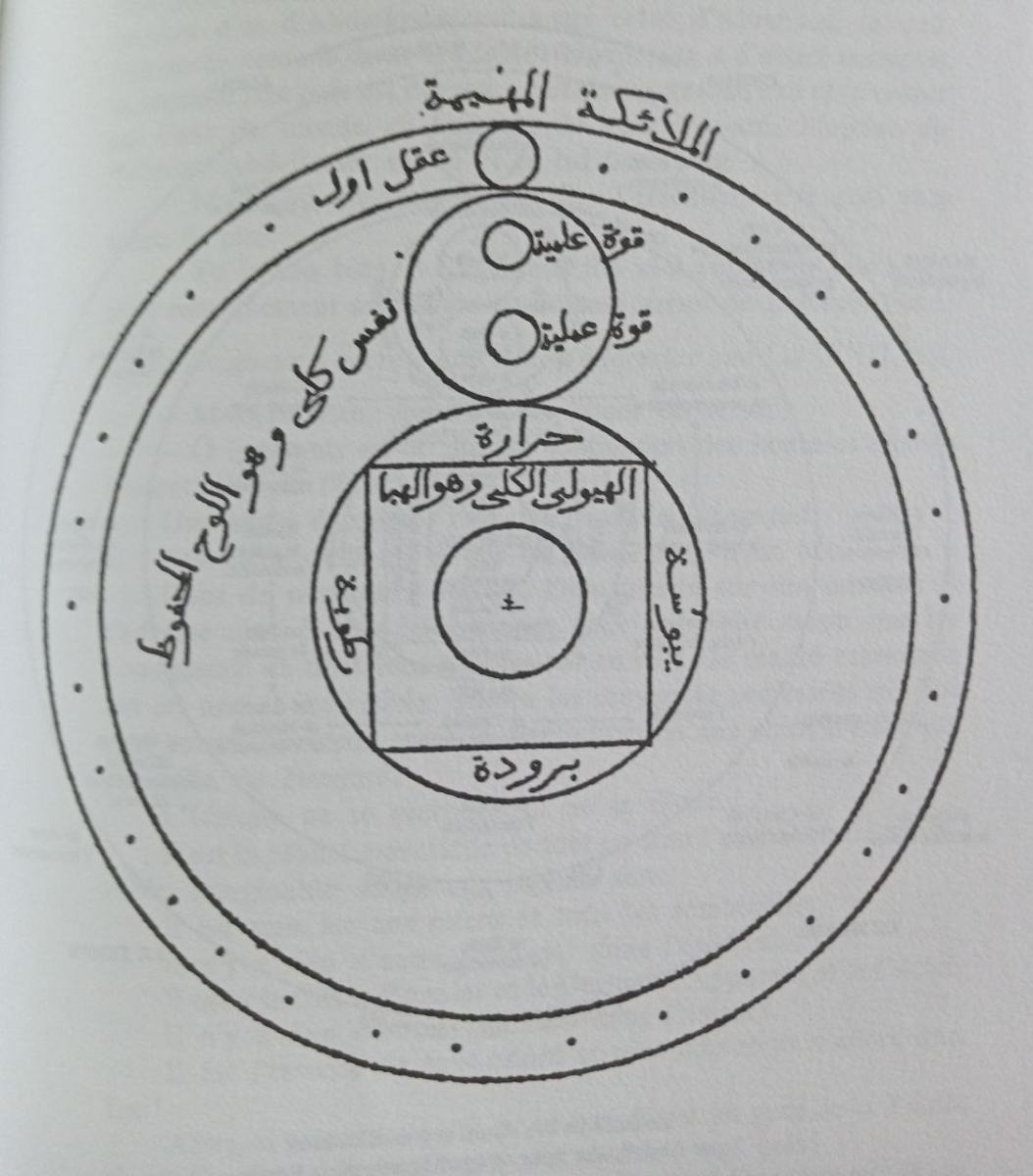
(A Via-Hygeia note: Although separated by six centuries, Emir Abd el-Kader and the Andalusian mystic Ibn ‘Arabi (1165–1240) are bound by a “spiritual golden silsila” (chain of transmission) that transcends chronological time. In the Sufi tradition, knowledge is not merely academic but a living light passed from heart to heart; Abd el-Kader, a master of the Qadiriyya order, recognized Ibn ‘Arabi as his supreme spiritual ancestor, often referring to him as “the Pole of Poles” (Qutb al-Aqtab).
This relationship was not one of direct historical mentorship but of tawajjuh (spiritual orientation), where the later master aligns his inner vision with the eternal truth revealed to the earlier one. For Abd el-Kader, Ibn ‘Arabi’s metaphysical framework—particularly the concepts of the “Perfect Man” (al-Insan al-Kamil) and the “Unity of Being” (Wahdat al-Wujud)—was not abstract theory but the very blueprint for the Smala.
By tracing Ibn ‘Arabi’s cosmological diagrams in the sand, Abd el-Kader was effectively activating this golden chain, making the 13th-century mystic the invisible architect of his 19th-century mobile capital. In this sacred lineage, the Emir becomes the living embodiment of Ibn ‘Arabi’s thought, proving that the silsila is a golden thread of light that connects the “seal of the saints” directly to the warrior-saint in the desert, allowing the ancient wisdom to breathe anew in the geometry of the camp).
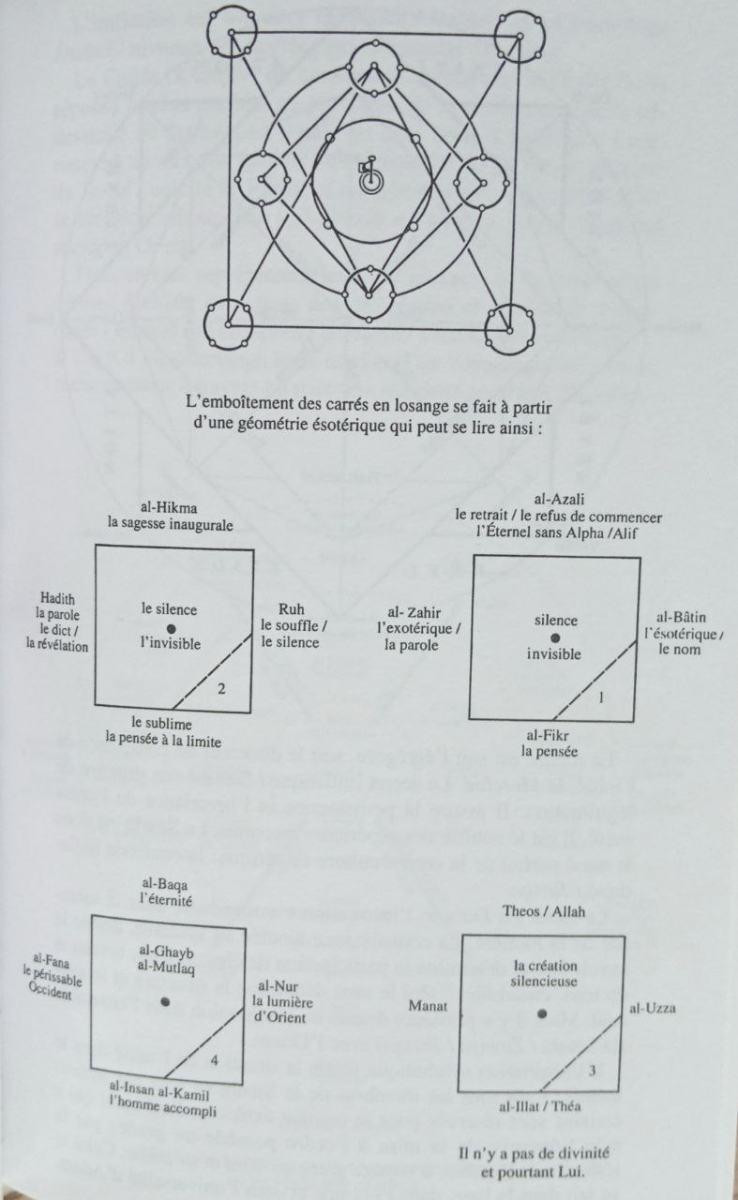
(A Via-Hygeia Note: The page explains that the “nesting of the diamond-shaped squares” is based on an esoteric geometry. It presents four diagrams, each representing a different aspect of this cosmology. The top diagram shows the complete geometric figure: a central point within concentric circles, all enclosed within a square formed by four overlapping diamonds.
Diagram 1: The Square of Inaugural Wisdom (al-Hikma)
(This square represents the initial manifestation of divine wisdom)
Center: le silence / l’invisible (silence / the invisible). The unknowable core.
Top: al-Hikma / la sagesse inaugurale (inaugural wisdom). The first emanation of divine knowledge.
Right: Ruh / le souffle / le silence (the Spirit / the breath / silence). The divine breath that gives life.
Bottom: le sublime / la pensée à la limite (the sublime / thought at its limit). The highest form of human contemplation.
Left: Hadith / la parole / le dict / la révélation (the Hadith / the word / the dictation / revelation). The spoken or revealed word of the Prophet.
Diagonal: Connects the invisible center to the sublime limit of thought.
Diagram 2:
The Square of Thought and Essence
(This square explores the relationship between the manifest and the hidden,
and the nature of thought itself)
Center: silence / invisible. Again, the unknowable origin.
Top: al-Azali / le retrait / le refus de commencer (the Eternal / withdrawal / the refusal to begin). The state of God before creation, the unmanifest.
Right: al-Bâtin / l’ésotérique / le nom (the Inner / the esoteric / the name). The hidden, inner meaning of things.
Bottom: al-Fikr / la pensée (Thought). The human faculty of reasoning and contemplation.
Left: al-Zahir / l’exotérique / la parole (the Outer / the exoteric / the word). The apparent, outer form of things.
Diagonal: Labeled “1”, it connects Thought to the Esoteric Name, suggesting a path from human reason to divine mystery.
Diagram 3:
The Square of Pre-Islamic Divinities (Theos / Allah)
(This is a highly significant diagram. It re-contextualizes three pre-Islamic goddesses,
often dismissed as idols, within a monotheistic framework)
Center: la création silencieuse (silent creation). The act of creation before it is named or understood.
Top: Theos / Allah. The supreme, singular divinity.
Right: al-Uzza. One of the three chief goddesses of pre-Islamic Mecca.
Bottom: al-Illat / Théa. “Al-Illat” can mean “the cause” or “the fault”; “Théa” is Greek for “goddess.” This equates the Arabian al-Lat with a classical concept of divinity.
Left: Manat. The third of the chief pre-Islamic goddesses, associated with fate and time.
Caption: Il n’y a pas de divinité et pourtant Lui. (There is no divinity, and yet He is.). This is a crucial statement. It suggests that while these named deities (Manat, al-Uzza, al-Illat) are not independent gods, they are nonetheless aspects or manifestations of the one true God (Allah/Theos). It’s a syncretic move to integrate pre-existing beliefs into the new Islamic cosmology.
Diagonal: Labeled “3”, it connects al-Illat/Théa to al-Uzza.
Diagram 4: The Square of Eternity and the Perfected Human
This square represents the culmination of the spiritual journey.
Center: al-Ghayb al-Mutlaq (the Absolute Unseen). The ultimate, unknowable reality of God.
Top: al-Baqa / l’éternité (Eternity / Subsistence). The state of eternal life in God, the goal of the Sufi path.
Right: al-Nur / la lumière d’Orient (the Light of the Orient). Divine illumination and guidance.
Bottom: al-Insan al-Kamil / l’homme accompli (the Perfected Human). The Sufi ideal of a human being who has fully realized their divine potential.
Left: al-Fana / le périssable / Occident (Annihilation / the perishable / Occident). The necessary dissolution of the ego before attaining eternity. The association with “Occident” (the West, the place of sunset) symbolizes the end of the self.
Diagonal: Labeled “4”, it connects the Perfected Human to the Light of the Orient.
Synthesis
Taken together, these four squares form a complete cosmological system.
They map a journey:
From the initial descent of Wisdom (al-Hikma) into the world of speech and silence.
Through the human struggle with Thought (al-Fikr) to understand the inner and outer realities.
By reconciling and integrating past beliefs (the Divinities) into a unified understanding of the One God.
To achieve the final goal: the Annihilation (al-Fana) of the ego and attainment of Eternity (al-Baqa) as a Perfected Human (al-Insan al-Kamil).
This geometry is not just theoretical; according to the text, it was the literal blueprint for the Smala, making the entire encampment a machine for spiritual transformation and a physical manifestation of this sacred worldview). (End of note).
Professor Etienne’s text continues:
II. The Esoteric Architecture: A Confraternity of Light
(Analysis of the Cosmological Diagrams)
The master is either the egregore or the director of conscience of the initiate, the Murchid. The initiatic secret (Sirr) is his principle of legitimacy. He assures the permanence and invariance of the sacred order. He is the breath of the unknown superiors. The Smala is thus the perfect tracing of the esoteric counter-culture: the initiatic confraternity (Tariqa).
The ritual is Da’wa: transcendent instruction in the sacrality of light. Knowledge added to the symbol gives the “knowing-how-to-be” (savoir-être) and determines the participation of each at his level and of all, together: only meaning determines the structure and the sense of the whole. But there are several degrees of communion in the whole (the Smala / Zawiya / Tariqa) with the Orient.
Symbolic imagination founds the situation of the initiate in the theater: but not all members of the Smala are initiates; certain ones are reserved for exterior combat.
Only he who has undergone the ordeal of being brought to order possesses a grade: by reflection and asceticism, he travels thanks to the Wird and the Dhikr. This is done in the lodge, in man, and in the universality of Adam.
Initiation is always ascending (Balagh) and translates into levels (Hudud) by providential grace (Baraka).
The Caliphate (Khalifa) of light synthesized by the Smala is the most perfect response to the problem of nomadism and of the sedentarization of the Temple.
The Smala is thus indeed the Qadirian projection through a symbolic geometry of the monist thought of Tawhid (the unity of Unity) and at the same time a representation of the silent creation (al-Ghayb al-Mutlaq), before the great return to the Orient.
Three circles represent the three levels of divine lieutenancy (Khalifat) with three degrees (Hudud) and the ascending initiation (Balagh) that comprises the Murid (disciple), the Aschab (companions), and the Cheikh (master). It is a south/north pilgrimage and a graduated voyage toward transcendence through an interior journey to the center of the center.
(End of professor Etienne’s excerpted text).
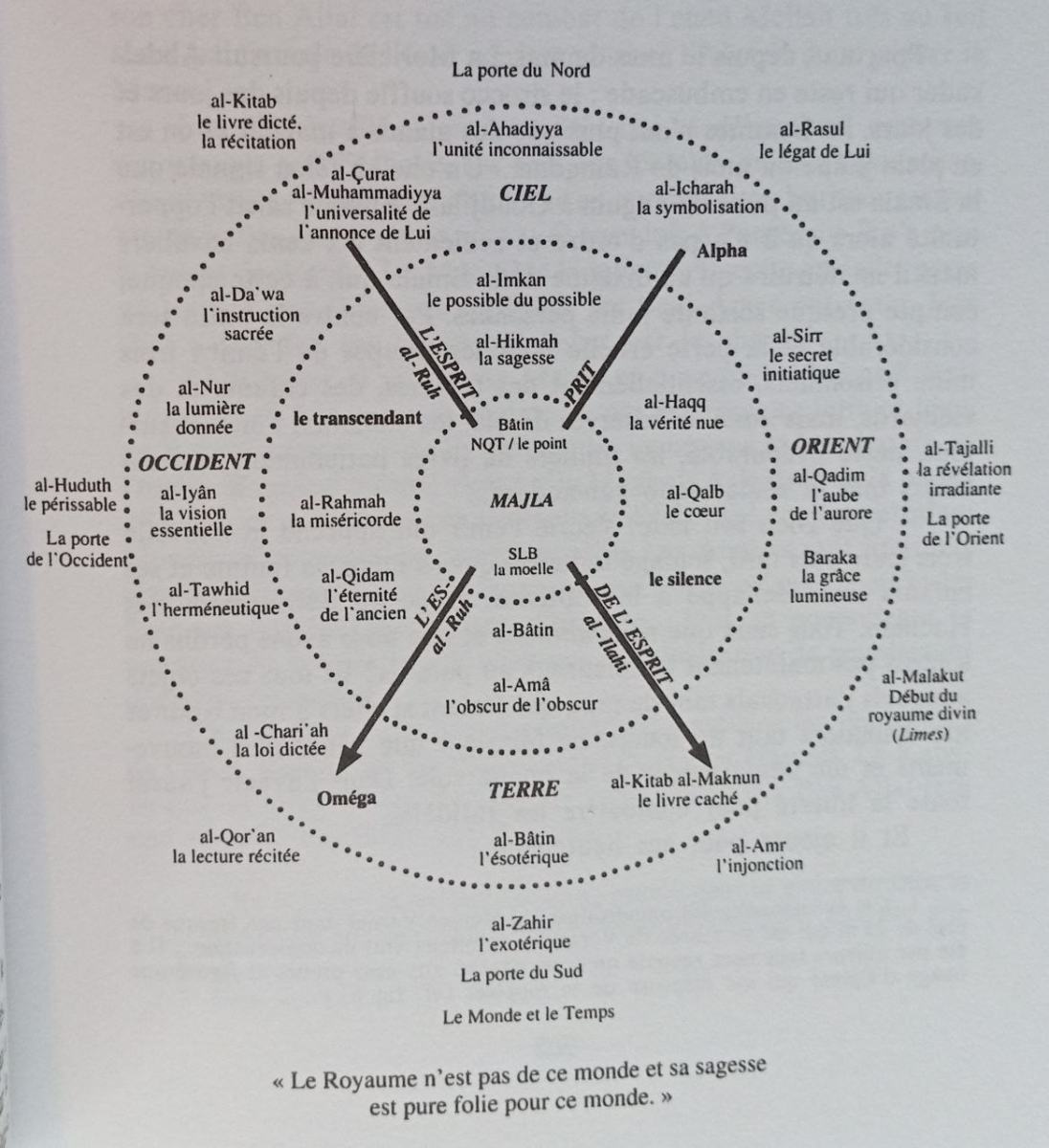
The Cosmological Map
(Summary of Diagram Labels)
The Center (MAJLA): The Point (NQT), the Marrow (SLB), Silence.
The Heavens (CIEL): The Dictated Book, Inconceivable Unity, The Legate, Alpha.
The Earth (TERRE): The Esoteric, The Exoteric, The South Door, Time.
The Occident: The Perishable, Mercy, The Dictated Law, Omega.
The Orient: The Irradiant Revelation, The Heart, The Naked Truth, The Initiatic Secret, The Divine Kingdom.
“The Kingdom is not of this world; its wisdom is sheer folly unto it.”
*
Key Terms Glossary
- Zawiya: Sufi lodge/convent.
- Smala (from zamala): The Emir’s mobile headquarters/camp.
- Hijra: Migration (in the Prophet’s sense).
- Outak: The Emir’s central tent.
- Douar: Encampment circle.
- Tariqa: Sufi path/order.
- Wird / Dhikr: Sufi litanies/remembrance practices.
- Marbub / Rabb: The vassal / the lord.
- Murchid: Spiritual guide.
- Sirr: Secret/esoteric knowledge.
- Tawhid: Divine unity/monotheism.
- Khalifa: Caliph/successor.
- Balagh / Hudud / Baraka: Spiritual degrees/levels/grace.
- Murid / Aschab / Cheikh: Disciple/companions/master.
- Batin / Zahir: Esoteric/exoteric.
- Ghayb al-Mutlaq: Absolute unseen/unknowable.
*
Source

*
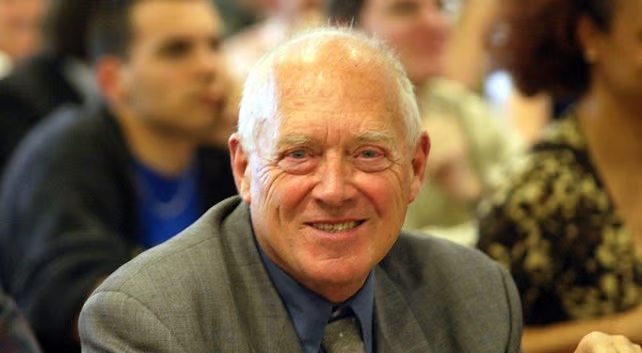
Bruno Étienne’s intellectual formation was deeply rooted in the Mediterranean itself. A graduate in Arabic and political science from the Institut d’études politiques d’Aix-en-Provence and the University of Tunis, he pursued research in Cairo and went on to teach across North Africa and the Middle East—at the École nationale d’administration in Algiers, the law faculty of Algiers, and the universities of Casablanca and Marmara. He later served as a research director at the CNRS and was elected to the Institut universitaire de France. A Chevalier of the Légion d’honneur and a member of the Grand Orient de France, he embodied a rare blend of rigorous scholarship and engaged citizenship.
Perhaps his most enduring institutional legacy is the Observatoire du religieux, which he founded in 1992 at Sciences Po Aix and directed until 2006. At a time when the study of religion in France was still largely confined to theology or classical sociology, Étienne insisted on approaching it as a political and social phenomenon in constant mutation. The Observatoire became a pioneering laboratory, federating research across political science, sociology, and anthropology. Under his direction, it produced a landmark series of volumes—Être musulman en France aujourd’hui, Être catholique…, Être juif…, Être bouddhiste…—that offered nuanced, field-based portraits of France’s religious landscapes. He also directed attention toward new religious movements and the question of sects, publishing La France face aux sectes (2002).
Étienne was not merely a director of research; he was the founder of a school. In Aix-en-Provence he gathered and mentored a remarkable cohort of younger scholars who would go on to shape French and international academia, including Jocelyne Cesari, Frank Fregosi, and Raphaël Liogier, who succeeded him at the Observatoire. Even Gilles Kepel, one of France’s most prominent analysts of contemporary Islam, is counted among those who fell under his intellectual influence. His method was demanding: he imposed a common problematic and rigorous comparative framework, yet encouraged his students to plunge into the specificity of each tradition.
***
Related Articles


Leave a Reply