
Circle of Transmission: The Living Loom
A Little Antoine Faivre Sampler – Part 1: Karl von Eckartshausen and Alchemy
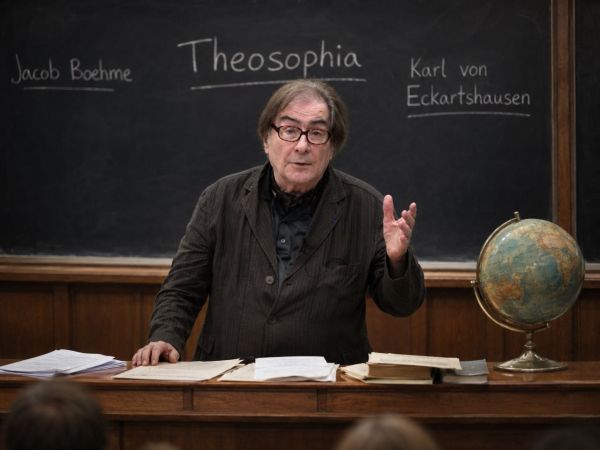
‘WELTANSCHAUUNG !’
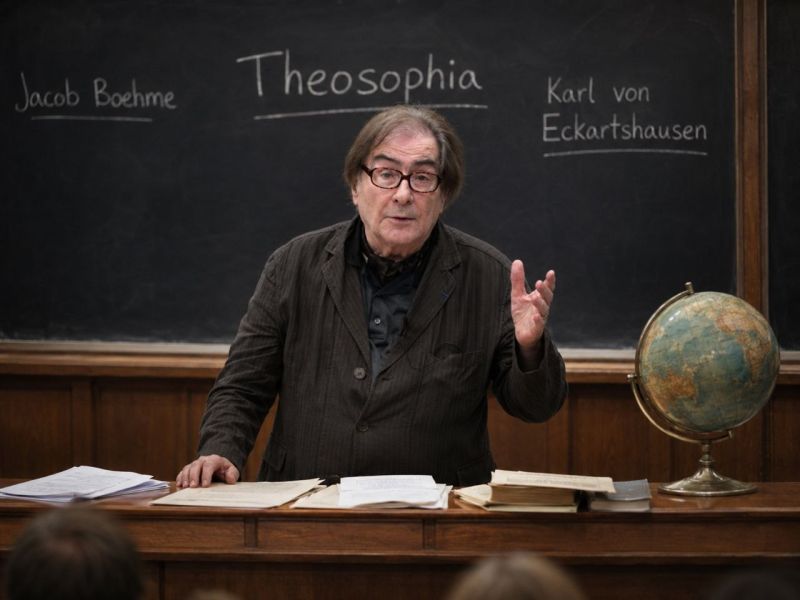
A commemorative Illustration of
Professor Antoine Faivre teaching a class.
*
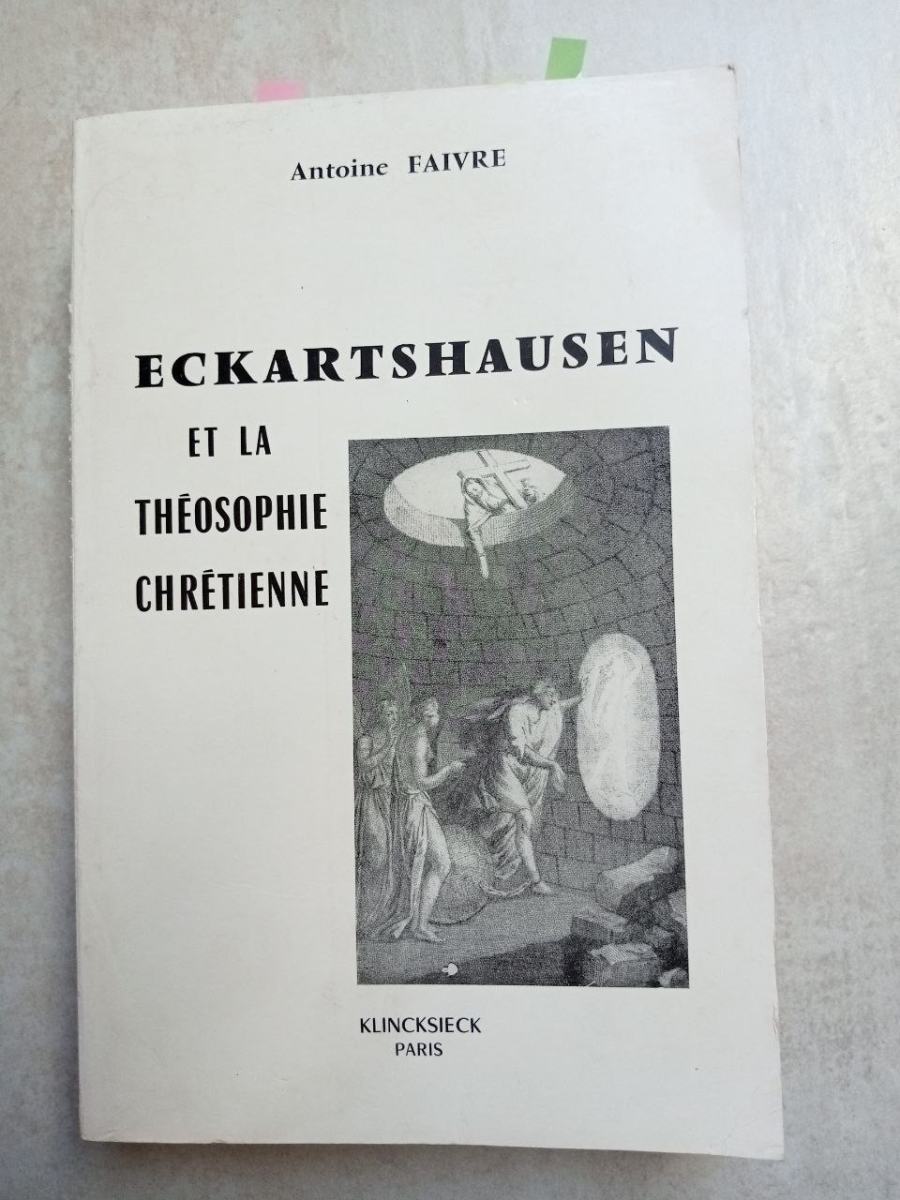
Today’s sharing from the Blue House of Via-HYGEIA marks the first installment of a sampler devoted to the memory of Professor Antoine Faivre. Excerpted from his groundbreaking 1969 monograph on Karl von Eckartshausen, ‘Eckartsausen et la Théosophie Chrétienne‘, (Klingsiek, Paris), this selection spans pages 501 to 509.
Having previously situated the trailblazing work of Professor Faivre within the legacy of the French school for the study of esotericism, we now present Faivre’s masterful analysis in his own words. Here, he demonstrates how Eckartshausen’s alchemy dissolves the boundary between the laboratory and the oratory, uniting physical experiment with spiritual prayer.
Coming soon: A Little Antoine Faivre Sampler – Part 2: ‘Creative Imagination-Magical Function & Mythical Foundation of the Image‘ (1981).
**
When, on that February afternoon in 2021, Wouter J. Hanegraaff announced to the international community that Antoine Faivre had died in a Paris hospital at 4:02 p.m., he did more than mourn a friend; he marked the end of an era:
“With deep sadness I must report that my dear friend and colleague Antoine Faivre passed away today… He had been suffering with serious health problems for several years, and so his death does not come unexpected, but still it came as a shock.”
Those words, sent across the networks that now bind the global community of esotericism scholars, carried the weight of a generational transition. For Hanegraaff, as for so many others, Faivre was not merely a prolific historian; he was the architect of the very space in which all subsequent scholars of Western esotericism have been privileged to work.
From the vantage point Hanegraaff has cultivated over decades—both as Faivre’s successor in spirit and as his critical interlocutor—Faivre’s legacy appears as a complex weave of institutional daring and philological patience. It was Faivre who, occupying the chair at the École pratique des hautes études (Section des Sciences Religieuses) in Paris, effectively carved out an academic sanctuary for a subject long banished to the margins.
Where previous generations had dismissed Alchemy, Theosophy, and Kabbalah as so much detritus of ‘rejected knowledge‘, Faivre treated them with the methodological rigor of the history of religions.
His six ‘characteristics‘ of esotericism—correspondences, living nature, imagination & mediations, transmutation, concordance, and transmission—provided the first heuristic scaffolding for the field.
Hanegraaff, who would later refine and challenge this paradigm, has never failed to acknowledge that without Faivre’s foundational act of conceptual cartography, there would have been no map for the rest of us to redraw.
The chapter translated here, drawn from Faivre’s 1969 monograph Eckartshausen et la théosophie chrétienne, distills the method that made this institutional breakthrough possible. In these pages, Faivre does not reduce Eckartshausen’s alchemy to ‘proto-chemistry’ or inflate it into vague mysticism. Instead, he inhabits the theosopher’s own logic, tracing with almost microscopic fidelity the passage ‘from Kabbalah to Alchemy‘ as a single, continuous spiritual current.
The ‘three great ideas‘—universal light, metallic transmutation, and spiritual illumination—are not presented as eccentric curiosities but as a coherent Weltanschauung in which matter and spirit, laboratory and oratory, phosphorus and prayer, belong to one symbolic economy.
For Hanegraaff, this sympathy for the imaginal world of the theosophers was both Faivre’s greatest strength and the necessary horizon of his work. Faivre read from within a French Catholic intellectual tradition that could still recognize in Eckartshausen’s ‘alchemical prayers‘ a genuine religious phenomenology. Where a more radically historicist reading might see only the detritus of eighteenth-century Naturphilosophie, Faivre perceived a ‘technique of illumination‘. Yet it is precisely this capacity to take the theosophers at their word—combined with the “great intellect and untiring dedication to the pursuit of knowledge” that Hanegraaff so admired—that created the conditions for the field’s flourishing.
Hanegraaff’s own critical project, with its insistence on situating esotericism within the contested terrain of modernity and the academy, stands on the shoulders of the institutional and intellectual space Faivre opened. The debt is personal as well as scholarly. Hanegraaff’s tribute emphasized Faivre’s “unique personality and a deep sense of humanity”, qualities that manifested in a generosity toward younger scholars that shaped careers across continents. To translate Faivre into English is, in a sense, to answer Hanegraaff’s call to ‘carry on his legacy‘. Rest in peace, dear Professor. The work continues.
*
A Personal Note
from Via-Hygeia
There is a specific resonance to reading these pages again. As an auditeur libre at the Sorbonne, I had the privilege of attending some of Professor Faivre’s lectures, where the German terms ‘Weltanschauung‘, ‘Naturphilosophie‘, and the name ‘Jakob Boehme’ were not merely academic references, but part of the very rhythm of his speech—almost like a second breathing!
To hear him articulate Eckartshausen’s worldview was to understand that for Faivre, esotericism was never a dead history, but a living, coherent system of thought.
Translating this text now feels less like an archival exercise and more like continuing that conversation, bridging the lecture halls of Paris with the quiet study of the Blue House.
And now the text:
Eckartshausen and Alchemy
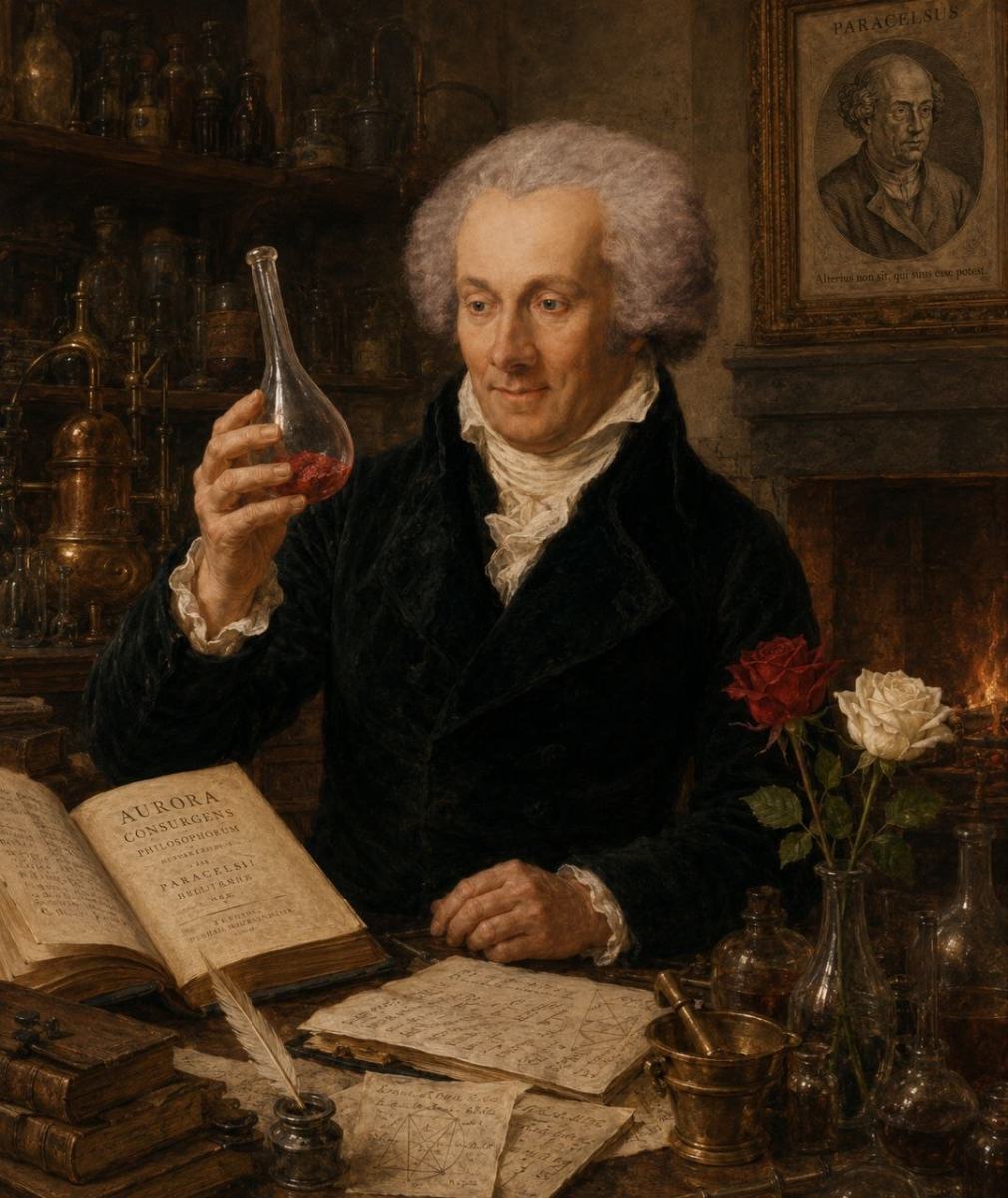
At its core, palingenesis is merely one form of alchemy. Moreover, it is evident that most of the ideas which follow are inseparable from the exposition concerning Eckartshausen’s conceptions of nature (cf. the whole third chapter).
The science of Nicolas Flamel is mentioned for the first time by Eckartshausen in a collection of literary miscellanies, in 1788; it is a tale entitled The Gerner Family. The author aims to demonstrate that when the ignorant become passionate about alchemy, their ignorance can lead them to great extremes. Gerner, in order to find the Philosopher’s Stone, needs a man who would agree to let himself be pulverized. In the same collection, one finds another brief allusion to alchemy.
Evidently, Eckartshausen had not yet occupied himself much with this science. One must wait for the second volume of the Éclaircissements sur la Magie to find more precise and more accurate allusions, which are, moreover, inseparable from our author’s theosophy.
Eckartshausen writes that every material body encloses a spirit—we have seen this with regard to palingenesis—and that this spirit causes dissolution and corruption; it is not a matter of an energy but of a fine and invisible body occupying a certain space. A body which loses this spirit begins to dry up; as long as the spirit is in it, it produces life; but if the spirit no longer communicates with the air, the body putrefies. The volume and form of this Lebensgeist can change, which modifies its action.
This is already alchemy, for Eckartshausen distinguishes two sciences: ordinary chemistry, which occupies itself with the infinite multiplicity of forms, and superior chemistry, which has as its object to bring everything back to simplicity and which permits one to attain the highest degree of knowledge of natural things. The second purifies substances, elevates them toward Unity; it is a matter of calcining, purifying, dissolving, distilling, sublimating, uniting, fixing; of drawing from the earth the argentum vivum of the Philosophers.
This is what Hermes means when he teaches: Visita interiora terrae, et invenies occultum lapidem (Visit the interior of the earth, and by rectifying, you will find the hidden stone). The water which is the blood of nature transforms perfect bodies into a true Tincture capable of tinging (tingiren) all other imperfect bodies: it is the azoth, or aqua vitae, which vivifies everything and transforms the spirit into a new body.
The Royal Art consists in penetrating to the very depths of nature, in observing its secret workshops, in making use of its principles in order to produce and recreate. Three great ideas characterize Eckartshausen’s alchemy: universal light, the transmutation of metals, and spiritual illumination.
We already know the importance of light in our author’s conceptions of nature. It is therefore not surprising that he attributes a great role to it in alchemy. Light must penetrate the matter of the adept so that fire may be united and that the spirit emanating from light and fire may wholly animate this matter. One then sees a sun emerge from darkness which produces a new creation. The absolute luminous substance is a body (Körper) independent of sensible and “latent” light; it is the real foundation of phenomena.
The object of the Essais chimiques is to study caloric, igneous, and absolute luminous substances; by very simple manipulations, Eckartshausen separates them from phosphorus. In metal, luminous light presents itself in the form of terra virginea or ‘compacting‘ substance (einschränkender Stoff), igneous matter in the form of sulphur-phosphorus or metallic charcoal. Caloric matter, the universal solvent of metals, is linked to the metal by luminous and igneous matters.
At bottom, ‘nature‘ is nothing other than the fixation of light and fire. All metals are coagulated phosphorus; gold occupies the first rank there. One may consider the sun as phosphorus in deflagration, gold as phosphorus in concentration. The luminous and igneous substance, expansive in the sun, is condensed in gold; the different degrees of these proportions make for the diversity of metals.
Eckartshausen thus sees within things a pure, igneous, sulphuric, incombustible substance which, when fixed, might be called the Light of Nature; it is the brilliance and form of all metals, it illuminates and perfects all bodies. It is a salt, a tinging stone which transforms one metal into another metal; this substance can melt even diamonds. This salt is the true balsam of sulphur.
At the center of metallic ashes is found an extremely pure salt resembling a limpid crystal; it liquefies when it has been sufficiently purified; in it resides the incorruptible power to give perfection and all possible increase. Such a force can be destroyed neither by fire nor by cold because it is animated and moved by its own ‘spirit‘, and because it is reintegrated into its primitive state. In the creatures of the subterranean realm this salt is of a particular fixity and penetration. One understands henceforth that salt has always been considered sacred.
Eckartshausen also explains that the union of the white earth of nature causes a new regeneration of things; the addition of philosophical mercury to sulphur (universal mercury) permits one to obtain the mercury of the sages, the true metallic G U R; one must, as Paracelsus writes, steal the sun, cook the water in the moon—that is to say one needs sulphur (or fire, which is in charcoal) and sulphur-phosphorus (phosphoric acid, or the philosophers’ arsenic). Phosphoric acid contains the three principles of metals: sulphur, mercury, salt. What does Eckartshausen mean?
It seems one may summarize his thought by positing that metals are formed of bound elements and binding elements. The former are sulphur (carbonic and igneous substance), mercury (caloric substance, acid or vital air), salt (luminous substance). This Salt-Principle is neither a principle of corporealization, nor the result of the union of sulphur and mercury, but it permits this union because it has issued from their common androgynous source. The binding elements are talciform, astringent metallic earth, and colorant earth having the Tinktur as its principle.
Eckartshausen thinks that the more phosphorus a metal contains, the more noble it is. Gold, silver, platinum are particularly noble. We have seen to what the diversity of metals was due; the theosopher holds that phosphorus permits one to dissociate and recompose them all; for this, a radical dissolution is first necessary: one decomposes a metal by covering it with phosphorus; likewise one decomposes glass by covering it with alkali.
For there to be radical dissolution and not merely mechanical division, the constituent substances of the agent of solution and of the object to be dissolved must interpenetrate. Noble metals present this characteristic: their fundamental substances are associated in such a way that neither nature, nor art, nor any base [force] from behind which might constitute their element, they melt in it like ice in water.
The medium of this fusion is the universal menstruum, the [☿] of nature, the mercurius Philosophorum which can thicken into this body called stone, then unite with other pure metals dilated by caloric; it will then carry these metals to their supreme perfection; they themselves will become the redeemers of imperfect metals.
Profane chemistry strives to multiply the species of already known metals—it has found some twenty—instead of bringing them all back to a single species which would better account for the goal of nature in the mineral realm. This is why present-day chemistry does not know the true “trans-fusio per minima,” or complete penetration; it knows only how to separate mechanically.
The transmutation of metals depends essentially upon this radical dissolution. Eckartshausen knows its principle. But if one asks him: “Then, can you make gold?” He replies: “To analyze metals, then to synthesize them, is still far from producing them.” The gold he seeks is truth. Alchemists and lotto players have almost the same destiny; each of the former vainly hopes for his universal in each operation, just as the latter at each drawing hopes for the ‘quine‘ (the rare jackpot of guessing all five numbers).
He who seeks gold does not find it; but he who seeks God might well find everything in God. One must first seek the divine Kingdom, the rest will be given to us. As long as man does not know interior chemistry (innere Scheidkunst), that is, as long as he does not know how to separate the sacred from the profane, the pure from the impure, he does not succeed in separating in the exterior the blessing from the curse.
To understand this one must know the chain of interior divine laws and natural laws. God and nature are close to one another, which makes Saint Paul say: in ipso vivimus, movemur et sumus. God does not permit that His secrets be found in other hands than those which act according to His plans. What mad temerity to wish to reach the sanctuary of nature—without having first found the sanctuary of grace within oneself! Gold would be a quite inferior production if it did not procure for us the primordial physical knowledge of things.
These truths, Eckartshausen adds, have always kept themselves far from those who devoted themselves to alchemy, sold its secrets or pretended to teach them; the theosopher declares having heard many alchemists, and having found in very few of them a pure understanding. The gold one must seek is truth, the silver one must desire is Wisdom; our Philosopher’s Stone must first be the knowledge of our nothingness—and of the omnipotence of God in the depths of nature.
These considerations do not prevent Eckartshausen from providing some indications on the fabrication of gold. It is difficult to take his explanations literally because the words he employs do not always have the same sense. The author sets himself to drawing on several planes at once—like most alchemists. Gold consists of two superficial elements and one essential element.
The first two are the binding parts: metallic earth and liquid of phosphorus; the essential element, or bound, is the sulphur-phosphorus which radically dissolves all metals; the sulphur which is found in the metal unites with the bound parts of the mixture and meets the binding parts, or metallic base, the terre vierge. Thus the sulphur of the metal, as soul of gold, unites with phosphorus, abandoning the body-gold or the earth-gold.
‘The spirit follows the soul‘. The body then becomes white as snow: it must obtain its soul anew, for the spirit and the soul, after their reunion, receive a new form. One revivifies this pure body, or Metallgrund, by means of phosphorus which is at once fire of corruption and fire of generation because it corrupts impure bodies and regenerates pure bodies by bringing them to the highest perfection. All the transmutation of the Ancients consists in this: that pure earth, the soul, the internal, attracts phosphorus, bathes itself in this same pure metal, unites with it while rejecting the impure.
Does Eckartshausen still speak of real experiments? Or has he imperceptibly passed from practical science to spiritual symbolism? He explains more concretely that if one places fine charcoal dust in a porcelain vessel, in the summer sun, and if one moistens this dust with phosphoric acid before melting the mass by means of a burning-glass, one obtains a very beautiful little leaf of gold which soon vanishes in the air into phosphoric acid—or rather into ‘auric‘ acid; it lacks, in effect, the ‘compacting‘ earth. This experiment shows that a metal consists in the union of the igneous substance and the luminous substance which are found in charcoal and phosphoric acid.
In the mineral realm, gold is like the sun which brings everything to perfection. Gold and diamond have a tendency toward the same form, particularly in crystallization where salts form octahedra. Both are thus akin, and like all noble metals they are condensed phosphorus. The diamond is differentiated from gold by its transparency. Gold is more opaque; luminous matter is fixed there, igneous matter is diffused there, whereas it is the inverse in the diamond. The igneous substance of gold exceeds in weight its luminous substance; it is the inverse for silver; gold is thus of masculine nature and silver of feminine nature. But all this must lead to a real process. The perfection of the work consists in uniting the celestial Spirit to matter; this Spirit resides in our natural sulphur, it is apprehended by the earth.
Eckartshausen finally describes the last stages of the ‘philosophical work‘. The matter will rise like the morning dew and fall back upon the earth. Little by little the volatile will become fixed. The most beautiful colors will show themselves and all the liquid will coagulate into a mass, the fixed, first white, then red.
This fixed, great treasure containing the forces of nature, justifies the aphorism of Hermes: “That which is above is like that which is below, to produce a single thing which contains all the others and engenders all the forces; but its power is greatest when it transforms itself into earth; it encloses all the treasures of the Universe.” It is the traditional formula of our theosophers: Vis ejus integra si conversus fuerit in terram (Its power is complete [or whole] if it is turned into earth-In the context of Eckartshausen’s alchemy, this means that the universal spiritual force (the ‘power‘) only becomes fully effective and manifest in the physical realm when it is grounded, fixed, or embodied in matter (‘turned into earth‘). It echoes the Hermetic principle ‘As above, so below’, suggesting that the spiritual must become material to complete the Great Work). It was normal to find it at the end of this rapid inquiry into the alchemical conceptions of Eckartshausen.
On the most spiritual plane, alchemy is a technique of illumination. The sage works no less in his laboratory than in his oratory. Just as religion shows us the divine Savior, His Incarnation, His Passion and His glorious Resurrection, so nature shows us a physical Savior, his incarnation, his death in a hostile matter, his resurrection in the glorification of his being.
Eckartshausen composes two alchemical prayers; one on the model of the Pater, the other on that of the Ave Maria. Just as the Holy Spirit united with Mary to give birth to the most perfect Man Spirit, so the pure spirit of Nature unites with the purest matter to produce the most perfect physical form, that is, the Savior of physical nature thanks to which all other physical things are brought to perfection. Only he who follows Christ will understand this art.
The true sage will then be capable of nourishing the famished, of giving drink to the thirsty, of lodging strangers, of clothing the naked, of awakening dead nature. In his alchemical work he will avoid the seven capital sins of the work: excessive fire, over-concentration, waste, parsimony in the use of matter, overloading, inflammation, and premature cooling.
Eckartshausen thinks that there are perhaps in his time some Elect ones sent among men to bring them new sparks of light; these sages are the mercatores lucis of whom Bacon speaks in his New Atlantis. If we find the Spirit of Christ we will no doubt also find the spirit of nature. One would be mistaken in thinking that secrets well used materially must always lead to the same result whatever the moral value of the operator.
Our theosopher therefore wishes that his reader not attribute to the Royal Art of the true mystic the unruly actions of a few individuals in certain epochs and in certain circumstances. The science of Regeneration teaches man to distinguish pure and incorruptible nature from impure and corrupt nature; it teaches him to separate them in order to reconquer the former.
*
Two Alchemical Prayers by Karl von Eckartshausen
(Eckartshausen composed two alchemical prayers;
one on the model of the Pater, the other on that of the Ave Maria)
I. The Alchemical ‘Pater’
“Highest Light-Power, You who are the divine in Nature, and who dwell in its innermost part as in Heaven, hallowed be Your properties and ordinances. Where You are, all is perfection; may the kingdom of Your knowledge come unto Your own. May our will in all work be only You Yourself, working Light-Power! And as You effect everything in all Nature, so also effect everything in our work. Give us of the dew of Heaven and the fatness of the Earth, the fruits of the Sun and of the Moon from the Tree of Life. And forgive us our errors, just as we renounce the errors of those who have opposed our doctrines; do not abandon us to our own conceit or mere human science, but deliver us from all evil through the completion of Your work, Amen.”
II. The Alchemical ‘Ave Maria’
“Hail to thee, pure source of self-motion, pure form capable of receiving the Light-Power! With you alone unites itself the Light-Power of all things. You are among all receptive forms the most blessed, and holy is the fruit which you receive, the essential being of united Light and Warmth-Substance. Pure Form, bearer of the most perfect Being, raise yourself to the Light-Power for our sake, now, as we work, and in the hour when we complete the work!”
*
Lexicon of Key Alchemical &
Theosophical Terms
A
- Azoth: The universal solvent and the vital agent of transformation. Often equated with aqua vitae (water of life), it is the spiritual ‘blood‘ of nature that vivifies matter and enables the transmutation of imperfect bodies into perfect ones.
- Argentum Vivum: Literally ‘living silver‘. In this context, it refers not to common silver but to the primordial, vivifying mercury extracted from the earth by the adept, essential for the creation of the Philosopher’s Stone.
C
- Caloric Matter: The substance of heat. Eckartshausen views this as the ‘universal solvent‘ of metals, linked to the metal by luminous and igneous matters. It is associated with the principle of Mercury.
- Compacting Substance (Terra Virginea): The ‘virgin earth‘ or fixed base that gives form and solidity to the luminous and igneous principles. Without this ‘compacting‘ earth, gold (or the alchemical product) remains volatile and vanishes.
E
- Eckartshausen, Karl von (1752–1803): A German theosopher and mystic. In Faivre’s analysis, he is presented not as a proto-chemist but as a spiritual thinker for whom alchemy is a ‘technique of illumination‘ uniting physical experiment with Christian mysticism.
- Essais Chimiques (Chemical Essays): Refers to Eckartshausen’s experimental works where he attempts to separate caloric, igneous, and luminous substances, particularly from phosphorus, to understand the fundamental makeup of nature.
G
- G U R: A cryptic Paracelsian acronym for the Tria Prima (Three Principles) in their perfect, unified state:
- G (Gas/Geist): Sulphur (Spirit/Fire).
- U (Unda): Mercury (Soul/Water).
- R (Res/Terra): Salt (Body/Earth).
- The ‘True Metallic GUR’ is the Philosopher’s Stone itself—the perfect fusion of these three principles.
I
- Innere Scheidkunst (Interior Chemistry): The spiritual counterpart to laboratory alchemy. It is the inner work of separating the sacred from the profane and the pure from the impure within the adept’s own soul. Faivre emphasizes that without this inner purification, external alchemical work is impossible.
- Igneous Substance: The fiery principle, often associated with Sulphur and phosphorus. It is the agent of dissolution and regeneration (‘fire of corruption and fire of generation‘).
L
- Lebensgeist: German for ‘Spirit of Life‘. An invisible, fine body present in all living things. If it leaves, the body putrefies; if it remains, it produces life. It is the bridge between the spiritual and physical realms.
- Light of Nature (Lumière de la Nature): A pure, incombustible, sulphuric substance found within things. When fixed, it becomes the brilliance and form of all metals, capable of illuminating and perfecting all bodies. It is the physical manifestation of divine wisdom.
- Living Nature: A core concept in Faivre’s definition of esotericism. Nature is not dead matter but a living, spiritual entity filled with divine forces that the adept must interact with.
M
- Menstruum Universale (Universal Menstruum): The universal solvent capable of dissolving all metals back into their primal state (mercurius Philosophorum). It is the medium of fusion that allows for ‘complete penetration‘ (transfusio per minima) rather than mere mechanical mixing.
- Mercatores Lucis: Latin for ‘Merchants of Light‘. A term from Francis Bacon’s New Atlantis referring to the ‘Elect‘ or enlightened sages sent to humanity to bring new sparks of divine knowledge.
- Metallgrund: The ‘pure body‘ or metallic base that remains after the impure elements have been removed. It must be “revivified” by phosphorus to receive a new soul and form.
P
- Palingenesis: The regeneration or resurrection of a being (often a plant) from its ashes or essential salts. Faivre notes that for Eckartshausen, this is merely one form of alchemy, demonstrating the indestructibility of the ‘spirit‘ within matter.
- Phosphorus: Central to Eckartshausen’s theory. It is not just a chemical element but the carrier of the ‘Light of Nature‘. Gold is viewed as ‘phosphorus in concentration‘, and the sun as ‘phosphorus in deflagration‘. It is the key agent for dissociating and recomposing metals.
R
- Royal Art (Ars Regia): Another name for Alchemy. It consists of penetrating the depths of nature, observing its secret workshops, and using its principles to ‘produce and recreate‘.
- Regeneration: The process by which pure, incorruptible nature is separated from impure, corrupt nature and restored to its primitive, perfect state. This applies to both metals and the human soul.
S
- Salt-Principle: The luminous substance (one of the Tria Prima). It is not merely a result of union but the mediator that allows Sulphur and Mercury to unite, having issued from their common ‘androgynous source‘. It is the ‘true balsam of sulphur‘.
- Superior Chemistry: Distinguished from ‘ordinary chemistry‘. While ordinary chemistry deals with the multiplicity of forms, superior chemistry seeks to return all things to Unity, purifying substances and elevating them toward the divine.
T
- Tincture (Tinktur): A concentrated spiritual substance (often red or white) capable of ‘tingeing‘ or transmuting imperfect metals into perfect ones (gold or silver). It is the active agent of the Philosopher’s Stone.
- Tria Prima: The three alchemical principles of Paracelsus: Sulphur (combustibility/soul), Mercury (fluidity/spirit), and Salt (solidity/body). Eckartshausen reinterprets these as light, fire, and matter.
- Transfusio per Minima: ‘Transfusion through the smallest parts‘. A true alchemical penetration where substances intermingle at the most fundamental level, as opposed to ‘profane chemistry‘ which only achieves mechanical mixing.
V
- Visita Interiora Terrae…: The famous alchemical acronym VITRIOL. “Visit the interior of the earth, and by rectifying, you will find the hidden stone.” It signifies that the truth (the Stone) is found by looking inward (into the earth/matter/self) and purifying what is found there.
- Volatile vs. Fixed: A key alchemical dynamic. The ‘volatile‘ (spirit) must be made ‘fixed‘ (stable in matter), and the ‘fixed‘ (body) must be made ‘volatile‘ (spiritualized). The completion of the Work is when the volatile becomes permanently fixed.
W
- Weltanschauung: German for ‘worldview‘ or ‘conception of the world‘. Faivre uses this term to describe Eckartshausen’s alchemy not as a disjointed collection of eccentric ideas, but as a coherent, unified system. In this view, matter and spirit, the laboratory and the oratory, phosphorus & prayer, are not separate domains but interconnected parts of a single symbolic economy where physical operations mirror spiritual truths.
Source
*
Coming soon
A Little Antoine Faivre Sampler – Part 2: ‘Creative imagination-
Magical function and mythical foundation of the image‘ (1981).
***
Related Articles

Leave a Reply