
Circle of Transmission: The Living Loom
Qi as Fire (氣為火): An Annotated Reading of the Xiuzhen Baochuan (修真寶傳)
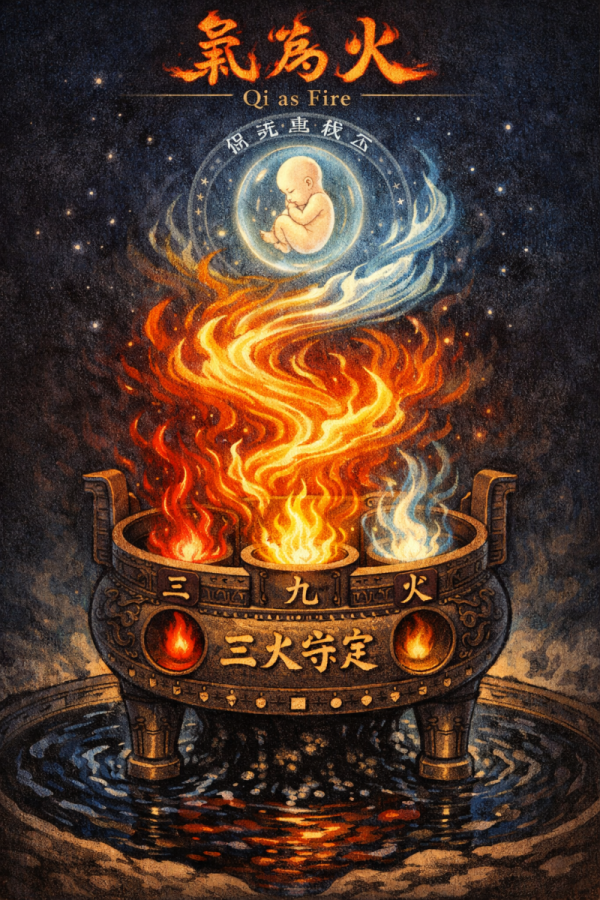
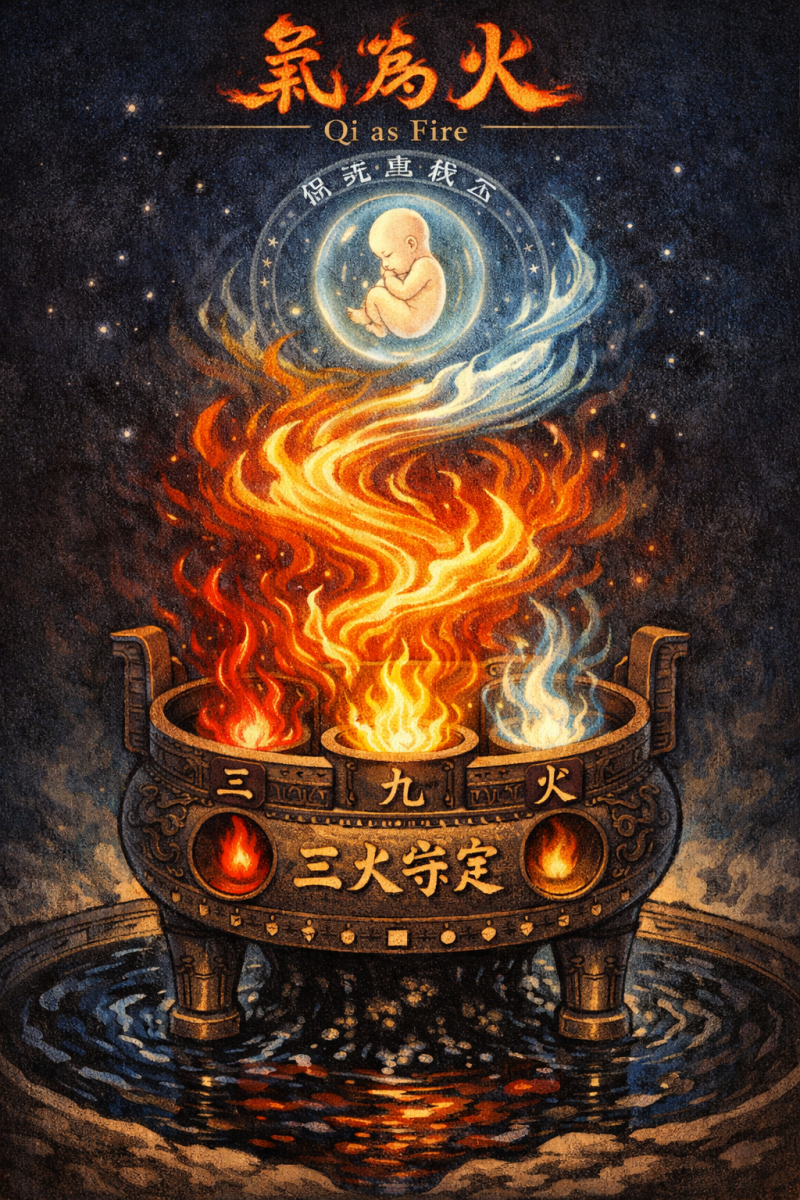
Illustration Legend: The Three Fires Maintained Steadily (三火守定). At the crucible’s triple mouth, Minister Fire burns crimson and deep, Sovereign Fire commands with golden awareness, and Civil Fire circulates in pale ethereal streams—three modalities of qi-as-fire, guarding the trinity of essence, energy, and spirit.
Below, the watery darkness of jing; above, the luminous sphere of the Holy Infant, neither born nor unborn, suspended in the vast obscurity where transformation completes itself. The spiral flames ascend not by consuming but by refining, their cool tips touching the void—this is fire-timing (火候), the duration of becoming.
As the text declares: preserving non-being, guarding being, in a moment it is complete; yet this moment requires three years, nine years, one full cycle of steady maintenance. The furnace stands in still water, reflecting what it consumes, generating what it cannot contain.
*
Today’s sharing from the Blue House of Via-HYGEIA presents more excerpts from the Xiuzhen Baochuan (Precious Transmission of Cultivating Reality), a late imperial Chinese spiritual text of the neidan (internal alchemy) tradition.
Our focus is the theme of ‘Qi as Fire’ (qi wei huo 氣為火), naturally extending our previous publications on Stillness, the body as Alchemical Vessel, the Heart-Mind as Monarch, and Essence as Medicinal Herb, while opening new avenues for investigating the text’s synthesis of Buddhist and Daoist technologies of the self. We examine the huohou (火候)—the ‘fire-timing‘—that cooks the medicinal jing (精) into qi (氣), and qi eventually into shen (神, Spirit).
In our next issue, we will realize ‘Shen as the Elixir’ (shen wei dan 神為丹), exploring the ‘Holy Infant‘ (shengying 聖嬰) that emerges when the fire has completed its work—the product that transcends its own production.
**
Editorial Introduction:
The Alchemical Sequence
Our exploration of the Xiuzhen Baochuan (修真寶傳) has thus far established the foundational architecture of the internal elixir (neidan 内丹). We began with Stillness (shouding 守定)—not as mere quietude, but as the primordial substrate, the ‘root of return‘ (gui 歸) that precedes all transformation.
Upon this ground of silence, we erected the Body as Alchemical Vessel (yi shen zuo ding lu 以身作鼎爐), defining the physical and energetic crucible wherein the transformation occurs. Without this container—stable, sealed, and grounded—the fire would have no locus, and the medicine no place to refine.
Within this vessel, we then enthroned the Heart-Mind as Monarch (xin wei junzhu 心為君主), acknowledging that without the directive intelligence of the Heart (xin 心)—the ruler who maintains the seal and governs the fire—stillness remains inert, mere potential without operative wisdom.
We next identified Essence (jing 精) as the Medicinal Herb (yao 藥), the raw material that fills the vessel and awaits the monarch’s command—the ‘superior medicine‘ (shangyao 上藥) that descends from pre-heaven, yet manifests in the body’s vital fluids and foundational vitality.
With these pillars established—the field, the vessel, the governor, and the substance—we turn now to the transformative agent itself. This issue examines Qi as Fire (qi wei huo 氣為火), the dynamic principle that cooks the medicinal jing into qi, and qi eventually into shen (Spirit).
In the pyrotechnics of internal alchemy, qi is simultaneously the most volatile and the most precise: it is both what is cooked and what does the cooking, the ‘Three Fires‘ (san huo 三火) that guard the trinity of essence, energy, and spirit while actively dissolving their boundaries.
The selections herein trace the operation of this fire: its manifestation as the Three Fires (san huo 三火)—Sovereign, Minister, and Civil—each with distinct thermal qualities and temporal rhythms; the delicate regulation of fire-timing (huohou 火候) through the ‘returning light‘ (huiguang fanzhao 回光返照), the foundational technique that turns awareness back upon itself to generate heat without consumption; the temporal structure of transformation encoded in ‘three years, nine years, one full cycle‘ (san nian jiu zai, yi ji 三年九載,一紀)—where the text pairs 年 (nian, year) with 載 (zai, also year) to achieve rhythmic balance, 載 bearing the additional resonance of ‘to carry‘ or ‘to record,’ suggesting that each cycle bears the weight of the work in progress. These figures are not chronological duration but qualitative measures of fiery intensity; and the ever-present danger of worldly fire (ren huo 人火)—the ‘torment‘ (jian’ao 煎熬) of fame, profit, spouse, and children that would burn the essence to ash before the Holy Infant (shengying 聖嬰) can be produced.
Yet fire, however potent, remains destructive without its completion. In our next issue, we will realize Shen as the Elixir (shen wei dan 神為丹), exploring the ‘Holy Infant‘ that emerges when the cooking is complete—the product that is itself a new beginning, the fruit that becomes seed, the return to emptiness that completes the cycle.
How does one nurse an infant that is neither born nor unborn? The furnace has been built, the vessel sealed, the monarch enthroned, the herb identified, and the fire kindled; now we must learn to let what has been cooked, cook us.
*
The Four Selections
Selection 1: The ‘Three Fires’—Stabilizing the Trinity
Selection 1a: The Upper Medicine
Source: Page 6, right column, lines 1–4
Chinese:「上藥三品,神與氣精。恍恍惚惚,杳杳冥冥。」
Pinyin: ‘Shàng yào sān pǐn, shén yǔ qì jīng. Huǎng huǎng hū hū, yǎo yǎo míng míng’.
Translation: ‘The upper medicine, three grades: Spirit with Qi and Essence. Dim and indistinct, vast and obscure‘.
Commentary: This passage presents the sān pǐn (Three Grades) of the upper medicine—shén, qì, and jīng—in their primordial interrelation. The text lists them in reverse order of refinement (Spirit first, Essence last), signaling the alchemical perspective: from the viewpoint of completed practice, the trinity is already unified. The phrase huǎng huǎng hū hū, yǎo yǎo míng míng—the Daodejing’s description of the Dao’s indistinctness—locates these three treasures in the ontologically prior realm, the ‘vast obscurity‘ where transformation originates. Here, the medicine is not yet cooked; it awaits the fire.
*
Selection 1b: The Three Fires Maintained Steadily
Source: Page 6, left column, lines 1–2
Chinese:「三火守定,神與氣精。」
Pinyin: ‘Sān huǒ shǒu dìng, shén yǔ qì jīng’.
Translation: ‘The Three Fires maintained steadily: Spirit with Qi and Essence‘.
Commentary: Here the text names the sān huǒ (Three Fires)—Sovereign, Minister, and Civil—as the functional aspect of qì itself. In internal alchemy theory, the Three Fires designate distinct yet interdependent modalities of transformative heat: the jūn huǒ (Sovereign Fire) of heart-awareness, the chén huǒ (Minister Fire) of kidney-qi, and the mín huǒ (Civil Fire) of circulating vitality [1][2].
The verb shǒu dìng (maintained steadily) invokes our first installment’s foundation—stillness as root—while transforming it: here, stillness is not mere quiescence but the steady maintenance of transformative heat. The fires ‘guard‘ (守) the trinity precisely by keeping it at the temperature of change, neither cooling into stagnation nor boiling into dissipation.
The repetition of shén yǔ qì jīng binds this selection to the preceding one: what was listed as static ‘grades‘ (品) is now revealed as a dynamic process guarded by fire. Qì-as-fire operates not at the level of gross combustion but in the subtle zone between being and non-being, where jing (substantial) and shen (insubstantial) interpenetrate. This is the hòu (timing) of fire: not chronological duration but the qualitative moment of transformation [3][4].
Selection 2:
Fire-Timing and the Production of the Holy Infant
Source: Page 6, right column, lines 4–8
Chinese: 「存無守有,頃刻而成。回光返照,產出聖嬰。三年九載,一紀飛昇。」
Pinyin: ‘Cún wú shǒu yǒu, qǐng kè ér chéng. Huí guāng fǎn zhào, chǎn chū shèng yīng. Sān nián jiǔ zǎi, yī jì fēi shēng’.
Translation: ‘Preserving non-being, guarding being—in a moment it is complete. Returning the light, turning the illumination inward, produces the Holy Infant. Three years, nine years, one full cycle—then ascension‘.
Commentary: Here the text articulates the temporal structure of fire-timing (huǒhòu 火候). The pairing cún wú shǒu yǒu (preserving non-being, guarding being) names the dialectical operation: ‘non-being‘ (無) is the void-shen that serves as fire; ‘being‘ (有) is the substantial jing-qi that serves as medicine. The cultivator simultaneously holds both, neither dissolving into pure emptiness nor clinging to full substantiality [5][6].
Huí guāng fǎn zhào (returning the light, turning illumination inward) is the foundational fire-technique—using conscious attention (shén) as fire to ‘cook‘ lower energies. Yet the text collapses the distinction: the light is qì in its fiery aspect, turning back upon itself to generate form. The shèng yīng (Holy Infant) is the product of sustained fire—qì that has been sufficiently ‘cooked‘ by its own nature until it sublimates into shen.
The numerical sequence sān nián jiǔ zǎi (three years, nine years) encodes the classical stages: three years for the small celestial cycle (xiǎo zhōutiān 小周天) of jing-to-qi, nine years for the great celestial cycle (dà zhōutiān 大周天) of qi-to-shen completion [7][8]. Yī jì (one full cycle of twelve years) marks the total gestation before fēi shēng (ascension)—the shen‘s liberation from conditioned embodiment. These are not literal durations but fire-timings: qualitative measures of transformative intensity [9][10].
Selection 3:
Fire as Urgency and Command
Source: Page 8, left column, lines 9–12
Chinese: 「火速領旨莫遲鈍,有悞原人罪不輕。素真拜辭謹遵命,不敢遲延久住停。」
Pinyin: ‘Huǒ sù lǐng zhǐ mò chí dùn, yǒu wù yuán rén zuì bù qīng. Sù zhēn bài cí jǐn zūn mìng, bù gǎn chí yán jiǔ zhù tíng’.
Translation: ‘Urgently receive the command with fire-speed, do not delay or be dull. If there is error regarding the original person, the offense is not light. Suzhen bows and departs, respectfully obeying the order, not daring to delay or dwell long‘.
Commentary: This narrative moment—Liú Sùzhēn receiving her mission—encodes fire-timing as moral urgency and physiological imperative. The compound huǒ sù (fire-speed) is common parlance for ‘urgently‘, yet here carries technical weight: the ‘fire‘ that must be ‘speedy‘ is the wǔ huǒ (martial fire) of initial cultivation, the intense awareness required to begin the cooking process before the medicine cools or the vessel cracks [11][12].
The zhǐ (command) she receives is the imperative of transformation itself—the body’s innate direction toward refinement, what the Neiye calls the ‘inner heart’s self-arising regulation‘ [13]. To be chí dùn (dull/delayed) is to fail to kindle qì-as-fire; the yuán rén (original person) is the primordial self that suffers when fire-timing is neglected. The narrative thus dramatizes the physiological: Liú Sùzhēn’s obedience mirrors the cultivator’s submission to alchemical logic, not daring to jiǔ zhù tíng (dwell long) in any fixed state lest the fire cool and the process stagnate.
The passage reveals qì-as-fire’s imperative structure: it is not merely a tool the cultivator wields but a summons that precedes and constitutes the self. The ‘original person‘ is both what is at stake and what commands; the fire is both external urgency and internal nature.
Selection 4:
The Fire of Worldly Torment vs. Alchemical Fire
Source: Page 8, left column, lines 17–24
Chinese: 「有一等為著名不思睡覺,有一等為著利受盡煎熬,有一等為妻思上了圈套,有一等為子愛背駝肩挑。」
Pinyin: ‘Yǒu yī děng wèi zhe míng bù sī shuì jiào, yǒu yī děng wèi zhe lì shòu jìn jiān áo, yǒu yī děng wèi qī sī shàng le quān tào, yǒu yī děng wèi zǐ ài bēi tuó jiān tiāo’.
Translation: ‘There are those who cling to fame and forget to sleep; there are those who cling to profit and suffer complete torment; there are those who cling to wife and are caught in snares; there are those who cling to children and bend under the load‘.
Commentary: This passage presents fire in its negative aspect—the jiān áo (torment/decocting) of worldly attachment. The term 煎熬 literally means ‘to decoct/fry‘—the same cooking terminology used for alchemical refinement. Here lies the crucial distinction: ordinary qì becomes fire that burns and consumes (the unconscious fire of desire that cooks the body into exhaustion), while alchemical qì becomes fire that transforms and elevates (the conscious fire of cultivation that cooks jing into shen) [14][15].
The four entanglements—míng (fame), lì (profit), qī (wife), zǐ (children)—are the fuel for the wrong fire. The text implies that this ‘human fire‘ (rén huǒ 人火) must be converted into ‘heavenly fire‘ (tiān huǒ 天火) through the practice described in Passages 1–3. The cultivator does not extinguish desire but redirects its fire—the same energy that ‘clings to fame‘ (wèi zhe míng) can be retrained to guard the Three Fires steadily (sān huǒ shǒu dìng).
The bodily imagery—bēi tuó jiān tiāo (bending under load, hunched shoulders bearing weight)—contrasts with the fēi shēng (ascension) of Passage 2. Worldly fire produces gravitational collapse; alchemical fire produces levitation through sublimation. Qì-as-fire is thus morally ambivalent until directed: it is always cooking, but the product depends on the cook’s intention and timing.
Index of Key Terms
| Term | Pinyin | Definition |
|---|---|---|
| 氣為火 | qì wéi huǒ | Qi as Fire; the transformative agent that cooks jing into shen |
| 三火 | sān huǒ | Three Fires: Sovereign Fire (君火), Minister Fire (臣火), Civil Fire (民火) |
| 火候 | huǒhòu | Fire-timing; the qualitative regulation of transformative heat |
| 守定 | shǒu dìng | Maintained steadily; guarding in stability (see Installment 1) |
| 上藥三品 | shàng yào sān pǐn | Upper medicine, three grades: shen, qi, jing |
| 恍恍惚惚,杳杳冥冥 | huǎng huǎng hū hū, yǎo yǎo míng míng | Dim and indistinct, vast and obscure; the primordial state of transformation |
| 存無守有 | cún wú shǒu yǒu | Preserving non-being, guarding being; the dialectical fire-operation |
| 回光返照 | huí guāng fǎn zhào | Returning the light, turning illumination inward; the foundational fire-technique |
| 聖嬰 | shèng yīng | Holy Infant; the shen-elixir produced by sustained fire |
| 三年九載 | sān nián jiǔ zǎi | Three years, nine years; the temporal structure of fire-timing |
| 一紀 | yī jì | One full cycle (twelve years); total gestation before ascension |
| 飛昇 | fēi shēng | Ascension; the liberation of completed shen |
| 火速 | huǒ sù | Fire-speed; urgency as martial fire |
| 武火 | wǔ huǒ | Martial fire; intense awareness for initial cooking |
| 文火 | wén huǒ | Civil fire; gentle awareness for later refinement |
| 煎熬 | jiān áo | Torment/decocting; worldly fire that consumes (unconscious) vs. alchemical refinement (conscious) |
| 原人 | yuán rén | Original person; the primordial self requiring transformation |
| 人火 | rén huǒ | Human fire; ordinary desire that burns |
| 天火 | tiān huǒ | Heavenly fire; alchemical fire that elevates |
*
Bibliography
Classical Texts
[1] Anonymous. Huangting jing 黃庭經 (Yellow Court Scripture). ca. 3rd century CE.
[2] Chen Zhixu 陳致虛。Jindan dayao 金丹大要 (Great Essentials of the Golden Elixir). Yuan dynasty.
[3] Jiao Yanshou 焦延壽,attributed. Yilin 易林 (Forest of Changes). Han dynasty.
[4] Li Daochun 李道純。Zhonghe ji 中和集 (Collection of Central Harmony). Yuan dynasty.
[5] Liu Yiming 劉一明。Xiangyan poyi 象言破疑 (Breaking Through Doubt with Symbolic Language). Qing dynasty.
[6] Lü Dongbin 呂洞賓,attributed; Zhongli Quan 鍾離權,attributed. Zhong-Lü chuandao ji 鍾呂傳道集 (Anthology of the Transmission of the Dao from Zhongli Quan to Lü Dongbin). Song dynasty.
[7] Neiye 內業 (Inward Training). Guanzi 管子,chapter 49. ca. 4th century BCE.
[8] Xingming guizhi 性命圭旨 (Principles of Human Nature and Life Destiny). Ming dynasty, 1615.
[9] Zhang Boduan 張伯端。Wuzhen pian 悟真篇 (Folios on Awakening to Perfection). Song dynasty, 1075.
*
Modern Scholarship
[10] Baldrian-Hussein, Farzeen. “Proclaimed and Secret Motifs in the ‘Great Purity’ Scriptures.” In Proceedings of the International Conference on Taoism, 1991.
[11] Despeux, Catherine. Taoïsme et corps humain: Le Xiuzhen tu. Paris: Guy Trédaniel, 1994.
[12] Eskildsen, Stephen. “The Daoist Body and the Elixir of Immortality.” In Daoism Handbook, ed. Livia Kohn. Leiden: Brill, 2000.
[13] Komjathy, Louis. “Daoist Internal Alchemy: The ‘Great Purity’ Tradition.” In Daoist Cultivation and the Great Purity Tradition, 2013.
[14] Pregadio, Fabrizio. The Seal of the Unity of the Three. Mountain View, CA: Golden Elixir Press, 2011.
[15] Pregadio, Fabrizio, ed. The Encyclopedia of Taoism. London: Routledge, 2008. See entries on “Neidan” and “Huohou.”
[16] Roth, Harold D. Original Tao: Inward Training (Neiye) and the Foundations of Taoist Mysticism. New York: Columbia University Press, 1999.
[17] Schipper, Kristofer. The Taoist Body. Berkeley: University of California Press, 1993.
*
Source
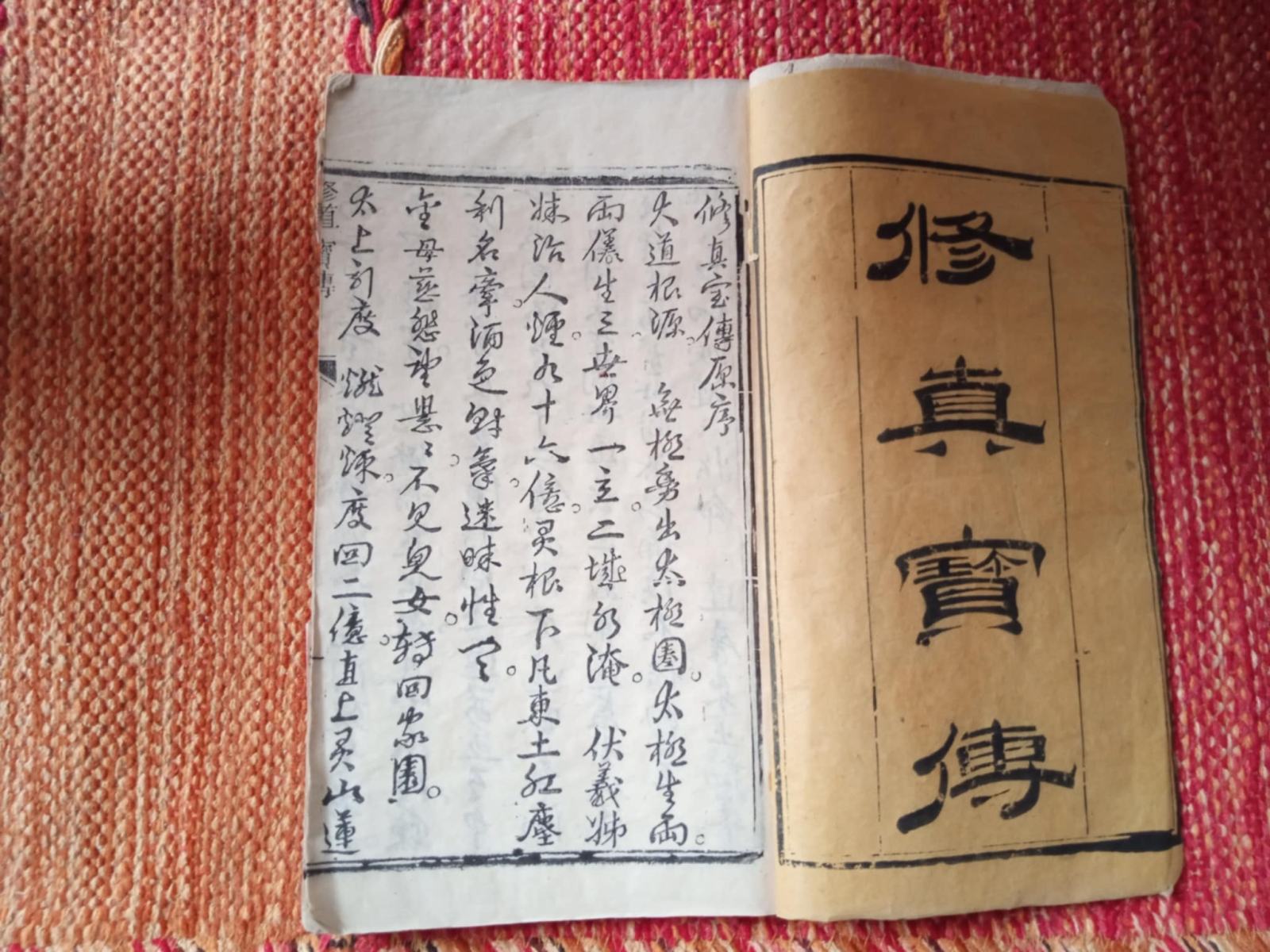
Xiuzhen Baochuan (修真寶傳)
***

Related Articles


Leave a Reply