
Circle of Transmission: The Living Loom
Recovering the Lost Harmonic Canon: Pythagoras, Zhu Zaiyu, the Yijing, the Sefer Yetzirah, and Gurdjieff’s Objective Music
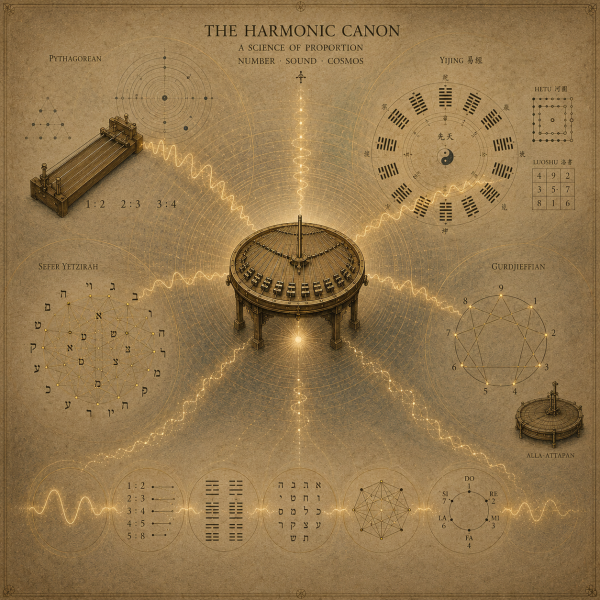
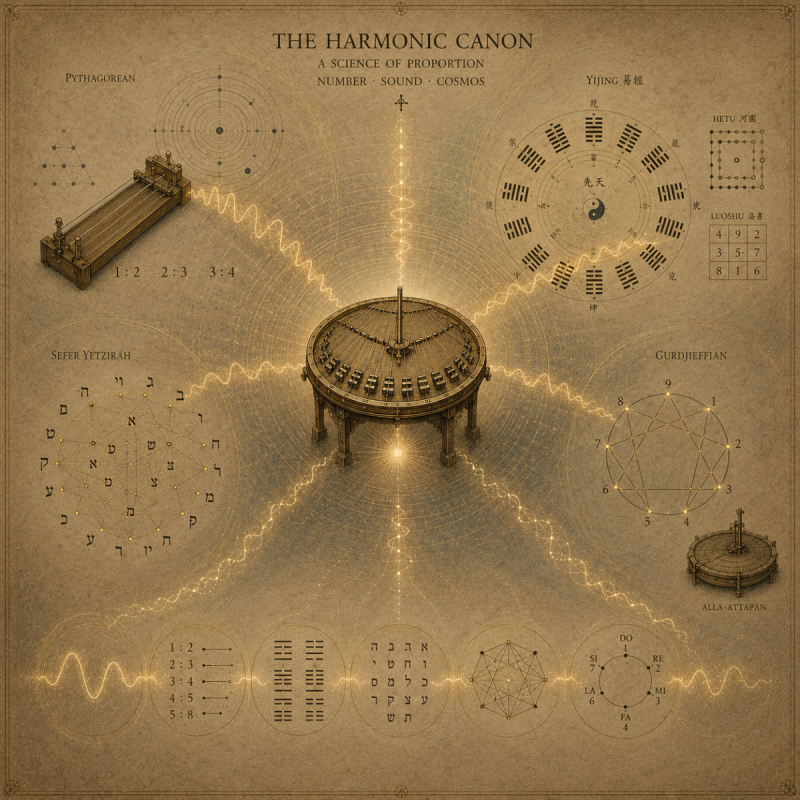
Featured Illustration: The Harmonic Canon. This symbolic frontispiece evokes a forgotten science of proportion shared across distant civilizations. At its luminous centre stands the Junzhun of the Ming polymath Zhu Zaiyu (1536–1611), whose mathematically demonstrable equal temperament serves here as the historical anchor of a wider inquiry. Around it unfold five complementary languages of cosmic order: the Pythagorean monochord and numerical ratios; the Yijing‘s hexagram cosmology; the combinatorial grammar of the Sefer Yetzirah; and G. I. Gurdjieff’s doctrine of objective music and the Law of Seven. Rather than asserting a direct historical lineage between these traditions, the plate proposes a common epistemological horizon: that number, sound, and form may constitute different expressions of a single intelligible order.
The harmonic wave issuing from the centre gradually transforms into ratios, binary figures, letters, geometric networks, and octave structures, suggesting that the world’s symbolic traditions may be understood not as isolated systems but as distinct grammars describing the same invisible architecture of proportion. Conceived in the spirit of a lost eighteenth-century scientific frontispiece, the illustration serves not as a historical reconstruction but as a visual meditation on the possibility of a universal harmonic canon. Harmony is not the agreement of voices, but the remembrance of the law from which every true voice arises.
*
Another sharing for the day from the Blue House of Via-HYGEIA: our little contribution to a very interesting subject: The Harmonic Canon. Its aim is to foster further research and possible debate in the academic world, bridging the gap between ancient cosmological wisdom and verifiable mathematical science.
By anchoring our inquiry in the documented rigor of Zhu Zaiyu, we invite scholars from musicology, sinology, history of science, and esoteric studies to explore whether proportion is merely a metaphor or a unified method of knowing.
We hope this opening study serves as a catalyst for cross-traditional dialogue and the recovery of lost epistemological tools.
**
Prolegomenon:
Why This Study Now
The history of ideas has produced a recurring pattern — one that is not merely esoteric but epistemological. Across civilizations and millennia, certain figures have approached the relationship between number, sound, and cosmos not as a matter of aesthetic preference or cultural convention, but as a science of proportion: the conviction that an invisible numerical order underlies audible reality, and that this order can be made knowable through mathematical demonstration rather than textual authority alone.
The present study brings five traditions into deliberate dialogue for the first time:
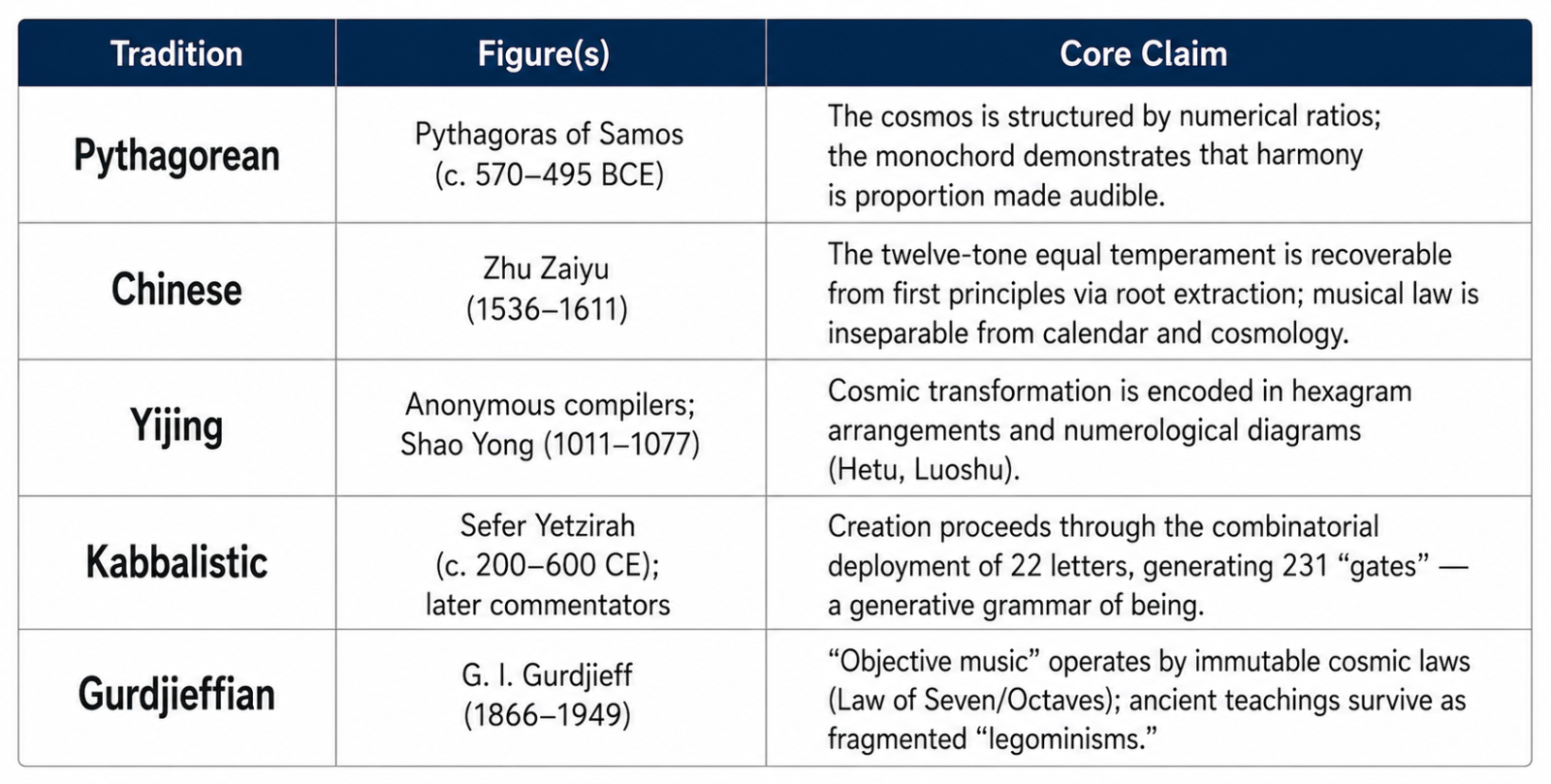
This study does not assert that these traditions form a single historical lineage. Rather, it proposes that they share a common epistemological structure — what we shall call the harmonic canon — and that Zhu Zaiyu, as the most rigorously documented figure in the set, serves as the crucial test case for determining whether this structure represents a unified science or merely a family resemblance.
The Via Hygeia Circle of Transmission takes as its mission the fostering of precisely this kind of cross-traditional inquiry — one that respects philological rigor while remaining open to structural insights that disciplinary boundaries often obscure.
*
Part I: The Three Research Questions
Any genuinely comparative study of the harmonic canon must address three interlocking questions:
I.1 The Ontological Question
Do these traditions share a common object (a “harmonic science”), or do they merely exhibit structural homologies?
If the former, then we are dealing with a perennial philosophy — a science of proportion that recurs across cultures because it reflects an objective feature of reality. If the latter, then the similarities are artifacts of convergent evolution: different civilizations, responding to similar mathematical constraints (the need to divide the octave, the need to correlate pitch with calendar, the need to encode cosmology in combinatorial systems), arrived at structurally similar solutions without historical contact.
The ontological stakes are high. A positive answer would mean that the harmonic canon is not a metaphor but a method — a way of knowing that transcends cultural particularity. A negative answer would mean that each tradition must be understood on its own terms, and that cross-cultural comparison risks the very Eurocentric (or Sinocentric, or Hellenocentric) projection that careful scholarship seeks to avoid.
I.2 The Historical Question
Is there transmission (direct or mediated), or independent invention responding to similar mathematical constraints?
The historical question cannot be settled a priori. It requires:
- Documentable channels: trade routes, missionary networks, manuscript circulation, oral transmission.
- Linguistic evidence: loanwords, calques, shared technical terminology.
- Archaeological evidence: instruments, measuring devices, astronomical instruments that could have travelled.
- Textual evidence: citations, allusions, shared errors that suggest common source rather than independent derivation.
For the Pythagorean–Chinese axis, the transmission hypothesis has been debated since Joseph Needham and Kenneth Robinson (1962) raised the possibility that Zhu Zaiyu’s equal temperament might have reached Europe via Jesuit channels. Fritz Kuttner (1975) refuted direct transmission, and the current consensus favors independent invention — but with acknowledged Chinese priority in both date and rigor.
For the Chinese–Kabbalistic axis, no documented channel exists. The Sefer Yetzirah’s 22-letter combinatorics and the Yijing’s hexagram numerology share a structural feature (generative systems based on discrete elements), but no historical pathway connects them.
For the Gurdjieffian axis, the question is complicated by Gurdjieff’s own method: he mythologizes historical figures rather than citing them, embedding real knowledge in allegorical narratives (“legominisms”) that are meant to be decoded rather than believed. His “Chai-Yoo” — identified by recent Gurdjieff scholarship as a rendering of Zhu Zaiyu — appears in the Bokharian Dervish chapter of Beelzebub’s Tales as one of two Chinese brothers who “discovered the law of the sevenfoldness” and constructed the instrument Alla-attapan. Whether Gurdjieff knew of Zhu through Amiot’s Mémoire (1779), Helmholtz’s Tonempfindungen (1863), or through Russian Orientalist circles (Prince Esper Ukhtomsky’s network is a plausible but unproven channel) remains an open question.
I.3 The Methodological Question
What counts as “reconstruction” — mathematical derivation, textual emendation, experimental verification, or initiatory practice?
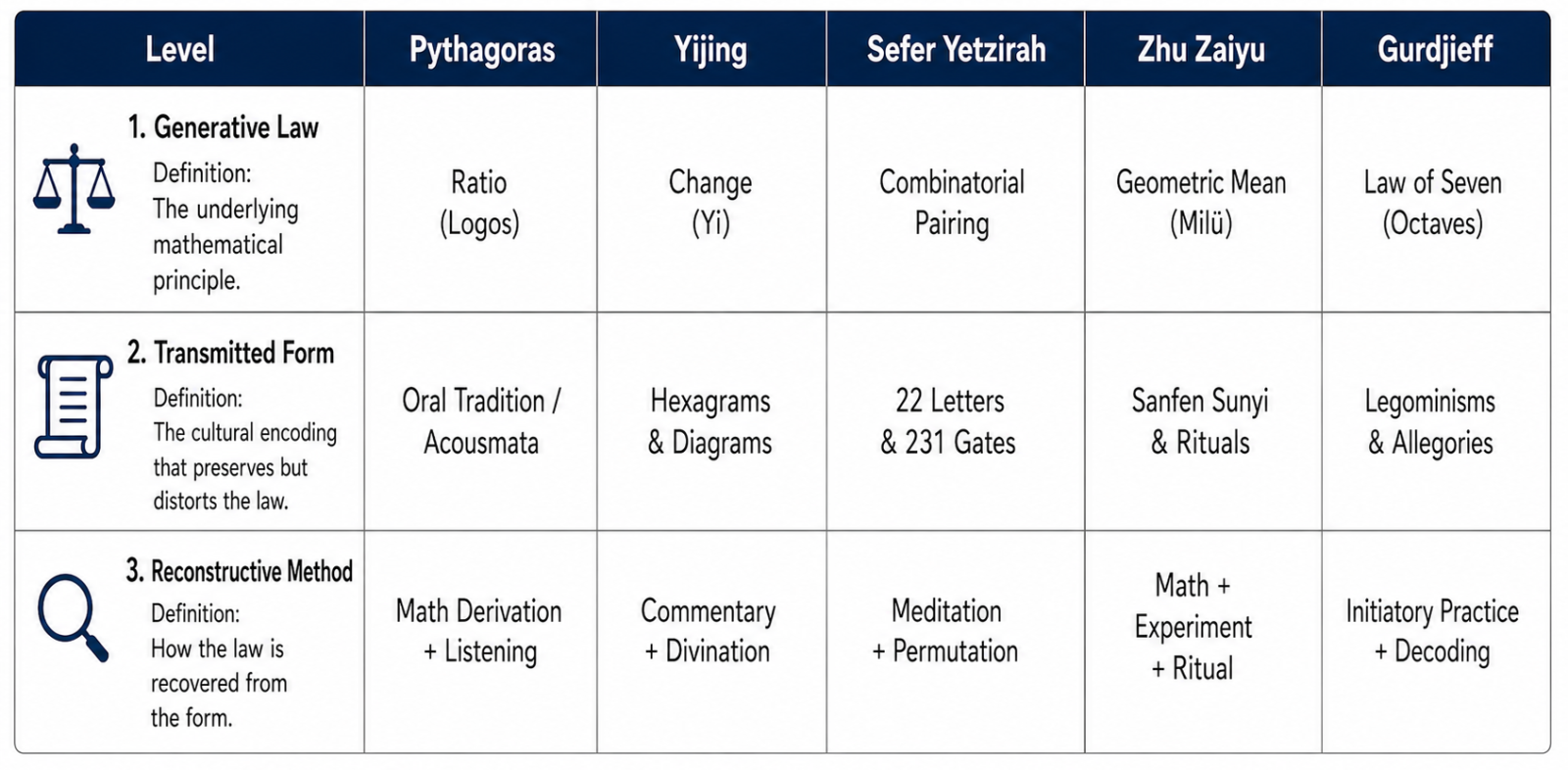
This is perhaps the most neglected question in comparative esotericism. Each tradition in our set employs a different reconstructive method:
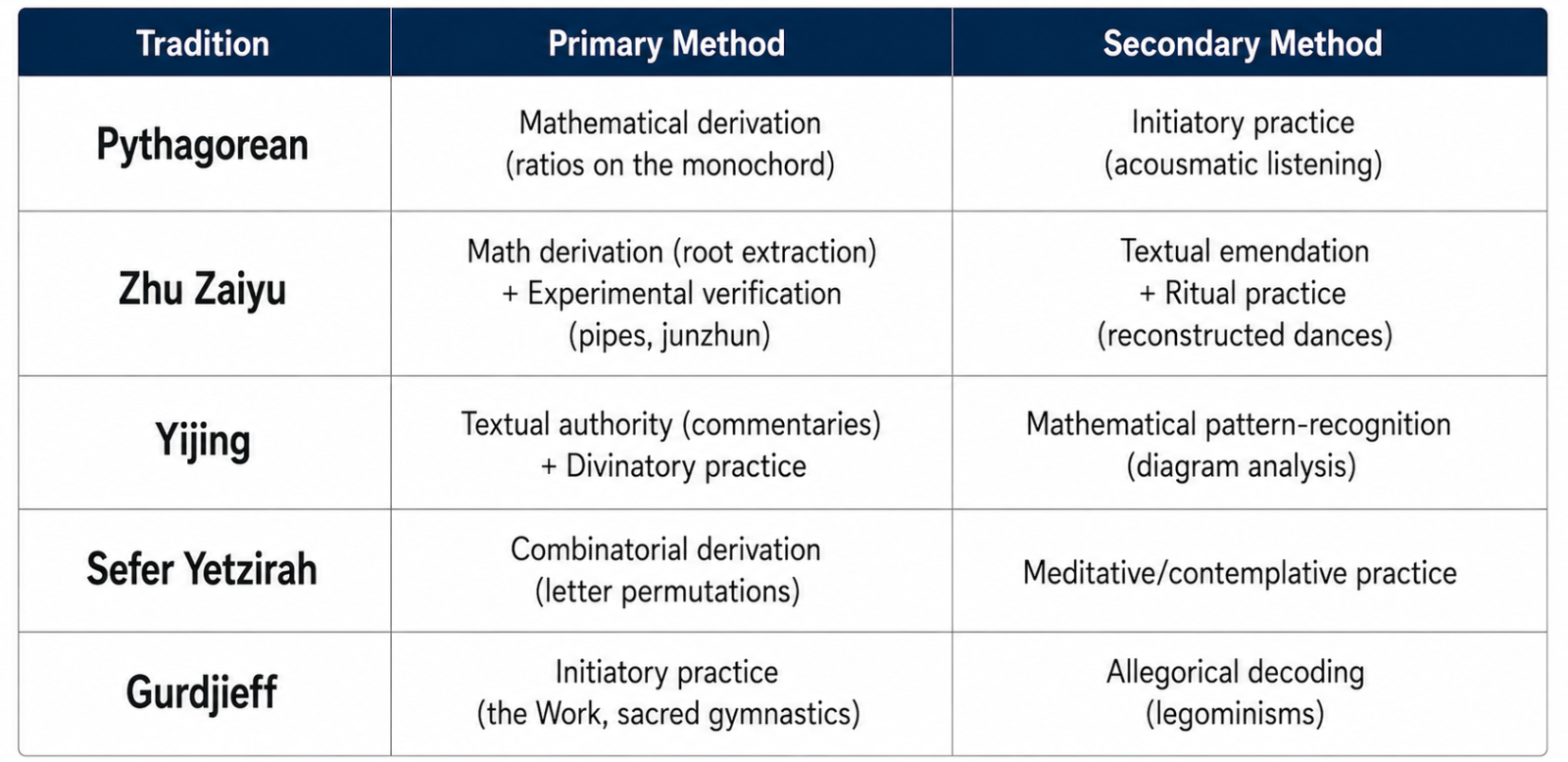
Zhu Zaiyu is unique in combining all four methods: he emended texts, derived mathematically, verified experimentally, and practiced ritually. This makes him the test case par excellence for whether the “science of proportion” is a unified epistemology or a family resemblance. If one figure can credibly unite all four methods, the case for a common object strengthens. If not, the homologies may be superficial.
*
Part II: Zhu Zaiyu as Test Case — A Detailed Profile
II.1 Life and Historical Context
Zhu Zaiyu 朱載堉 (1536–1611), courtesy name Boqin 伯勤, was a Ming imperial clansman — ninth-generation descendant of the dynastic founder Zhu Yuanzhang and hereditary prince of the Zheng 鄭 establishment at Huaiqing (modern Qinyang, Henan). Two catastrophes defined his life and work.
First catastrophe (1548–1568): the mud-hut vigil. At age twelve, his father Zhu Houwan 朱厚烷, Prince Gong of Zheng, was stripped of rank and imprisoned at Fengyang after remonstrating with the Jiajing emperor over Taoist obsessions and being framed by a jealous kinsman. The young heir protested by building a mud hut outside the palace gate and living there on straw mats for nineteen years — the famous episode of xigao duchu recorded in the Ming Shi itself. During this period he devoted himself entirely to self-directed study in music, mathematics, and calendrics. He also studied Chan Buddhism with the master Songgu 松谷 and wrote a commentary on the Diamond Sutra (now lost). His father was rehabilitated in 1567; Zhu re-entered the palace in 1568.
Second catastrophe (1591–1606): the abdication. After his father’s death, Zhu refused the princely throne of Zheng, arguing that by right of seniority it belonged to the line of a cousin — who was the grandson of the very kinsman whose slanders had destroyed his father. After fifteen years and seven memorials, the Wanli emperor relented in 1606, praising him in terms no Ming prince had earned: “Zaiyu earnestly declines the princely title — such lofty spirit in yielding a state is rare in a thousand ages.”
He died in 1611, aged 76 by Chinese reckoning, and is buried on Jiufengshan 九峰山 north of Qinyang, with the posthumous honorific Duanqing 端清. His tomb became a National Key Cultural Relic in 2001; the Qinyang Memorial Hall opened in 1991.
II.2 The Writings: Surviving Corpus and Lost Books
Zhu’s surviving masterpiece is the Yuelü quanshu 樂律全書 (“Complete Writings on the Laws of Music”), a self-authored encyclopedia of fifteen treatises in 47–48 juan — over a million characters — carved at the Zheng princely press between 1596 and 1606.
Key Treatises:
- Lülü jingyi 律呂精義 (20 juan, pref. 1596): The masterwork: Xinfa Milü equal temperament, pipe-diameter acoustics, critiques of past tuning theory.
- Lüxue xinshuo 律學新說 (4 juan, pref. 1584): First statement of the close-ratio method; metrology of ancient foot-measures.
- Suanxue xinshuo 算學新說 (1 juan, 1603): Abacus arithmetic, root extraction, geometric series.
- Lülü rongtong 律曆融通 (4 juan + glosses, 1581): Harmonization of pitch-pipe and calendar theory on a guaqi armature.
Lost works (titles preserved on the 1624 Wang Duo funerary stele and in county gazetteers): Yunxue xinshuo (phonology), Xiantian tu zhengwu (“Corrections of Errors concerning the Prior-Heaven Diagram”), Se ming jie shu, Mao shi yun fu, Li ji lei bian, Suan jing ju pi xiang kao (monograph on black-millet metrological grains), Jin gang xin jing zhu (Buddhist commentary), plus a 20-juan Ancient Music Scores with Diagrams and a Qieyun zhinan.
II.3 The Mathematical Discovery: 新法密率 (Xinfa Milü)
For two millennia Chinese pitch theory generated its twelve lü 律 by the sanfen sunyi 三分損益 cycle — stacking pure fifths (3:2) and fourths (4:3). The method produces just fifths but unequal semitones (~90 and ~114 cents), and after twelve generations the spiral fails to close on the octave: the thirteenth generation overshoots by a Pythagorean comma (~23.5 cents). Transposition (xuanguan) through all twelve keys therefore never worked cleanly — Zhu called it the method that “goes forth and never returns.”
Zhu’s solution, conceived by 1581 and printed in 1584, replaces the additive cycle with a geometric progression: twelve equal steps between a pipe and its octave, each the twelfth root of 2. Using an abacus spanning 81 columns and his own algorithms for square- and cube-root extraction, he obtained:
2(1/12)=1.059463094359295264561825
— correct to all 24 printed digits. His procedure: 2 (= the tritone Ruibi), again (= Nanlü), then the cube root (= the semitone Yingzhong).
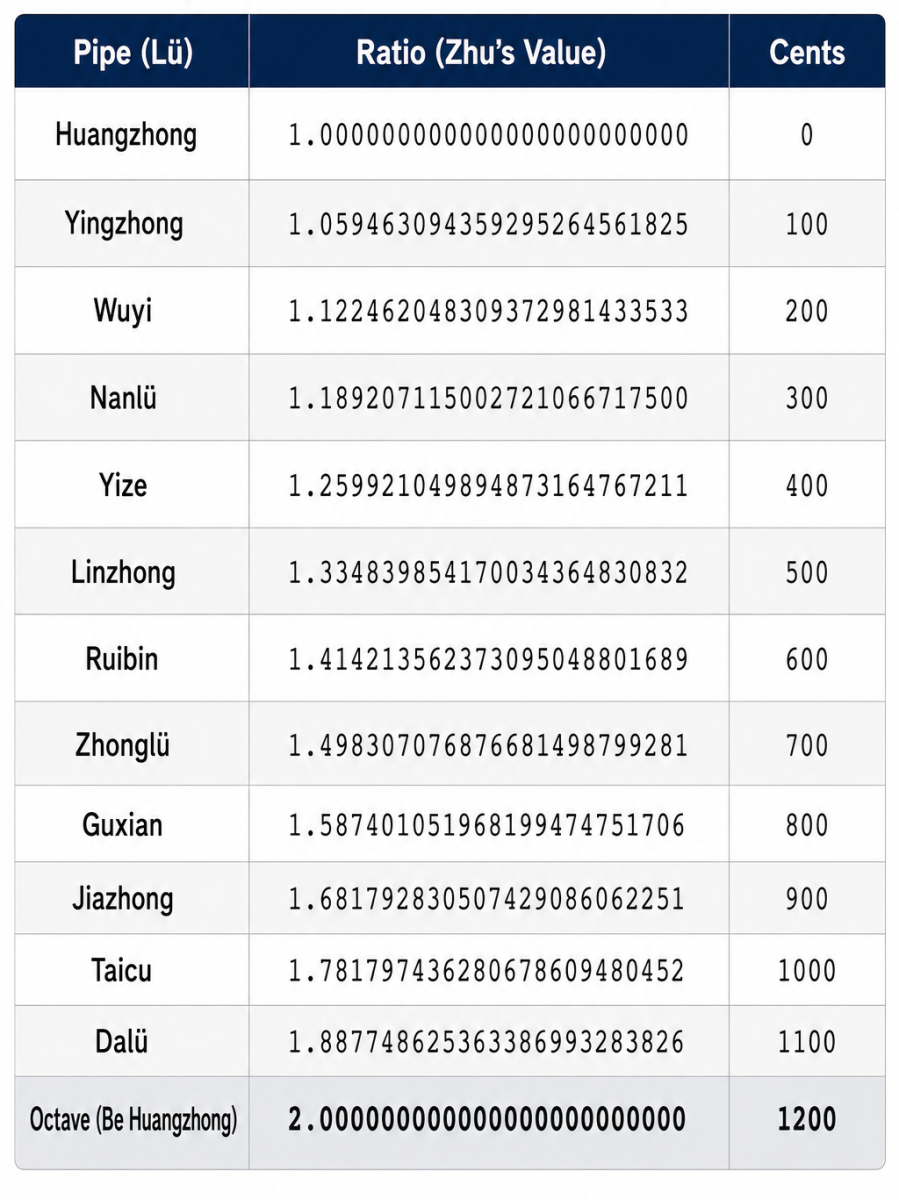
The equal semitone of 100 cents replaces the limma/apotome pair of the fifth-cycle, and the thirteenth generation closes exactly on the octave.
II.4 From Number to Sound: Instruments and Verification
Zhu was not content with arithmetic. For strings he built the junzhun 均準 — the world’s first equal-temperament tuning instrument. For blown pipes he solved the end-correction problem with his “different-diameter pipe law” (yijing guanlü): the bore diameter shrinks by the square root of the semitone ratio as pitch rises, an empirical correction without parallel in its century. He designed 36 tuned pipes in chromatic order across three registers (bass, alto, soprano), and applied his ratios to qin and se construction — a qin dated 1582 from his workshop survives in the Gansu Provincial Museum.
II.5 The Calendar, Metrology, and Cosmology
Zhu’s Lülü rongtong (1581) takes its era from Wanli 9 and its constants from his pipe-metrology: the calendar origin lüyuan 律元 = 9 (the Huangzhong pipe of 81 = 9×9, “the odd number of the Luoshu self-multiplied”), and the calendar matrix lümu 律母 = 100. On this armature he recomputed the tropical year with an accuracy verified in 1986 as within 17 seconds of the modern value.
His metrological program — the millet-grain foot (horizontal millet 100 = vertical millet 81 = diagonal millet 90), cross-checked by twelve categories of evidence — culminated in the Jialiang suanjing (1610), a complete recomputation of the Wang Mang standard measure from the Kaogong ji.
II.6 Dance, Literature, and the Lost Classic of Music
Zhu coined the word wuxue 舞學 (“dance studies”) and gave it its first systematic framework, with the earliest extant Chinese dance notation. His four surviving dance books reconstruct the Six Minor Dances and the Han Lingsing harvest dance for sixteen boys miming ploughing, sowing, weeding, and reaping.
As a vernacular poet he wrote the Xingshi ci 醒世詞 (“Verses to Wake the World”), including the masterpiece Shanpo Yang · Shi Bu Zu — a crescendo of human appetite from hunger to immortality, ending with King Yama’s summons.
The lost classic he genuinely retro-engineered was the Yue King 樂經 (Classic of Music), not the Yi King: his Yuexue xinshuo argues the Zhouli’s “Director of Music” chapter is the old Classic of Music, and his whole antiquarian program — reconstructed se technique, Odes reset to music, resurrected ritual dances, recomputed Zhou bronzes — hangs on this thesis.
*
Part III: The Five Traditions in Comparative Profile
III.1 Pythagoras: The Monochord and the Tetraktys
The Pythagorean tradition begins with the monochord (kanōn) — a single string whose length is divided by movable bridges to demonstrate that musical consonance is numerical proportion. The ratios 1:2 (octave), 2:3 (fifth), 3:4 (fourth), and 1:1 (unison) are not merely pleasant intervals; they are ontological facts, windows onto the structure of reality.
The tetraktys — the triangular figure of the first four numbers summing to ten — was the Pythagorean oath-object. The tetraktys encodes the ratios of the consonances within its structure, making it simultaneously a mathematical, musical, and cosmological symbol.
Reconstructive method: Mathematical derivation on the monochord, supplemented by initiatory practice (the acousmatic tradition of listening in silence). Limitation: The Pythagorean system generates the diatonic scale but cannot close the circle of fifths cleanly — the Pythagorean comma (23.46 cents) remains. The “problem” that Zhu Zaiyu solved was already implicit in Pythagorean mathematics.
III.2 The Yijing: Hexagrams, Guaqi, and the Prior-Heaven Diagram
The Yijing (Book of Changes) presents a cosmology of transformation encoded in 64 hexagrams, each composed of six lines (yao 爻) that are either broken (yin) or solid (yang).
Two diagram traditions are especially relevant:
- The Hetu and Luoshu: Numerical diagrams that correlate numbers with directions, elements, and cosmic forces. The Luoshu is a 3×3 magic square summing to 15 in every direction.
- The Xiantian tu (Prior-Heaven Diagram): Attributed to Fu Xi and systematized by Shao Yong, this arranges the 64 hexagrams in a circular pattern based on binary progression (yin = 0, yang = 1), generating a sequence that Leibniz later recognized as isomorphic to binary numeration.
The guaqi (hexagram-qi) system assigns hexagram lines to the 24 solar terms and the 360 days of the year, creating a calendar-acoustical cosmology. Zhu Zaiyu’s Lülü rongtong is the last major work in this tradition.
Reconstructive method: Textual authority + divinatory practice + mathematical pattern-recognition. Note on Lost Texts: The Lianshan and Guicang were lost by Han times. Reconstruction attempts (notably by Huang Daozhou) sought to recover them through calendrical numerology. Zhu Zaiyu is not associated with this project in any source, though his lost Xiantian tu zhengwu suggests he engaged critically with diagrammatic errors.
III.3 The Sefer Yetzirah: Letters, Gates, and the Generative Grammar of Being
The Sefer Yetzirah (Book of Creation) presents creation as a combinatorial process:
- 32 paths of wisdom: the 10 sefirot + the 22 letters of the Hebrew alphabet.
- 231 gates: the number of unique pairs of the 22 letters ($22 \times 21 / 2 = 231$), representing all possible relationships between cosmic forces.
Reconstructive method: Combinatorial derivation (letter permutations) + meditative/contemplative practice. Structural parallel with Zhu Zaiyu: Both systems are generative grammars — finite sets of elements (12 lü / 22 letters) combined by mathematical rules to produce a cosmos of relationships. The Sefer Yetzirah’s 3+7+12 = 22 mirrors Zhu’s 12 lü organized in triple registers (3×12 = 36 pipes).
III.4 Gurdjieff: Objective Music, the Law of Seven, and Legominisms
G. I. Gurdjieff’s concept of “objective music” is music created according to immutable mathematical laws that produce predictable physical and psychological effects. In the Bokharian Dervish chapter of Beelzebub’s Tales, he sets an extraordinarily high standard: music that can make flowers grow, raise boils on legs, or bring down walls.
The Law of Seven and the 12-Tone Mapping: The “law of the sevenfoldness” that the Chinese brothers Choon-Kil-Tez and Choon-Tro-Pel discover is Gurdjieff’s version of the Law of Seven (or Law of Octaves): the teaching that all processes in the universe develop through seven stages, with two “intervals” or “shocks” where the process risks deviating unless a specific force is applied.
- Mapping the 12 Semitones: In Gurdjieff’s system, the octave (12 semitones) is mapped onto the 7 notes of the diatonic scale (Do, Re, Mi, Fa, Sol, La, Si). The two “intervals” or missing steps occur between Mi-Fa and Si-Do. These gaps correspond to the specific points where the “shocks” are required to maintain the momentum of the process. Thus, the 12-tone equal temperament provides the continuous mathematical substrate, while the Law of Seven describes the discontinuous dynamics of energy flow within that substrate. The enneagram symbol encodes this relationship: the circle represents the octave (12/12 or 1.0), the inner triangle represents the 3 shocks (or the 3 mother letters), and the hexad represents the 6 active stages.
The “Chai-Yoo” identification: A 2021 Gurdjieff seminar SlideShare states explicitly: “Zhu Zaiyu in 1584 — possibly this is the Chinese individual Chai-Yoo that Gurdjieff mentions in The Tales.” “Chai-Yoo” is a phonetic rendering of 朱載堉 (Zhu Zaiyu). The instrument associated with the Chinese brothers — the Alla-attapan — is Gurdjieff’s version of Zhu’s junzhun and pipe sets.
Reconstructive method: Initiatory practice + allegorical decoding. Critical observation: Gurdjieff’s engagement with Zhu Zaiyu is acoustical and mathematical, not philological. There is no mention of the Yijing or divinatory tradition in Gurdjieff’s musical writings. His interest is in the mathematical law — the division of the octave — not in the cultural apparatus.
*
Part IV: The Comparative Matrix
IV.1 The Epistemological Structure: Form, Law, Method
IV.2 The Mathematical Isomorphisms
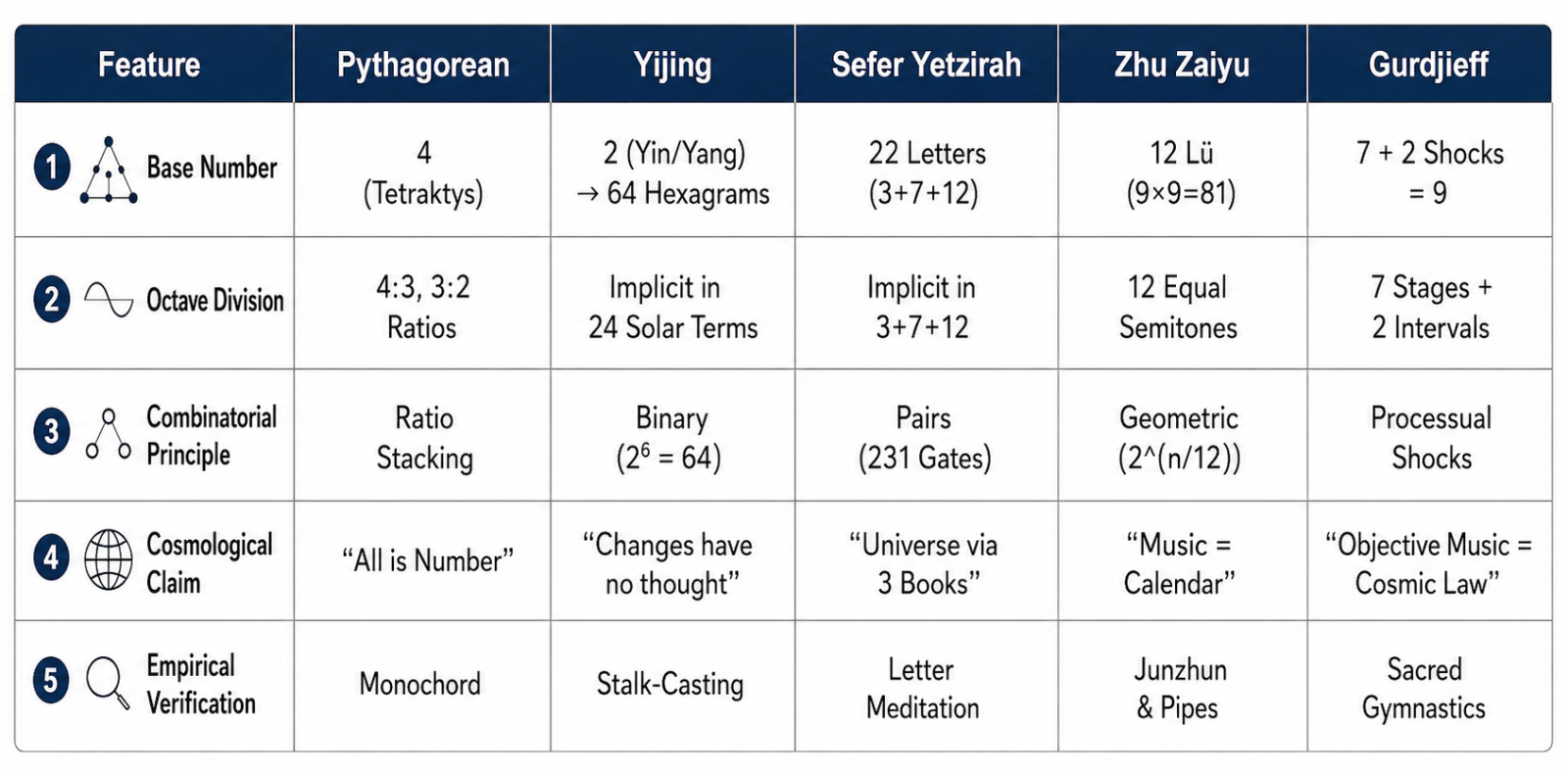
Analysis of the Isomorphisms: The number 12 appears centrally in Zhu’s lü, the Sefer Yetzirah’s simple letters, and the Yijing’s earthly branches. The number 7 appears in the Sefer Yetzirah’s double letters and Gurdjieff’s Law of Seven. The number 3 (triads, registers, mother letters) appears in all five systems. Whether these shared numbers reflect a common object (a unified harmonic science) or convergent mathematical constraints (the natural limits of dividing an octave or organizing a year) is the central question this study opens for further investigation.
IV.3 The Historical Question: Transmission or Independent Invention?
- Pythagorean–Chinese: Consensus favors independent invention, Chinese priority.
- Chinese–Kabbalistic: No documented channel. Structural similarities likely reflect convergent responses to similar mathematical constraints.
- Gurdjieffian: If Gurdjieff knew of Zhu, the channel was likely European scholarship mediated through Russian Orientalist circles. Gurdjieff’s method of absorption — mythologizing Zhu into “Chai-Yoo” — makes the question of direct knowledge secondary to the question of structural recognition.
*
Part V: Zhu Zaiyu as the Test Case — Why He Matters
V.1 The Four Methods United
Zhu Zaiyu is unique among the figures in our set for combining all four reconstructive methods:
Mathematical derivation: The Xinfa Milü, computed to 24 digits.
Experimental verification: The junzhun, the 36 pipes, the corrected-bore formula.
Textual emendation: The Jialiang suanjing, correcting the Kaogong ji.
Ritual practice: The reconstructed dances and Xiangyin shiyue pu.
No other figure in the set unites all four. Pythagoras is legendary; the Yijing compilers are anonymous; the Sefer Yetzirah’s author is unknown; Gurdjieff deliberately obscured his sources. Zhu is the only one we can verify at every level.
V.2 The Documented Anchor
Zhu’s strength is that he is dated, documented, and computable:
His texts are extant and datable (prefaces 1584, 1596, 1603; printing completed 1606).
His mathematics is verifiable (recomputed ratios match to all 24 digits).
His instruments are reconstructable (the junzhun design is preserved).
His dances are notatable (the earliest Chinese dance notation survives).
This makes him the anchor in waters that are otherwise deep. Claims about Pythagoras or the Sefer Yetzirah must rely on fragmentary evidence. Claims about Zhu can be tested.
V.3 The Rationalist Within the Cosmological Frame
Zhu’s most instructive feature is his epistemological stance: he operates within the Yijing cosmological framework (Hetu, Luoshu, guaqi) while maintaining a striking empiricist discipline. He rejects the houqi “watching-the-ethers” test as empirically false, shrugging “as to whether it verifies or not, that depends on the man.” He keeps the diagrams and discards the miracles.
This is precisely the stance that the comparative study needs: cosmological commitment without methodological credulity.
V.4 The Gurdjieff Connection: What Is Actually Claimed
The Gurdjieff–Zhu connection, if valid, does not support the claim that Zhu “retro-engineered the lost Yi books.” It supports something more precise: Gurdjieff recognized in Zhu Zaiyu (as “Chai-Yoo”) a figure who recovered an objective mathematical law from a corrupted transmission.
The “law of the sevenfoldness” is the division of the octave into equal parts — Gurdjieff’s version of the Law of Seven applied to acoustics. The Alla-attapan is the physical demonstration of this law. Gurdjieff’s interest is acoustical and mathematical, not philological. The confusion between Yi King (易經) and Yue King (樂經) — both “-king” classics in European languages — is the most probable source of any misattribution regarding the Yijing.
*
Part VI: Open Questions for Further Research
VI.1 The Xiantian tu zhengwu Question
Zhu’s lost treatise Xiantian tu zhengwu (“Corrections of Errors concerning the Prior-Heaven Diagram”) is the most tantalizing item in his bibliography. If this work ever surfaces, it could be the missing link between his mathematical music theory and the Yijing diagram tradition. Priority: High.
VI.2 The Ukhtomsky Channel
Prince Esper Esperovich Ukhtomsky (1861–1921), Russian Orientalist, wrote extensively on Buddhism and Chinese philosophy. Did his network transmit knowledge of Zhu Zaiyu to Gurdjieff’s Moscow circles? His Travels in the East of Nicholas II and Buddhist writings await examination for musical or cosmological references. Priority: Medium-High.
VI.3 The Enneagram–Guaqi Isomorphism
Both Zhu’s Lülü rongtong and Gurdjieff’s enneagram are 9-based matrices organizing cyclic processes. Zhu’s 9×9 = 81 (Huangzhong origin) and the enneagram’s 9 points with 2 internal shocks invite formal comparison. Is the isomorphism superficial or deep? Priority: Medium.
VI.4 The Instrument Family: Monochord, Junzhun, Alla-attapan, ’Ud, Vina
A comparative organology — tracing the historical diffusion of the monochord-type instrument and its mathematical use — could reveal whether this is a universal type or a historically transmitted technology. Priority: Medium.
VI.5 The Sefer Yetzirah’s 231 Gates and Zhu’s 36 Pipes
Can a formal mathematical comparison be developed between the combinatorial mathematics of the Sefer Yetzirah (C(22,2)=231) and Zhu’s instrumental layout (3 registers × 12 pipes = 36)? Does the 3+7+12 = 22 structure map onto Zhu’s 3 registers + 12 lü? Priority: Medium.
VI.6 The “Science of Proportion” as Epistemology
The deepest question: is the harmonic canon a unified epistemology or a family resemblance? Zhu Zaiyu is the test case because he is the only figure whose claims can be verified at all four methodological levels. Priority: Highest.
*
Part VII: Conclusion — The Trail Ahead
The study of the harmonic canon is not an antiquarian exercise. It is an inquiry into whether proportion can be a method of knowledge — whether the relationship between number, sound, and cosmos that preoccupied Pythagoras, the Yijing compilers, the Sefer Yetzirah’s author, Zhu Zaiyu, and Gurdjieff represents a genuine alternative to propositional knowledge, or merely a poetic metaphor.
Zhu Zaiyu’s importance lies in his documented rigor. He is not a legendary figure like Orpheus or a mythologized one like Pythagoras. He is a dated, computable, verifiable historical person who combined the four reconstructive methods that the comparative study requires. His mathematics checks out. His instruments are reconstructable. His dances are notatable. His calendar constants were better than the state’s.
If the harmonic canon is a unified epistemology, Zhu is where it can be tested. If it is a family resemblance, Zhu is where the comparison can be controlled. Either way, he is indispensable.
The Via Hygeia Circle of Transmission proposes this study as an invitation — to philologists, musicologists, historians of science, sinologists, kabbalists, and Gurdjieff scholars — to enter a conversation that no single discipline can complete alone.
*
Appendix A:
Lexicon of Key Terms
Alla-attapan: A mythical instrument described by Gurdjieff in Beelzebub’s Tales, constructed by the Chinese brothers Choon-Kil-Tez and Choon-Tro-Pel to demonstrate the Law of Seven. Likely a mythologized version of Zhu Zaiyu’s junzhun.
Chai-Yoo: Gurdjieff’s phonetic rendering of Zhu Zaiyu (朱載堉), appearing in Beelzebub’s Tales as one of two Chinese brothers who discovered the law of the sevenfoldness.
Guaqi (卦氣): “Hexagram Qi.” A Han-dynasty system correlating the 64 hexagrams of the Yijing with the 24 solar terms and the 360 days of the year, creating a calendar-acoustical cosmology.
Hetu (河圖) & Luoshu (洛書): The “River Chart” and “Luo Writing.” Ancient Chinese numerical diagrams (1–10 and 1–9) correlating numbers with directions, elements, and cosmic forces. The Luoshu is a 3×3 magic square.
Junzhun (均準): The world’s first equal-temperament tuning instrument, designed by Zhu Zaiyu. A monochord-like device with movable bridges calibrated to the 12-tone equal temperament.
Legominism: A Gurdjieffian term for an intentional transmission of information to remote generations, where true ideas are embedded in outwardly absurd forms (myths, allegories, rituals) to survive censorship or time.
Lü (律): The twelve pitch standards in traditional Chinese music theory. Zhu Zaiyu redefined these using equal temperament.
Lülü Rongtong (律曆融通): “Harmonization of Pitch-Pipes and Calendar.” A treatise by Zhu Zaiyu (1581) integrating music theory, metrology, and astronomy.
Sanfen Sunyi (三分損益): “Three-Part Addition and Subtraction.” The traditional Chinese method of generating pitch by stacking pure fifths (3:2) and fourths (4:3). It fails to close the octave cleanly (Pythagorean comma).
Sefer Yetzirah: “Book of Creation.” A foundational and root Kabbalistic text describing creation via the combinatorial permutation of the 22 Hebrew letters and 10 sefirot.
Xiantian Tu (先天圖): The “Prior-Heaven Diagram.” A circular arrangement of the 64 hexagrams attributed to Fu Xi and systematized by Shao Yong, based on binary progression.
Xinfa Milü (新法密率): “New Method of Secret Ratio.” Zhu Zaiyu’s term for his discovery of the twelfth root of 2, establishing the mathematical basis for 12-tone equal temperament.
Yuelü Quanshu (樂律全書): “Complete Writings on the Laws of Music.” Zhu Zaiyu’s magnum opus, a 47–48 juan encyclopedia of music, dance, and metrology.
*
Appendix B:
Bibliography and Further Reading
On Zhu Zaiyu
Dai Nianzu. Zhu Zaiyu — Mingdai Kexue yu Yishu de Juxing (Zhu Zaiyu — A Star of Science and Art in the Ming Dynasty). Beijing: Renmin chubanshe, 1986. (Standard modern Chinese biography).
Robinson, Kenneth G. A. Critical Study of Chu Tsai-yü’s Contribution to the Theory of Equal Temperament in Chinese Music. Wiesbaden: Steiner, 1980. (First Western monograph from Chinese sources).
Needham, Joseph, and Kenneth G. Robinson. “Sound (Acoustics).” In Science and Civilisation in China, vol. 4, part 1, pp. 126–228. Cambridge: Cambridge University Press, 1962. (Canonical English treatment).
Kuttner, Fritz A. “Prince Chu Tsai-Yü’s Life and Work: A Re-Evaluation of His Contribution to Equal Temperament Theory.” Ethnomusicology 19, no. 2 (1975): 163–206. (Standard re-evaluation).
Peng, Bei. “Musik als Harmonie von Himmel und Erde — Zhū Zǎiyù (1536–1611) und seine Musiktheorie.” PhD diss., Universität Heidelberg, 2019. (Comprehensive modern study).
Peng, Bei. “On the Western Reception of Prince Zhu Zaiyu’s Music Theory from the Eighteenth to the Twentieth Century.” European Journal for Philosophy of Religion (2023).
On Gurdjieff and Objective Music
Gurdjieff, G. I. Beelzebub’s Tales to His Grandson. New York: Harcourt, Brace, 1950. (See specifically the “Bokharian Dervish” chapter for the “Chai-Yoo” material).
Kravchenko, Victoria. “Objective Music in the Teaching of G.I. Gurdjieff.” 2021. (Connects Gurdjieff’s objective music to Chinese pitch theory and the Lüshi Chunqiu).
Sicroff, Elan. Interview, 2019. (Discusses the Bokharian Dervish chapter and the Alla-attapan).
Web Search Reference: 2021 Gurdjieff Seminar SlideShare, identifying “Chai-Yoo” as Zhu Zaiyu.
On the Sefer Yetzirah
Kaplan, Aryeh. Sefer Yetzirah: The Book of Creation. York Beach, ME: Samuel Weiser, 1990. (Standard English translation with commentary).
Stambollion, Liba Waring. Interview, 2021. (Describes reconstructive methods and the “original living source” hidden behind Renaissance Kabbalistic diagrams). After ‘The Tree and the Tarot‘ (2023-part I of a trilogy), new book to be published in September 2026-part II of a trilogy, ‘The Tree and the Cycle‘.
On the Yijing and Chinese Cosmology
Shao Yong. Huangji jingshi shu (Book of Supreme World Ordering Principles). (Source of the Prior-Heaven diagram tradition).
Huang Daozhou. Yixiang zheng and Sanyi dongji. (Late-Ming reconstruction attempts of lost Changes texts).
Fang Yizhi (circle). Zhouyi shilun hebian. (Integration of Yijing diagrams with pitch-pipe theory).
General References
Helmholtz, Hermann von. Die Lehre von den Tonempfindungen als physiologische Grundlage für die Theorie der Musik (On the Sensations of Tone). 1863.
Amiot, Jean Joseph Marie. Mémoire sur la musique des Chinois, tant anciens que modernes. Paris, 1779. (Early European source on Chinese music theory).
***
Related Articles

Leave a Reply