
Circle of Transmission: The Living Loom
A Little Roland Edighoffer Sampler – Part 1: The Rosicrucian Writings: Between History And Mythology
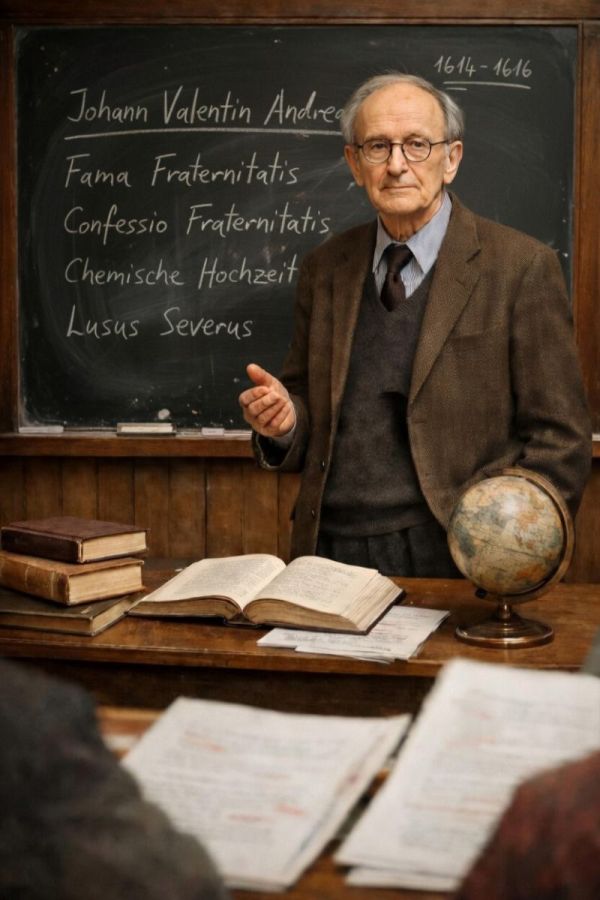
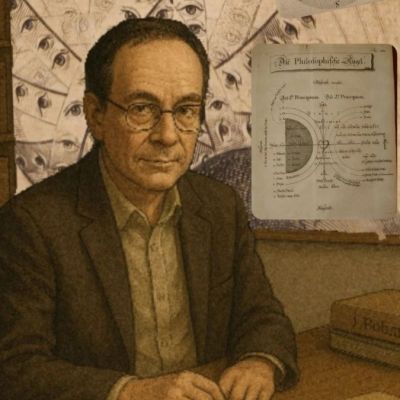
A symbolic portrait of Roland Edighoffer,
(in the absence of a real photograph).
*
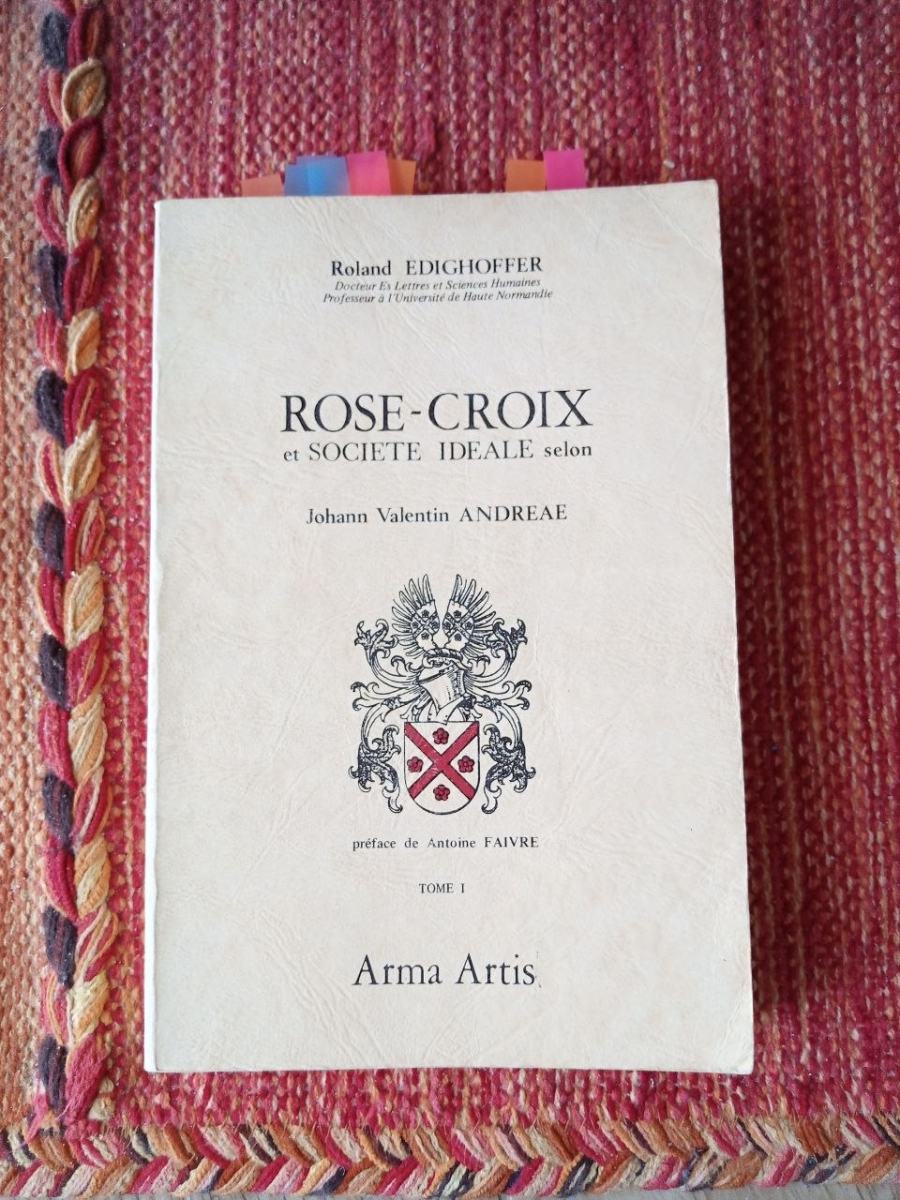
Today’s sharing from the Blue House of Via-HYGEIA is the first sampler installment of a planned series dedicated to honoring the memory of Professor Roland Edighoffer (1923–2017). We begin with an excerpt from his magnum opus, the celebrated Rose-Croix et Société idéale, selon Johann Valentin Andreae, published in 1982 by Arma Artis in Paris. Our excerpt is drawn from Part II, Chapter 2, covering pages 207 to 225.
To help situate this passage within the broader landscape of modern esotericism scholarship, we begin with a brief contextual introduction. It outlines the emergence of the French academic school dedicated to the study of Western esotericism, and the place of Professor Edighoffer alongside such luminaries as Henry Corbin, Antoine Faivre, Pierre Deghaye, and Bernard Gorceix.
Following this introduction, we present an original English translation of the second chapter’s second part, ‘The Reception of the Rosicrucian Writings: A Diachronic Study Following the Evolution of the Debate through the Centuries‘. Through this excerpt, readers will discover how Professor Edighoffer navigates the centuries-old controversy surrounding Johann Valentin Andreae’s role in the Rosicrucian manifestos, and why his balanced, historically grounded approach remains essential reading today.
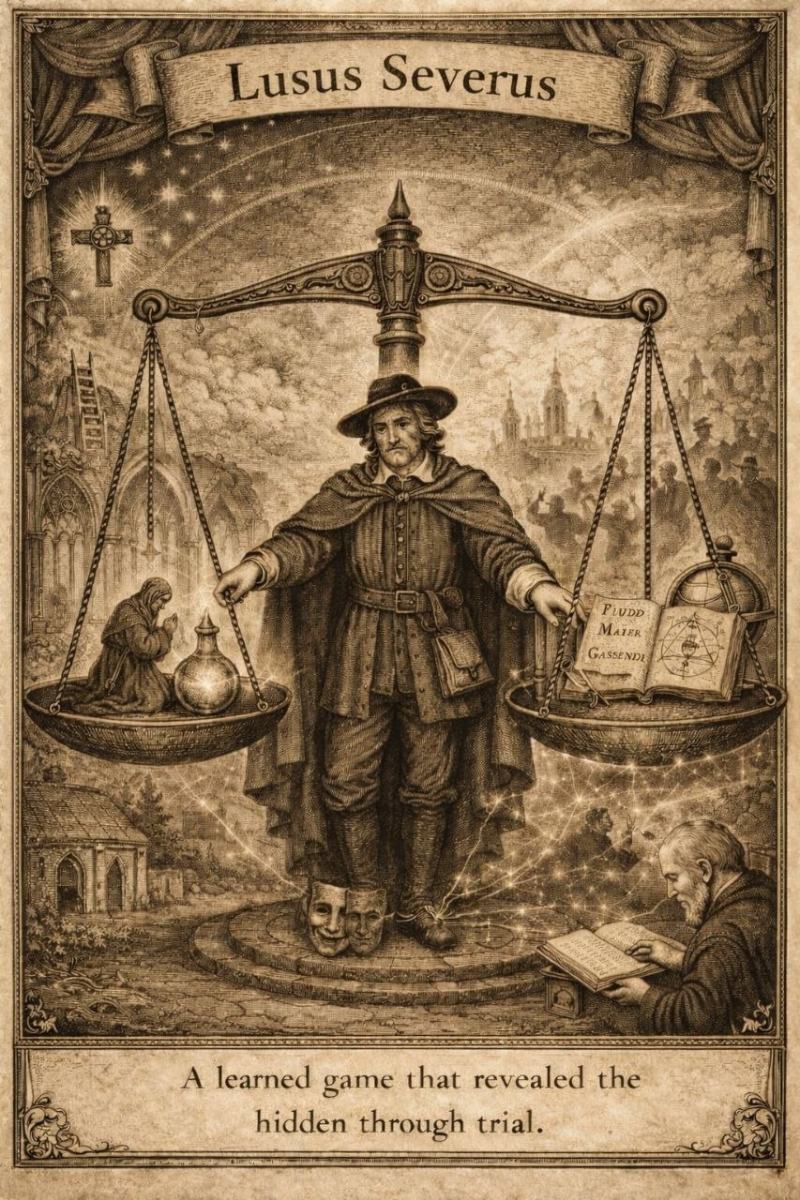
Coming soon: A Little Roland Edighoffer Sampler – Part 2: ‘Johann Valentin Andreae’s Lasting Influence’.
**
A Contextual Introduction:

The ‘French School’
Building a Discipline
Emerging in the mid-20th century, this informal yet highly influential group transformed the study of Western esotericism from a niche interest into a rigorous academic field. Centered at the Sorbonne’s École Pratique des Hautes Études (EPHE), its key figures shared a commitment to historical, philological, and comparative methods, studying Hermeticism, Alchemy, Kabbalah, Christian Theosophy, and related currents with scholarly rigor. Their work collectively established a framework that continues to guide research today.
The Epicenter of the EPHE
At the heart of this movement lay a distinctive group of scholars who formed the epicenter of the EPHE. Henry Corbin (1903–1978) specialized in Islamic mysticism, particularly Sufism and Shi’ite gnosis. His defining contribution was the introduction of concepts like the mundus imaginalis, which successfully bridged Western and Islamic esoteric traditions.
Antoine Faivre (1934–2021) dedicated his career to the theory and history of Western esotericism as a whole. He held the first academic chair in the discipline, created its core typology, and was instrumental in founding its key journals. Most notably, in 1983, he co-founded Aries (an acronym for Association pour la Recherche et l’Information sur l’Ésotérisme). Published by Les Éditions de la Table d’Émeraude, each issue of this internationally renowned journal was considered a significant event, recognized globally for its uncompromising academic rigor. In 2001, Aries was relaunched with professor Wouter Hanegraaff, as its first editor until 2010, and from 2010-Present, it is edited by professor Peter J. Forshaw. A Little Sampler series will be dedicated to professor Faivre soon.
Pierre Deghaye (1924–2005) focused on German theosophy, specifically the works of Boehme and Zinzendorf, mapping the intricate connections between esoteric doctrine and literary imagination. Like Faivre, he was a co-founder of Aries in 1983, helping to establish the journal as the field’s premier publication.
Roland Edighoffer (1923–2017), who specialized in Rosicrucianism, Paracelsus, and German mysticism, is especially credited for the publication of major studies on the Rosicrucian movement. His bibliography includes the seminal two-volume work Rose-Croix et société idéale selon Johann Valentin Andreae (Vol. 1, 1981; Vol. 2, 1987, Arma Artis), the accessible yet rigorous Les Rose-Croix (1982, Presses universitaires de France, coll. ‘Que sais-je ?’), and his later synthesis, Les Rose-croix et la crise de la Conscience Européenne Au XVIIe Siècle (1998, Editions Dervy). Edighoffer, too, was a co-founder of Aries in 1983. As this overview illustrates, he was distinctly a scholar of the German-speaking esoteric tradition, whose work laid the foundation for future studies in the field.
Working alongside this central group was Bernard Gorceix (1937–1984), a specialist in Rosicrucianism, Gichtel, Boehme, and Christian mysticism. Gorceix was especially praised for his seminal translation and commentary of the three great Rosicrucian writings: the Fama Fraternitatis (1614), the Confessio Fraternitatis (1615), and the Chymical Wedding of Christian Rosenkreutz (1616), making these foundational texts accessible to modern scholarship.
The Significance
of Edighoffer’s Scholarship
His scholarship remains vital for several reasons. First, it offers a balanced, definitive study. In his magnum opus, Rose-Croix et société idéale selon Johann Valentin Andreae, Edighoffer masterfully navigated the centuries-old debate over Andreae’s role in the Rosicrucian manifestos. His work is praised as ‘the most accomplished and best-conceived fruit of what was a long and patient search‘, providing the first comprehensive, academically rigorous analysis.
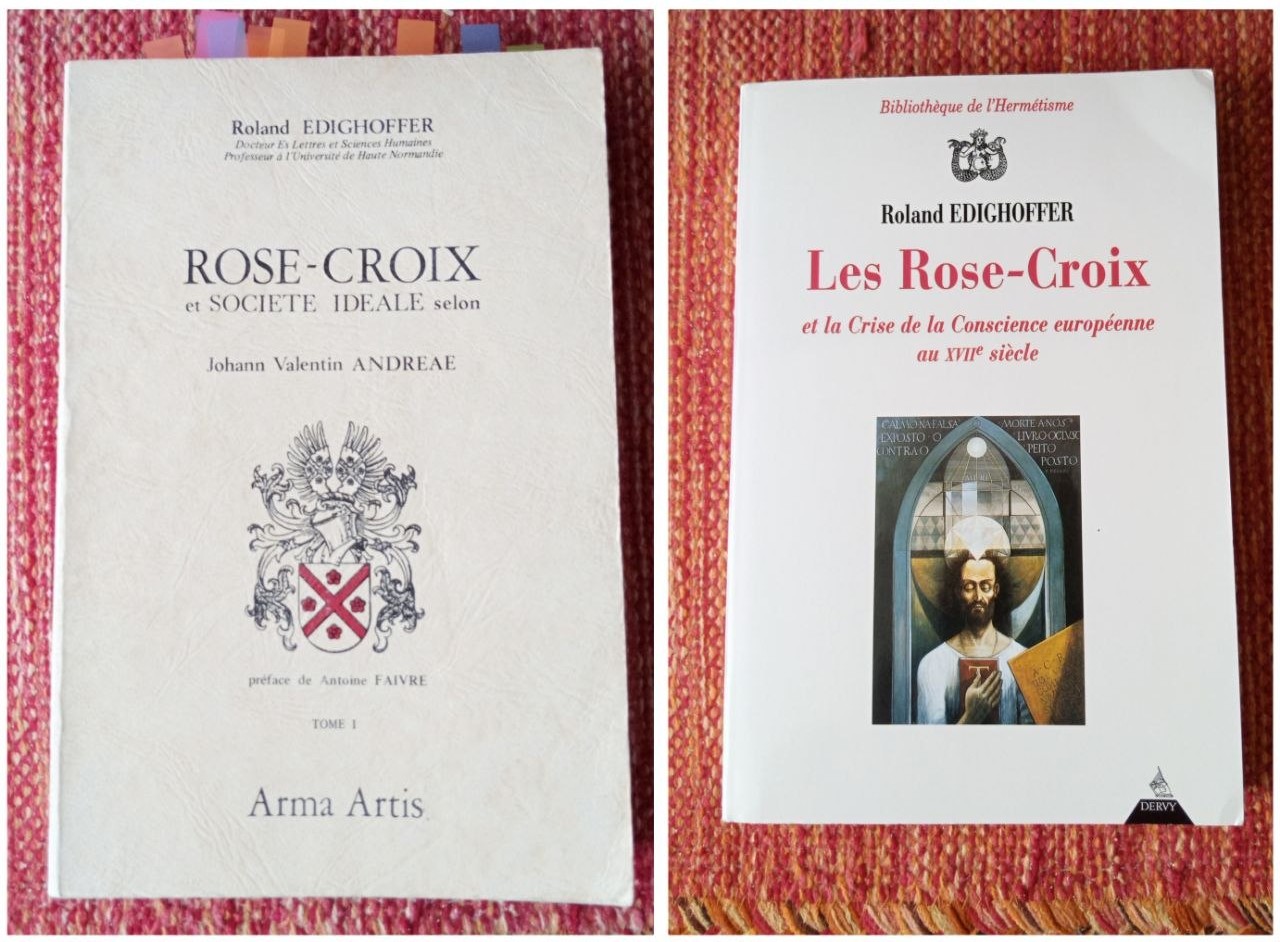
Second, his work excels at mapping the intellectual crisis. In titles such as Les Rose-Croix et la crise de la conscience européenne au XVIIe siècle, he argues that Rosicrucianism was not merely an occult fad, but a meaningful response to the deep intellectual and religious crisis of 17th-century Europe.
Third, he was pivotal in creating a foundation for future research. As co-founder of the journal Aries (the field’s premier academic publication) and as editor of Andreae’s collected writings, his efforts to build institutional frameworks have ensured the ongoing study of Western esotericism.
Why It Matters Today
Edighoffer’s work continues to be indispensable for two main reasons:
First, by establishing a rigorous, historical methodology, he set a standard that still separates serious academic study from the many popular, speculative, or sensationalist works on esotericism.
Second, his in-depth focus on a single, enigmatic author and movement provides a concrete model for integrating intellectual history, religious studies, and literary analysis—a valuable approach for anyone studying the intersection of ideas and culture in any era.
*
And now the text:
CHAPTER TWO
‘HISTORY AND MYTHOLOGY’
1 – SOLUTIONS TO AN ENIGMA
Any appellate procedure must first mention previously pronounced judgments. Peuckert, as a conscientious clerk, had established in 1928 a survey of authors attributing authorship of the Fama and the Confessio to Andreae, as well as those who did not recognize it as his; from his chronological table it appears that between 1700 and the beginning of the 20th century, the former greatly outnumbered the latter, with twenty names against eight.
Fourteen years later, Schick takes up and completes the statistics; he discovers twenty-three studies attributing full responsibility for these writings to Andreae; thirteen trust his denials, while eight others do not take sides. Since 1942, the trend has further intensified; a census of studies published up to 1978 shows that twelve authors consider the Fama and the Confessio as writings by Andreae, three others are hesitant, six see them as a collective work in which he participated, and only two affirm that he is not the author.
But statistics are often distorting mirrors: in this case, they do not aim for exhaustiveness and have no other ambition than to express a trend. Moreover, the figures given do not always take into account an important category of studies that consider the Rosicrucian manifestos as the late expression of a long occult tradition.
Some believe they have rediscovered the name, signs, or trace of the Fraternity from a period prior to Andreae. Such was the case, for example, of Karl Kiesewetter who, on the faith of a manuscript in his possession, mentioned the existence of an Imperator of the Fraternitas Rosae Crucis in 1574. Unfortunately, the text is apocryphal: according to Kiesewetter’s own indications, his manuscripts were only copies from the end of the 18th century.
Stanislas de Guaita believed that:
‘the Rosy Cross, whose constitutive emblems take us back to the poems of Dante and Guillaume de Lorris, functioned for a very long time in the shadows before manifesting itself through works in broad daylight‘.
In the Divine Comedy, the symbolism of the rose could not fail to attract the attention of commentators.
Robert Ambelain draws on Guaita in his chronology of illuminism: he in turn notes the presence of the Rose and the Cross in the Paracelsian Prognostication of 1536 and dates the foundation of the ‘Brothers of the Golden Rosy Cross’ to 1570.
In a study on Hieronymus Bosch, published in 1957, Clément A. Wertheim Aymès notes that the painter was a member of the Confraternity of Our Lady, and affirms that a small group of Rosicrucians existed within this society. He recalls that the artist’s house was called ‘Rosenkrans‘ and observes that a work by the master, damaged and restored, represents, near the head of the Virgin Mary, a tower in the middle of a crown of roses; according to him, the painting originally bore a CH and a + which were subsequently erased.
Alongside these archaeologists of the Rose and the Cross, one encounters a good number of esoteric sleuths who consider Rosicrucian manifestations as the resurgence of an underlying current of thought whose traces can be discovered in the Renaissance. As early as 1615, an anonymous work appeared seeking to demonstrate that the ideas and promises of the Rosicrucian manifestos, the Magnalia Dei of which they speak, were already known in 1597, the very year when Julius Sperber had circulated his De magia and various other manuscripts of the same kind. The Echo of the Fraternity highly illuminated by God of the illustrious Order of the Rosy Cross sought to prove that these revelations, made in their time to particularly pious persons, had simply been ‘plundered’ afterwards. The same Sperber refers to the Swabian Aegidius Gutmann, whose Revelation of the Divine Majesty, published in 1619, would have been written as early as 1575; this large volume gathers a part of the themes that would reappear in the Fama and the Confessio.
Michael Maier, who was not one to shy away from a hypothesis , believed, for his part, that the origin of the Fraternity should be sought in certain conventicles that gathered at the end of the 16th century and whose thought was inspired by Cornelius Agrippa. The Frenchman Gabriel Naudé, a critic of Maier and a scorner of the Fraternity, specifies in 1623, in his Instruction to France on the truth of the history of the brothers of the Rosy Cross, from which sources they had drunk:
John Dee, Monas hieroglyphica,
Trithemius, Steganographia,
Francesco Giorgi, Harmonia mundi,
François de Candale, Pimandre,
Thiart his Musique,
Bruno, Upon the shadows of ideas,
Ramon Lull his Dialectic,
Paracelsus his Commentary upon the Apocalypse.
Modern criticism has also sought to discover the occult roots of the Rosicrucian Fraternity well before Andreae. In his monumental work on Templar and occultist Freemasonry, René Le Forestier attempts to discern it in the ‘fugitive silhouette‘ of hermetic societies of the 16th century, guarding against both skepticism and credulity.
In two interesting studies, the Englishwoman Frances Yates sought to demonstrate the filiation between Giordano Bruno, John Dee, and the German Rosicrucian movement . The evident influence of Paracelsus, vigorously demonstrated by Peuckert, led Serge Hutin to ask himself this rhetorical question:
‘was Paracelsus himself not a member of a Rosicrucian secret society? For me, the affirmative answer leaves no doubt‘.
And the same author evokes the hypothesis of an even older secret tradition of the Rosy Cross.
Certain contemporaries of Andreae, like the mysterious Irenaeus Agnostus, who called himself ‘unworthy secretary of the (…) fraternity in Germany‘, traced the order back to Adam. Michael Maier, who was physician to Emperor Rudolf II and also practiced his art with Maurice of Hesse-Kassel , saw ancestors for it in India, Egypt, Persia, among the Pythagoreans of Magna Graecia, and in Arabia; his references to the Brahmans and the Gymnosophists were certain satirical allusions by Andreae.
This distant filiation has been accepted by 20th-century authors. Max Heindel, an American of Danish origin who founded ‘The Rosicrucian Fellowship‘ in 1911 in Oceanside, California, recognizes the Order’s distant origins, affirms that as early as the 14th century it recruited lay members, and that throughout the Middle Ages it exercised a salutary influence on the Sages and ‘sincere Alchemists‘.
Shortly afterwards, in 1915, another American, Spencer Lewis, created a spiritualist movement whose acronym A.M.O.R.C. evokes a most ancient mystical tradition, since he attributes the founding of the Rosicrucians to the Pharaoh Thutmose III.
The anthroposophist Rudolf Steiner had followed, when he believed he could fix the 4th century, at the time of Emperor Constantine, as the favorable conditions for the blossoming of the Rosicrucian movement. This current, long underground, would only have appeared on the surface around the year 1050.
Walter Weber, a disciple of Rudolf Steiner, postulates, for his part, a fundamental opposition between ‘mysticism‘ and ‘chemistry‘ which he discovers in the etymology of these two words. Starting from Saint John the Evangelist, he discerns an ‘anti-mystical‘ lineage whose most eminent representatives would have been John Scotus Eriugena, Joachim of Fiore, Albert the Great, and the different incarnations of Christian Rosenkreuz; an ‘occult’ Rosicrucianism would indeed be perceptible among the most important personalities of the Renaissance and the Reformation.
Under these conditions, Andreae no longer appears as the true author of the Rosicrucian manifestos, but as a kind of inspired man, a prophet, charged almost against his will with revealing to the world a long-kept secret message.
As for Sédir, he does not hesitate, like Irenaeus Agnostus, to go back to the limits of possibility when he affirms that the ‘essential Rosy Cross‘ has existed since there have been men on earth.
In this resolutely occultist perspective, Andreae’s position becomes delicate; when he does not appear, as in the anthroposophist W. Weber, as a kind of medium, he is, on the part of some, the object of severe judgment.
Ferdinand Katsch, for example, considers that the Fama is not by his pen and attributes great importance to it, while the Chymical Wedding, whose authorship cannot be doubted, is in his eyes only a satire of the Rosicrucians. Under these circumstances, Andreae appears to him as a thoroughgoing hypocrite whose work could only harm the Fraternity.
François Wittemans adopts a similar attitude thirty years later and reproaches Andreae for having voluntarily scuttled the future Freemasonry, for having dealt a ‘mortal blow to the spiritual child he had most helped to bring into the world‘.
At the other end of the spiritual horizon, it is confessional piety that denies Andreae any real participation in the Fraternity. The biographies of orthodox inspiration, written by pastors from Württemberg, are careful to conceal this episode in the Superintendent’s life. Written in a laudatory and almost hagiographic style, they content themselves with highlighting his industrious youth, his charitable activity in Vaihingen and Calw, his courage during the Thirty Years’ War, and the reforms he introduced into the teaching and ecclesiastical organization of his country. The booklet by Otto Schuster, published in 1950 with Andreae’s motto as an epigraph, does not deviate from this rule.
*
2 – THE RECEPTION OF THE ROSICRUCIAN WRITINGS –
A DIACHRONIC STUDY
The diversity of judgments regarding the Rosicrucian blossoming from 1614 onwards and the degree of Andreae’s participation in this affair is essentially motivated by extrinsic reasons and not by an internal analysis of the writings themselves. Historical, geographical, and ideological components have played an important role in the way the message contained in the main Rosicrucian manifestos has been received over the ages.
It is therefore not superfluous to describe the different stages of criticism and to situate them in their civilizational context. The diachronic analysis of the ‘reception‘ of the Rosicrucian writings allows us in particular to note that interest in these ideas manifests itself especially at the turn of the centuries.
a) The end of the 17th century
It was in 1675 that Jakob Spener’s Pia Desideria appeared (1635-1705), and the first ‘Collegia Pietatis‘ gathered in Frankfurt as early as 1670. The notion of lived faith, so dear to Andreae, then enjoyed extraordinary fortune and the development of Pietism testifies to the inability of traditional structures to satisfy the religious needs of the time.
Hence it is not surprising that tensions and conflicts arose between Lutheran orthodoxy and the groups where this form of spirituality was cultivated. Count von Zinzendorf, organizer of the Herrnhut community, was twice banished from Saxony. The theology professor August Hermann Francke (1662-1727), one of the most remarkable Pietists and pedagogues of his time, was forced to leave the University of Leipzig and go to settle in Halle.
For its part, the Aufklärung contributed to the discredit of orthodoxies and favored a certain indifferentism towards them, insofar as it preached tolerance. The jurist Christian Thomasius (1655-1728) of Leipzig had moreover provoked their wrath by breaking with neo-scholasticism and emphasizing the importance of natural law. In 1694, he prefaced an edition of the De eruditione triplici and drew on Weigel, Böhme, and Fludd alike. Such an eclectic attitude could only favor the renewal of Rosicrucian ideas, supported by both Pietists and Aufklärer. But this enthusiasm soon gave rise to a new wave of mistrust among certain scrupulous Protestants who did not fail to see in it a subterranean action of the Jesuits.
It was in this tense climate that the famous Impartial History of Churches and Heretics appeared in 1699-1700, an ambitious and voluminous work in which the author undertook to rehabilitate all the ‘damned of the Churches‘, the marginalized, the illuminati, and to carry out a vast reversal of values. In the pages he devotes to the Rosicrucian writings, Gottfried Arnold addresses the problem of their authorship. He rejects the hypotheses attributing the origin of the movement to Tauler, to Luther, to Johann Arndt; on the other hand, he affirms that Andreae was the principal inventor of this Fraternity and that he was the last to leave it.
According to him, ‘there is no doubt that Andreae published the Fama and the Confessio, in agreement with a few close friends‘. Arnold indeed provides, in another chapter of his voluminous work, clarifications about this collaboration. He refers to a letter found among the papers of the theosopher Christoph Hirsch; according to its author, the theologian Johann Arndt, Andreae had confided to him ‘sub rosa‘ that he had, ‘with thirty other persons, published the Fama fraternitatis in Württemberg in order to learn under cover what would be said in Europe, and what secret lovers of true wisdom would exist here and there and would make themselves known on this occasion‘.
A little further on, Arnold, drawing the portrait of Christoph Hirsch, again echoes this revelation. He also mentions another letter, addressed to Comenius, in which Johann Valentin himself acknowledged ‘that about thirty intelligent men had envisaged a Reformation of this kind‘ and had wanted to launch a trial balloon by publishing the Fama, and he emphasizes that most of the authors of Rosicrucian writings were distinguished Lutheran pedagogues.
In volume III, where he refutes the criticisms made of his Histories, Arnold notes that the authenticity of these missives has been contested, notably by Andreas David Carolus. He also responds to the attacks of Ernst Salomon Cyprian, according to whom the Rosicrucian manifestos cannot be attributed to Johann Valentin Andreae.
It must be believed, however, that these clarifications had not convinced all of Arnold’s readers. In 1710, Ludwig Melchior Fischlin contested his assertions concerning the Rosicrucians and Christoph Stephan Kazaverus in turn developed, in 1715, an argument against Gottfried Arnold to show that Andreae was not the author of the manifestos.
b) The end of the 18th century
A century later, the quarrel flared up again. In 1777, a paramasonic order appeared bearing the name ‘Golden Rosy Cross of the Ancient System‘, whose intellectual leader was none other than Friedrich Christoph Oetinger, the ‘Mage of the South‘, very keen on alchemy, and of which certain members succeeded in gaining the confidence of the future Frederick William II of Prussia. The Instructions of these “Gold- und Rosenkreuzer” show that they had read, among others, Khunrath’s Amphitheatrum Sapientiae Aeternae, which seems to have influenced the author of the Chymical Wedding.
In 1782, a ‘Life of Johann Valentin Andreae‘ appeared in the journal Wirtenbergisches Repertorium der Litteratur; the publication is anonymous, but the author, Johann Wilhelm Petersen, is presumably the same who, the same year and in the same periodical, presented New explanations relating to the history of the Rosicrucians and gold-makers, under the pseudonym Wilhelmus ab Indagine. He seems to have been the first to discover that the General Reformation, published with the Fama Fraternitatis in 1614, was the German version of one of Boccalini’s Ragguagli di Parnaso.
In 1799, Professor David Christoph Seybold provided, for the collection Selbstbiographien berühmter Männer, a translation of the Latin manuscript of the Vita ab ipso conscripta. In 1793, Markus Philipp Burk published a Complete Catalogue of all the printed Latin and German writings of (…). Dr. Joh. Valentin Andreae, to which he made additions in 1798.
At the end of the 18th century, interest in the works of Andreae was therefore very lively. We know with what admiring curiosity that great discoverer Johann Gottfried Herder read the works of Johann Valentin Andreae. He had gained access to them thanks to Lessing, who, being then librarian at Wolfenbüttel, had also taken an interest in the writings of the Swabian theologian and had attempted to pierce the Rosicrucian mystery. Immediately, Herder became enthusiastic about this ‘man of uncommon mettle‘.
In May 1786, he completed the dithyramb that was to serve as a preface to the German translation of Andreae’s Latin poems, carried out by K.G. Sontag. In 1793, he devoted nearly two hundred pages of his volume of Zerstreute Blätter to the works of the Swabian theologian. This ‘anthology‘, in the fullest sense, contains translations of apologues from Christian Mythology, dialogues from Menippus, as well as the Pastoral Theology in verse. Herder analyzes Andreae’s writings with great penetration and sees in them ‘not vast empty halls, but charming apartments‘; he admires the ‘salt‘, the truth, the finesse, the typically German virtues of the literary productions of ‘this exceptional beautiful soul‘.
The Rosicrucian manifestos were also republished around the same time. The General Reformation and the Fama Fraternitatis Rosae Crucis appeared in 1781 with Regensburg as a fictitious place of publication; in reality they were published in Berlin by the bookseller and publicist Friedrich Nicolai, who provided, two years later, a second edition of the Fama in the first part of the Archives for Freemasons and Rosicrucians. He had also published in 1781 the Chymical Wedding of Christian Rosenkreuz.
Echoing the sentiments of the previous century, certain figures—this time recruited from the camp of rationalist Masons—suspected the Rosicrucian revival of being the work of the Jesuits, whose Company had been dissolved in 1773.An anonymous work published in Berlin in 1782, The Rosy Cross Laid Bare (Le Rose-Croix à nu), ‘lumped together Rosicrucians and Templars as puppets whose strings were pulled by the Jesuits‘. Shaken, Friedrich Nicolai wanted to see the situation for himself. In 1781, he traveled to southern Germany and Austria, ‘where the Rosicrucians were considered very active‘.
At the same time, he carefully studied the first Rosicrucian manifestos which he had just edited and recorded the results of his investigation in an Essay on the accusations brought against the Order of the Templars, and on its mystery, with an appendix devoted to the origins of Freemasonry, published in 1782. He believed that Andreae, in creating the poetic fiction of the Rosicrucian society, had moral and political intentions. But this fiction was taken literally by many people and transformed according to each person’s whims, which led to extravagant results.
Nicolai also supposed that Johann Valentin Andreae originally hoped to take his Rosicrucian experiment further and seriously envisaged ‘gathering into a society all those who venerated the beautiful and the good and thus improving morals, theology, and science‘. But a greater knowledge of the world soon frightened and discouraged Andreae; he was quickly dissuaded from his project by the persecutions that await all those whose laudable desire is to reform their times and unmask their flaws. To this were added the abuses that ‘enthusiasts‘ of all kinds made of his idea; so he decided, for the sake of peace, to withdraw; in various places in his writings, he intimated that the supposed Rosicrucian society did not exist, or, at least, that he took no part in it.
Apart from the Confessio, Nicolai unhesitatingly attributed to Andreae all the first manifestos, including the General Reformation, whose images he compared with those of the Appap proditus. Even if the author did not succeed in realizing his designs, the idea he had conceived nonetheless exerted a considerable influence on his century.
When Friedrich Nicolai’s Essay on the Templars appeared, Herder took up his pen to refute its arguments. He affirmed that the Rosicrucian movement had nothing in common with the Freemasons and believed that Johann Valentin Andreae’s intention to found a society was absolutely not proven. Confronted with a proliferation of sects — Paracelsian, Weigelian, alchemical, astrological, oneiric and others — he would have attempted both to mock them and to turn them away from their reveries by writing his Rosicrucian pamphlets, the Chymical Wedding, but also the Fama Fraternitatis, the Universal and General Reformation of the Whole World, and the Confessio Fraternitatis. Although his interpretation was fundamentally different from Nicolai’s, Herder thus went even further than the Berlin publicist, since he had no doubt that Andreae was indeed the author of all the first Rosicrucian manifestos.
Such was also, at least initially, the opinion of the Swabian theologian Philipp Markus Burk, whose Andreaean bibliography, which remained the most complete for a long time, moreover mentioned the Chymical Wedding with a truncated title and an incorrect publication date (1617). Burk corresponded with Friedrich Nicolai on the problem of Andreae’s relations with the Rosicrucians. In a letter of September 12, 1794, he deemed it implausible, given Johann Valentin’s character, that he had participated directly or indirectly in this Fraternity. Nicolai replied to him on October 14 and developed the following argument: Johann Valentin Andreae was indeed attracted, in his youth, to secret societies; in his inexperience, he even went so far as not to underestimate the Jesuits. But he understood the danger when they seized upon the Rosicrucian idea and turned it to their advantage. To avoid compromising situations and persecution, he was therefore obliged to disguise certain youthful activities.
Burk seems to have been convinced by Nicolai’s argument. In an article written for the Nürnberger litterarische Blätter of 1802, he reproduces the quotation from Psalm 17 which concludes the Fama: Sub Umbra Alarum Tuarum Jehova and believes he discovers therein the onomastic symbol of Johann Valentin Andreae: Johannes Valentinus Andreae Stipendarius Tubingensis. Happy with this first discovery, Burk continues his research; in a letter to Nicolai of September 18, 1808, he cites terms taken from an Epistola ad D.D. Fratres de Rosea Cruce which all contain the three letters I, V, A:
SANGVIS – TINTVRA – QVINTA ESSENTIA IEHOVA – ELIAS ARTIUM
Nothing would prevent, he adds, ‘detecting in this a repeated allusion to our Andreae without being accused of juggling with mere chimeras‘.
At the same time as Burk, Christoph Gottlieb von Murr believed that Johann Valentin Andreae had taken the whole Rosicrucian affair very seriously, although he never envisaged the foundation of an order.
At the beginning of the nineteenth century, Nicolai was again led to cross swords over the Rosicrucian enigma. Johann Gottlieb Buhle had published in 1804 a study on the origins of the movement and of Masonic orders, in which he noted that the occult tendencies manifested in the Fama and the Confessio were opposed to Andreae’s concerns; if he nonetheless attributed authorship of these works to the Swabian theologian, it was because, according to him, the author had found there a means, a pedagogical device for spreading the ideas he held dear; moreover, the Fama and Confessio would have been printed without Andreae’s consent. Nicolai sent him a stinging reply two years later.
c) The 19th century
In his study on Andreae, published in 1819, the Berlin preacher Wilhelm Hoszbach expressed, for his part, the conviction that the four Rosicrucian manifestos were due to Johann Valentin’s pen. He cites passages from the Turris Babel, from the Alethea exul, and reaches the conclusion that if one brings together these declarations with the undeniable external and internal kinship of the Chymical Wedding with the Fama, one is thereby obliged to conclude with the greatest likelihood that he is also the author of the latter.
For the Confessio, he refers to Besold, who speaks, concerning the Rosicrucian ‘phantasm‘, of lusus ingenii nimium lascivientis, and believes that the ‘playful spirit‘ who was the author of the two writings could be none other than Johann Valentin Andreae.
Finally, Hoszbach, who knew that the General Reformation was nothing other than a German version of Boccalini’s Ragguagli di Parnaso, also attributes the translation to Andreae. Concluding his demonstration, he admires the extraordinary superiority of a man who was capable of inventing a jest of such magnitude with the sole aim of amending his contemporaries. He believes that there was in these writings a ‘curative virtue‘ from which those who could discern their serious foundation profited, but the blindness of the age most often rendered it ineffective, and he whom Hoszbach calls the ‘hidden physician‘ was forced to reappear in broad daylight to revive energies.
Coming after forty years of Rosicrucian vogue, Hoszbach’s study, accompanied by German translations taken from Menippus, Veri Christianismi solidaque Philosophiae Libertas, Mythologia christiana, and some poems extracted from Geistliche Kurtzweil, shares with Herder’s publications the merit of situating the Rosicrucian episode in relation to the considerable work of religious, moral, social, and political restoration of truth, to which Andreae devoted his entire existence.
The original Latin text of the Vita ab ipso conscripta, collated by Friedrich Heinrich Rheinwald and published in Berlin in 1849, provides another important source for Andreaean criticism. The following year saw the publication of a study by Gottschalk Eduard Guhrauer, in which the author, referring to Leibniz, echoes a legend according to which Joachim Jungius, philosopher and naturalist from Lübeck, who became a professor at Rostock, then director of the Johanneum in Hamburg, would have been the mysterious promoter of the Fama Fraternitatis. It is true that, two years later, he rallied to Wilhelm Hoszbach’s thesis and considered Andreae the author of this writing.
It was around this time that Abbé Alphonse-Louis Constant, alias Eliphas Lévi, published his Dogme et Rituel de Haute Magie, founded a Rosicrucian Society, and obtained his admission into the Societas Rosicruciana in Anglia, which claimed to be heir to the original Rosy Cross.
The end of the century witnessed a renewed interest in esotericism; in Germany, Franz Hartmann created an Esoteric Rosicrucian Order in 1888; in France, Stanislas de Guaita organized, with Joséphin Péladan, the Kabbalistic Order of the Rosy Cross the following year, and Papus founded the journal l’Initiation, which would appear until 1911.
It was also the period when Arthur Edward Waite published his first study on Rosicrucianism; he supposed that Andreae had maintained relations with the occult group of the Militia Crucifera Evangelica, of which Simon Studion was the soul, and that he would have created the Fraternity of the Rosy Cross as a continuation of this movement after the death of its founder. Waite later abandoned this hypothesis.
In 1899, a controversy developed in the monthly Cahiers of the Comenius Society concerning the authorship of the first Rosicrucian writings. Jan Kvačala published a solid and well-documented study in which he began by reviewing the diverse opinions of a large number of decipherers of the Rosicrucian enigma and summarized their positions for or against; then he presented his own demonstration, which he developed in four points:
1- The material evidence of Johann Valentin Andreae’s participation does not withstand examination; 2- Andreae denies this participation; 3- There are not sufficient subjective and objective reasons to conclude that Andreae did not tell the truth; 4- On the other hand, the author’s efforts to constitute secret associations suggest that the Rosicrucian writings were not a joke and aimed at the real constitution of a new society.
According to Wilhelm Begemann, who reacted the same year with an article published in the Cahiers of the Comenius Society, Kvačala’s method of investigation could not succeed; the latter moreover admits he is not in a position to assert that the Fama is not by someone other than Johann Valentin Andreae. Begemann, for his part, is convinced of the dual meaning of the Rosy Cross: it was at once a ludibrium intended to deceive the curiosi and a serious exhortation to turn toward the Lord. Contrary to Kvačala, he expresses the near certainty that Johann Valentin is at the origin of the whole affair. The same opinion appears in Karl Kiesewetter, whose fanciful assertions have been summarized by Paul Arnold.
d) The 20th century
More serious is the study by Rudolph Pust, also published in the Cahiers of the Comenius Society. He believes that ‘despite all the attempts made to deny him authorship, the Fama must likely be attributed to Andreae‘; he emphasizes, among other things, that he ‘knows of no place where Andreae expressly contested being its author‘.
On the eve of the First World War, interest again turned to the Rosicrucian tradition: in Paris, under the auspices of the Chevaliers Bienfaisants de la Cité Sainte, a Centre des Amis had been founded which wanted to constitute a Rosicrucian Chapter in 1913; the following year saw the publication of René Le Forestier’s important thesis on Les Illuminés de Bavière et la Franc-Maçonnerie allemande.
At the same time, Ferdinand Maack republished in Berlin the Four principal writings of the ancient Rosicrucians in the first volume of the collection ‘Occult Sciences‘. In a copious and interesting preface where he emphasizes the dual origin, corporative and Rosicrucian, of Freemasonry, he presents a fairly complete chronology of editions of the Chymical Wedding, the Fama, and the Confessio up to the end of the 19th century and expresses the conviction that these three works were indeed written by Andreae.
In the aftermath of the First World War, Arthur Edward Waite again came forward and presented the fruit of long research on Rosicrucianism in a work he published in 1924. This serious, precise, abundantly documented study constitutes a valuable reference work; but it is not free from errors. The author corrects and moderates his first interpretation, while developing the comparison between Studion’s Naometria and the Confessio Fraternitatis; he believes he has rediscovered the famous thirty-seven reasons for revealing the Fraternity, which are announced in the Fama.
Taking up an argument already developed in The Real History of the Rosicrucians , he demonstrates that the joint publication of various texts does not prove they are by the same author. Very far from any Lutheran interpretation, he considers the Rosicrucian event from an occultist perspective and thus inscribes himself within a critical tradition that Frances Yates would perpetuate after the Second World War.
Since interest in the Rosicrucians is subject to cyclical phenomena, it is not surprising that at the very time when Waite was publishing the results of more than thirty years of reflection on these problems, two other researchers of quality also came forward. In 1926, an excellent study by Richard Kienast appeared on ‘Johann Valentin Andreae and the four authentic Rosicrucian writings‘. This analysis is only the fragmentary result of a work that was to be much more extensive; the long interruption due to the war of 1914-1918 did not allow Kienast to complete the vast inquiry he had undertaken, but his partial conclusions are not without interest and still serve as a reference.
The author undertook a minute analysis of the language and style of the four manifestos and reached the following results:
1- these works were all written in Swabian dialect; 2- the language and style of the Chymical Wedding are clearly distinct from those of the other three manifestos; 3- although the General Reformation and the Confessio are of very different characters, they show an evident stylistic kinship.
On the basis of this formal study, and thanks to various cross-checks, the author attempts to reconstruct the puzzle of the Rosicrucian ludibrium as follows:
the young student Johann Valentin Andreae, driven by an ardent desire for religious and moral renewal, conceived with a group of friends the fable of Christian Rosenkreuz, under conditions similar to the genesis of Turbo, as described in the Mora philologica excusata, under the impetus of Christoph Besold.
He composed the Chymical Wedding and largely conceived the Fama, which was probably written by another member of the circle. Shortly after 1611, the group discovered, thanks to Tobias Adami, the ideas of the Calabrian Dominican Tommaso Campanella, and then decided to publish the Fama; Besold translated Boccalini’s Generale Riforma dell’universo ‘to thus accentuate the esoteric tendency of the Fama‘.
But the emotion aroused by the publication of this text, to which political ulterior motives were attributed, led Besold to replace it, in subsequent editions, with the German version of the Confessio which he had written in Latin towards the end of 1614.
It was also he who, in 1616, encouraged Andreae to have his Chymical Wedding published in Strasbourg, with the dual aim of further ridiculing the alchemy maniacs and enlightening serious readers as to the meaning of the whole mystification.
Kienast thus attributes a preponderant role to Besold in this affair, of which Andreae would have been only the initiator; but this participation, this compromising involvement, discovered no doubt as a result of some indiscretion, would have caused the theologian serious trouble and heavily mortgaged his future. This would explain both his acknowledgment of authorship for the Chymical Wedding and his rigorous discretion regarding the origin of the other writings.
Kienast’s interesting analysis is contemporary with a study on the Fama, that of Will-Erich Peuckert on the Rosicrucians. The author reviews there some of the numerous attempts made since the 18th century to pierce the mystery, then interrupts his enumeration to demonstrate that Andreae is indeed the author of the three principal writings of the Fraternity. There is no doubt, according to him, that Christian Rosenkreuz appears there as the very image of the pansopher, that is to say, of one who discovers God in His creation. And how could an author mock a hero to whom he attributes his own family coat of arms?
Therefore the Chymical Wedding is not a simple amusement; therefore Andreae believes in the pansophic gospel revealed by the manifestos, in true alchemy, in astrology; therefore he later disguises the truth by denying in bulk that he was ever interested in it; he ‘forgot‘ in order to clear himself of all suspicion. And, ‘if the Fama, Confessio, and Chymical Wedding are arrows from the same quiver, if they are related, similar in their intentions, describing the same hero (who is at the same time the writer), then it must be admitted that the author of the Wedding was also that of the Fama and the Confessio‘.
For Peuckert, this self-evident truth has not appeared to most commentators because they have not discovered the common motor of all these writings, which is the pansophic ideal. Peuckert describes the restless youth of Johann Valentin Andreae in Tübingen, his insatiable intellectual curiosity, the friendships he formed with Tobias Hesz and Besold, the somewhat disordered readings he was able to undertake thanks to the latter’s friendship, his discovery of Paracelsus, Weigel, Sperber, Gutmann. Now, there are traces of Gutmann’s influence in the Confessio.
The syllogistic conclusion then comes of itself. Andreae is, for sure, the author of the Confessio! This demonstration by Peuckert, written in a lively, pleasant, and sometimes passionate style, does not rely on irrefutable arguments. Starting from a pansophic a priori, it quickly turns hypotheses into certainties and desires into reality. It certainly leads to seductive conclusions, but it has the defect of making a trial of Andreae’s intentions and of not sufficiently taking into account the entirety of his writings.
Although Kienast’s study appeared two years earlier, Peuckert only received communication of it when his own work was already in press; it was therefore only in the notes and commentaries of his book that he was able to give his opinion on a thesis so fundamentally divergent from his own. The stylistic investigation to which Kienast subjects himself in attempting to discover the authorship of the two Rosicrucian manifestos seems to him all the more hazardous since the morphosyntactic differences noted in the Rosicrucian writings could very well, according to him, be attributable solely to the printers — Wessel in Kassel, Zetzner in Strasbourg — who often took considerable liberties with texts in that period. To these hypotheses must be added the fact that the Fama and Confessio first circulated for several years in manuscript form, and one does not know which copies, more or less faithful, reached the hands of the publisher. Moreover, a similar research carried out on Paracelsus’s printed works would lead one to think that they were written by a good dozen people!
The chronological element confirms Peuckert in his opinion. Taking into account the date ranges indicated by Kienast for the conception of the Chymical Wedding and the Fama, he considers it utterly implausible that the young Andreae, entering into relations with a man who was ten years his senior and already held teaching positions, would have had nothing more urgent than to incite him to write the Fama, a work in which the hero borrows his name from his own family’s coat of arms…
Peuckert also reproaches Kienast for having given an exclusively mystical interpretation of the Chymical Wedding and for having supported it with a large number of themes of Orphic, Persian, Greek, Semitic, or medieval origin. He remains, for his part, persuaded that this work, without being alchemical in the narrow sense of the term, exactly reflects the pansophic ideas of the time and that its author is certainly also that of the Fama and the Confessio.
This conception gained credence with most later critics. Hans Schick, in a study published in 1942, considers that the Fama and Confessio are indeed by Andreae’s hand; the use of the pronoun ‘we‘ instead of the ‘I‘ of the Chymical Wedding is explained, according to him, by the community of reforming and pansophic ideas of the small Tübingen circle ‘of which Besold is the head and Andreae the heart‘. Andreae, more inclined toward practical problems of social pedagogy and pastoral care, strongly influenced by the example of Calvinist Geneva, would have written these two manifestos to provoke the formation of a larger community, of a vaster and more active ‘fraternity‘.
In 1957, the anthroposophist W. Weber published under Andreae’s name a transcription into modern German of the Chymical Wedding and the Fama Fraternitatis.
The same year, Harald Scholtz attributed authorship of the Fama to Andreae, but denied him that of the Confessio.
On the other hand, Winfried Zeller, in the volume he devoted in 1962 to ‘18th-century Protestantism‘, presents his modernized edition of the Confessio Fraternitatis as a work by Andreae and affirms in his interesting and copious preface:
‘It is now almost certain that Andreae was, with as much humor as profundity, the inventor of the Rosicrucian myth and at the same time the author of the anonymous Rosicrucian treatises‘.
In the introductory pages of his 1970 French edition of the three principal initial writings, the Chymical Wedding, the Fama, and the Confessio, Bernard Gorceix subscribes to this thesis, which according to him ‘currently enjoys on the other side of the Rhine an almost general favor‘ .
The idea of a collective creation, evoked by Richard Kienast, taken up by Hans Schick and Richard Newald, reappears in the study that Paul Arnold devoted in 1955 to the History of the Rosicrucians; by combining psychological analysis of the different texts and certain stylistic observations, he reaches the conclusion that none of the five pieces is the work of a single author; then, implicitly rallying to Peuckert’s camp, he concentrates all his attention on Andreae, who henceforth appears no longer merely as a secondary figure, but as a leader, as a convinced and consistent partisan of the Rosy Cross throughout his life.
Paul Arnold postulates an almost total adherence of the young theologian to the ideas printed in the Chymical Wedding, the Fama, and the Confessio, and even in Haselmeyer’s Response. He believes that by publishing the Chymical Wedding in 1616, Andreae wanted to support the Rosicrucians. If he takes great care, on multiple occasions, to criticize this movement and keep his distance from it, it is solely because admitting belonging to the Fraternity became, after 1617, a real danger, but Andreae remained, in his heart, a fervent partisan.
Paul Arnold takes as proof the objectivity and impartiality that Johann Valentin manifests in his later judgments on the Fraternity, and he cites in support of his thesis a passage from the Turris Babel where he believes he finds the expression of a ‘public renunciation of the Rosy Cross‘. The author then considers that the manifestos of the Christian Society published by Andreae in 1617, 1618, and 1620 take up again
‘in a new form the ideal of the Fama while pretending to oppose it‘.
In his eyes, ‘the only difference between the two movements is that the Rosy Cross has been a myth, whereas the Christian union passes, or at least attempts to pass, to the effective realization of the Christian city‘ .
In a new work, published in Paris in 1970 and entitled La Rose-Croix et ses rapports avec la Franc-Maçonnerie, Essai de synthèse historique, Paul Arnold takes up and completes the argumentation of his Histoire des Rose-Croix. Less assertive than in his first study regarding the persistence of Rosicrucian convictions in Andreae, he insists more on the ‘persecutions‘ of which the theologian declares he was the object throughout his life, but does not note that the calumnies or resentments against him could have had causes other than the Rosicrucian affair.
On the basis of Kienast’s stylistic analysis, Paul Arnold attempts, but without proof, to attribute the manifestos to different authors from the group of Andreae’s friends: Besold, Wense, Schickard, Leyser, and of course Andreae,
‘who was the soul and inspirer of the movement, the inventor of the myth of Christian Rosenkreutz on the basis of an ancient fable and a coat of arms‘ .
To this slight shift in perspective are added the homage paid by Paul Arnold, in this second study, to the work of Will-Erich Peuckert on the Rosicrucians and the consideration of the pansophic element in the genesis of the movement.
Conversely, Peuckert takes into account, in the revised version of his work on the Rosicrucians, the hypothesis of a collective writing of the Rosicrucian texts which he had rejected twenty-eight years earlier from Kienast; but if Arnold’s arguments seem to have shaken him, he nevertheless continues to consider the Chymical Wedding as ‘the Wedding of the pansophic chemist Rosenkreutz‘ , whereas Paul Arnold believes that the Rosicrucian movement is ‘closer to the mystical current‘.
At the very moment when R.C. Zimmermann was publishing the posthumous work that Peuckert had considered the third part of his pansophic triptych, English-language criticism brought a double and important contribution to the study of the Rosicrucian problem: two serious, interesting, well-documented books, which do not fail to follow a well-established tradition by presenting two different and irreconcilable interpretations of the famous enigma.
The first appeared in London in 1972; its author, Frances A. Yates, had already drawn the attention of specialists with her research on the hermetic tradition at the time of the Renaissance and with the hypothesis tending to make Giordano Bruno the true father of German Rosicrucianism. Another work, published two years later and devoted to the problem of mnemonics, studied its pedagogical applications, notably in Andreae’s Christianopolis.
In The Rosicrucian Enlightenment, the author presents new ingenious hypotheses on the genesis of the movement; driven by a laudable patriotic zeal, she accumulates historical and philosophical arguments to demonstrate that the German Fraternity of the Rosy Cross has British origins: the symbol itself would derive from the famous Order of the Garter with which Frederick of Württemberg had been decorated in 1603: is not the chivalry of Saint George of England characterized by a red cross and roses?
Frances Yates also recalls a fact that had not escaped the sagacity of Karl Kiesewetter and Peuckert: in his beautiful capital of Prague, Emperor Rudolf II, surrounded by a swarm of alchemists, passionate about astrology, plunged into his Kabbalistic calculations, had brought to him, in 1583, the Englishmen Edward Kelley and John Dee. The author of the Monas Hieroglyphica presented himself as a new inspired prophet; spirits — angels — dictated to him a new Holy Book intended to replace the Bible, in which would be revealed the age of the world and announced the new Reformation.
These prophecies did not convince the emperor; John Dee left for England; while crossing Germany, he had contacts with Heinrich Khunrath, with the Landgrave of Hesse-Kassel, with Christian of Anhalt, who was also passionate about alchemy, Kabbalah, and Paracelsian philosophy. Now this Calvinist prince would later play an important role in the fatal game of European history; when the Bohemians refused Ferdinand’s sovereignty in 1619, Christian of Anhalt was at the origin of the movement that would bring, for a short time, the Elector Palatine Frederick V to the throne of Bohemia. Now Frederick had married, in 1613, an English princess, Elizabeth, daughter of James I. Now Christian of Anhalt was in contact with the circles in which the famous John Dee had moved, whose influence also extended to the court of Heidelberg at the time of Frederick V, which Frances Yates calls an ‘Hermetic golden age‘.
Now the symbol of the Monas Hieroglyphica is reproduced by Andreae in the first pages of the Chymical Wedding; moreover, edition C of the Rosicrucian manifestos, published in Frankfurt in 1615, contains a Consideratio Brevis by a certain Philipp a Gabella which reproduces the ideas of the Monas Hieroglyphica. With great skill, the author gathers and weaves all these threads and considers that, in the events that provoked the Thirty Years’ War, the Rosicrucian manifestos, impregnated with English thought, constituted the mystical background of a vast reform movement of a magical, hermetic, alchemical character, in every way comparable to that which John Dee had propagated in Bohemia.
Frances Yates believes that the Fama and the Confessio were probably not written by Andreae, but by one or more other persons whose identity remains unknown; she is not concerned with solving this enigma, but she would readily accept the hypothesis attributing authorship to Joachim Jungius. As for Andreae, who is indeed at the origin of the Rosicrucian myth, he was, the author recalls, influenced by English comedians and Frances Yates wonders whether the sumptuous ceremonies that took place in Stuttgart and at the University of Tübingen during the reception of Duke Frederick of Württemberg into the Order of the Garter did not strike the young student’s imagination and leave traces in the Chymical Wedding.
Now Frederick of the Palatinate was also a knight of the Order of the Garter! How can one not suppose, therefore, that Andreae, returning around 1615 to the first version of his novel, wanted to include allusions to this Calvinist principality? The castle described in the Chymical Wedding can only be a replica of that of Heidelberg, with its ‘English wing‘ dating from 1612 and its magnificent gardens, with the Lion, emblem of the Palatine princes; and Frederick’s wife, Elizabeth Stuart, can only appear in watermark in the novel, notably during the Third Day.
One of the English personalities participating in the Stuttgart ceremonies in 1603 was Robert Spenser, related to the poet Edmund Spenser (he had died in 1599), the author of The Faerie Queene, in which Paul Arnold wanted to recognize a model for the Chymical Wedding. Such a filiation is obviously sympathetic to Frances Yates, who subscribes to the theses set forth by the French critic: according to her, Andreae only renounced the Rosy Cross for reasons of diplomacy, but never abandoned its ideals; his utopia of Christianopolis merely takes them up again in disguised form; it reveals, just like the Fama and the Confessio, just like the Chymical Wedding, the influence of John Dee and is part, according to the author, of an ‘Hermetic-Cabalist Tradition‘.
How to identify and define the elusive with precision? With a consummate art of persuasion, Frances Yates sets forth theses that may seduce the reader, but which remain hypotheses.
Another English-language critic, but of American nationality, John Warwick Montgomery, who was associate professor at the Faculty of Protestant Theology of the University of Strasbourg, published a remarkable study entitled: Cross and Crucible, Johann Valentin Andreae (1586-1654), Phoenix of the Theologians (The Hague: Martinus Nijhoff, 1974). If the main title, cleverly playing on the two English words, evokes the very Rosicrucian relations between Christian regeneration and alchemical transmutation, the subtitle recalls the eulogy of astonishment that had been awarded to the theologian on April 25, 1650, a few years before his death, and already indicates in which direction his interpretation will go.
From the outset, the author attacks the detractors of 17th-century Lutheran orthodoxy, of which Andreae is, according to him, an eminent representative; he demonstrates, moreover, its vitality through its openness to the sciences, techniques, and discoveries of his time, through the quality of his literary work, through the efforts he tirelessly deployed in the religious, moral, social, and political domains. Thanks to this tireless and manifold activity in the service of God and men, Andreae has recently been considered the most important personality in the religious history of Württemberg for more than two hundred years.
Under these circumstances, the Rosicrucian affair loses its relative importance, and the author’s aim is to prove, by a precise and ‘learned‘ biographical study, by a minute analysis of Andreae’s Weltanschauung, that he never devoted himself, either directly or indirectly, to ‘white magic‘, to occultism, that he was never a pansopher and that the Chymical Wedding was conceived by him as a skillful means of bringing back into the fold of true Christianity all those who had allowed themselves to be seduced by the Rosicrucian mystification.
For there is no doubt, in J.W. Montgomery’s view, that the Fama and the Confessio were not written by Andreae. He relies on a passage from Martin Crusius’s Diarium, dated 1597, which reports words of Tobias Hesz prophesying the ruin of the Pope intra septennium; now seven years later, that is the fateful date of 1604 when the tomb of Christian Rosenkreuz is supposed to have been discovered! In Montgomery’s eyes, this fact is of capital importance for the solution of the Rosicrucian enigma. It demonstrates, in fact, according to him in an indisputable manner, that the intellectual climate in which the Rosy Cross crystallized is shown to have existed no later than 1597, seventeen years before the publication of the manifestos.
This allows Andreae to be cleared of all suspicion, since at that date he was still a little schoolboy of eleven years old, in Königsbronn. Committed to the path of this demonstration, the author has only one way out: that which leads to accrediting Michael Maier’s doubtful claims that traced the origins of the Rosy Cross back to around 1570 and to presenting Aegidius Gutmann and Julius Sperber as authentic adepts of the Fraternity.
Montgomery’s apologetic zeal forces him to put on Manichaean spectacles, to oppose without nuance the first two manifestos, inspired by an extra-Christian ideology, to the very orthodox description of the Chymical Wedding. The author does not explain how or why the denomination of Rosy Cross appears nowhere in Gutmann, Sperber, or Studion, but suddenly emerges in writings whose existence is attested around 1610; he merely affirms that ‘the rose and cross of the Rosicrucians and that of J.V. Andreae may present an apparent similarity, but at the level of their profound meaning, a universe separates them‘.
J.W. Montgomery’s monograph has the rare merit of resting on precise and abundant documentation, exploited with discernment, by a specialist in religious history who was associate professor at the Faculty of Protestant Theology of the University of Strasbourg.
Another theologian, who directed for several years the famous Stift of Tübingen, has also taken an interest in Andreae. After a first study on the efforts he undertook for the renovation of the Church in Württemberg, Martin Brecht published in 1977 an excellent analysis of his principal works, which has the advantage of placing the Rosicrucian episode in its true context: Theologen und Theologie an der Universität Tübingen. The author postulates the existence in Tübingen, between 1608 and 1610, of a circle whose head would have been Tobias Hesz and in which they were concerned with the natural sciences, occultism, apocalyptic speculations, but where they also sought to promote authentic Christian piety.
Martin Brecht then conjectures that Johann Valentin Andreae could have belonged to this small group and been the author of the Fama Fraternitatis, as he was of the Confessio and the Chymical Wedding, which appeared later, when Tobias Hesz had partly renounced his speculations and it had become necessary to criticize the inanitas curiosorum.
The unexpected success of the affair indeed forced its authors to revise their point of view. The Theca, the Menippus, the Mythologia christiana, the two Invitationes, the Christianopolis, are so many opportunities for Andreae to clarify his thought on this subject, and the Mora philologica would mark in him the end of the Rosicrucian phase and the awareness of his own program of reforms.
The analysis of the works carried out by Martin Brecht constantly brings him back to the essential question of the orthodoxy of Andreae’s thought. He notes and emphasizes that Andreae was conscious of deviating in no way, that the theocentric and Christocentric foundation of his ecclesiology was entirely in conformity with Lutheran theology, that the primacy of the Word does not yield in him to an inner revelation and that he cannot be accused of spiritualism, finally that his conception of Christian liberty and fraternity is close to the ideas of Luther.
Certainly the ethical and mystical coloring of his thought is undeniable, but Brecht pertinently observes on several occasions that, despite the use of a terminology borrowed among others from Tauler, Andreae cannot in any way be called a mystic. Doubtless, the efforts he deploys tend to Christianize society and prefigure the hope of better times that the Pietist Spener would manifest, but Andreae does not at all believe in a restitutio in integrum.
Assuredly, he seeks to regroup sincere Christians, but he practices no separatism nor does he abandon the idea of the invisible Church. By insisting on the fact that Christians are in the World without being of the World, he simply underlines the inevitable paradox of their existence and remains in line with Luther. Through his pedagogical and ethical concerns, he announces Pietism, and his work testifies to the change that took place as early as the 17th century in the religious, intellectual, and political domains.
It is to these last two aspects that the important study by Richard van Dülmen more particularly attaches itself, the first volume of which appeared in 1978. It seeks to demonstrate that Andreae represents the new tendency of an ‘enlightened‘ Christianity that asks intellectuals to take over from ecclesiastics and entrusts them with the task of improving the world. On the interest that the author had in the mathematical and experimental sciences, on the ‘modern‘ ideas he exploits in matters of pedagogy, one can read very good pages, and the announced second volume will certainly provide excellent details on the practical action of the Swabian Church dignitary in the society of his time.
Another merit of this work is to insist on the continuity of Andreae’s thought. Already the Chymical Wedding would bear the mark of a constant desire to Christianize the world, and the Rosicrucian myth would have been born in a tiny circle constituted by Andreae, Hesz, and Hölzel.
A marginal note by Besold, inscribed on the copy of the Fama which he had in his library — the catalogue of which was rediscovered by van Dülmen — would tend to prove that Andreae was its author. On the other hand, van Dülmen believes that the Confessio, which would only have seen the light of day around 1612 or 1613, should be attributed to another member of the Tübingen group.
One is surprised that three booklets together representing barely more than two hundred small-format pages should have provoked, over several centuries, and still provoke, interest and sometimes passionate controversy.
It is true that the problems they raise remain current despite the outdated imagery that accompanies them: that of the relations between science and religion, that of international collaboration in matters of research, that of a new ethic of man in society, and finally the ever-attractive mysteries of what is now called parapsychology.
In the long gallery of portraits of those who wanted to solve the Rosicrucian enigma, it was not possible to stop before each painting and recall the ideas of the man represented; moreover, the features of their thought are often so similar that it would sometimes have sufficed to draw a stereotype.
Whatever the strength of each one’s testimony, the ardor of his plea, the scientific value of his arguments, the case is not yet decided. Will it ever be?
They say that in the Bordeaux region, certain boundary disputes have been ongoing since the time of Joan of Arc. That of Andreae and the Rosicrucians can therefore, without risk of ridicule, be opened once again.
*
Source
*
Coming soon
A Little Roland Edighoffer Sampler – Part 2
“Johann Valentin Andreae’s Lasting Influence”
***
Leave a Reply