
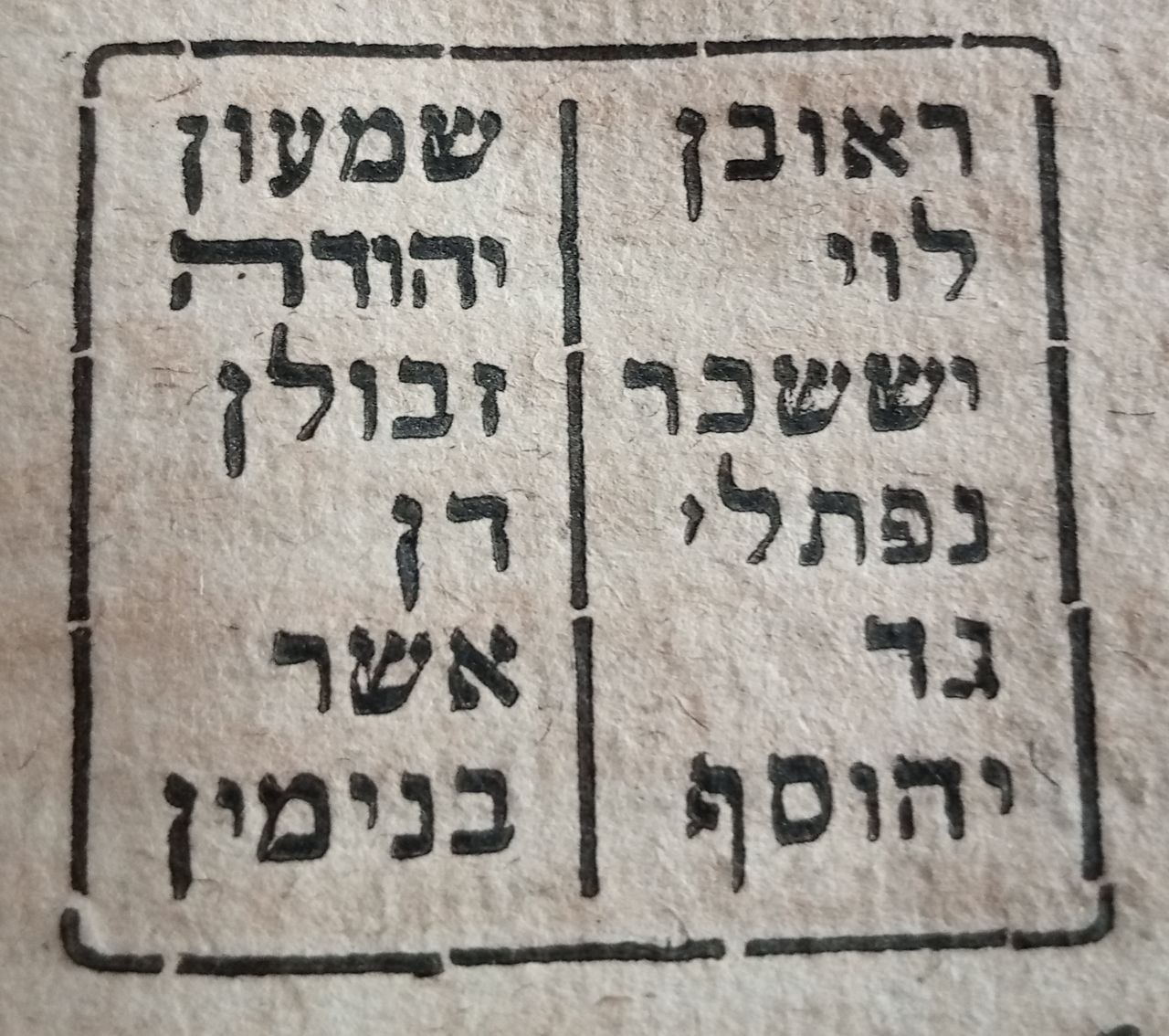
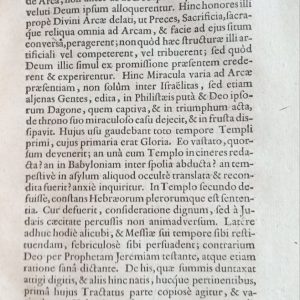
(A Via-Hygeia Note: Explanation of the rationale for adding Abraham, Isaac, Jacob, and “Tribus Jah” to the breastplate. Buxtorf (page 273) writes that above the tribal names on the breastplate was written:
Circle of Transmission: The Living Loom
A Little Johannes Buxtorf the Younger Sampler – Part 2: From the 1659 ‘Exercitationes ad Historiam’ – Urim & Thummim
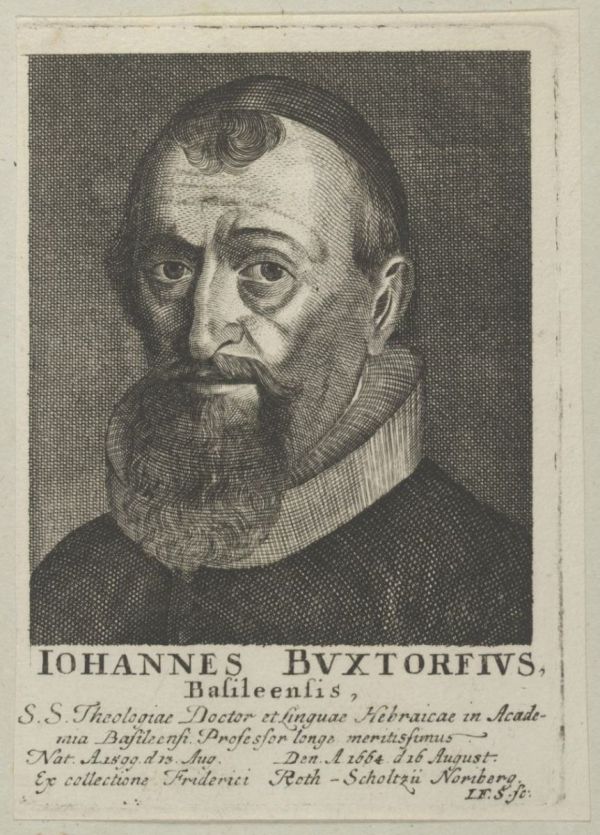
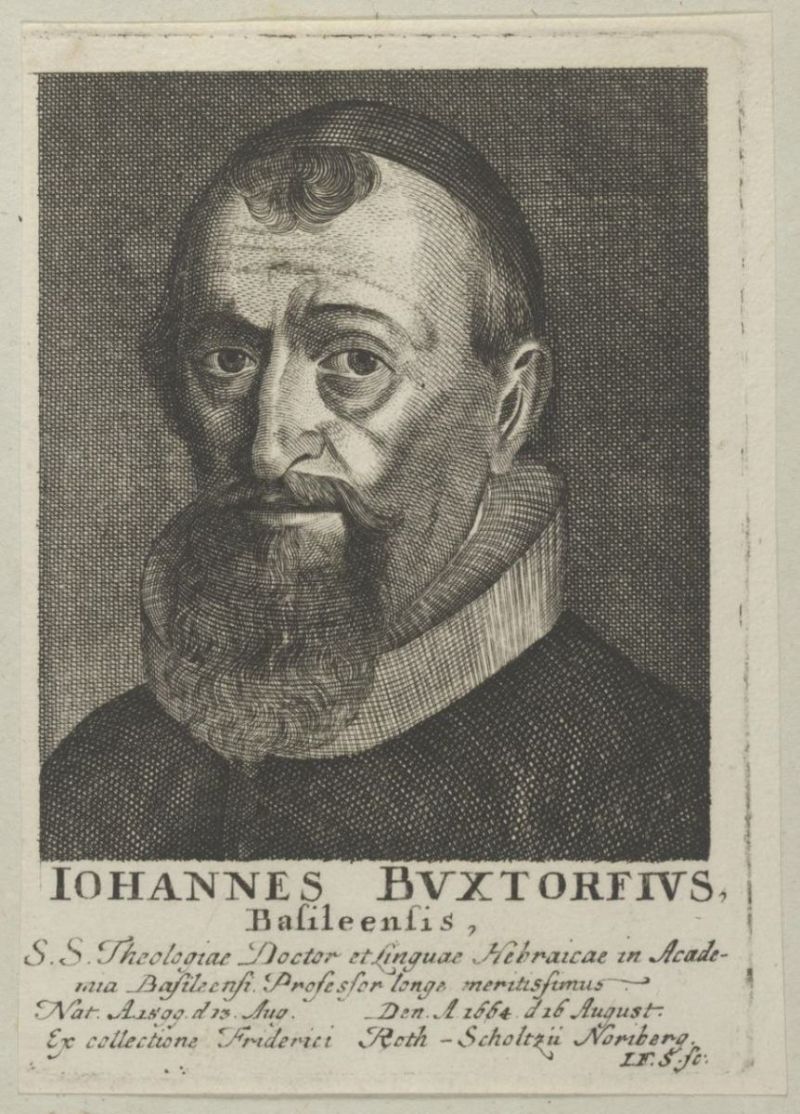
Johannes Buxtorf the Younger, a portrait by L.F. S. (?),
in the collections of the Münster-LWL Museum of Art and Culture
(Westphalian State Museum).
Picture at Wikimedia Commons.
*
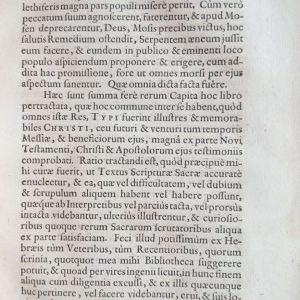
Today’s sharing from the Blue House of Via-HYGEIA continues our series honoring Johannes Buxtorf the Younger (1599–1664). Following our presentation of Maimonides’ Letter on Astrology and the 1629 Institutio Epistolaris Hebraica, we now turn to his ambitious 1659 work of Sacred Philology: the Exercitationes ad Historiam. Here, Buxtorf examines six Old Testament mysteries—the Ark of the Covenant, Heavenly Fire, Urim and Thummim, Manna, the Rock in the Desert, and the Brazen Serpent—drawing chiefly from ancient and modern Hebrew sources to elucidate and defend Scripture.
We offer these modest glimpses into a forgotten world, for their polymathic virtues, as they are rarely called upon, but have much to offer for who knows the art of gleaning. Our aim is to offer significant excerpts of the whole book, one post at the time, as there is much to explore!
The excerpt of the Epistola Dedicatoria recalls the Ark’s true glory not as “childish rudiments” of gold and cedar, but as the enclosed Majesty of God speaking between the Cherubim. It traces the Heavenly Fire that consumed sacrifices untouched by rain, introduces the Urim and Thummim—the oracle in the High Priest’s breastplate—and summarizes the histories of Manna, the Rock that gave water, and the Brazen Serpent. Buxtorf presents all six mysteries as types of Christ.
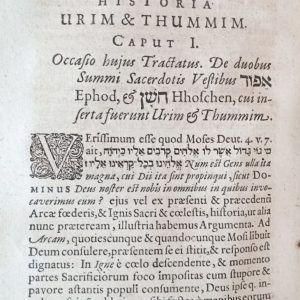
Chapter I of the Urim and Thummim section sets the stage. Citing Chrysostom on the heavenly origins of the Jewish religion, Buxtorf outlines five guiding questions. He details the High Priest’s vestments per Maimonides and Josephus: the Ephod (shoulder-piece) and the Choshen (Breastplate). Woven of gold and four colors, the Breastplate bore twelve gems with tribal names, supplemented by the Patriarchs and “Tribus Jah” to include all 22 Hebrew letters. Into this sacred garment were placed the Urim and Thummim, a divine oracle for grave matters. Buxtorf closes Chapter I by posing the first question: ‘What were Urim and Thummim?’
Coming soon: A Little Johannes Buxtorf the Younger Sampler – Part 3: From the 1659 Exercitationes ad Historiam – Part III: Urim & Thummim, Chapter 2.
**
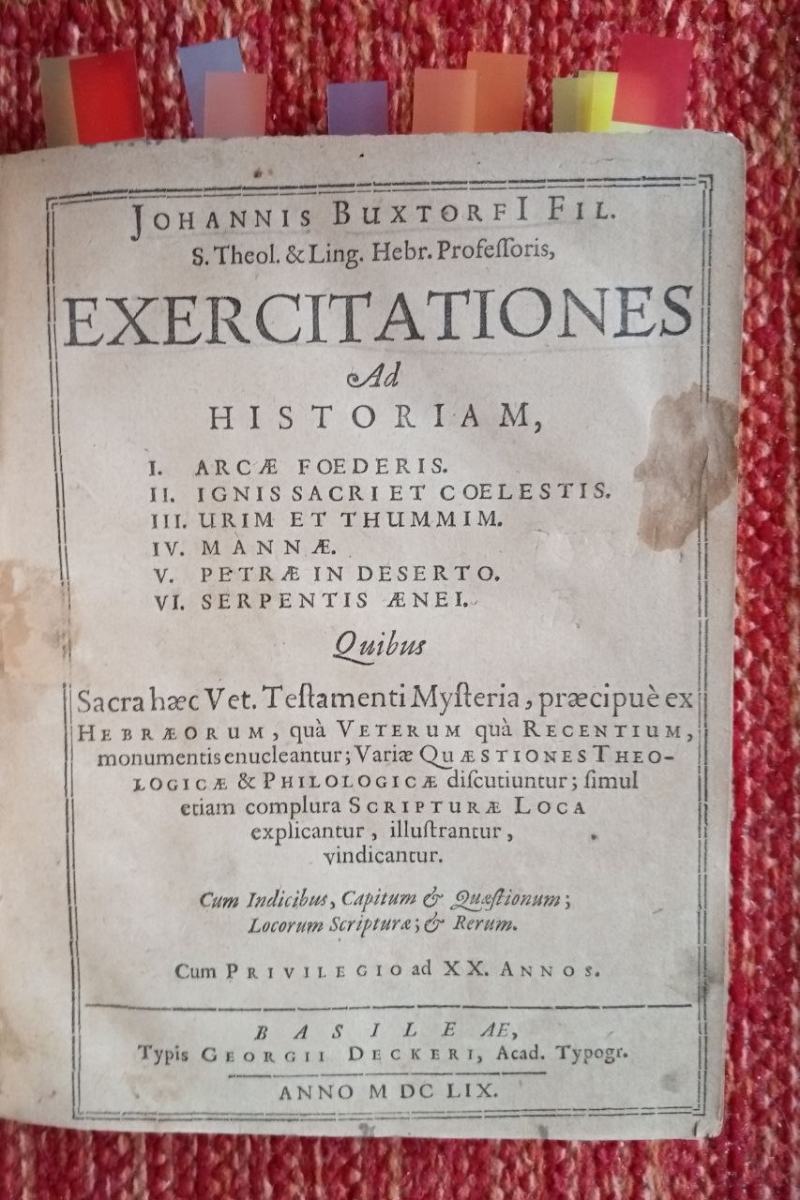
Title Page
By Johann Buxtorf the Son, Professor
of Sacred Theology and the Hebrew Language
EXERCISES ON HISTORY,
I. ON THE ARK OF THE COVENANT.
II. ON THE SACRED AND HEAVENLY FIRE.
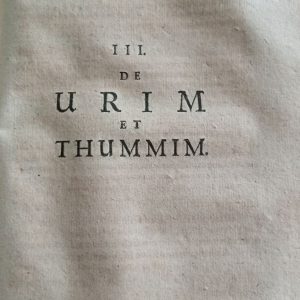
III. ON URIM AND THUMMIM.
IV. ON MANNA.
V. ON THE ROCK IN THE DESERT.
VI. ON THE BRAZEN SERPENT.
In which These holy mysteries of the Old Testament, chiefly from the records of the Hebrews, both ancient and modern, are laid bare; various theological and philological questions are discussed; and at the same time many passages of Scripture are explained, illustrated, and defended.
With indices of the chapters and questions; of Scripture passages; and of topics.
With a privilege for twenty years.
BASEL, Printed by Georg Decker, University Printer.
In the year 1659.
*
Description of the ‘Exercitationes’
Project & Plan
(…) The first part deals with the Ark of the Covenant of God [Heb. אֲרוֹן הַבְּרִית ʾĂrôn habbərîṯ, “the chest of the covenant”], whose entire history I weave together methodically and in order from various passages of Scripture. Its divine excellence, just as it was once astonishing and worthy of admiration not only among the Jews but also among the Gentiles, so it ought not, deservedly, to be unknown to us Christians.
It was made not by human choice or counsel, but by God’s own command and decree. Its architect was not some common artisan or craftsman of the dregs, hired by men for profit or favour, but Bezalel [Heb. בְּצַלְאֵל Bəṣalʾēl, “in the shadow of God”], called by name by God for this work and endowed by the Holy Spirit with extraordinary gifts of nature and skill. Moses was its draftsman, who did not design its form from his own ingenuity but according to the most perfect pattern shown to him on the mountain of God from heaven; he delineated and dictated it. It was constructed from cedar wood, which was held in great value, the noblest of all species; overlaid with solid gold, gleaming within and without, as large as it was. Covered with a skillfully made mercy‑seat [Heb. כַּפֹּרֶת kappōreṯ, “propitiatory”] and hidden by the two angelic images of Cherubim [Heb. כְּרוּבִים kərûḇîm], shining from the same metal. In its embrace it held the truly gem‑like Tablets of the Divine Law, carved by the very finger of God, together with other divine treasures likewise stored there by God’s command for a perpetual memorial: namely, the volume of the Law of Moses written by Moses’ own hand, Aaron’s rod [Heb. מַטֵּה אַהֲרֹן maṭṭēh ʾAhărōn], and the jar of manna [Heb. צִנְצֶנֶת הַמָּן ṣinṣeneṯ hammān]. It was not lawful for anyone to carry it except the priests designated and sanctified by God for that purpose; for anyone to touch or handle it was utterly forbidden, under penalty of death. Hence it was covered with precious curtains and fitted with long poles inserted into golden rings, so that it might be taken up and carried by its bearers without touching it. It was placed in the innermost shrine and sanctuary, called the Holy of Holies [Heb. קֹדֶשׁ הַקֳּדָשִׁים Qōḏeš haqqŏḏāšîm] — into which no one except the High Priest had entrance, and even he only once a year, on the Day of Atonement [Heb. יוֹם הַכִּפֻּרִים Yōm hakkippurîm]. Thence, without a special command of God, it was not permitted to bring it out or move it from its place.
These and its other external ornaments, however splendid and excellent they may be if we measure them by our senses, yet when compared with the rest of its excellence, they were nothing but trinkets and, as it were, childish rudiments, accommodated to the infancy and carnal disposition of the Israelites, so that by them they might be more gently drawn to the worship of the true God and kept within certain bounds and limits; and also that they might be lessons of greater things.
Its chief glory and κεχωρημένον [kechōrēmenon]¹ was the Majesty of God Himself, which was there, as it were, fixed and enclosed. This Ark of God, dwelling among the Israelites, was the inner and more secret sanctuary and ταμεῖον [tameion, “inner chamber, treasury”], where in doubtful matters He willed to be found, where He willed to be met, and always to be present to give audience. The surest proofs of this were both the pillar of cloud and of fire that miraculously always accompanied and covered it, and the fact that whenever Moses thought it fitting to consult the face of God concerning matters pertaining to the salvation of the people, he received an answer from the Ark, and specifically from that small space between the two Cherubim fixed to the mercy‑seat of the Ark, by a voice that was sonorous, distinct, and articulate.
(A Via-Hygeia Note: ¹ κεχωρημένον [kechōrēmenon] – The printed text of 1659 reads κεχωμάλου [kechōmalou], which is nonsensical. The context and Buxtorf’s argument (God’s Majesty being “enclosed” within the Ark) suggest the intended word is the perfect passive participle of χωρέω [chōreō, “to contain, hold”], namely κεχωρημένον [kechōrēmenon] (neuter nominative, “that which is contained”). The typesetter likely misread a handwritten manuscript: the sequence -ημένον could easily be corrupted to -ημάλου or -ωμάλου, and the case ending -ον mistaken for -ου. The sense is that the Ark’s true glory was the contained divine Presence. Some earlier commentators have proposed similar emendations).
A miracle surpassing all human understanding! That God, infinite and immense, who fills and exceeds heaven, earth, seas, and this whole universe, as much as there is, and even whatever lies beyond it, should have enclosed Himself, as it were circumscribed, within the narrow confines of this Ark (which was not even three full cubits, nay, only the span of a single fist, as they note, between the two Cherubim whence the voice of God issued) for the sake of His people.
Hence those splendid eulogies and proud titles with which it is adorned in the Holy Scriptures, to the point that they spoke of the Ark no differently than of God Himself, and addressed it as if it were God Himself. Hence those honours paid to the divine Ark, so that prayers, sacrifices, and all sacred rites were performed facing the Ark and turned toward its resting place – not because they thought such things belonged to or were to be paid to that artificial structure, but because they believed and experienced that God was present there at the same time by His promise.
Hence the various miracles performed at the presence of the Ark, not only among the Israelites but also among foreign nations, such as the Philistines and their god Dagon, whom, when the Ark was captured and led in triumph, it cast down from his throne by a miraculous fall and shattered him to pieces.
The Israelites enjoyed its use throughout the time of the first Temple, of which it was the primary glory. When that Temple was laid waste, it is anxiously inquired whither the Ark departed: whether it was reduced to ashes together with the Temple, or whether it was carried away to Babylon among the spoils, or whether it was seasonably hidden and secretly transferred to some refuge. The constant opinion of most Hebrews is that it was lacking in the second Temple. Why it was lacking is worth considering, but the Jews, stricken with exact punishment, did not perceive it. They feverishly persuade themselves that it still lies hidden somewhere today and will be restored to them at the time of their Messiah; but God testifies the contrary through the prophet Jeremiah, and sound reason also disagrees.
These matters, which I only touch with the fingertips, together with others arising from them and pertaining to them, are treated copiously in the first part of this treatise, and various things are adduced from the Hebrews, and then disputed against them.
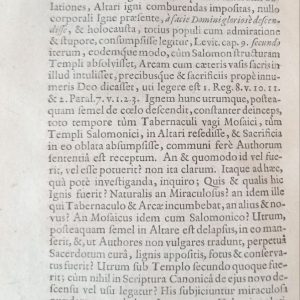
The second part treats of the Heavenly and Sacred Fire. This is the fire which first, at the inauguration of the Mosaic Tabernacle, upon the first offerings of Aaron placed on the altar to be burned by fire, when no physical fire was present, came down from before the face of the Lord in glory and consumed the holocausts, to the admiration and astonishment of all the people, as we read in Leviticus chapter 9. Secondly, again in the same manner, when Solomon had finished the Temple, brought the Ark with the other sacred vessels into it, and by prayers and almost countless sacrifices had made supplication to God, as we read in 1 Kings 8:10–11 and 2 Chronicles 7:1–3.
It is accepted by the common opinion of almost all authors that each of these fires, after once descending from heaven, thereafter continued throughout the whole time of both the wandering Mosaic Tabernacle and the Solomonic Temple, living on the altar and consuming the sacrifices offered upon it. But whether and how this either was or could be is not so clear. Therefore I inquire into these matters as far as possible: What and of what kind this fire was – natural or miraculous? Whether it was the same fire that rested upon the Tabernacle and the Ark, or another and new one? Whether the Mosaic fire was the same as the Solomonic? Whether, after it once descended upon the altar, it remained there and, as not uncommon authors relate, was fed and preserved by the perpetual care of the priests with added fuel? Whether it also existed under the second Temple, since nothing is read in canonical Scripture about a new descent or use of it?
To these are added certain miraculous things that the Hebrews note about this fire: for instance, that it dwelt for a long time on a wooden altar covered with thin bronze plates; that it burned inextinguishable; and yet the bronze was not melted nor the wood consumed; that although the altar stood in the middle of the courtyard under the open sky, no rains or storms ever extinguished the fire, nor did the force and violence of the winds disrupt the column of smoke rising straight up from it.
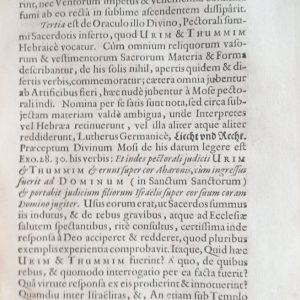
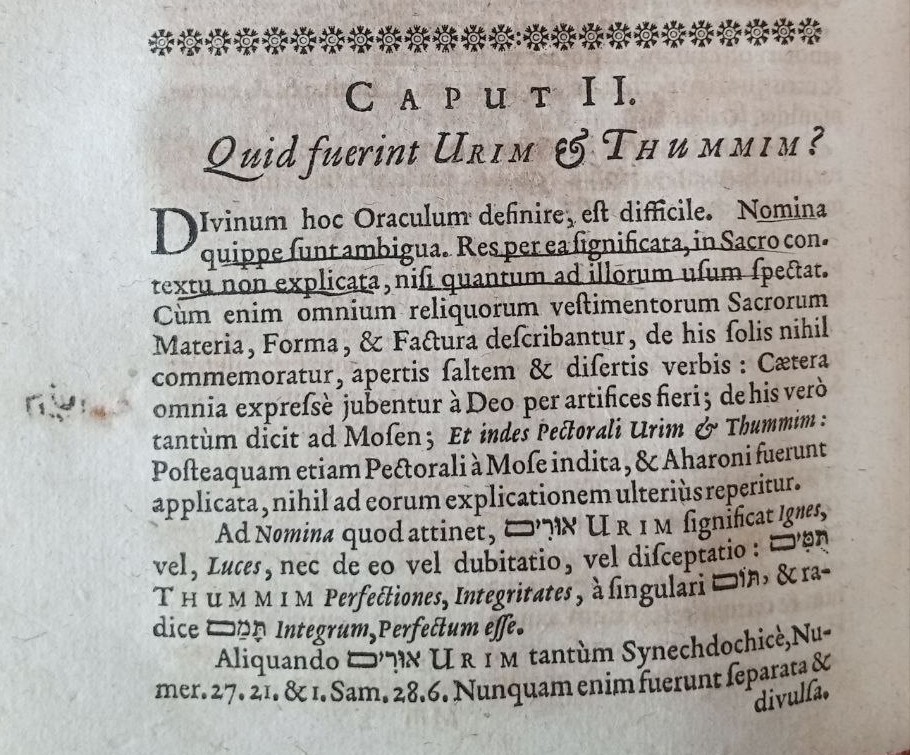
The third part concerns that Divine Oracle inserted into the Breastplate of the High Priest, which in Hebrew is called Urim and Thummim [Heb. אוּרִים וְתֻמִּים ʾÛrîm wəṮummîm, “Lights and Perfections” (or “Integrities”)]. While the material and form of all the other sacred vessels and vestments are described, concerning these alone nothing is recorded in clear and explicit words; all other things are ordered to be made by artisans, but these are merely ordered by Moses to be placed in the breastplate. The names themselves are sufficiently well known, but concerning their underlying reality they are very ambiguous, which is why interpreters have either retained the Hebrew words or rendered them one way or another – Luther in German as Licht und Recht.
The divine command given to Moses concerning these is read in Exodus 28:30, in these words: And you shall put in the breastplate of judgment the Urim and the Thummim, and they shall be upon Aaron’s heart, when he goes in before the Lord (into the Holy of Holies); and Aaron shall bear the judgment of the children of Israel upon his heart before the Lord continually. The use of them was that the High Priest, clothed with them, and having duly consulted concerning grave matters affecting the salvation of the Church, received a most certain answer from God and gave it back, which experience confirmed with many examples.
Therefore, what these Urim and Thummim were; by whom, concerning what matters, and how inquiry was made through them; by what power the answers that came forth from them were given and made known; how long they remained among the Israelites, and whether they also existed under the second Temple; for what reasons God willed to grant His people this special means of consulting Him in doubtful matters – concerning these things, I say, as much as I have been able either to glean from Scripture or to extract from the records of the Hebrews according to my modest ability, I have diligently collected.
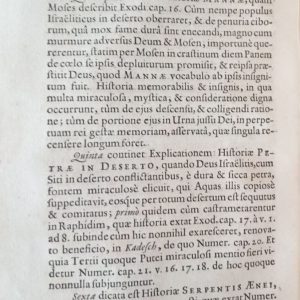
The fourth part is devoted to the History of Manna [Heb. מָן mān, “what is it?”], which Moses describes in Exodus chapter 16. When the Israelite people were wandering in the desert and were complaining with great murmuring against God and Moses, unreasonably demanding relief from the scarcity of food by which they were soon to be painfully starved to death, God immediately through Moses promised that on the next day bread would rain down from heaven for them; and God indeed performed it, which they marked with the name “Manna.” A memorable and remarkable history, in which many miraculous, mystical, and worthy matters occur, both concerning its descent and the manner of gathering it, and concerning the portion of it kept in a jar beside God, for a perpetual memorial of the deed done – each of which it would be long to recount.
The fifth part contains an Explanation of the History of the Rock in the Desert [Heb. הַצּוּר haṣṣûr, “the rock”], when God, with the Israelites suffering from thirst in the desert, miraculously brought forth a spring from a hard and dry rock, which supplied them with abundant water and followed and accompanied them through the whole desert. First, indeed, when they were encamped at Rephidim – the history of which is found in Exodus chapter 17, from verse 1 to 8. Then, when that source somewhat dried up, the benefit was renewed at Kadesh, concerning which in Numbers chapter 20. And because mention also seems to be made of a third miraculous well in Numbers chapter 21, verses 16–18, some remarks are added about that as well.
The sixth part is called the History of the Brazen Serpent [Heb. נְחַשׁ הַנְּחֹשֶׁת nəḥaš hannəḥōšeṯ, “serpent of bronze”], erected by Moses in the desert at God’s command, which is found in Numbers chapter 21, verses 4–9. For when the people grew impatient because of the very long detours through the wilderness and, overcome by impatience, burst into harsh and dire words against God and Moses, God, being angered, sent poisonous serpents among them, by whose deadly bite a great part of the people miserably perished. But when they acknowledged their sin, prayed, and entreated Moses, God, won over by Moses’ prayers, showed this remedy for salvation: to make a bronze serpent and set it up in a public and elevated place for the people to look upon, with the added promise that all who were about to die would be healed by looking at it. All of which was done as said.
These are roughly the main subjects treated in this book, which have this in common: that all these matters were illustrious and memorable types of Christ, that is, of the Messiah who was to come in those times, and of His benefits, for the most part confirmed by the testimonies of the New Testament, Christ and His apostles.
My method of treatment has been that I took particular care to expound the text of Holy Scripture accurately, and to further illustrate those points that either have or could have any difficulty, doubt, or scruple, and that seemed to have been treated too sparingly or wholly untouched by interpreters, and thus to satisfy in some measure the more curious investigators of sacred matters. I have done this especially from the Hebrews, both ancient and modern, whose stores – as many as my library could supply – I have searched with some diligence for this purpose, as far as the strength of my intellect allowed, and from them I have extracted and produced in their proper places whatever seemed to pertain or contribute to this end. For both my professional duty and the demands of students of Sacred Philology require this; I wished to gratify them on this occasion.
This offspring of my intellect, such as it is, I now offer to you.
**
‘Exercitationes ad Historiam’-Part III
‘Upon Urim &Thummim’
Index
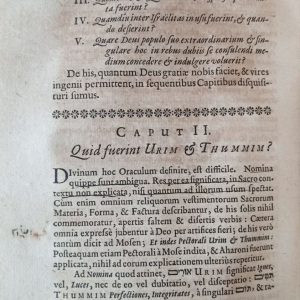
Chapter I. On the two vestments of the High Priest, the Ephod and the Choshen [Breastplate], into which the Urim and Thummim were inserted. p. 268.
Chapter II. What the Urim and Thummim were? p. 276.
Chapter III. In what manner inquiry was made through Urim and Thummim: on the quality of the one consulting, the one consulted, the inquiry itself, and the mode of inquiring. p. 294.
How Joshua is commanded to ask Eleazar through Urim and Thummim, yet nowhere in his entire history do we read that either he or the Israelites consulted God through Urim and Thummim, except after his own death? p. 299.
On the use of this Oracle in casting lots. p. 302.
Chapter IV. In what manner, and by what power, answers were given through Urim and Thummim? p. 308.
Since the grade of prophecy was higher than the grade of Urim and Thummim, why are their promises said by the Hebrews to be immutable, but prophetic ones not likewise? p. 316.
Why Joshua, who was a prophet, had need to consult Urim and Thummim, whose grade was lower than the prophetic grade? p. 317.
Whether the priests who gave answers through Urim and Thummim whenever they wished were equal in this respect to Moses? p. 317.
Why God did not answer Saul when he inquired through Urim and Thummim? p. 318.
Chapter V. How long Urim and Thummim remained among the Israelites, and whether they also existed under the second Temple? p. 321.
Chapter VI. Why God willed to grant to His people this extraordinary and singular means of consulting Him in doubtful matters? p. 329.
*
Chapter I: Introduction
Occasion of this treatise. On two vestments of the High Priest: the Ephod and the Choshen [Breastplate], into which the Urim and Thummim were inserted.
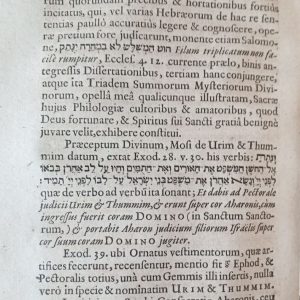
That which Moses says in Deut. 4:7 is most true: “For what great nation is there that has gods so near to it as the LORD our God is to us, whenever we call upon Him?” – of this we have illustrious proofs from the present and preceding history of the Ark of the Covenant and of the Sacred and Heavenly Fire (to pass over other things). At the Ark, as often and whenever Moses wished to consult God, God presented Himself to him and deigned to answer. In the Fire descending from heaven and in a moment consuming the parts of the sacrifices placed on the altar, to the stupor and fear of the surrounding people, God Himself was, as it were, wrapped up, and accepted the offerings made to Him from their hands.
Related to this, and no less worthy of admiration, is what we read concerning Urim and Thummim [Heb. אוּרִים וְתֻמִּים ʾÛrîm wəṮummîm, “Lights and Perfections”] in the Breastplate of the High Priest. When the High Priest consulted God in doubtful and perplexing matters pertaining to the salvation of the whole people, he received and delivered most certain answers and oracles – not from Apollo’s tripod, but from God Himself, by a singular revelation of the Holy Spirit. Hence most truly and elegantly wrote St. Chrysostom, Orat. IV contra Judaeos:
Καὶ γὰρ ἡ Ἰουδαϊκὴ πολιτεία οὐκ ἀπὸ γῆς τὰς ἀρχὰς εἶχε, ἀλλὰ καὶ τὰς πλείους καὶ σεμνοτέρας ἄνωθεν ἐκ τῶν οὐρανῶν. [Kai gar hē Ioudaïkē politeia ouk apo gēs tas archas eiche, alla kai tas pleious kai semnoteras anōthen ek tōn ouranōn.]
“For the Jewish religion did not have all its origins from below, but many and more magnificent ones from above, from heaven.”
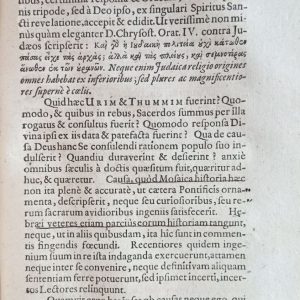
What these Urim and Thummim were; in what manner and in what matters the High Priest asked and consulted through them; how divine answers were given and revealed to him from them; for what reason God granted this method of consulting Him to His people; how long they lasted and when they ceased – this has been anxiously sought by learned men in every age, is still sought, and will be sought. The reason is that the Mosaic history did not describe these things so fully and accurately as the other ornaments of the High Priest, nor did it satisfy either the more curious or the lovers of sacred matters. The ancient Hebrews also touch upon their history rather sparingly, and are not so given to inventing fictions in this matter as in some others. More recent writers have indeed exercised their ingenuity in investigating this thing, yet they have been able neither to agree among themselves nor to produce any definitive opinion, but leave the reader himself uncertain and unresolved.
Therefore, although for these very reasons I too – knowing well both the weakness of my own intellect and the difficulty of the subject – can promise nothing certain and solid to others or to myself in this matter, and so it might perhaps be better to keep my hand away; nevertheless, invited by the affinity of the subject (because this oracle was consulted in the Holy of Holies before the Lord at the Ark), and more strongly urged by the prayers and exhortations of certain friends who judged it worthwhile to read and learn the various opinions of the Hebrews on this matter a little more accurately – Solomon also reminding us that “a threefold cord is not quickly broken” (Eccl. 4:12) – I have decided, with the press now running, to join this third dissertation to the two that have gone before, and thus to present to the cultivators and lovers of Sacred Philology a triad of the highest divine mysteries, illuminated by my humble effort (may God prosper it and graciously assist it with the grace of His Holy Spirit).
The divine command given to Moses concerning Urim and Thummim is found in Exod. 28:30, in these words:
וְנָתַתָּ אֶל־חֹשֶׁן הַמִּשְׁפָּט אֶת־הָאוּרִים וְאֶת־הַתֻּמִּים וְהָיוּ עַל־לֵב אַהֲרֹן בְּבֹאוֹ לִפְנֵי יְהוָה וְנָשָׂא אַהֲרֹן אֶת־מִשְׁפַּט בְּנֵי־יִשְׂרָאֵל עַל־לִבּוֹ לִפְנֵי יְהוָה תָּמִיד [wənātatā ʾel-ḥōšen hammišpāṭ ʾet-hāʾûrîm wəʾet-hattummîm wəhāyû ʾal-lēb ʾAhărōn bəbōʾô lip̄nê YHWH wənāśāʾ ʾAhărōn ʾet-mišpaṭ bənê Yiśrāʾēl ʾal-libbô lip̄nê YHWH tāmîd]
“And you shall put into the breastplate of judgment the Urim and the Thummim, and they shall be upon Aaron’s heart when he goes in before the LORD; and Aaron shall bear the judgment of the children of Israel upon his heart before the LORD continually.”
In Exod. 39, where the ornaments of the vestments that the artisans made are enumerated, mention is made of the Ephod and the whole Breastplate, together with the gems set in it, but nowhere specifically and by name of Urim and Thummim.
In Levit. 8, where the consecration of Aaron as High Priest is described, verse 8 says:
וַיִּתֵּן עָלָיו אֶת־הַחֹשֶׁן וַיִּתֵּן בַּחֹשֶׁן אֶת־הָאוּרִים וְאֶת־הַתֻּמִּים [wayyittēn ʿālāyw ʾet-haḥōšen wayyittēn baḥōšen ʾet-hāʾûrîm wəʾet-hattummîm]
“And he put the breastplate upon him; and he put into the breastplate the Urim and the Thummim.”
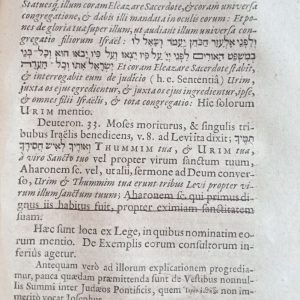
In Numbers 27, where God commands Moses to appoint Joshua as leader of the people after his departure from this life, among other things it says (vv. 19–21):
“And set him before Eleazar the priest and before all the congregation, and give him a charge in their sight. And you shall put some of your honor upon him, that all the congregation of the children of Israel may obey.”
וְלִפְנֵי אֶלְעָזָר הַכֹּהֵן יַעֲמֹד וְשָׁאַל לוֹ בְּמִשְׁפַּט הָאוּרִים לִפְנֵי יְהוָה עַל־פִּיו יֵצְאוּ וְעַל־פִּיו יָבֹאוּ הוּא וְכָל־בְּנֵי־יִשְׂרָאֵל אִתּוֹ וְכָל־הָעֵדָה [wəlip̄nê ʾElʿāzār hak-kōhēn yaʿămōd wəšāʾal lô bəmišpaṭ hāʾûrîm lip̄nê YHWH ʿal-pîw yēṣəʾû wəʿal-pîw yāḇōʾû hûʾ wəḵol-bənê Yiśrāʾēl ittô wəḵol-hāʿēdâ]
“And he shall stand before Eleazar the priest, who shall inquire for him by the judgment of the Urim before the LORD; at his word they shall go out, and at his word they shall come in, both he and all the children of Israel with him, the whole congregation.” Here mention is made only of Urim.
In Deut. 33, Moses, about to die and blessing each tribe of Israel, says to Levi (v. 8):
תֻּמֶּיךָ וְאוּרֶיךָ לְאִישׁ חֲסִידֶךָ [tummeykā wəʾûreykā ləʾîš ḥăsîdekā]
“Your Thummim and your Urim belong to your holy man” (i.e., Aaron) – or, as others render it, with the address turned to God: “Your Urim and Thummim shall be for the tribe of Levi, on account of that holy man of yours,” namely Aaron, who was first deemed worthy of them because of his outstanding holiness.
These are the places in the Law where they are expressly mentioned. The examples of consultations with them will be discussed below.
But before we proceed to their explanation, a few things must be premised concerning some of the vestments of the High Priest among the Jews, whom Josephus not undeservedly calls ἀρχιερεύς [archiereus, “high priest”].
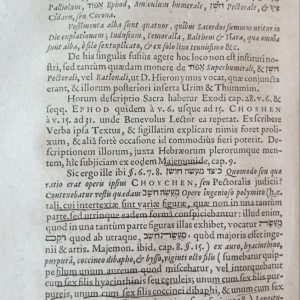
Rabbi Moses ben Maimon (Maimonides), in Yad ha‑Ḥazaqah, Hilkhot Kelei ha‑Mikdash, ch. 8, writes:
“There are three kinds of priestly vestments: the vestments of an ordinary priest, the golden vestments, and the white vestments. The vestments of an ordinary priest are four: tunic, breeches, turban, and sash. The golden vestments – these are the vestments of the High Priest – are eight in number: namely, the four mentioned for the other priests, plus the cloak, the ephod, the shoulder‑piece, the breastplate, and the diadem or crown. The white vestments are four, which the High Priest uses on the Day of Atonement: tunic, breeches, sash, and turban – all of white, of six‑ply fabric, made of the finest linen, etc.”
To treat each of these at length here is not my present purpose, but only to say a few things about the Shoulder‑piece (Ephod) and the Breastplate (or Rationale, as St. Jerome calls it), which were joined together, and into the latter of which the Urim and Thummim were inserted.
The sacred description of these is found in Exodus ch. 28, v. 6ff. The Ephod from v. 6 to v. 15; the Choshen from v. 15 to v. 31. Let the kind reader look them up there. To transcribe the very words of the text and explain them one by one would be too lengthy, and perhaps another occasion will allow it to be done more conveniently. I shall here subjoin a description of them, according to the opinion of most Hebrews, from the same Maimonides, ch. 9.
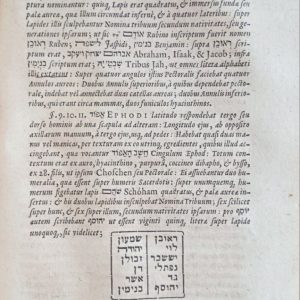
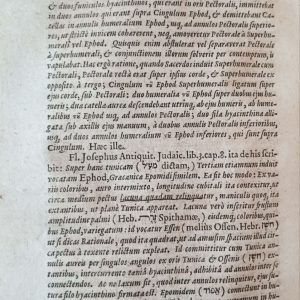
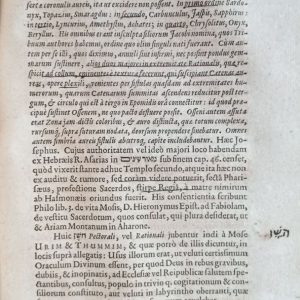
Thus he says there, §§ 6–8: “What was the manner or method of the work of the Choshen itself, that is, the Breastplate of Judgment? A certain fabric was woven with variegated work (that is, such that various figures are interwoven, appearing not on one side only but on both sides with the same form; for that which displays such figures only on one side is called ἀμφίταπος [amphitapos]; that which does so on both sides is δίκροκος [dikrokos], of greater skill and art) – from gold, blue, purple, crimson, and fine linen, with twenty‑eight threads (for one golden thread was taken and mixed or twisted with six blue threads, one with six purple threads, one with six crimson threads, and one with six white linen threads, making in total twenty‑eight). Its length was a cubit (i.e., two spans); its breadth a span, so that it was square, a span on each side (because it was doubled according to length, as it is said: ‘It shall be square, doubled’; hence in length it had only a span). Into it were set four rows of precious stones, which are named in Scripture. Each stone was square and set in a golden bezel that surrounded it from below and on four sides. Upon those stones were engraved the names of the tribes according to their births or genealogies; so that, for example, upon the ruby was engraved the name Reuben; upon the jade, Benjamin; above was written Abraham, Isaac, and Jacob; below was written ‘Tribes of Jah’ [Heb. שִׁבְטֵי יָהּ šivṭê Yâh], so that all the letters of the alphabet might be present there. On the four corners of this Breastplate he made four golden rings. On the two upper rings, from which the Breastplate hung, he put or attached two golden chains; on the two lower rings, which were near the breasts, two blue cords.”
§§ 9–11: “The width of the Ephod corresponded to the back of a man from one shoulder to the other; its length from the opposite of the armpits, behind him, down to the feet. It had, as it were, two hands or sleeves emerging from it on each side by the weave, with which they girded it – these are called the ‘girdle of the Ephod.’ The whole fabric was of gold, blue, purple, crimson, and fine linen, with 28 threads, like the Choshen or Breastplate itself. There were sewn onto it two shoulder‑pieces, which were upon the priest’s shoulders. On each shoulder was fixed a square shoham stone [Heb. אֶבֶן שֹׁהַם ʾeven šōham, “onyx” or “beryl”] set in a golden bezel; and on these two stones were engraved the names of the tribes: six names on this stone, and six on that, according to their births. Moreover, they wrote or made twenty‑five letters on each stone, as follows:
Right shoulder (first‑born order) — stone on the right side of the High Priest
| Row | Hebrew | Transliteration | English |
|---|---|---|---|
| 1 | רְאוּבֵן | Rəʾûvēn | Reuben |
| 2 | שִׁמְעוֹן | Šimʿôn | Simeon |
| 3 | לֵוִי | Lēwî | Levi |
| 4 | יְהוּדָה | Yəhûdâ | Judah |
| 5 | דָּן | Dān | Dan |
| 6 | נַפְתָּלִי | Nap̄tālî | Naphtali |
Left shoulder (next six) — stone on the left side
| Row | Hebrew | Transliteration | English |
|---|---|---|---|
| 1 | גָּד | Gād | Gad |
| 2 | אָשֵׁר | ʾĀšēr | Asher |
| 3 | יִשָּׂשכָר | Yiśśāḵār | Issachar |
| 4 | זְבוּלוּן | Zəvûlūn | Zebulun |
| 5 | יוֹסֵף | Yōsēp̄ | Joseph |
| 6 | בִּנְיָמִין | Binyāmîn | Benjamin |
(Note on order: Genesis 29–30 gives the birth order as: Reuben, Simeon, Levi, Judah, Dan, Naphtali, Gad, Asher, Issachar, Zebulun, Joseph, Benjamin. The two stones are divided exactly at the sixth name.)
*
Original Text
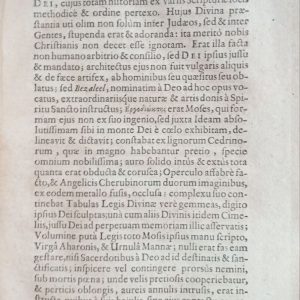
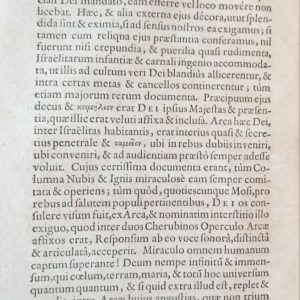
*
*
Source
Complete Digital Version here
*
Coming Soon
A Little Johannes Buxtorf the Younger Sampler -Part 3:
From the 1659 ‘Exercitationes ad Historiam‘ –
Part III-Urim & Thummim- Chapter 2.
***
More about Johannes Buxtorf the Younger: https://en.wikipedia.org/wiki/Johannes_Buxtorf_II

Related Articles

Leave a Reply